

Ozempic and Alcohol: What Is Known About Drinking on GLP-1 Medicines
Key Takeaways
- The only randomized trial of semaglutide in alcohol use disorder enrolled 48 people for nine weeks and found less drinking per drinking day and lower cravings, but no reduction in the number of drinking days.
- Semaglutide alone rarely causes low blood sugar, but combined with insulin or a sulfonylurea and alcohol, the risk rises sharply and the warning signs mimic drunkenness.
- A standard US drink carries about 100 calories from alcohol alone, and the body burns ethanol before fat, which works directly against the medicine's weight-loss goal.
- Alcohol and gallstones are the two leading causes of acute pancreatitis, and GLP-1 medicines carry their own label warning about the same condition.
- Tirzepatide (Mounjaro) has no randomized trial data on alcohol cravings; any effect is assumed by analogy with semaglutide, not demonstrated.
- No regulator has approved any GLP-1 medicine for reducing alcohol use, and larger NIH-funded trials are not expected to report results until later this decade.
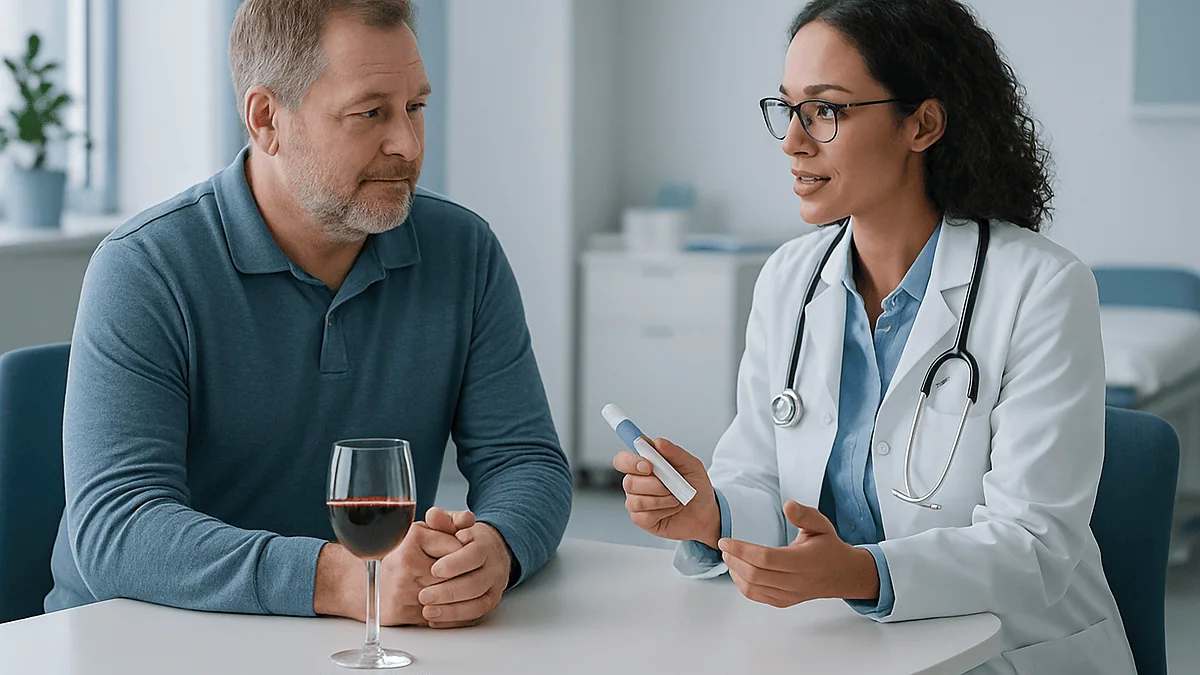
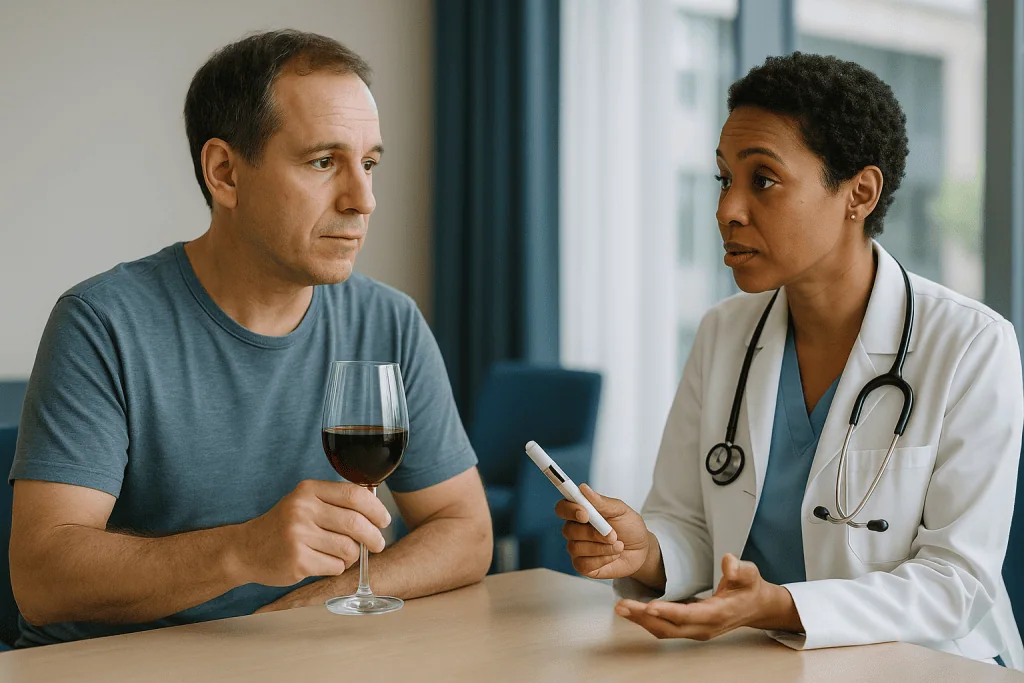
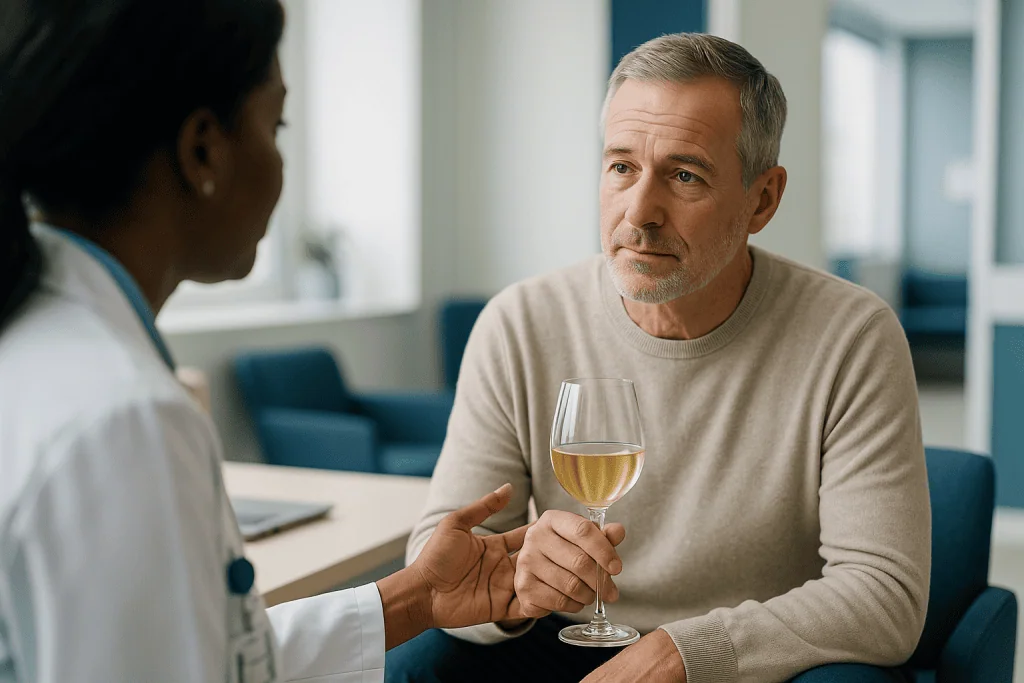
Drinking alcohol while taking Ozempic (semaglutide) is not prohibited by its prescribing information, but the combination can raise the risk of low blood sugar, worsen nausea and dehydration, and strain the pancreas. Small randomized trials suggest semaglutide may reduce alcohol cravings, though it is not approved for that purpose. Anyone using a GLP-1 medicine should discuss their drinking habits with the prescribing clinician.
A reader wrote to us last month with a confession that sounded almost apologetic: she had poured her usual Friday glass of wine, taken two sips, and set it down. Not from willpower. It simply did not taste like anything she wanted. She had started a GLP-1 injection eleven weeks earlier. “Is this a thing?” she asked. “Or am I imagining it?”
She is not imagining it, and she is not alone. As of early 2026, ozempic and alcohol is one of the fastest-rising health searches in the United States, pushed along by a wave of social posts describing vanished cravings and by a small randomized trial, published in February 2025, that put those stories to a formal test. Larger trials are now recruiting.
The story deserves more care than the headlines give it. There is a hopeful signal about cravings, a set of real safety concerns about drinking on these medicines, and a wide gap between what the evidence shows and what a viral clip implies. This piece walks through all three.
Why is ozempic and alcohol trending right now?
Three currents met at once. The first is scale. Semaglutide, the active ingredient in Ozempic and Wegovy, is now taken by millions of Americans, and when millions of people change a habit at the same time, the change gets noticed. Alcohol is one of the most social habits there is, so a quieter Friday night is the kind of shift friends comment on.
The second is science catching up to anecdote. GLP-1 receptor agonists are medicines that mimic glucagon-like peptide-1, a gut hormone released after eating that tells the pancreas to release insulin, slows stomach emptying, and signals fullness to the brain. Researchers had long noticed that rodents given these medicines drank less alcohol. In 2025, the first randomized, placebo-controlled trial in people with alcohol use disorder reported that semaglutide reduced how much participants drank on drinking days and how strongly they craved alcohol. Alcohol use disorder is the medical term for a pattern of drinking that a person struggles to control despite harm.
The third current is confusion. Because the craving story is so appealing, it has crowded out a less glamorous question that matters more to most patients: is it actually a good idea to drink while taking these medicines? Nausea, delayed digestion, dehydration and blood-sugar swings all sit in the background, and alcohol nudges each of them in the wrong direction.
This article separates those threads. The evidence on cravings is genuinely interesting and genuinely preliminary. The evidence on safety is older, less exciting, and more relevant to the person reading this with an appointment next Tuesday. We will grade both honestly. Where the science is thin, we will say so rather than round up to certainty.
What changed recently
Until 2024, the idea that GLP-1 medicines dampen drinking rested almost entirely on animal work and patient reports. That changed in a series of steps.
In November 2024, a Swedish registry analysis of more than 200,000 people diagnosed with alcohol use disorder found that periods of semaglutide or liraglutide use were associated with fewer hospitalizations for alcohol-related problems compared with periods without the medicines. Around the same time, a large United States electronic health record analysis of people with obesity reported lower rates of new and recurring alcohol use disorder diagnoses among those prescribed semaglutide. Both are observational, which means they can show a link but cannot prove the medicine caused it.
In February 2025, the first randomized clinical trial specific to semaglutide and alcohol appeared in a major psychiatry journal. It enrolled 48 adults with alcohol use disorder who were not seeking treatment, ran for nine weeks, and used a low dose. Participants on semaglutide drank less on the days they drank and reported lower cravings than those on placebo. The number of drinking days did not differ significantly. Small, short, but rigorous.
Since then, several larger trials funded through the National Institutes of Health and academic centers have opened, some running for many months and enrolling hundreds of participants. Results are not expected until later in the decade.
On the safety side, nothing dramatic has changed, which is itself worth stating. The consumer drug information for semaglutide maintained by MedlinePlus, and the United Kingdom’s NHS guidance on the medicine, continue to flag nausea, vomiting, diarrhea, dehydration, pancreatitis and low blood sugar (especially when combined with other diabetes medicines) as the issues to watch. None of these documents ban alcohol. All of them describe effects that alcohol can amplify.
One thing that has not changed at all: no regulator anywhere has approved semaglutide, tirzepatide or any GLP-1 medicine for reducing alcohol use. That remains an investigational question.
Does Ozempic curb your desire for alcohol? The GLP-1 alcohol cravings question
Many people say yes, and the early trial data lean the same way. The more interesting question is how a medicine designed for blood sugar could reach into the part of the brain that decides a second drink sounds good.
GLP-1 receptors are not confined to the gut and pancreas. They sit in brain regions that handle reward, including the ventral tegmental area and nucleus accumbens, the circuitry that releases dopamine, a signaling chemical tied to motivation and pleasure, when we eat, drink or do anything the brain has learned to want. In animal studies, GLP-1 medicines blunt the dopamine surge that alcohol normally produces. The drink still arrives, but the brain’s applause is quieter.
Human imaging and lab studies point the same direction. In the 2025 trial, participants sat in a comfortable room with their preferred alcoholic drink available for two hours. Those on semaglutide drank measurably less in that session and rated their craving lower beforehand. Participants who also smoked reported smoking fewer cigarettes, a hint that the effect may not be specific to alcohol.
There is also a simpler, mechanical piece. Semaglutide slows stomach emptying and increases fullness, so a large glass of beer can feel heavier and less pleasant. Nausea, common in the first weeks, makes alcohol actively unappealing for some. And the medicine seems to reduce “food noise,” the background chatter of wanting, which many patients say extends to drinks.
What this does not mean is that everyone experiences it. In clinical practice some people notice no change in their drinking at all. The effect size in trials so far is moderate, the trials are short, and no one knows whether the change lasts after stopping. If your desire for alcohol has dropped, the observation is worth sharing with your prescriber; it is real enough to be studied and not yet solid enough to be promised.
What the evidence actually says, graded by strength
Medical evidence comes in tiers, and this topic spans all of them. Here is where each claim currently sits.
Strongest: randomized controlled trials. One placebo-controlled trial of semaglutide in alcohol use disorder, 48 people, nine weeks, low dose. It found less drinking per drinking day and lower cravings, but not fewer drinking days. An earlier trial of exenatide, an older GLP-1 medicine, followed 127 people for 26 weeks and found no overall reduction in heavy drinking days, though a subgroup with obesity did drink less. Verdict: encouraging but small and inconsistent. A single positive trial of this size would not be enough to approve a medicine for any condition.
Middle tier: observational data. Large registry and health-record studies from Sweden and the United States link GLP-1 use to fewer alcohol-related hospitalizations and diagnoses. These studies involve hundreds of thousands of people, which is impressive, but the people who get prescribed these medicines differ from those who do not in ways that are hard to fully adjust for. Verdict: consistent signal, cannot establish cause.
Supporting: laboratory and animal work. Rodents and non-human primates reliably drink less alcohol on GLP-1 medicines, and brain imaging suggests reduced reward-circuit activation. Verdict: strong biological plausibility, not human proof.
Weakest: patient reports and social media. Vivid, plentiful, and unreliable as evidence because people who notice a change are far more likely to post about it than people who notice nothing.
On safety, the picture is better established. Alcohol’s ability to lower blood sugar, irritate the stomach lining, dehydrate the body and inflame the pancreas is documented across decades of research. The GLP-1 side-effect profile is drawn from trials enrolling tens of thousands of participants. What is not well studied is the specific interaction: whether people on semaglutide absorb alcohol differently or feel its effects faster. That question, oddly, has almost no formal data behind it.
Is it safe to drink alcohol while taking Ozempic?
The honest answer is that it depends on how much, how often, and what else is going on in your body, which is why the prescribing information neither forbids alcohol nor gives it a pass.
Consider the mechanics. Semaglutide slows the rate at which your stomach empties into the small intestine. Alcohol is absorbed partly in the stomach and mostly in the small intestine, so slowed emptying could, in theory, change how quickly a drink hits your bloodstream. Some patients describe feeling the effects sooner or more strongly than they expect; others describe the opposite. No controlled study has settled this, so the sensible working assumption is that your usual tolerance may not be your current tolerance.
The more established concerns are these:
- Alcohol lowers blood sugar for hours, particularly when consumed without food. GLP-1 medicines rarely cause low blood sugar on their own, but the risk climbs in people who also take insulin or sulfonylureas, a class of oral diabetes medicines that push the pancreas to release insulin regardless of glucose level.
- Alcohol irritates the stomach lining and triggers nausea and vomiting. So does semaglutide, especially in the first weeks and after each step-up in treatment. Stacking the two invites misery.
- Both are linked to pancreatitis, inflammation of the pancreas, which is painful and occasionally dangerous. Heavy drinking is one of the two leading causes of acute pancreatitis; GLP-1 medicines carry a label warning about it.
- Alcohol is a diuretic and vomiting or diarrhea drains fluid further. The GLP-1 labels specifically warn about kidney injury linked to dehydration.
For a person with type 2 diabetes on multiple glucose-lowering medicines, or someone in the nauseated early weeks, the safest amount of alcohol may be none. For an otherwise healthy adult well settled on the medicine, an occasional drink with food is a conversation to have with the prescriber, not a rule to look up online. Current federal dietary guidance, summarized by the CDC, caps moderate drinking at two drinks a day for men and one for women, and notes that drinking less is better for health than drinking more.
Ozempic and alcohol: the blood sugar problem explained
The liver is a quietly heroic organ. Between meals and overnight it manufactures glucose from stored glycogen and from raw materials like amino acids, a process called gluconeogenesis, so your brain never runs dry. Alcohol interrupts this. When the liver is busy breaking down ethanol, it deprioritizes glucose production, and blood sugar can drift downward for six to twelve hours after drinking, sometimes longer.
For most people without diabetes, this is invisible. Insulin secretion adjusts and glucose stays in range. The situation changes when a medicine is also pushing insulin. Semaglutide, used alone, is described in mainstream drug references as a low-risk medicine for hypoglycemia, the medical term for blood glucose falling below about 70 mg/dL, because it stimulates insulin release only when glucose is elevated. Add insulin injections or a sulfonylurea and the safeguard disappears. The Mayo Clinic lists alcohol, skipped meals and excess diabetes medicine among the classic triggers.
Alcohol does something else that makes this dangerous: it masks the warning signs. The early symptoms of a low, which include shakiness, sweating, confusion, slurred speech and unsteadiness, overlap almost perfectly with the signs of being drunk. Companions may assume you have simply had too much. You may assume so yourself. Meanwhile the GLP-1 medicine has suppressed your appetite, so the natural response of reaching for food does not kick in the way it once did.
Nighttime is the riskiest window. A person who drinks in the evening, eats little because the medicine has dulled hunger, and goes to bed can experience a low during sleep with no one to notice. Anyone on insulin or a sulfonylurea who also drinks should talk with their clinician about glucose monitoring and about carrying a fast-acting carbohydrate.
The practical points are unglamorous but protective: eat when you drink, know your specific medicine combination, and tell the people you are with what a low looks like. The prescriber, not a magazine, decides whether your regimen needs adjusting.
Nausea, slow digestion and why hangovers can feel different
Gastrointestinal side effects are the most common reason people struggle with GLP-1 medicines. In the large semaglutide trials for weight management, nausea affected roughly four in ten participants at some point, vomiting about one in four, and diarrhea about three in ten. Most of it faded over weeks. Alcohol has a way of bringing it back.
The overlap is not a coincidence. Semaglutide delays gastric emptying, meaning food and drink sit in the stomach longer than usual. Alcohol, particularly in larger amounts, also slows emptying and irritates the stomach lining directly. A meal with several drinks on top of a medicine that already keeps the stomach full can leave a person bloated, reflux-prone and queasy well into the next day.
Then there is the hangover itself. A hangover is partly dehydration, partly the inflammatory by-products of alcohol breakdown, partly disrupted sleep, and partly low blood sugar. Every one of those pieces has a GLP-1 amplifier. Dehydration is worse if the medicine has already caused loose stools. Low blood sugar is more likely for the reasons described above. Sleep may already be lighter in people eating much less than before. Several patients describe hangovers that feel disproportionate to what they drank, and while no trial has measured this, the biology makes it plausible.
Carbonated drinks deserve a specific mention. Beer, sparkling wine and mixed drinks with soda add gas to a stomach that empties slowly, and many patients on GLP-1 medicines report that carbonation is the single most uncomfortable thing they consume. Sugary cocktails add a second problem: a rapid glucose spike followed by the alcohol-driven fall.
The pattern that emerges from clinical experience is fairly consistent. Small amounts, taken slowly, with food, on a day when the stomach is already calm, cause the least trouble. Large amounts, fast, on an empty stomach, in the week after a treatment change, cause the most. If nausea is persistent regardless of alcohol, that belongs in a conversation with the prescriber rather than a home fix.
Pancreatitis, the pancreas and two risks that point the same way
The pancreas is a hand-sized gland tucked behind the stomach that does two jobs: it releases digestive enzymes into the gut and hormones, including insulin, into the blood. Pancreatitis is inflammation of this gland. When it is acute, the enzymes that should be digesting food begin to digest the pancreas itself, which is why the pain is so severe.
Alcohol is one of the two leading causes of acute pancreatitis in the United States, sharing that distinction with gallstones. According to the Cleveland Clinic, heavy drinking over years is also the most common cause of chronic pancreatitis, the scarring form that permanently impairs digestion and can lead to diabetes. The risk rises with the amount and duration of drinking, and there is no threshold below which it is zero.
GLP-1 medicines carry their own warning. Cases of acute pancreatitis were reported in clinical trials and after approval, and the prescribing information advises stopping the medicine and seeking care if pancreatitis is suspected. How large the added risk truly is remains debated. Some large observational analyses find a modest increase; others find none once diabetes itself, which independently raises pancreatitis risk, is accounted for. The evidence here is graded as uncertain, but the label warning stands.
What is not uncertain is that two risk factors pointing at the same organ are worse than one. A person with a history of pancreatitis is generally advised to avoid GLP-1 medicines altogether, and heavy drinking on top of the medicine is a combination clinicians actively discourage.
The symptom pattern to know is specific: severe, persistent pain in the upper abdomen that often bores through to the back, worsens after eating, and may come with vomiting and fever. It does not feel like ordinary indigestion. It is covered again in the “When to see a doctor” section because it is the one scenario in this article where waiting is the wrong choice.
Mounjaro and alcohol: is tirzepatide any different?
Tirzepatide, sold as Mounjaro for type 2 diabetes and as Zepbound for weight management, is often lumped together with semaglutide, and for the purposes of alcohol the two are more alike than different. There are a few distinctions worth knowing.
Tirzepatide is a dual agonist. It activates the GLP-1 receptor, as semaglutide does, and also the GIP receptor. GIP, glucose-dependent insulinotropic polypeptide, is a second gut hormone released after eating that helps the body handle fat and sugar. In head-to-head trials for weight loss, tirzepatide produced larger average reductions than semaglutide, and its gastrointestinal side-effect profile is broadly similar: nausea, vomiting, diarrhea and constipation lead the list. Delayed stomach emptying is present with both.
On alcohol specifically, tirzepatide has far less research behind it than semaglutide. The randomized trial in alcohol use disorder used semaglutide. The large registry studies focused on semaglutide and liraglutide. Whether the added GIP activity changes the effect on cravings, in either direction, is unknown. Animal studies of GIP receptor activity and alcohol are limited and mixed. The most accurate statement is that any craving-related effect of Mounjaro is plausible by analogy but not demonstrated.
The safety considerations transfer directly. The MedlinePlus entry for tirzepatide lists the same cautions as semaglutide’s: pancreatitis, low blood sugar when combined with insulin or sulfonylureas, dehydration from vomiting and diarrhea, and gallbladder problems. Alcohol amplifies each. Tirzepatide’s stronger effect on appetite may, if anything, make the “drinking without eating” scenario more common, which is precisely the scenario that produces hypoglycemia.
One practical difference: because tirzepatide’s weight-loss effect is larger on average, people taking it sometimes find their body weight, and therefore their alcohol tolerance, changing faster than they realize. A smaller body reaches a higher blood alcohol concentration from the same drink. A person who has lost a substantial amount of weight is, in a real sense, drinking in a different body. That is true on any GLP-1 medicine and worth remembering on all of them.
Does Ozempic still work if you drink alcohol?
The medicine itself keeps working. Alcohol does not deactivate semaglutide, block its receptor or speed its breakdown. The pharmacology is undisturbed. What alcohol does is work against the goals the medicine is meant to serve.
Start with calories. Alcohol supplies about seven calories per gram, more than carbohydrate or protein and only a little less than fat. A standard United States drink contains about 14 grams of alcohol, so roughly 100 calories before any mixer, juice or sugar. A large glass of wine, a craft beer or a cocktail can exceed 200. Three drinks on a Saturday can equal the caloric deficit the medicine helped you create over a full day of reduced eating.
Those calories are also unusual. The body cannot store alcohol, so it burns ethanol first and postpones burning fat while it does. Alcohol also lowers inhibition around food. Many people who eat very little on the medicine find that a few drinks reopen the appetite the medicine had closed, and the late-night eating that follows undoes more progress than the drinks themselves.
For people using semaglutide to control type 2 diabetes, alcohol complicates the picture in a different way. It causes short-term drops in glucose, longer-term rises if the drinks are sugary, and over time it can worsen insulin resistance and liver fat. The hemoglobin A1C, a blood test that reflects average glucose over roughly three months, tends to improve less in people who drink heavily.
Sleep is the quieter cost. Alcohol fragments sleep in the second half of the night, and poor sleep raises hunger hormones the next day. On a medicine that depends partly on appetite control, that is a direct headwind.
None of this means one drink cancels a week of treatment. It means the medicine is a tool, and alcohol, in quantity, is a tool pulling the other way. People who see the best results in trials and in clinics tend to be those who treated the medicine as one piece of a larger change rather than a license to leave everything else untouched.
Ozempic, Mounjaro and alcohol side by side
When the same question comes up across several medicines, a table earns its place. The rows below summarize what mainstream drug information and current research say about each medicine and alcohol. “Evidence level” refers to the craving question, not the safety concerns, which are well established for the whole class.
| Medicine | How it works | Approved uses | Alcohol-craving evidence | Key cautions with alcohol |
|---|---|---|---|---|
| Ozempic / Wegovy (semaglutide) | GLP-1 receptor agonist, weekly injection | Type 2 diabetes; chronic weight management; heart-risk reduction in eligible adults | One small randomized trial positive on drinks per drinking day and cravings; large observational studies supportive; not approved for alcohol use | Nausea and vomiting, hypoglycemia if combined with insulin or sulfonylureas, dehydration, pancreatitis |
| Mounjaro / Zepbound (tirzepatide) | Dual GLP-1 and GIP receptor agonist, weekly injection | Type 2 diabetes; chronic weight management; obstructive sleep apnea in eligible adults with obesity | No randomized trials on alcohol; effect assumed by analogy only | Same class cautions; stronger appetite suppression may increase drinking-without-eating risk |
| Liraglutide (daily GLP-1) | GLP-1 receptor agonist, daily injection | Type 2 diabetes; chronic weight management | Observational data supportive; no positive randomized trial | Same class cautions |
| Exenatide (older GLP-1) | GLP-1 receptor agonist | Type 2 diabetes | One 26-week randomized trial negative overall; positive only in a subgroup with obesity | Same class cautions |
Two patterns stand out. First, the research on cravings is concentrated almost entirely on semaglutide; the enthusiasm about “GLP-1 medicines and alcohol” as a class is running ahead of the data for every other molecule. Second, the safety cautions do not vary by brand. Whichever medicine is in the pen, the physiology of delayed stomach emptying, appetite suppression and pancreatic strain is the same, and so is the way alcohol interacts with it.
The exenatide result is a useful corrective. It was longer and larger than the semaglutide trial and did not show a benefit overall. Older, weaker GLP-1 medicines may simply not reach the brain in the same way, or the difference may be chance. Either way, it is a reminder that one positive trial is a beginning, not a verdict.
Common myths about Ozempic and drinking
Viral claims travel faster than trial results. These are the ones circulating most widely, and what the evidence actually supports.
“Ozempic is a cure for alcoholism.” No. One nine-week trial in 48 people who were not seeking treatment found reduced drinking on drinking days and lower cravings. It did not find fewer drinking days, did not test long-term outcomes, and did not enroll people with severe dependence. Alcohol use disorder has approved treatments, including medicines and behavioral therapy, and semaglutide is not among them. Anyone struggling with alcohol should ask their clinician about options that are established.
“You cannot drink at all on these medicines.” Also no. The prescribing information for semaglutide and tirzepatide does not prohibit alcohol. It warns about effects alcohol worsens. The right amount for you depends on your other medicines, your stomach’s tolerance and your health history, which is a clinician’s call.
“Alcohol makes the medicine stop working.” The medicine works regardless. Alcohol adds calories, reopens appetite, disturbs sleep and can swing blood sugar, all of which undercut results without touching the drug itself.
“You get drunk twice as fast on Ozempic.” Unproven. Delayed stomach emptying could plausibly change absorption, and weight loss changes tolerance, but no controlled study has measured blood alcohol levels on these medicines. Treat your tolerance as unknown rather than doubled.
“If you stop craving alcohol, you can stop other treatment.” Dangerous. Nobody should change or stop any prescribed medicine, for alcohol or anything else, without the prescriber’s involvement.
“Everyone loses interest in drinking.” Some people do; others notice nothing. The trial effect was an average, and averages hide wide individual variation.
“Compounded or research-grade semaglutide works the same for cravings.” Products sold as research peptides or made outside regulated manufacturing are not approved medicines, have not been tested in these trials, and are not for sale or self-use. Their contents and strength are unverified.
The pattern in these myths is consistent: each takes a real, modest, preliminary finding and inflates it into a certainty. The corrective is not cynicism. It is proportion.
What should be avoided during Ozempic treatment besides alcohol?
Alcohol dominates the search results, but it is only one item on a longer list of things that make GLP-1 treatment harder or riskier. Most of them share the same root cause: a stomach that empties slowly and an appetite that has gone quiet.
Large, high-fat meals are the classic culprit. Fat already slows gastric emptying; stacked on semaglutide it can leave food sitting for hours, producing bloating, reflux and nausea. Fried foods, heavy cream sauces and very large restaurant portions are the meals patients most often regret. Smaller, more frequent, protein-forward meals tend to sit better.
Skipping meals entirely is the opposite mistake. Because hunger is muted, some people eat far too little, lose muscle along with fat, and become lightheaded. Anyone on insulin or a sulfonylurea who skips meals risks hypoglycemia. Protein intake and, ideally, resistance exercise help preserve lean mass during rapid weight loss.
Dehydration deserves a place on the list. Vomiting and diarrhea drain fluids, thirst is often blunted along with appetite, and the labels for these medicines specifically warn of kidney injury linked to fluid loss. Water intake needs conscious attention.
Certain other medicines require timing conversations. Because stomach emptying slows, oral medicines may be absorbed more slowly or unevenly. This matters most for medicines with a narrow margin between effective and harmful levels, and for oral contraceptives in the case of tirzepatide, where the label advises discussing backup contraception around treatment changes. Your pharmacist and prescriber, not a general article, should review your specific list.
Procedures involving sedation are a newer concern. Anesthesiologists have reported food remaining in the stomach longer than expected in people on GLP-1 medicines, raising aspiration risk. Tell every clinician and dentist that you take one of these medicines before any procedure.
Finally, avoid the temptation to self-adjust. Increasing, skipping or pausing treatment to accommodate a holiday, a wedding or a bad week of nausea changes how the medicine behaves and belongs entirely to the prescribing clinician.
Why do people stop taking Ozempic? The Amy Schumer question
Searches for why a well-known comedian stopped taking Ozempic spike alongside searches about alcohol, and they are asking the same underlying question: what is it actually like to be on this medicine, and why do some people quit?
The public account is straightforward and not unusual. She has said in interviews that side effects, chiefly nausea and exhaustion severe enough to keep her from ordinary activities, made the medicine untenable for her. That experience sits within the range seen in clinical trials, where a meaningful minority of participants discontinued because of gastrointestinal effects. It is a reminder that averages describe populations, and a given person may land far from the average.
The research on discontinuation paints a broader picture. In real-world analyses of people prescribed GLP-1 medicines for weight management, a large share stop within the first year. The reasons cluster into several groups: side effects that do not settle, cost and insurance changes, supply interruptions, feeling that results have plateaued, and, for some, reaching a goal and choosing to stop. Weight regain after stopping is common and well documented, which is why current expert opinion frames these as long-term treatments rather than short courses.
Alcohol threads through this quietly. People who drink regularly while adjusting to the medicine are more likely to experience the nausea and dehydration that drive early discontinuation. Conversely, people who find that drinking loses its appeal sometimes describe an unexpectedly easier adjustment, one fewer source of calories and stomach upset to manage.
The point is not to judge anyone’s decision. Stopping a medicine because it makes you feel unwell is a legitimate choice, and public figures who describe it honestly do a service by countering the impression that these medicines are effortless. The important part is how the stopping happens. Abrupt self-discontinuation, especially in someone taking the medicine for diabetes, can allow blood sugar to rise unnoticed. The decision to stop, pause or switch should be made with the prescriber, who can also address what happens to weight and glucose afterward.
When to see a doctor
Most of what this article describes is uncomfortable rather than dangerous. A handful of situations are different, and recognizing them matters more than anything else here.
Seek emergency care immediately for any of the following:
- Severe, persistent pain in the upper abdomen, especially if it spreads to the back, worsens after eating, or comes with vomiting and fever. This pattern can indicate pancreatitis.
- Signs of severe low blood sugar in someone taking insulin or a sulfonylurea: confusion, inability to speak clearly, seizure, or loss of consciousness. Do not assume it is intoxication. If the person cannot safely swallow, call emergency services.
- Vomiting that will not stop, an inability to keep fluids down for more than a day, very little urine, dizziness on standing, or a racing heartbeat. These suggest serious dehydration and possible kidney strain.
- Sudden severe pain in the upper right abdomen with fever or yellowing of the skin or eyes, which can indicate a gallbladder problem, a recognized side effect of GLP-1 medicines.
- Difficulty breathing, swelling of the face or throat, or a widespread rash after an injection, which can signal an allergic reaction.
Contact your prescribing clinician promptly, though not necessarily urgently, if:
- Nausea or vomiting persists beyond the first several weeks or returns strongly after a treatment change.
- You notice blood glucose readings lower than your usual range, particularly after drinking or overnight.
- You are drinking more than you intend to, drinking to manage stress, or finding it hard to cut down. Alcohol use disorder is common and treatable, and it deserves its own evaluation rather than an experiment with an unapproved use of your current medicine.
- You have lost interest in alcohol and want to understand what that means for your treatment plan.
- You are planning surgery, dental sedation, or an endoscopy, so the team can plan around delayed stomach emptying.
- You are considering stopping, pausing or changing the medicine for any reason.
Every decision about the medicine itself, including whether it is right for you, how it is used, and whether any change in drinking should factor into the plan, belongs to the clinician who prescribes it and knows your full history. This article can inform that conversation; it cannot replace it.
Frequently asked questions
Does Ozempic curb your desire for alcohol?
For some people, yes, and early research supports the pattern. A 2025 randomized trial found that adults with alcohol use disorder on semaglutide reported lower cravings and drank less on drinking days than those on placebo. Large observational studies point the same way. The effect is an average, not a guarantee: many patients notice no change. Semaglutide is not approved for this purpose, and the finding needs confirmation in larger, longer trials.
Can you drink alcohol on Ozempic at all?
The prescribing information does not prohibit alcohol, but it warns about side effects that alcohol worsens, including nausea, dehydration, pancreatitis, and low blood sugar when combined with other diabetes medicines. Whether any amount is reasonable for you depends on your full medication list, how your stomach is tolerating treatment, and your health history. That judgment belongs to your prescribing clinician, ideally discussed before the first drink rather than after.
Does Ozempic still work if you drink alcohol?
The medicine keeps working; alcohol does not block or break it down. What alcohol does is undermine the results. It adds calories the body burns before fat, reopens appetite that the medicine had quieted, fragments sleep, and can swing blood glucose. One drink does not erase a week of progress, but regular or heavy drinking measurably slows weight loss and blunts improvements in blood sugar control.
Is Mounjaro and alcohol a different story from Ozempic?
Mostly the same story. Tirzepatide shares semaglutide’s delayed stomach emptying, nausea profile and label cautions about pancreatitis, dehydration and hypoglycemia with insulin or sulfonylureas, so alcohol carries the same practical risks. The difference is in the craving research: the randomized trial was done with semaglutide, and no comparable trial exists for tirzepatide. Any effect on alcohol cravings from Mounjaro is plausible but not demonstrated.
Why do GLP-1 alcohol cravings seem to drop for some people?
GLP-1 receptors sit in brain reward regions that release dopamine when we eat or drink something the brain has learned to want. Animal and imaging studies suggest these medicines dampen the dopamine surge alcohol normally produces, so the drink is less rewarding. Slower stomach emptying and early nausea also make alcohol physically less appealing. Together, these effects may explain the drop, though the human evidence remains preliminary.
Do you get drunk faster on Ozempic?
Nobody knows for certain, because no controlled study has measured blood alcohol levels in people taking these medicines. Delayed stomach emptying could plausibly change how quickly alcohol is absorbed, and significant weight loss raises the blood alcohol concentration produced by the same drink. Many patients report feeling effects sooner than expected. The sensible approach is to assume your tolerance has changed and to drink less than you used to.
What are the signs of low blood sugar after drinking on Ozempic?
Shakiness, sweating, confusion, slurred speech, unsteadiness, irritability and a racing heart. The problem is that these overlap almost exactly with intoxication, so lows can go unrecognized by the person and by companions. The risk is highest in people who also take insulin or a sulfonylurea, who drink without eating, or who drink in the evening and sleep through a nighttime low. Anyone in that group should discuss glucose monitoring with their clinician.
Can Ozempic be prescribed to help me stop drinking?
It is not approved for that use anywhere. The evidence consists of one small, short randomized trial and observational data, which is far from the standard required for approval. Alcohol use disorder has established treatments, including approved medicines and behavioral therapy. If drinking is a concern, raise it directly with your clinician, who can weigh the evidence and decide what is appropriate; that decision rests with the treating clinician alone.
Why did Amy Schumer stop taking Ozempic?
She has said publicly that side effects, mainly nausea and exhaustion severe enough to disrupt daily life, made the medicine unworkable for her. That experience falls within the range seen in clinical trials, where a meaningful minority of participants stopped because of gastrointestinal effects. Individual reactions vary widely. Anyone considering stopping should do so with their prescriber, since abrupt discontinuation can allow blood sugar and weight to rebound unnoticed.
What should be avoided during Ozempic treatment?
Beyond heavy drinking, the main items are large high-fat meals, which sit in a slowed stomach and cause nausea; skipping meals entirely, which risks lightheadedness and low blood sugar in people on other diabetes medicines; and neglecting fluids, since dehydration is linked to kidney injury on these medicines. Tell every clinician and dentist you take a GLP-1 medicine before any sedation, and never adjust the medicine yourself.
References
- MedlinePlus: Semaglutide Injection
- MedlinePlus: Tirzepatide Injection
- NHS: Semaglutide (Ozempic, Wegovy)
- CDC: Moderate Alcohol Use
This article is for general information only and is not a substitute for professional medical advice. Please consult a qualified doctor about your individual situation.

More from the Blog

Survodutide: The Glucagon-GLP-1 Dual Agonist Being Studied for Obesity and Liver Disease
Survodutide is an investigational injectable peptide that activates both the glucagon receptor and the GLP-1 receptor. In phase 2 trials it produced average weight…

Ozempic Feet: What Rapid Weight Loss Does to the Fat Pads of the Feet
Ozempic feet is a social-media term, not a medical diagnosis. It describes feet that look bonier or feel sore under the heel or ball…

Is Ozempic Safe? What Years of Semaglutide Data Say About Risks and Benefits
Ozempic (semaglutide) is considered safe for most adults with type 2 diabetes when prescribed and monitored by a clinician. Large randomized trials covering tens…
Food Noise: Why GLP-1 Medicines Quiet It, and What Helps When You Are Not on Them
Food noise is the persistent, intrusive stream of thoughts about food that continues when the body does not need fuel. GLP-1 medicines such as…

Weight Loss Injections Explained: The Approved Medicines, How They Differ and Who Qualifies
Weight loss injections are prescription medicines that mimic gut hormones to reduce appetite and slow digestion. Three are FDA-approved for chronic weight management: semaglutide…

Zepbound Side Effects: What the Trials Recorded, What Is Common and What Needs a Call to Your Doctor
Zepbound (tirzepatide) most often causes digestive side effects: nausea, diarrhea, constipation, vomiting, indigestion and reduced appetite, which in trials were usually mild to moderate…