

Pain in the Fingertips: Nerve, Nail and Infection Causes and How It Differs from Joint Pain

Key Takeaways
- Tingling in the thumb, index and middle fingers points to the median nerve at the wrist, while tingling in the little and ring fingers points to the ulnar nerve at the elbow.
- Peripheral neuropathy almost always starts in the feet before the hands, so fingertip symptoms with normal feet make it a less likely explanation.
- A tense, throbbing fingertip pad after a splinter or puncture suggests a felon, which usually needs surgical drainage rather than antibiotics alone.
- Raynaud's attacks turn fingers white, blue and then red for minutes to hours, but a single finger that stays cold and pale is a circulation emergency.
- Bony lumps at the joints nearest the nail are typical of osteoarthritis, whereas rheumatoid arthritis tends to spare those end joints and swell the middle and base knuckles symmetrically.
- A fingertip that droops and cannot straighten after a jammed finger is a mallet injury and needs splinting within days to heal well.
Pain in the fingertips most often comes from the nail fold, the skin pad, a small nerve or the blood supply, while pain in the finger joints usually points to arthritis or an injured ligament. Fingertip pain with throbbing, redness and swelling suggests infection; tingling or numbness suggests a nerve; color change suggests circulation. A cold, pale or blue finger, or spreading redness with fever, needs same-day care.
The first clue is usually the keyboard. A letter lands slightly wrong, you press harder, and a sharp sting shoots up from the pad of one finger. Or it is the morning routine: the lid of a jar, the clasp of a watch, and a dull ache that seems to sit under the nail rather than in the knuckle. Fingertips are crowded real estate, and when they hurt the body is rarely vague about it.
People who search for pain in fingertips and joints are often trying to settle one question before anything else: is this the tip or the joint, a nerve or a nail, a bug or wear and tear? Those are good instincts. The fingertip and the knuckle are built differently, fail differently, and are examined differently, and the location of the pain narrows the list faster than almost any test.
This guide walks through the common and harmless causes first, then the ones that deserve a check, and explains how a clinician tells them apart in the clinic. It will not tell you what you have. It will show you how the question gets answered.
Pain in fingertips and joints: the short answer before the detail
Most fingertip pain has a local, visible cause. The skin beside the nail is red and tender because a small infection has started in the nail fold. The pad is sore because a splinter, a burn or a thousand keystrokes have bruised the soft tissue. The tip tingles and burns because a nerve higher up the arm is being squeezed, most often at the wrist. The finger goes white and numb in the cold because the small arteries have clamped down. None of these is dangerous in itself, and most settle with simple care.
Joint pain tells a different story. The knuckles swell, stiffen in the morning and ache with gripping, and the usual culprits are osteoarthritis (cartilage wear), inflammatory arthritis (the immune system attacking the joint lining) or a sprain from a jammed finger. The joint, not the tip, is the sore spot.
A small group of fingertip problems can become emergencies. If a finger is cold, pale or blue and stays that way after warming, if redness and throbbing spread up the finger with fever, if the pad is tense and exquisitely painful, or if a cut has gone through the nail bed, seek care the same day. Deep infection in the pulp of the fingertip can damage the bone within days, and a blocked artery can cost tissue within hours. The NHS lists these among the finger symptoms that should not wait for a routine appointment.
What actually sits inside a fingertip
The last segment of a finger packs more structures into a smaller space than almost anywhere else in the body. Under the nail lies the nail bed, a thin strip of living tissue that grows the nail plate forward. Around its edges sit the nail folds, the ridges of skin that seal the nail against water and bacteria. Below and in front of the nail is the pulp, a fat pad divided by tough fibrous walls into tiny compartments; these walls give you grip but also leave no room for swelling.

Two small digital nerves run along each side of the finger and fan out into the pad, which is why fingertips can read Braille and also why they hurt so vividly. Two digital arteries run alongside them, the final branches of a blood supply that must pass through the wrist, the palm and the narrow finger itself. The distal phalanx, the last bone, is shaped like a tiny shovel and anchors the pad to the skeleton. The nearest joint, the one just below the nail, is the distal interphalangeal (DIP) joint, and the knuckle in the middle of the finger is the proximal interphalangeal (PIP) joint.
Each of those parts has its own way of hurting. The nail fold gets infected. The pulp gets crushed or abscessed. The nerves get pinched upstream or damaged by disease. The arteries spasm or clog. The joints wear or inflame. Working out which structure is the sore one is the whole exercise.
How clinicians tell fingertip pain from joint pain
The first test is the one you can do yourself: press. Fingertip problems are tender over the pad, the nail or the skin beside the nail, and the knuckle below moves freely without complaint. Joint problems are tender along the joint line, and bending or straightening the finger reproduces the ache. A clinician will do the same, then add three questions.
What does it feel like? Burning, tingling, electric shocks or numbness point to a nerve, because joints and skin do not generate those sensations. Throbbing that keeps time with the pulse points to inflammation or infection with pressure building in a closed space. A deep, grinding ache that worsens with use and eases with rest is the classic pattern of osteoarthritis.
What does it look like? Swelling centered on a joint, with the finger looking spindle-shaped, suggests arthritis. Redness tracking along the nail fold suggests paronychia. Pale or blue color that comes and goes suggests a circulation problem. A tense, shiny, swollen pad suggests a deep infection.
When does it happen? Night-time tingling that wakes you and eases when you shake the hand is typical of carpal tunnel syndrome, as the NHS describes. Morning stiffness lasting longer than half an hour raises the question of inflammatory arthritis. Pain only in the cold points toward Raynaud’s phenomenon.
Put those answers together and the examination usually lands on one or two possibilities before any imaging or blood test is ordered.
Nail causes: paronychia, ingrown nails and bleeding under the nail
The commonest fingertip infection starts at the nail fold. Paronychia is an infection of the skin beside or behind the nail, usually after a hangnail is torn, a cuticle is pushed back too hard, or the fingers spend hours in water. The fold turns red, swollen and hot, and within a day or two a bead of pus may collect under the skin. Pressing the fold is painful; pressing the pad itself usually is not. Bacteria, most often the staphylococcus species that live on normal skin, are the usual cause of the acute form, while the chronic form, with a dusky, puffy fold that waxes and wanes for weeks, is common in people whose hands are constantly wet and often involves yeast.
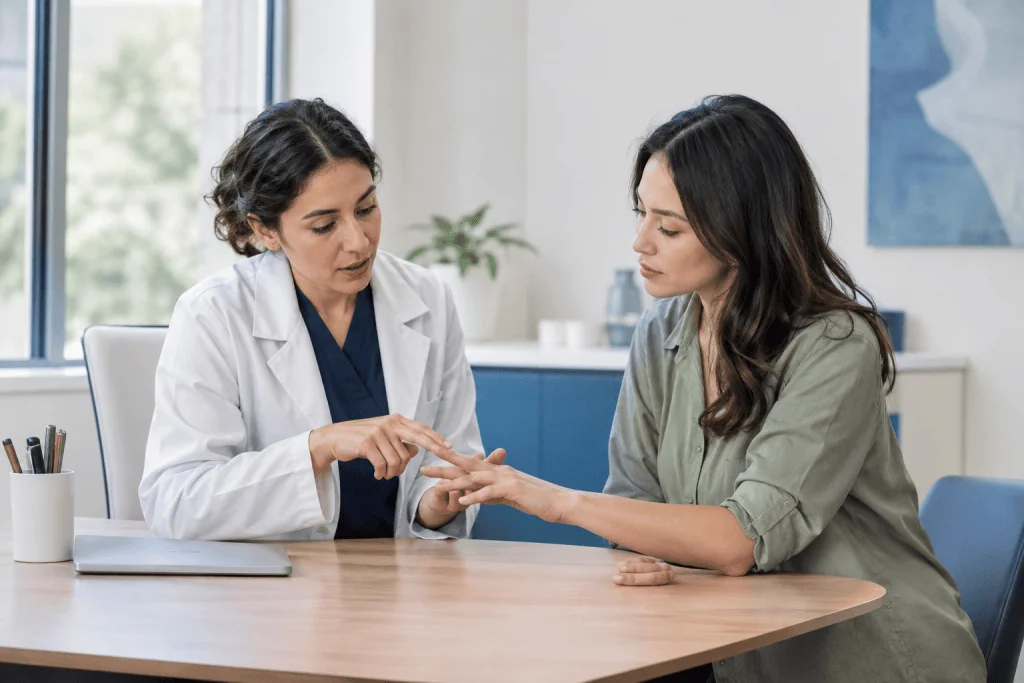
An ingrown fingernail is rarer than its toe counterpart but behaves the same way: the nail edge grows into the fold, the fold reacts, and infection follows.
A subungual hematoma is blood trapped under the nail after a crush, a slammed door or a hammer blow. The pressure between hard nail and hard bone produces a throbbing that can be out of proportion to the injury. The nail looks purple or black, and the throb eases dramatically once the pressure is released, which is a procedure a clinician performs under clean conditions rather than a kitchen-table job. A large hematoma, or one with a visibly bent or lifted nail, raises the question of a fracture of the distal phalanx beneath it, and an X-ray is often requested.
Infection causes: felon, herpetic whitlow and when infection spreads
A felon is an infection inside the pulp of the fingertip, the fat pad in front of the bone. Because the pad is divided into small compartments by fibrous walls, pus has nowhere to expand. The pad becomes tense, shiny and intensely painful, and the throbbing is often severe enough to disturb sleep. A felon usually follows a puncture, such as a splinter, a thorn or a finger-prick blood test, though sometimes no wound is remembered. It matters because the pressure can cut off blood supply to the pad and spread to the bone. Treatment almost always involves draining the pus surgically as well as antibiotics, which is why a tense, throbbing pad is a same-day problem rather than something to watch.
Herpetic whitlow is a fingertip infection with the herpes simplex virus, the same family that causes cold sores. It produces clusters of small, clear or cloudy blisters on a red, swollen base, often with tingling or burning before the blisters appear. It is seen in people who handle saliva, in children who suck a finger during a cold sore outbreak, and in anyone whose fingertip touches an active lesion. Unlike a felon, the pad is not uniformly tense, and cutting into a whitlow does more harm than good. Clinicians look carefully at the blisters before deciding, because the two conditions call for opposite approaches.
Any fingertip infection that spreads should prompt urgent review: a red streak running up the finger or forearm, swelling that crosses into the palm, fever, or a finger held in a slightly bent position that is painful to straighten. The last pattern can indicate infection inside the tendon sheath, which is treated as an emergency.
Nerve causes: which fingers tingle tells you where the problem sits
Fingertip pain without redness, swelling or injury is often a nerve problem, and the map of which fingers are affected is remarkably informative. The median nerve passes through the carpal tunnel, a narrow passage at the wrist, and supplies the thumb, index finger, middle finger and the thumb side of the ring finger. The NHS describes carpal tunnel syndrome as producing tingling, numbness or an ache in exactly those fingers, often worse at night, sometimes with weakness of the thumb and a tendency to drop things. People frequently say they shake the hand to bring it back.
The ulnar nerve runs behind the elbow, the spot you hit when you bang your funny bone, and supplies the little finger and the other half of the ring finger. Tingling in those two fingers, especially after leaning on the elbow or sleeping with the arm bent, suggests the nerve is irritated at the elbow (cubital tunnel syndrome) rather than the wrist.
Nerve roots leaving the neck can also be pinched by a bulging disc or a worn joint, a condition called cervical radiculopathy. The pattern then runs from the neck through the shoulder and arm into particular fingers, and turning or tilting the head may provoke it.
A clinician checks sensation in each of these territories, taps over the nerve to see whether it fires tingling into the fingers, and tests the small muscles each nerve controls. When the picture is unclear or weakness is present, nerve conduction studies, which measure how fast electrical signals travel along the nerve, can confirm the site and severity.
What are the symptoms of peripheral neuropathy, and could it explain fingertip pain?
Peripheral neuropathy is damage to the long nerves that run from the spinal cord to the hands and feet. Because the longest nerves are affected first, symptoms almost always start in the toes and feet and only later reach the fingertips, in what clinicians call a stocking-and-glove pattern. Fingertip symptoms with entirely normal feet make neuropathy less likely, though not impossible.
The NINDS, the NIH’s neurological institute, describes the hallmark symptoms: numbness, tingling, prickling, burning or stabbing pain, oversensitivity to touch so that a bedsheet feels painful, loss of balance from not feeling the ground, and in some forms weakness or changes in sweating and skin color. It estimates that more than 20 million people in the United States have some form of peripheral neuropathy. In the UK, the NHS names diabetes as the most common cause; other causes include heavy alcohol use, low vitamin B12, kidney disease, some chemotherapy drugs, inherited conditions and inflammatory disorders.
The link with blood glucose is one of the better-studied relationships in medicine. The Diabetes Control and Complications Trial, published in 1993, followed people with type 1 diabetes for years and showed that keeping glucose closer to target substantially lowered the risk of developing nerve damage. That finding is the reason a clinician assessing new tingling in the hands and feet will almost always check blood sugar first.
Diagnosis rests on the history, an examination of sensation with a soft filament and a tuning fork, reflex testing, and blood tests that look for the treatable causes. Nerve conduction studies follow if the type of neuropathy is in doubt.
Circulation causes: Raynaud's phenomenon and chilblains
If a fingertip turns white, then blue, then red when you step into the cold or pick up a frozen bag, the problem is in the small arteries. Raynaud’s phenomenon is a spasm of those vessels in response to cold or emotional stress. The NHS describes attacks that can last from minutes to hours, affecting the fingers, toes and sometimes the ears, nose or lips, with numbness, pins and needles and pain as blood returns. The pain is usually in the tips because they are furthest from the heart and lose their supply first.
Most people have primary Raynaud’s, which starts in the teens or twenties, affects both hands symmetrically and causes no lasting damage. The secondary form appears later in life, is often asymmetric, and is linked to an underlying condition such as scleroderma, lupus or other connective tissue diseases, to vibration tool use, or to certain medicines. Secondary Raynaud’s can cause small painful ulcers at the fingertips, which is one of the features clinicians look for, alongside tightening of the finger skin and abnormal capillaries at the nail fold seen under magnification. Blood tests for autoantibodies help separate the two forms.
Chilblains are different: small, itchy, red or purple swellings that appear hours after cold exposure and can become painful or blister. They settle in a week or two once the skin stays warm.
The circulation problem that cannot wait is a single finger that goes cold, pale or blue and stays that way. That can mean a clot or blockage in a digital artery rather than a spasm, and it needs assessment within hours.
Pain in fingertip when pressed: splinters, glomus tumors and overuse
A fingertip that hurts only when something pushes on it has a short list of causes, and most are mechanical. A retained splinter or glass fragment, sometimes too small to see, produces a pinpoint spot of tenderness that may fester into a small abscess. Overuse from typing, guitar playing, climbing or a weekend of DIY bruises the pulp and leaves it tender for a few days; the skin may look slightly thickened or callused.
Repeated small knocks can also crack the skin of the pad, particularly in dry winter weather, and those fissures sting sharply with pressure. People with eczema or who wash their hands many times a day are especially prone.
One uncommon cause is worth knowing about because it is so often missed. A glomus tumor is a tiny benign growth, usually under the nail, arising from the structures that regulate blood flow to the skin. It causes an exquisitely localized point of pain when pressed, striking sensitivity to cold, and sometimes a faint bluish spot under the nail. People can carry the diagnosis of anxiety or arthritis for years before someone presses on the exact spot with a pen tip and watches them flinch. Magnetic resonance imaging can show it, and removal usually settles the pain.
Finally, pressure pain over the joint just below the nail rather than the pad itself is more likely to be osteoarthritis of the DIP joint, often with a small bony lump at the side called a Heberden’s node, or a mucous cyst, a small fluid-filled swelling that can press on the nail and leave a groove in it.
Pain in fingertips and joints together: when arthritis is the explanation
When the pain sits in the knuckles rather than the tips, arthritis moves to the front of the list, and the type of arthritis shows in which joints are involved. Osteoarthritis is wear of the cartilage that cushions a joint. In the hand it favors the DIP joints nearest the nail, the PIP joints in the middle of the finger and the base of the thumb. The NHS describes aching that is worse after use, stiffness that eases within minutes of moving, and firm bony swellings at the sides of the joints. It usually develops over years and is more common after midlife.
Rheumatoid arthritis is an autoimmune disease in which the immune system inflames the joint lining. It prefers the PIP joints and the large knuckles where the fingers meet the hand, typically spares the DIP joints, affects both hands symmetrically, and causes morning stiffness lasting an hour or more, along with fatigue and sometimes a low fever. Early diagnosis matters because treatment that calms the immune response can limit joint damage.
Psoriatic arthritis can inflame an entire finger so that it looks like a sausage, often with pitted or lifted nails, and it does involve the DIP joints. Gout can strike a finger joint suddenly with hot, red, shiny swelling and pain that makes a bedsheet unbearable.
A jammed or sprained finger from a ball, a fall or a bent-back digit injures the ligaments around the PIP joint; the joint swells, bruises and stays stiff for weeks. If the fingertip droops and will not straighten after such an injury, the tendon that straightens it may have torn, a mallet finger, which needs a splint early.
Causes compared: features and usual next steps at a glance
The table below gathers the patterns described above. It is a guide to how clinicians think, not a self-diagnosis tool, and several causes can coexist in the same hand.
| Cause | Typical features | Usual next step |
|---|---|---|
| Paronychia (nail fold infection) | Red, swollen, tender skin beside the nail; sometimes a pus bead | Warm soaks; clinician drains pus if present; antibiotics if spreading |
| Felon (pulp infection) | Tense, shiny, throbbing pad; often after a puncture | Same-day assessment; surgical drainage and antibiotics |
| Herpetic whitlow | Clusters of small blisters on a red base; tingling first | Clinical diagnosis; antiviral medicine may be considered; no incision |
| Carpal tunnel syndrome | Night tingling in thumb, index, middle fingers; shaking relieves | Wrist splint at night; nerve tests if unclear or weak |
| Peripheral neuropathy | Numbness and burning starting in the feet, later fingertips | Blood tests for causes; nerve conduction studies |
| Raynaud’s phenomenon | White, blue then red fingertips in cold; minutes to hours | Keep warm; blood tests if late onset, ulcers or one-sided |
| Subungual hematoma | Purple or black nail after crush; throbbing | X-ray if large; pressure release by a clinician |
| Glomus tumor | Pinpoint pain under the nail; cold sensitivity | MRI; surgical removal |
| Osteoarthritis | Bony lumps at DIP or PIP joints; ache with use | Examination; X-ray; hand exercises and joint protection |
| Rheumatoid or psoriatic arthritis | Symmetric swelling; morning stiffness over an hour; nail pitting in psoriasis | Blood tests, imaging, rheumatology referral |
Two patterns in the table deserve the strongest emphasis. A tense throbbing pad and a persistently cold pale finger sit in the urgent column; everything else allows a few days of sensible home care before a routine review.
What is reasonable to do at home, and what about natural remedies for nerve pain?
Simple measures help most fingertip problems, and they are the same ones mainstream guidance recommends. For a sore nail fold, soaking the finger in warm water for a few minutes several times a day softens the tissue and encourages a small collection to drain; keep the area clean and dry afterwards and stop pushing back or cutting cuticles. For a bruised pad or a jammed joint, rest, a cool pack wrapped in cloth, and keeping the hand raised for the first day or two limit swelling. A pharmacist can advise on over-the-counter pain relief if you need it; the choice depends on your other conditions and medicines, and that conversation belongs with the pharmacist or prescriber rather than an article.
For night-time tingling in the median nerve fingers, the NHS suggests a wrist splint worn at night to hold the wrist straight, along with avoiding activities that keep the wrist bent. Many people notice improvement within a few weeks; if there is none, or if the thumb is weakening, a clinician should review.
For cold-triggered pain, warm gloves, warming the whole body rather than just the hands, and avoiding smoking, which narrows small arteries, are the measures with the clearest evidence.
Searches for natural remedies for nerve pain deserve an honest answer. The best-supported non-drug measures are the unglamorous ones: keeping blood glucose and blood pressure in the target range agreed with your clinician, limiting alcohol, correcting a proven vitamin B12 deficiency under supervision, regular walking, and foot and hand care. Supplements marketed for neuropathy have small, inconsistent trials behind them, and the NIH Office of Dietary Supplements notes that high doses of vitamin B6 can themselves cause nerve damage. Anything you plan to take alongside prescribed medicine is worth raising with the prescriber first.
What the examination and tests involve
A fingertip consultation is mostly looking and pressing. The clinician inspects both hands side by side for color, swelling, nail changes and skin texture, then presses systematically over the nail folds, the pulp, each joint line and the base of the thumb. They test sensation with a wisp of cotton and a blunt point in each nerve territory, check the small muscles that spread the fingers and pinch the thumb, and may tap over the wrist or ask you to hold the wrists flexed for a minute to see whether tingling appears. For suspected Raynaud’s they will ask about the sequence of colors and look at the nail folds under magnification.
Tests follow the examination rather than replacing it. An X-ray shows fractures, bony lumps of osteoarthritis and the erosions of inflammatory arthritis. Ultrasound can show fluid in a joint, a cyst or an abscess. Nerve conduction studies and electromyography, which record the electrical activity of muscles, locate and grade nerve compression or neuropathy. Magnetic resonance imaging is reserved for puzzles such as a suspected glomus tumor.
Blood tests are chosen by the question being asked. For tingling in hands and feet, typical requests are glucose or HbA1c, vitamin B12, thyroid and kidney function and a full blood count. For symmetric joint swelling, inflammatory markers and antibodies associated with rheumatoid disease are added. If a nail fold is draining pus, a swab helps choose an antibiotic if the first one does not work. The ordering clinician interprets each result against the laboratory’s own reference ranges, which differ from one laboratory to another.
What people often get wrong about fingertip and finger joint pain
The most common error is assuming that every tingling finger means carpal tunnel syndrome. Tingling confined to the little and ring fingers is not carpal tunnel at all; it points to the elbow. Tingling that started in the feet months earlier points to a generalized neuropathy. Treating the wrist for either of those wastes months.
The second is draining things at home. Squeezing a nail fold or lancing a tense pad with a needle from the sewing box pushes bacteria deeper and can turn a simple paronychia into a felon or spread infection into the tendon sheath. Warm soaks are safe; home surgery is not.
The third is the opposite mistake, treating a cold blue finger as a nuisance. A spasm that resolves in minutes is Raynaud’s; a finger that stays cold and pale for hours is a circulation emergency until proven otherwise.
The fourth is reading bony lumps at the end joints as rheumatoid arthritis. Heberden’s nodes are osteoarthritis, which is managed very differently and does not require the immune-suppressing medicines that rheumatoid disease does. Rheumatoid arthritis tends to spare those end joints and to involve the middle and base knuckles symmetrically.
The last is believing that a drooping fingertip after a jammed finger will right itself. A mallet finger needs splinting promptly to give the torn tendon the best chance of healing; leaving it for weeks often leaves a permanent droop. The NHS advises seeing a clinician the same day for a finger that cannot be straightened after injury.
When to see a doctor: red flags for pain in the fingertips
Most fingertip and finger joint pain can be watched for a few days with simple care and seen at a routine appointment if it persists. Some patterns should not wait. Seek urgent or same-day care if you notice any of the following:
- A finger that is cold, pale, blue or black and does not recover with warming within minutes.
- A tense, shiny, throbbing fingertip pad, especially after a puncture or splinter.
- Redness spreading up the finger or forearm, a red streak, swelling into the palm, or fever with a finger infection.
- A finger held slightly bent that is very painful to straighten, which can signal infection in the tendon sheath.
- A cut through the nail or nail bed, a nail lifted off its bed, or a crush injury with a visibly deformed finger.
- A fingertip that droops and will not straighten after an injury.
- Sudden hot, red, swollen joint with fever, which can be a joint infection or gout and needs the fluid examined.
- Rapidly worsening numbness or weakness in the hand, or numbness that appears with slurred speech, facial drooping or weakness on one side of the body, which are signs of stroke and need emergency services immediately.
Book a routine appointment if tingling or numbness lasts more than a couple of weeks or wakes you most nights, if you are dropping objects or the thumb muscles look thinner, if joint swelling and morning stiffness persist beyond a few weeks, if a nail fold infection has not settled within a week of warm soaks, if fingertip ulcers appear, or if Raynaud’s symptoms begin after age 30 or affect one hand only. In children, a swollen painful finger with fever or refusal to use the hand should be seen the same day. During pregnancy, hand tingling from fluid-related carpal tunnel is common and usually eases after birth, but new weakness, one-sided numbness or a headache with visual change should be reported promptly to the maternity team.
Frequently asked questions
Why does my finger hurt at the tip but not at the joint?
Pain confined to the tip usually comes from the nail fold, the pad, a digital nerve or the small arteries rather than the joint. Infection beside the nail, a bruised or cracked pad, a retained splinter, nerve compression at the wrist or elbow, and cold-induced vessel spasm are the common explanations. Pressing to find the exact tender spot, and noting whether there is redness, tingling or color change, is how a clinician narrows it down.
What does pain in fingertip when pressed usually mean?
Pressure pain at one precise point most often means a splinter, a crack in the skin, a small abscess or a bruised pad from overuse. If the spot is under the nail, is extremely sensitive to cold and has been there for months, a tiny benign glomus tumor is a possibility that clinicians check for by pressing with a pen tip and sometimes with MRI. Pressure pain over the end joint rather than the pad is more typical of osteoarthritis.
What are the symptoms of peripheral neuropathy in the hands?
Numbness, tingling, pins and needles, burning or stabbing pain, oversensitivity to light touch, clumsiness with buttons and small objects, and sometimes weakness, according to the NINDS. The symptoms usually begin in the toes and feet and reach the fingertips later, in a glove-and-stocking distribution. Diabetes is the most common cause; low vitamin B12, alcohol, kidney disease and some medicines are others, and blood tests look for the treatable ones.
What are the symptoms of nerve damage in the ankle and foot, and are they related?
Burning, numbness, tingling, a feeling of walking on cotton wool, poor balance in the dark and, later, weakness or foot drop are the typical signs. They are closely related to fingertip symptoms because peripheral neuropathy affects the longest nerves first, so the feet usually declare the problem before the hands. New fingertip tingling in someone who already has foot symptoms usually points to the same underlying cause.
How do I know if fingertip pain is an infection?
Infection shows itself with redness, warmth, swelling and throbbing pain that often worsens overnight, sometimes with a visible bead of pus beside the nail. A tense, shiny pad after a puncture suggests deeper pulp infection, and clusters of small blisters suggest herpetic whitlow. Spreading redness, a red streak up the arm, fever, or a finger that is painful to straighten mean the infection is advancing and need same-day assessment.
Can carpal tunnel syndrome cause pain only in the fingertips?
Yes. Many people with carpal tunnel syndrome notice tingling, numbness or burning mainly in the tips of the thumb, index and middle fingers, especially at night or when holding a phone or steering wheel, rather than pain at the wrist itself. The NHS lists these as typical features. If the little finger is also affected, the wrist is less likely to be the site and the elbow or neck is examined instead.
Why do my fingertips go white and hurt in the cold?
That sequence, white then blue then red with pain as blood returns, is the classic description of Raynaud’s phenomenon, a spasm of the small arteries triggered by cold or stress. It is common and usually harmless when it starts young and affects both hands. Onset after age 30, one-sided attacks, fingertip ulcers or tight skin on the fingers prompt blood tests for an underlying connective tissue condition.
How to live with neuropathy that affects the fingers?
Daily care centers on protecting fingers you cannot fully feel: checking water temperature with the elbow, using oven gloves, inspecting hands and feet for cuts, and keeping blood glucose, alcohol and blood pressure within the limits agreed with your clinician. Regular walking and hand exercises help maintain strength and balance. Medicines that calm nerve pain exist and work gradually over weeks; the prescriber chooses and adjusts them based on your other conditions.
Is pain in fingertips and joints together a sign of arthritis?
It can be, particularly when the joints nearest the nail are the sore spots, because osteoarthritis favors those joints and forms bony lumps beside them. Psoriatic arthritis can inflame the whole finger and pit the nails. Rheumatoid arthritis more often spares the end joints. Fingertip pain plus joint pain can also be two separate problems, such as carpal tunnel syndrome alongside thumb-base osteoarthritis, which is why both are examined.
Should I release blood trapped under my fingernail myself?
No. A subungual hematoma throbs because blood is trapped between nail and bone, and releasing it does relieve the pain, but the procedure should be done by a clinician under clean conditions after checking for a fracture or a cut in the nail bed. Doing it at home risks infection and can convert a simple bruise into a felon or bone infection. Cool packs and elevation are the safe measures while you arrange to be seen.
References
This article is for general information only and is not a substitute for professional medical advice. Please consult a qualified doctor about your individual situation.
Add us as a Preferred Source to see more of our trusted health content across Google Search, AI Overviews and Discover.

More from the Blog

Walking, Hiking and Sport After Ankle Replacement: What Is Encouraged and What to Avoid
After ankle replacement, most care teams encourage walking, cycling, swimming, golf and low-impact hiking on even ground once the surgeon has cleared full weight-bearing…

Mid and Upper Back Pain: Thoracic Spine, Muscle and Organ Causes and When to Get It Checked
Mid back pain most often comes from strained muscles, stiff thoracic joints or long hours in one posture, and it usually eases within a…

How Long Does a Bruised Tailbone Take to Heal? The Usual Timeline and Signs of a Fracture
A bruised tailbone usually takes up to about four weeks to heal, although tenderness when sitting can linger a little longer; a fractured tailbone…

Living With a Knee Replacement: Implant Precautions, Exercise Choices and Long-Term Checkups
Living with a knee replacement mostly means protecting the implant through habits rather than strict rules: walk and strengthen daily, choose low-impact activities such…
Do You Really Need Carpal Tunnel Surgery? Splints, Injections and When Release Is Advised
Most people with carpal tunnel syndrome do not need surgery straight away. Mild or recent symptoms are usually managed first with a night splint,…

Right Shoulder Blade Pain: Muscle, Spine and Gallbladder Causes and Warning Signs
Right shoulder blade pain most often comes from strained or overworked muscles between the spine and the shoulder blade, from the neck, or from…