

Pediatric Movement Treatment Between Visits: The Home Exercise Program and Progress Checks

Key Takeaways
- Public health guidance from the CDC and WHO asks children aged 6 to 17 for at least 60 minutes of moderate to vigorous activity every day, and therapy exercises done at home count toward it.
- The NHS recommends toddlers and preschoolers accumulate at least 180 minutes of activity spread through the day, which is why short bursts of practice suit young children better than one long session.
- CDC developmental milestone checklists describe what roughly 75 percent of children can do at each age, making them a useful anchor for progress notes on children under 5.
- Short video clips filmed from the same angle each week often tell a therapist more about movement quality than a written description of whether a task was completed.
- Research on movement breaks for children with ADHD shows small, short-term gains in attention after activity, but the CDC identifies behavioral therapy and, where prescribed, medication as the core of treatment.
- Sharp pain during an exercise, night pain, a new limp, or a hot swollen joint are reasons to stop that activity and contact the treating team before repeating it.
A home exercise program for pediatric movement is a short set of therapist-chosen activities a child practices between physical or occupational therapy visits, woven into play and daily routines. Progress is checked with simple observations, videos or timed tasks the family records, then reviewed at each appointment. The program is individual, is adjusted often, and every change stays with the treating team.
The sheet came home in a backpack, slightly creased, with four stick-figure drawings and a note that said “3 times this week.” By Thursday it was under a cereal box. If that scene feels familiar, you are in good company: most of what a child gains from therapy is built in the ordinary hours between appointments, and those hours belong to families, not clinicians.
A home exercise program for pediatric movement is the bridge across that gap. It is not homework in the school sense. Done well, it looks like a toddler crawling through a couch-cushion tunnel, a seven-year-old hopping to the bathroom on one foot, or a teenager balancing on a rolled towel while brushing her teeth.
This explainer walks through how these programs are designed, how progress is measured without fancy equipment, what the evidence does and does not show, and when a change in your child’s movement is a reason to pick up the phone rather than wait for the next visit.
How does a home exercise program for pediatric movement actually work?
The logic is repetition. A therapist sees a child for perhaps 45 minutes a week; the nervous system, which learns movement through thousands of attempts, needs far more than that. A home exercise program (often shortened to HEP) is the therapist’s way of multiplying practice by handing part of the work to the people who see the child every day.
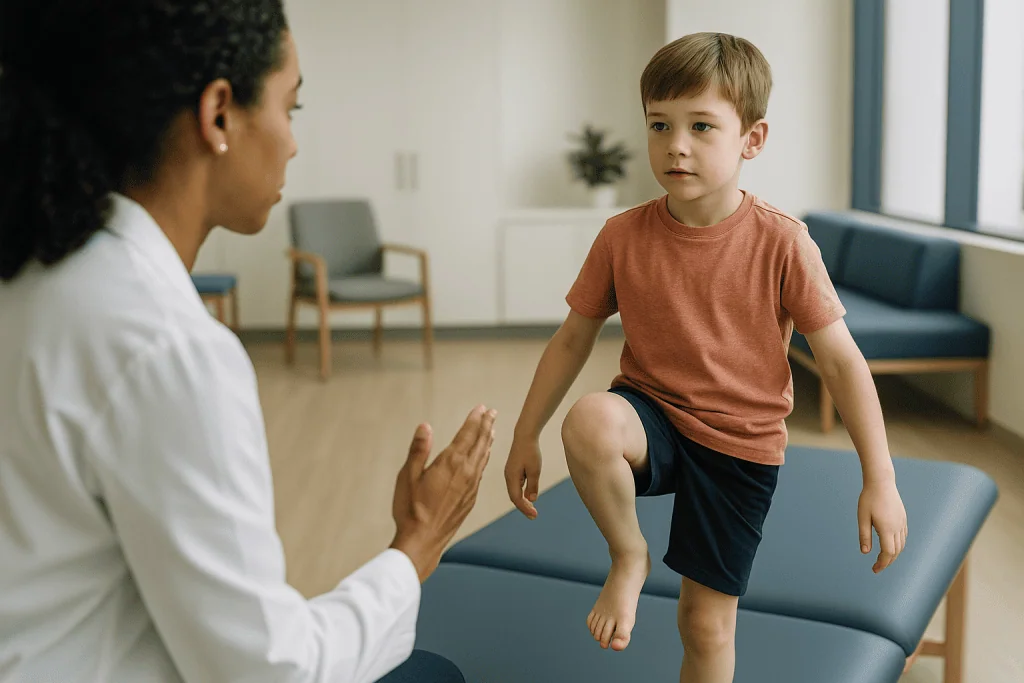
Design starts with an assessment. The therapist watches how a child sits, stands, walks, reaches or catches, compares that with what is typical for the age, and names one or two goals in plain language: “get up from the floor without using hands,” or “stand on one leg long enough to put on a sock.” Each exercise then targets a component of that goal. Something that looks like a game of Simon Says may in fact be training trunk strength, hip stability and motor planning, which is the brain’s process of organizing a sequence of movements before starting them.
The program is deliberately small. Two to four activities are more likely to happen than ten, and a therapist would rather see two done well than eight half-remembered. Instructions usually describe the setup, the target, what “good” looks like, and what to do if it is too hard or too easy.
Crucially, the HEP is a living document. What a child practices in week two is not what they practice in week eight. The therapist reviews the family’s observations, watches the child again, and trades finished activities for the next rung. The family’s role is to practice, notice and report; the clinical decisions about progression stay with the treating team.
Who is a pediatric home exercise program usually for, and who is asked to wait?
Home programs are prescribed across a wide range of situations. The common thread is a movement goal that benefits from frequent practice: a baby who strongly prefers turning the head one way, a preschooler whose walking looks different from peers, a child with cerebral palsy working on standing balance, a school-age child with developmental coordination disorder (a condition in which motor skills lag behind what is expected for age without another explanation), or a teenager recovering after a fracture or knee surgery. Children with low muscle tone, joint hypermobility, or genetic conditions that affect strength may work on the same principles for years, with the content changing as they grow.

Some families are asked to hold off, at least on the exercise part. A child with an acute injury may need a period of protected rest before loading a limb. When a diagnosis is still unclear, a clinician may prefer to complete imaging or a specialist review first, because the wrong exercise for an undiagnosed problem can be unhelpful or occasionally harmful. Fever, a recent seizure, or a flare of a rheumatologic condition are typical reasons to pause and check in.
Age itself is rarely a barrier. Infant programs consist almost entirely of positioning and play, such as supervised tummy time, which the NHS recommends building toward at least 30 minutes spread across the day for babies who are not yet mobile. What changes with age is who does the work: for a baby, the parent creates the opportunity; for a teenager, the goal is a program the young person owns.
Whether a home program is appropriate, how intensive it should be, and when to start are judgments made by the treating team after seeing the child. A written plan from a clinician who has assessed your child is the starting point, not a generic list found online.
What are some good home exercise programs for kids?
The honest answer is that the good program is the one written for your child, because a plan that suits a four-year-old with tight calves would bore a ten-year-old working on ball skills and could frustrate an infant. That said, well-built pediatric physical therapy home exercises tend to share a shape, and knowing it helps you judge whether a plan is realistic.
First, they are embedded in routines. Squats become “pick up ten blocks from the floor and put them on the table.” Single-leg balance happens while a parent ties the other shoe. Therapists call this activity-based practice; families call it getting through the day.
Second, they mix categories. A balanced program usually touches strength (getting up from the floor, climbing stairs), balance (standing on a cushion, walking along a line of tape), coordination (catching a beanbag, jumping over a rope on the ground) and flexibility (reaching to a shelf, animal-walk stretches). Public health guidance from the CDC and WHO for ages 6 to 17 asks for muscle- and bone-strengthening activity on at least 3 days a week within a daily 60 minutes of moderate to vigorous activity, and a therapist’s program often fits inside that broader target rather than adding to it.
Third, they include a “make it easier” and “make it harder” version of each task, so the parent is not stuck when the child sails through or melts down.
Fourth, they are short. Several brief bouts across the day suit young nervous systems and family schedules better than one long session. The NHS guidance for under-fives explicitly describes the 180 minutes of daily activity for toddlers as “spread throughout the day,” and the same rhythm works for structured practice.
If the plan you have does not look like this, that is a conversation to have with the therapist, not a reason to invent your own.
How much movement do children need at each age?
Home programs sit inside a larger picture of daily movement, and it helps to know the public health baseline before worrying about a specific exercise. The figures below come from CDC, WHO and NHS guidance and describe healthy children in general; a therapist may set different targets for a child with a medical condition, and those individual targets take precedence.
| Age group | Daily activity guideline | What it looks like at home |
|---|---|---|
| Infants (under 1) | Active several times a day; NHS suggests working toward at least 30 minutes of supervised tummy time spread across the day | Floor play, reaching, rolling, supported sitting |
| Toddlers and preschoolers (1–4) | At least 180 minutes spread through the day (NHS, WHO), with 3–4 year olds including 60 minutes that is energetic | Walking, climbing, chasing, dancing, playground time |
| Children and teens (5/6–17) | 60 minutes or more of moderate to vigorous activity daily, with vigorous, muscle-strengthening and bone-strengthening activity each on at least 3 days a week (CDC, WHO) | Running games, cycling, sports, climbing, jumping, carrying |
Two points matter for families with a home program. The first is that therapy exercises count. Ten minutes of animal walks and beanbag tosses contributes to the 60 minutes, so the HEP is not competing with “real” play. The second is that these are population guidelines, not pass or fail thresholds. The WHO notes that some activity is better than none and that children should build up gradually.
Sedentary time is the other half of the equation. Both the WHO and NHS advise limiting long stretches of sitting and, for under-fives, restricting screen-based sitting. For a child with a movement goal, breaking up sitting is itself part of treatment: every transition from floor to standing is a repetition.
What activities promote movement skills? Fundamental movement skills activities explained
Therapists and coaches often organize children’s movement into three families of fundamental movement skills. Locomotor skills move the body from place to place: crawling, walking, running, hopping, skipping, galloping. Stability skills keep the body upright and controlled: balancing, turning, bending, landing. Object-control skills manage something outside the body: throwing, catching, kicking, striking, carrying. Most childhood activities draw on all three, which is why a game of tag is more useful than it looks.
Activities that promote these skills share a few properties. They offer variety, because a child who only runs on flat ground never learns to adjust footing. They allow safe failure, since a missed catch teaches timing as effectively as a caught one. They are self-paced, so a child who needs 40 tries gets them without a queue of classmates watching.
Everyday examples by category:
- Locomotor: obstacle courses through the living room, hopscotch chalked on a path, “floor is lava” stepping between cushions, stair climbing with one hand rather than two.
- Stability: standing on one leg during tooth-brushing, walking heel to toe along a tape line, yoga-style animal poses, playground beams and stepping stones.
- Object control: rolling and then bouncing a ball against a wall, catching a scarf before a beanbag, kicking a ball at a target, carrying a laundry basket with both hands.
For a child with a specific movement difficulty, the therapist will usually pick a narrow slice of this menu and build it up deliberately: rolling a ball before catching, catching a large soft ball before a small one, catching at arm’s length before catching on the move. The progression is the treatment. Families who understand the sequence are better placed to notice when a step has been mastered and to report it, rather than guessing which activity to try next.
What are the 6 basic exercise movements, and do they apply to children?
The phrase “six basic movements” comes from adult strength coaching rather than pediatric medicine. It usually lists squat, hinge (bending at the hips with a straight back, as when lifting a box), lunge, push, pull and carry, with some versions adding rotation and gait. The framework is a shorthand for covering the body’s major movement patterns rather than a clinical standard, and it should be read that way.
Does it apply to children? Loosely, yes, and the overlap with therapy goals is real. A toddler squats dozens of times a day to pick things up. A child hinges to look under a bed. Climbing a playground ladder is a pull; pushing a loaded toy stroller is a push; carrying a backpack is a carry. Pediatric therapists rarely use these labels with families, but many home programs are built from the same raw material.
The differences are important, though. Children’s bones have growth plates, areas of developing cartilage near the ends of long bones, and their strength training should emphasize body weight, control and good form rather than heavy external load. Public health guidance from the CDC describes muscle-strengthening activity for children in terms of climbing, playing on equipment, using resistance bands and gymnastics rather than lifting for maximal effort. Children also learn movement patterns most efficiently through play and imitation, so a therapist is more likely to prescribe “bear walk to the kitchen” than “three sets of lunges.”
If a coach or program at school uses the six-movement language, there is no conflict with a therapy plan as long as the child’s therapist knows about it and the activities respect any restrictions. Bringing the school program to a therapy appointment is a useful way to check that the two are pulling in the same direction.
Can movement breaks help children with ADHD? What the evidence shows
Movement breaks for kids, meaning short bursts of activity between periods of sitting, are widely used in classrooms and homes, and parents of children with attention-deficit/hyperactivity disorder (ADHD) often ask whether they do more than let off steam. The answer from research is cautiously encouraging and clearly limited.
Small trials and systematic reviews indexed in PubMed have reported short-term improvements in attention, response control and classroom behavior after bouts of aerobic activity in children with ADHD. Proposed mechanisms include increased blood flow and release of brain chemicals involved in attention and arousal, the same pathways that are relevant to core ADHD symptoms. The effects measured are typically modest, appear within the hour or so after activity, and vary a great deal between studies, which differ in the type, length and intensity of exercise used. Longer-term structured exercise programs have shown mixed results, and study quality is uneven.
What the evidence does not support is the idea that exercise replaces treatment. The CDC describes behavioral therapy, and for many children medication, as the evidence-based core of ADHD care, with physical activity, sleep and nutrition as part of a healthy lifestyle that supports rather than substitutes for it. Decisions about whether medication is appropriate, and any change to an existing prescription, belong with the prescribing clinician.
For families, the practical takeaway is that movement breaks are low risk, fit within the 60 minutes of daily activity the CDC recommends for all children, and may make the next block of homework go a little more smoothly. A child with ADHD who also has a movement goal in therapy can often combine the two: the home exercise program becomes the movement break, and each five-minute obstacle course counts twice.
How do progress checks work between therapy visits?
Progress in pediatric movement is easy to miss from inside the house, because change arrives in small increments and parents adjust to the new normal within days. Structured progress checks exist to catch what daily life blurs.
Most therapists use one or more of the following, and will tell you which apply to your child:
- Timed or counted tasks. How many seconds a child stands on one leg, how many times they can rise from a chair in 30 seconds, how long it takes to walk a set distance. The family records the number once or twice a week under the same conditions.
- Short videos. Ten seconds of the child walking, jumping or getting up from the floor, filmed from the same angle each time. Video is often more useful than description because the therapist can see quality, not just completion.
- Goal ratings. A simple scale of how much help the child needed, or how many attempts succeeded out of five.
- Milestone checklists. The CDC’s developmental milestone checklists describe what most children, roughly 75 percent, can do at each age from 2 months to 5 years, and can anchor observations for younger children.
The rules for a fair check are consistency and honesty. Test at a similar time of day, on a rested child, with the same shoes or barefoot as agreed. Record the bad days as well as the good ones; a therapist learns as much from “could not do it after school on Wednesday” as from a personal best.
These checks are information for the treating team, not a scorecard for the family. A plateau on a timed task may mean the exercise needs changing, the child has grown, or the child was simply tired. Interpreting it is the therapist’s job, and adjusting the program based on it is what the next visit is for.
What do the following weeks usually look like after a program starts?
Timelines in pediatric movement are individual, and any figure here describes a typical pattern rather than a promise for your child.
The first one to two weeks are usually about logistics rather than gains. Families are finding where in the day the activities fit, discovering which exercise the child resists, and learning what “good form” looks like well enough to recognize it. Therapists expect questions during this window and would rather hear “we cannot get him to do the balance one” early than at the next appointment.
By the second and third weeks, the activities that are working start to feel routine, and early changes often appear first as confidence rather than measurable skill: a child who used to avoid the climbing frame heads toward it. Strength changes in children, as in adults, involve the nervous system learning to recruit muscles more efficiently before the muscles themselves change, which is one reason early progress can look like better coordination rather than visible strength.
Somewhere around four to eight weeks, many programs are substantially revised. Tasks that have been mastered are retired, new ones added, and goals sometimes rewritten as the therapist sees what has become possible. For a child recovering from an injury, this may coincide with discharge planning; for a child with a lifelong condition, it is one turn of a cycle that continues through growth spurts, school changes and new interests.
Setbacks are part of the pattern. Illness, a growth spurt that temporarily disrupts balance, or a change in routine can knock a child back for a week or two. Public health guidance from the WHO emphasizes building activity gradually and returning gradually after a break, and therapists apply the same principle to home programs. When a setback lasts longer than expected or is accompanied by new symptoms, it is a reason to contact the team rather than push harder.
How do families keep a home exercise program going? Home exercise program adherence in practice
Studies of home exercise program adherence in pediatric rehabilitation consistently find that the sheet-under-the-cereal-box problem is the norm, not a failing of individual families. The barriers reported are practical: not enough time, forgetting, a child who refuses, uncertainty about doing it right, and a plan that feels disconnected from real life. Programs that families actually complete tend to share a few features, and they are worth asking your therapist to build in.
Fewer, clearer tasks. Two or three activities with a one-line purpose each (“this one is for getting up from the floor”) are remembered; a page of ten is not. Knowing why an exercise matters is repeatedly linked with sticking to it.
Anchors in the day. Tie each activity to something that already happens: balance during tooth-brushing, squats while unloading the dishwasher, animal walks on the way to the bath. The habit borrows the reliability of the routine it attaches to.
The child’s own goal. A six-year-old will not practice for “hip stability” but may practice hard to ride the scooter cousins ride. Therapists often ask children directly what they want to be able to do, and the best programs point at that.
Shared load. When one parent carries the whole program, it collapses on that parent’s busiest week. Grandparents, older siblings and after-school caregivers can each own one activity if the instructions are clear enough.
Honest reporting. Families sometimes overstate practice to avoid disappointing the therapist. That leaves the therapist adjusting a program based on work that did not happen. “We managed it twice” is far more useful than a polite “most days.”
None of this requires special equipment or extra hours. A cushion, a roll of painter’s tape, a soft ball and a laundry basket cover most pediatric home programs, and a therapist can usually adapt any exercise to whatever a household already owns.
Comfort, pain and safety: when should a child stop an exercise?
Therapy exercises should challenge a child, and challenge sometimes looks like frowning, grunting and complaining. Distinguishing that from a signal to stop is one of the most common worries parents raise, and a therapist should cover it explicitly when the program is handed over.
Effort is expected. A child working hard on a single-leg stand may wobble, hold on, or say it is too hard. Mild muscle tiredness or a little soreness the next day after new strength activities is common and settles within a day or two. Reluctance is also expected, particularly with tasks the child finds hard, and is a behavioral problem to solve with games and choices rather than a medical one.
Pain is different. Sharp pain during a movement, pain that persists after the activity ends, pain that wakes a child at night, or a child who begins to limp, guard a limb or refuse weight-bearing are all reasons to stop that exercise and contact the therapist before repeating it. So is any new swelling, redness or warmth at a joint, or a joint that seems to give way, catch or lock.
Some safety principles apply across programs. A child should be rested and fed rather than exhausted and hungry. Surfaces should be clear and non-slip; socks on a hard floor are a common cause of falls during balance work. Younger children need direct supervision for anything involving height or equipment. Growth plates make heavy loading inappropriate, so children should not be adding weight to exercises unless the therapist has specifically prescribed it.
Finally, a home program written for one child should never be used for a sibling, however similar their needs appear. Assessment, not resemblance, decides what is safe. If in doubt, pause the specific activity and ask; missing a few repetitions costs nothing, and the therapist can decide whether to modify, replace or continue.
What people often get wrong about home exercise programs
“More is better.” Doubling the repetitions or adding activities from the internet feels proactive, but children’s motor learning depends on quality of practice and enough recovery, not volume alone. Extra work on an exercise done with poor form can entrench the pattern the therapist is trying to change. If your child breezes through the program, that is news for the therapist, who will progress it appropriately.
“If she can do it in the clinic, the home version is optional.” The opposite is closer to the truth. Skills shown in a quiet, padded room with an expert coaching each attempt have to be practiced in kitchens, playgrounds and classrooms to become usable. The home program is where transfer happens.
“Missing a week means starting over.” Skills learned by the nervous system are durable. A week off during a stomach bug or a vacation is a pause, not a reset, and the WHO’s guidance to build back gradually applies. Guilt about missed days is one of the main reasons families stop reporting honestly.
“Kids just grow out of it.” Some do, and many milestones have wide normal ranges. But the CDC’s milestone checklists exist precisely because delays are easier to address early, and a therapist’s assessment is the way to know which situation applies to your child. Waiting to see is a decision to make with the team, not by default.
“A screen-based exercise game counts as therapy.” Active video games and app-based movement programs can add enjoyable activity, and some therapists use them deliberately. As a stand-alone treatment for a specific movement difficulty, the evidence is thin and inconsistent, and they should be treated as a supplement rather than a substitute for the prescribed program.
“The therapist will notice if something is wrong.” Between visits, the family is the monitoring system. New pain, regression in a skill, or a change in how a child moves should be reported promptly rather than saved for the next appointment.
Questions to ask your care team about the home exercise program
A ten-minute conversation at the end of a session can determine whether a program lives or dies at home. Parents who arrive with questions written down tend to leave with a plan they can actually run. Consider asking:
- What is the single most important goal this program is working toward, in words my child would understand?
- Which one activity matters most if we can only manage one this week?
- What does doing this exercise well look like, and what is the most common mistake you see families make with it?
- How do I make each activity easier on a bad day and harder when it becomes routine?
- What should we measure or film at home, how often, and under what conditions?
- What signs mean stop and call you, and what signs are just normal effort?
- How does this program fit with sports, PE, dance or other activities my child does, and is anything off-limits for now?
- How long do you expect this version of the program to last before we review it, and what would tell you it needs changing sooner?
- Can other caregivers be shown the exercises, and is there a written or video version we can share with them?
- If we cannot get my child to cooperate with a particular task, what are the alternatives?
Two further questions are worth asking about the broader plan. First, how will you know when therapy has done its job, and what does discharge or a maintenance program look like? Second, who should we contact between visits, and how quickly can we expect a reply? Knowing the answer to the last one removes much of the anxiety about whether a worry is worth raising.
Write the answers on the program sheet itself. The version taped inside a kitchen cupboard, with the child’s own goal at the top and the therapist’s contact route at the bottom, is the one that survives the cereal box.
When to call your doctor
Most bumps in a home exercise program are handled with a message to the therapist. Some changes, however, need prompt medical assessment, because they can signal a problem that exercise will not fix and could worsen. Contact your child’s doctor or the treating team promptly if you notice any of the following:
- A child who loses a skill they had reliably mastered, such as walking, sitting unsupported, using a hand, or speaking, particularly if the loss is sudden or progressive.
- New weakness, floppiness or stiffness in a limb or on one side of the body, or a new limp that lasts more than a day or two without an obvious cause.
- Pain that wakes a child at night, pain that is present at rest, or pain over a bone rather than a muscle.
- A joint that is swollen, hot, red or that the child will not move, especially with fever.
- A child who refuses to bear weight on a leg or cries when a limb is moved.
- New or worsening balance problems, frequent unexplained falls, headaches, vomiting, or changes in vision, alertness or behavior.
- Numbness, tingling, or changes in bladder or bowel control.
- Any injury during exercise involving a fall from height, a head impact, or a deformed or unusually painful limb.
Seek emergency care immediately for a suspected fracture, a head injury with vomiting or drowsiness, a seizure, breathing difficulty, or a child who cannot be roused normally.
Between those extremes, trust your instinct about your own child. A parent’s sense that “something is different” is a legitimate reason to make the call. Clinicians would rather assess a false alarm than learn weeks later about a change that was noticed and not reported. The home program can always be paused; the decision to resume, modify or stop it belongs with the treating team once they have seen the child.
Frequently asked questions
What are some good home exercise programs for kids?
The good program is the one a therapist writes after assessing your child, because needs differ so widely by age and diagnosis. Well-designed programs are short, usually two to four activities, embedded in daily routines, mixed across strength, balance and coordination, and come with easier and harder versions of each task. Generic lists found online are not substitutes; bring them to your therapist if you want to know whether they fit.
Can movement breaks help children with ADHD?
Movement breaks may help modestly in the short term. Small studies and reviews report improvements in attention and behavior for an hour or so after aerobic activity in children with ADHD, though findings vary and study quality is uneven. The CDC describes behavioral therapy and, for many children, medication as the evidence-based core of ADHD care, with activity supporting rather than replacing it. Any medication decisions rest with the prescribing clinician.
What are the 6 basic exercise movements?
The six basic movements are a strength-coaching framework, not a medical standard: squat, hinge, lunge, push, pull and carry, sometimes with rotation and gait added. Children perform versions of all six through play, such as squatting to pick up toys or climbing a ladder. For children, body-weight control and good form matter more than added load, because growth plates are still developing, and therapists typically frame these patterns as games rather than sets.
What activities promote movement skills in children?
Activities that combine locomotor skills (running, hopping, crawling), stability skills (balancing, landing, turning) and object-control skills (throwing, catching, kicking) promote movement development best. Obstacle courses, hopscotch, walking along a tape line, animal-walk poses, ball games against a wall and carrying a laundry basket all qualify. Variety, safe failure and self-pacing matter more than any single activity, and a therapist narrows this menu for children with specific difficulties.
How often should my child do their pediatric physical therapy home exercises?
Frequency is set by the therapist for your child and can change at every review, so follow the written plan rather than a general rule. As a pattern, therapists tend to favor several short bouts spread across the day, echoing the NHS advice that young children’s 180 minutes of daily activity should be spread throughout the day. If the prescribed frequency is not realistic for your household, say so; a plan that happens beats a perfect one that does not.
How do I know if the home exercise program is working?
Your therapist will usually give you one or two simple measures, such as seconds balanced on one leg, repetitions in 30 seconds, or a short weekly video filmed from the same angle. Consistent conditions matter more than the measure itself. Early progress often shows as confidence or smoother movement before it shows as strength. The therapist interprets the trend at each visit; a plateau is information, not failure.
What if my child refuses to do the exercises?
Refusal is common and is usually a behavior and design problem, not a reason to stop therapy. Tell the therapist, who can swap the task for a game with the same purpose, attach it to a routine the child already enjoys, or link it to a goal the child cares about, such as riding a scooter. Offering a choice between two activities, and involving siblings or other caregivers, often helps. Forcing repetitions rarely does.
Why does home exercise program adherence matter so much in children?
Motor learning depends on repetition, and a weekly clinic session provides only a fraction of the practice a developing nervous system needs to make a skill automatic. Skills shown in a quiet treatment room must be rehearsed in kitchens, playgrounds and classrooms to transfer into daily life. Adherence studies in pediatric rehabilitation show families do best with fewer, clearer tasks tied to routines, which is why therapists keep programs deliberately small.
Is it safe to continue the program during a growth spurt or after an illness?
Usually, with adjustment. Growth spurts can temporarily unsettle balance and coordination, and illness reduces stamina, so a child may struggle with tasks that were easy the week before. The WHO advises building activity back gradually after a break, and therapists apply the same principle. Pause during fever or acute illness, restart at an easier level once well, and tell the therapist so the program can be recalibrated rather than pushed.
When should I stop the exercises and call the doctor?
Stop and contact the team for sharp pain during movement, pain that persists or wakes the child at night, a new limp, refusal to bear weight, or a joint that is swollen, hot or red. Loss of a previously mastered skill, new weakness on one side, frequent unexplained falls, or changes in alertness, vision, or bladder control need prompt medical assessment. Seek emergency care for suspected fractures, head injuries with vomiting, or seizures.
References
- CDC: Child Activity: An Overview (Physical Activity Guidelines for Children)
- WHO: Physical activity fact sheet
- NHS: Physical activity guidelines for children (under 5 years)
- CDC: CDC's Developmental Milestones
This article is for general information only and is not a substitute for professional medical advice. Please consult a qualified doctor about your individual situation.

More from the Blog

Bronchiolitis Warning Signs: Fast Breathing, Blue Lips and Feeding Drops Needing Urgent Care
Take a child with bronchiolitis to hospital, or call emergency services, if breathing becomes fast or labored with the chest sucking in, there are…

Baby Poop Colors and Textures: What Is Normal
Normal baby poop varies widely: sticky greenish-black meconium in the first days, then mustard-yellow and seedy stools in breastfed babies or tan, pasty stools…

What Does Growing Up With Pediatric Chronic Kidney Disease Involve? Nutrition, School and Play
Growing up with pediatric chronic kidney disease usually involves regular clinic visits, close tracking of growth and blood pressure, a dietitian-guided eating plan that…

Pediatric Chronic Kidney Disease Stage by Stage: How Care Changes as Kidney Function Falls
Pediatric chronic kidney disease stages describe how much filtering ability a child's kidneys still have, measured as estimated glomerular filtration rate (eGFR). Stages 1…

After ROP Treatment: Eye Redness, Swelling and the Follow-Up Retinal Examinations Ahead
After ROP treatment, most premature babies have puffy eyelids, red or bloodshot eyes and light sensitivity for a short period while the surface heals;…

What to Do During a Febrile Seizure: Side Position, Timing and When to Call Emergency Services
During a febrile seizure, stay calm, note the time it starts, and move your child onto their side on a soft, flat surface away…