

Why Does Fever Trigger Febrile Seizures in Young Children and How Is Care Planned?

Key Takeaways
- Febrile seizures affect roughly 2 to 5 in every 100 children, almost always between 6 months and 5 years, with the peak around 12 to 18 months.
- The trigger is the fever meeting a child's individual seizure threshold, not the number on the thermometer; many seizures happen before the fever is even noticed.
- A simple febrile seizure lasts under 15 minutes, involves the whole body and does not repeat within 24 hours; anything outside those limits is labeled complex and prompts closer evaluation.
- Fever-reducing medicines can make a child more comfortable but have not been shown to prevent febrile seizures.
- About 1 in 3 children will have another febrile seizure, most often when the first came before 18 months or a parent or sibling had them.
- The later risk of epilepsy is about 1 in 50 after simple febrile seizures versus about 1 in 100 in the general population, and brief febrile seizures have not been shown to affect learning or development.
Febrile seizures happen when a fever, usually from a common childhood infection, temporarily lowers the seizure threshold of a young child's developing brain; inherited susceptibility plays a large part. They mostly occur between 6 months and 5 years, are typically brief, and rarely cause lasting harm. Care focuses on finding the source of the fever, ruling out serious infection, and planning what families should do if another one happens.
The thermometer had read a shade over 101°F at bedtime, and the plan was simple: fluids, a cool room, check again at midnight. Then, at 11:40, the crib rail rattled. Eighteen months old, eyes rolled back, arms and legs stiff and jerking, lips a dusky color. Ninety seconds that felt like an hour. By the time the ambulance arrived, the toddler was limp, asleep and breathing normally, and the parents were asking the question every family in that hallway eventually asks: what causes febrile seizures, and why did it happen to our child?
The answer is more reassuring than the scene suggests, and more interesting than “the fever got too high.” It involves a brain that is still wiring itself, an immune system throwing off chemical signals, and, very often, a family tree with a similar story a generation back.
This explainer walks through the biology, the moment itself, what the emergency team is actually checking for, and how the weeks afterward usually unfold.
What causes febrile seizures? The honest short answer
Strip away the jargon and the cause comes down to three ingredients meeting at once: a fever, a brain at a particular stage of development, and a built-in tendency, often inherited, for that brain to be more excitable than average when its temperature climbs. Remove any one ingredient and the seizure usually does not happen. A teenager with the same virus and the same fever almost never seizes. A toddler with no family history and a fever will, most of the time, just be miserable and clingy.
Mayo Clinic describes febrile seizures as convulsions triggered by a fever, most often from an infection, in children between about 6 months and 5 years, with a peak around 12 to 18 months. The National Institute of Neurological Disorders and Stroke (NINDS), part of the NIH, puts the frequency at roughly 2 to 5 in every 100 children, which makes this the most common type of seizure in early childhood by a wide margin.
Two points deserve emphasis because they shape everything that follows. First, the fever is the trigger, not the disease. The child does not have a brain disorder; the brain is responding to an ordinary illness in a way that is, for a small share of children at a specific age, within the range of normal development. Second, the illness behind the fever is almost always mundane. Respiratory viruses, ear infections and roseola account for most cases. Meningitis, the infection of the lining around the brain that parents fear most, is uncommon, and checking for it is precisely why the emergency team asks the questions and does the examination it does.
The rest of this article unpacks each ingredient in turn, then follows the child from the living-room floor to the follow-up visit.
How does a fever tip a developing brain into a seizure?
A seizure is a burst of abnormally synchronized electrical firing across groups of nerve cells. Every brain has a threshold above which that runaway firing can start; in adults it sits high, and a fever alone will not reach it. In a child under 5, the threshold sits lower, for reasons that are still being mapped.
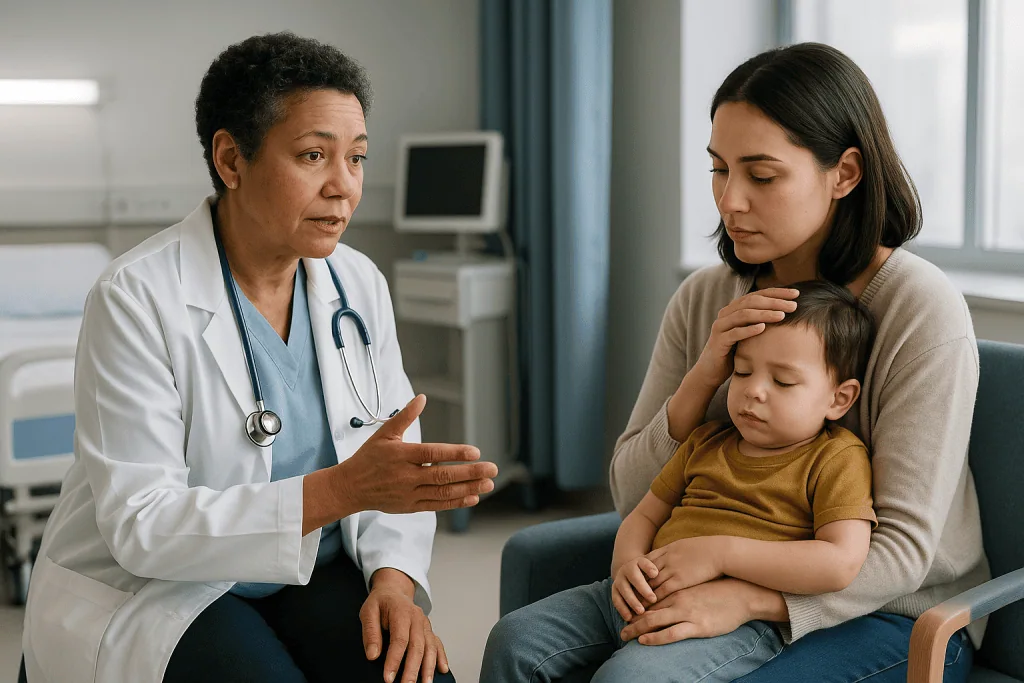
The clearest factor is maturation. Between infancy and school age, the brain is adding connections faster than it prunes them, and the balance between excitatory signals (which push cells to fire) and inhibitory signals (which hold them back) tilts toward excitation. The brain’s main inhibitory messenger, GABA, works less effectively as a brake in very young neurons than it does later. Heat itself changes how quickly ion channels, the tiny pores that let charged particles into and out of nerve cells, open and close, and several of those channels behave differently at higher temperatures.
Fever adds a chemical layer. When the immune system meets a virus, it releases signaling proteins called cytokines; one of them, interleukin-1 beta, has been shown in laboratory studies to increase neuronal excitability directly, not just by raising body temperature. Fever also makes children breathe faster, and rapid breathing shifts blood chemistry toward alkalinity, a state that in animal models lowers the seizure threshold further. NINDS notes that the exact reasons some children seize and most do not are not fully understood, and that is the honest state of the science: several plausible mechanisms, each with laboratory support, none yet proven to be the whole story in human children.
What the evidence does not support is the idea that a specific temperature “causes” the seizure. Many children seize early in an illness, sometimes before the fever is even noticed, and plenty run very high fevers without ever seizing.
Which children are most likely to have one, and which usually are not
Age is the single strongest predictor. Mayo Clinic gives the typical window as 6 months to 5 years, with the highest risk between 12 and 18 months. Before 6 months, a fever with a seizure is treated as a different and more concerning problem, because the immature immune system and the possibility of serious infection change the calculation entirely. After age 5 or 6, the threshold has usually risen enough that fever no longer tips the balance, which is why most children outgrow febrile seizures by school age, as MedlinePlus and NINDS both describe.
Family history comes next. Cleveland Clinic and Mayo Clinic both list a parent or sibling with febrile seizures as a risk factor, and twin studies point to a substantial inherited component. In a minority of families, specific gene variants affecting sodium channels have been identified, though routine genetic testing is not part of standard care after a first simple seizure.
A first febrile seizure at a young age, particularly under 18 months, raises the chance of having another during a later illness, as does a relatively low fever at the time of the first event, which suggests that child’s individual threshold sits lower than average.
Who is usually not in this picture? Children whose seizures happen without a fever, children under 6 months, children with a known neurological condition or developmental delay, and children whose seizure lasts a long time or affects only one side of the body. For those children, the clinical team will not file the event under “febrile seizure” and move on; they will look further, and the timeline for tests and follow-up is decided case by case rather than by the usual reassuring pathway. The label matters because it determines how much investigation is needed.
Which infections most often set off febrile seizures?
Almost any illness that produces a fever can do it, but a handful account for the majority. Viral upper respiratory infections top the list, simply because toddlers catch so many of them. Roseola, caused by human herpesvirus 6, is a classic trigger; its fever often runs high for several days before the characteristic rash appears, and the seizure tends to arrive during that feverish stretch. Influenza is another frequent culprit, and ear infections, tonsillitis and gastroenteritis all appear regularly in emergency department records. Mayo Clinic and the NHS both list these ordinary childhood infections as the usual background.
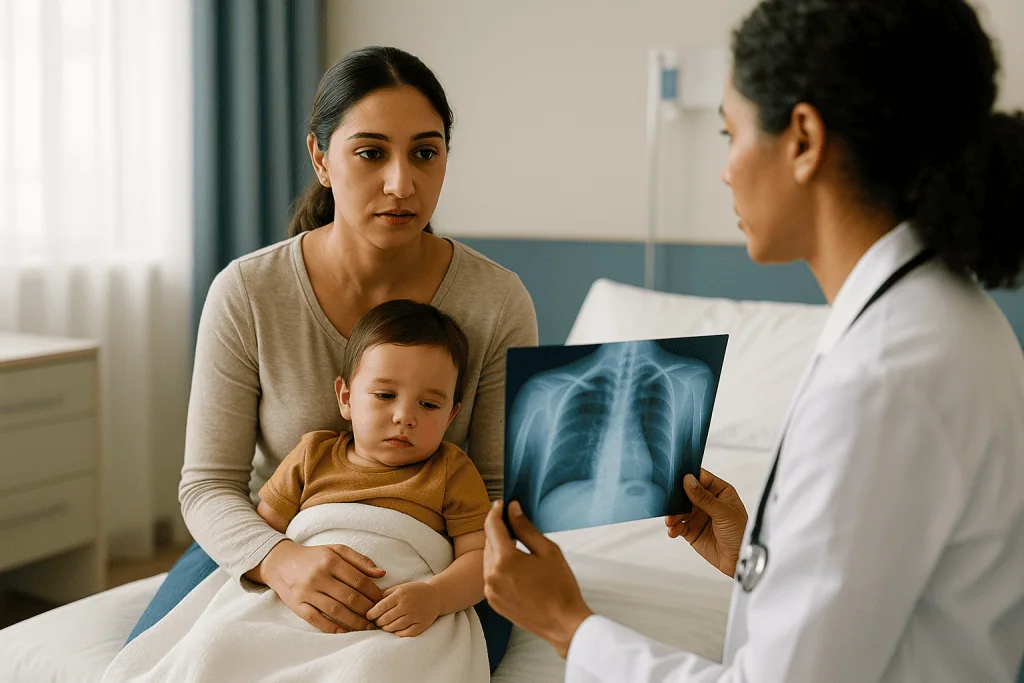
Bacterial infections of the bloodstream, urinary tract or lungs can also produce the fever that triggers a seizure, which is one reason a urine sample is sometimes requested in the emergency department: a urinary tract infection in a toddler may produce fever with no other obvious sign.
Vaccines deserve a plain statement. Some childhood vaccines, notably the measles, mumps and rubella vaccine and certain combinations given in the second year of life, can cause a fever in the days afterward, and a small number of children will have a febrile seizure during that fever. Mayo Clinic and the NHS both describe this risk as small and note that the trigger is the fever, not the vaccine itself, and that these seizures are no different in character or outlook from those following an infection. The diseases the vaccines prevent, measles among them, carry a far higher risk of both fever and serious neurological complications. The clinical team can talk through timing if a child has had a seizure after a previous vaccination; that decision remains with them and the family.
Which infection is behind the fever matters for one practical reason: it directs the search. The emergency team is not treating the seizure so much as identifying what caused the fever.
Simple vs complex febrile seizure: what the labels mean
Within minutes of arrival, the team will be sorting the event into one of two categories, because the category drives nearly every decision that follows.
A simple febrile seizure is generalized (it involves the whole body, not one side), lasts less than 15 minutes, and does not happen again within the same 24 hours. Mayo Clinic uses exactly these three criteria. A complex febrile seizure fails one or more of them: it lasts 15 minutes or longer, it is focal (confined to one side or one limb, or beginning on one side before spreading), or it recurs within 24 hours or within the same illness. The NHS adds that a child who does not recover fully within an hour may also be placed in the complex group.
| Feature | Simple febrile seizure | Complex febrile seizure |
|---|---|---|
| Duration | Under 15 minutes (most under 5) | 15 minutes or longer |
| Body involvement | Both sides, whole body | One side or one limb, or starts on one side |
| Repeat within 24 hours | No | Yes, or repeats in the same illness |
| Share of cases | The large majority | A minority |
| Usual workup | History, examination, find the fever source; EEG and imaging usually not needed | Individualized; may include EEG, imaging, specialist referral |
| Later epilepsy risk (NHS estimate) | About 1 in 50 | About 1 in 20 (general population about 1 in 100) |
Most febrile seizures, in every published series, are simple. A complex label is not a diagnosis of anything in itself; it is a signal that the team should look harder before settling on the reassuring explanation. Some children with a complex febrile seizure will turn out, after evaluation, to have had nothing more than an unusually long or one-sided version of the same benign event. Others will have a structural or genetic reason that becomes apparent over time. The label opens the door to further tests; it does not walk the child through it.
How long do febrile seizures last, and what should you do while one is happening?
Most febrile seizures last less than 5 minutes, according to the NHS, and many are over in one or two. The sequence is abrupt: the child becomes unresponsive, the body stiffens, then the arms and legs jerk rhythmically. Eyes may roll upward or fix to one side. Breathing turns irregular, and the lips or face can look bluish for a short period. Some children vomit or lose bladder control. Then the jerking slows and stops, and the child is limp and deeply drowsy. The NHS notes that this sleepy phase can last up to an hour, and it is expected.
What to do in those minutes is the same advice given by MedlinePlus, Mayo Clinic and the NHS, and it is worth knowing before it is ever needed.
- Note the time the seizure started. This single detail is the most useful thing you can bring to the emergency team.
- Place the child on their side on a flat, safe surface, on the floor if possible, and move hard or sharp objects away.
- Loosen anything tight around the neck.
- Do not hold the child down, and do not put anything in the mouth, including fingers, food or medicine; the tongue cannot be swallowed, and objects can break teeth or block the airway.
- Do not put the child in a bath to cool them; a seizing child in water can drown.
- Stay with the child and, if you can, have someone film the event on a phone; a short video helps clinicians distinguish a seizure from a shivering rigor or a breath-holding spell.
Call emergency services if the seizure lasts more than 5 minutes, if the child is struggling to breathe, or if it is the first seizure. Duration is the reason for the 5-minute rule: the longer a seizure runs, the less likely it is to stop on its own, and the more likely the team will want to intervene.
Should you go to the ER after a febrile seizure?
For a first febrile seizure, the answer from Mayo Clinic, the NHS and MedlinePlus is consistent: yes, the child should be seen promptly, and if the seizure is still going at 5 minutes, call emergency services rather than driving. The reason is not that the seizure itself is dangerous in most cases. The reason is that a clinician needs to confirm that what looked like a febrile seizure actually was one, and needs to identify the source of the fever with their own eyes and hands.
Two questions sit at the center of that first assessment. Is there any sign of meningitis or encephalitis, the infections of the brain’s lining and of the brain tissue itself, which can present with fever and seizure and need urgent treatment? And is the child recovering the way a child recovers from a simple febrile seizure, meaning drowsy but rousable, gradually more alert, and back to something like their usual self within the hour?
The picture is different for a child who has had a febrile seizure before, whose family has been given a written plan, and whose seizure was brief, generalized and followed by normal recovery. Many care teams tell such families they can manage at home and arrange a same-day or next-day review, with clear instructions on what would change that advice. That is a decision for the treating team to make with the family, and it should be made in advance, not improvised at midnight.
What the emergency visit is not: it is not usually a place where a battery of scans and blood tests is ordered. Parents sometimes leave feeling that “nothing was done.” In fact, the most important work, a careful history and physical examination by someone trained to spot the exceptions, was done, and the decision to stop there was itself an expert judgment.
How is care planned? Which tests are done, and which are usually skipped
Planning starts with the story. The team will want to know exactly what the seizure looked like, how long it lasted, whether it involved both sides, how the child behaved before and afterward, which vaccinations the child has had, whether anyone in the family has had febrile seizures or epilepsy, and whether the child was already unwell. A phone video shortens this conversation considerably.
Next comes the examination: temperature, heart rate, breathing, hydration, a look in the ears and throat, a listen to the chest, a check of the skin for rashes, and a neurological assessment suited to a toddler, watching how the child moves, tracks, responds and settles. In a child who has had a simple febrile seizure and is recovering normally, this examination is often the entire workup, and that reflects guideline practice rather than a shortcut.
Tests are added when the picture is incomplete. A urine sample may be sent if no source of fever is obvious. Blood tests are considered when the child looks more unwell than expected or is dehydrated after vomiting or diarrhea. A lumbar puncture, in which a small sample of the fluid around the spinal cord is drawn through a needle in the lower back, is reserved for situations where meningitis cannot be ruled out on examination, which is more likely in very young infants, in children not fully vaccinated against the bacteria that cause meningitis, or when a child has already been taking antibiotics that could mask the signs.
Brain imaging and an electroencephalogram (EEG), the test that records the brain’s electrical activity through scalp electrodes, are usually not needed after a simple febrile seizure, as Cleveland Clinic and Mayo Clinic describe. After a complex febrile seizure, or when the neurological examination is abnormal, the team may arrange them, often as an outpatient rather than in the emergency department, and may refer the child to a pediatric neurologist. Each of those steps is a judgment about this particular child, not a standard menu.
Will my child be prescribed medicine to prevent another one?
Usually not, and the reasons are worth understanding rather than simply accepting.
Daily anti-seizure medication, the class of drugs used to manage epilepsy, can reduce the chance of further febrile seizures in some children, but NINDS and Mayo Clinic are clear that it is not generally recommended after simple febrile seizures. The seizures themselves are brief, stop on their own and are not known to cause lasting harm, whereas the medicines carry side effects on behavior, alertness and learning that would be borne every day for years to prevent an event that may never recur. For most children the trade is a poor one. The calculation can change for a child with frequent, prolonged or complex seizures, and that decision belongs to a pediatric neurologist working with the family.
Rescue medication is a different idea. For a child who has had a prolonged febrile seizure, or who lives far from emergency care, the team may prescribe a medicine from the benzodiazepine class to be given only during a seizure that is not stopping on its own. These drugs work by boosting the brain’s main inhibitory signal, GABA, which damps the runaway firing. If one is prescribed, the clinical team will teach the family when and how to use it and what to do afterward; this article deliberately does not, because the instructions must match the child, the product and the prescriber.
Fever reducers, the acetaminophen and ibuprofen class, help a child feel more comfortable during an illness, and a child’s clinician can advise on comfort measures. What they do not do is prevent febrile seizures. Mayo Clinic and the NHS both state that lowering the fever with medicine has not been shown to reduce the chance of a seizure, and NINDS adds that studies have found no benefit for this purpose. The seizure often arrives before anyone knows there is a fever to treat.
What the following days and weeks usually look like: febrile seizure recurrence risk
The first hour is drowsiness. The NHS notes that children are often sleepy for up to an hour after a febrile seizure, and a child who is hard to wake in that window is not, by itself, a red flag. Many families describe a child who is irritable and clingy for the rest of the evening and then, unnervingly, entirely normal the next morning, still running the fever from whatever virus started it.
The illness runs its course over the following days. During that time the fever will rise and fall, and each rise carries a small chance of a further seizure in the same episode; a second seizure within 24 hours moves the event into the complex category and warrants another assessment.
The bigger question families ask in the weeks afterward is whether it will happen again. The NHS puts the overall recurrence figure at about 1 in 3 children, meaning roughly two-thirds never have another. The odds shift with circumstances that Mayo Clinic and Cleveland Clinic both describe: a first seizure before 18 months of age, a family history of febrile seizures, a relatively low fever at the time of the first event, and a short interval between the start of the fever and the seizure all push the recurrence risk upward. A child with none of these features sits well below the average.
Recurrences, when they happen, tend to occur within the same age window and fade as the child approaches school age. The practical outcome of a first visit is therefore a plan rather than a prescription: what to do during the next seizure, when to call, when to come in, and a follow-up appointment if anything about the first event was unusual. Some families find it steadying to keep the written plan on the refrigerator door, where a babysitter or grandparent can find it at 3 a.m.
Febrile seizure vs epilepsy: what the long-term evidence shows
The two are not the same thing, and the distinction is the one that most often needs stating out loud in the consultation room.
Epilepsy is a condition in which seizures occur repeatedly without a provoking trigger such as fever. A febrile seizure is, by definition, provoked. A child who has had three febrile seizures, each during a fever, does not have epilepsy. A child who has one seizure with no fever at all is in a different category and will be assessed differently.
Does having febrile seizures raise the chance of epilepsy later? Slightly, and the honest figures are these. The NHS estimates that a child with a history of simple febrile seizures has about a 1 in 50 chance of developing epilepsy in later life, compared with about 1 in 100 in the general population. After complex febrile seizures the estimate rises to about 1 in 20. Read the other way, roughly 49 of every 50 children with simple febrile seizures never develop epilepsy, and 19 of every 20 with complex ones do not either. The risk is higher again when a child also has a developmental or neurological condition, or a family history of epilepsy rather than of febrile seizures.
Whether febrile seizures cause the later epilepsy or simply reveal a brain that was already predisposed is a genuine scientific question, and the balance of evidence leans toward the second explanation for most children. The exception under study is very prolonged febrile seizures, lasting well over half an hour, which in some studies have been associated with changes in the temporal lobe; the direction of cause and effect is still being worked out, and NINDS describes this as an area of active research.
On intelligence and learning, the news is firm. NINDS reports that studies have found no difference in school achievement or intelligence between children who had febrile seizures and those who did not.
What people often get wrong about what causes febrile seizures
Myths cluster around this condition because the event is so frightening and so brief that the explanation is usually delivered to parents who are still shaking. These are the ones that surface most often, and what the evidence says.
“The fever got too high.” Height of fever is a weak predictor. Many children seize at modest temperatures, and many run much higher fevers without incident. The individual brain’s threshold, not the number on the thermometer, decides.
“If we had brought the fever down faster, it would not have happened.” Mayo Clinic, the NHS and NINDS all state that fever-reducing medicines have not been shown to prevent febrile seizures. Parents carry guilt they have not earned. Comfort is the reason clinicians suggest treating a fever; prevention of seizures is not a promise anyone can make.
“My child will swallow their tongue.” Anatomically impossible. Putting anything in the mouth, on the other hand, can cause real injury.
“This means epilepsy.” It does not. The small increase in later risk described above is exactly that: small, and concentrated in children with complex seizures or other neurological conditions.
“The seizure damaged the brain.” For brief febrile seizures, NINDS and the NHS report no evidence of lasting harm. Very prolonged seizures are treated urgently precisely to avoid that possibility.
“A cool bath will stop it.” Water around a seizing child is a drowning hazard, and rapid cooling causes shivering that can raise core temperature. The NHS advises against it.
“Vaccines cause febrile seizures.” Some vaccines can cause a fever, and any fever can trigger a seizure in a susceptible child. The seizures are the same benign events, and the diseases prevented carry far greater risks.
The common thread is that people search for something they could have controlled. For most febrile seizures, there was nothing.
Questions to ask your care team
Emergency departments are noisy, and the visit often ends faster than parents expect. Writing questions down beforehand, or on a phone in the waiting room, helps. These are the ones that tend to matter most, drawn from what families most commonly ask afterward.
- Was this a simple or a complex febrile seizure, and what made you decide?
- Did you find the source of the fever? If not, what happens next, and when should I expect results from any samples taken?
- What signs over the next 24 hours would mean I should bring my child straight back?
- Is any follow-up appointment needed, and with whom?
- Given my child’s age, family history and this event, how likely is another seizure, roughly?
- If another one happens, do you want me to call emergency services, come to the department, or manage at home and call in the morning? Can that plan be written down?
- Should my child have a rescue medicine, and if so, who will show me how to use it?
- Does anything about this event change the timing of upcoming vaccinations?
- What should I tell daycare or school, and is there any activity my child should avoid while unwell?
- Is there anything about my child’s development or health you would like to keep an eye on because of this?
Two habits help across all of these. First, ask the team to say the plan back in plain language and to write it down; a discharge sheet with the words “febrile seizure” and a phone number is worth more than any pamphlet. Second, ask who to call if a question comes up two days later, when the fever spikes again in the small hours and the memory of the advice has blurred. A good plan anticipates that moment. The decisions themselves, about tests, medicines and follow-up, sit with the treating team, but a family that understands the reasoning is a family that can act calmly the next time.
When to call your doctor: red-flag signs
Most febrile seizures end on their own, and the child recovers within the hour. The signs below are the exceptions that should prompt an emergency call or an immediate return to the department, and they match the lists published by Mayo Clinic, the NHS and MedlinePlus.
Call emergency services immediately if:
- the seizure lasts longer than 5 minutes, or a second seizure begins before the child has recovered from the first;
- the child has trouble breathing, or the bluish color of the lips does not clear once the jerking stops;
- the seizure affects only one side of the body, or the child is weak on one side afterward;
- the child was injured during the seizure, particularly to the head, or the seizure happened in water;
- this is the first seizure the child has ever had, or the child is under 6 months old.
Seek urgent medical review the same day if, after the seizure, the child:
- remains unusually drowsy, floppy or hard to wake for longer than an hour, or becomes harder to rouse rather than easier;
- has a stiff neck, a bulging soft spot on the head, a persistent high-pitched cry, or dislike of bright light;
- develops a rash that does not fade when a glass is pressed against it;
- is vomiting repeatedly, refusing all fluids, or producing very little urine;
- looks worse to you in a way you cannot name; parental instinct about a “different” illness is taken seriously by clinicians for good reason.
Between those extremes sits the ordinary course: a fever that comes and goes, a child who is grumpy but drinking and responsive, and a family watching the clock more closely than usual. For that situation, the written plan from the first visit is the guide, and the child’s regular clinician is the right person to call with questions. Trust the plan, and trust the instinct that something is off if it arrives.
Frequently asked questions
What is the root cause of febrile seizures?
The root cause is a fever acting on a young brain whose seizure threshold is temporarily lower than an adult’s, usually in a child with an inherited tendency toward that lower threshold. Immune signaling proteins released during infection, heat-sensitive ion channels in nerve cells and the immature balance of excitatory and inhibitory signals all contribute. The fever is the trigger; the underlying illness is almost always an ordinary childhood infection.
Should you go to the ER after a febrile seizure?
Yes, for a first febrile seizure, and call emergency services if the seizure is still going at 5 minutes. The visit is not mainly about the seizure but about confirming what it was, finding the source of the fever and ruling out meningitis. Families whose child has had febrile seizures before may be given a written plan that allows home management with a same-day or next-day review; that decision sits with the care team.
What are the red flags for a febrile seizure?
The red flags are a seizure lasting longer than 5 minutes, breathing difficulty or blueness that does not clear, jerking on one side only or weakness on one side afterward, a second seizure before recovery, an injury during the event, a stiff neck, a non-fading rash, a bulging soft spot, or a child who stays hard to rouse beyond an hour. Any of these warrants an emergency call or an immediate return to the department.
At what age do kids grow out of febrile seizures?
Most children stop having febrile seizures by about age 5 or 6, according to MedlinePlus and NINDS, because the brain’s seizure threshold rises as it matures. The typical window is 6 months to 5 years, and recurrences tend to fade as a child approaches school age. A seizure with fever after that age is uncommon and is usually assessed more closely by the care team.
Can a febrile seizure cause brain damage?
Brief febrile seizures have not been shown to cause brain damage. NINDS reports that studies have found no difference in school achievement or intelligence between children who had febrile seizures and those who did not. Very prolonged seizures, lasting well over half an hour, are treated as emergencies partly because their long-term effects are still being studied, which is one reason the 5-minute rule for calling emergency services exists.
Does giving fever medicine prevent febrile seizures?
No. Mayo Clinic, the NHS and NINDS all state that fever-reducing medicines have not been shown to prevent febrile seizures. They can make a feverish child more comfortable, which is a reasonable goal in its own right, but the seizure often occurs early in the illness before anyone realizes a fever is present. Parents should not blame themselves for a seizure they could not have prevented.
What is the difference between a febrile seizure vs epilepsy?
A febrile seizure is provoked by fever and stops being a risk as the child grows; epilepsy is a condition of repeated seizures without such a trigger. Having febrile seizures raises the later chance of epilepsy only slightly, from about 1 in 100 in the general population to about 1 in 50 after simple febrile seizures and about 1 in 20 after complex ones, according to NHS estimates.
What is a simple vs complex febrile seizure?
A simple febrile seizure involves the whole body, lasts less than 15 minutes and does not recur within 24 hours. A complex febrile seizure breaks one or more of those rules: it lasts 15 minutes or longer, affects one side of the body, or happens more than once in the same day or illness. Most febrile seizures are simple; a complex label prompts closer evaluation rather than a diagnosis in itself.
Will my child need an EEG or a brain scan after a febrile seizure?
Usually not after a simple febrile seizure in a child who is recovering normally; Cleveland Clinic and Mayo Clinic both describe routine EEG and imaging as unnecessary in that situation. After a complex febrile seizure, or if the neurological examination is abnormal, the team may arrange an EEG, imaging or a referral to a pediatric neurologist, often as an outpatient. Those decisions are made case by case.
Can vaccines cause febrile seizures?
Some vaccines, particularly the measles, mumps and rubella vaccine, can cause a fever in the days afterward, and a small number of children will have a febrile seizure during that fever. Mayo Clinic and the NHS describe the risk as small and the seizures as no different from those following an infection. The diseases the vaccines prevent carry far higher risks; timing questions can be discussed with the care team.
References
- NHS – Febrile seizures
- MedlinePlus – Febrile seizures
- Cleveland Clinic – Febrile Seizures
- NIH National Institute of Neurological Disorders and Stroke – Febrile Seizures
This article is for general information only and is not a substitute for professional medical advice. Please consult a qualified doctor about your individual situation.

More from the Blog
Bronchiolitis Warning Signs: Fast Breathing, Blue Lips and Feeding Drops Needing Urgent Care
Take a child with bronchiolitis to hospital, or call emergency services, if breathing becomes fast or labored with the chest sucking in, there are…
Baby Poop Colors and Textures: What Is Normal
Normal baby poop varies widely: sticky greenish-black meconium in the first days, then mustard-yellow and seedy stools in breastfed babies or tan, pasty stools…

What Does Growing Up With Pediatric Chronic Kidney Disease Involve? Nutrition, School and Play
Growing up with pediatric chronic kidney disease usually involves regular clinic visits, close tracking of growth and blood pressure, a dietitian-guided eating plan that…

Pediatric Chronic Kidney Disease Stage by Stage: How Care Changes as Kidney Function Falls
Pediatric chronic kidney disease stages describe how much filtering ability a child's kidneys still have, measured as estimated glomerular filtration rate (eGFR). Stages 1…
After ROP Treatment: Eye Redness, Swelling and the Follow-Up Retinal Examinations Ahead
After ROP treatment, most premature babies have puffy eyelids, red or bloodshot eyes and light sensitivity for a short period while the surface heals;…
What to Do During a Febrile Seizure: Side Position, Timing and When to Call Emergency Services
During a febrile seizure, stay calm, note the time it starts, and move your child onto their side on a soft, flat surface away…