

Genetic Testing in Turkey: Samples, Consent, and Timelines

Genetic testing in Turkey is legal and regulated when a physician orders it and a licensed laboratory performs it. You give written consent, provide a blood, saliva, swab or tissue sample, and analysis takes days to weeks depending on the test. Samples are usually collected during your visit; results can be discussed remotely afterwards, so most patients do not need to stay in Turkey for the report.
You may be wondering whether one trip is enough, or whether you will be sitting in Istanbul for weeks waiting for a laboratory result. It is a fair question, and the honest answer is: it depends on the test, but you can usually plan around it. Genetic testing supports diagnosis, treatment planning, family risk assessment and pregnancy-related decisions, and each of those pathways carries its own paperwork, sample requirements and waiting period.
This guide explains what to prepare before genetic testing in Turkey, how samples are collected, what the consent form actually covers, why some results take days and others take weeks, and how reports usually reach international patients after they return home.
At a glance
- Legal status: Clinical genetic testing is legal in Turkey when ordered by a physician and performed in a licensed laboratory or genetics centre
- Main sample types: Blood, saliva, cheek swab, tumour tissue, or pregnancy-related samples, depending on the test
- Consent required: Yes, written informed consent is documented before genetic testing
- Typical timeline: Varies by test; a focused single-variant test is usually faster than a large panel or exome analysis, which can take weeks
- Do you have to wait in Turkey? Usually not, samples are collected during your visit and results discussed later by planned follow-up
- Best preparation: Prior reports, family history notes, medication list, and passport identification matching your registration
What genetic testing in Turkey usually involves
Genetic testing in Turkey may be recommended for many different reasons: to investigate a suspected inherited condition, clarify an uncertain diagnosis, guide cancer treatment planning, assess carrier status before or during pregnancy, check how you may respond to certain medications, or confirm whether a variant already found in a relative is also present in you. Your exact pathway depends on why the test is requested, which gene or panel is analysed, and whether the result may affect your own care, your relatives, or a future pregnancy.
The most important thing for an international patient to understand is that genetic testing is not a single quick blood draw with an instant answer. A proper pathway includes medical review, informed consent, correct sample collection, laboratory analysis, interpretation by qualified specialists, and a plan for how you will receive and understand the result after you have gone home. Each of those steps exists for a reason, and skipping any of them tends to produce reports that are hard to act on.
Testing is typically coordinated through a medical genetics department working alongside the specialty that raised the question, oncology, cardiology, neurology, obstetrics, paediatrics or another team. For international patients, coordination also involves interpreters and patient coordinators, so that the consent you sign is one you genuinely understood and the report you receive is one your doctors at home can use.
Who orders the test matters
Genetic tests answer specific questions. A physician decides which question is worth asking: a targeted test for one known family variant, a multi-gene panel, or a broader exome analysis, and that decision shapes the sample type, the timeline and the kind of report you get back. A test ordered without a clear clinical question often returns findings nobody knows what to do with. This is one reason clinical genetic testing sits inside a hospital pathway rather than being sold as a standalone product.
Is genetic testing legal in Turkey?
Yes. Clinical genetic testing in Turkey is legal and regulated. Tests are performed in licensed laboratories and genetics centres, ordered by a physician, and carried out with documented written consent. The regulation exists to protect exactly the things this guide covers: sample identification, consent quality, laboratory standards and the confidentiality of genetic information.
Confusion on this point usually comes from the separate world of direct-to-consumer testing. Rules for mail-order ancestry and lifestyle DNA kits differ widely between countries: some permit them freely, others restrict genetic testing to medical settings, and rules change over time. If you have read that DNA testing is restricted somewhere, it almost always refers to consumer kits, not to physician-ordered clinical testing. If a consumer ancestry kit is what you want, check the current regulations of the country you are ordering in before you buy, because this guide, and hospital genetics services generally, deal with clinical testing, not ancestry products.
One more piece of context that international patients sometimes ask about: Anatolia has been a crossroads of populations for thousands of years, and the Turkish population is genetically diverse. Some inherited conditions, such as familial Mediterranean fever and beta-thalassaemia carrier states, are encountered more often in Mediterranean and Anatolian populations than in some others. This is clinically relevant because laboratories familiar with the region’s variant spectrum interpret results against appropriate reference data, but it does not change how testing works for you as a visiting patient.
Types of samples you may be asked to provide
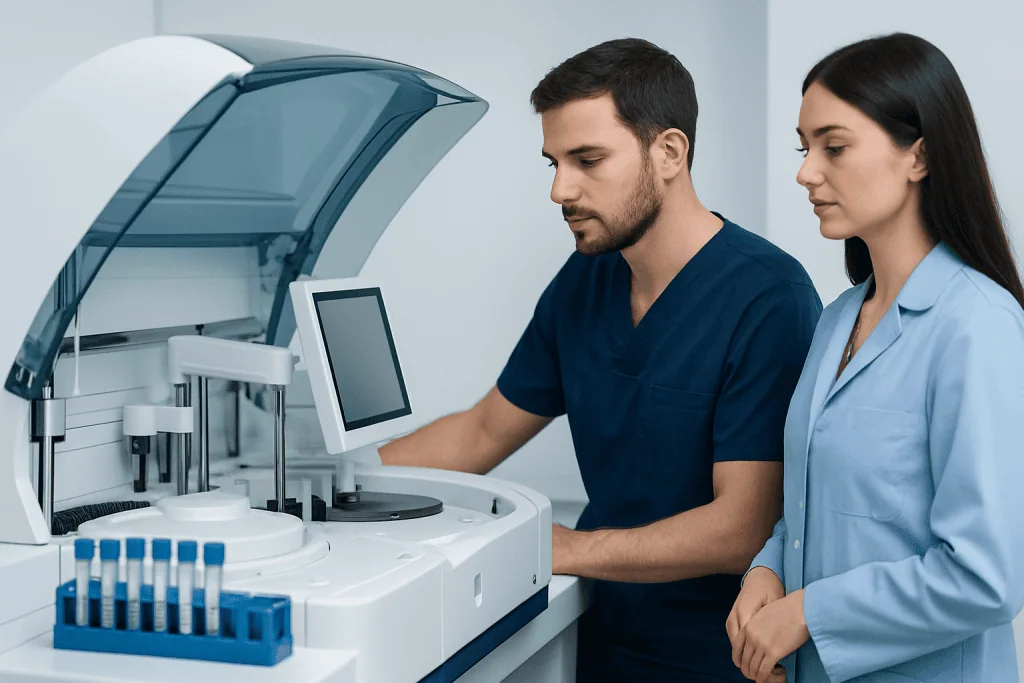
The sample type follows the purpose of the test. Blood is the standard sample for most inherited disease testing, carrier screening, pharmacogenetic testing and germline cancer-risk evaluation. Saliva or cheek swab samples are acceptable for certain tests, particularly where blood collection is unnecessary or difficult, but not every laboratory or test accepts them, do not assume a swab will do until the team confirms it.
Germline versus tumour testing
For cancer-related questions, there is an important distinction. Germline testing looks for inherited variants present in all your normal cells; a blood or saliva sample is usually enough. Tumour testing analyses the cancer tissue itself to identify changes that may guide treatment; it requires a biopsy sample, a pathology block, unstained slides, or tissue previously collected in your home country. If tissue is being transported internationally, there are packaging, documentation, customs and laboratory acceptance requirements, and tissue quality can limit what analysis is possible. This is always arranged in advance, never improvised at the airport.
Pregnancy-related samples
Prenatal genetic assessment may involve maternal blood, ultrasound-based evaluation, or specialist sampling procedures, depending on the clinical question and the stage of pregnancy. Timing windows matter here, and interpretation is sensitive, so these decisions are made jointly by the obstetrics and genetics teams. Couples using assisted reproduction may also encounter embryo-stage testing, described on the genetic testing (PGT/PGD) page, which follows its own consent and timeline logic within an IVF cycle.
Whatever the sample, collection follows the same discipline: your identity is verified against your registration, the sample is labelled to laboratory requirements, and the requisition travels with the clinical information the analysts need. A mislabelled or insufficient sample is one of the commonest causes of delay, which is why this stage is deliberately unhurried.
Consent, privacy, and family implications

Genetic testing requires written informed consent, and the form deserves more attention than most hospital paperwork. The reason is simple: a genetic result carries information not only about you but potentially about your biological relatives. A report may show a known disease-causing variant, a negative finding, a variant of uncertain significance, or occasionally an unexpected finding unrelated to the original question.
Before you sign, you should understand five things: what exactly is being tested, what types of result may be reported, what the test cannot rule out, who can access the information, and what the result could mean for your children, siblings, parents or future family planning. If any part of the form is unclear, ask for an interpreter before signing rather than after. Our guides on medical consent forms in Turkey and questions to ask before signing a consent form explain the general framework these documents follow.
Genetic information is treated as sensitive medical data. Hospital policy and applicable regulation govern how it is stored, who may view it, and what verification is needed before it is released. As an international patient, it is worth asking three practical questions before the sample is taken: how will the report be delivered to you, can it be shared with your doctor abroad and under what authorisation, and what identity checks apply before sensitive results are released to anyone. The broader rules are covered in medical records privacy in Turkey.
Timelines: why some tests are quick and others take weeks
Timelines for genetic testing in Turkey vary widely, and the variation is driven by the test, not by inefficiency. A focused test that looks for one known family variant involves confirming the presence or absence of a single change. A large multi-gene panel or whole exome analysis involves sequencing, filtering, classification of variants against international databases, and specialist review before anything is reported. Those are different amounts of work, and they take different amounts of time.
| Situation | What drives the timeline |
|---|---|
| Known family variant test | Usually among the faster tests: the laboratory checks one defined change |
| Carrier or pharmacogenetic testing | Depends on the panel size and whether confirmation by a second method is needed |
| Large panel or exome analysis | Usually the longest, sequencing, variant classification and specialist interpretation all add time |
| Tumour tissue testing | Depends on when acceptable tissue reaches the laboratory and on tissue quality |
| Pregnancy-related testing | Often prioritised because clinical decisions may be time-bound |
The clock starts when the laboratory receives an acceptable sample together with the signed consent and required clinical information, not when you arrive in Turkey. Delays happen when a sample is insufficient, tissue quality is limited, prior reports are missing, a finding needs confirmation by a second method, or a variant requires additional specialist review before it can be reported responsibly. A slightly slower, properly reviewed report is worth more than a fast ambiguous one.
For travel planning, the practical point is this: do not assume you must stay in Turkey until the report is ready. In most cases the consultation and sample collection happen during your visit, and the result is discussed later by secure communication or at a planned follow-up, depending on hospital policy and your doctor’s recommendation. If a treatment decision hinges on the result, that changes the calculation, which is exactly why the expected timeline should be discussed before you book flights, not after.
Documents and information to bring with you
Good preparation prevents most avoidable delays. Bring your passport, previous genetic test reports, pathology reports, imaging summaries, surgery notes, biopsy details, your medication list, allergy information, and any relevant family medical history. If the test relates to cancer, include pathology block or slide details where your doctor has requested tissue review.
Family history deserves particular care for inherited conditions. Note which relatives were affected, their approximate age at diagnosis, the type of disease, and whether any family member has already had genetic testing. If a relative carries a known variant, bring the exact laboratory report if at all possible: the precise wording and nomenclature matter, and a verbal description of “a gene problem” cannot be tested against.
- Previous genetic reports, even old ones, classification systems change, but the raw finding remains useful
- Diagnosis letters and treatment summaries from your home doctor
- Pathology and biopsy reports where relevant
- Family tree notes covering at least first- and second-degree relatives
- Pregnancy records if testing is prenatal
- Passport details matching your hospital registration exactly
Receiving results and planning follow-up
Genetic results need context. A positive result does not always mean a disease will occur; a negative result does not always remove risk; and a variant of uncertain significance may not justify any immediate medical action at all. This is why reports are explained by the doctor who ordered the test or by a genetics professional, rather than left to the reader and a search engine.
Ask in advance how your report will be delivered, whether it will be in English, and who will walk you through it. Depending on the finding, follow-up may sit with medical genetics, oncology, obstetrics, neurology, paediatrics or a focused service such as cardiogenetics for inherited heart conditions. Some results also carry implications for relatives: you may be advised to share specific findings with family members so they can seek their own medical advice in their own country. Your report informs their decision, but it never replaces their own evaluation.
Interpretation is also not frozen in time. Genetic knowledge is built by international research and shared databases, and a variant classified as uncertain today may be reclassified as evidence accumulates. Keeping a complete copy of your report, original and any translation, makes future re-evaluation far easier, wherever it happens.
Step by step
- Clarify the reason for testing before travel. The hospital will typically ask for your diagnosis, current treatment plan, pregnancy status if relevant, and previous reports in advance, so the right specialty reviews your case and confirms that testing during your visit makes sense.
- Prepare documents and family history. Gather prior genetic reports, pathology reports, imaging summaries and family history notes. If a relative has a known variant, bring the original report, exact wording matters.
- Meet the relevant specialist or genetics team. The doctor reviews why the test is being considered and what the result can and cannot answer. This is the moment to ask about sample type, expected timeline, reporting language and remote follow-up options.
- Review and sign informed consent. Read the form carefully and use an interpreter if anything is unclear. Confirm you understand the possible result types, privacy handling, family implications and how the report will be shared.
- Provide the required sample. Blood, saliva, cheek swab, tissue or another sample, depending on the test. The collection team verifies your identity and labels the sample to laboratory requirements.
- Confirm the reporting and follow-up plan. Before leaving the hospital, establish when the result is expected, who will explain it, and whether a remote consultation is possible. Keep your coordinator’s details.
- Discuss results before making decisions. Do not interpret a genetic report alone or act on a laboratory phrase in isolation. Review it with the doctor who ordered the test or a qualified genetics professional, especially where relatives may be affected.
Your checklist
- Passport or official ID matching your hospital registration
- Previous genetic test reports for you or affected relatives
- Pathology reports, biopsy details, or tissue block information if relevant
- Current diagnosis letter and treatment summary from your home doctor
- Medication list, allergies, and pregnancy status if applicable
- Family history notes with ages and diagnoses where known
- Questions about privacy, consent, result sharing, and report language
- Contact details for your doctor at home for coordinated follow-up
- Travel schedule, return date, and preferred method for receiving results
Key takeaways
- Clinical genetic testing is legal and regulated in Turkey: physician-ordered, performed in licensed laboratories, with written consent.
- Blood is the commonest sample, but saliva, cheek swab, tumour tissue or pregnancy-related samples may be needed depending on the test.
- Timelines run from days to several weeks, targeted single-variant tests are fastest, large panels and tissue-based tests take longest.
- Written informed consent matters because results can affect your privacy and your relatives.
- You usually give the sample during your visit and discuss results remotely later, confirm report language, delivery method and follow-up before leaving Turkey.
Frequently asked questions
Is genetic testing illegal in Turkey?
No. Clinical genetic testing is legal in Turkey and is regulated: it is ordered by a physician, performed in licensed laboratories and genetics centres, and carried out with written informed consent. Restrictions you may have read about generally concern direct-to-consumer kits, which are a separate category with their own rules in many countries, not physician-ordered medical testing.
Can I get an ancestry DNA test in Turkey?
Hospital genetics departments in Turkey perform clinical testing, diagnosis, carrier status, treatment planning, not ancestry analysis. Consumer ancestry kits are commercial products governed by separate and changing rules, and their availability differs between countries. If ancestry is your goal, check the current regulations that apply where you would order and use the kit; a clinical genetics pathway is not the route for it.
Can I fit genetic testing into a short medical trip?
Often yes, but it depends on the test and the reason it is ordered. In most cases the consultation and sample collection fit into a short visit, and results are shared later by planned follow-up. Confirm the expected timeline before booking flights, especially if a treatment decision depends on the result.
Can I bring a tumour tissue sample from my home country?
It may be possible, but the receiving team must first confirm what material is acceptable: a pathology block, unstained slides, or reports. International tissue transport involves packaging, documentation, customs and laboratory acceptance rules, and tissue quality can limit the analysis. Arrange it in advance rather than carrying samples without instructions.
What happens if my result is unclear?
Some reports include a variant of uncertain significance, meaning current evidence cannot classify it as harmful or harmless. Your doctor may recommend monitoring, testing selected family members, or re-evaluation later as scientific knowledge grows. Major medical decisions should not rest on an uncertain finding alone.
Will my report be in English?
International patient pathways commonly support English communication, but confirm the report language before testing rather than after. If your doctor or insurer at home needs an official translation, ask your coordinator what options exist, and keep copies of both the original and the translated documents.
Is genetic testing confidential?
Genetic information is treated as sensitive medical data and handled under hospital privacy policies and applicable regulation. Ask who can access the report, how it will be delivered, and what written permission is needed before results are released to another person, including your doctor abroad. Identity verification typically applies before any sensitive result is released.
Add us as a Preferred Source to see more of our trusted health content across Google Search, AI Overviews and Discover.

Update history
- PublishedJune 16, 2026
- Medical review approvedSeptember 13, 2026
- Last content updateSeptember 12, 2026
References3
More Patient Guides

Sleep Apnea Testing in Turkey: What Happens During Your Evaluation
Sleep apnea testing in Turkey may include a consultation, overnight sleep study or home test, and a clear review of your results…

How to Organize Your Test Results Before Traveling to Turkey
Organize your test results before traveling to Turkey by sorting records, images, medicines and timelines so your Istanbul care team can review…

When Extra Tests Are Needed Before Treatment in Turkey
Extra tests before treatment in Turkey may be needed to confirm diagnosis, timing, and safety. Here is what you can expect in…

At Acibadem, How to Prepare for Blood Tests, Scans, and Pre-Op Checks
Blood tests, scans, and pre-op checks at Acibadem in Turkey help confirm you are ready for treatment and avoid delays on the…