

Sleep Apnea Testing in Turkey: What Happens During Your Evaluation
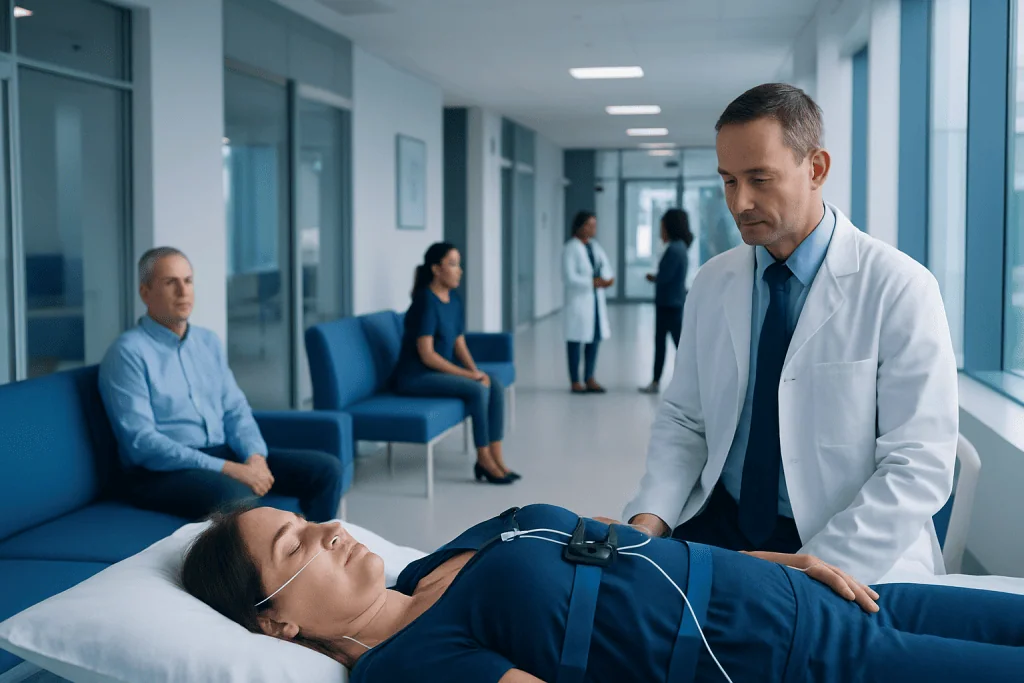
Sleep apnea testing in Turkey usually follows a fixed sequence: a consultation with a sleep specialist, then either an overnight polysomnography study in a monitored sleep room or, for selected patients, a home sleep apnea test. A specialist scores and interprets the recording afterwards, and results are discussed before you leave or through a planned remote follow-up.
Sleeping a full night in a hospital room, in another country, with sensors on your skin: it sounds harder than it usually turns out to be. This guide explains how sleep apnea testing in Turkey is arranged, what each type of test actually involves, and how results reach you and your doctor at home.
Your evaluation is planned around three things: your symptoms, your medical history and your travel dates. You receive preparation instructions before you arrive, the monitoring itself follows a well-rehearsed routine, and the results discussion is scheduled either before departure or as a planned remote follow-up. Knowing the sequence in advance removes most of the uncertainty.
At a glance
- Main purpose: To record breathing, oxygen levels and sleep patterns and identify pauses or reductions in breathing during sleep
- Common test: Overnight polysomnography in a private, monitored sleep room
- Other option: Home sleep apnea testing for selected adults with suspected uncomplicated obstructive sleep apnea
- Typical timing: Consultation, the test and a results review can often be arranged within one visit, depending on scheduling
- Interpretation: A qualified sleep specialist scores and reports the recording; it is not read at the bedside the next morning
- What to bring: Medical records, medication list, comfortable two-piece sleepwear and identification
What sleep apnea testing is designed to assess
Sleep apnea testing looks for repeated pauses or reductions in breathing during sleep. These events can lower oxygen levels, fragment normal sleep stages and leave a person tired after what looks like a full night in bed. Testing also helps clinicians separate sleep apnea from other possible explanations for snoring, restless sleep, morning headaches or daytime sleepiness, because those symptoms overlap with several unrelated conditions, symptoms alone are not enough for a diagnosis.
The evaluation starts with the wider picture, not just one night of data. You may be asked about loud snoring, pauses in breathing that a partner has noticed, waking with a choking or gasping sensation, difficulty concentrating, high blood pressure, weight changes, nasal blockage, alcohol use and the medicines you take. Heart, lung, neurological and metabolic conditions matter here, because they influence which test is appropriate and how the recording should be interpreted. Sleep apnea testing in Turkey follows the same clinical logic used internationally: the test is chosen to answer a specific question, not applied as a standard package to everyone.
The most complete form of testing is overnight polysomnography. Depending on the study design, it can record airflow at the nose and mouth, breathing effort at the chest and abdomen, oxygen saturation, heart rhythm, body position, limb movements, eye movements and brain-wave activity used to identify sleep stages. The combination matters: brain-wave data shows whether you were actually asleep when breathing changed, which a simpler device cannot confirm.
Types of sleep study at a glance
| Study type | Setting | What it typically records | When it is used |
|---|---|---|---|
| Polysomnography | Hospital sleep room, technician-monitored | Airflow, breathing effort, oxygen, heart rhythm, sleep stages, movements, position | The standard detailed study; needed when other sleep disorders are possible or health is complex |
| Home sleep apnea test | Your accommodation, self-fitted device | Breathing patterns, oxygen levels, sometimes position and snoring | Selected adults with suspected uncomplicated obstructive sleep apnea |
| Titration or split-night study | Hospital sleep room | Same signals as polysomnography, with therapy adjustment during the night | When device settings need to be established under monitoring, if the specialist recommends it |
Your clinician decides which of these fits your situation. The table is a map of the options, not a menu to choose from yourself.
Your first consultation in Turkey
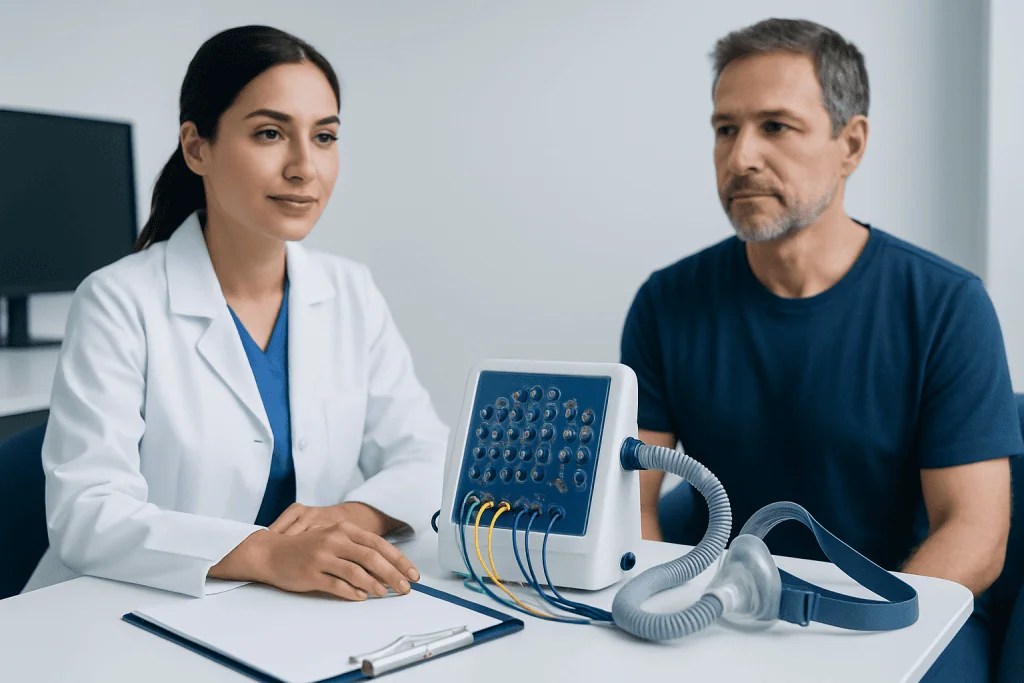
Before any test, you meet a sleep specialist or another member of the sleep medicine team. This appointment is where the plan is actually made. You describe what has been happening at home, how long it has been going on, and how it affects work, driving, mood or daily life. If you travel with a partner who has watched you sleep, their observations are genuinely useful, witnessed pauses in breathing are something you cannot report about yourself.
Bring prior sleep reports if you have them, along with recent relevant test results, clinic letters and a current medication list. Tell the team about allergies, pregnancy, implanted devices, mobility needs, oxygen use, hearing or visual needs, and any worry about spending a night away from home. None of this is small talk; each detail can change how the room is set up or which test is chosen.
Interpreters can be arranged when needed, so instructions and the results discussion happen in a language you follow comfortably. It is also worth knowing that an in-person consultation can adjust a plan made from records alone: the guide on what happens if your in-person evaluation changes the initial plan explains how that works in practice. A specialist who examines you may confirm the expected test, or may recommend a different one. That is the evaluation doing its job, not a complication.
What happens during an overnight sleep study
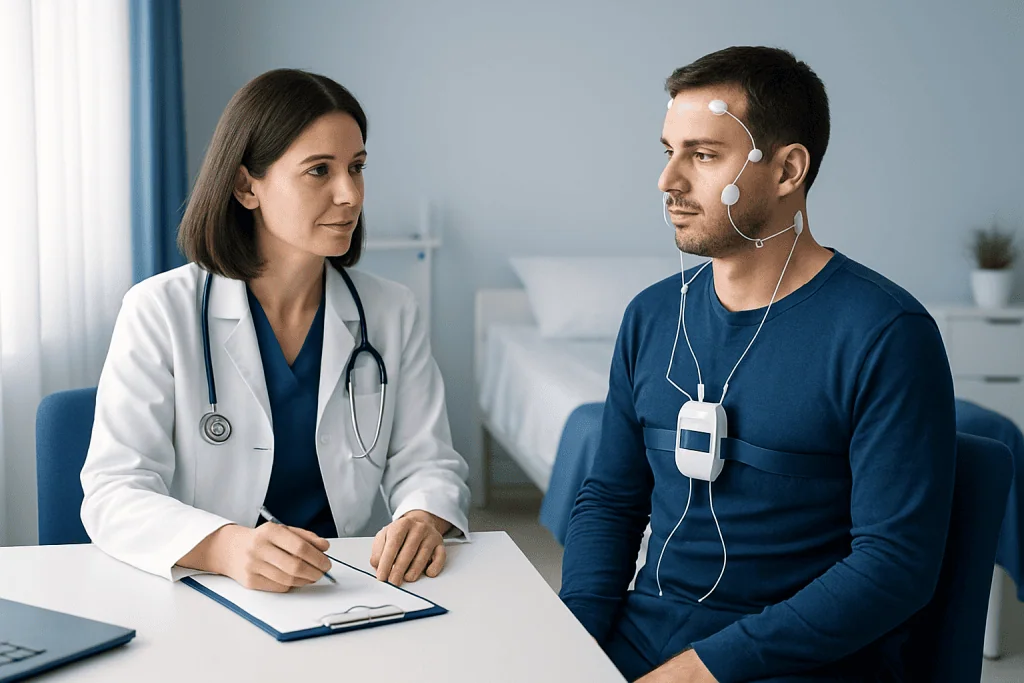
An overnight study takes place in a private sleep room within the hospital or sleep unit. You arrive in the evening, complete registration, settle in and meet the sleep technician. The room is designed to feel closer to a simple bedroom than an examination room, although the monitoring equipment is visible and the setting is clearly clinical. Expect something functional and quiet rather than hotel-like.
The technician attaches small sensors to your skin with gentle adhesive or tape. Belts sit around your chest and abdomen to measure breathing effort, a probe on your finger measures oxygen, and a small airflow sensor rests near your nose and mouth. Electrodes on the scalp record brain activity if sleep staging is part of your study. The setup takes time, usually longer than people expect, because sensor placement determines the quality of the whole recording. The wires connect to monitoring equipment but are bundled so that you can turn over and sleep in your usual positions as much as possible.
Until lights-out you can usually read or follow your normal wind-down routine, within the unit’s schedule. Overnight, a technician watches the recording from a separate room and can come in if a sensor loosens or you need help, including a trip to the bathroom. You will not be left to manage the equipment alone.
The morning after
In the morning the technician removes the sensors, which takes a few minutes; adhesive residue washes off with normal soap and water. You can shower, dress and continue with your day unless further assessment has been arranged. The recording itself then goes for scoring and interpretation: you will not receive a full result at the bedside, and a technician cannot give you one.
- Wear comfortable two-piece sleepwear; it works better with belts and wires than a nightgown or one-piece.
- Bring toiletries and anything you normally need at bedtime.
- Ask in advance about companion arrangements, as these vary by unit and test type.
- Tell staff if you have anxiety, claustrophobia, pain or difficulty sleeping away from home; they adjust the setup routine more often than you might think.
A common worry is sleeping badly and “ruining” the test. In practice, even a shorter or lighter night than usual often contains enough data to answer the clinical question. If it does not, the specialist will say so plainly and explain the options.
When a home sleep apnea test may be considered
For some adults whose symptoms suggest uncomplicated obstructive sleep apnea, a home sleep apnea test is an option. These devices typically record breathing patterns, oxygen levels and sometimes sleep position or snoring. They are deliberately simpler than laboratory polysomnography: most do not measure brain activity, so they cannot confirm sleep stages or detect the full range of sleep disorders.
When it is clinically appropriate, home testing can fit neatly into a travel schedule, since the recording happens where you are staying. You are shown how to fit the device, start the recording and return it. Follow the setup guidance exactly: a displaced sensor or an incomplete recording is the most common reason a home study has to be repeated, and a repeat costs you a night of your trip.
Home testing has clear limits, and it is worth hearing them stated plainly. It is not suitable if you have significant heart, lung or neurological conditions, if a non-obstructive sleep disorder is possible, or if your symptoms need more detailed observation. A negative home test also does not rule out sleep apnea when symptoms remain strongly suggestive; in that situation, an in-laboratory study is usually the next step. The choice between home and laboratory testing is a clinical decision, not a convenience decision.
How to prepare for your test
Keep your usual routine in the days before testing unless your clinical team tells you otherwise. Do not deliberately deprive yourself of sleep to “make sure” you sleep in the lab: the goal is a night that is reasonably representative of normal. Confirm the appointment time and location, whether any fasting applies (usually it does not, unless other tests share the day), and whether you should avoid particular products.
On the day of an overnight study, arrive with clean, dry hair and skip hair oils, heavy lotions and makeup on areas where sensors attach; residue interferes with adhesion and signal quality. Avoid alcohol on the day of the test unless your clinician specifically says otherwise. Ask about caffeine, some people are asked to limit it from the afternoon, but follow the instructions given for your own assessment rather than a general rule.
Do not stop, start or adjust prescribed medication on your own account. Bring your medicines in their original packaging and ask the clinical team whether to take them as usual on the test day; some medicines affect sleep recordings and the specialist will factor that in. If you cross time zones to get here, the practical guide on keeping your regular medicines on schedule during medical travel covers the logistics. If you already use a CPAP device, oral appliance or oxygen, tell the team in advance and bring the equipment only if asked: the CPAP travel checklist for hospital patients walks through carrying a device through airports and hospitals.
How costs and quotes for sleep testing work
This guide does not quote figures, because no honest figure exists before a clinician has reviewed your case. What can be explained is the structure. The cost of a sleep evaluation depends on the type of study (home device versus full polysomnography), the number of nights required, whether a titration study is added, the consultations around the test, and interpretation and reporting. A quote is normally prepared after your records have been reviewed, and it should state what is included, consultation, the study itself, the specialist’s report, and what would only apply if the plan changes. If the in-person evaluation alters the recommended test, the quote is revised to match before anything goes ahead.
Understanding your results and next steps
Your recording is scored event by event and then interpreted by a sleep specialist alongside your symptoms and medical background. You may hear terms such as apnea-hypopnea index, oxygen desaturation, sleep efficiency or positional dependence; the clinician should translate these into plain language for you, and it is reasonable to keep asking until they do.
The results discussion happens either before you leave Turkey or by a planned remote follow-up, depending on when the study took place and how long reporting needs. If sleep apnea is identified, recommendations can range from weight, lifestyle and sleep-position measures to evaluation for CPAP therapy, an oral appliance through dental sleep medicine, nasal or upper-airway assessment, or further specialist review. Which step is right depends on the type and severity of the findings and your overall health, no single treatment fits every result, and a test result on its own never guarantees a particular treatment path.
Before you travel home, ask for copies of your sleep study summary, any prescriptions or recommendations, and a written follow-up plan. Sleep apnea care usually benefits from ongoing monitoring, so continuity with your own doctor or sleep clinic matters as much as the test itself. If treatment in Turkey follows the testing, your clinician will explain how the interval between the final report and any treatment is used and what happens during it.
Step by step
- Records are shared before travel. Available medical records, previous sleep study reports and a medication list are exchanged through the coordination process agreed with the hospital, along with practical details such as preferred language, mobility needs and travel dates.
- You attend your sleep consultation. The specialist reviews your symptoms, health history and sleep habits, then explains which type of test is suitable and how it fits your itinerary.
- You follow the preparation instructions. Keep your usual sleep routine unless told otherwise, avoid alcohol and products that interfere with sensors if advised, and confirm how your regular medicines should be handled on the day.
- You complete the scheduled test. For an overnight study, a technician places the sensors and monitors the recording while you sleep. For a home test, you are shown how to fit the device, record and return it.
- The recording is scored and interpreted. A sleep specialist reviews breathing events, oxygen changes and other signals in the context of your history, not an automated readout alone.
- You discuss results and the plan. The clinician explains the findings, the limits of the test and any recommended next steps, and provides written information you can share with your regular doctor at home.
Your checklist
- Passport, appointment confirmation and hospital contact details
- Current medication list with doses, plus any allergies
- Previous sleep study reports, clinic letters and relevant test results
- Comfortable two-piece sleepwear and toiletries for the overnight stay
- Glasses, hearing aids, mobility aids or other daily support items
- Your CPAP device, oral appliance or oxygen details, only if the team has asked you to bring them
- Contact details for your doctor or sleep clinic at home
- A written list of questions about results, follow-up and travel timing
Key takeaways
- The test is chosen to fit your symptoms, medical history and the level of monitoring you need, not the other way around.
- Overnight polysomnography records breathing, oxygen and sleep-stage signals in a monitored room; home testing is a simpler option for selected patients only.
- Results are scored and interpreted by a specialist after the study, never read off at the bedside the next morning.
- Do not change your medicines or routine before the test without instructions from the clinical team.
- Plan in advance how you will receive results and continue follow-up after returning home.
Frequently asked questions
How long does sleep apnea testing in Turkey take?
The overnight recording itself covers one night, but the consultation before it and the results review after it need their own time. The exact schedule depends on the type of test, the reporting workflow and whether further assessment is recommended. When planning travel, allow enough days for a results discussion before departure, or agree a remote follow-up in advance.
Will I be able to sleep with all the sensors attached?
Most people worry about this, and the setup does feel unfamiliar at first. The sensors are arranged to allow reasonable movement in bed, and a technician can help overnight if something becomes uncomfortable or detaches. Even a night that feels shorter or lighter than usual often provides enough data to be clinically useful.
Do I need to fast before a sleep study?
Sleep studies do not usually require fasting, though your own instructions may differ if other tests are planned on the same day. Have a normal evening meal unless advised otherwise, and ask about caffeine, alcohol and your usual medicines. Always follow the instructions given for your individual appointment rather than a general rule.
Can I bring a companion to my overnight sleep study?
Companion arrangements depend on the unit, the room setup and the type of test, so ask before your visit, particularly if you need assistance, are travelling with a child or feel anxious about staying overnight. Some units can accommodate a companion nearby; others cannot, so it is worth confirming rather than assuming.
What if my home sleep apnea test is inconclusive?
An incomplete or unclear home recording may need to be repeated, or the clinician may recommend an overnight laboratory study instead. This does not necessarily point to anything serious; it usually means more detailed information is needed. A negative home result also does not rule out sleep apnea when symptoms remain strongly suggestive.
Can treatment start immediately after my results?
It depends on the findings, your overall health and your travel schedule. Some people are advised about next steps promptly; others need further assessment, device fitting or specialist review first. Testing informs the plan but does not by itself determine or guarantee a treatment, and a careful clinician will not promise one from a test alone.
What documents should I take home after testing?
Ask for the written sleep study report or summary, the clinician’s recommendations and details of any planned follow-up. If you are returning abroad, request a version suitable for your own doctor or sleep specialist. Keep both digital and paper copies with your medical records so nothing depends on a single file.
Add us as a Preferred Source to see more of our trusted health content across Google Search, AI Overviews and Discover.

Update history
- PublishedAugust 22, 2026
- Medical review approvedSeptember 13, 2026
- Last content updateSeptember 12, 2026
References3
- NHS: Sleep apnoea nhs.uk
- MedlinePlus: Sleep study medlineplus.gov
- Cleveland Clinic: Sleep study (polysomnography) my.clevelandclinic.org
More Patient Guides

How to Organize Your Test Results Before Traveling to Turkey
Organize your test results before traveling to Turkey by sorting records, images, medicines and timelines so your Istanbul care team can review…
When Extra Tests Are Needed Before Treatment in Turkey
Extra tests before treatment in Turkey may be needed to confirm diagnosis, timing, and safety. Here is what you can expect in…

At Acibadem, How to Prepare for Blood Tests, Scans, and Pre-Op Checks
Blood tests, scans, and pre-op checks at Acibadem in Turkey help confirm you are ready for treatment and avoid delays on the…

Medical Test Results in Turkey: How to Understand the Next Step in Your Plan
Medical test results in Turkey usually lead to a clear next-step plan: review findings, confirm urgency, ask for copies, and arrange follow-up…