

Medical Test Results in Turkey: How to Understand the Next Step in Your Plan

Treat your test results as the start of a plan, not the end of one. Ask three things before you leave the hospital: what the main finding is in plain language, how urgent it is, and what the next practical step should be. Then collect a complete record set, reports, images, and a summary letter, so follow-up can continue wherever you are.
Your results have arrived, and you are looking at a page of terms you did not expect to read on a trip. The most useful thing you can do now is turn that report into a plan: what was found, what needs attention soon, and what can wait. This guide shows you how to do that with medical test results in Turkey, whether you stay on in Istanbul for further review or fly home with your records.
It covers how reports are worded and why, the questions worth asking before you leave the clinic, how results are shared in the Turkish system, what a full check-up typically involves, and exactly which documents to take home. It does not interpret findings for you. Only the doctor who examined you can do that, because a report only makes sense alongside your history, symptoms and earlier tests.
At a glance
- Best for: International patients reviewing lab reports, scans and specialist recommendations in Turkey
- Main goal: Turn test findings into a clear, timed next-step plan
- What to request: Written report, imaging files where relevant, a plain-language explanation, and a summary letter in English
- Key question to ask: Is the next step urgent, soon, or routine, and can it happen at home?
- Helpful support: Interpreter, international patient coordinator, and an organised record set for your home-country doctor
What your medical test results in Turkey are really for
A test result is not a verdict. It is one input into a decision: whether you need another test, a specialist consultation, treatment on a defined timetable, or simply monitoring. The report itself is often the least useful part to a non-clinician. What matters is the plan that follows from it.
If you are handling medical test results in Turkey as a visitor, think in three layers. First, what did the test actually show? Second, how urgent is it, in the judgement of your doctor, not in the tone of the wording? Third, what is the practical next step, and where should it happen? Working through those three questions turns even a dense report into something you can act on.
Large hospital groups such as Acibadem typically place an international patient coordinator between you and the paperwork. Coordinators gather the pieces of your plan in one place: the report, imaging copies where relevant, interpreter support at the results consultation, and the name of the specialty that should see the finding next. That coordination matters most when your testing and consultation are compressed into a short stay.
One honest limit to state early: no guide can tell you what your specific result means. Two patients with identical report wording can need entirely different next steps. That is not evasion; it is how diagnostics work.
How to read a report without getting overwhelmed
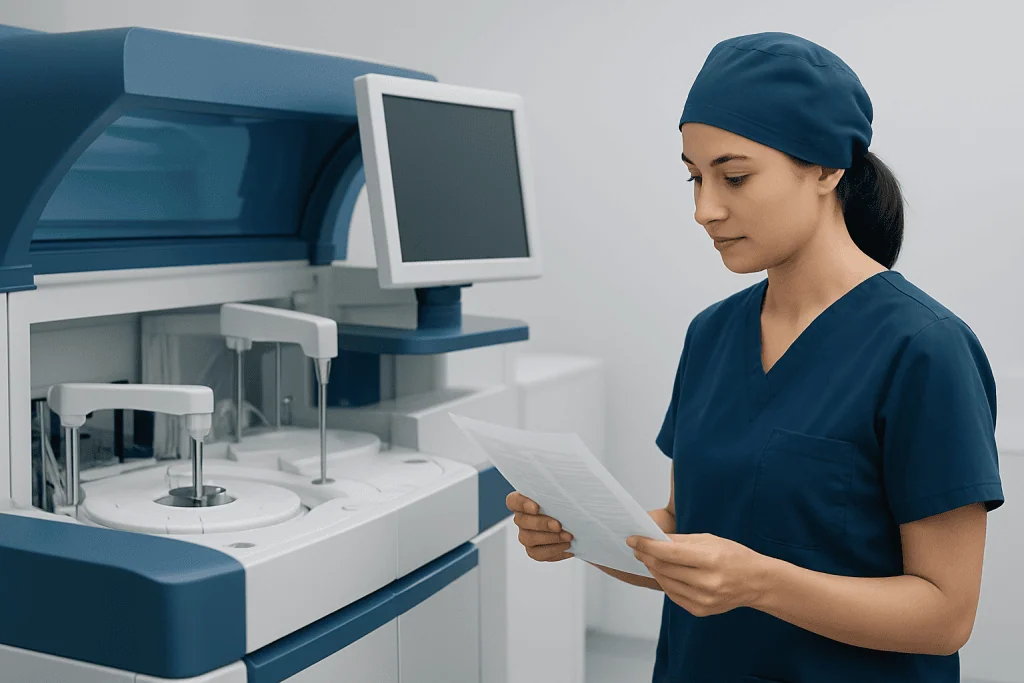
Reports are written by clinicians for clinicians. That is why they read the way they do. An unfamiliar term is not a signal of bad news; it is a signal that the document was never meant to be your main source of information.
Some phrases appear constantly in imaging and pathology reports and are worth demystifying. “Finding” means something was observed, nothing more. “Suggestive of” and “consistent with” describe possibilities, not conclusions. “Correlate clinically” is an instruction to your doctor: interpret this alongside the examination and history. “Recommend follow-up” means the reporting specialist wants the finding checked again or compared over time, which is routine practice, not an alarm.
When you read your own report, start at the end. Most reports close with a conclusion or “impression” section that summarises the main finding. Then look for any explicit recommendation: repeat testing, referral, comparison with previous scans, or a follow-up interval. Everything above those sections is technical description that your doctor will interpret for you.
As you review, write down answers to six practical questions:
- What is the main finding, in one sentence?
- Does it explain the symptoms that prompted the test?
- Is the next step urgent, soon, or routine?
- Is another test needed before any decision can be made?
- Which specialty should review this?
- What is the recommended timing for follow-up?
If English is not your first language, ask for interpreter support early rather than guessing at meaning. Acibadem can usually arrange interpretation for results consultations, and it is far better used at the consultation itself than after you have spent an evening searching terms online. Lab results in particular follow reference ranges that vary between laboratories, so a value flagged outside the range on paper still needs your doctor’s reading, resources such as MedlinePlus explain the principle, but not your case.
If your testing schedule is still under way, the timing side of this is covered separately in our guide to waiting for test results in Turkey and planning your stay.
Questions to ask your doctor before you leave

The cheapest and most effective moment to clarify your results is before you leave the consultation room. Ten focused minutes there prevent weeks of uncertainty later, especially when you are travelling on a schedule. You do not need to understand every medical detail; you need to understand what affects your next step.
Questions that consistently earn their place:
- What did the test show, in plain terms?
- What happens next, and by when?
- Do I need treatment now, or further evaluation first?
- Is it reasonable for me to fly home before the next step?
- What should I watch for, and what would change the plan?
- If several findings were made, which one matters most?
If the result is uncertain, ask what would make the picture clearer. Often the honest answer is not treatment but comparison with older tests, repeating a scan after an interval, or review by a different specialty. In larger hospital groups, findings that touch several fields, a scan reviewed by radiology, oncology and surgery together, for instance, go to a multidisciplinary discussion before a recommendation is made. That takes slightly longer and produces a more reliable plan.
Before you go, ask for your documents in a shareable format: printed reports, digital image files, blood test summaries, prescriptions where relevant, and a brief letter explaining the recommendations for your doctor at home. Asking at the consultation is faster than requesting copies after you have left the country.
Understanding urgency: now, soon, or later
The single most useful thing your care team can give you is a time category. Some findings need attention within days. Some should be followed up within weeks. Many can be monitored on a routine schedule. Knowing which category you are in shapes everything practical: your return flight, accommodation, companion support and work commitments.
Do not try to judge urgency from the report wording alone. A phrase that sounds alarming may correspond to routine follow-up, and a mild-sounding line may matter more in your specific clinical context. The report text and the urgency of your situation are two different things, and only your doctor can connect them. Ask directly: “Is this urgent, soon, or routine, and what date should the next step happen by?” Write the answer down.
Your doctor may also give you monitoring advice specific to your case, what to keep an eye on and what would change the plan. That advice belongs to your situation and outranks anything written in a general guide, so ask for it explicitly and keep it with your documents.
If your result leads to a biopsy or you are already waiting on pathology, the logistics differ enough that we cover them separately in staying in Turkey for biopsy results. If you are flying home soon, ask your treating doctor two things before booking: whether it is medically reasonable to travel on your intended date, and whether any part of the plan should be completed before departure.
How results are shared in Turkey: reports, portals and e-Nabız
Turkey runs a national personal health record system called e-Nabız, operated by the Ministry of Health. It aggregates test results, imaging and prescriptions from providers across the country into one account. It is a genuinely useful system, for people who can log into it. Access is built around Turkish national ID or foreigner ID credentials, so residents and long-stay foreign nationals with a Turkish foreigner ID number can typically use it, while short-stay visitors generally cannot.
As an international patient on a short trip, plan around that. Your practical channel for results is the hospital itself: the written report, the imaging files, and whatever patient portal or secure delivery method the hospital uses for people abroad. Ask at the results consultation how you will receive documents after you leave, by portal, secure email, download link or physical media, and confirm the contact details on file are correct before you fly.
Two practical notes. First, imaging is usually available both as a written report and as the image files themselves; your doctor at home may want both, because a specialist often prefers to view the images rather than rely on the report alone. Second, if your results will feed into a treatment decision at the same hospital later, ask how the hospital stores and re-accesses them, so a future review does not start from zero. How hospitals actually work through incoming records is described in our guide on how medical records are reviewed before a treatment plan is given.
Full body check-ups in Turkey: what they include and how pricing works
Many people searching for medical test results in Turkey arrive at the topic through check-up programmes, so it is worth being precise about what these are. A full body health check-up is a structured screening package rather than a diagnostic investigation. It typically combines blood and urine panels, cardiology tests such as an ECG, imaging appropriate to your age and history, and consultations that pull the results together. Large private hospital groups, including Acibadem, run such programmes in tiers: a core package, plus modules aimed at cardiac, women’s or men’s health, or other areas.
Two honest caveats. A check-up is a snapshot, not a guarantee that nothing is wrong; screening tests are chosen for what they commonly detect, not for everything that exists. And a check-up abroad only pays off if you leave with usable documents, reports in English, image files, and a summary your home doctor can act on. Confirm all of that before booking, not after.
On cost: no reliable figure can be quoted in a guide, because check-up and scan pricing depends on structural variables. The main ones are the scope of the package (a basic panel versus a modality-heavy programme), which imaging is included and whether contrast is used, how many specialist consultations are bundled in, whether interpreting and English reporting are included, and the hospital and city. Quotes are normally itemised. When comparing them, compare line by line: the cheapest headline figure often simply contains less. Ask specifically what would trigger an additional charge, such as a follow-on test prompted by a finding.
A related question international readers ask is how good Turkey’s healthcare system is overall. The fair answer: it is a large, mixed public–private system, and a significant number of private hospitals are organised specifically around international patients, with dedicated coordinators and English-language reporting. Quality is a property of the specific institution and team, not of the country, so evaluate the hospital in front of you: its experience with your condition, its international patient services, and how clearly it communicates, rather than a national label. The CDC’s guidance for people considering healthcare abroad makes the same point about verifying the specific provider.
Note also that visiting tourists do not receive free healthcare in Turkey. The public insurance scheme covers enrolled residents; visitors pay for care directly or through travel insurance, including care in emergency departments. Travel insurance that covers medical care abroad is worth arranging before any trip that includes tests.
If your trip exists purely for testing, flying in, testing, flying out, the scheduling logic is covered in flying to Turkey for tests only.
What documents to collect for follow-up at home
Patients often feel fully informed until they land at home and discover their local doctor needs a document they never asked for. Leave Turkey with a complete, organised record set. It saves weeks and reduces the chance of repeating tests unnecessarily.
Depending on your case, the set may include: consultation notes, laboratory results with reference ranges, pathology reports, imaging reports, the image files themselves on disc or secure download link, a current medication list, and written follow-up instructions. A short summary letter in English is the single most valuable item, because it gives your home doctor the context that raw results lack.
Keep both digital and paper versions where you can. Store the digital files in one clearly labelled folder and send copies to yourself and a trusted family member. If anything is time-sensitive, write the recommended follow-up date on the first page so it does not disappear among travel documents. If parts of your record still need to move between countries afterwards, our guide to handling medical records securely between countries explains the safe ways to do it.
Where your care involved more than one department, records coordination matters even more: a cardiology result, an imaging report and a lab panel arriving separately tell your home doctor much less than the same three documents arriving together with a covering summary. Acibadem’s international teams commonly handle this consolidation for patients before departure.
Planning the next step if more care is needed
Not every result leads to treatment. Often the right next step is a specialist consultation, a biopsy, another imaging study, or a defined period of observation. The goal is to replace uncertainty with a plan that has a reason and a date attached.
If treatment is recommended, ask what must happen before it can begin: pre-treatment tests, review of your current medications by the treating doctor, a multidisciplinary discussion, or a preparation period. If you are coordinating travel, ask which parts can be completed in Turkey during your current stay and which can safely be handed to your doctor at home. There is rarely one correct split; there is a correct split for your case, and your treating doctor is the person to define it.
If you have several findings, ask for a priority order. Patients regularly receive three or four recommendations at once and cannot tell which drives the timetable. A simple “first, second, third” from your doctor turns a pile of advice into a sequence.
Where the next step does involve returning for treatment, the broader logistics, quotes, scheduling, documents, travel, are laid out in our step-by-step medical travel planning guide.
Step by step
- Get the summary in plain language. Before you leave the consultation, ask for the main result in one or two simple sentences. You do not need every technical phrase: you need to know what was found and whether it explains your symptoms.
- Clarify urgency and timing. Ask whether the next step is urgent, soon, or routine, and get a date or interval attached to it. This single answer shapes your travel plans and return date.
- Collect the full record set. Written reports, image files where relevant, prescriptions, and a summary letter in English. Gathering everything now is far easier than retrieving it from abroad later.
- Confirm who should see the results next. Some results go back to the same doctor; others need a different specialty or a multidisciplinary review. Leave knowing exactly which.
- Ask what to monitor. Request case-specific monitoring advice from your treating doctor and keep it in writing with your documents. Personal advice from the doctor who examined you outranks any general list.
- Split the plan between Turkey and home. Ask which steps are best completed during your stay and which can be handed over to your local doctor, so nothing is delayed and nothing is duplicated.
- Share your records with your local doctor early. Send the set as soon as you are home, earlier if follow-up is time-sensitive, so the gap between landing and continuing care stays short.
Your checklist
- Written test report or reports, with reference ranges for lab work
- Digital copies of imaging and scan files, if applicable
- Plain-language explanation of the main finding, written down
- Urgency category and a date or interval for follow-up
- Name of the specialty or doctor type to see next
- Case-specific monitoring advice from your treating doctor, in writing
- Medication list and any travel advice related to the result
- English summary letter for your home-country doctor
Key takeaways
- A test result matters most when it is attached to a clear, dated next step.
- Read the conclusion and recommendations of a report; leave the technical body to your doctor.
- Never judge urgency from wording alone: the same phrase can mean different things in different clinical contexts.
- Short-stay visitors generally cannot use e-Nabız, so arrange document delivery directly with the hospital before leaving.
- Leave Turkey with a complete record set: reports, images where relevant, and an English summary letter.
- Coordination support, interpreters and organised records make follow-up at home significantly smoother.
Frequently asked questions
Where can I find a full body health check-up in Turkey?
Check-up programmes are offered by large private hospital groups, including Acibadem, as well as university and public hospitals. They are structured packages combining blood panels, cardiology tests, imaging and consultations, usually in tiers by scope. When comparing programmes, look at what each tier actually contains, whether reporting is provided in English, and whether image files and a summary letter are included for use at home.
How good is Turkey’s healthcare system?
Turkey has a large mixed public–private system, and many private hospitals are organised specifically around international patients, with coordinators, interpreters and English-language reporting. Quality is a property of the individual institution rather than the country, so the useful question is not “how good is Turkey” but “how experienced is this hospital and team with my specific situation”, something you can assess from its departments, communication and documentation.
How much does a full body scan cost in Turkey?
There is no single figure, because pricing depends on structural variables: which imaging modalities are included, whether contrast is used, how many body regions are covered, how many specialist consultations are bundled in, whether English reporting and interpreting are included, and the hospital and city. Quotes are normally itemised, so compare them line by line and ask what would trigger an additional charge, such as a follow-on test after a finding.
Do tourists get free healthcare in Turkey?
No. Turkey’s public insurance scheme covers enrolled residents, not visitors. Tourists pay for care directly or through travel insurance, including care received in emergency departments. Travel insurance that covers medical treatment abroad is worth arranging before any trip that includes tests or procedures.
Should I worry if my report contains unfamiliar or serious-sounding terms?
Not necessarily. Reports are written in technical language for clinicians and often describe possibilities rather than conclusions, so the wording can sound more alarming than the situation warrants. Phrases such as “suggestive of” or “correlate clinically” are routine report language. The reliable approach is a plain-language explanation from your doctor and a clear plan, rather than interpreting isolated terms yourself.
What if my result is unclear or says more tests are needed?
This is common and does not automatically point to anything severe. One test often raises a question that only another scan, a lab test, a comparison with older results, or a different specialist’s review can answer. In those cases the next step is clarification, not treatment, and it is worth asking your doctor which of those routes applies and on what timeline.
Can I access my results through e-Nabız as a visitor?
Generally not on a short stay. e-Nabız, Turkey’s national personal health record system, is built around Turkish national ID or foreigner ID credentials, so it mainly serves residents and long-stay foreign nationals. As a visiting patient, arrange to receive your documents directly from the hospital, as printed reports, digital files, or through whatever secure delivery method the hospital offers, before you leave.
Can I travel after receiving my test results?
It depends on the result and on how you feel, and it is a question for the doctor who examined you rather than a general guide. Ask specifically whether flying on your intended date is medically reasonable and whether any part of your plan should be completed before departure. Get the answer before booking or changing flights.
Add us as a Preferred Source to see more of our trusted health content across Google Search, AI Overviews and Discover.

Update history
- PublishedAugust 4, 2026
- Medical review approvedSeptember 13, 2026
- Last content updateSeptember 12, 2026
References3
More Patient Guides
Sleep Apnea Testing in Turkey: What Happens During Your Evaluation
Sleep apnea testing in Turkey may include a consultation, overnight sleep study or home test, and a clear review of your results…

How to Organize Your Test Results Before Traveling to Turkey
Organize your test results before traveling to Turkey by sorting records, images, medicines and timelines so your Istanbul care team can review…

When Extra Tests Are Needed Before Treatment in Turkey
Extra tests before treatment in Turkey may be needed to confirm diagnosis, timing, and safety. Here is what you can expect in…

At Acibadem, How to Prepare for Blood Tests, Scans, and Pre-Op Checks
Blood tests, scans, and pre-op checks at Acibadem in Turkey help confirm you are ready for treatment and avoid delays on the…