

Flying to Turkey for Tests Only: How to Plan a Short Medical Trip

A tests-only trip to Turkey can usually be completed in two to five days if it is planned in advance. Confirm exactly which tests are proposed, what preparation they need, and how long reports take before you book flights. Send your existing records ahead so appointments can be grouped, and leave flexibility in your return travel in case a specialist requests one more test.
You do not need a long stay in Turkey if you are only coming for diagnostics. Most tests-only trips fit into a few days, but only when the planning is done before the flight, not after landing. This guide sets out what to confirm, what to bring, and where short trips usually go wrong.
Flying to Turkey for tests only is a different kind of trip from travelling for surgery or a treatment course. The goal is narrow: complete consultations, blood work, imaging or other diagnostics in a compact, well-sequenced visit, then go home with results or a clear picture of what comes next. That narrowness is an advantage. It means the whole trip can be planned around a small number of fixed points, appointment times, preparation rules, and report timing, and almost everything that goes wrong on short diagnostic trips traces back to one of those three.
At a glance
- Best for: Scans, laboratory work, second-opinion diagnostics, or a specialist assessment without immediate treatment
- Typical trip length: Often 2–5 days, depending on the number of tests and how long reports take
- What to prepare: Passport, prior medical records and imaging files, a current medication list, and insurance or payment documents
- Key planning point: Confirm before booking flights which tests need fasting, contrast dye, sedation, or a companion
- Biggest scheduling risk: Booking the return flight before report timing is known
- Follow-up: Agree before you leave how results and any remaining reports will reach you at home
- Support available: International patient coordinators, interpreters, and travel guidance at Acibadem International
What a tests-only trip to Turkey usually looks like
A typical diagnostics visit runs like this: your records are reviewed before you travel, appointments are grouped into one or two concentrated days, tests are done in a sequence that respects preparation rules, and a final consultation explains what is ready and what is still pending. When people describe flying to Turkey for tests only as easy, this structure is what they mean. When they describe it as stressful, it is usually because one of those stages was skipped.
Treat the trip as a logistics project. Three questions shape everything: which tests are actually needed, what preparation each one requires, and how long the reports take. Some blood panels are processed within hours. Some imaging needs formal reporting by a radiologist and then review by the specialist who ordered it, which can take a day or more. Certain results, pathology, some genetic and microbiology work, routinely take longer than any sensible trip and are shared remotely. Knowing which category each of your tests falls into is the difference between a calm three-day visit and an expensive hotel extension.
At Acibadem International, international patient teams coordinate specialist appointments, diagnostics, interpreters and practical travel support. For a short trip, the practical benefit is sequencing: one coordinated schedule rather than several separate bookings that may not fit together.
Before you book flights: confirm exactly which tests you need
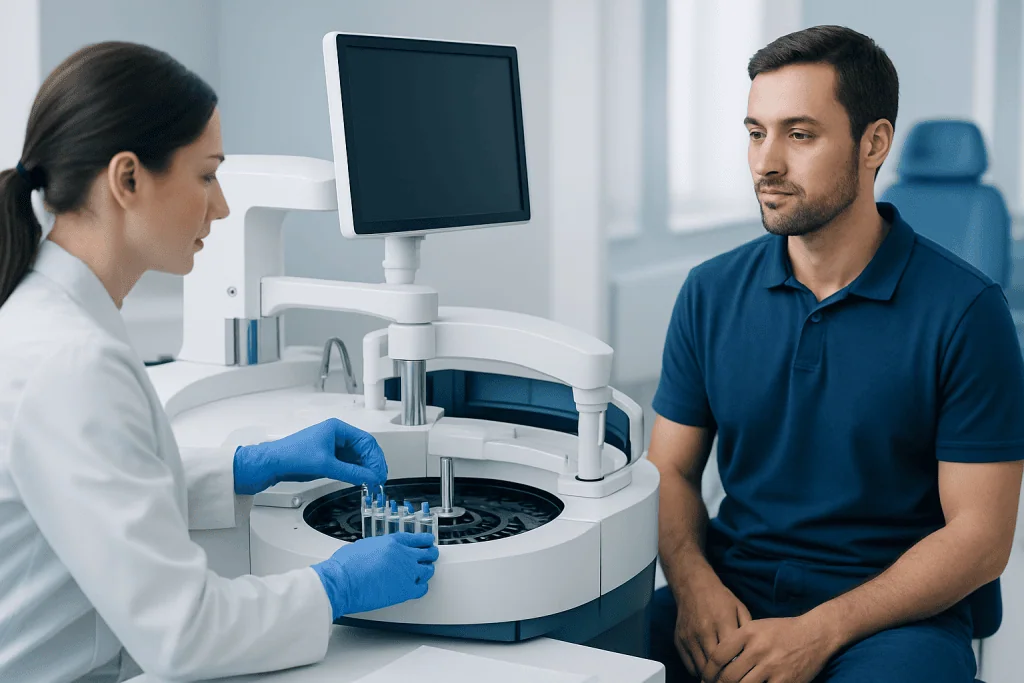
The most common mistake is flying on a vague plan. Before you commit to travel dates, get a written outline of the proposed consultations and tests. For each item, three things should be clear: whether it is definitely required or depends on an in-person examination first, what preparation it involves, and how long the result usually takes. This matters most when the purpose of the trip is a second opinion or clarification of earlier findings, because the review of your existing records may change which tests are worth doing at all. It is worth understanding how medical records are reviewed before a plan is given, since a thorough pre-travel review often shortens the trip itself.
Share as much documentation as you can in advance: referral letters, clinic notes, pathology reports where relevant, recent blood results, prior scan reports, and, importantly, the actual image files on CD, USB or a secure digital link. Written scan reports are not a substitute for the images; comparison with previous imaging often requires the originals. If your records are not in English or Turkish, ask whether the main findings need translating before your visit.
Some baseline tests are better done at home before travelling, and some doctors will ask for them so that time in Turkey is spent on what genuinely needs to be done in person. Our guide to which medical tests to complete before flying to Turkey covers this in detail.
Finally, ask the screening questions that affect a short itinerary more than the tests themselves: does any scan involve contrast dye, is a kidney function blood test needed first, is fasting required, is sedation involved, and can you travel immediately afterwards? A test that takes twenty minutes but requires a prior blood result and a post-procedure rest period is, for planning purposes, a two-day test.
What a checkup or diagnostic visit in Turkey costs, and how quotes actually work
This is one of the most searched questions, and the honest answer is that no single figure means anything without your specifics. What a diagnostic visit costs depends on the number and type of tests, whether imaging uses contrast, whether sedation or a companion procedure is involved, which specialists review the results, and whether anything is added after the first consultation. A basic blood panel and a multi-department assessment with advanced imaging are entirely different undertakings, even if both are marketed as a “checkup”.
The practical approach is to ask for an itemised written quotation before you travel, based on the specific tests your reviewing doctor proposes, not a generic package name. A useful quote states what is included, what is excluded, what happens to the price if a test is added or cancelled after the in-person examination, and which payment methods are accepted. Ask separately about non-medical costs you will carry yourself: flights, accommodation, local transport and any translation of documents. If you hold international health insurance, confirm directly with your insurer, before booking anything, whether diagnostics abroad are covered and what pre-authorisation they require, because hospitals cannot answer that on the insurer’s behalf.
Be cautious of any quotation that promises a fixed all-inclusive figure before anyone has looked at your records. Diagnostics are, by definition, a process of finding things out; a plan that cannot change is usually a plan that was not tailored to you.
Safety, travel rules, and choosing where to go
Two related questions come up constantly: is it safe to travel to Turkey for medical care, and which country offers the “best” checkup for travellers. Neither has a one-line answer, and you should be sceptical of anyone who gives one.
On travel safety and entry rules, rely on your own government’s official travel advice rather than hospital websites or forums, because requirements change and only official sources are kept current. Check your country’s guidance for Turkey shortly before booking and again before departure, covering visa or e-visa requirements, passport validity rules, and any regional advisories. Confirm what your travel insurance covers, and be aware that standard travel insurance often treats trips taken specifically for medical purposes differently, read the policy, not the summary.
On choosing a country or hospital: there is no objectively “best” destination for a full body checkup, and comparison lists rarely account for what matters in your case. Sensible criteria are specific, not national, does the hospital have the specialty relevant to your question, can it review your existing records before you commit, does it provide interpreter support in a language you are comfortable in, how are results reported and shared afterwards, and how does remote follow-up work once you are home. Turkey attracts large numbers of international patients partly because major hospitals there are set up for exactly this kind of coordinated short visit, but the right choice is the one that answers those questions well for you.
Timing also affects safety and comfort in a mundane way: national holidays and Ramadan can change clinic schedules, transport and opening hours. If your dates fall near either, read our guide to planning a medical trip to Turkey during Ramadan or public holidays before fixing flights.
How to schedule a short, efficient visit

On a short trip, timing outweighs almost everything else. Arrive the day before your first appointment rather than the same morning. That single decision absorbs flight delays, immigration queues, traffic and travel fatigue, and it means you walk into your first consultation rested rather than rushed.
Build the itinerary around two constraints: preparation rules and report timing. Fasting tests belong early in the morning. Contrast imaging may need a prior blood result, which fixes its position in the sequence. Anything involving sedation should sit where a rest period afterwards does no scheduling damage. If several departments are involved, ask whether appointments can be clustered into one or two concentrated days rather than spread thinly across the week.
Do not book the return flight tightly against the last scheduled appointment. Small changes are normal in diagnostics: a doctor may want one additional image, a sample may need repeating, or the specialist may prefer to discuss findings in person before you leave. A buffer of a day, or a flexible ticket, costs less than the stress of rebooking from a hospital corridor. People flying to Turkey for tests only tend to regret tight returns more than any other planning choice.
If you are travelling alone, keep each day humane. Leave room for meals, hydration after fasting, rest, and transport between hospital and hotel. A schedule that looks efficient on paper can feel punishing when you are fasting, anxious and navigating an unfamiliar city. And if walking distances or stairs are a concern, our guide to travelling to Turkey with limited mobility covers airport assistance, transfers and hotel choices.
Documents, medications, and practical items to bring
You are not packing for a treatment stay, but you are packing for scrutiny. Keep your passport, appointment confirmations, hospital contact details, insurance documents and a written medication list in one folder, physical or on your phone, that you can produce in seconds.
Bring previous records in more than one format. Printed summaries speed up a consultation; original image files may be essential for comparison. If you have implanted devices, allergies, kidney problems, diabetes, or a history of reactions to contrast dye, make sure that information is clearly documented and easy to show: it can change how a test is done or whether it is done at all. Patients travelling with implants or devices should also check what to prepare before flying with medical devices or implants, since airport screening and imaging both raise practical questions.
Medicines travel in your hand luggage, in original packaging, with enough supply for the trip plus a margin for delays. Whether and how to take a particular medicine before a fasting test or a scan is a question for the doctor who ordered the test: it is not something to decide alone, and this guide will not answer it for you. What you can do in advance is ask that question explicitly when your itinerary is drafted, so the answer arrives before the fasting morning, not during it.
Small comforts earn their place: a phone charger, a refillable water bottle for after fasting periods, a light snack for after tests if permitted, and clothing that is easy to change in and out of. If any test may leave you tired or groggy, arrange for someone to travel back to the hotel with you.
Language, transport, and hospital support
On a visit measured in days, communication failures are expensive. Confirm in advance who your single point of contact will be during the visit and whether interpreter support is available if you are not fully comfortable discussing medical detail in English or Turkish. Misunderstandings about fasting hours, appointment times or where to collect reports are far easier to prevent than to repair.
Sort local transport before you land. Depending on the city, the distance between airport, hotel and hospital can be a bigger factor than expected, and Istanbul traffic in particular can consume a fasting morning. Pre-arranged transfers remove one variable from days that already have enough of them.
Acibadem International supports overseas patients with appointment coordination, interpreter services, and practical guidance on accommodation and transfers. The value on a tests-only trip is concentration: one pathway handling scheduling, language and logistics leaves you free to focus on the reason you travelled.
If a companion is coming, agree their role beforehand. They may simply navigate and take notes, or they may be genuinely necessary, for instance, if a test involves sedation, or if a results discussion is likely to carry a lot of information. A second set of ears in a consultation is one of the cheapest safeguards available.
Results, next steps, and going home
Before your final departure from the hospital, establish exactly which results are final and which are pending. Some findings can be explained the same day; others need formal reporting, specialist review or additional laboratory time. For anything pending, get three specifics: who will contact you, by what channel, and roughly when. Vague reassurance here is what turns into anxious weeks at home.
Leave with a complete package for your doctor at home: test reports, image files where applicable, a summary letter, and a plain explanation of any recommended next steps. If further treatment is suggested, ask whether it is urgent, optional, or suitable to pursue in your own country: the answer shapes everything you do next. Understanding what results actually mean for your plan is its own skill; our guide to understanding medical test results and the next step in your plan walks through it.
Remote follow-up matters as much as the trip. Confirm whether your case can be reviewed by video consultation after you return, whether translated reports are available if you need them, and how questions are handled once you are home. A diagnostics trip is only finished when the results have been explained to you in a way you can act on.
And do not sprint from the last consultation to the airport if you can avoid it. Time to eat, rest, gather paperwork and check your medications is not a luxury: it is the point at which short trips either end well or end frayed.
Step by step
- 1. Get your case reviewed before you travel. Share referral notes, current findings and previous results before booking flights, so the trip is confirmed as appropriate and the right appointments are reserved.
- 2. Ask for a draft itinerary. A day-by-day plan showing consultations, tests, preparation rules and likely result timing is what lets you choose sensible flight dates.
- 3. Check preparation requirements per test. Fasting, kidney function checks, contrast precautions, sedation and companion requirements all change the shape of a short trip, clarify them early.
- 4. Check official travel advice and entry rules. Use your government’s current guidance for Turkey for visas, passport validity and any advisories; verify insurance coverage directly with your insurer.
- 5. Book flexible travel where possible. Flights and accommodation with room for change matter most when multiple specialties are involved or an extra test might be added.
- 6. Organise records and medicines. Documents in one folder, medicines in hand luggage in original packaging, and both digital and printed copies of key reports for comparison.
- 7. Confirm how results will reach you. Before your final day, establish what is available immediately, what follows later, and whether delivery is in person, by email, via a portal, or in a remote consultation.
- 8. Leave with a written next-step plan. Whether results are reassuring, inconclusive or lead to recommendations, go home knowing what to do next and who answers later questions.
Your checklist
- Passport, visa or e-visa, and travel eligibility documents
- Appointment confirmations and hospital contact details
- Recent medical reports, referral letters, and original imaging files
- Current medication list, allergy information, and implant or device details
- Insurance documents or payment method, plus the written quotation
- Comfortable clothes and essentials for a long hospital day
- A companion plan if any test involves sedation or heavy information
- Return-travel flexibility in case an additional test is requested
Key takeaways
- A tests-only trip to Turkey is often short, typically a few days, but only when every appointment, preparation rule and report timeline is confirmed before flights are booked.
- Send complete records, including original imaging files, ahead of travel so unnecessary repeat testing is less likely and the itinerary can be sequenced properly.
- Costs depend on the specific tests and specialties involved; an itemised written quotation based on your reviewed records is more useful than any package figure.
- Check your government’s official travel advice for entry rules and advisories, and confirm insurance coverage directly with your insurer.
- Build flexibility into your return travel, and agree before leaving how pending results and follow-up questions will be handled once you are home.
Frequently asked questions
How long should I stay in Turkey if I am coming only for tests?
Many diagnostics-focused visits fit into about two to five days, depending on the type of tests and how long formal reports take. If several specialties are involved, or a doctor may add imaging after the first consultation, a small buffer day is a sensible investment. Some results, such as pathology or genetic testing, routinely take longer than any trip and are shared remotely afterwards.
How much does a full medical checkup cost in Turkey?
There is no single meaningful figure, because the cost depends on which tests are included, whether imaging uses contrast, whether sedation is involved, and which specialists review the results. The reliable approach is an itemised written quotation based on the specific tests proposed after your records are reviewed, stating clearly what is included, what is excluded, and what changes if a test is added or removed.
Is it safe to go to Turkey for medical procedures?
Safety depends on the specific hospital and how well the visit is planned, not on the country label. Sensible checks include whether the hospital reviews your records before you commit, whether interpreter support is available, how results are reported, and how follow-up works after you return home. For general travel safety and entry requirements, rely on your own government’s current official travel advice for Turkey.
Are there current travel restrictions for Turkey?
Entry rules, visa requirements and advisories change, so check your government’s official travel guidance for Turkey shortly before booking and again before departure. Confirm visa or e-visa requirements for your nationality, passport validity rules, and anything your travel insurer requires for a trip taken for medical purposes.
Which country offers the best full body checkup for travellers?
No country is objectively best, and ranking lists rarely reflect what matters in an individual case. Better criteria are specific: whether the hospital has the relevant specialty, reviews your records in advance, offers interpreter support, explains report timing honestly, and provides remote follow-up. Turkey is a common choice partly because major hospitals there are organised for coordinated short international visits.
Can I fly home on the same day as my tests?
Sometimes, but it depends on the tests involved and whether results still need discussion. If fasting, contrast dye, sedation, or multiple appointments are part of the day, staying at least one more night is usually more comfortable and leaves room for a final in-person conversation about findings.
Will I get my test results before I leave Turkey?
Some results are available quickly; others need formal reporting or specialist review and follow later. Before travelling, ask which of your tests are usually same-day and which will be shared remotely. Before leaving, confirm who will send pending results, by what method, and when.
What should I ask before I book my flight?
Ask exactly which tests are planned, what preparation each requires, how long reports usually take, and whether additional tests might be added after the first examination. Also confirm who your contact person will be during the visit, what the written quotation covers, and how follow-up will work once you are home.
Add us as a Preferred Source to see more of our trusted health content across Google Search, AI Overviews and Discover.

Update history
- PublishedJuly 6, 2026
- Medical review approvedSeptember 1, 2026
- Last content updateSeptember 1, 2026
References2
- Foreign travel advice: Turkey: GOV.UK gov.uk
- Travelers' Health: Türkiye (Turkey): CDC wwwnc.cdc.gov
More Patient Guides
Sleep Apnea Testing in Turkey: What Happens During Your Evaluation
Sleep apnea testing in Turkey may include a consultation, overnight sleep study or home test, and a clear review of your results…

How to Organize Your Test Results Before Traveling to Turkey
Organize your test results before traveling to Turkey by sorting records, images, medicines and timelines so your Istanbul care team can review…

When Extra Tests Are Needed Before Treatment in Turkey
Extra tests before treatment in Turkey may be needed to confirm diagnosis, timing, and safety. Here is what you can expect in…

At Acibadem, How to Prepare for Blood Tests, Scans, and Pre-Op Checks
Blood tests, scans, and pre-op checks at Acibadem in Turkey help confirm you are ready for treatment and avoid delays on the…