

Traveling to Turkey with CPAP: Sleep Apnea Checklist for Hospital Patients

You can travel to Turkey with a CPAP machine. Keep the device in your hand luggage, carry a prescription or short medical letter, confirm your airline's medical equipment policy before flying, and check your machine handles 220–230 V power with Type C or F plugs. Tell your hospital team in advance that you have sleep apnea and use CPAP, especially before any sedation or surgery.
Will your CPAP clear security, count against your cabin allowance, and plug in safely once you reach your hospital room in Turkey? These are the questions patients ask first, and all three have practical answers. This guide works through them one at a time.
If you use CPAP for sleep apnea, traveling to Turkey with CPAP is entirely manageable, but it rewards preparation. Airlines have paperwork preferences, Turkish sockets differ from those in many home countries, and your hospital team needs to know about your device before you arrive, not on the morning of a procedure. This guide covers packing, flights, power, documents and hospital admission, from departure through to discharge.
At a glance
- Best for: Patients with sleep apnea bringing a personal CPAP device to Turkey
- Main goal: Uninterrupted CPAP use during flights, hotel nights and hospital admission
- What to prepare: Device, mask, tubing, power adapter, prescription or medical letter, cleaning supplies
- Who to inform: Your airline, the hospital team, the anaesthesiologist and your patient coordinator
- Power in Turkey: 220–230 V, 50 Hz, Type C and Type F plugs, check your device label
- Key rule: The CPAP travels in your hand luggage, never in checked baggage if you can avoid it
Why traveling to Turkey with CPAP takes planning, not worry
If you use CPAP every night, it is part of your health routine, not an accessory. When you are coming to Turkey for tests, surgery or a hospital stay, keeping that routine intact helps you rest, keeps stress down and makes the whole trip more predictable. The good news is that traveling to Turkey with CPAP is routine for airlines, airport security and hospitals alike. Thousands of passengers carry these devices through Turkish airports; the machine itself will not raise eyebrows. What causes problems is the detail nobody checked: a power supply left at home, an airline that wanted notice for onboard use, or a surgical team that learned about your sleep apnea only at admission.
Sleep apnea matters to your medical team beyond the machine. Sedation, anaesthesia, pain medicines and sleeping in an unfamiliar setting can all affect breathing and sleep quality, and your doctors plan differently when they know about your diagnosis in advance. So the planning has two halves: the logistics of moving the equipment, and the communication that makes sure everyone caring for you knows how you sleep. This guide covers both. If your trip involves broader preparation, records, medications, insurance, the pre-travel health checklist for international patients is a useful companion to this one.
What to pack in your CPAP travel bag
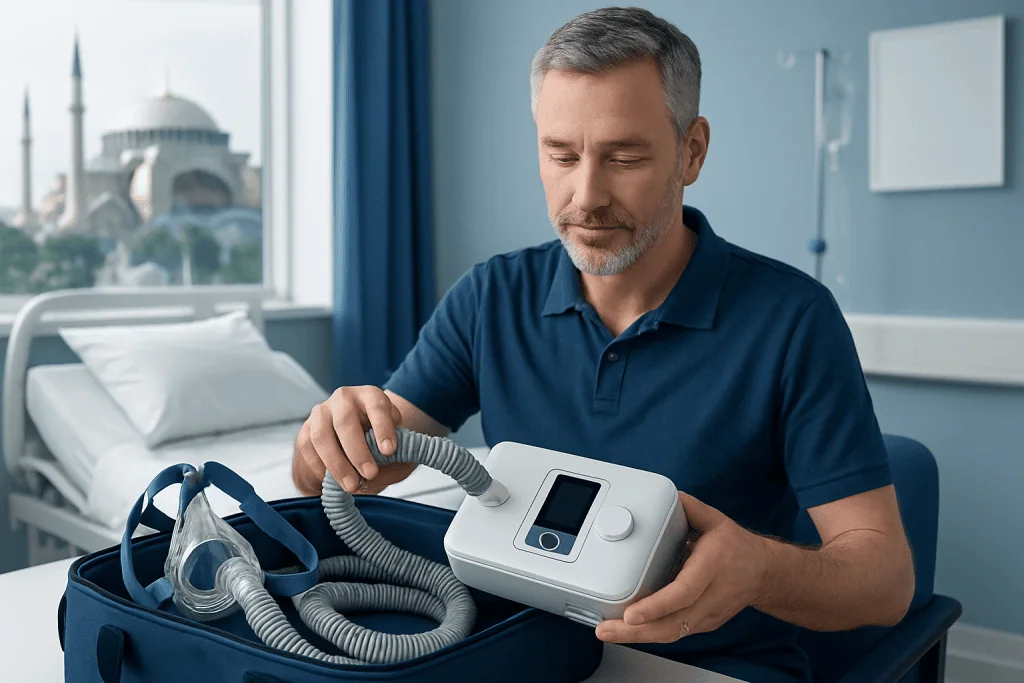
Pack the machine in its own case if you have one, and keep every essential part together in that case. This makes security screening faster, hospital admission simpler and losses less likely. Label the bag clearly with your name, phone number and your destination address in Turkey.
A complete CPAP travel kit usually includes:
- The CPAP machine itself
- Mask, cushion and headgear
- Tubing
- Power cord and power supply unit: the part most often forgotten
- A plug adapter suitable for Turkish sockets
- Humidifier chamber, if you use one
- Distilled water for the first night if practical, or a plan to buy suitable water locally
- Spare filters, and a spare mask cushion if you have one
- Cleaning wipes or simple cleaning supplies
- A copy of your prescription or sleep study report
- A short letter from your doctor stating that you use CPAP
If you use related equipment, a mandibular advancement device, chin strap, battery pack or pulse oximeter, pack those too. Prioritise anything brand-specific that would be hard to replace quickly abroad. A generic extension lead can be bought anywhere; a cushion for your particular mask model often cannot.
One habit worth adopting before you leave home: photograph your machine’s label, its settings screen if your model shows one, and your prescription. If paperwork goes missing or a part fails, those photos answer most of the questions anyone will ask.
Do you need a letter to fly with CPAP?
Strictly, most airlines do not require a letter simply to carry a CPAP machine in the cabin: it is recognised medical equipment. In practice, a short letter or a copy of your prescription solves problems before they start. It answers security questions in any country, supports your case if a gate agent challenges your bag count, and becomes genuinely necessary if you want to use the machine during the flight, because several airlines ask for medical documentation and advance notice for onboard use.
The letter does not need to be elaborate. A few lines from your doctor confirming your diagnosis, stating that you use a CPAP device whenever you sleep, and identifying the machine model is enough. Carry it in English if you can, printed and saved on your phone. The same logic applies to your wider paperwork: the medical records checklist before traveling to Turkey explains what else your hospital will want to see.
Flights, security and the carry-on question
The question patients ask most often: does the CPAP count against my carry-on allowance? On many airlines, no, medical equipment travels in addition to your standard cabin bag. But this is policy, not law, and policies differ between carriers and fare types. Confirm with your specific airline before you fly, ideally in writing or by email so you have something to show at the gate. Never assume the rule that applied on your last trip applies on this one.
Whatever the allowance, the machine belongs in the cabin with you. Checked luggage can be delayed, rerouted or handled roughly, and arriving in Turkey without the device you use for sleep and breathing support is exactly the situation this guide exists to prevent.
At security, CPAP machines are screened routinely. Some airports ask you to remove the machine from its case, much like a laptop; others do not. Keeping it in a clear protective bag inside the case makes inspection quicker, and keeping your prescription or letter within reach settles any questions. The screening itself does not harm the device.
If you plan to use the CPAP during a long flight, plan further ahead. Ask the airline about seat power availability: it is not universal, and not every seat that has a socket supports medical devices, and about their battery rules. Lithium batteries for medical equipment are generally accepted in the cabin within watt-hour limits, but the limits and approval steps vary by airline. Charge any battery fully before departure and carry it with you, not in the hold.
Power and plugs in Turkey
Turkey uses Type C and Type F plugs, with mains power at 220–230 V and 50 Hz. If you are coming from the UK, the Gulf, North America or parts of Asia, your plug will not fit a Turkish socket without an adapter.
The adapter is usually the whole story. Most modern CPAP machines have dual-voltage power supplies that handle 100–240 V automatically, which means a simple plug adapter is all you need. But check your own machine, look at the power supply label for an input range such as “100–240 V”, rather than trusting the general rule. Older machines or single-voltage models need a voltage converter, which is heavier and better bought before departure than hunted down after a long flight.
Two smaller points earn their place in your bag. First, hotel and hospital bedside sockets are not always where you want them, so a short extension lead can save you from sleeping at an awkward angle to reach the wall. Second, if you use humidification, think about water: distilled water is not stocked in every Turkish pharmacy or supermarket under that name, so bring a small supply for the first nights or check your manufacturer’s guidance on acceptable alternatives for short-term use.
What is the 4-hour rule, and does it matter for this trip?
Patients searching for travel advice often run into the “4-hour rule” and wonder whether it is a flight regulation. It is not. The phrase refers to an adherence benchmark: many prescribers and insurers define regular CPAP use as at least four hours per night on most nights, and some machines record usage data against that threshold. It has nothing to do with airlines or airports.
It is still relevant to your trip in one way. If your machine reports usage data to your home provider or insurer, days of disrupted travel can show up in that record. Keeping the machine in your hand luggage and setting it up on your first night, rather than leaving it packed until you feel settled, keeps your routine and your usage record intact. If your treatment in Turkey includes a sleep evaluation, your recent usage pattern is also useful information for the team; the guide to sleep apnea testing in Turkey explains what an evaluation involves.
What your hospital team needs to know before admission
Tell your hospital as early as possible that you have diagnosed sleep apnea and use CPAP. This matters most if your plan includes surgery, sedation, endoscopy, imaging under sedation or an overnight stay. Your doctors need more than the diagnosis: they need your usual pattern of use, whether you depend on the machine every time you sleep, and any past difficulties, for example, if you have ever needed oxygen or closer monitoring after anaesthesia.
Useful details to share include your machine model, your mask type, whether you use humidification, and your prescribed pressure settings if you know them. If you have a recent sleep study report or a letter from your sleep specialist, bring copies, in English where possible. If your records are in another language, a brief translated summary helps; at Acibadem, interpreter support is available so you can explain your routine clearly during admission.
One honest caveat: whether you use your own device on the ward, and when, depends on the type of admission, the department, infection control procedures and the complexity of your treatment plan. Policies genuinely vary. Ask in advance rather than assuming, either answer is workable if you know it before you pack, and neither is if you learn it at the bedside.
Using CPAP during your hospital stay and recovery
Bring your CPAP on the day of admission unless you have been told otherwise. Keep it with your personal belongings and mention it again at check-in, even if it is already on your forms. Repeating important information in a hospital is not a nuisance; it is how safe care works. The same principle appears in the safety checklist of questions to ask before surgery in Turkeypatients who restate the essentials make the system work better.
Once admitted, ask where and when you should use your machine, particularly if you expect to nap after a procedure. If you normally need CPAP for every sleep period, including daytime naps, say so plainly to the nurses. After anaesthesia or pain medication, your team may plan closer observation, and your own machine can be part of that plan rather than an afterthought.
Comfort details are worth raising too: whether you use a nasal or full-face mask, whether dry air bothers you, how you route your tubing. Small preferences make a real difference when you are tired and recovering in an unfamiliar bed.
Before discharge, do a deliberate sweep of the room. The power supply plugged in behind the bed, the humidifier chamber drying in the bathroom, a mask clip on the side table: these are the pieces patients leave behind while concentrating on medicines, transport and paperwork.
Cleaning, hygiene and backup plans away from home
Aim for a simple, realistic cleaning routine while travelling rather than a perfect one. Pack basic supplies that are safe for your device and usable in a hotel or hospital bathroom. If you normally do a deeper weekly clean at home, a lighter temporary routine is fine for a short trip.
Do not improvise with unfamiliar chemicals because you are away from your usual products. Follow the manufacturer’s instructions for the machine, mask, tubing and humidifier chamber, and if you are staying several days, let washed parts dry fully before repacking them.
Plan for minor failures too. Bring spare cushions or filters if you are due to replace them soon, note your home equipment provider’s contact details in case you need brand-specific advice, and keep those photos of your machine label and prescription on your phone. If a part is lost or damaged during your stay, tell your ward team or patient coordinator early. Not every brand-specific component can be replaced quickly in Turkey, that is the honest position, but early notice gives far more room to find a workable option than a request at midnight.
Making the journey easier for you and your companion
If someone is travelling with you, ask them to learn the basics before the trip: what the machine looks like, which bag it lives in, and how to tell staff that you use CPAP whenever you sleep. They do not need technical knowledge: they need to be a second voice for the essentials when you are tired or sedated.
Build slack into your schedule. Security screening, admission paperwork and moving between hotel and hospital all take longer with medical equipment in tow, and a calmer timetable keeps you organised, especially if you are also managing fasting instructions or mobility needs. The arrival day checklist for international patients covers the first day in Turkey in more detail.
Keep one folder or phone note with your key information: diagnosis, prescription, medication list, allergies, emergency contact and your hospital details in Turkey. And do not be embarrassed about repeating that you have sleep apnea and use CPAP. In airports and on wards alike, restating essential information is part of protecting your own comfort and safety.
Step by step
- Confirm your travel and hospital plan early. As soon as dates are set, tell the hospital and your airline that you use CPAP. Ask whether you should bring your own device, whether forms are needed, and whether there are instructions specific to surgery, sedation or an overnight stay.
- Prepare your documents. Carry your prescription, a brief medical letter and any recent sleep study summary, with digital copies on your phone as backup.
- Pack the CPAP in hand luggage. Keep the device, mask, tubing, power supply, adapter and essential accessories together in one case you can open easily at security.
- Check power compatibility. Confirm on the power supply label that your machine handles 220–230 V, and pack a Type C or F plug adapter. If you use a battery, charge it fully and confirm airline rules before departure.
- Repeat your sleep apnea history at admission. Tell the admissions team, nurses and anaesthesiologist that you use CPAP, even if your forms already say so. Mention whether you need it for every sleep period, including naps.
- Set up your sleeping space on the first night. Check outlet position, machine placement and that every part works. Fixing setup problems early is far easier than at midnight when you are exhausted.
- Repack deliberately before discharge or transfer. Check for the mask, tubing, humidifier chamber, power supply and small accessories before you leave the room.
Your checklist
- CPAP machine packed in hand luggage, in its own labelled case
- Mask, tubing, headgear and power supply included
- Turkey plug adapter packed; voltage range on device label checked
- Prescription or medical letter printed and saved digitally
- Airline policy for medical devices and carry-on allowance confirmed in writing
- Onboard power or battery arrangements confirmed if using CPAP in flight
- Hospital informed about sleep apnea and CPAP use before arrival
- Recent sleep study or clinic summary available, in English if possible
- Basic cleaning supplies and spare small parts packed
- Coordinator, hotel and home equipment provider contacts saved
- Companion knows you use CPAP and where it is packed
Key takeaways
- Keep your CPAP in cabin baggage with all essential parts in one case.
- Most airlines carry CPAP machines in addition to your cabin allowance, but confirm your airline’s policy before flying.
- A short medical letter is not always mandatory but prevents problems at security, at the gate and for onboard use.
- Turkey uses 220–230 V power with Type C and F plugs, check your device label and pack an adapter.
- Tell your hospital team about your sleep apnea and CPAP use before admission, and repeat it before any sedation or surgery.
Frequently asked questions
Do I need a letter to fly with CPAP?
Usually not just to carry it, most airlines recognise CPAP as medical equipment. A short doctor’s letter or prescription copy is still worth carrying: it speeds security checks, supports your carry-on case, and becomes necessary on some airlines if you plan to use the machine during the flight, which often requires advance notice.
Does a CPAP count as a carry-on for international flights?
On many airlines, medical equipment travels in addition to your standard cabin allowance, so the CPAP does not use up your bag count. Policies differ between carriers and fare types, so confirm with your specific airline before travel, ideally in writing so you can show it at the gate.
What is the 4-hour rule for CPAP?
It is an adherence benchmark, not a travel regulation. Many prescribers and insurers define regular use as at least four hours per night on most nights, and some machines record usage against that threshold. For travel, the practical point is to set the machine up from your first night so your routine and usage record stay intact.
Should I pack my CPAP in checked baggage or hand luggage?
Hand luggage, whenever possible. Checked bags can be delayed, lost or handled roughly, and you do not want to arrive without the device you use for sleep and breathing support. Keeping it with you also makes security checks simpler and lets you use it as soon as you arrive.
Will my CPAP work in Turkey?
Turkey uses 220–230 V electricity at 50 Hz with Type C and Type F plugs. Most modern CPAP power supplies accept 100–240 V, in which case a plug adapter is all you need, but check your own device label rather than relying on the general rule. Single-voltage machines need a converter, best bought before departure.
Do I need to tell the hospital about my sleep apnea if I am bringing my CPAP anyway?
Yes. Your team needs the diagnosis and your usual pattern of use, especially where anaesthesia, sedation, pain medicines or overnight monitoring are involved. Bringing the device helps, but it does not replace clear communication, and whether you use your own machine on the ward depends on the admission type and hospital procedures, so ask in advance.
Can I use my CPAP in hospital after a procedure?
Often yes, but the plan depends on your treatment, the level of monitoring you need and the hospital’s procedures. Tell the team if you normally need CPAP for every sleep period, including naps, so they can build your device into the recovery plan and tell you when and where to use it.
What if a part is lost or breaks during the trip?
Tell your ward team or patient coordinator as soon as you notice, rather than waiting until bedtime. Brand-specific parts cannot always be replaced quickly in Turkey, but early notice leaves more time to find workable options. Carrying spare cushions and filters, and keeping photos of your machine label and prescription on your phone, makes these situations much easier.
Add us as a Preferred Source to see more of our trusted health content across Google Search, AI Overviews and Discover.

Update history
- PublishedAugust 6, 2026
- Medical review approvedSeptember 13, 2026
- Last content updateSeptember 12, 2026
References3
- NHS: Sleep apnoea nhs.uk
- MedlinePlus: Sleep Apnea medlineplus.gov
- Cleveland Clinic: CPAP Machine my.clevelandclinic.org
More Patient Guides

GHIC and EHIC in Turkey: Why They Do Not Cover You
The blue card that quietly covers you across Europe stops working at the Turkish border, and every summer, travelers discover this…

Do You Need Vaccinations for Turkey?
Here is the answer travel clinics give every day: no vaccinations are required to enter Turkey from anywhere in the normal course…

Flying With a Broken Leg or Cast: Airline Rules and Comfort
A broken leg does not cancel a flight, airlines carry passengers in casts every single day. What surprises travelers is that…

Travel Insurance After Cancer: What Patients Should Know
A cancer diagnosis changes how insurers read your name, but it does not end your traveling life. Thousands of people with…