

Peyronie’s Disease Myths: Does It Always Progress, and Is Surgery the Only Answer?

Key Takeaways
- NIDDK estimates about 1 in 100 US men have been diagnosed with Peyronie's disease, with the true figure possibly nearer 1 in 10 because so many never report it.
- The active phase, when the plaque forms and curvature can change, typically lasts roughly 6 to 18 months before the condition stabilizes.
- Cleveland Clinic cites spontaneous improvement in roughly 13% of men, but for most the curve plateaus rather than resolving or progressing indefinitely.
- Erection pain usually fades within the first year or two as inflammation settles, even when the curvature itself remains.
- Collagenase injections, the best-studied non-surgical treatment, are approved for a palpable plaque with curvature greater than 30 degrees and are given in cycles over several months.
- Most surgeons wait until the curve has been stable and erections pain-free for 9 to 12 months before operating, and the type of surgery depends heavily on erection quality.
No. Peyronie's disease does not always progress, and surgery is not the only option. The condition usually moves through an active phase of roughly 6 to 18 months, after which curvature typically stabilizes, and a minority of men improve without treatment. Monitoring, injections and traction are used before surgery, which is reserved for stable, bothersome curvature. A urologist can advise which path fits each person.
A man in his fifties notices, in the shower, a small firm ridge along the shaft of his penis. It does not hurt yet. Over the next few weeks his erections begin to bend upward, then slightly to the left, and a quiet dread sets in. He searches late at night and finds two stories competing for his attention: one says the bend will keep getting worse until he cannot have sex at all, the other says a supplement will straighten it in a month.
Neither story is true. Peyronie’s disease is common, under-reported and surrounded by more peyronie disease myths than almost any other condition in men’s urology, partly because so few people talk about it out loud. The silence leaves room for fear on one side and false promises on the other.
This explainer walks through what the evidence actually shows: how the condition behaves over time, why most men never need an operation, what the non-surgical options can and cannot do, and when a bend genuinely needs a doctor’s eyes.
Why do peyronie disease myths spread so easily?
Peyronie’s disease is a condition in which scar tissue forms inside the penis and causes it to curve, dent or shorten during erection. Despite being named after an eighteenth-century surgeon, it is still poorly understood by the public, and a surprising number of men assume they are the only one it has ever happened to.
They are not. The National Institute of Diabetes and Digestive and Kidney Diseases (NIDDK) reports that about 1 in 100 adult men in the United States have been diagnosed, and estimates that the true figure may be closer to 1 in 10, because many men never mention it to a doctor. That gap between how common the condition is and how rarely it is discussed is exactly where peyronie disease myths take root.
Three things keep the myths alive. Embarrassment stops men from comparing notes with friends or clinicians, so personal anxieties go unchecked. The internet rewards dramatic claims, whether that is “it always ends in surgery” or “this device straightens it in weeks.” And the condition itself behaves inconsistently from one man to the next, which makes almost any anecdote sound plausible.
The honest picture is more reassuring than the fearful version and more sober than the miracle version. Peyronie’s disease has a recognizable natural history, a clear set of treatments with graded evidence behind them, and a small group of red flags that signal when to act quickly. Everything that follows rests on guidance from NIDDK, the NHS, Mayo Clinic, Cleveland Clinic and MedlinePlus rather than on forum anecdotes.
Peyronie's disease stages: what actually happens inside the penis
Inside the penis, two cylinders of spongy tissue fill with blood during an erection. Each is wrapped in a tough, elastic sheath called the tunica albuginea, which is the layer that stretches evenly so the penis extends straight. Peyronie’s disease begins when a patch of that sheath heals abnormally and forms a plaque, a flat lump of dense scar tissue made mostly of collagen, the protein that gives skin and tendons their strength.
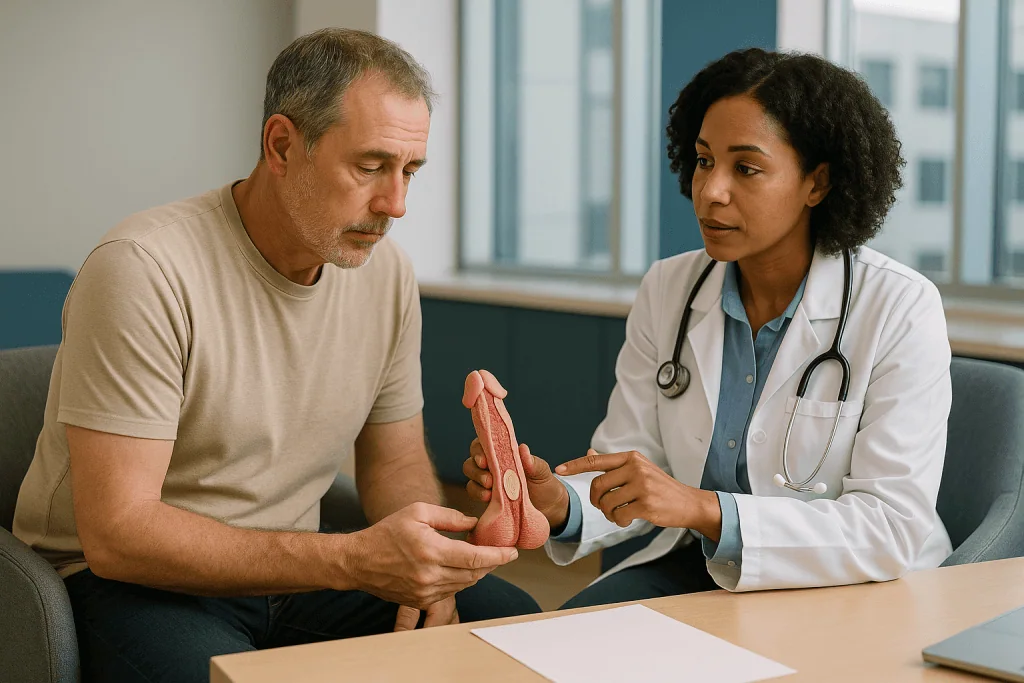
Scar does not stretch the way healthy tunica does. When the rest of the sheath expands during erection and the plaque stays put, the penis bends toward the stiff patch, much as a balloon curves if you tape one side. A plaque on the top surface produces an upward curve; one on the side pulls sideways; a ring-shaped plaque can create an hourglass waist or hinge.
Clinicians describe two Peyronie’s disease stages. The acute, or active, phase is when the plaque is forming. Pain with erection is common, the curve may change from month to month, and the lump itself can feel tender. NIDDK and Mayo Clinic put this phase at roughly 6 to 18 months for most men.
The chronic, or stable, phase follows. Pain usually fades, the plaque hardens and stops growing, and the degree of curvature settles. The curve rarely worsens once this phase is reached, but it also rarely resolves without intervention. Knowing which phase you are in matters more than almost any other detail, because treatment choices, especially surgery, depend on it.
Does Peyronie's disease go away on its own, or does it always get worse?
Here is the first and most damaging myth: that the bend will inevitably keep increasing until sex becomes impossible. The evidence does not support that.
Observational data summarized by Cleveland Clinic suggest that in roughly 13% of men, the curvature improves without any treatment. For the majority, the course is different but still not relentless: the condition worsens during the active phase, then plateaus. Mayo Clinic describes it plainly: in most men, the curvature stabilizes rather than progressing indefinitely.
The flip side deserves equal honesty. “Does Peyronie’s disease go away?” is a question many men ask hoping for a yes, and for most the answer is no. Once the chronic phase arrives, the plaque is mature scar and tends to stay. Pain may disappear completely, which feels like recovery, but the curve itself typically remains at whatever angle it reached.
So neither extreme holds. Progression is not guaranteed, and spontaneous resolution is the exception. The practical consequence is that the active phase is a time for monitoring and, in some cases, treatments aimed at limiting the final curve, while the stable phase is when definitive decisions can be made with confidence that the target is no longer moving.
One more nuance: a mild curve that has always been present, often from birth, is called congenital curvature and is a different condition with no plaque and no active phase. If a bend appeared in adulthood after years of straight erections, Peyronie’s disease is the more likely explanation, and a urologist can usually tell the two apart on examination.
Does Peyronie's disease cause pain, and does the pain last?
Pain is common, and it is also one of the parts of the condition that usually improves on its own. During the active phase, the inflamed plaque can ache, especially during erection, when the stiff patch is under tension while everything around it stretches. Some men also notice tenderness when the lump is pressed, and a few feel discomfort even when the penis is flaccid.

The pattern over time is reassuring. Mayo Clinic and NIDDK both note that erection pain typically settles within the first year or two as the plaque matures and inflammation calms. By the chronic phase, the majority of men have little or no pain, even if the curvature persists. That is why pain alone is rarely the reason for surgery.
Not every ache is the plaque. A penis that bends during intercourse can place strain on the base or on the partner, and that mechanical discomfort is a separate issue that may improve by changing positions or pausing penetrative sex while the curve is unstable. Pain that is sudden, severe and accompanied by a popping sensation or rapid swelling is something else entirely and is covered in the red-flag section below.
What about the question itself, does Peyronie’s disease cause pain in everyone? No. Some men discover the condition only because they notice a lump or a change in shape, with no discomfort at all. The absence of pain does not mean the condition is milder, and its presence does not mean it is progressing faster. Pain tracks inflammation, not the eventual angle.
For pain relief during the active phase, over-the-counter options exist, but the choice belongs to your clinician, who can weigh them against your other health conditions.
What causes Peyronie's disease, and does alcohol affect it?
The honest answer to “what causes it” is that no single culprit has been proven. The leading explanation, described by Mayo Clinic and NIDDK, is that repeated minor injury to the erect penis, usually during sex or sport and often unnoticed, triggers bleeding and inflammation inside the tunica albuginea. In most men this heals cleanly. In those who develop Peyronie’s disease, the healing goes wrong and produces excess collagen that becomes a plaque.
Why some men scar this way and others do not appears to be partly genetic. Peyronie’s disease clusters in families and is linked to Dupuytren’s contracture, a condition in which thickened tissue in the palm pulls the fingers inward. Both involve the same tendency toward abnormal scarring. Age plays a role too: tissue elasticity declines in middle age, and the condition is most often diagnosed in men in their fifties and sixties, though it can appear earlier.
The myth that one specific event always explains it is worth retiring. Some men recall an obvious injury; most do not. Circumcision in adulthood, prostate surgery and penile injections for erectile dysfunction have each been associated with plaque formation in some cases, but they are contributing factors rather than universal causes.
Does alcohol affect Peyronie’s disease? There is no mainstream evidence that alcohol causes plaques or makes an existing curve worse. What alcohol does do, in excess, is impair erection quality and blood vessel health, and firm erections are what the penis depends on to stretch evenly. Mayo Clinic lists heavy alcohol use and smoking among factors associated with erectile dysfunction, which frequently coexists with Peyronie’s disease. Moderating alcohol will not straighten a plaque, but it supports the broader vascular health that treatment plans rely on.
Peyronie's disease treatment without surgery: what the evidence supports
Most men with Peyronie’s disease never have an operation. That alone dismantles the second myth in the title. Peyronie’s disease treatment without surgery falls into three evidence-backed categories, each with limits worth stating clearly.
The first is watchful monitoring. For mild curves that do not interfere with sex, Mayo Clinic notes that a clinician may simply recommend regular review, particularly during the active phase while the picture is still changing. This is not neglect; it is a recognition that intervening in an evolving condition can mean treating a moving target.
The second is injection therapy into the plaque. The best-studied option is collagenase clostridium histolyticum, an enzyme that breaks down the collagen fibers in scar tissue. Mayo Clinic explains that it is approved for men whose curvature is greater than 30 degrees and who have a palpable plaque, and that it is given as a series of injection cycles over several months, combined with gentle stretching or “modeling” of the penis between sessions. Verapamil and interferon, two other injected medicines, are also used by some urologists; the evidence for them is less consistent. Common effects include bruising and swelling, and your clinician will discuss the rarer risks.
The third is traction therapy, in which a mechanical device applies steady stretch to the penis. Mayo Clinic describes it as an option that may reduce curvature and preserve length, particularly during the early phase, but it demands daily use over months, and results vary widely.
Oral medicines, by contrast, have generally disappointed in controlled studies. NIDDK and Mayo Clinic both note that no tablet has consistently reduced curvature. Whether any of these approaches suits you is a decision for your urologist, based on your phase, your curve and your goals.
Which Peyronie's disease remedies have weak or no evidence?
If the fearful myth is “it always ends in surgery,” the hopeful myth is “this product straightens it.” The second deserves just as much scrutiny, because men who believe it often spend months on something that cannot work while their window for better-supported treatment narrows.
Vitamin E has been used for Peyronie’s disease for decades. Controlled studies, as summarized by NIDDK, have not shown that it reduces curvature or plaque size better than placebo. Other supplements marketed online, including various antioxidants and amino acids, rest on even thinner evidence. None has been shown in a rigorous trial to change the physical plaque.
Low-intensity shockwave therapy, which delivers acoustic pulses to the plaque, has been studied as well. Mayo Clinic’s summary is that it may ease pain in some men but has not been shown to straighten the penis. That is a meaningful distinction: a treatment that relieves discomfort without changing shape should be described exactly that way, not sold as a straightening solution.
Topical creams, massage techniques and “natural plaque dissolvers” fall into the no-evidence category. The plaque sits deep within the tunica albuginea; substances applied to the skin do not reach it in meaningful amounts.
Why does this matter beyond wasted money? Because the active phase is when evidence-based interventions have the most room to influence the final curve, and because relying on an ineffective remedy can delay the conversation with a urologist that would reveal whether erectile dysfunction, a treatable and common companion, is also present. Skepticism toward unproven therapies is not pessimism. It is what protects the time and tissue you actually have.
Is surgery the only answer? Who is usually offered it, and who is asked to wait
Surgery has a specific place in Peyronie’s disease, and it is a narrower place than the myths suggest. Mayo Clinic describes it as generally reserved for men whose deformity is severe, persistently bothersome and interferes with intercourse. Three conditions typically have to be met before a surgeon will operate.
The first is stability. Operating during the active phase risks correcting a curve that then changes again. Mayo Clinic notes that most surgeons want the curvature to have stopped progressing and erections to have been pain-free for at least 9 to 12 months before surgery; NIDDK frames a minimum of 3 to 6 months of stability. Your surgeon’s threshold will depend on how your curve has behaved.
The second is functional impact. A 25-degree upward bend that does not trouble either partner is rarely a surgical case. A curve that makes penetration painful, impossible or distressing is a different matter, regardless of its exact angle.
The third is erection quality. Whether erections are firm enough on their own, firm enough with medication, or not reliably firm at all determines which operation is suitable, as the next section explains.
Who is usually asked to wait? Men still in the active phase, men with pain that has not yet settled, men whose curve has changed in the last several months, and men who have not yet tried or discussed non-surgical options. Waiting is not a dismissal. It is the step that gives a one-time operation its best chance of matching the final shape of the problem.
Nobody is told surgery is inevitable. The decision rests with you and your treating team, after the condition has shown its hand.
How do the main treatment options compare?
Seeing the options side by side makes the “surgery or nothing” myth harder to hold. Each approach answers a different combination of phase, curve severity and erection quality.
| Approach | What it involves | Usually considered for | Main considerations |
|---|---|---|---|
| Watchful monitoring | Regular review, no active intervention | Mild curve, little impact on sex, especially during active phase | Requires patience; curve may still change before stabilizing |
| Collagenase injections | Enzyme injected into plaque in cycles, with modeling | Palpable plaque, curve over 30 degrees (Mayo Clinic) | Bruising and swelling common; several months of treatment |
| Traction therapy | Device applies steady stretch daily over months | Early phase; men wishing to preserve length | Time-intensive; variable evidence |
| Plication surgery | Stitches shorten the longer side to straighten | Stable curve, good erections, modest angle | Some loss of length expected |
| Incision or excision and grafting | Plaque cut or removed; gap patched with graft tissue | Stable, severe curve or hourglass deformity, good erections | Higher risk of erectile changes and numbness |
| Penile implant | Device placed inside the penis; curve corrected during surgery | Stable curve plus erectile dysfunction not helped by other measures | Permanent; replaces natural erection mechanism |
Two patterns stand out. Non-surgical options dominate the early and moderate end of the spectrum, and surgery divides sharply by erection quality: plication and grafting assume the penis can become firm on its own, while an implant is reserved for men whose erectile dysfunction has not responded to other approaches, as Mayo Clinic and NIDDK describe.
None of these rows is a recommendation. They are the menu a urologist works from, and the right line depends on an examination, a measured angle, often an ultrasound, and a frank conversation about what you want sex to look like afterward.
What do the following weeks usually look like after treatment?
Timelines vary by treatment and by person, and what follows describes typical ranges from mainstream sources rather than promises.
After collagenase injections, bruising and swelling at the injection site are expected and usually settle over days to a couple of weeks. Mayo Clinic notes that treatment is delivered in cycles spread over several months, with the modeling exercises your clinician teaches performed between sessions. Sexual activity is generally paused for a period after each injection; your urologist sets that interval. A rare but serious complication is rupture of the tunica during a subsequent erection, which is why the red flags below matter during this period.
After plication or grafting surgery, most men go home the same day or the following day. Swelling and bruising peak in the first week, and dissolvable stitches soften over the following weeks. Mayo Clinic indicates that return to sexual activity is often permitted around 4 to 8 weeks after surgery, though the surgeon decides based on healing. Some numbness of the penile skin is common early on and often improves over months, though it can persist, particularly after grafting.
After a penile implant, recovery follows a similar early pattern, with the addition of learning to operate the device once the surgeon confirms healing, usually several weeks in.
Across all three, a few things are consistent. Pain is normally manageable and declines week by week. Erections during healing can feel strange or tight. And the final shape is judged months, not days, after treatment, because swelling distorts early impressions. Follow-up visits are where the result is actually assessed, and they are worth keeping even when everything feels fine.
Does Peyronie's disease affect your partner?
Yes, though usually not in the way men fear. The physical effect on a partner is typically limited to discomfort if a pronounced curve makes certain positions awkward or if penetration becomes difficult. Peyronie’s disease is not infectious, not transmissible and not caused by anything a partner did.
The larger impact is emotional, on both sides. Mayo Clinic lists anxiety, stress and relationship strain among the complications of the condition, and NIDDK notes that depression is more common in men living with it. Men often withdraw from intimacy out of embarrassment before they have explained what is happening, and partners can misread that withdrawal as rejection or loss of attraction. The silence does more damage than the curve.
What helps, according to the same sources, is straightforward: naming the condition out loud, explaining that it is a scarring problem rather than a reflection of desire, and involving the partner in the conversation with the urologist if that feels right. Sex does not have to pause entirely during the active phase; many couples adjust positions, slow down, or focus on non-penetrative intimacy while the curve settles. A clinician can advise which activities to avoid while a plaque is tender or while injections are ongoing.
Where distress is significant, counseling, individually or as a couple, is a legitimate part of treatment rather than an admission of weakness. Erectile dysfunction, which frequently accompanies Peyronie’s disease, carries its own emotional weight and is treatable in most cases; addressing it often changes how the curve itself is experienced.
Partners frequently say afterward that they wished they had been told sooner. That is a quiet argument against the most common instinct, which is to manage it alone.
What people often get wrong: peyronie disease myths, corrected
Several peyronie disease myths have already been addressed, but a few others circulate widely enough to deserve direct correction.
- “It is a form of cancer.” It is not. The plaque is benign scar tissue, and it does not spread or turn malignant. Any new penile lump should still be examined, because other conditions can look similar, but Peyronie’s plaque itself is not a tumor.
- “It is a sexually transmitted infection.” No infection is involved, and the condition cannot be passed to a partner.
- “It only happens to older men.” Diagnosis is most common in the fifties and sixties, but Cleveland Clinic and NIDDK both note that younger men, including those in their twenties and thirties, can develop it.
- “Any curve means Peyronie’s disease.” Mild curvature present since puberty is congenital and lacks a plaque. A new bend after years of straight erections is the pattern that points to Peyronie’s.
- “If it does not hurt, it is not serious.” Pain reflects inflammation, not severity. Painless plaques can still produce significant curvature.
- “Erectile dysfunction is caused by the plaque alone.” The two coexist frequently, but erectile dysfunction usually has its own vascular or hormonal contributors that need separate assessment.
- “Surgery always shortens the penis dramatically.” Plication involves some shortening, which Mayo Clinic describes as expected; grafting and implants are chosen partly to limit it. Your surgeon should give you a realistic estimate for your anatomy.
- “Once treated, it is finished forever.” Plaques can occasionally recur or new ones form. Follow-up matters.
The thread connecting these corrections is that Peyronie’s disease is a scarring disorder with a predictable arc. Understanding that arc replaces fear with a plan.
Questions to ask your care team
A urology appointment for Peyronie’s disease moves quickly, and the questions that matter most are easy to forget once you are in the room. Bringing a short list, and a partner if you wish, changes the quality of the conversation.
Start with phase. Ask: based on my history and examination, am I in the active or stable phase, and how will we know when that changes? The answer shapes everything else.
Then ask about measurement. How many degrees is my curve, and how was it measured? Many urologists photograph the erect penis or induce an erection in clinic to measure precisely, and some use ultrasound to map the plaque and check blood flow. Knowing the number lets you track change rather than rely on impression.
Ask about erections directly. Is erectile dysfunction contributing here, and should it be assessed separately? This determines which treatments are even on the table.
On treatment options, useful questions include: Which non-surgical approaches are reasonable for my phase and angle? What does the evidence actually show for each, and what are the common and rare side effects? If surgery were ever considered, which type would suit my anatomy, what change in length is realistic, and what is the risk to sensation and erections?
Ask about timing. What are we waiting for before deciding, and how often should I be reviewed?
Finally, ask what to avoid. Are there sexual positions or activities I should pause during the active phase or during treatment, and what symptoms should prompt me to call sooner than my next appointment?
No question on this list is awkward to a urologist. They answer them every day, and the men who ask tend to leave with clearer expectations.
When to call your doctor
Most of Peyronie’s disease is a slow story measured in months, which is exactly why the few fast-moving situations stand out. Seek care promptly if you notice any of the following.
Sudden severe pain during sex accompanied by a cracking or popping sensation, rapid swelling and dark bruising can indicate a penile fracture, a tear in the tunica albuginea. MedlinePlus and Mayo Clinic describe this as an emergency requiring same-day evaluation, because delayed repair can worsen scarring and erectile function. Men undergoing collagenase injections should be especially alert, since the treated plaque is temporarily weakened.
Call your doctor without waiting for a routine appointment if a curve changes noticeably within a few weeks rather than months, if a plaque becomes markedly larger or more tender, or if you develop difficulty urinating, which is not a typical feature of Peyronie’s disease and needs a different explanation.
Any new lump on the penis deserves examination, even if you assume it is another plaque. Skin changes, open sores, bleeding or discharge are not caused by Peyronie’s disease and warrant their own assessment.
After surgery or injection, contact the team for fever, spreading redness, pus, wound separation, or pain that escalates instead of easing. After an implant, inability to operate the device or a sudden change in its position should be reported.
Seek help, too, for the quieter emergencies. If low mood, anxiety or withdrawal from your relationship is building, say so to your clinician. These are recognized complications of the condition, and they are treatable.
For everything that is not on this list, a scheduled appointment with a urologist is the right next step. Every decision about monitoring, injections or surgery belongs with you and your treating team.
Frequently asked questions
Does Peyronie's disease go away on its own?
For most men it does not, although a minority improve without treatment; Cleveland Clinic cites roughly 13%. The usual pattern is that curvature develops during an active phase of about 6 to 18 months, then stabilizes. Pain often disappears completely, which can feel like recovery, but the plaque and curve typically persist once the chronic phase is reached.
What are the Peyronie's disease stages?
There are two. The acute or active phase is when scar tissue is forming: pain with erection is common and the curve can change. NIDDK and Mayo Clinic put this at roughly 6 to 18 months. The chronic or stable phase follows, when pain fades, the plaque hardens and the curvature settles. Treatment decisions, especially about surgery, depend on which phase you are in.
Does Peyronie's disease cause pain?
Often, but not always, and usually only during the active phase. The inflamed plaque can ache during erection and feel tender when pressed. Mayo Clinic and NIDDK note that pain generally settles within the first year or two as the scar matures. Some men never have pain and notice only a lump or a change in shape. Pain reflects inflammation, not how severe the final curve will be.
Is Peyronie's disease treatment without surgery effective?
It can be, depending on the phase and the curve. Collagenase injections, an enzyme that breaks down scar collagen, are approved for curvature over 30 degrees with a palpable plaque. Traction devices may help during the early phase but require daily use over months. Oral tablets and vitamin E have not shown consistent benefit in controlled studies. A urologist can advise which option fits your situation.
Does alcohol affect Peyronie's disease?
There is no mainstream evidence that alcohol causes plaques or worsens an existing curve. Heavy drinking does impair erection quality and blood vessel health, and Mayo Clinic lists it among factors linked to erectile dysfunction, which often coexists with Peyronie’s disease. Moderating alcohol will not straighten a plaque, but it supports the vascular health that treatment and sexual function depend on.
How do you control Peyronie's disease?
Control means limiting the final curve and protecting sexual function rather than reversing the scar. During the active phase, that typically involves monitoring, avoiding activities that strain a tender plaque, and discussing injections or traction with a urologist. Once stable, options range from accepting a mild curve to surgery for a severe one. Addressing erectile dysfunction, if present, is often part of the plan.
Does Peyronie's disease affect your partner?
Physically, only through discomfort if a pronounced curve makes some positions awkward; it is not infectious or transmissible. The larger effect is emotional. Mayo Clinic lists relationship strain among the complications, often because men withdraw from intimacy without explaining why. Talking openly, adjusting positions and involving a partner in medical conversations tends to reduce that strain considerably.
Is surgery the only answer for Peyronie's disease?
No. Most men never need an operation. Surgery is generally reserved for a curve that is stable, severe and interferes with intercourse, and Mayo Clinic notes most surgeons want 9 to 12 months of stability and pain-free erections first. Before that, monitoring, injections and traction are the usual paths. The choice always rests with the patient and the treating urologist.
Can young men get Peyronie's disease?
Yes. Although diagnosis is most common in men in their fifties and sixties, Cleveland Clinic and NIDDK both note that it can develop in younger men, including those in their twenties and thirties. The underlying process, abnormal scarring of the tunica albuginea after minor injury, is the same at any age, and younger men should be evaluated just as promptly.
Is Peyronie's disease a sign of cancer?
No. The plaque is benign scar tissue made of collagen; it does not spread or turn malignant. That said, any new lump on the penis should be examined by a clinician, because other conditions can resemble a plaque. Skin changes, sores, bleeding or discharge are not features of Peyronie’s disease and need their own assessment.
References
- Penile Curvature (Peyronie's Disease), NIDDK, National Institutes of Health
- Peyronie's Disease, Cleveland Clinic
- Peyronie disease, MedlinePlus Medical Encyclopedia
- Peyronie's disease, NHS
This article is for general information only and is not a substitute for professional medical advice. Please consult a qualified doctor about your individual situation.

More from the Blog

Living With an Enlarged Prostate: Follow-Up Visits, Medication Reviews and Daily Habits
Living with an enlarged prostate usually means a long-term partnership with a clinician rather than a single fix: periodic follow-up visits that track symptoms,…

Life During Incontinence Treatment: Bladder Training, Exercises and Follow-Up Adjustments
Living with urinary incontinence during treatment usually means a structured stretch of bladder training, daily pelvic floor exercises, changes to fluids and caffeine, and…

Preparing for TURP: Why Any Urine Infection Is Treated First and What Else Comes Before
Preparing for TURP usually means a pre-operative assessment several weeks ahead, a urine test to rule out infection, and a medicine review with your…

Recurrent UTI Work-Up: Urine Cultures, Imaging and When a Urologic Evaluation Is Added
A recurrent UTI work-up starts with a proper urine culture taken during symptoms, repeated with each new episode, so the organism and its antibiotic…
How Doctors Confirm Orchitis: Scrotal Ultrasound, Urine Tests and Finding the Cause
Doctors confirm orchitis with a physical examination, a urine test and, in most cases, a scrotal ultrasound with Doppler flow. The ultrasound shows swelling…

Free PSA, PSA Density and PSA Velocity: How Urologists Refine a Borderline Result
Free PSA is the fraction of prostate-specific antigen that circulates unbound in the blood; total PSA counts the bound and free forms together. When…