

Planning Endoscopy or Colonoscopy in Istanbul: Stay Length, Sedation and the Trip Home
Key Takeaways
- NHS guidance bars driving, alcohol, operating machinery and signing legal documents for 24 hours after sedation, which also rules out flying within that window.
- Mayo Clinic gives typical procedure times of 15 to 30 minutes for an upper endoscopy and 30 to 60 minutes for a colonoscopy, so the day is lost to preparation and recovery rather than the test itself.
- A gastroscopy can be done with throat spray alone and a colonoscopy with an inhaled gas mixture, and the NHS notes people choosing these options can often leave and drive the same day.
- Bleeding from a biopsy or polyp site is listed by MedlinePlus and Mayo Clinic as an uncommon complication that can be delayed, which is why teams often ask for a longer local stay after polyp removal.
- The CDC notes that clot risk rises on flights over about four hours, and bowel preparation can leave you dehydrated, so fluids and aisle walks matter more than usual on the trip home.
- "Endoscopy" is an umbrella term, but in clinic speech it usually means the upper test only, so a booking or a result labelled "endoscopy" does not automatically include the colon.
If you are having an upper endoscopy or colonoscopy while away from home, the medical picture is reassuring but not instant: both are usually same-day procedures, sedation effects last about 24 hours, and most people feel normal within a day or two. Flying is generally delayed until sedation has cleared and any biopsy or polyp sites have settled; your endoscopy team sets the exact timing.
The itinerary looked tidy on paper: land, sleep, scope on the second morning, fly home two days later. Then the email from the endoscopy unit arrived with a page of prep instructions, a line about needing a companion for 24 hours, and a polite question about whether any flight was booked within the week. Suddenly the trip needed rethinking.
That is the reality of endoscopy colonoscopy in Istanbul planning, or in any city where you do not live: the procedures themselves are brief and well studied, but sedation, bowel preparation and the possibility of a biopsy or polyp removal all push against a tight travel schedule. The questions people ask are practical ones. How groggy will I be? Can I do the bowel prep in a hotel room? When is it safe to sit on a plane?
This guide answers those questions with what mainstream guidance actually says, and leaves the final calls where they belong, with the team doing the procedure.
Why endoscopy colonoscopy in Istanbul planning starts with sedation, not the flight
Most people planning a scope abroad begin with the flight calendar. Endoscopy nurses begin somewhere else entirely: with the sedative. Once a sedative is on the plan, a chain of practical rules follows, and every one of them shapes the length of the stay.
NHS guidance on both gastroscopy and colonoscopy is consistent. If you are sedated, someone must collect you, stay with you for the rest of the day and ideally overnight, and you should not drive, drink alcohol, operate machinery or sign legal documents for 24 hours. That single rule means a solo traveler cannot simply take a taxi back to a hotel and fly the next morning without someone else in the picture.
The second shaping factor is what the endoscopist finds. A purely diagnostic look, with nothing removed, has a very different aftermath from a colonoscopy in which several polyps are taken off. You will not know which version you are getting until the scope is done, so a sensible plan builds in slack for the second scenario.
The third is bowel preparation, which occupies the day before a colonoscopy and requires reliable access to a bathroom, clear fluids and rest. Hotel rooms can work well for this; sightseeing days cannot.
Put those three together and a realistic outline emerges: arrive with at least one clear day before the procedure, allow the procedure day itself to be a write-off, and hold the days after it as flexible until the team has told you what they found. None of this is dramatic. It is simply the difference between a schedule built around a flight and one built around a body that has just had a sedative and a camera inside it.
What actually happens during an upper endoscopy and a colonoscopy
An upper endoscopy, also called a gastroscopy or EGD, is an examination of the esophagus, stomach and the first part of the small intestine using a thin, flexible tube with a camera on the end. A colonoscopy uses a longer version of the same kind of instrument to examine the large bowel, from the rectum to the point where it meets the small intestine.
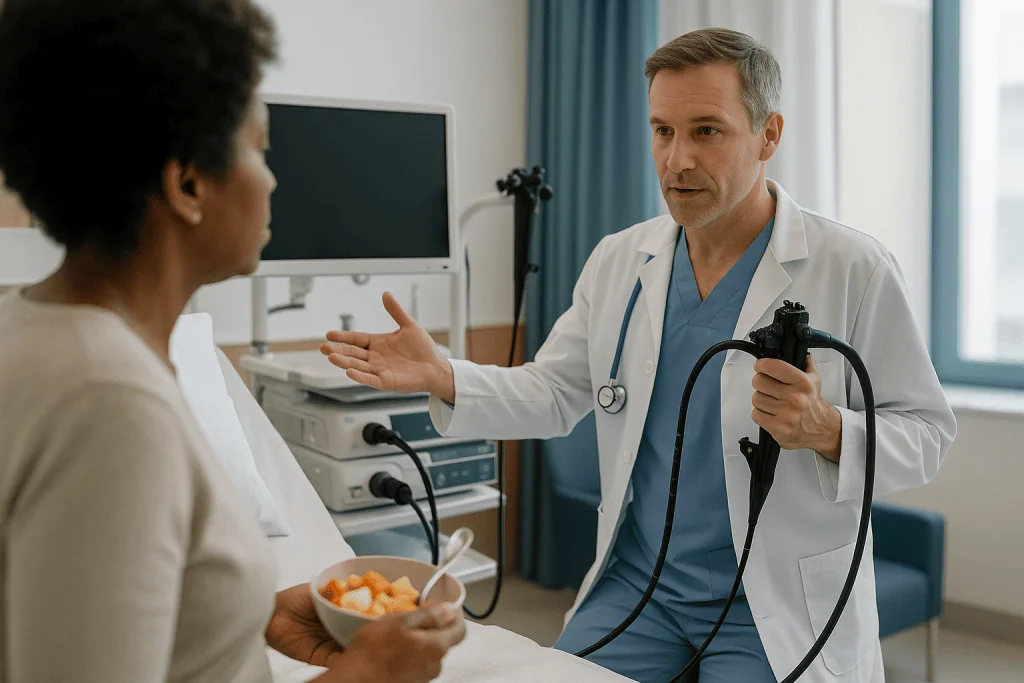
For the upper test, you lie on your left side. A local anesthetic spray may numb the throat, a mouth guard protects your teeth, and the scope passes over the back of the tongue as you swallow. Air is gently introduced so the lining can be seen. The Mayo Clinic describes the examination itself as typically taking 15 to 30 minutes.
For a colonoscopy, you also lie on your side. The scope is passed through the anus and advanced around the bowel, again with gas to open the walls. Most of the careful looking happens on the way back out. Mayo Clinic puts the typical duration at 30 to 60 minutes.
During either test the endoscopist can pass tiny instruments down a channel in the scope: forceps to take a biopsy (a pinch of tissue for the laboratory) or a snare to remove a polyp (a small growth on the lining). These additions are painless because the bowel and stomach lining do not register cutting the way skin does, though they add a few minutes and some aftercare.
Afterwards you rest in a recovery bay while the sedative wears off, usually under observation with a blood pressure cuff and an oxygen probe on a finger. The endoscopist will normally tell you the main findings before you leave, with biopsy results following later, once the laboratory has looked at them.
Who these tests are usually for, and who is usually asked to wait
Upper endoscopy is commonly requested for persistent heartburn that has not responded to standard treatment, difficulty swallowing, unexplained upper abdominal pain, vomiting blood or black stools, unexplained weight loss, or iron-deficiency anemia with no obvious cause. It is also used to follow up known conditions such as Barrett’s esophagus or celiac disease, where periodic biopsies matter.
Colonoscopy has two broad purposes. One is diagnostic: investigating rectal bleeding, a change in bowel habit, anemia, or an abnormal stool test. The other is screening and surveillance, looking for polyps in people at average or increased risk of bowel cancer before symptoms appear. MedlinePlus and Johns Hopkins both describe polyp removal during colonoscopy as the mechanism by which the test can prevent cancer, since most bowel cancers begin as polyps.
Some people are usually asked to wait or to have the plan adjusted. Anyone taking a blood-thinning medicine, whether an anticoagulant or an antiplatelet drug, needs a decision from the prescribing clinician about whether to pause it around the procedure; that decision balances bleeding risk against clot risk and is never made by the patient alone. People with severe heart or lung disease may need an anesthetist present rather than nurse-led sedation. Pregnancy generally leads to postponement of non-urgent scopes. An acute flare of inflammatory bowel disease, recent bowel surgery or suspected perforation can also change timing.
Travelers add one more category: those whose flight home falls within a day or two of the procedure. Many units will ask such patients to rebook rather than proceed, because a finding that needs treatment during the scope would leave no safe margin. If you are traveling for the test, mention the flight when you book, not on the day.
Is it a good idea to get an endoscopy and colonoscopy at the same time?
Combining an upper endoscopy and colonoscopy in one sedation session, sometimes called a bidirectional endoscopy, is routine in gastroenterology units worldwide when there is a clinical reason for both. Iron-deficiency anemia is the classic example, because blood can be lost from either end of the digestive tract and both need to be seen.
The advantages are practical. You prepare once, are sedated once and recover once. For a traveler this is significant: two separate sedations would mean two separate 24-hour recovery windows and two companion requirements. The upper test is normally done first, then the colonoscopy, using a different scope, so there is no cross-contamination.
The disadvantages are modest but real. The total time under sedation is longer, so grogginess afterwards may last a little longer. The gas used to inflate the stomach and bowel can leave you feeling bloated from both directions. And if the endoscopist removes tissue in both places, aftercare instructions cover two sites.
Whether combining them is a good idea for you depends on whether both are actually indicated. Guidance from Mayo Clinic and the NHS frames each test around specific symptoms or screening needs; neither describes a routine “full check” of both ends in someone without a reason for the upper test. Adding an upper endoscopy because you are already sedated brings the small procedural risks of that test, such as a sore throat, a reaction to sedation or, rarely, a tear, without a matching benefit.
Ask the referring or performing clinician a direct question: what is the upper test looking for in my case? If there is a clear answer, doing both together is usually sensible. If the answer is vague, it is reasonable to ask whether the colonoscopy alone would do.
What is more painful, endoscopy or colonoscopy?
Neither test is usually described as painful in the way an injury is painful, but they are uncomfortable in different ways, and people disagree about which is worse.
An upper endoscopy is quick, but the moment the scope passes the back of the throat triggers a gag reflex that many people find distressing for a few seconds. Once the scope is in the stomach, most people feel pressure and fullness rather than pain. Afterwards the NHS notes a sore throat that can last a day or so, and bloating from the air used during the test.
A colonoscopy involves no gagging, but the scope must navigate bends in the bowel, and pulling around those corners produces cramping. The gas used to open the bowel causes a stretching sensation that can be quite sharp for a moment and then eases. Mayo Clinic describes cramping and bloating that typically settle within hours as gas is passed. Some units use carbon dioxide rather than air because it is absorbed faster, reducing bloating afterwards.
Sedation changes the calculation entirely. With conscious sedation, most people remember little of either test. With deeper sedation, they remember nothing. The NHS points out that some people choose to have a gastroscopy with only throat spray and a colonoscopy with a gas-and-air mixture instead of sedation, which keeps recovery short; others prefer to be sedated for both.
An honest answer, then: the endoscopy’s discomfort is brief and concentrated at the throat; the colonoscopy’s is lower, crampy and spread over a longer procedure. For most people having both under sedation, the combined experience is a hazy half hour followed by a nap, and the distinction becomes academic.
Sedation for colonoscopy and endoscopy: the options explained
Sedation for colonoscopy and upper endoscopy sits on a spectrum, and where you land on it affects both comfort and how quickly you can travel.
At one end is no sedation at all. A gastroscopy can be done with a local anesthetic throat spray alone; a colonoscopy can be done with an inhaled nitrous oxide and oxygen mixture that eases cramps without lingering effects. The NHS notes that people who choose these options can usually leave shortly after the test and may drive themselves home the same day. For a traveler without a companion, this route removes the 24-hour restriction entirely, at the cost of being awake and aware.
In the middle is conscious sedation, sometimes called moderate sedation: a sedative given through a small cannula in the back of the hand, often combined with a short-acting pain reliever. You remain rousable, can follow simple instructions, and may remember fragments. Recovery in the unit typically takes an hour or so, and the 24-hour rules on driving, alcohol and important decisions apply.
At the far end is deep sedation or general anesthesia, delivered by an anesthetist, in which you are unaware throughout. Some units offer this routinely; others reserve it for complex or long procedures or for people with previous poor tolerance. Recovery is a little longer and the same 24-hour restrictions apply.
Whichever level is used, the medicines involved work by damping activity in the central nervous system; their effects fade over hours, but judgment and reaction times can remain subtly impaired even when you feel alert. That is why guidance insists on a companion and forbids driving for a full day. The choice of level is made with the endoscopy team, taking account of your health, your preference and, if you raise it, your travel plans.
Bowel preparation when you are away from home
Bowel preparation, the process of emptying the colon so its lining can be seen clearly, is the part of a colonoscopy that people dread most and the part most likely to go wrong when done in an unfamiliar place. A poorly prepared bowel can mean a repeat test, which no traveler wants.
The pattern described by the NHS and Mayo Clinic is broadly the same everywhere. In the days before the test you switch to a low-fiber diet, avoiding wholegrains, nuts, seeds, raw vegetables and fruit skins. The day before, you stop solid food and take a strong laxative solution, usually in two portions, one the evening before and one early on the day of the test. Clear fluids are encouraged throughout to prevent dehydration. Your unit will supply the specific product and schedule; follow that sheet, not a general article.
Doing this in a hotel takes forethought. Book a room with a private bathroom and plan to stay in it from the first dose onwards; the laxative works within an hour or two and continues for several hours. Stock clear fluids in advance: water, clear broth, pale sports drinks, apple juice, weak tea without milk. Ask the unit which colors to avoid, since red and purple drinks can be mistaken for blood on the camera. A barrier cream and soft tissues make the evening more bearable. Charge your devices and download something to watch.
People taking diabetes medicines, blood pressure tablets or blood thinners need instructions from the prescribing clinician about what to take, hold or adjust during the prep day; these are individual decisions. If you become dizzy, cannot keep fluids down or develop severe abdominal pain during preparation, contact the unit rather than pushing on.
How long should you stay in Istanbul after an endoscopy or colonoscopy?
There is no international guideline that states a fixed number of nights after a scope before travel, and any source that gives you one with certainty is simplifying. What guidance does provide is a set of building blocks, and stacking them produces a reasonable range. The table below summarizes the typical windows described in mainstream sources; your team may lengthen any of them for good reason.
| Milestone | Typical window in guidance | Source |
|---|---|---|
| Leave the recovery bay | Roughly 1 hour after sedation | NHS colonoscopy and gastroscopy pages |
| No driving, alcohol, machinery, legal documents | 24 hours after sedation | NHS |
| Bloating and cramping settle | Hours, usually same day | Mayo Clinic |
| Return to normal diet and activity | Next day for most people | Mayo Clinic, MedlinePlus |
| Biopsy results available | Days to a few weeks | NHS |
| Delayed bleeding after polyp removal | Listed as uncommon risk; can appear days later | MedlinePlus, Mayo Clinic |
For a purely diagnostic scope with sedation, the medical minimum is therefore the procedure day plus one full night, so the 24-hour restrictions have passed and any delayed reaction to the sedative would have shown itself. Many teams suggest a further day of buffer, particularly before a long-haul flight, because being unwell at altitude is harder to manage than being unwell in a hotel.
If polyps were removed, teams commonly ask for a longer local stay so that any delayed bleeding happens where it can be dealt with. Because the risk and its timing depend on how many polyps came off, how large they were and how they were removed, the endoscopist’s instruction on this overrides any general figure, and it is entirely reasonable to ask for it in writing before you rebook anything.
Colonoscopy recovery time: the first 24 hours
Recovery from a scope is front-loaded. The most noticeable effects are in the first few hours; by the next morning most people feel close to normal.
In the recovery bay you will doze, then gradually become alert. Nurses check your blood pressure, pulse and oxygen level and make sure you can drink and pass gas before discharge. The NHS suggests this phase usually takes about an hour with conscious sedation. You may be offered a drink and a light snack once the throat spray, if used, has worn off; swallowing before then risks liquid going down the wrong way.
Bloating is the dominant sensation after a colonoscopy, and the treatment is unglamorous: walk about, lie on your side, and let the gas out. Mayo Clinic notes that cramping and bloating typically settle within hours. After an upper endoscopy, a scratchy throat and mild belching are common and fade over a day.
A small amount of blood on the paper after a colonoscopy, particularly if a biopsy or polyp removal took place, is described by MedlinePlus as expected. Larger amounts are not; see the red flags section below.
Eat lightly the first evening, avoid alcohol, and drink well to rehydrate after the prep. Rest. The sedative can leave you feeling emotionally flat or oddly tearful; this passes. Do not make decisions about your results, your travel or anything else important until the next day; that is exactly what the 24-hour rule exists to protect.
By the following morning, most people can eat normally, walk around, and, if they were not sedated or if 24 hours have passed, resume ordinary activities. Colonoscopy recovery time in this everyday sense is short. What may take longer is the emotional settling, especially if the endoscopist found something that needs follow-up. Bring your companion to the results conversation if you can.
How long after colonoscopy can you fly? Clots, cabin air and timing
Flying after an endoscopic procedure raises two separate medical questions: is the sedation out of your system, and is there anything in your bowel or stomach wall that a long flight could aggravate?
The first is straightforward. The NHS 24-hour rule after sedation applies to flying as it does to driving: you should not board within that window, and airlines have the right to refuse a passenger who appears sedated. Once a full day has passed and you feel normal, sedation is no longer the limiting factor.
The second is more nuanced. Air travel itself carries a small increase in the risk of deep vein thrombosis, a blood clot in the leg, and the CDC notes that the risk rises with flights lasting more than about four hours because of prolonged immobility. A scope does not add to that clot risk directly, but a day of bowel preparation can leave you dehydrated, which does. The remedies are basic and worth taking seriously: drink water before and during the flight, avoid alcohol, walk the aisle every hour or so, flex your calves while seated and wear loose clothing. Anyone with a prior clot, recent surgery, pregnancy or a clotting disorder should discuss individual measures with their clinician before flying.
Cabin pressure is lower than at sea level, and gas in the bowel expands slightly. This is why teams prefer that residual bloating has cleared before you fly; it is a comfort issue more than a safety one after an uncomplicated scope.
Where tissue has been removed, the concern is delayed bleeding at altitude, far from help. There is no single evidence-based number of days that covers every case, which is why the question “how long after colonoscopy can you fly” is best answered by the person who removed the polyp, who knows its size and how the site was closed. Ask before you leave the unit, and carry the written report with you.
If polyps were removed or biopsies were taken
Finding out that tissue was removed changes the tone of the trip home, so it helps to know what it means in advance.
A biopsy is a pinch of lining a few millimeters across, taken to look for inflammation, infection or abnormal cells under a microscope. Biopsies are routine in both upper and lower scopes and rarely cause anything more than a spot of blood. A polypectomy is the removal of a polyp, either with cold forceps for tiny ones, a wire snare for small ones, or a snare with electrical current for larger ones. Larger polyps sometimes need a technique called endoscopic mucosal resection, in which fluid is injected under the polyp to lift it before removal; this is still done through the scope but leaves a bigger raw area.
Both Mayo Clinic and MedlinePlus list bleeding from a biopsy or polyp site as a recognised but uncommon complication. The important point for travelers is that this bleeding is not always immediate. It can appear after the scab-like crust over the removal site separates, which is why aftercare leaflets ask you to watch for bleeding over the days that follow rather than only on the day itself.
Practical steps are the same whether you are at home or abroad. Avoid alcohol and vigorous exercise for the period your team specifies. Keep any advice about blood-thinning medicines exactly as the prescribing clinician set it out; restarting or continuing to hold them is a clinical decision made with your bleeding and clot risk in mind, not a judgement call for the airport lounge. Know how to reach the unit, and know where the nearest emergency department is at your destination.
Biopsy and polyp results take time because laboratory processing cannot be rushed. Ask how results will be sent to you and to your usual doctor, and confirm the contact details before you travel.
Does endoscopy cover colonoscopy? Sorting out the terms
Confusion about words causes real problems in scheduling, so it is worth being precise.
“Endoscopy” is the umbrella term for any examination of the inside of the body using a flexible camera scope. Under that umbrella sit upper endoscopy (gastroscopy or EGD), which looks at the esophagus, stomach and duodenum; colonoscopy, which examines the whole large bowel; flexible sigmoidoscopy, which looks only at the lower part of the colon; capsule endoscopy, in which a swallowed camera photographs the small intestine; and more specialized procedures such as ERCP, which uses an endoscope to reach the bile and pancreatic ducts, and enteroscopy, which examines the small bowel with a long scope.
In everyday clinic speech, however, “an endoscopy” almost always means the upper test, and “a colonoscopy” means the lower one. When a referral letter or an insurance document says “endoscopy,” it may be using either meaning, and the only safe move is to ask. A booking for “endoscopy” will not automatically include a colonoscopy; they are separate procedures with separate consent forms, separate scopes and, crucially for the traveler, separate preparation. An upper endoscopy needs only a few hours of fasting; a colonoscopy needs the full bowel preparation.
The same care applies to results. A normal upper endoscopy says nothing about the colon, and vice versa. If you were told “your endoscopy was clear,” check which organs were actually examined before assuming the whole digestive tract has been looked at.
People also ask whether one test can substitute for the other. It cannot; the anatomy does not connect in a way any single scope can traverse. Where both areas need examining, the answer is the combined session described earlier, not a longer single procedure.
What people often get wrong about scopes and travel
“I’ll be fine to fly the same evening.” After sedation, no. The NHS 24-hour restriction is about impaired judgment and coordination that persists after you feel awake. Airlines can also refuse boarding to a passenger who appears drowsy.
“Bowel prep is just a strong laxative; I can do it on the move.” Preparation quality directly affects how much of the bowel lining can be seen. Mayo Clinic notes that residue can obscure polyps and lead to a repeat test. Treat the prep day as a stay-in day.
“A colonoscopy will pick up everything.” It is an excellent test, but small or flat polyps can be missed, and it examines only the large bowel. Stomach and small-bowel problems need other tests.
“Endoscopy is the dangerous one; colonoscopy is safe.” Both carry small risks. MedlinePlus lists bleeding, a tear in the wall (perforation) and reactions to sedation for colonoscopy; the upper test carries similar rare risks. Neither should be described as risk-free, and neither is high-risk in a healthy adult.
“If they remove a polyp, it was cancer.” Most polyps are benign. Removal is preventive, because some types could develop into cancer over years if left. The laboratory report, not the fact of removal, tells you what it was.
“I should stop my blood thinner myself to be safe.” Stopping or continuing an anticoagulant or antiplatelet medicine around a procedure is a balance of bleeding and clot risk that the prescribing clinician weighs for each person. Self-adjusting is one of the more dangerous things a patient can do before a scope.
“Doing this abroad is a shortcut.” The tests are the same wherever they are done; what changes is the logistics of preparation, companionship and follow-up. Planning for those is the whole task.
Questions to ask your care team before you book anything
A ten-minute conversation before the procedure prevents most travel problems afterwards. These are the questions worth asking, with a note on why each matters.
- Which test or tests are you recommending, and what is each one looking for in my case? This clarifies whether a combined session is indicated or whether one scope would do.
- What level of sedation do you suggest, and could I choose a lighter option? Sedation level determines whether the 24-hour rule applies and whether you need a companion.
- Who needs to be with me afterwards, and for how long? Units vary in how strictly they apply the companion requirement; find out before you travel alone.
- What exactly should I do about each of my regular medicines, particularly blood thinners and diabetes medicines? Ask for this in writing and confirm it with the prescribing clinician.
- If you find and remove polyps, how long would you want me to stay locally before a long flight? Get a range now so you can hold flexible bookings.
- How and when will I receive biopsy results, and will they go to my usual doctor as well? Cross-border results can go astray; agree the route in advance.
- What are the warning signs I should act on, and whom do I call, including out of hours? Save the number in your phone before the procedure.
- Will I get a written report with photographs to take home? A report lets a doctor elsewhere understand what was seen and done.
- Is there anything about my medical history that makes you want an anesthetist present? Heart, lung and sleep apnea histories change the sedation plan.
Write the answers down, or have your companion do it. Sedated people forget conversations, and the ones you have before the scope are the ones you will rely on afterwards.
When to call your doctor
Most people leave an endoscopy unit with nothing worse than bloating and a mild sore throat. A small minority develop complications in the hours or days that follow, and because you may be far from the unit that treated you, recognizing them early matters more than usual.
Seek urgent care, calling emergency services or going to the nearest emergency department, if you develop any of the following after an upper endoscopy or colonoscopy:
- Severe or worsening abdominal pain, especially with a hard or swollen belly.
- Fever or chills.
- Passing a large amount of blood or clots from the rectum, or repeated episodes of bleeding, rather than a trace on the paper.
- Vomiting blood, or passing black, tarry stools.
- Chest pain, difficulty breathing or pain on swallowing that is severe or getting worse after an upper endoscopy.
- Feeling faint, dizzy on standing, or a racing heart, which can signal internal bleeding or dehydration.
- Calf pain, swelling or redness, or sudden breathlessness, at any point around travel, which could indicate a blood clot.
MedlinePlus and Mayo Clinic both list bleeding, perforation and reactions to sedation as the recognized complications to watch for. Perforation, a tear in the wall of the bowel or esophagus, is rare but serious, and its hallmark is pain that builds rather than fades.
Contact the endoscopy unit, or your usual doctor once home, for less urgent concerns: bleeding that is small but persists beyond what you were told to expect, a sore throat that has not improved after a couple of days, ongoing bloating, or uncertainty about when to restart a paused medicine. Carry the written procedure report with you when traveling; a clinician in another country can act far faster with it in hand. Every decision about treatment and timing sits with the team that knows your case.
Frequently asked questions
Is it a good idea to get an endoscopy and colonoscopy at the same time?
Combining both tests in one sedation session is routine when there is a clinical reason for each, such as unexplained anemia. You prepare once, are sedated once and recover once, which suits travelers. The downside is slightly longer sedation and bloating from both directions. If there is no clear reason for the upper test, adding it brings small risks without matching benefit, so ask what it is looking for.
What is more painful, endoscopy or colonoscopy?
Neither is usually painful under sedation, but they are uncomfortable in different ways. The upper endoscopy causes a brief gag when the scope passes the throat, followed by a sore throat for a day. The colonoscopy causes cramping and gas pressure as the scope rounds bends in the bowel, settling within hours according to Mayo Clinic. With sedation most people remember little of either.
How long does it take to recover from an endoscopy and colonoscopy?
Most people leave the recovery bay about an hour after sedation and feel close to normal by the next morning. Bloating and cramping typically settle within hours, and normal eating usually resumes the same evening or next day. The NHS 24-hour restrictions on driving and alcohol are the main limit. If polyps were removed, your team may set a longer period of caution.
Does endoscopy cover colonoscopy?
Not automatically. Endoscopy is the umbrella term for any camera-scope examination, and colonoscopy is one type of endoscopy. In everyday clinic language, though, “an endoscopy” usually means the upper test of the esophagus and stomach. A booking or a normal result described as “endoscopy” may refer to the upper test alone, so always confirm which organs were or will be examined.
How long after colonoscopy can you fly?
There is no single guideline figure. After sedation, the NHS 24-hour rule rules out flying the same day. After an uncomplicated diagnostic scope, many teams are comfortable with a flight once that window has passed and bloating has settled. After polyp removal, delayed bleeding is a recognized risk, and the endoscopist who removed the tissue should set your timing based on its size and number.
Can I do the endoscopy and colonoscopy on the same day I arrive?
It is not usually practical. A colonoscopy requires bowel preparation starting the day before, during which you need a private bathroom and rest, and a low-fiber diet for a few days beforehand. Arriving with at least one clear day before the procedure allows the preparation to be done properly. Poor preparation can obscure the bowel lining and lead to a repeat test.
What sedation for colonoscopy is best if I am traveling alone?
The choice is made with your endoscopy team, but the practical point is that any intravenous sedation triggers a companion requirement and a 24-hour restriction on driving and important decisions. The NHS notes that colonoscopy can be done with an inhaled gas mixture and gastroscopy with throat spray alone, options that let people leave unaccompanied. Comfort is lower, so weigh that honestly.
Is colonoscopy recovery time longer if polyps are removed?
The immediate recovery is much the same: bloating and grogginess that settle within hours. What changes is the period of caution afterwards. MedlinePlus and Mayo Clinic list bleeding from a polyp site as an uncommon risk that may not appear immediately. Teams therefore commonly advise avoiding alcohol and strenuous activity and, for travelers, staying nearby for longer before a long flight.
Should I stop my blood thinner before the procedure?
Never make that decision yourself. Anticoagulant and antiplatelet medicines reduce clot risk and increase bleeding risk during and after a scope, and the balance differs for every person. The prescribing clinician, in discussion with the endoscopy team, decides whether to continue, pause or bridge the medicine and when to restart it. Ask for those instructions in writing before you travel.
What are the red flags after an endoscopy or colonoscopy while I am still traveling?
Seek urgent care for severe or worsening abdominal pain, a hard or swollen belly, fever, passing large amounts of blood or clots, vomiting blood, black stools, chest pain or difficulty breathing, or feeling faint. Calf pain or swelling with breathlessness around a flight could signal a clot. Carry your written procedure report so a clinician anywhere can act quickly.
References
- MedlinePlus: Colonoscopy
- MedlinePlus: EGD – esophagogastroduodenoscopy
- NHS: Colonoscopy
- NHS: Gastroscopy
This article is for general information only and is not a substitute for professional medical advice. Please consult a qualified doctor about your individual situation.

More from the Blog
Which H. Pylori Test Comes First for a Stomach Ulcer? Breath, Stool and Biopsy Compared
For a suspected stomach ulcer, most guidelines favor a non-invasive H. pylori test first, usually a urea breath test or a stool antigen test,…
What Remission Looks Like in Autoimmune Hepatitis and Why Monitoring Continues
Autoimmune hepatitis remission means the immune attack on the liver has quieted: liver enzymes and immunoglobulin G return to normal, and a biopsy, if…
Lactose Intolerance Myths: Do You Have to Give Up All Dairy for Good?
No. Most people with lactose intolerance do not need to give up all dairy. The condition means the small intestine makes less lactase, the…
Preparing for Varices Endoscopy: Fasting, Clotting Tests and the Blood Thinner Question
Preparing for varices endoscopy usually means fasting for several hours beforehand, having blood tests that check clotting and platelet levels, and reviewing every medicine…
Why Cirrhosis Patients Have Regular Ultrasound Scans and Blood Tests: Surveillance Explained
People with cirrhosis have an ultrasound scan and blood tests about every six months because scarred liver tissue carries a higher risk of liver…
Is the Virus Really Gone? The Follow-Up Test After Hepatitis C Treatment Explained
The follow-up test after hepatitis C treatment is a blood test for the virus's genetic material (HCV RNA), usually taken about 12 weeks after…