

Platelet Transfusion for Thrombocytopenia: When It Is Used and What the Procedure Involves

Key Takeaways
- Guidelines from the AABB set the routine prophylactic transfusion trigger for stable, non-bleeding patients with marrow suppression at a platelet count of 10,000 per microliter, not the 50,000 many people assume.
- Transfused platelets begin working within minutes, and the post-transfusion count is often checked as soon as 10 to 60 minutes after the bag finishes to confirm the response.
- A single adult platelet unit is typically expected to raise the count by roughly 30,000 to 60,000 per microliter in an average-sized adult without complicating factors, according to StatPearls.
- Platelets are stored at room temperature for only about five to seven days, which is why bacterial contamination is monitored more closely than for refrigerated red cells.
- In immune thrombocytopenia, donor platelets are usually destroyed within hours by the same antibodies attacking the patient's own, so transfusion is generally reserved for serious active bleeding.
- Persistent poor responses across two consecutive transfusions are called refractoriness, and testing for HLA antibodies can determine whether specially matched platelets would help.
A platelet transfusion gives donated platelets through an intravenous line to a person whose platelet count is dangerously low or who is bleeding. It is typically used for thrombocytopenia caused by chemotherapy, bone marrow disorders, or major bleeding, and is usually infused over roughly 30 to 60 minutes with close monitoring. Blood tests afterward show how much the count rose. The treating team decides if and when it is needed.
The nurse arrives with a bag that looks nothing like blood. It is pale yellow, almost the color of weak tea, and she rocks it gently in her hands before hanging it on the pole. Your latest count came back at a number your oncologist called “too low to sit on,” and now this small, cloudy bag is the plan for the next hour. You have questions, and the ones that matter most are practical: will this hurt, how long does it take, and will it actually work?
If you are searching for platelet transfusion what to expect, you are probably in that chair or love someone who is. Platelets are the smallest cells in the bloodstream and the first responders to any leak in a vessel wall. When there are too few of them, ordinary bruises spread and gums bleed after brushing.
This explainer walks through when transfusion is used, what the procedure involves, what commonly goes right and wrong, and how to talk with your care team about the decision.
What is thrombocytopenia, and why do platelets matter so much?
Thrombocytopenia is the medical term for a low platelet count. Platelets, also called thrombocytes, are tiny cell fragments made in the bone marrow that clump together at the site of a damaged blood vessel and form the first plug of a clot. A healthy adult carries roughly 150,000 to 450,000 of them in every microliter of blood, according to the Cleveland Clinic, and each one survives in circulation for only about a week to ten days before the spleen clears it. The marrow therefore has to produce new platelets constantly, which is exactly why treatments that suppress marrow, such as chemotherapy, cause counts to fall so predictably.
Three broad mechanisms drive a low count. The marrow may not be making enough, as happens with leukemia, aplastic anemia, or after chemotherapy or radiation. The body may be destroying platelets faster than it makes them, as in immune thrombocytopenia (ITP), where antibodies mistakenly tag platelets for removal, or in certain drug reactions. Or platelets may be trapped and diluted, as with an enlarged spleen, advanced liver disease, or massive bleeding replaced with large volumes of fluid.
That distinction matters for transfusion more than almost anything else. Donated platelets help most when the problem is underproduction, because the new platelets can circulate normally. When the problem is destruction, the same antibodies that attack a person’s own platelets often attack the transfused ones within hours, so guidelines reserve transfusion in ITP for active, serious bleeding rather than for a number on a lab report. MedlinePlus notes that many people with mildly low counts have no symptoms at all and need only monitoring. The count, in other words, is the beginning of the conversation with your team, not the end of it.
How a platelet transfusion works, step by step
A platelet transfusion is the infusion of platelets collected from a volunteer donor into a recipient’s vein. There are two ways those platelets are gathered. In apheresis, a donor sits with a machine for around two hours while blood is drawn, platelets are separated out, and the remaining components are returned; one apheresis donation yields a single therapeutic adult unit. Alternatively, platelets are separated from several whole-blood donations and pooled, typically four to six donations making one adult unit, as the StatPearls review describes.
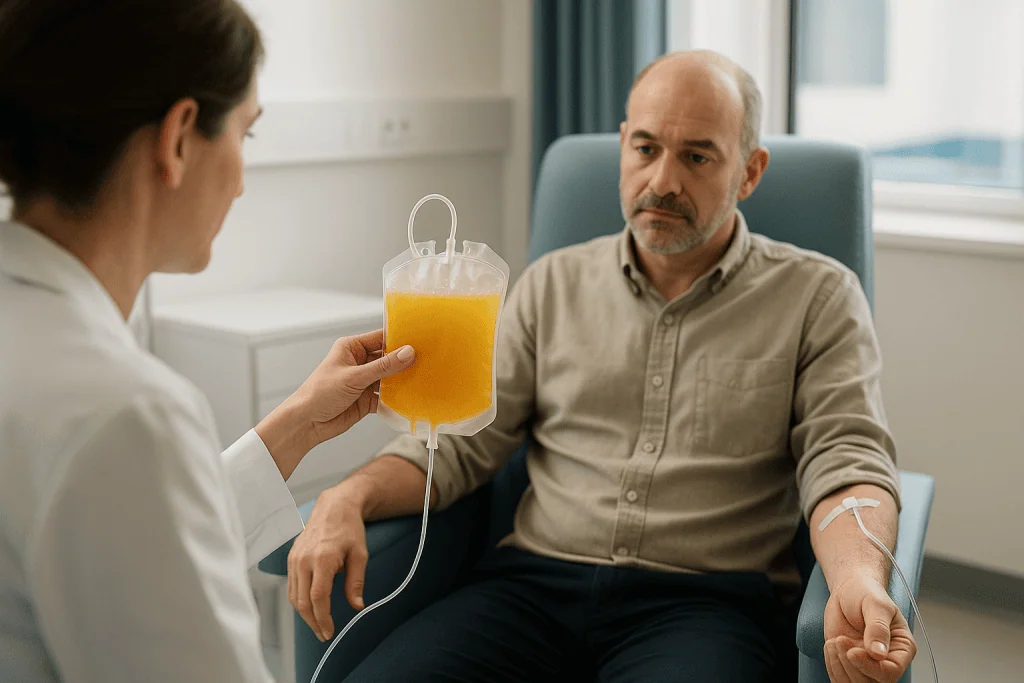
Unlike red cells, which are refrigerated, platelets are stored at room temperature with continuous gentle agitation, and they have a shelf life of only about five to seven days depending on the testing method used. That short window explains two things patients notice: why hospitals sometimes wait for a unit to arrive from the blood supplier, and why bacterial contamination is watched more closely for platelets than for any other blood component.
Before the bag is hung, two clinicians check your wristband against the label, confirming your name, date of birth, and the unit number. Platelets are matched by ABO blood group where possible, though unlike red cells they can sometimes be given across groups when supply is tight, and Rh-negative recipients of childbearing potential are usually given Rh-negative units or a preventive antibody injection, again per StatPearls.
The unit is connected to a standard intravenous line through a filter that catches clumps. A nurse records your temperature, pulse, blood pressure, and breathing before starting, again after the first 15 minutes, and at the end. If nothing unusual happens, the bag typically runs through in 30 to 60 minutes. A blood sample drawn between about 10 minutes and an hour afterward shows how much the count actually rose, which is the single most useful piece of information about whether the transfusion did its job.
Who is usually offered a platelet transfusion, and who is usually asked to wait?
Transfusion decisions split into two categories that feel similar to patients but are quite different to clinicians. A therapeutic transfusion is given to someone who is actively bleeding. A prophylactic transfusion is given to someone who is not bleeding but whose count has fallen low enough that spontaneous bleeding, particularly into the brain, becomes a realistic concern.
People most commonly offered prophylactic platelets are those whose marrow has been suppressed by chemotherapy, stem cell transplant conditioning, or a marrow disease such as acute leukemia. The AABB clinical practice guideline, published in Annals of Internal Medicine, recommends prophylactic transfusion in this group when the morning count falls to 10,000 per microliter or below. The evidence behind that threshold comes from randomized trials that compared a 10,000 trigger with older, higher triggers and found no increase in serious bleeding, which is why hospitals moved away from transfusing at 20,000 as routine.
Procedures raise the bar. The same guideline suggests transfusing to reach roughly 20,000 before placing a central venous catheter, and about 50,000 before a lumbar puncture or major non-neurological surgery, because the consequences of bleeding into a confined space are so much greater.
Who is asked to wait? Someone with ITP and no bleeding, because transfused platelets are destroyed quickly and treatment aims instead at the immune process. Someone with a stable count in the 20,000 to 50,000 range who is not bleeding and has no procedure planned. Someone whose thrombocytopenia stems from a clotting disorder such as thrombotic thrombocytopenic purpura or heparin-induced thrombocytopenia, where the StatPearls review notes transfusion may worsen clotting and is generally avoided outside life-threatening hemorrhage. Waiting is not neglect; it is the evidence-based default whenever the risks of a transfusion outweigh the risk of the number.
What platelet count for transfusion do guidelines use?
Patients often want a single magic number, and clinicians resist giving one, because the right threshold depends on what is happening in the body and what is about to happen in the operating room. The table below summarizes the thresholds described in the AABB guideline and the StatPearls review. Individual hospitals adapt these, and your team may reasonably choose differently based on your bleeding history, fever, kidney function, or medications.

| Clinical situation | Count commonly used as a trigger (per microliter) | Type of transfusion |
|---|---|---|
| Chemotherapy or marrow failure, no bleeding, no fever | 10,000 or below | Prophylactic |
| Central venous catheter placement | Below 20,000 | Pre-procedure |
| Lumbar puncture or major surgery outside the brain | Below 50,000 | Pre-procedure |
| Active, significant bleeding | Judged case by case; often kept above 50,000 | Therapeutic |
| Bleeding into the brain or eye, or brain surgery | Higher targets, often around 100,000 | Therapeutic or pre-procedure |
| Immune thrombocytopenia without bleeding | Transfusion usually not given regardless of count | Not indicated |
Two nuances get lost when people read only the numbers. First, a fever, an infection, or a fast-falling trend can push a team to transfuse at a higher count than the table suggests, because platelets are consumed faster when the body is inflamed. Second, a stable count slightly below a trigger in a person with no bleeding and no procedure may be watched rather than treated, especially if they have already shown poor responses to donor platelets. The AABB authors themselves graded much of this evidence as low or very low quality, which is honest scientific language for “we have reasonable practice, not certainty.”
Platelet transfusion: what to expect on the day
Most transfusions happen in a hospital bed, an infusion chair on a day unit, or occasionally an outpatient clinic room. Wear something with sleeves that roll up easily. Eat normally beforehand unless you have been told otherwise for another procedure; there is no fasting requirement for the transfusion itself, and the NHS notes people can usually eat and drink during a transfusion.
If you do not already have a central line or a port, a nurse will place a cannula, a thin plastic tube, into a vein in your hand or forearm. A blood sample is often drawn first to confirm your baseline count and, for a first transfusion, your blood group. There may then be a wait while the blood bank issues the unit, and because platelets are in short supply nationally, that wait can stretch to hours. This is the part patients find most frustrating, and it is worth asking the team for a realistic estimate rather than watching the door.
Once the bag is connected, you will feel nothing from the platelets themselves. The line may feel cool. The nurse checks your vital signs at the start, after 15 minutes, and at the end, and will ask you to report any itching, chills, back pain, breathlessness, or a sense that something is off. Speak up early; most reactions announce themselves in the first quarter hour.
How long does a platelet transfusion take? The infusion itself typically runs 30 to 60 minutes according to StatPearls, considerably faster than a red cell unit, which Mayo Clinic describes as one to four hours. Add pre-checks, waiting for the unit, and an observation period afterward, and a realistic block of time is two to four hours. Bring a book, a charger, and a companion if you are allowed one; the hour with the bag is rarely the long part.
Do platelets start working immediately after a transfusion?
Yes, and this is one of the more reassuring facts about the procedure. Donated platelets are functional the moment they enter circulation. They do not need to mature, be activated by the recipient’s body, or wait for a drug effect. If someone is bleeding from a low count, the new platelets begin plugging vessel walls within minutes, which is why a post-transfusion count is measured as early as 10 minutes after the bag finishes, as described in StatPearls.
How much the count rises depends on the recipient’s body size, the number of platelets in the unit, and whether anything is consuming or destroying them. In an average-sized adult with underproduction and no complicating factors, a single apheresis unit is generally expected to lift the count by roughly 30,000 to 60,000 per microliter, per the StatPearls review. That is the good scenario.
The disappointment, when it comes, is usually not about immediacy but about durability. Transfused platelets do not last as long as a person’s own. Their circulating lifespan is shortened by storage and by the recipient’s spleen, and in the presence of fever, infection, bleeding, an enlarged spleen, or certain medications, the count can drift back down within a day or two. Someone on active chemotherapy may need repeat transfusions every two to three days until their own marrow recovers, and that pattern is expected rather than a sign of failure.
Clinicians use a calculation called the corrected count increment, which adjusts the rise for body size and the number of platelets given, to judge whether a response was adequate. If two consecutive transfusions produce a poor increment measured within an hour, the team starts looking for a cause, a state called refractoriness that gets its own section below. The bottom line for patients: expect the effect right away, and expect it to be temporary.
Platelet transfusion side effects: what is common and what is rare
Most people walk away from a platelet transfusion feeling no different than when they sat down. When reactions occur, the majority are mild and short-lived. The most frequent are a febrile non-hemolytic reaction, which means a rise in temperature and sometimes chills during or shortly after the infusion without any breakdown of blood cells, and mild allergic reactions such as itching or hives. Both are described by the NHS and StatPearls as the reactions nurses most often manage at the bedside, typically by pausing the infusion and giving symptomatic treatment.
Platelets carry some risks that are relatively higher than for red cells, and honesty about them matters. Because platelets are stored at room temperature, bacterial contamination of a unit is more likely than with refrigerated components; modern testing and pathogen-reduction methods have reduced but not eliminated this risk, and it is the reason a new fever during a platelet transfusion is treated seriously rather than dismissed.
Two lung complications deserve mention because they are serious even though they are uncommon. Transfusion-associated circulatory overload, or TACO, occurs when the added fluid volume strains the heart and lungs, causing breathlessness and high blood pressure, and is a particular concern in older adults and people with heart or kidney disease. Transfusion-related acute lung injury, or TRALI, is a sudden inflammatory reaction in the lungs within six hours of transfusion, thought to be triggered by antibodies in donor plasma. Both require prompt medical management, which is why observation continues after the bag empties.
Longer-term, repeated transfusions can lead the immune system to develop antibodies against donor platelets, a process called alloimmunization, which makes future transfusions less effective. Viral transmission from screened donations in high-income countries is, per the NHS, exceedingly rare. None of this should frighten someone whose count is genuinely dangerous; it should simply inform the conversation about whether each transfusion is needed.
How serious is a platelet transfusion?
People ask this in two different senses, and both deserve an answer. The first is: how serious is the procedure itself? For the person receiving it, a platelet transfusion is a routine infusion, closer in experience to receiving intravenous fluids than to an operation. There is no anesthesia, no incision, and no recovery period in the surgical sense. Millions of platelet units are transfused worldwide each year, and the observation protocol exists precisely because reactions are manageable when caught early.
The second sense is: how serious is my situation if I need one? Here the honest answer is that a platelet transfusion signals that your count has reached a level where your team judges the risk of bleeding to outweigh the risks of the transfusion. That is a meaningful clinical moment, but it is also an expected one in many treatment pathways. Someone receiving intensive chemotherapy for acute leukemia is anticipated to need platelet support for days or weeks; it is built into the plan. The transfusion is not an emergency measure in that context but a scheduled part of care, the way a person on dialysis has a scheduled session.
Where it becomes more serious is when transfusion is being used because of active bleeding, when counts fail to rise despite transfusion, or when a person cannot receive platelets safely because of a clotting disorder. In those situations the transfusion is one tool among several, and the underlying illness, not the infusion, is what determines the outlook.
Guidelines from the AABB and reviews such as StatPearls stress a restrictive approach: transfuse when evidence shows benefit, hold when it does not. That philosophy is worth internalizing as a patient. A team that declines to transfuse at 25,000 in a calm, non-bleeding patient is following the evidence, not rationing your care.
Can you go home after a platelet transfusion?
Often, yes. Whether you go home depends far more on why you needed the platelets than on the transfusion itself. Many people with chemotherapy-related thrombocytopenia receive platelets on an outpatient day unit and leave within an hour or two of the bag finishing, once a nurse has rechecked their vital signs and, in many centers, confirmed that the post-transfusion count rose. The NHS describes blood transfusion as something commonly done as an outpatient procedure for people who are otherwise stable.
Staying in the hospital is usually about the bigger picture. Someone who is actively bleeding, who has a fever alongside a low count, who is in the middle of an inpatient chemotherapy cycle, or who is about to have surgery will remain admitted because those situations need monitoring, not because the platelets require it. Similarly, if a transfusion reaction occurred, the team will want a longer observation period before discharge.
If you are heading home, a few practical points make the next day safer. Arrange for someone to drive you if you feel tired or received medication for a reaction, since some antihistamines cause drowsiness. Keep the cannula site clean and dry for the first several hours, and watch for redness or swelling. Know the number to call out of hours, and ask specifically what count or symptom would prompt the team to want you back.
A low platelet count that has just been topped up is still a low platelet count in the sense that your marrow has not changed. Avoid contact sports, heavy lifting that strains, and any activity with a real risk of a fall for as long as your team advises. Use a soft toothbrush, an electric razor rather than a blade, and do not take aspirin or non-steroidal anti-inflammatory drugs unless your prescriber has specifically cleared them, because these medicines impair the platelets you just received.
What to expect after a platelet transfusion: the following days and weeks
The pattern of the days that follow depends almost entirely on what your bone marrow is doing. For someone whose count was low because of chemotherapy, the transfused platelets provide a bridge while the marrow recovers. That recovery usually takes one to three weeks after a chemotherapy cycle, with the exact timing depending on the drugs used and the person’s marrow reserve, and your team will draw counts every day or every few days to track it. During that window, further transfusions may be needed whenever the count dips below the trigger, and it is common to need several.
Bruises that were already present will fade on their own schedule, typically over one to two weeks, regardless of the transfusion. Petechiae, the pinpoint red dots that appear when tiny vessels leak, usually stop forming within a day or two once the count is adequate, and existing spots fade over a week or so as the skin clears the leaked blood. Nosebleeds and gum bleeding should ease quickly if they were driven by the low count; persistent bleeding after a transfusion that raised the count is something to report.
For someone with a chronic marrow disorder, such as myelodysplastic syndrome or aplastic anemia, transfusion may become a recurring event over months, and the conversation shifts to how to reduce the frequency and manage the risk of alloimmunization. For someone whose low count came from an acute event such as sepsis or massive bleeding, the count often recovers as the underlying problem resolves and no further transfusion is needed.
Expect follow-up blood tests. Expect your team to watch not just the count but your bleeding symptoms, because a person with a count of 15,000 and no bleeding is in a different situation from a person with a count of 30,000 and a bleeding gut. Keep a simple note of any bruising, nosebleeds, or dark stools; those observations often guide decisions more than the number does.
When transfusions stop working: refractoriness and alloimmunization
Some people notice that their count barely budges after a transfusion, or rises and then collapses within hours. Clinicians call a consistently poor response platelet refractoriness, formally defined by a low corrected count increment on at least two consecutive occasions when measured 10 to 60 minutes after transfusion, as described in StatPearls. Understanding why it happens matters, because the fixes differ.
Most refractoriness is non-immune. Fever, infection, sepsis, an enlarged spleen, active bleeding, disseminated intravascular coagulation, and certain medications including some antibiotics and antifungals all shorten platelet survival. In these cases the platelets are working but being consumed or sequestered as fast as they arrive. The remedy is to treat the driver, and the team may accept a lower count in the meantime.
Immune refractoriness, or alloimmunization, is different. After repeated exposure to donor platelets, some people develop antibodies against human leukocyte antigens, HLA, a set of protein markers on the surface of platelets and most other cells that differ between individuals. Those antibodies coat incoming platelets and the spleen removes them within hours. Alloimmunization is confirmed by a blood test that detects the antibodies, and it is managed by requesting HLA-matched or crossmatch-compatible platelets from the blood supplier, a process that takes longer and depends on donor registry availability.
Historically, alloimmunization rates were high, but the routine removal of white blood cells from blood components, called leukoreduction, has lowered the risk substantially, per the StatPearls review. If you have had many transfusions and are responding poorly, ask whether an HLA antibody screen has been done. The distinction between “the platelets are not working” and “the platelets are being destroyed” changes the plan, and it is a legitimate question for any patient to raise.
Alternatives and what else the care team may consider
A platelet transfusion treats the number, not the cause, and a thoughtful team is always asking whether something else would serve better. What that something is depends on the mechanism behind the low count.
When the cause is immune destruction, as in ITP, the first-line approach is usually medication that dampens the immune attack, most commonly corticosteroids, sometimes with intravenous immunoglobulin for faster effect. These work over days rather than minutes and are prescribed and adjusted by the treating hematologist; MedlinePlus and Mayo Clinic both describe them as the usual starting point. For longer-term control, a class of medicines called thrombopoietin receptor agonists can stimulate the marrow to make more platelets, and they are also used in some people with chronic liver disease before procedures and in certain marrow failure conditions. Whether any of these is appropriate is a decision for your prescriber based on your diagnosis.
When bleeding is the problem, particularly from mucosal surfaces such as the nose, gums, or uterus, an antifibrinolytic medicine such as tranexamic acid, which slows the breakdown of clots that have already formed, may be considered alongside or instead of platelets. It does not raise the count.
When a medication is causing the low count, stopping or switching it, under the prescriber’s direction, is often the most effective single step. When an enlarged spleen is sequestering platelets, treating the underlying liver or blood disease is the target. When the marrow is suppressed by chemotherapy, the alternative to transfusion is frequently simply time, with careful monitoring and a restrictive trigger.
None of these replaces transfusion in someone who is bleeding dangerously with a very low count. They are the reason, though, that two people with identical counts can receive entirely different plans, and why the question “why this, rather than something else?” is always worth asking.
What people often get wrong about platelet transfusions
“A transfusion will fix my platelet problem.” It will raise the count for a matter of days at most. It does nothing to the marrow, the immune system, or the spleen. Think of it as a bridge, never a repair.
“If my count is under 50,000, I need platelets.” Guidelines from the AABB place the routine prophylactic trigger for stable, non-bleeding patients with marrow suppression at 10,000, not 50,000. The higher figure applies to surgery and specific procedures. Many people live safely for extended periods with counts between 20,000 and 50,000 and no transfusion at all.
“Platelets are just a type of blood transfusion, so the risks are identical.” Platelets carry a relatively higher risk of bacterial contamination and of febrile and allergic reactions than red cells, because of room-temperature storage and the plasma they arrive in. They also carry a lower risk of fluid overload per unit because the volume is smaller. Different component, different risk profile.
“Eating certain foods will raise my platelets instead.” No diet, supplement, or herbal product has been shown in controlled trials to raise platelet counts meaningfully in people with thrombocytopenia from marrow suppression or immune destruction. Some supplements, including high-dose fish oil, ginkgo, and vitamin E, may impair platelet function and are generally discouraged; check anything you take with your team.
“Donated platelets could give me the donor’s blood type or illness.” Platelets do not change your blood type. Donations are screened for hepatitis B and C, HIV, syphilis, and other infections, and the NHS describes transmission risk from screened donations as extremely low.
“A poor response means the hospital gave me a bad unit.” Almost always it means something in your body, fever, infection, spleen, or antibodies, is shortening platelet survival. The unit is the same; the recipient’s circumstances differ.
Questions to ask your care team before and after a platelet transfusion
Good questions do more than gather information; they signal to your team what you are worried about and often surface reasoning that would otherwise stay in the chart. Bring these written down, because it is hard to think clearly when someone is taping a cannula to your arm.
- Why is my count low, and is the cause underproduction, destruction, or something else? The answer shapes whether transfusion is likely to help.
- What count are you using as the trigger for me, and why that number rather than the guideline default?
- Is this transfusion to prevent bleeding or to treat bleeding that is already happening?
- What rise in count would you consider a good response, and when will you check it?
- How many transfusions do you anticipate I might need over the coming days or weeks, given my treatment plan?
- Have I been tested for HLA antibodies, and would that change which platelets you order for me?
- Which of my current medicines or supplements affect platelets, and should any be paused? Please do not stop anything on your own; ask.
- Is there an alternative or an addition to transfusion that suits my situation, such as a medicine that stimulates production or one that stabilizes clots?
- What symptoms would you want me to call about tonight, and what number do I ring after hours?
- Can I go home after this one, and what activities should I avoid until my next count?
After the transfusion, ask what the post-transfusion count was and how it compares with what the team expected. That single number tells you more about your own biology than any general article can, and it is your result to know. If the response was poor, ask what the leading explanation is and what the plan is if it happens again. A team that welcomes these questions is a team practicing evidence-based medicine out loud, which is exactly what you want.
When to call your doctor: red-flag signs during and after a platelet transfusion
During the infusion, tell the nurse immediately about any of the following, even if it seems minor: chills or shaking, a new fever, itching or hives, flushing, pain in the back or chest, a racing heart, breathlessness, wheezing, a feeling of dread, or dark urine. The infusion can be paused within seconds, and early reporting is what keeps mild reactions mild.
In the hours after leaving, seek urgent care or call emergency services if you develop sudden shortness of breath, chest tightness, a fever with chills, fainting, or a severe headache with confusion, vomiting, or weakness on one side of the body. Sudden breathing difficulty within six hours can indicate a lung reaction such as TRALI or TACO, and a new severe headache in someone with a low platelet count must always be assessed for bleeding inside the skull.
Bleeding red flags at any time with a low count include: a nosebleed that does not stop after 20 minutes of firm pressure, blood in the urine, black or tarry stools or visible blood in the stool, vomiting blood or material that looks like coffee grounds, heavy or prolonged menstrual bleeding, spreading bruises that appear without injury, a widespread rash of pinpoint red dots that is new or rapidly increasing, or bleeding from the gums that will not settle. Any blurred vision or new visual disturbance also warrants a same-day call, because bleeding into the retina can occur with very low counts.
Call your team on the ordinary line, rather than waiting for the next appointment, if you notice redness, swelling, warmth, or discharge at the cannula site, if a fever develops a day or two after the transfusion, or if you feel unusually tired, dizzy on standing, or unwell in a way you cannot name. None of these signs means something has gone wrong for certain. All of them mean your team should know today rather than next week, and every one of these decisions belongs with the clinicians who know your case.
Frequently asked questions
How serious is a platelet transfusion?
As a procedure, a platelet transfusion is a routine intravenous infusion with no anesthesia or incision, and most people feel nothing beyond the cannula. Its seriousness lies in what it signals: a platelet count low enough, or bleeding significant enough, that the treating team judges transfusion worthwhile. In many chemotherapy pathways, that moment is anticipated and planned for rather than an emergency. The underlying condition, not the infusion, determines how serious the overall situation is.
Can you go home after a platelet transfusion?
Many people do, especially those receiving platelets on an outpatient day unit for chemotherapy-related low counts. After the bag finishes, a nurse rechecks vital signs and often confirms the count rose before discharge, usually within an hour or two. Staying in the hospital is generally about the bigger picture, such as active bleeding, fever, ongoing inpatient chemotherapy, or a reaction during the infusion, rather than about the transfusion itself. Your team decides based on your situation.
Do platelets start working immediately after a transfusion?
Yes. Donor platelets are functional as soon as they enter the bloodstream and begin plugging damaged vessel walls within minutes, which is why post-transfusion counts are measured as early as 10 minutes afterward. The limitation is durability rather than speed: transfused platelets survive a shorter time than a person’s own, and fever, infection, an enlarged spleen, or antibodies can shorten that further, so counts often need rechecking within a day or two.
What is the success rate of platelet transfusion?
There is no single success rate, because the goal differs from person to person. Clinicians judge each transfusion by the corrected count increment, a calculation that adjusts the rise in platelet count for body size and the number of platelets given. In an average adult with underproduction and no complicating factors, one unit typically raises the count by about 30,000 to 60,000 per microliter, per StatPearls. Fever, infection, bleeding, or antibodies reduce that response, sometimes substantially.
How long does a platelet transfusion take?
The infusion itself typically runs about 30 to 60 minutes, faster than a red cell unit, which Mayo Clinic describes as taking one to four hours. The full visit is longer: expect time for a cannula, baseline blood tests, waiting for the blood bank to issue the unit, vital-sign checks during the infusion, and an observation period afterward. A realistic block is two to four hours, and delays waiting for platelets are common because supply is limited.
What platelet count for transfusion do doctors use?
For stable, non-bleeding people with chemotherapy or marrow-related thrombocytopenia, the AABB guideline recommends prophylactic transfusion at a count of 10,000 per microliter or below. Higher thresholds apply before procedures: roughly 20,000 for a central line and about 50,000 for a lumbar puncture or major surgery. Active bleeding, brain surgery, or bleeding into the eye or brain call for higher targets. Fever, infection, and bleeding history can shift the trigger, so your team’s number may differ.
What are the most common platelet transfusion side effects?
The most frequent reactions are mild: a rise in temperature with or without chills, called a febrile non-hemolytic reaction, and allergic symptoms such as itching or hives. Both are usually managed at the bedside by pausing the infusion. Less common but serious reactions include bacterial contamination, fluid overload affecting the heart and lungs, and transfusion-related acute lung injury within six hours. Repeated transfusions can also lead to antibodies that make future units less effective.
Why do transfused platelets not last as long as my own?
Platelets stored for days at room temperature undergo changes that shorten their survival once infused, and the recipient’s spleen clears them faster than freshly made cells. A person’s own platelets circulate for about a week to ten days; transfused ones often last a few days at most. Fever, infection, active bleeding, an enlarged spleen, certain antibiotics, and antibodies against donor platelets all shorten survival further, which is why repeat transfusions are common during chemotherapy.
Can platelet transfusion change my blood type or give me an infection?
A platelet transfusion does not change your blood type; platelets carry surface markers but do not replace your own red cells or the genes that determine your group. Donations are screened for hepatitis B and C, HIV, syphilis, and other infections, and the NHS describes the risk of transmission from screened blood as extremely low. Bacterial contamination of a unit is a separate, uncommon risk that hospitals monitor by treating any new fever during a platelet transfusion seriously.
What happens if my platelet count does not rise after a transfusion?
A poor rise on two consecutive transfusions is called refractoriness, and the team will look for a cause. Most often it is non-immune: fever, infection, bleeding, an enlarged spleen, or medications consuming platelets quickly. Less commonly, antibodies against donor HLA markers destroy the platelets within hours; a blood test can detect these, and HLA-matched or crossmatched platelets may then be requested from the blood supplier. Ask your team which explanation applies to you and what the plan is.
References
- MedlinePlus: Thrombocytopenia
- NHS: Blood transfusion
- Cleveland Clinic: Thrombocytopenia (Low Platelet Count)
- NIH National Library of Medicine, StatPearls: Platelet Transfusion
This article is for general information only and is not a substitute for professional medical advice. Please consult a qualified doctor about your individual situation.

More from the Blog

Monitoring Marrow Failure Between Visits: Blood Counts, Infection Signs and Transfusion Needs
Between clinic visits, monitoring marrow failure rests on three habits: scheduled complete blood counts that track neutrophils, hemoglobin and platelets; daily attention to fever,…

Why a Peripheral Smear Is Ordered Alongside a Platelet Count in Thrombocytopenia
A peripheral smear is ordered alongside a platelet count in thrombocytopenia because the automated count can be misleading and, on its own, says nothing…

Factor Replacement Therapy for Hemophilia: How Infusions Are Given and Monitored
Factor replacement therapy treats hemophilia by infusing the missing clotting protein, factor VIII in hemophilia A or factor IX in hemophilia B, directly into…

Von Willebrand Disease and Pregnancy: How Hematology and Obstetrics Plan Delivery Together
Most people with von Willebrand disease can have a healthy pregnancy and birth. Von Willebrand factor usually rises during pregnancy, then drops quickly after…

Fever, Bleeding or Severe Fatigue With Bone Marrow Failure: Why Prompt Contact Matters
With bone marrow failure, a fever, new or unusual bleeding, or a sudden, severe drop in energy should prompt a same-day call to your…

Anemia in Older Adults: Why the Cause Search Is Wider and How Treatment Is Paced
Anemia treatment in older adults starts with finding the cause, not just raising the blood count. Common causes include iron loss from slow gut…