

Preparing for a Lyme Disease Consultation: Rash Photos, Exposure Timeline and Past Test Results

Key Takeaways
- The Lyme rash appears 3 to 30 days after a bite and often fades before the visit, so dated daily photos with a coin for scale are the single most valuable thing to bring.
- In most cases a tick must be attached for 36 to 48 hours or more to transmit Lyme bacteria, so your best estimate of attachment time belongs in the exposure timeline.
- Standard Lyme testing is two-tier: a screening antibody test followed by a confirmatory test, and a result counts as positive only when both agree.
- Antibodies take weeks to form, so a negative test drawn in the first days of illness does not exclude infection, and the draw date is the most important number on an old report.
- Antibodies can persist for years after successful treatment, which is why a positive test cannot distinguish current from past infection or be used to check that treatment worked.
- The CDC advises against basing treatment decisions on laboratory testing of the tick itself, though the tick's species and engorgement still help estimate risk.
For a Lyme disease appointment, bring dated photos of any rash, a written timeline of outdoor exposure and tick bites, copies of previous Lyme test results with the dates they were drawn, a list of current symptoms and when each began, and your medication and allergy list. If you saved the tick, bring it in a sealed bag. Your clinician weighs these details alongside a physical examination to decide whether testing or treatment is appropriate.
The rash was the size of a quarter on Tuesday. By Saturday it had crept past the edge of her sock line, pale in the middle, pink at the rim, and not the least bit itchy. She had already searched for it twice, deleted the search twice, and finally booked the appointment. Then the more practical worry set in: what to bring to a Lyme disease appointment so the visit would actually settle something.
It is a reasonable question, because Lyme disease is one of the few infections where your own record-keeping can change the quality of the medical decision. The bacteria hide, the blood tests lag behind the illness, and the most useful clue, the expanding rash, has often faded by the time anyone with a stethoscope sees it.
This guide walks through what clinicians genuinely find helpful, why each item matters, and what you can safely leave at home.
What to bring to a Lyme disease appointment: the short version
Clinicians assessing possible Lyme disease are trying to answer three questions at once. Was there plausible exposure to infected ticks? Does the story and the skin fit the infection? And does anything from the past, including old test results, change how today’s findings should be read? Everything worth carrying into the room supports one of those three questions.
- Photographs of any rash or bite site, ideally taken on several different days, with the date visible or preserved in the file information.
- A one-page exposure timeline: where you have been outdoors, what you were doing, any tick you found, and roughly when you removed it.
- Copies of any previous Lyme disease blood tests, with the full laboratory report rather than a summary line.
- A short symptom log listing what you noticed, when it started, and whether it has changed.
- Your current medications, supplements and allergies, especially any past reaction to an antibiotic.
- The tick itself, if you kept it, sealed in a small bag or taped to an index card.
Notice what is not on the list. You do not need a printout of internet theories, a self-diagnosis, or results from a mail-order tick test. Those tend to steer the conversation away from the examination and toward debate.
A physical examination still anchors the visit. The Centers for Disease Control and Prevention (CDC) notes that the characteristic rash, called erythema migrans, is diagnosed by a clinician looking at it in a person with a credible exposure history, without waiting for blood work. Your job is to make that history as clear and verifiable as possible.
How a Lyme disease consultation actually works
Most appointments follow a recognizable arc, even if the clinician never announces the steps. The first part is conversation. You will be asked about the past month or so: travel, hiking, gardening, camping, pets that roam, and whether you noticed a tick or a bite. Expect questions about fever, aches, headache, unusual tiredness, and any weakness in the face, because those are patterns clinicians are trained to weigh together.

Next comes the examination. The clinician will look at the rash if there is one, measure it, and check skin folds and the scalp where bites are easily missed. They may listen to the heart, test facial movement, and examine joints for swelling. According to the CDC, erythema migrans (a slowly expanding red or pink patch at the bite site) appears in roughly 70 to 80 percent of infected people, so its presence or absence carries real weight.
Only then does testing come up, and only when it can help. The standard approach is called two-tier serology, which means a first blood test screens for antibodies, the proteins your immune system makes against the bacteria, and a second test confirms a positive or borderline result. The CDC’s testing guidance explains that antibodies take weeks to develop, so someone tested in the first days of illness may test negative despite being infected.
The visit usually ends with one of three plans: treat now based on the rash and history, test and wait for results, or watch and re-evaluate. Each is a legitimate outcome, and each depends on the quality of the information you brought. A clear photo of a rash that has since faded can be the difference between the first plan and the second.
Why Lyme disease rash pictures matter more than you think
Ask any clinician what they wish patients brought more often, and dated rash photos come near the top of the list. The reason is timing. The CDC describes erythema migrans as appearing 3 to 30 days after a bite, most often around a week, and expanding gradually over days. By the time you are sitting in an exam room, the rash may be at its largest, already fading, or gone altogether. A series of photos turns a single snapshot into a time-lapse, and the direction of change is diagnostic information.
Photos also correct a stubborn misconception. Many people expect a crisp target with rings, and the classic bull’s-eye does occur, but the CDC and the National Health Service (NHS) both note that the rash is frequently a plain, uniformly pink or red oval. It can look bruised on darker skin. It is rarely itchy or painful, which is part of why people ignore it. A photo lets the clinician judge shape, color and border without relying on your memory of what “sort of round” meant.
Size matters too. The CDC notes the rash can grow to 12 inches (30 centimeters) or more across. A reaction to the bite itself, by contrast, tends to stay small, often under an inch, and settles within a day or two. Photos taken 48 hours apart make that distinction easy.
Finally, pictures protect against the reverse error. If the mark was a spider bite, ringworm, or a skin allergy, a good image series helps your clinician say so with confidence rather than reaching for antibiotics out of caution.
How to photograph a tick bite or rash so the photos are actually useful
Phone cameras are good enough; technique is what fails. A few habits make the difference between an image that helps and one that gets squinted at and set aside.
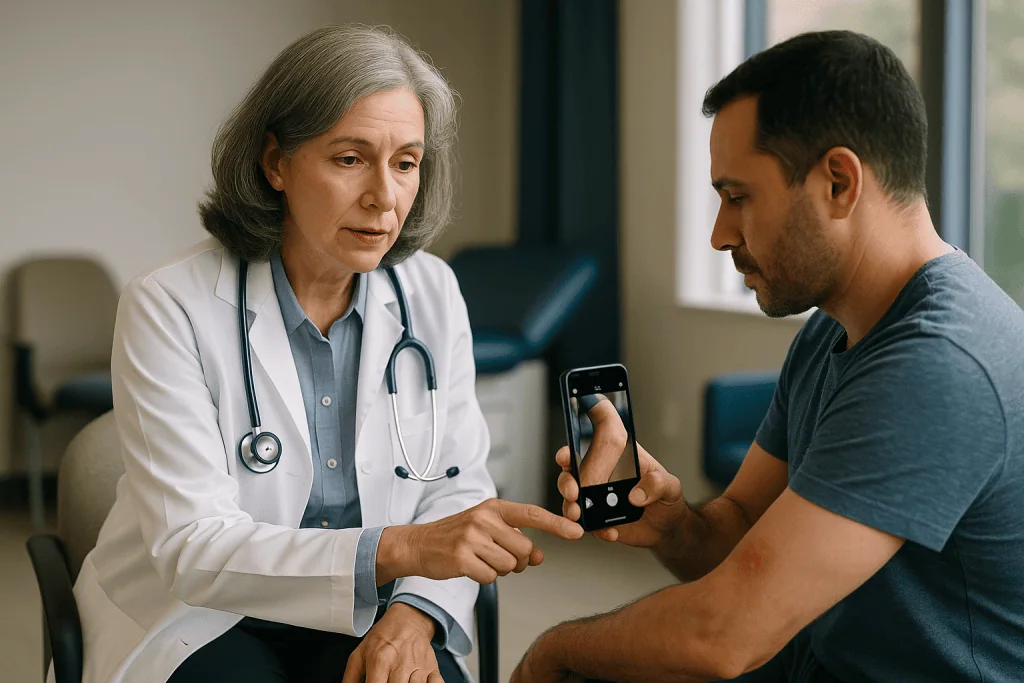
Use daylight from a window rather than a bathroom bulb, which shifts skin tones toward yellow or green. Turn off any beauty filter or automatic skin-smoothing setting, because those features literally erase the border you are trying to document. Hold the camera directly above the rash, not at an angle, so the shape is not distorted.
Place a familiar object beside the rash for scale. A coin works well; so does a ruler or the edge of a bank card. Take one close photo with the scale object and one wider shot showing where on the body the rash sits, since location is part of the story. Bites on the back of the knee, groin, waistband or scalp are typical tick sites.
Repeat at roughly the same time each day, from the same distance, until your appointment. If the rash is growing, drawing a line around its edge with a ballpoint pen before photographing gives a crisp reference for the next day’s picture.
Do not edit the images. Cropping is fine; brightness adjustments are not, because you may accidentally exaggerate or hide redness. Keep the originals so the date and time information stays embedded in the file.
If someone else saw the rash earlier, ask whether they took a photo. Partners and parents often have the earliest and most informative picture without realizing it. Bring everything on the phone itself rather than printing, so the clinician can zoom in.
Building your Lyme disease exposure timeline
An exposure timeline is simply a dated list of moments when a tick could plausibly have reached your skin. It does not need to be elegant. A page of notes in your phone will do, but it should be honest about uncertainty. “Weekend camping about two weeks before the rash, do not remember a tick” is more useful than a confident guess.
Work backward from the first symptom or the first day you noticed the rash. The CDC’s incubation range of 3 to 30 days gives you a window; anything outdoors in the month before matters. Note the type of terrain. Ticks that carry Lyme bacteria favor grassy, brushy and wooded areas and are especially active in late spring and summer, when the tiny nymph stage feeds, according to the CDC. Nymphs are about the size of a poppy seed and are the stage most often responsible for infection because they are so easily missed.
If you found a tick, record where on the body it was, how large and how engorged it looked, and your best estimate of how long it had been attached. The CDC notes that in most cases the tick must be attached for 36 to 48 hours or more before Lyme bacteria are transmitted, so a tick you brushed off after a morning walk is a very different exposure from one discovered after a weekend.
Geography counts. The CDC identifies the Northeast, mid-Atlantic, upper Midwest and parts of the Pacific coast as the regions where most United States cases occur, and the NHS notes cases occur across the United Kingdom and much of Europe. Mention recent travel, including short trips, and whether pets that go outdoors sleep on your bed.
Should you bring the tick itself?
If you still have it, yes, but understand what it can and cannot tell anyone. A tick in a sealed bag lets the clinician confirm the species and judge how engorged it was, which is a rough proxy for attachment time. Both details help estimate risk. An unfed tick that looks like a flattened sesame seed is reassuring; a plump grey one suggests it fed for a while.
What the tick cannot do is decide your treatment. The CDC advises against relying on tick testing to guide care, because a tick carrying the bacteria may not have transmitted them, and a negative tick result does not rule out infection from a different tick you never noticed. If you have already paid for a laboratory tick test, bring the result, but do not expect it to override your own symptoms and history.
Removing a tick correctly also protects the evidence. The CDC recommends fine-tipped tweezers, grasping the tick as close to the skin as possible and pulling upward with steady pressure, then cleaning the bite with soap and water or rubbing alcohol. Twisting, burning, or smothering with petroleum jelly or nail polish is discouraged; those methods delay removal and may leave the mouthparts behind. If a fragment stays in the skin and will not come out easily, the CDC advises leaving it alone and letting the skin heal.
To preserve the tick, drop it in a small zip bag or tape it flat to a white card and write the removal date and body location beside it. Kept dry at room temperature, it will remain identifiable for weeks.
Past test results: Lyme disease test results explained
Old Lyme tests are among the most misread documents in medicine, which is precisely why the full report belongs in your folder. Bring the laboratory printout, not a summary that says “positive” or “negative,” because the details change the interpretation entirely.
Start with the two-tier structure described by the CDC. The first tier is an immunoassay, often called an EIA or ELISA, which measures total antibody against the Lyme bacteria. If it is negative, testing usually stops. If it is positive or equivocal, a second-tier test follows, either a Western blot or a second, different immunoassay. A result is considered positive only when both tiers agree. A lone first-tier positive, without a confirming second tier, is not a diagnosis.
Look for two antibody types on the report. IgM antibodies (the early response) rise in the first weeks; IgG antibodies (the longer-term response) build over the following weeks and months. The CDC cautions that IgM results are unreliable after the first month of illness and are prone to false positives, so an isolated IgM band from a test drawn long after exposure means less than it appears to.
The date the blood was drawn may be the single most important number on the page. A negative test in the first week of a rash does not exclude infection, because antibodies have not yet formed. A positive test from years ago does not prove current infection, because the CDC notes antibodies can persist for years after successful treatment. Tests measure your immune memory, not live bacteria, which is also why they are not used to check whether treatment worked.
A one-page checklist: what to bring and why it helps
The table below condenses the earlier sections into something you can screenshot. Each item is paired with the clinical question it helps answer, so you can prioritize if you are short on time.
| Item | What it helps the clinician judge | Practical tip |
|---|---|---|
| Dated rash or bite photos | Whether the mark is expanding in the pattern of erythema migrans, or a local bite reaction | Daylight, no filters, coin for scale, originals kept on the phone |
| Exposure timeline | Plausibility and timing of a tick bite within the 3 to 30 day incubation window | Work backward from first symptom; admit uncertainty |
| The tick (sealed) | Species and engorgement, a rough guide to attachment time | Tape to a card with removal date; do not rely on tick testing |
| Previous lab reports | Which tier was performed, IgM versus IgG, and how long after exposure blood was drawn | Full printout with reference ranges, not a summary |
| Symptom log | Onset, sequence and change over time | Plain descriptions, no self-labels |
| Medication and allergy list | Safe choices if treatment is offered | Include supplements and past antibiotic reactions |
| Prior clinic notes or discharge letters | Whether Lyme was considered or treated before | Especially any earlier antibiotic course and its timing |
If you can only manage two items, make them the photos and the timeline. Those are the two things nobody else can reconstruct for you. Laboratory reports can often be retrieved later from the testing facility, and your medication list is usually in the pharmacy record.
One more small thing: write your questions down before the visit. Anxiety shortens memory, and the consultation moves faster than most people expect.
Who a Lyme evaluation is usually for, and who is usually asked to wait
Not everyone who finds a tick needs a blood test, and not everyone with a puzzling rash needs Lyme treatment. Understanding where you fit helps set expectations before you walk in.
People with an expanding rash consistent with erythema migrans and a believable exposure are usually assessed and treated promptly. The CDC’s guidance is explicit that laboratory testing is not required in this situation, because the rash itself is the diagnosis in the right setting. Waiting for antibodies would only delay treatment during the window when tests are least reliable.
People with fever, aches and headache after a known bite, but no rash, occupy a middle ground. The clinician may test, may treat based on judgment, or may ask you to return if symptoms persist so that a repeat test can be drawn after antibodies have had time to form.
People who found a tick but feel entirely well are often asked to wait and watch. Testing right after a bite is not useful, because the body has not yet mounted an antibody response. The CDC recommends monitoring the bite area and general health for about 30 days and seeking care if a rash or fever develops. In certain circumstances, such as a tick known to have been attached for a long time in a high-incidence area, clinicians may discuss a preventive antibiotic; that judgment sits with the prescriber.
People with months of fatigue or joint pain and no clear exposure may be tested, but a thoughtful clinician will also explore other explanations, since many conditions share those symptoms. Being asked to wait, or to consider alternatives, is not dismissal. It reflects where the evidence is strongest.
How to describe your symptoms without diagnosing yourself
Clinicians hear two versions of the same story. One is “I have Lyme disease.” The other is “Ten days after a hike I started running a low fever, then a pink patch appeared behind my knee and has grown every day.” The second version is far more useful, not because the first is wrong, but because it leaves the interpretation to the person examining you.
Keep a simple log with three columns: what you noticed, when it started, and how it has changed. Describe sensations plainly. A joint that is swollen and warm is different from one that merely aches. A headache with a stiff neck is different from a tension headache. Facial weakness, a drooping eyelid or trouble closing one eye deserves its own line, since the Mayo Clinic notes that nerve involvement can appear weeks after the initial infection.
Record the pattern, not just the presence. Symptoms that come and go, migrate from one joint to another, or appear in a sequence tell a story. Note whether fever was measured or estimated, and whether anyone else in the household or on the same trip became ill.
Avoid ranking your symptoms against lists found online. Fatigue, muscle aches and headache appear in dozens of illnesses, from ordinary viral infections to other tick-borne infections such as anaplasmosis or babesiosis, which the CDC notes can be transmitted by the same ticks. Your clinician will consider those possibilities; your job is to give them accurate raw material.
If English is not your first language or medical conversations make you freeze, bring someone who can help you tell the story in order. A second set of ears also helps afterward, when instructions blur.
What the following days and weeks usually look like
What happens after the appointment depends on which of the three plans you left with, so it helps to know the typical shape of each.
If treatment was started for early Lyme disease, expect a course of oral antibiotics whose length is set by your prescriber. Antibiotics in this setting work by stopping the bacteria from multiplying so the immune system can clear them. The rash generally fades over days to a couple of weeks, though the CDC notes that fatigue and aches can linger for some weeks even when treatment has worked. That lingering does not by itself mean the infection persists, and the CDC does not recommend repeat antibody testing to check, because antibodies remain detectable long after the bacteria are gone.
If blood was drawn, first-tier results usually return within a few days, and a second-tier test adds more time. Ask how you will be told, and whether a repeat test is planned if the first is negative but symptoms continue.
If you were asked to watch and wait, the CDC’s 30-day monitoring window is your guide. Photograph the bite area every couple of days and take your temperature if you feel unwell, so that any return visit comes with the same quality of evidence as the first.
A minority of people treated for Lyme disease report symptoms such as fatigue, pain or difficulty concentrating that persist for more than six months, a pattern the CDC calls post-treatment Lyme disease syndrome. The cause is not fully understood, and the CDC states that long courses of antibiotics have not been shown to help and carry real risks. If this becomes your situation, the conversation shifts toward managing symptoms and ruling out other causes, and it belongs with your care team.
What people often get wrong about Lyme disease and its tests
Some of the most persistent errors around Lyme disease come from half-truths that sound plausible. Correcting them before your visit saves time in the room.
The rash always looks like a target. A ringed bull’s-eye is the textbook image, but the CDC and NHS both describe many cases with a uniformly colored patch, and the rash can be subtle on darker skin. Absence of rings proves nothing.
A negative test rules Lyme out. Only if it was drawn late enough. Antibodies take weeks to appear, so a test in the first days of illness can be falsely negative. This is the single strongest argument for bringing the date of any past test.
A positive test means active infection. Not necessarily. The CDC notes antibodies can persist for years after treatment. Serology measures immune memory, not live bacteria.
Testing the tick settles it. The CDC advises against using tick test results to make treatment decisions. The tick that infected you may not be the one you found.
Ticks jump or fall from trees. They wait on low vegetation and grab passing skin or clothing. Most bites happen at ankle, knee and waist height.
You need deep woods to be at risk. Suburban yards, park edges and leaf litter under garden shrubs are common exposure sites, according to the CDC.
Heat or petroleum jelly removes a tick safely. These methods delay removal. Fine tweezers and steady upward pressure remain the recommended technique.
Lingering tiredness after treatment means the antibiotic failed. Fatigue can outlast the infection for weeks. The CDC does not support repeated or prolonged antibiotic courses for this pattern, citing lack of benefit and documented harms.
Questions to ask your doctor about Lyme disease at the visit
Good questions do two things: they fill gaps in your understanding, and they signal to the clinician which uncertainties worry you most. Bring these written down, and add your own.
- Based on the rash and my exposure, do you think testing will add information, or would you diagnose on examination alone?
- If you are ordering a test, how long after my likely exposure will the blood be drawn, and could the result be falsely negative at this stage?
- Which type of test is this, and will a second confirmatory test follow automatically if the first is positive or borderline?
- How should I read my earlier results, given the date they were drawn and the antibody types listed?
- If you are recommending treatment, how does the medicine work, how long does the rash typically take to fade, and what side effects should prompt a call?
- Are there other tick-borne infections you are considering, and would they change the plan?
- If we are watching and waiting, what specifically should make me come back sooner, and how should I document it?
- How will I receive results, and who do I contact if I have not heard by a certain point?
- Are there symptoms after treatment that you would consider expected, and which would concern you?
- Should family members or pets who shared the same exposure be checked?
Avoid asking the clinician to guarantee an outcome. Nobody can promise how quickly you will feel well, and a clinician who declines to promise is being honest, not evasive. The more useful ask is “what would change your mind,” because it reveals the reasoning behind the plan and tells you exactly what to watch for once you leave.
When to call your doctor
Most Lyme disease is identified early and treated in an ordinary outpatient setting. A small number of situations, however, should not wait for a routine appointment or a scheduled follow-up. Contact your care team promptly, or seek urgent care, if any of the following develop, whether or not you have started treatment.
- New weakness or drooping on one or both sides of the face, or difficulty closing an eye. The Mayo Clinic and CDC describe facial nerve palsy as a recognized early neurological sign that warrants prompt assessment.
- Severe headache with a stiff neck, sensitivity to light, or confusion, which can indicate involvement of the nervous system.
- Palpitations, fainting, light-headedness, chest pain or unexplained shortness of breath. The CDC notes that Lyme carditis, in which the infection disrupts the heart’s electrical signaling, can cause dangerously slow rhythms and needs immediate evaluation.
- A joint, most often a knee, that becomes markedly swollen, hot or difficult to bend.
- A rash that continues to spread rapidly, blisters, or is accompanied by high fever, particularly if multiple rashes appear on different parts of the body.
- Any sign of an allergic reaction after starting an antibiotic, such as hives, swelling of the lips or face, or trouble breathing, which requires emergency care.
- Severe or bloody diarrhea during or after antibiotic treatment.
Call as well if you were asked to watch and wait and a rash or fever appears within the 30-day window, or if symptoms you were told to expect to improve are instead getting worse. Bring the same evidence you gathered for the first visit, updated, because fresh photos and a continued log make the follow-up decision faster and safer.
Every decision about testing, treatment and follow-up rests with the team examining you. This article is meant to help you arrive prepared, not to replace that conversation.
Frequently asked questions
What should I bring to a Lyme disease appointment if I never saw a tick?
Bring the same core items: dated photos of any rash, a timeline of outdoor activity in the month before symptoms, previous test reports and a symptom log. Most people with Lyme disease never notice the tick, because the nymph stage is roughly poppy-seed sized. A clear account of where you were and when is enough for a clinician to judge exposure risk without a confirmed bite.
Do Lyme disease rash pictures need to show a bull's-eye to be taken seriously?
No. The ringed target is only one appearance of erythema migrans. The CDC and NHS describe many cases as a uniformly pink or red expanding oval, and the rash may look bruised on darker skin. What matters most is growth over days, so a series of photos showing the patch enlarging is more persuasive than a single dramatic image.
How far back should my Lyme disease exposure timeline go?
Cover at least the 30 days before your first symptom or the first day you noticed the rash, since the CDC gives an incubation range of 3 to 30 days. Include short outings, gardening, and pets that roam outdoors. If you are being assessed for later symptoms such as joint swelling, extend the timeline several months back and note any earlier rash or flu-like illness.
Can you explain Lyme disease test results that show IgM positive but IgG negative?
An isolated IgM result is interpreted cautiously. IgM antibodies rise early, but the CDC notes they are unreliable more than about a month after illness begins and are prone to false positives. Whether the result means early infection or a nonspecific reaction depends heavily on when the blood was drawn and whether a confirmatory second-tier test was done. Bring the full report so your clinician can weigh both.
Should I get tested right after a tick bite?
Testing immediately after a bite is generally not useful, because antibodies have not yet formed and the result will almost certainly be negative regardless of infection. The CDC recommends monitoring the bite site and your general health for about 30 days and seeking care if a rash or fever develops. Your clinician may discuss other options depending on the tick and the region.
Is it worth paying to have the tick tested for Lyme bacteria?
The CDC advises against using tick test results to decide on treatment. A tick carrying the bacteria may not have transmitted them, and a negative tick result cannot rule out a bite from a different tick you never found. Bringing the physical tick is still useful, because its species and how engorged it is help estimate attachment time and risk.
What questions should I ask my doctor about Lyme disease if my earlier test was negative?
Ask when the earlier blood was drawn relative to your likely exposure, whether antibodies would have had time to form, and whether a repeat test now would add information. Ask which tier of testing was performed. A negative result from the first week of illness carries little weight, and a clinician may reasonably retest weeks later if symptoms continue.
Will a repeat blood test show whether my Lyme treatment worked?
Usually not. Lyme tests detect antibodies, and the CDC notes these can remain in the blood for years after the bacteria are cleared. A positive result after treatment is expected and does not mean the infection persists. Clinicians judge response by symptoms and examination, and they will tell you which lingering effects are typical and which would prompt a fresh look.
Can the Lyme rash come back or appear in more than one place?
Yes. If the infection spreads through the bloodstream before treatment, additional erythema migrans rashes can appear on other parts of the body, sometimes weeks after the first. The CDC lists multiple rashes among the signs of early disseminated disease. Photograph any new patch with the date and location and let your care team know, because it may change the assessment.
What if I still feel tired weeks after finishing treatment?
Fatigue and aches can outlast the infection for weeks after successful treatment, according to the CDC. If symptoms persist beyond six months, clinicians may describe it as post-treatment Lyme disease syndrome; its cause is not fully understood, and the CDC states prolonged antibiotics have not shown benefit and carry risks. Report ongoing symptoms so other causes can be considered and a management plan agreed.
References
- CDC: Lyme Disease Signs and Symptoms
- CDC: Diagnosis and Testing for Lyme Disease
- NHS: Lyme disease
- MedlinePlus: Lyme Disease
This article is for general information only and is not a substitute for professional medical advice. Please consult a qualified doctor about your individual situation.

More from the Blog

Dengue Recovery Timeline: The Fever Phase, the Critical Window and When Strength Returns
Dengue usually follows three phases. A fever of 2 to 7 days comes first, then a critical window of roughly 24 to 48 hours…

Antibiotic Side Effects: The Common, the Rare and How to Protect Your Gut
Antibiotics side effects are usually mild and digestive: loose stools, nausea, bloating or a yeast infection, affecting roughly one in five people. Rarer problems…

Sun Poisoning: When Sunburn Becomes a Medical Problem
Sun poisoning is an informal name for a severe sunburn, or occasionally a sun-triggered rash, that produces whole-body symptoms: widespread blistering, fever, chills, headache,…
When a Household Member Is Treated for Tuberculosis: Contact Screening and Everyday Precautions
Living with someone with tuberculosis usually means the local health department or care team will offer you a TB skin or blood test, often…

Malaria Treatment During Pregnancy: Why the Plan Differs and How Mother and Baby Are Monitored
Malaria treatment in pregnancy differs because the parasite can lodge in the placenta, the mother is more prone to severe illness and low blood…

Pneumonia and Tdap Boosters: The Adult Vaccines Most People Forget
Adults need a Tdap booster, or a Td booster, every 10 years, with Tdap given during each pregnancy, ideally between 27 and 36 weeks.…