

Preparing for All On 4: Imaging, Bite Records, Infection Control and What to Pause Beforehand

Key Takeaways
- A CBCT scan maps bone height, the lower jaw nerve and the sinuses in three dimensions, which is why it precedes every other planning step for All-on-4.
- Bite records, including facial and vertical dimension measurements, determine how evenly chewing force is shared across four implants that cannot flex the way natural teeth do.
- The American Heart Association recommends antibiotics before dental procedures only for specific high-risk cardiac conditions such as prosthetic valves and prior endocarditis, not for most heart patients.
- Blood thinners are frequently continued through dental implant surgery with local bleeding control, and any change must be agreed by the prescribing physician, never made by the patient alone.
- Mayo Clinic identifies smoking and poorly controlled diabetes as factors linked to implant complications, making them the two most common reasons a surgery date is postponed.
- The temporary bridge fitted at surgery is a healing prosthesis; the final bridge follows the several months of bone integration described by Mayo Clinic, during which a soft diet protects the implants.
All on 4 preparation usually involves a medical and dental history review, a three-dimensional CBCT scan of the jaws, photographs and bite records that capture how the jaws meet, and a written plan for the day of surgery. Most teams also ask about smoking, blood thinners, diabetes control and supplements well in advance, and every decision about pausing a medicine rests with the prescribing clinician and surgical team.
The folder arrives a few weeks before the surgery date. Inside sits a checklist that reads like packing for a long trip: bring a driver, stop eating after midnight, tell us about every tablet you take, no cigarettes. For someone who has spent years hiding a loose denture behind a closed-mouth smile, the list can feel oddly bureaucratic. Yet each line traces back to a specific risk the surgical team is trying to shrink.
All on 4 preparation is quieter and longer than the operation itself. The imaging, the bite records and the medication review happen on ordinary weekday appointments, often across a month or more, and they decide far more about how the new teeth will feel than anything that happens once the sedation begins.
This explainer walks through what those appointments are for, what actually gets paused and why, what the first weeks afterward tend to look like according to mainstream medical sources, and which questions are worth asking before you sign the consent form.
What All-on-4 actually is, and why the planning matters more than the drilling
All-on-4 is a way of replacing a full arch of missing or failing teeth with a single fixed bridge that screws onto four dental implants. A dental implant is a small titanium or zirconia post placed into the jawbone to act as an artificial tooth root. The two rear implants are typically angled backward, which lets the surgeon use the denser bone toward the front of the jaw and avoid the sinus cavities in the upper jaw or the main nerve canal in the lower jaw. The Mayo Clinic describes how implants fuse with bone over time through a process called osseointegration, the biological bonding of living bone to the implant surface.
What makes the concept different from placing single implants one at a time is that everything is loaded together. The four posts share the chewing forces through one rigid bridge, and in many cases a temporary bridge is attached the same day or within a day or two. That shared loading is precisely why preparation is unforgiving. If the implants are placed where the bone is thin, or if the temporary bridge sits even slightly off the bite, uneven force lands on posts that have not yet fused. Mayo Clinic notes that healing of bone around implants takes several months, and that period is when the fixture is most vulnerable to overload.
The people who fit All-on-4 well are usually those whose teeth have already reached the point of no return: extensive decay, advanced gum disease, or dentures that no longer stay put. Preparation, then, is less about deciding whether teeth are worth saving and more about measuring bone, mapping the bite, controlling infection and clearing the medical decks so the four posts land in the best place available and stay undisturbed while they heal.
Who is usually a candidate, and who is usually asked to wait
Most surgical teams look for the same broad picture. The patient has a full arch of teeth that are missing or cannot be predictably saved, has a jaw with enough bone to hold four implants without major grafting, and is well enough to sit through a two to four hour procedure under local anesthesia with or without sedation. Mayo Clinic lists healthy gum tissue, adequate bone, and the ability to commit to good oral hygiene and regular dental visits as the general prerequisites for any implant work.

Being asked to wait is common and rarely means being turned away for good. Typical reasons include:
- Active gum infection or an abscess that needs treating first, because implants placed into an infected site carry a higher risk of failure.
- Poorly controlled diabetes. Cleveland Clinic and Mayo Clinic both describe uncontrolled blood sugar as a factor that slows healing and raises infection risk.
- Current smoking, which Mayo Clinic identifies as contributing to implant complications; many teams ask for a period of abstinence before and after surgery.
- Recent or planned treatment with certain bone medicines, radiotherapy to the jaw, or chemotherapy, which change how bone heals.
- Uncontrolled heart or bleeding conditions that need a physician’s input before elective surgery.
Age by itself is not a barrier. What matters is the state of the bone, the state of the gums and the state of general health. Adolescents are usually asked to wait until jaw growth is complete, and Mayo Clinic notes that implants are generally suitable once the jawbone has reached full growth. Whether a particular person should proceed, wait or consider another option is a judgment for the treating surgeon and, where relevant, the patient’s physician.
All on 4 preparation begins with a conversation, not a scan
The first appointment tends to be mostly talking. The surgeon or restorative dentist wants the medical history in detail: heart valve problems, joint replacements, bleeding disorders, diabetes and how it is managed, thyroid disease, autoimmune conditions, previous reactions to anesthesia and sedation, and every prescription, over-the-counter medicine and supplement. Cleveland Clinic advises patients to bring a full list of medicines to any implant consultation so the team can plan around them rather than discover them on the day.
This is also where expectations get set. A fixed full-arch bridge is not a set of natural teeth, and a good team will say so plainly. It will feel bulkier than natural teeth at first, it needs specific cleaning tools, and it will need maintenance visits for the rest of its working life. The conversation should cover the alternative paths too, including conventional dentures, implant-retained removable dentures and, where the remaining teeth allow it, saving what can be saved.
Patients often arrive braced to be told off for the state of their mouth. That is not the purpose of the visit. The purpose is to identify anything that would make the surgery riskier or the result less durable and to work out, together, how to fix or manage it beforehand. A well-run consultation ends with a written outline of what will happen next: which scans, which impressions, which letters need to go to which doctor, and roughly how many weeks the whole process is likely to take. If any of that is missing, ask for it.
Why a CBCT scan comes before anything else
Cone beam computed tomography, usually shortened to CBCT, is a dental CT scan that produces a three-dimensional image of the jaws, teeth, nerves and sinuses in a single rotation lasting under a minute. It replaces the guesswork of the older two-dimensional panoramic X-ray, which flattens curved jaws into one plane and can make bone look thicker or thinner than it really is.
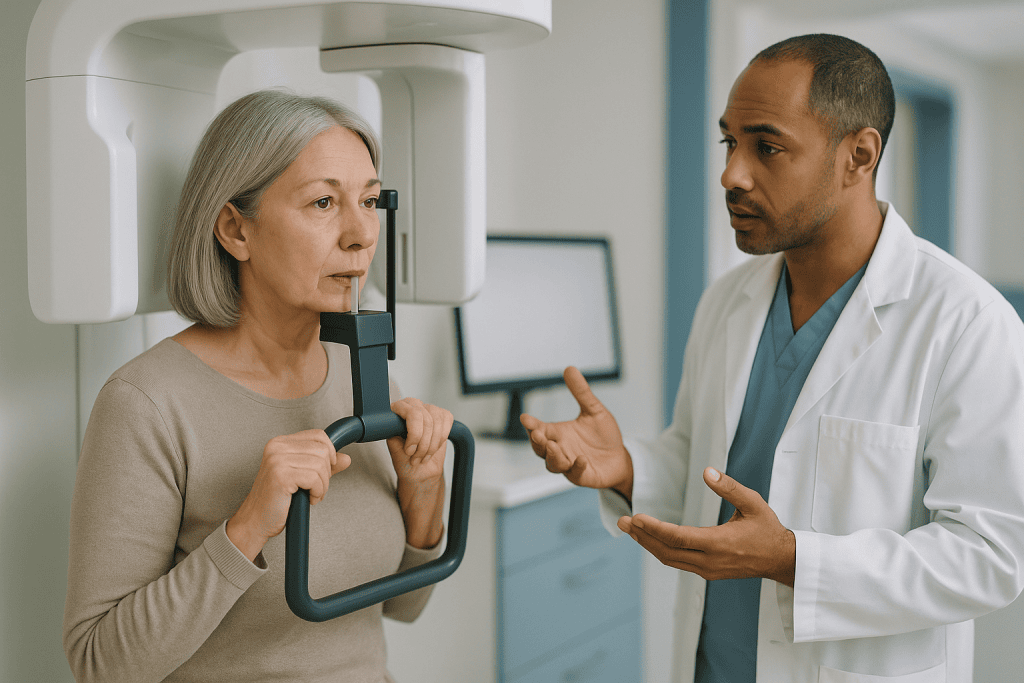
For All-on-4 planning the scan answers four questions. How much bone height and width is available at each proposed implant site? Where exactly does the inferior alveolar nerve run through the lower jaw, since damaging it can leave numbness of the lip and chin? How low do the maxillary sinuses sit in the upper jaw? And is there any hidden pathology, such as a cyst, a retained root fragment or a chronic infection at the tip of a tooth, that needs dealing with first?
The scan is usually taken with a marker or a scan appliance in the mouth so the software can line up the bone with the position of the planned teeth. Many teams then design a surgical guide, a custom plastic template that sits on the gums or remaining teeth and directs the drill to the planned angle and depth. Mayo Clinic notes that the planning phase may involve several specialists, including an oral surgeon, a periodontist and a prosthodontist, precisely because the bone, the gums and the final teeth all have to agree.
Radiation from a CBCT scan is higher than from a simple dental X-ray but is considered justified for implant planning, and dental teams follow the principle of using the lowest dose that gives a diagnostic image. If you have had a recent CT scan of the head or jaw elsewhere, tell the team; it may be usable and spare you a second exposure.
Bite records and the digital plan: how the team captures the way your jaws meet
Occlusion is the dental word for how the upper and lower teeth meet when you close and slide your jaw. Getting it right on a fixed bridge is harder than on natural teeth, because natural teeth have tiny ligaments that let them flex and give feedback; implants do not. A bridge that is a fraction of a millimeter too high on one side will send excess force into the posts on that side, day and night, without the patient feeling much until something loosens.
Bite records are the set of measurements and impressions that prevent that. Depending on the team they may include:
- Conventional impressions or an intraoral optical scan of the existing teeth or denture, capturing the shape of the gums and any teeth still present.
- A facebow or digital facial scan that relates the upper jaw to the hinge of the jaw joints and to facial landmarks, so the new teeth are level with the eyes and lips rather than with a tilted jaw.
- Vertical dimension recording, meaning the height of the lower face when the teeth are together, which can collapse over years of tooth loss and needs restoring gradually.
- Photographs and sometimes video of the smile line and lip movement in speech.
These records feed a digital design in which the planned teeth are drawn first and the implants are positioned to support them, a sequence dental teams call restoratively driven planning. The temporary bridge that goes in on the day of surgery is made from this design, often milled or printed in advance, then adjusted at the chairside once the implants are in.
Patients sometimes find this stage tedious, particularly when a try-in of the proposed teeth is done in wax or resin before surgery. It is worth the extra visit. Changes to tooth length, lip support or shade are cheap and easy at this point and awkward once the posts are in the bone.
Infection control: what happens in the room and what you do at home
Implant surgery is elective and clean, but it opens bone to the bacteria of the mouth, so infection control runs in two directions. The clinic controls its environment; the patient controls the mouth that arrives in the chair.
On the clinic side, the Centers for Disease Control and Prevention sets out standard infection prevention practices for dental settings: hand hygiene before and after every patient contact, sterile instruments processed in monitored autoclaves, single-use disposables where possible, surface barriers on equipment, and personal protective equipment for the team. For surgical procedures such as implant placement the CDC guidance also covers sterile gloves, sterile irrigation water and aseptic technique. You are entitled to ask how instruments are sterilized and how sterilization is monitored, and a well-run practice will answer without hesitation.
On the patient side, the mouth is prepared to carry as little bacterial load as possible. That usually means a professional cleaning of any remaining teeth and treatment of active gum disease in the weeks before surgery, because implants placed next to inflamed gums start life at a disadvantage. Teams often provide an antibacterial mouth rinse to use in the days beforehand, and many ask patients to rinse again in the waiting room. Whether antibiotics are prescribed before or after surgery varies; the evidence on routine antibiotic use for healthy implant patients is mixed, and the decision belongs to the surgeon.
One easily overlooked item is the denture itself. Old dentures harbor a film of bacteria and yeast, and some teams ask patients not to wear them for a period before surgery or to clean them in a specific way. If a temporary denture will be worn between extraction and implant placement, ask how to keep it clean and how long to leave it out overnight.
Antibiotics before dental surgery: who needs them for heart protection
Some patients arrive certain they need antibiotics before any dental work because a relative once did. The rules have narrowed considerably. The American Heart Association now recommends antibiotic prophylaxis, a preventive dose taken before a procedure, only for people at the highest risk of infective endocarditis, an infection of the heart lining or valves that can follow bacteria entering the bloodstream. The AHA lists prosthetic heart valves or prosthetic material used for valve repair, a previous episode of endocarditis, certain congenital heart defects, and heart transplant recipients who have developed valve disease as the groups for whom prophylaxis before dental procedures involving gum tissue is reasonable.
Everyone else, including most people with mitral valve prolapse, past rheumatic fever without valve damage, pacemakers or coronary stents, is no longer routinely given antibiotics for dental work under the AHA guidance. The reasoning is that the daily bacteria showers from chewing and brushing far exceed those from an occasional dental procedure, and the risks of unnecessary antibiotics, including allergic reactions and resistance, outweigh an unproven benefit for lower-risk groups.
Joint replacements sit in a similar place. Orthopedic and dental bodies in the United States have moved away from routine antibiotics before dental procedures for most people with artificial joints, reserving them for specific situations decided between the orthopedic surgeon and the dentist.
Practically, this means the pre-surgery paperwork asks about heart and joint history, and if anything flags, the surgical team writes to the cardiologist or orthopedic surgeon. Do not start an antibiotic on your own because you have some left over, and do not skip one you have been told to take. The what and whether is the prescribing clinician’s call; your job is to make sure every relevant condition is on the form.
Blood thinners, diabetes medicines and other prescriptions: what to pause and who decides
The single most important sentence in this section is this: do not stop or change any prescribed medicine for dental surgery unless the doctor who prescribes it has agreed. Well-meaning patients who quietly pause a blood thinner a few days early can put themselves at far greater risk of stroke or clot than the bleeding the surgeon would have managed in the chair.
Anticoagulants and antiplatelet drugs, medicines that reduce the blood’s ability to clot, are the most common concern. For many dental extractions and implant placements, current guidance from bodies such as the NHS is that patients on these medicines can often continue them, with the dental team using local measures such as sutures, packing and pressure to control bleeding. Some newer anticoagulants may have a dose timing adjusted on the day, and warfarin users may be asked for a recent blood test of clotting time. Each of those decisions is made jointly between the surgeon and the prescribing physician, based on why the medicine was started in the first place.
Diabetes medicines need planning around fasting. If sedation requires an empty stomach, insulin and some tablets may need adjusting to avoid low blood sugar, and the surgical team typically wants a recent long-term blood sugar reading because Mayo Clinic identifies poorly controlled diabetes as a risk factor for implant complications.
Bone-strengthening medicines used for osteoporosis or cancer belong on the list too, because they alter how the jawbone remodels around a surgical wound. Steroids, immunosuppressants, hormone treatments and even some antidepressants can affect bleeding or bone. None of this means surgery is off; it means the surgeon needs the full picture early enough to write the letters and get the answers back before the date.
What not to do before dental implants: smoking, alcohol and supplements
Ask any implant surgeon what they most wish patients would stop beforehand and the answer is almost always tobacco. Nicotine narrows blood vessels and reduces oxygen delivery to healing tissue, and the tar and heat of smoking irritate the surgical site directly. Mayo Clinic lists smoking as a factor that can contribute to implant failure and complications, and the NHS advises that smokers are more likely to experience problems after dental implant treatment. Teams differ on how long they ask for, and the requested period should be seen as a floor rather than a target; the longer the break on either side of surgery, the better the healing environment. Vaping is not a neutral substitute, because nicotine is still delivered.
Alcohol matters mainly around the day itself. It thins the blood modestly, interacts with sedatives and pain relievers, and dehydrates tissue. Most teams ask patients to avoid alcohol for at least the day before and for the early healing period; the exact window is theirs to set.
Supplements are the quiet troublemaker. Fish oil, high-dose vitamin E, ginkgo, garlic capsules, turmeric extracts and ginger are among the products with plausible effects on bleeding, and St John’s wort interacts with sedative and anesthetic drugs. Herbal remedies rarely appear on medication lists because people do not think of them as medicines. Put every capsule and powder on the form and let the team decide what, if anything, to hold.
The list of what not to do before dental implants also includes the mundane: do not arrive with an untreated toothache elsewhere in the mouth, do not schedule surgery in the middle of a cold or chest infection without telling the team, and do not plan a long flight or heavy physical work in the first days afterward.
The night before and the morning of surgery
The final twenty-four hours are mostly about the anesthetic plan. All-on-4 is commonly done under local anesthesia with intravenous sedation, sometimes under general anesthesia in a hospital setting. If any form of sedation is planned, the team will give fasting instructions, typically no solid food for a set number of hours and clear fluids up to a shorter cut-off. Those windows exist to reduce the risk of stomach contents entering the airway while reflexes are dulled, and they are not negotiable on the day; arriving with a full stomach usually means postponement.
Medicines that you have been told to continue should be taken as usual, with a small sip of water if fasting, unless the team has said otherwise. Diabetics on insulin need the specific plan discussed earlier. Anyone taking a blood thinner should already know from the joint decision of surgeon and physician whether the morning dose is taken, delayed or skipped.
Practical preparation makes the day smoother:
- Arrange an adult to drive you home and ideally stay with you for the first night if sedation is used; you will not be permitted to drive, and judgment can be impaired for the rest of the day.
- Wear loose, comfortable clothing with sleeves that roll up easily for a cannula and blood pressure cuff.
- Leave jewelry, contact lenses and nail polish off if asked; oxygen monitors read through the fingernail.
- Stock the kitchen in advance with soft, cool foods and remember that the first day is often spent dozing.
- Fill any prescriptions the team has given you beforehand, following their written instructions on when to start them.
Bring the medication list, the consent forms and any letters from other doctors. Expect a final review of the plan, a check of blood pressure and oxygen saturation, and a chance to ask last questions before anything begins.
All on 4 recovery time: what the first days and weeks usually look like
Recovery unfolds in phases, and Mayo Clinic’s description of typical implant recovery, with swelling, bruising, minor bleeding and discomfort settling over the first days, applies to full-arch surgery with the added factor that several teeth are usually extracted at the same visit. The table below summarizes the typical pattern reported in mainstream sources; individual experiences vary and the team’s written instructions take precedence.
| Period | What is common | What the team usually asks |
|---|---|---|
| First 24 hours | Numbness wearing off, oozing, peak drowsiness from sedation | Rest, gentle pressure on gauze, cold packs, no rinsing or spitting |
| Days 2–3 | Swelling and bruising usually at their worst; jaw stiffness | Soft cool diet, prescribed pain relief as directed, gentle salt-water rinses if instructed |
| Week 1–2 | Swelling receding, sutures dissolving or removed at review | First follow-up, check of the temporary bridge and bite |
| Weeks 2–8 | Gum healing, adapting to speech and eating with the temporary bridge | Soft diet continued, careful hygiene around the bridge |
| Several months | Osseointegration of implants, per Mayo Clinic several months | Return for final bridge fabrication once the surgeon confirms integration |
Most people take a few days off work, longer if the job is physical. Swelling that peaks around the second or third day and then steadily improves is the expected trajectory; swelling that improves and then worsens again is not, and belongs in the red-flag section later in this article.
Emotionally, the first fortnight can be harder than patients expect. The temporary bridge feels large, speech sounds different, and the face looks puffy in photographs. Those effects fade. Skipping follow-up visits during this period is the most common way small problems, such as a high spot on the bite, turn into larger ones.
Eating after All-on-4: how long until normal food
The question people search most is when they can bite into an apple again, and the honest answer is that the diet is staged to protect implants that have not yet fused, not to protect the bridge itself. The temporary bridge can usually withstand more than the bone beneath it can during early healing.
In the first days the diet is liquid to very soft and cool: yogurt, smooth soups, blended fruit, mashed vegetables, scrambled eggs. Hot foods are avoided while numbness lingers and because heat increases bleeding. Straws are discouraged because suction can disturb clots at extraction sites.
From roughly the first week through the early weeks, a soft diet that needs little chewing is standard: pasta, fish, soft-cooked vegetables, soft bread without crusts. Teams commonly ask patients to stay on this softer diet for the whole period the temporary bridge is in place, which follows the several months of osseointegration Mayo Clinic describes, because it is the period when a hard bite on a nut or a crust can overload a single implant. Cleveland Clinic similarly advises avoiding hard, crunchy and sticky foods while implants heal.
Once the surgeon confirms integration and the final bridge is fitted, most patients return to an essentially normal diet, with a few permanent exceptions that apply to any dental prosthesis: cracking ice, chewing pens, biting fishing line or opening packages with teeth. Very hard foods such as hard candies and unpopped popcorn kernels remain risky to the bridge material for life.
Two practical points help. Protein and fluids matter for healing, so soft does not have to mean sugary; and cutting food into small pieces and chewing on both sides at once distributes force across all four implants rather than loading one side. If the bite feels uneven when chewing at any stage, that is worth a phone call rather than waiting for the next scheduled visit.
What is the downside of All-on-4? Risks and alternatives in plain language
Any honest preparation includes the downsides, and there are real ones. Mayo Clinic lists the general risks of implant surgery: infection at the implant site, injury to surrounding structures such as adjacent teeth or blood vessels, nerve damage causing pain, numbness or tingling in the lip, chin or gums, and sinus problems when upper-jaw implants intrude on the sinus cavity. Full-arch surgery adds the risks of multiple extractions performed in one session, including more swelling and a longer initial recovery than a single implant.
Specific to the All-on-4 design is the consequence of losing one post. Because the bridge is supported by only four implants, failure of one, particularly a rear angled implant, can compromise the whole bridge until it is replaced, which may mean a period back in a removable denture. Some surgeons place additional implants for this reason, and it is a fair question to ask why four rather than five or six in your case.
Longer term, peri-implantitis, inflammation and bone loss around implants driven by bacterial plaque, is the main threat, and a fixed bridge is harder to clean underneath than natural teeth. Food trapping under the bridge, speech changes from the bulk of the acrylic or zirconia, and wear or fracture of the bridge material over years are all reported. Any published success percentages come from specific study populations and are not promises for an individual, so treat headline figures with caution.
Alternatives deserve equal airtime. A conventional complete denture remains the least invasive option. An implant-retained overdenture, a removable denture that clips onto two or more implants, offers stability with easier cleaning and lower surgical burden. Where several sound teeth remain, saving them with periodontal treatment and conventional crowns or bridges may be reasonable. The right choice depends on bone, health, hygiene habits and priorities, and belongs in a discussion with the treating team rather than in a checklist.
What people often get wrong about preparing for All-on-4
The myths tend to cluster in predictable places.
Same day means same day finished. The temporary bridge often goes in within a day of surgery, but it is a healing prosthesis. The final bridge follows the several months of bone integration that Mayo Clinic describes, and patients who expect to be eating steak that weekend are set up for disappointment.
Stopping a blood thinner is the responsible thing to do. It is the opposite unless the prescribing doctor has agreed. Bleeding from dental surgery is usually manageable with local measures; a clot in the brain or heart is not.
Everyone needs antibiotics before dental surgery because of their heart. The American Heart Association reserves prophylaxis for a short list of high-risk cardiac conditions. Most people with common heart histories are no longer advised to take them.
Bone loss rules you out. The angled rear implants were designed specifically to make use of the front bone in jaws that have lost height at the back. Severe loss can still require grafting or a different approach, but the CBCT scan decides that, not a glance in the mirror.
Cutting down on smoking is enough. The evidence Mayo Clinic and the NHS cite links smoking itself, not just heavy smoking, to poorer implant outcomes. A pause is the goal, and the dental team can refer to stop-smoking support.
The bridge cannot get gum disease because the teeth are artificial. Peri-implantitis affects the bone around the implants, not the teeth on top, and it is driven by the same plaque as ordinary gum disease. Cleaning underneath the bridge with floss threaders, water flossers or interdental brushes is a lifelong task, not an optional extra.
Preparation is the clinic’s job. Imaging and records are theirs. Smoking, blood sugar, hygiene and honest disclosure of every medicine and supplement are yours, and they weigh at least as heavily.
Questions to ask your care team before you consent
A consent conversation is a two-way exchange, and it helps to arrive with questions written down. These are the ones that experienced patients say they wish they had asked earlier.
- What did the CBCT scan show about my bone, and is any grafting or sinus work planned? Will I be able to see the scan and the digital plan?
- Who will place the implants and who will make the teeth? Will the same team see me for problems in the first weeks?
- Which of my medicines, if any, are you asking my doctor about, and who will confirm the plan for the day of surgery in writing?
- What is your policy on antibiotics before and after surgery, and does anything in my heart or joint history change it?
- How long are you asking me to stop smoking before and after, and what support can you offer?
- What anesthesia or sedation is planned, who provides it, and what monitoring is in place?
- Will I have teeth when I leave on the day of surgery? If not, what will I wear and for how long?
- What will the temporary bridge be made of, how long will it stay in, and what happens if it breaks?
- What foods should I avoid and for how long, and who do I call if the bite feels wrong?
- How many implants are you placing and why that number for my jaw?
- What are the most likely complications in my specific case, and what is the plan if an implant does not integrate?
- How will I clean under the bridge, and how often will I need professional maintenance visits?
- What alternatives did you consider for me, and why do you favor this one?
Take notes or bring someone who can. If any answer is vague, particularly about infection control, anesthesia or the plan for a failed implant, it is reasonable to ask again or to seek a second opinion before proceeding.
When to call your doctor: red-flag signs before and after surgery
Some symptoms in the preparation period should prompt a call to the surgical team before the date rather than on it. A new toothache, facial swelling or a bad taste from an abscess, a chest infection, a fever, a new diagnosis or a new medicine started by another doctor, or an unexplained bleed or bruise pattern all change the risk calculation and may mean the date should move.
After surgery, the ordinary course is swelling and discomfort that peak by about the third day and then steadily improve. Contact the surgical team the same day, or use emergency services if the symptom is severe, for any of the following:
- Bleeding that soaks through gauze and does not slow with firm pressure after half an hour, or bleeding that restarts heavily after it had stopped.
- Swelling that begins to increase again after having improved, spreads toward the eye or under the jaw, or makes swallowing or breathing difficult. Difficulty breathing or swallowing is an emergency.
- Fever, chills, or pus draining from the surgical site.
- Pain that worsens after the third day rather than easing, or pain not controlled by the prescribed medicine taken as directed.
- Numbness of the lip, chin or tongue that persists beyond the expected hours of local anesthesia.
- A loose, cracked or shifting temporary bridge, or a feeling that the bite has changed suddenly.
- Nosebleeds, a sense of fluid moving between the mouth and nose, or sinus pressure after upper-jaw implants.
- Chest pain, sudden weakness on one side, slurred speech or shortness of breath, particularly in anyone whose blood thinner was adjusted; these need emergency care immediately.
- A rash, facial swelling or wheeze after starting a prescribed medicine, which can indicate an allergic reaction.
Keep the team’s out-of-hours number somewhere visible. A reassuring phone call costs nothing, and the problems that damage implants are almost always the ones left for a few days too long.
Frequently asked questions
What not to do before dental implants?
Do not stop or change any prescribed medicine without the prescribing doctor’s agreement, do not smoke or vape, avoid alcohol in the day before surgery, and do not eat or drink past the fasting cut-off if sedation is planned. Disclose every supplement, since products such as fish oil, ginkgo and St John’s wort can affect bleeding or interact with sedatives. Arrive with any gum infection already treated and with a driver arranged.
What is the downside of all on four dental implants?
The main downsides are surgical risks such as infection, nerve injury and sinus involvement, the fact that failure of one of only four implants can compromise the whole bridge, and lifelong cleaning demands under a fixed prosthesis to prevent peri-implantitis. The bridge can also feel bulky, alter speech at first, and wear or fracture over years. Alternatives include removable implant-retained dentures and conventional dentures.
How long after All-on-4 dental implants can I eat normally?
Most teams ask for a liquid to soft diet in the first days and a softer, low-chewing diet for the whole period the temporary bridge is in place, which follows the several months of bone integration Mayo Clinic describes. A near-normal diet usually resumes once the surgeon confirms integration and fits the final bridge, with permanent avoidance of very hard items such as ice and unpopped popcorn kernels.
How long does it take to recover from All-on-4 dental implants?
Initial recovery, with swelling and bruising peaking around the third day and easing over one to two weeks, is the typical pattern described in mainstream sources such as Mayo Clinic. Bone integration around the implants then continues for several months before the final bridge is made. Most people take a few days away from work; the exact timeline depends on the number of extractions, general health and how closely instructions are followed.
What is the all on 4 recovery time compared with single implants?
Full-arch surgery generally involves more swelling and a longer initial recovery than a single implant because several teeth are usually extracted at the same visit and a larger area of gum is opened. The bone integration phase is similar, several months in Mayo Clinic’s description. The main difference is the volume of surgery on the day rather than the biology of healing afterward.
Do I need to stop blood thinners before All-on-4 surgery?
Usually not on your own initiative. Current guidance from bodies such as the NHS indicates many patients can continue anticoagulant or antiplatelet medicines through dental extractions and implant placement, with the surgeon controlling bleeding using sutures and pressure. Some medicines may have their timing adjusted on the day. Any change is a joint decision between the surgeon and the doctor who prescribes the medicine, made in writing before the date.
Will I need antibiotics before All-on-4 because of a heart condition?
Only if you fall into the high-risk groups the American Heart Association identifies: prosthetic heart valves or valve repair material, a previous episode of infective endocarditis, certain congenital heart defects, or a heart transplant with valve disease. Most other heart conditions, including stents, pacemakers and mitral valve prolapse, no longer carry a routine recommendation. Your surgical team will confirm with your cardiologist if anything in your history flags.
What does a CBCT scan show before All-on-4?
A CBCT scan produces a three-dimensional image of the jaws showing bone height and width at each proposed implant site, the route of the lower jaw nerve, the position of the sinuses in the upper jaw, and any hidden infection, cysts or retained roots. The images are combined with bite records to plan implant angles and, often, to manufacture a surgical guide and the temporary bridge in advance.
How long should I stop smoking before dental implants?
There is no single universal number; teams set their own minimum, and it should be treated as a floor. Mayo Clinic and the NHS both link smoking to a higher risk of implant complications and failure because nicotine reduces blood flow and oxygen to healing tissue. The longer the break before and after surgery, the better the healing environment, and vaping still delivers nicotine so is not a neutral substitute.
What is eating after all on 4 surgery like in the first week?
The first days are typically liquid to very soft and cool: yogurt, smooth soups, blended fruit, mashed vegetables and scrambled eggs, with hot foods and straws avoided to protect clots at extraction sites. By the end of the first week most people move to soft foods that need little chewing. Numbness, swelling and an unfamiliar bulky bridge make eating slow at first; that improves steadily over the following weeks.
References
- Cleveland Clinic: Dental Implants
- CDC: Summary of Infection Prevention Practices in Dental Settings
- MedlinePlus: Dental Health
This article is for general information only and is not a substitute for professional medical advice. Please consult a qualified doctor about your individual situation.

More from the Blog

What a CT Scan Shows Before Zygomatic Implants: Cheekbone Volume, Sinus Anatomy and the Path
A CT scan for zygomatic implants gives the surgical team a three-dimensional map of the upper jaw and cheekbones. It shows how much bone…

How Grinding and Erosion Lead to Full Mouth Reconstruction: Bite Collapse and Tooth Wear
Tooth wear bite collapse happens when years of grinding (bruxism) or acid erosion shorten the teeth enough that the jaws close too far, straining…

Who Is a Candidate for All On 6? Bone Volume, Bite Force and When Six Implants Are Advised
An all on 6 candidate is usually an adult missing most or all teeth in one jaw, with enough jawbone in the back of…
Why You Never Stop Blood Thinners Alone Before a Dental Bone Graft: What the Surgeon Checks
Stopping a blood thinner on your own before a dental bone graft is rarely advised. Most guidelines say routine dental surgery, including grafting, can…
Who Needs a Porcelain Crown? Cracked, Heavily Filled and Root-Treated Teeth Explained
A porcelain crown is usually considered when a tooth has lost too much sound structure for a filling to hold it together: a cracked…
Dental Crown Myths: Does a Crowned Tooth Stop Decaying and Never Need Care Again?
No. A dental crown covers the visible part of a tooth, but it cannot stop decay. The natural tooth structure beneath and around the…