

Preparing for ESS: Treating Active Infection and Allergies Before Endoscopic Sinus Surgery

Key Takeaways
- Chronic rhinosinusitis is defined by Mayo Clinic as sinus inflammation lasting 12 weeks or more despite treatment, and surgery is considered only after medical therapy has been tried.
- Most sinus infections are viral, and the CDC notes clinicians consider bacterial infection when symptoms exceed 10 days without improvement, are severe from the start, or worsen after initial recovery.
- Infected or allergic mucosa bleeds more and hides the landmarks near the eye socket and skull base, which is the core surgical reason flares are settled before ESS.
- Intranasal steroid sprays work by reducing inflammatory signaling and are slower to reach full effect than antihistamines, so teams usually want them established well before the date and continued through surgery.
- The typical post-operative experience is pressure and blockage rather than sharp pain, and the roughest stretch is usually the few days before the first clinic debridement clears clots and crusts.
- Cleveland Clinic describes many people returning to work or school within about one to two weeks, while the nasal lining continues to heal for weeks to months and maintenance treatment continues afterwards.
Preparing for endoscopic sinus surgery usually means arriving with the nose as calm as it can be. Surgeons commonly ask patients to settle any active sinus infection and to bring allergy symptoms under control in the weeks beforehand, because swollen, infected tissue bleeds more, obscures the surgeon's view and can slow healing. Your ENT team sets the exact plan, including any medicines, based on your examination and scan.
The surgery date has been circled on the kitchen calendar for six weeks. Then, on a Tuesday morning, the throat tickle arrives, followed by the familiar heaviness behind the cheekbones. Anyone who has lived with chronic sinus trouble knows the sinking feeling: is this the same old congestion, or is it a new infection that could push the operation back?
That question sits at the heart of preparing for endoscopic sinus surgery, usually shortened to ESS. The operation itself is done through the nostrils with a thin camera, and it is generally not the dramatic part. The quieter work happens beforehand, when the surgical team tries to hand the surgeon a nose that is as uninflamed, uninfected and settled as a chronically unhappy nose can be.
This explainer walks through why active infection and uncontrolled allergies matter so much, how clinicians decide whether to postpone, what recovery honestly feels like, and which signs mean you should pick up the phone.
Why preparing for endoscopic sinus surgery starts weeks before the operating room
Most people picture surgical preparation as a list of last-minute rules: nothing to eat after midnight, arrive early, bring a driver. Those rules exist for ESS too, but they are the smallest part of the job. The larger part is what the tissue inside your nose looks like on the day, and that is shaped by what happens in the weeks before.
Endoscopic sinus surgery is almost always offered for chronic rhinosinusitis, which Mayo Clinic defines as inflammation of the sinuses and nasal passages lasting 12 weeks or longer despite treatment attempts. The lining of those passages, called the mucosa, is the surface a surgeon actually works on. When the mucosa is angry, it is thicker, more fragile and more richly supplied with blood. When it is calm, it is thinner, paler and far easier to see through and around.
That difference has practical consequences. A calmer field means less bleeding, a clearer camera picture and more precise removal of only what needs removing. It also means the raw surfaces left behind start healing from a better baseline. Surgeons cannot make chronic inflammation disappear before an operation; if they could, you would not need the operation. What they can do is separate the long-standing, structural problem from any short-term flare layered on top of it, and deal with the flare first.
Two flares dominate that conversation: acute infection and allergic swelling. Each has its own biology, its own timeline and its own set of decisions, and each is worth understanding before you sit down with your team to talk about your date.
What actually happens during endoscopic sinus surgery
An endoscope is a slim, rigid tube with a light and a lens at the tip, thin enough to pass through a nostril. The surgeon watches the magnified image on a screen while guiding small instruments alongside it. There are no cuts on the face, and the eyes and skin are never opened.
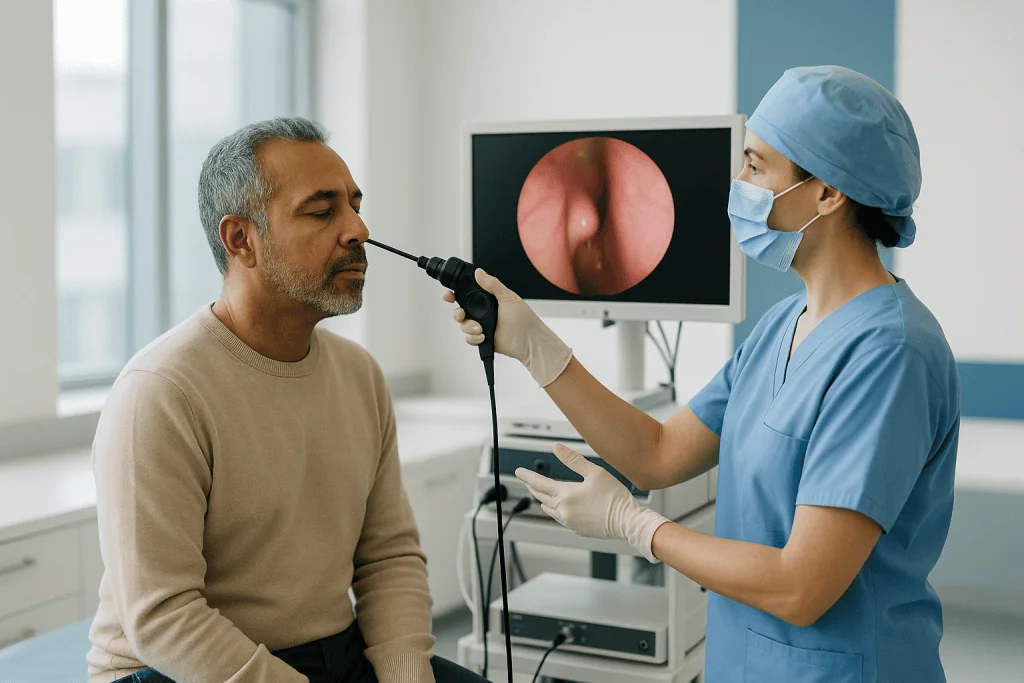
According to Cleveland Clinic, the goal of the procedure is to widen the natural drainage pathways of the sinuses, remove nasal polyps or diseased tissue, and clear blockages so that mucus can drain and prescribed sprays and rinses can actually reach the lining afterwards. Nasal polyps are soft, non-cancerous growths of swollen mucosa that hang into the passages like teardrops; they are a common reason people end up in the ESS discussion.
The operation is usually performed under general anesthesia, meaning you are fully asleep, and many people go home the same day, as Cleveland Clinic describes. Some surgeons use image guidance, a navigation system that matches the endoscope’s position to your CT scan in real time, which is helpful when previous surgery or unusual anatomy makes landmarks harder to read. Whether that is used is a surgical judgment, not a marker of quality.
At the end, some teams place dissolvable spacers or light packing to hold tissue apart and limit bleeding; others prefer to leave the nose open. Neither approach is universally right. What matters for you is knowing which to expect, because it changes how the first days feel.
One more definition that will matter later: debridement is the gentle cleaning of crusts and old blood from the surgical site at a follow-up visit, done with the same kind of endoscope. Think of it as tidying the construction site so the new surface can heal flat.
Who is usually offered ESS, and who is usually asked to wait
Surgery is rarely the first move. Mayo Clinic lists saline irrigation, intranasal corticosteroid sprays, treatment of underlying allergies and, in selected cases, antibiotics or a short course of oral corticosteroids as the standard medical therapies for chronic rhinosinusitis, with surgery considered when those measures have not brought adequate relief. In practice, candidates typically fall into a few groups: people with chronic rhinosinusitis that persists despite a genuine trial of medical treatment, people with polyps that keep blocking breathing or smell, people with repeated acute infections that a scan links to a narrow drainage pathway, and people with specific findings such as a fungal ball or a mucus-filled cyst that medicines cannot clear.
The list of people asked to wait is shorter but firmer. Someone in the middle of an acute infection, particularly with fever or facial pain that is clearly worse than their baseline, is usually rescheduled. So is someone whose asthma is flaring; the upper and lower airways behave as one system, and anesthesia on an unstable chest carries avoidable risk. Poorly controlled diabetes, an unexplained bleeding tendency, a recent chest infection or a new heart problem also tend to trigger a pause, because the operating day is meant to be the calmest day possible for your whole body, not just your nose.
Pregnancy deserves its own conversation. Elective sinus surgery is generally deferred until after delivery unless there is an urgent reason, and the decision belongs to the surgical, anesthesia and obstetric teams together.
None of these are permanent disqualifications. They are timing decisions, and a surgeon who postpones is usually protecting the result you are hoping for rather than withholding it.
Why an active sinus infection can postpone surgery
Infection changes tissue in three ways that a surgeon notices immediately. First, blood vessels dilate to bring immune cells to the site, so the mucosa becomes engorged and bleeds more freely when touched. Bleeding is the single biggest enemy of visibility in a space the width of a pencil, and reduced visibility means slower, more cautious surgery. Second, the mucosa swells with fluid, which narrows the working room and blurs the boundary between tissue that should go and tissue that should stay. Third, pus and thick secretions coat the surfaces, hiding the delicate landmarks that sit just millimeters from the eye socket and the base of the skull.

There are whole-body reasons too. Anesthesia teams are cautious about operating on anyone with an active upper respiratory infection, because inflamed airways are more reactive during and after a breathing tube is placed. Fever or malaise on the day is a common reason for a same-morning cancellation.
Healing is the third concern. Freshly operated surfaces are essentially controlled wounds, and wounds heal best when the surrounding tissue is not already fighting bacteria. An active infection can raise the chance of thicker crusting and of adhesions, which are bands of scar that bridge two raw surfaces and can narrow the very pathway the operation was meant to open.
There is an honest counterpoint. Some people with chronic rhinosinusitis are never fully infection-free; their baseline includes low-grade colonization, and surgery is being done partly to fix the drainage problem that keeps that going. Surgeons distinguish that stable baseline from a new, acute flare. The first is the reason for the operation. The second is a reason to reschedule it.
Cold, flare or bacterial infection? How your team tells the difference
This is the question behind that Tuesday-morning throat tickle, and it is a clinical judgment rather than a self-test. According to the CDC, most sinus infections are caused by viruses and improve on their own without antibiotics. The NHS puts the usual course of an ordinary sinus infection at around 2–3 weeks. A viral cold two weeks before surgery may therefore have run its course by the date, or it may not, and the team will want to see you rather than guess.
The CDC describes the situations in which clinicians start to consider a bacterial infection: symptoms lasting more than 10 days without improvement, symptoms that are severe from the start, or the pattern sometimes called double worsening, where a person begins to recover and then clearly deteriorates again. Those are the cues your surgeon or primary care clinician weighs, alongside what they see.
What they see is the decisive part. In an ENT clinic the same endoscope used in the operating room can be passed, usually after a numbing spray, to look directly at the drainage openings. Frank pus, a fresh polyp bloom or bright red swollen mucosa tells a different story from the pale, thickened lining of long-standing disease. Some surgeons will swab visible pus and send it for culture, a laboratory test that identifies which bacteria are present and which antibiotics they respond to.
A repeat CT scan is not routine for a pre-operative flare. The scan ordered for surgical planning maps the bony anatomy, which does not change from week to week; the mucosal swelling on it is expected. If you develop new symptoms close to your date, the most useful thing you can do is report them early and let the team decide what, if anything, needs to change.
Antibiotics before sinus surgery: what the evidence actually supports
Many people assume a course of antibiotics is an automatic part of preparing for endoscopic sinus surgery. It is not. Antibiotics only work against bacteria, and the CDC is explicit that they do nothing for the viral infections that cause most sinus symptoms, while carrying real downsides including side effects and the spread of antibiotic resistance. Guideline-level practice is to reserve them for a demonstrated or strongly suspected bacterial infection.
When a surgeon does prescribe an antibiotic before surgery, the reasoning is usually one of the following: there is visible pus at endoscopy, a culture has grown a specific organism, or the patient has a pattern of bacterial flares that experience says will complicate the operation. The choice of medicine is often guided by the culture result rather than a general rule, and the course is timed so that it is finished, or nearly finished, by the operating date. Some surgeons also give a single dose in the operating room at the time of anesthesia; that is a standard surgical infection-prevention step and a separate question from treating a pre-existing infection.
Oral corticosteroids are the other medicine class that comes up. These are anti-inflammatory tablets that damp down the immune signaling driving swelling, and Mayo Clinic lists a short course among the medical options for severe inflammation or large polyps. Before surgery, some surgeons use them to shrink polyps and reduce bleeding. They are not harmless: even short courses can raise blood sugar, disturb sleep and mood, and interact with other conditions, which is why the decision sits with the prescriber and depends on your health history.
The practical rule for you is simple. Take exactly what is prescribed, finish the course as directed, tell the team about any medicine another clinician has started, and do not begin or stop anything on your own initiative before surgery.
Why allergies need to be under control before ESS
Allergic rhinitis is the NHS’s term for inflammation of the inside of the nose caused by an allergen such as pollen, dust mites, mold or animal dander. The mechanism is worth understanding because it explains why surgeons care. On exposure, immune cells release histamine and other chemicals that widen blood vessels, leak fluid into the tissue and switch mucus glands to full production. The result is exactly the swollen, wet, bleed-prone mucosa that makes surgery harder, produced not by infection but by the immune system overreacting to something harmless.
The overlap with chronic rhinosinusitis is large. Many people carry both, and the allergic component does not stop when the polyps are removed. An uncontrolled allergy on the day of surgery means a more congested field. An uncontrolled allergy in the weeks afterwards means more swelling around healing surfaces, more crusting and a higher chance of adhesions forming across the new openings.
Asthma sits in the same story. Many people with nasal polyps also have asthma, and allergic triggers can destabilize both at once. Anesthesia teams want the chest as quiet as the nose, so allergy control before ESS is partly airway safety as well as surgical convenience.
Some surgeons arrange allergy testing before the operation if it has never been done. Skin-prick or blood tests identify which allergens matter for you, which shapes the avoidance advice and the choice of long-term treatment once healing is complete. Others defer testing until after surgery because active nasal inflammation can muddy the picture. Either sequence is reasonable; the important thing is that allergy is treated as part of the plan rather than an afterthought.
Allergy control in the weeks before surgery: how the medicines work and how long they take
Three medicine classes do most of the pre-operative allergy work, and knowing how each acts explains why the timing differs.
Intranasal corticosteroid sprays deliver a small amount of anti-inflammatory medicine directly onto the lining. They act by reducing the production of inflammatory signals rather than blocking a single chemical, which is why they calm swelling, mucus and blockage together, and why the NHS describes them as slower to reach their full effect than antihistamines. Teams tend to want them established well before the date, and most surgeons expect them to continue right up to surgery and to restart soon afterwards; stopping them on your own before surgery is a common and avoidable mistake.
Antihistamines, taken as tablets or sprays, block histamine at its receptor. They work faster and are good for sneezing, itching and a runny nose, but do less for blockage. Older sedating antihistamines can interact with anesthesia and are worth flagging to the team.
Saline rinses, which the NHS lists among self-care measures, physically wash allergens and mucus off the lining. They are low-risk and are usually continued after surgery as a central part of healing.
Allergen avoidance is the unglamorous fourth pillar: keeping windows closed on high-pollen days, washing bedding hot for dust mites, and keeping pets out of the bedroom. None of it is quick, but two to three weeks of consistent effort can noticeably change what the surgeon sees.
Allergen immunotherapy, the gradual desensitization by injections or tablets under the tongue, is a long-term strategy measured in years rather than a pre-operative fix. If you are already on it, tell the team; whether to pause around surgery is their call.
Sinus surgery pre-op instructions: the checklist most teams work through
Instructions vary between surgeons and hospitals, so the written sheet you are given always outranks anything here. The table shows the areas that appear on nearly every list, why each matters, and who makes the final decision.
| Area | Why it matters | Who decides |
|---|---|---|
| Active infection | Increases bleeding, hides landmarks, raises anesthesia risk | Surgeon and anesthesia team after examination |
| Allergy flare | Swollen, wet mucosa; more crusting and adhesions afterwards | Surgeon, often with allergy or primary care input |
| Medicines that affect bleeding (blood thinners, some anti-inflammatory painkillers, certain supplements) | Bleeding in a narrow space; some must never be stopped without the prescriber | Prescribing clinician together with the surgeon |
| Smoking and vaping | Nicotine narrows vessels and impairs healing; smoke irritates the lining | You, with support from the team |
| Other conditions (asthma, diabetes, blood pressure) | Stability reduces anesthesia and healing complications | Your usual clinicians, informed of the date |
| Fasting and arrival | Empty stomach for safe anesthesia; escort home | Anesthesia team; follow the written times exactly |
Two items deserve emphasis. The first is medicines and supplements that thin the blood or affect clotting. Some people take these for a heart valve, a stent or a previous clot, and stopping them without instruction can be far more dangerous than a bloodier operation. Bring a complete list, including herbal products and fish oil, and let the team coordinate with whoever prescribed them. The second is smoking. Nicotine constricts the small vessels that feed healing tissue, and smoke is a direct irritant to the exact surfaces the surgeon has just worked on. Stopping, even for a limited window around surgery, helps the healing lining, and the pre-operative visit is a good moment to ask for support.
Finally, tell the team about anything that has changed since your consultation: a new cold, a new medicine, a new diagnosis. Surprises on the morning of surgery are the most common cause of late cancellations.
How painful is endoscopic sinus surgery, and which day is usually the worst?
This is one of the most searched questions about ESS, and the honest answer surprises many people: the dominant sensation is usually pressure and blockage rather than sharp pain. Cleveland Clinic describes the typical experience after functional endoscopic sinus surgery as facial pressure, congestion and mild to moderate discomfort, closer to a heavy head cold than to the pain people associate with surgery involving external incisions. There are no skin stitches, and the nasal lining, while sensitive, is not richly supplied with the sharp pain fibers of skin.
What people find hardest is often not pain at all. Breathing through the mouth because the nose is blocked with swelling and old blood, a dry throat from that mouth breathing, fatigue from anesthesia, and the steady dark drainage into a gauze pad under the nose combine into a miserable but rarely severe few days.
Which day is worst varies, but the pattern many people describe is that the first day is dulled by anesthesia and hospital pain relief, and the following two or three days feel roughest as swelling and crusting build before the first debridement visit clears them. Headache and tooth or cheek pressure are common in this window. Relief after the first clinic clean-out is often noticeable, which is one reason surgeons are insistent about that appointment.
Pain control is planned in advance. Most people manage with the medicines their surgeon recommends, and the team will specify which over-the-counter painkillers to avoid, since some increase bleeding risk. Follow that guidance rather than reaching for whatever is in the cupboard.
Pain that escalates rather than settles, especially with fever, swelling around the eye or a change in vision, is not part of normal recovery and belongs in the red-flag section below.
Endoscopic sinus surgery recovery time: what the first days and weeks usually look like
Recovery is a two-speed process. How you feel improves fairly quickly; how the lining heals takes much longer, and it is the second timeline that decides the final result.
In the first few days, expect bloody drainage that gradually turns pink then clear, congestion, fatigue and the pressure described above. Most surgeons ask you to avoid blowing your nose, to sneeze with the mouth open, to skip heavy lifting and straining, and to keep the head elevated when resting. Saline rinses usually start within a day or two on the team’s instruction and become the backbone of healing, flushing away clots and softening crusts so the new mucosa can regrow cleanly.
Cleveland Clinic notes that many people return to work or school within about one to two weeks, depending on the extent of surgery and the kind of work they do. Desk work often resumes sooner than physical jobs. The first debridement visit typically falls within this window, and there may be several more over the following weeks.
Beyond that, the lining continues to settle for weeks to months. Smell, if it was reduced, can return gradually and unevenly. Some people feel dramatically clearer early on and then experience a temporary dip as swelling fluctuates; that oscillation is expected rather than a sign of failure. Long-term maintenance, usually a steroid spray plus rinses, and allergy control, usually continues after surgery, because the underlying tendency to inflammation does not leave with the polyps.
Air travel, swimming, contact sports and returning to intense exercise each have their own timing, and they differ between surgeons. Ask specifically rather than assuming a general rule applies to your operation.
What people often get wrong
“Surgery means I can stop the sprays and rinses.” The opposite is closer to true. Mayo Clinic frames ESS as a way to open the sinuses so that medical treatment can reach the lining; the operation improves drainage and access, and the sprays and rinses do the long-term work of keeping inflammation down.
“Everyone gets antibiotics before sinus surgery.” They are reserved for demonstrated or strongly suspected bacterial infection. Taking them for a viral cold does not shorten it and, as the CDC stresses, adds side effects and drives resistance.
“A small cold is not worth mentioning.” It is exactly worth mentioning. Only the team can decide whether it changes the plan, and finding out on the morning of surgery is the worst timing for everyone.
“I should stop all my medicines a week before, to be safe.” Stopping some medicines, particularly blood thinners or heart and blood pressure treatments, without instruction can be dangerous. Bring the list and let the clinicians decide item by item.
“It will be the most painful thing I have done.” Most people describe pressure and blockage rather than severe pain. Discomfort is real and the first few days are hard, but the picture is closer to a heavy cold than to major surgery.
“I will breathe perfectly the moment I wake up.” Swelling and clot make the first days more blocked, not less. Improvement arrives over weeks as the lining heals and clean-outs clear the debris.
“Surgery fixes my allergies.” It changes the plumbing, not the immune response. Allergy management continues afterwards and is part of protecting the result.
“Once the polyps are gone, they are gone.” Polyps can regrow, particularly when inflammation is not controlled, which is another reason maintenance treatment matters.
Questions to ask your care team
The pre-operative visit is short and the questions you meant to ask tend to evaporate. Writing them down helps, and these cover the ground most people wish they had covered.
- Based on what you saw at endoscopy today, is there any infection or swelling you want settled before my date, and how will we know it has settled?
- If I develop a cold or a flare in the days before surgery, who should I contact and how quickly?
- Do you want me to keep using my steroid spray, antihistamine and rinses right up to the morning of surgery?
- Which of my regular medicines and supplements should continue, which should pause, and who will coordinate that with the doctor who prescribed them?
- Will you use packing or dissolvable spacers, and what will that feel like in the first days?
- How many follow-up debridement visits do you usually plan, and when is the first?
- What is your specific advice on head elevation while sleeping, nose blowing, exercise, swimming and flying after this operation?
- Which painkillers should I avoid because of bleeding risk, and what do you recommend instead?
- What signs would you want to hear about immediately, and what is the out-of-hours number?
- Once I have healed, what does long-term maintenance look like, and will allergy testing or treatment be part of it?
You are not being difficult by asking. A team that knows what you are worried about can tailor both the preparation and the instructions, and the answers give you a shared picture of what “ready for surgery” means in your particular nose. If you are given conflicting advice by different clinicians, say so and ask the surgical team to reconcile it; they would rather do that before the date than after.
When to call your doctor
Before surgery, contact the surgical team promptly if you develop a fever, a new or worsening facial pain clearly beyond your usual baseline, thick discolored discharge that is new for you, a chesty cough or wheeze, or any illness that would make you hesitate to go to work. Also call if a new medicine has been started by another clinician, if you have had a bleeding episode of any kind, or if you have been unable to follow the pre-operative instructions for any reason. None of these automatically cancels the operation, but each is a decision the team needs to make with the information in front of them.
After surgery, most drainage, congestion and pressure is expected. Seek urgent care, without waiting for a routine appointment, if you notice any of the following:
- Bleeding that is brisk, does not slow with the first-aid measures your team described, or repeatedly soaks through dressings.
- Swelling, bruising or pain around the eye, double vision, reduced vision or difficulty moving the eye.
- Clear, watery fluid dripping steadily from one nostril, especially when leaning forward, or a salty taste at the back of the throat.
- A severe headache, a stiff neck, confusion, drowsiness or a high fever.
- Pain that climbs steadily rather than easing, or new facial swelling and redness.
- Shortness of breath, chest pain or a swollen, painful calf.
These signs are uncommon. They are listed because the sinuses share thin walls with the eye socket and the base of the skull, and problems in those areas are far better assessed early than late. If you are unsure whether something is normal, call and ask; every surgical team would rather field an unnecessary call than miss a necessary one. Keep the out-of-hours number somewhere you can find it quickly, and make sure whoever is looking after you in the first days knows it too.
Frequently asked questions
How do I prepare for sinus surgery if I get a cold the week before?
Tell your surgical team as soon as symptoms start rather than waiting to see if they pass. A viral cold may clear before your date, but only an examination can tell whether the lining has settled enough to proceed safely. Do not start leftover antibiotics or stop prescribed medicines on your own; the team will decide whether to proceed, treat first or reschedule based on what they see.
What is the worst day after sinus surgery?
Many people find the second to fourth days hardest, when anesthesia and hospital pain relief have worn off and swelling, clot and crusting are at their peak. The dominant feeling is blockage and pressure, with mouth breathing and a dry throat, rather than sharp pain. Relief is often noticeable after the first debridement visit, when the surgeon gently clears the debris.
How painful is endoscopic sinus surgery?
Most people describe it as mild to moderate discomfort resembling a heavy head cold: facial pressure, congestion and a dull headache, rather than sharp surgical pain. There are no external incisions. Pain is planned for in advance, and your team will tell you which over-the-counter painkillers to avoid because of bleeding risk. Pain that escalates instead of settling should always be reported.
How long do I need to sleep sitting up after sinus surgery?
Many teams recommend keeping the head elevated with extra pillows or a recliner for the first several nights, because a raised head reduces swelling and slows bleeding. The exact duration depends on your surgery and whether packing was used, so follow your own written instructions. Sleeping after sinus surgery is often the most disrupted part of recovery, and mouth breathing can leave the throat dry; a humidifier and water at the bedside help.
How long does it take to fully recover from endoscopic sinus surgery?
Feeling better and being fully healed run on different timelines. Cleveland Clinic notes many people return to work or school within about one to two weeks, but the nasal lining continues to heal for weeks to months, with several debridement visits along the way. Sense of smell, if affected, may return gradually. Long-term sprays, rinses and allergy control usually continue to protect the result.
Do I need antibiotics before sinus surgery?
Not routinely. Antibiotics are reserved for a demonstrated or strongly suspected bacterial infection, often guided by what the surgeon sees at endoscopy or by a culture result. The CDC emphasizes that antibiotics do nothing for the viral infections that cause most sinus symptoms and carry side effects and resistance risks. A single dose given at the time of anesthesia is a separate, standard infection-prevention step.
Should I stop my allergy nasal spray before ESS?
Usually not, unless your surgeon specifically tells you to. Intranasal steroid sprays calm the very swelling that makes surgery harder, and most teams want them continued up to the morning of the operation and restarted soon afterwards. Stopping them on your own is a common mistake. Bring every spray, tablet and rinse you use to the pre-operative visit so the team can give item-by-item instructions.
What are the standard sinus surgery pre op instructions?
Most lists cover the same ground: report any infection or allergy flare, review medicines and supplements that affect bleeding with the prescriber, stop smoking and vaping, keep other conditions such as asthma and diabetes stable, follow fasting times exactly and arrange someone to take you home. Your surgeon’s written sheet takes priority over any general guidance, because packing, spacers and follow-up timing differ between teams.
Can uncontrolled allergies affect the endoscopic sinus surgery recovery time?
Yes. Allergic inflammation swells the lining, increases mucus and can encourage crusting and adhesions, the scar bands that bridge raw surfaces and narrow newly opened pathways. Controlling allergies before and after surgery gives the healing mucosa a calmer environment. This is why many surgeons treat allergy management as part of the surgical plan rather than a separate problem.
Will endoscopic sinus surgery fix my allergies or stop polyps coming back?
No on both counts. Surgery changes the drainage anatomy and removes existing polyps, but it does not alter the immune response that drives allergy or the inflammation that grows polyps. Polyps can recur, especially when inflammation is not controlled. That is why maintenance treatment, usually a steroid spray, rinses and allergy management, continues after surgery, with the plan set by your ENT team.
References
- Cleveland Clinic: Functional Endoscopic Sinus Surgery (FESS)
- CDC: About Sinus Infection (Sinusitis)
- NHS: Sinusitis (sinus infection)
- NHS: Allergic rhinitis
This article is for general information only and is not a substitute for professional medical advice. Please consult a qualified doctor about your individual situation.

More from the Blog

When Does Vertigo Need an ENT Specialist Rather Than Waiting for It to Pass?
See a doctor promptly for any first episode of vertigo, and seek same-day or emergency care if spinning arrives with a severe new headache,…

When Is Earwax Build Up a Job for an ENT Specialist Rather Than Ear Drops?
Most earwax build up clears on its own or with a few days of softening ear drops, so an ENT is not the first…

After an Intratympanic Steroid Injection: Ear Fullness, Dizziness and What to Report
After an intratympanic steroid injection, most people notice temporary ear fullness, muffled hearing and brief dizziness that settle within hours to a few days,…

Living With an Implantable Hearing Aid: Swimming, Skin Care Around the Post and Daily Use
Living with an implantable hearing aid usually means a short daily routine: the external sound processor comes off before swimming, bathing or sleeping, and…

Flying and Pressure Changes After Stapedectomy Surgery: What International Patients Ask
Most surgeons ask patients to avoid flying after stapedectomy for a period of weeks, not days, because cabin pressure changes stress the healing eardrum…

Mastoid Surgery Recovery: Dressings, Ear Drops and When Dizziness and Fullness Settle
Mastoidectomy recovery usually means a padded head dressing for the first day or so, dissolvable or removable packing in the ear canal for several…