

Prolotherapy: The Evidence Behind Ligament Injections, Honestly Read

Key Takeaways
- In the best randomized trial, knee osteoarthritis patients receiving dextrose prolotherapy improved about 15 points on a 100-point pain-and-function scale at one year, roughly double the improvement seen with placebo injections or exercise alone.
- A Cochrane review of five trials (366 participants) found prolotherapy alone is not effective for chronic low back pain, with possible benefit only when combined with other treatments.
- A full course typically means 3–6 sessions over several months, at roughly $150–$600 per session, and Medicare and most private insurers classify it as investigational and won't pay.
- One to three days of post-injection soreness is expected and considered part of the intended response: the treatment deliberately provokes brief inflammation rather than suppressing it.
- Head-to-head trials of PRP versus prolotherapy are few and small; PRP has the larger evidence base but typically costs several times more per session.
- Imaging studies have generally not shown ligaments visibly thickening after prolotherapy, so claims that it 'regenerates' tissue outrun the human evidence even where pain relief is real.
Prolotherapy is a series of injections, usually a concentrated sugar solution, placed around painful ligaments, tendons, or joints to trigger a mild, controlled healing response. The evidence is modest and mixed: small clinical trials suggest meaningful relief for knee osteoarthritis and some tendon problems, while results for chronic low back pain are inconsistent. It is generally low-risk, rarely covered by insurance, and worth discussing with your clinician before booking.
The vial itself is almost comically ordinary. Sugar and water, more or less: the kind of thing a hospital pharmacy could mix in minutes. Yet people pay hundreds of dollars a session to have it injected around an aching knee or a cranky sacroiliac joint, and some of them swear it gave them their hiking trails back.
That gap, between a humble ingredient and big claims, is exactly why prolotherapy deserves a careful read rather than a shrug or a sales pitch. The treatment has been around since the 1930s, longer than most of the pain clinics offering it. What it hasn’t had, until fairly recently, is decent research.
Now it does, at least in pockets. Some of that research is genuinely encouraging. Some of it is a firm ‘not proven.’ Here is the whole picture, joint by joint, dollar by dollar.
What is prolotherapy, exactly?
Prolotherapy, short for ‘proliferative therapy’, is an injection technique aimed at ligaments, tendons, and the places where they anchor to bone. A clinician injects a mildly irritating solution, most commonly concentrated dextrose (a purified sugar), into and around those structures. The deliberate goal is a small, temporary flare of inflammation, which is hypothesized to nudge the body into laying down new connective tissue.
That makes it philosophically different from most pain injections. Steroid injections try to shut inflammation down; prolotherapy tries to briefly turn it up. The technique traces back to the 1930s, when an American surgeon named George Hackett began injecting irritants around loose ligaments and reported that many patients’ chronic pain improved. For decades afterward, the practice lived mostly outside the medical mainstream, kept alive by enthusiastic practitioners, thin on rigorous trials.
That has shifted. Since the mid-2000s, university researchers have run randomized controlled trials of dextrose prolotherapy for knee osteoarthritis, tennis elbow, and low back pain, and academic reviews, including one published through the National Institutes of Health’s PubMed Central, now treat it as a legitimate, if still unproven-in-places, option for chronic musculoskeletal pain.
One caution before anything else: ‘prolotherapy’ is not a protected term. Clinics use it loosely, sometimes bundling it with treatments that have little in common with the studied version. When you read evidence summaries, including this one, they refer specifically to dextrose-based injections delivered over several sessions.
How is prolotherapy supposed to work?
The classic explanation goes like this: a concentrated sugar solution draws water out of nearby cells, causing brief, localized irritation. That irritation summons inflammatory cells, which release growth factors, which recruit fibroblasts, the body’s collagen-making cells, to strengthen the injected ligament or tendon over the following weeks.
It’s a tidy story. The honest footnote is that human evidence for it is thin. Animal studies show some tissue changes after irritant injections, but studies in people using ultrasound and MRI have generally not shown ligaments visibly thickening or ‘tightening’ after treatment, even when patients report feeling better. That mismatch matters, because ‘regenerates your ligaments’ is precisely the claim many clinics lead with.
Researchers have floated alternative mechanisms that fit the data better:
- A nerve effect. Dextrose may directly calm sensitized pain-signaling nerve fibers around chronically irritated tissue, independent of any rebuilding.
- Needle effects. Repeatedly needling a painful area can itself change pain processing, one reason good trials compare prolotherapy against saline injections, not against doing nothing.
- Expectation and ritual. A multi-session, hands-on treatment carries a real contextual effect, which trials try to subtract out.
Where does that leave a reader? The mechanism is plausible but unconfirmed, and the most defensible claim is narrower: in some conditions, people who receive dextrose prolotherapy report more pain relief than people who receive placebo injections. Why remains an open scientific question.
Does prolotherapy actually work? The honest answer
It depends entirely on which body part you’re asking about, and any answer that skips that qualifier is oversimplifying.
The strongest evidence sits with knee osteoarthritis. Several randomized trials, including a well-designed one from the University of Wisconsin published in a peer-reviewed family medicine journal, found that dextrose prolotherapy beat both saline injections and home exercise on validated pain-and-function scores, with the advantage holding at one year. These trials are small, dozens of participants, not thousands, but they were properly blinded and are consistent with each other.
Tennis elbow has promising but preliminary support from small pilot trials. Chronic low back pain is the weak spot: a Cochrane systematic review of five trials concluded that prolotherapy alone is not effective, with any benefit appearing only when it was bundled with other treatments. For Achilles problems, plantar fasciitis, finger osteoarthritis, and sacroiliac pain, there are scattered positive studies too small to settle anything.
Set that against the honest limitations: most trials are small, several involve researchers who champion the technique, and blinding an injection study is genuinely hard. Mainstream summaries from academic medical centers land on cautious language, ‘may help,’ ‘evidence is limited’, and that caution is earned.
A fair verdict: prolotherapy is neither a debunked fad nor a proven fix. For knee arthritis it’s a reasonable option to discuss; for back pain, the evidence says temper expectations considerably.
What does the research show for knee osteoarthritis?
The study most often cited, and worth understanding in detail, enrolled 90 adults with painful knee osteoarthritis and randomly assigned them to one of three arms: dextrose prolotherapy, identical-looking saline injections, or a structured at-home exercise program. Neither patients nor assessors in the injection arms knew who got which solution.
Everyone was scored on the WOMAC, a validated 0-to-100 questionnaire covering knee pain, stiffness, and daily function. At one year, the prolotherapy group had improved by roughly 15 points on average, about double the improvement in the saline group (roughly 8 points) and the exercise group (also roughly 8). A 15-point WOMAC change is generally considered clinically meaningful, not just statistically detectable; participants described things like managing stairs and walking farther with less pain.
Three details keep this in perspective. First, 90 people is a small trial by drug-study standards; small trials can overestimate effects. Second, participants received a whole course, typically three to five sessions over several months, so the result reflects the full protocol, not one injection. Third, an open-label follow-up of trial participants suggested improvements persisted around two and a half years, but without a control group that finding is suggestive, not conclusive.
Later meta-analyses pooling the available knee trials have generally echoed the positive signal while flagging the same weakness: consistent results, small studies. For a treatment this inexpensive to research, a large definitive trial is overdue, and its absence is itself worth noticing.
What about chronic low back pain?
Here the honest reading gets uncomfortable for prolotherapy’s biggest fans, because low back pain is historically the condition the technique was built around, and it’s where the evidence is weakest.
The most rigorous summary is a Cochrane systematic review that pooled five randomized trials with 366 total participants. Cochrane reviews are known for methodological strictness, and this one reached a two-part conclusion. Prolotherapy injections alone showed no reliable benefit over control injections for chronic low back pain. When prolotherapy was combined with other treatments, spinal manipulation, exercise programs, additional injections, some trials showed improvement, but it’s impossible to say which ingredient in that bundle deserved the credit.
Why might the back respond differently than the knee? A few plausible reasons:
- Chronic low back pain is rarely one structure’s fault; injecting a handful of ligament attachments may simply miss the mark.
- The trials used different solutions, techniques, and injection sites, muddying the pooled result.
- Back pain has an unusually strong natural tendency to wax and wane, which makes any treatment look better in uncontrolled settings.
If a clinic quotes glowing back-pain success rates, ask where those numbers come from. Testimonials and before-and-after clinic audits aren’t the same as controlled trials, and for this particular condition the controlled trials say ‘not by itself.’ That doesn’t make every practitioner wrong: it means the burden of proof hasn’t been met.
Tennis elbow, Achilles pain, and other tendon problems
Tendon overuse injuries are, on paper, a sensible target. Chronic tendinopathy is now understood less as raging inflammation and more as a stalled, degenerative healing process, and a treatment designed to restart healing at least matches the biology of the problem.
The clinical evidence is early but interesting. For tennis elbow (lateral epicondylosis), a small blinded pilot trial of about two dozen adults with pain that had already failed other treatments found that resting pain scores dropped substantially more in the prolotherapy group than the saline group by 16 weeks, with gains largely holding at one year. Grip strength improved as well. Two dozen people can’t establish a standard of care, but for a stubborn condition, it justified the larger studies that followed, which have generally pointed the same direction.
Elsewhere, the map gets patchier. Small studies suggest possible benefit for Achilles tendinopathy (sometimes alongside eccentric exercise), plantar fasciitis, Osgood-Schlatter disease in adolescent athletes, and finger and thumb osteoarthritis. Each of these rests on one or two trials with fewer than 50 participants, enough to say ‘worth studying,’ not enough to say ‘proven.’
One practical note that applies across tendon problems: progressive loading exercise remains the best-supported treatment for most tendinopathies. In several studies, prolotherapy was tested as an addition to exercise, not a replacement. Anyone offered injections instead of a structured rehab program should hear that as a yellow flag.
Which is better: PRP or prolotherapy?
These two get compared constantly because they share a philosophy, provoke healing rather than mask pain, and a payment model, since insurers rarely cover either. The differences are practical and financial.
Platelet-rich plasma (PRP) starts with a draw of your own blood, which is spun in a centrifuge to concentrate the platelets, then injected into the painful area. Platelets carry growth factors, so PRP delivers biological signals directly rather than trying to provoke the body into producing them. It has a larger research base overall, particularly for knee osteoarthritis and tennis elbow, though its trials have their own inconsistencies.
| Dextrose prolotherapy | PRP | |
|---|---|---|
| What’s injected | Concentrated sugar solution | Concentrated platelets from your own blood |
| Typical U.S. price per session | Roughly $150–$600 | Roughly $500–$2,500 |
| Usual course | 3–6 sessions | 1–3 sessions |
| Evidence base | Smaller; strongest for knee OA | Larger; strongest for knee OA and tennis elbow |
| Insurance coverage | Rarely covered | Rarely covered |
| Typical aftermath | 1–3 days of soreness | Similar, sometimes a stronger flare |
Head-to-head trials directly comparing the two are few and small, and they haven’t crowned a clear winner, some found similar results, some gave PRP a modest edge. A defensible summary: PRP has more evidence behind it at several times the price; prolotherapy is the budget option with a thinner but genuine research base. Neither is a sure thing, and for knee arthritis both should sit downstream of exercise and weight management, which cost far less and carry stronger evidence.
What happens during a prolotherapy session?
Expect the appointment to feel more hands-on than a typical steroid injection visit, because the technique depends on precise anatomy.
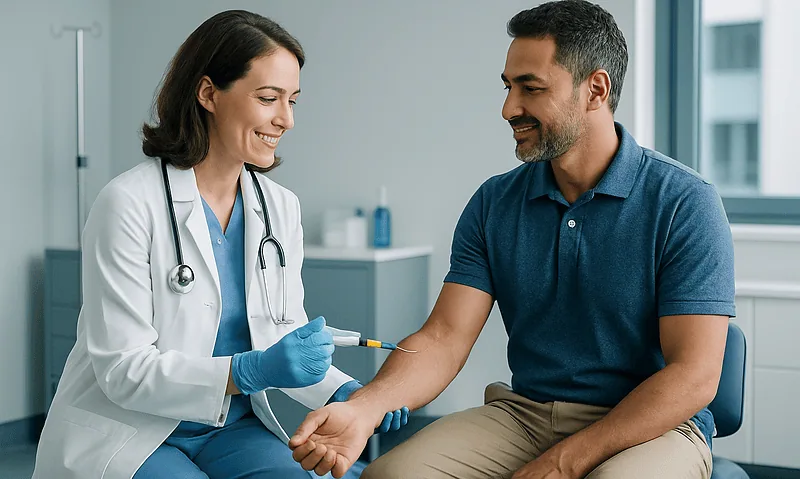
The clinician starts by pressing along the painful region to map tender ligament and tendon attachment points, often several per joint. After cleaning the skin, most practitioners apply or inject a local numbing agent, then deliver a series of small injections into and around those attachment sites. A knee might receive 10 to 20 tiny injections in one sitting; a back or sacroiliac region, sometimes more. Some clinicians use ultrasound to guide needle placement, which is worth asking about, particularly for deeper targets.
The whole thing usually takes 15 to 30 minutes. You’ll typically walk out under your own power, though someone should drive you home after spine or lower-limb sessions if you’re sore.
Aftercare instructions tend to include:
- Expect soreness, stiffness, and sometimes bruising for one to three days: this flare is considered part of the intended response, not a complication.
- Use ice sparingly and rest relatively, but keep gently moving; total immobilization isn’t the goal.
- Many practitioners suggest avoiding anti-inflammatory pain relievers for several days, on the theory they could blunt the healing response the injection is trying to provoke. Worth knowing: that theory is biologically plausible but not well proven in humans either.
Sessions are usually spaced three to six weeks apart, giving each round time to do whatever it’s going to do before the next.
How many sessions do you need, and how long does prolotherapy last?
Almost every studied protocol involves a course, not a single shot. Three to six sessions is typical, spaced roughly a month apart, which means the full treatment plays out over three to six months. The knee osteoarthritis trials generally used three to five sessions; some practitioners add more if improvement is trending but incomplete.
Two timing facts help set expectations. First, relief is usually gradual. Because the proposed mechanism involves tissue changes over weeks, most people don’t feel dramatically better after session one, and a short-lived worsening in the first few days is common. Trials measured their meaningful differences at three months, six months, and one year, not at week two.
Second, on durability: in the best knee study, the advantage over placebo was still present at 52 weeks, and an uncontrolled follow-up of those participants suggested improvements persisted around two and a half years. Beyond that, nobody honestly knows. Osteoarthritis is progressive, and no injection, this one included, has been shown to stop the underlying joint changes.
A practical benchmark worth agreeing on with your clinician before you start: if you’ve had two or three sessions with no improvement at all, the odds that sessions four through six will rescue the result are low. Reputable practitioners set a stopping point in advance. A clinic that responds to every non-result with ‘you just need more sessions’ is describing a revenue model, not a treatment plan.
What is the average cost of prolotherapy?
In the United States, commonly published fees for dextrose prolotherapy run from roughly $150 to $600 per session, depending on the region, the number of areas treated, whether ultrasound guidance is used, and who’s holding the needle. Large joints and spine work sit at the higher end; a single small joint at the lower end.
Since a typical course involves three to six sessions, a realistic total lands somewhere between $500 and $3,000 or more. That’s the number to budget for, not the per-session figure a clinic may quote first.
Now the part that surprises people: insurance almost never pays. Medicare and most private insurers classify prolotherapy as investigational or experimental, citing the limited evidence base, and have done so for decades. A few plans make case-by-case exceptions, but the working assumption should be that this is an out-of-pocket expense. Funds from a health savings or flexible spending account can sometimes be applied, check your plan’s rules before assuming.
Three money questions worth asking any clinic in writing:
- What is the all-in cost for a complete course, including guidance imaging and follow-up visits?
- At what point do we stop if it isn’t working?
- Is there a charge for an initial consultation even if we decide against treatment?
For comparison, the exercise-based approaches with the strongest osteoarthritis evidence, physical therapy, structured strengthening programs, are typically covered by insurance. That asymmetry deserves a place in the decision.
Prolotherapy side effects: what's normal and what's not
The safety record, for a needle-based treatment, is reassuring, with important location-specific caveats.
Expected and usually harmless: pain and stiffness at the injection sites for one to three days, mild swelling, bruising, and occasionally a temporary flare of the very pain you came in with. Reviews of trial data report these in a substantial share of patients and describe them as self-limited. A brief lightheaded spell during or after injections happens to some people and passes quickly.
Uncommon but real: any injection that breaks the skin carries a small infection risk, which is why sterile technique matters and why fever or spreading redness afterward warrants a same-day call. Nerve irritation near injection sites can cause temporary numbness or tingling. Allergic reactions to solution components are rare with dextrose but possible.
Rare and location-dependent: the serious complications in published case reports cluster around anatomically risky territory, spinal injections have rarely caused spinal fluid leaks with severe headache, and injections near the chest wall have rarely caused a collapsed lung. These events are exceptional, but they explain why training and image guidance matter far more for spine and rib-adjacent work than for a knee.
Reasonable screening questions for any practitioner: What is your training in this specific technique? Do you use ultrasound guidance for deep injections? How many of these do you perform in a typical month? Confident, specific answers are a good sign. Vague ones are information too.
Who should not get prolotherapy?
Prolotherapy’s gentleness has limits, and some situations call for a clear pass or a postponement.
Skip or delay treatment if you have an active infectionanywhere in the body, but especially at or near the planned injection site, since introducing needles into that environment invites trouble. An acutely hot, swollen joint needs diagnosis first, not injections; that presentation can signal infection, gout, or an inflammatory arthritis flare, each of which changes the plan entirely.
People with bleeding disorders or those taking blood-thinning medicines need an individualized conversation, because multiple needle passes raise bruising and bleeding risk. Anyone with rheumatoid arthritis or another systemic inflammatory condition should know that prolotherapy trials largely excluded these diagnoses, so the evidence simply doesn’t cover them, and deliberately provoking inflammation in an already inflammatory disease is an untested idea.
Two more groups deserve mention. People with poorly controlled diabetes are often advised to discuss it first; the sugar load from an injection is trivial, but any procedure planning should account for healing capacity and infection risk. And anyone whose pain lacks a clear diagnosis should get one before paying for a course of injections aimed at structures nobody has confirmed are the problem.
Prolotherapy also isn’t a fit for pain caused by conditions it can’t plausibly touch, fractures, complete ligament or tendon ruptures needing surgical evaluation, nerve compression syndromes, or pain referred from internal organs. A good practitioner screens for all of this. So should you.
When should joint or back pain send you to a doctor first?
Before any elective injection, prolotherapy or otherwise, certain symptoms need a proper medical evaluation, because they can signal problems no ligament treatment addresses. Chasing pain relief without a diagnosis is how serious conditions get missed.
See a doctor promptly if you have:
- A joint that is hot, red, and swollen, especially with fever, possible joint infection, which is an emergency.
- Sudden inability to bear weight or a joint that gives way or locks after an injury.
- Back pain with numbness in the groin or inner thighs, new leg weakness, or changes in bladder or bowel controlred flags for nerve compression that needs urgent assessment.
- Pain following significant trauma, such as a fall or collision, where a fracture is possible.
- Night pain that wakes you consistently, unexplained weight loss, or pain with a history of cancer.
- Pain that persists beyond about six weeks despite reasonable self-care, not an emergency, but a reason for an exam rather than more guesswork.
For everyone else, the far more common scenario of nagging, activity-related joint or back pain, a primary care visit is still the smart first stop. Guideline-backed basics come first: an accurate diagnosis, activity modification, a structured exercise program, and weight management where relevant. Those steps are covered by insurance, supported by stronger evidence than any injection discussed here, and they make you a better-informed candidate if you do pursue prolotherapy later.
The bottom line: where prolotherapy honestly fits
Strip away both the promotional gloss and the reflexive dismissal, and prolotherapy lands in a specific, defensible place: a low-risk, moderately priced option with real but limited evidence, strongest for knee osteoarthritis, promising for tennis elbow, and unconvincing on its own for chronic low back pain.
In my read, three principles should govern the decision. First, sequence matters: exercise therapy and weight management have better evidence and lower cost, so they belong upstream of any injection. Second, condition matters more than enthusiasm: the same syringe that has decent trial support at the knee has a Cochrane review against it at the lumbar spine, and a clinic that treats every joint identically isn’t reading the same literature. Third, exit criteria matter: agree in advance on how many sessions constitute a fair trial and what improvement would justify continuing.
What would change this picture is a large, multicenter randomized trial: the kind that has never been run, partly because there’s no patent on sugar water to fund it. Until then, the fairest sentence anyone can write about prolotherapy is this: it may genuinely help some people with some conditions, it will not rebuild a worn joint, and the person selling it to you should be able to tell you both of those things without flinching. If they can’t, keep your money and find someone who can.
Frequently asked questions
Does prolotherapy actually work?
It works for some conditions, by the evidence available, and not clearly for others. Small randomized trials show meaningful pain and function improvements for knee osteoarthritis, sustained at one year, and pilot studies suggest benefit for tennis elbow. For chronic low back pain, a Cochrane review found prolotherapy alone is not effective. The trials are small, so ‘promising for specific joints’ is more accurate than a blanket yes or no.
What is the average cost of prolotherapy?
Commonly published U.S. fees run roughly $150 to $600 per session, depending on the body region, the number of areas treated, and whether ultrasound guidance is used. Because a typical course involves three to six sessions, plan for a realistic total of $500 to $3,000 or more. Insurance and Medicare almost never cover it, classifying the treatment as investigational, so this is usually an out-of-pocket expense.
Which is better, PRP or prolotherapy?
Neither has a decisive edge in the small head-to-head trials that exist, some show similar results, some give PRP a modest advantage. PRP has a larger overall research base, especially for knee osteoarthritis and tennis elbow, but typically costs $500 to $2,500 per session versus a few hundred for prolotherapy. Both are rarely covered by insurance, and both should follow exercise-based treatment, not replace it.
How long does prolotherapy last?
In the strongest knee osteoarthritis trial, benefits over placebo persisted at 52 weeks, and an uncontrolled follow-up of participants suggested improvements lasted around two and a half years. Beyond that, durability is unknown. Prolotherapy has not been shown to stop the progression of arthritis or other degenerative conditions, so even people who respond well may need to revisit treatment options as the underlying condition evolves.
How many prolotherapy sessions are needed?
Most studied protocols use three to six sessions spaced roughly a month apart, so a full course plays out over three to six months. Relief tends to build gradually rather than arriving after the first injection. A useful benchmark: if two or three sessions produce no improvement at all, further sessions are unlikely to change the outcome, and reputable practitioners agree on a stopping point before treatment begins.
Does prolotherapy hurt?
It involves multiple small injections, so expect discomfort during the procedure despite local numbing: a knee may receive 10 to 20 needle passes in a session. Afterward, one to three days of soreness, stiffness, and sometimes a temporary flare of your usual pain is common and considered part of the intended response. Most people manage it with ice, relative rest, and gentle movement rather than staying off their feet.
Is prolotherapy covered by insurance or Medicare?
Almost never. Medicare and most private insurers classify prolotherapy as investigational or experimental because the supporting trials are small, and that designation has stood for decades. A few plans consider case-by-case exceptions, but you should budget as if the full cost is out of pocket. Health savings or flexible spending account funds can sometimes be applied, confirm with your plan administrator before scheduling.
Can prolotherapy regrow cartilage or tighten ligaments?
There’s no solid human evidence that it does either. Imaging studies have generally not shown ligaments thickening or cartilage regrowing after treatment, even in patients who report real pain relief. Researchers now suspect the benefit may come from effects on pain-signaling nerves rather than tissue rebuilding. Be wary of clinics that promise structural ‘regeneration’: the trials measured pain and function, not restored anatomy.
Is prolotherapy the same as stem cell injections?
No. Prolotherapy injects a concentrated sugar solution to provoke a mild healing response; stem cell procedures inject cells harvested from bone marrow, fat, or other tissue. They are often marketed side by side at the same clinics, which creates confusion. Stem cell injections for joint pain remain far more expensive, less standardized, and are viewed by mainstream medical organizations as unproven for routine orthopedic use.
Is there downtime after prolotherapy?
Very little for most people. You can usually walk out of the appointment, and many return to desk work the same or next day. Expect soreness for one to three days, during which practitioners typically advise relative rest, gentle movement, and avoiding anti-inflammatory pain relievers on the theory they might blunt the intended response. Strenuous exercise and heavy loading of the treated area are usually postponed about a week.
References
- NIH / PubMed Central: Prolotherapy in Primary Care Practice
- MedlinePlus: Back Pain
- NHS: Osteoarthritis
This article is for general information only and is not a substitute for professional medical advice. Please consult a qualified doctor about your individual situation.

More from the Blog

Medial Branch Blocks and Facet Injections: The Diagnostic Ladder Explained
A medial branch block is a diagnostic injection, not a lasting treatment. A physician places a small amount of numbing medication beside the tiny…

What Happens During a Joint Injection: Positioning, Ultrasound Guidance and the Needle
A joint injection procedure typically takes a few minutes. You are positioned so the joint space opens, the skin is cleaned with antiseptic, and…

Who May Be a Candidate for Spinal Cord Stimulation After Conservative Care Falls Short?
Spinal cord stimulation is usually considered for adults with chronic neuropathic pain, most often persistent leg or back pain after spine surgery, complex regional…
PRP Injection Cost: Per-Session Pricing and How Many Sessions Trials Use
PRP injections are priced per session. For a knee PRP injection, our guide range is EUR 450-900 per session (Turkey market average EUR 350-700),…

Who Is a Candidate for Shock Wave Therapy? Plantar Fasciitis, Tennis Elbow and More
Shockwave therapy is usually considered for adults with a chronic tendon or fascia problem, most often plantar fasciitis, tennis elbow or calcific shoulder tendinopathy,…

Interventional Pain Management: What Image-Guided Injections and Procedures Involve
Interventional pain management procedures are targeted treatments, most often injections, delivered under live X-ray or ultrasound guidance so a needle reaches a specific nerve,…