

Questions to Ask Before a Mastectomy: Reconstruction Timing, Lymph Nodes and Follow-Up

Key Takeaways
- For early-stage breast cancer, lumpectomy followed by radiation is generally as effective as mastectomy at controlling the disease, so the first question is whether a mastectomy is needed at all.
- A sentinel lymph node biopsy removes only the first draining node or nodes and carries a markedly lower lymphedema risk than a full axillary dissection.
- Radiation after mastectomy is the single biggest factor pushing reconstruction from immediate to delayed, because radiated tissue scars and raises implant complication rates.
- Breast implants are not lifetime devices and may need replacement, while flap reconstruction uses your own tissue but adds a donor-site scar and a longer operation.
- Supervised exercise, including resistance training, is protective against lymphedema, reversing older advice to rest the arm.
- After a mastectomy there is no routine cancer imaging of the removed side; follow-up relies on examination of the chest wall plus regular mammograms of any remaining breast.
Before a mastectomy, ask your surgical team which type of mastectomy is planned and why, how the lymph nodes will be checked, whether reconstruction would be immediate or delayed and how radiation might change that, what recovery usually involves, and how follow-up will work afterward. Write the questions down, bring someone to the appointment, and let the treating team guide each decision.
The folder sits on the kitchen table for two days before anyone opens it. Inside are the pathology report, a leaflet about surgery, and a consent form with a blank line where a signature is supposed to go. The appointment is next week. What most people feel at that table is not fear of the operation itself but the sense that they are about to make several large decisions at once without knowing what the right questions even are.
That is a reasonable feeling. A mastectomy is rarely one choice. It is a cluster of them: the kind of operation, what happens to the lymph nodes under the arm, whether to rebuild the breast and when, and how the years of follow-up will look. Each has evidence behind it, and each carries trade-offs the surgeon knows well but cannot guess you care about unless you ask.
This article walks through the questions to ask before mastectomy, in the order they usually come up, with what mainstream medical evidence actually says about each one.
What happens before a mastectomy, and why the right questions to ask before mastectomy start early
The weeks before surgery are busier than most people expect, and that is where the best questions get asked. After a biopsy confirms breast cancer, the results are usually reviewed by a multidisciplinary team: a group of surgeons, oncologists, radiologists and nurses who discuss each case together and agree a recommended plan. You then meet the surgeon to hear that plan and, ideally, to shape it.
Several practical steps follow. Imaging may be repeated or extended, sometimes with a breast MRI, to map how much tissue is involved. Blood tests and a pre-anesthetic assessment check that your heart, lungs and general health can tolerate a general anesthetic. If you take blood thinners, hormone therapy or supplements, the team will tell you what to pause and when; that instruction belongs to them, not to a leaflet. Smokers are usually asked to stop, because tobacco narrows small blood vessels and slows wound healing, a concern that becomes much larger if reconstruction is planned.
Use this window well. The Mayo Clinic suggests arriving with a written list of questions and a companion who can take notes while you listen. People consistently report that they remember only fragments of these conversations, which is normal under stress. Ask for the pathology report in writing and for the surgeon to walk you through the terms on it: tumor size, grade, hormone receptor status and HER2 status (a protein that drives some breast cancers). Those four details shape nearly everything that follows, from whether chemotherapy might come before surgery to how the lymph nodes will be handled.
If the plan feels rushed, say so. Breast cancer surgery is usually scheduled within weeks rather than days, and a short pause to understand the options is part of good care, not a delay of it.
How a mastectomy actually works
A mastectomy removes the breast tissue, which is what matters for cancer control, and in most forms also removes the nipple and some skin. The operation takes place under general anesthetic, meaning you are fully asleep. The surgeon makes an incision across the breast, separates the glandular tissue from the chest muscle beneath and from the skin above, and lifts it away in one piece so a pathologist can examine the edges, or margins, for cancer cells.
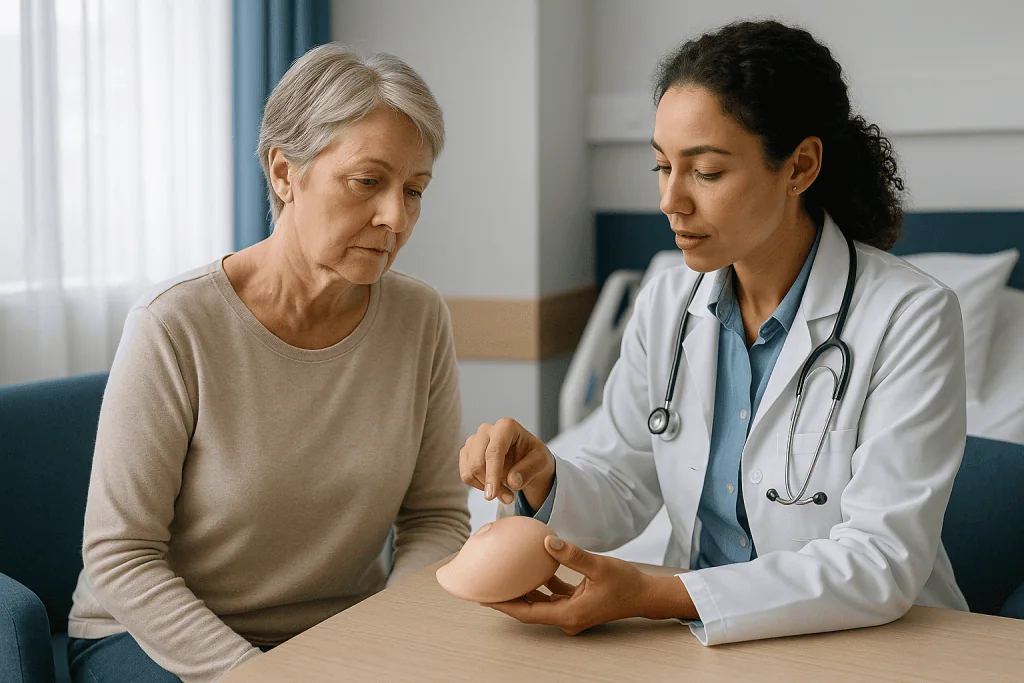
What happens next depends on the plan agreed with you. If lymph nodes are being checked, that is often done through the same incision or a small second one near the armpit. If reconstruction is immediate, the plastic surgeon works in the same session, either placing an implant or a temporary tissue expander, or moving tissue from elsewhere on the body. If you are not having reconstruction, the surgeon closes the chest wall flat.
Before closing, one or two thin drainage tubes are usually placed under the skin. These drains carry away the fluid the body produces after tissue is removed and reduce the chance of a seroma, a pocket of fluid that can collect in the space left behind. The Mayo Clinic describes these drains as staying in place for days to a couple of weeks, with the team removing them once the daily output falls.
The MedlinePlus description of the procedure notes that a mastectomy without reconstruction usually takes a few hours, and that reconstruction or extensive node surgery lengthens this. You will wake in a recovery area with a dressing across the chest and, often, a compression garment. Numbness over the chest is expected at this stage because small sensory nerves are cut when the tissue is removed; some sensation returns over months, but a degree of permanent numbness is common and worth asking about before rather than after.
Types of mastectomy compared: what is removed and what to ask
Surgeons use several named variations, and the word on your consent form determines what is taken, what is kept and what reconstruction becomes possible. The table below summarizes the main types as described by the National Cancer Institute and the Mayo Clinic.
| Type | What is removed | What is usually kept | A question worth asking |
|---|---|---|---|
| Simple (total) mastectomy | All breast tissue, nipple, areola, most overlying skin | Chest muscles, most lymph nodes | Will any nodes be sampled at the same time? |
| Modified radical mastectomy | All breast tissue plus many underarm lymph nodes | Chest muscles | Why is a full node dissection needed in my case? |
| Skin-sparing mastectomy | Breast tissue, nipple and areola | Most breast skin as an envelope for reconstruction | Is immediate reconstruction planned to use this skin? |
| Nipple-sparing mastectomy | Breast tissue only | Skin, nipple and areola | Is my tumor far enough from the nipple for this to be safe? |
| Bilateral (double) mastectomy | Both breasts, by any of the methods above | Depends on method | What does removing the unaffected breast change for me? |
Two points deserve emphasis. Skin-sparing and nipple-sparing operations keep the outer shape so that reconstruction can look more natural, but they are only appropriate when the cancer sits well away from the preserved tissue; the surgeon decides that from imaging and pathology, not from preference alone. And removing the healthy opposite breast is a separate decision with its own evidence. The Mayo Clinic notes that for most people without a strong inherited risk, taking the unaffected breast does not change the outlook of the cancer being treated, although it can be reasonable for symmetry or for peace of mind once the trade-offs are understood.
Who is usually offered a mastectomy, and who is usually asked to wait
Mastectomy is not the default for every breast cancer. For many early-stage tumors, breast-conserving surgery (a lumpectomy, which removes the tumor with a rim of healthy tissue) followed by radiation is an equally valid route. The Mayo Clinic states that for early-stage disease, lumpectomy with radiation is generally as effective as mastectomy in controlling the cancer. So the first question is not which mastectomy, but whether one is needed at all.

Situations where a mastectomy is usually recommended include a tumor that is large relative to the breast, cancer in more than one area of the same breast, inflammatory breast cancer, a prior course of radiation to the same breast, or a confirmed inherited mutation such as BRCA1 or BRCA2 (genes that normally repair DNA and, when altered, raise lifetime breast cancer risk substantially). Some people with the option of lumpectomy still choose mastectomy, perhaps to avoid radiation or repeated imaging worry, and that is a legitimate choice when it is informed.
Others are asked to wait, and understanding why helps. If the plan includes neoadjuvant therapy, meaning chemotherapy or targeted drugs given before surgery to shrink the tumor, the operation is scheduled after that course finishes and the body has recovered. Active infection, poorly controlled diabetes or recent heart problems may prompt a short delay while those are stabilized, because they raise anesthetic and wound risks. Current smoking is a frequent reason a plastic surgeon advises delaying reconstruction, not the mastectomy itself, since nicotine impairs blood supply to skin flaps and implant pockets.
Pregnancy, breastfeeding and recent weight change can also affect timing, especially for tissue-flap reconstruction. None of these are refusals. They are sequencing decisions, and the treating team should be able to explain the reasoning in plain language and give you a realistic sense of the expected wait.
Sentinel lymph node biopsy questions: how the nodes are checked and why it matters
Breast cancer spreads first, if it spreads at all, to the lymph nodes under the arm. Checking them tells the team the stage of the disease and whether treatments beyond surgery are needed. There are two ways to do this, and the difference affects your arm for life.
A sentinel lymph node biopsy identifies the one or few nodes that drain the breast first. Before or during surgery, a tracer, usually a blue dye, a weak radioactive substance or both, is injected near the tumor. The surgeon follows it to the first node or nodes that light up, removes them, and a pathologist examines them. The National Cancer Institute explains that if the sentinel nodes are clear, the remaining nodes are very likely clear too, so they can be left alone.
An axillary lymph node dissection removes a larger group of nodes from the armpit. It is used when imaging or biopsy already shows cancer in several nodes, or when the sentinel approach is not suitable. The NCI notes that dissection carries a higher chance of lymphedema, arm numbness and shoulder stiffness than sentinel biopsy. Current practice increasingly avoids full dissection when only a small amount of cancer is found in a sentinel node and radiation is planned, so ask whether that applies to you.
Questions that genuinely change what happens:
- Will my nodes be checked by sentinel biopsy or dissection, and what decides that?
- If a sentinel node turns out positive, will more nodes be removed in the same operation or discussed afterward?
- Could I need a second surgery based on the pathology result?
- What is my personal risk of lymphedema with the planned approach?
- Will the tracer injection be done before I am asleep, and what does it feel like?
The answers vary with your imaging and tumor biology, which is exactly why they should come from your own surgeon.
Immediate vs delayed breast reconstruction: how timing is decided
Reconstruction can happen in the same operation as the mastectomy, months or years later, or in a two-stage arrangement that keeps the door open. None of these is medically superior for everyone; the choice rests on your cancer treatment plan, your health and what you want.
Immediate reconstruction means the plastic surgeon rebuilds the breast mound during the mastectomy, often using the preserved skin from a skin-sparing or nipple-sparing operation. The National Cancer Institute lists its advantages as one anesthetic rather than two and waking up with a shape already present, which some people find easier emotionally. The main caution is radiation: if post-mastectomy radiation is likely, an implant placed now may tighten, shift or need replacing later, because radiated tissue scars and contracts.
Delayed reconstruction takes place after all cancer treatment is finished and the chest has healed. It allows the team to see the final pathology and complete radiation first, and gives you time to decide without pressure. The trade-off is living with a flat chest for a period and undergoing a second major operation.
Delayed-immediate reconstruction is a middle path. A tissue expander, which is a temporary adjustable implant, is placed at the mastectomy to hold the skin envelope. If radiation turns out not to be needed, the expander is swapped for the final implant or flap sooner; if it is needed, the swap waits until after radiation.
Choosing no reconstruction, sometimes called an aesthetic flat closure, is a fourth, fully legitimate option. Ask the surgeon to describe how the chest will be contoured if you choose this, because a flat result that is comfortable under clothing requires planning too. Whatever you lean toward, the questions to ask before mastectomy about reconstruction timing are these: Is radiation likely for me? Does that change which options are sensible now? What would each path mean for the number of operations ahead?
Implants or your own tissue: what to ask about reconstruction methods
Once timing is settled, the method follows. Broadly there are two families, and the NCI fact sheet on breast reconstruction describes both without favoring either.
Implant-based reconstruction uses a silicone shell filled with saline or silicone gel, often after a period with a tissue expander that is gradually filled over weeks to stretch the skin and muscle. The surgery is shorter and leaves no scars elsewhere on the body. Two honest limitations belong in the conversation. Implants are not lifetime devices; the NCI notes they may need to be replaced over the years for rupture, hardening of the scar capsule or changes in the chest. And a rare cancer of the immune system, breast implant-associated anaplastic large cell lymphoma, has been linked to certain textured implants; your surgeon can explain which implant types are used and what monitoring is advised.
Autologous, or flap, reconstruction moves skin, fat and sometimes muscle from another part of the body, most often the lower abdomen (DIEP or TRAM flaps), the back (latissimus dorsi flap) or the thigh or buttock. The rebuilt breast is warm, ages with you and generally tolerates radiation better. The cost is a longer operation, a second scar at the donor site, a longer hospital stay and, in some techniques, some loss of muscle strength at the donor area.
Worth asking about with either approach:
- Will my other breast need surgery to match, such as a lift or reduction?
- How is the nipple rebuilt, and is tattooing part of the plan?
- How many operations, in total, does my chosen path usually involve?
- What would make me a poor candidate for a flap, and does that apply to me?
- What does the reconstructed breast feel like, and will it have sensation?
Sensation is the question people most often wish they had raised. Reconstructed breasts are frequently numb, and expecting that in advance makes it far easier to live with.
How radiation, chemotherapy and hormone therapy change the surgical plan
Surgery rarely stands alone, and the other treatments shape its timing in ways that are easy to miss if you only talk to the surgeon. Ask who coordinates the whole sequence.
Chemotherapy may come before surgery or after. Neoadjuvant chemotherapy, given first, can shrink a large tumor enough to allow a smaller operation and lets the team see how the cancer responds. It can also change the lymph node plan, since nodes that were involved at diagnosis may clear. Adjuvant chemotherapy, given after surgery, usually begins once the wound has healed, a decision the oncologist makes based on how recovery is going.
Radiation after mastectomy is typically recommended when the tumor was large, when several lymph nodes contained cancer, or when the margins were close. The NCI explains that radiation to a reconstructed breast raises the chance of complications, particularly with implants, which is the single biggest reason reconstruction may be delayed or staged. If there is any chance you will need radiation, ask the surgeon and the radiation oncologist to speak to each other before the mastectomy date.
Hormone-blocking treatment, used when the cancer carries estrogen or progesterone receptors, works by lowering estrogen or stopping it from reaching cancer cells, and is usually taken for years after surgery. Targeted therapy for HER2-positive disease may run alongside chemotherapy. Neither affects the mastectomy itself, but both affect what the years afterward look like, including side effects on joints, bones and menopausal symptoms that are worth asking about now. Which drugs, when they start and how long they continue are decisions for the prescribing oncologist, and no article can substitute for that conversation.
A single question captures all of this: in what order will my treatments happen, and who do I call when I am unsure which team to ask?
What the first days and weeks after a mastectomy usually look like
Most people are surprised by two things: how quickly they go home and how long the chest takes to feel like their own again.
The Mayo Clinic notes that people having a mastectomy without reconstruction often go home the same day or after one night; flap reconstruction usually means several nights so the blood supply to the new tissue can be monitored. You will leave with drains in place and instructions for measuring and recording their output, a task that feels daunting on day one and routine by day three. The NHS describes drains being removed once fluid output drops, typically within the first week or two.
Pain is usually described as tightness and soreness rather than sharp pain, and the surgical team will arrange pain relief suited to you. Your arm on the operated side will feel stiff. Gentle shoulder and arm exercises, started when the team says so, prevent the shoulder from freezing and are among the most useful things you can do. Some people develop cording, tight bands running from the armpit down the arm, which usually responds to stretching and physiotherapy.
The NHS advises that recovery from a mastectomy takes several weeks, with heavier lifting, driving and strenuous exercise added back gradually once the team agrees. Fatigue often lasts longer than the wound does. Many people return to desk-based work within a few weeks and physically demanding work later, but that timing depends on reconstruction, on any chemotherapy that follows and on how you heal.
Emotional recovery runs on its own clock. Seeing the chest for the first time, often a few days after surgery when the dressing comes off, is a moment people remember; ask whether a nurse can be present and whether a soft temporary breast form is available if you want one. None of this is a promise about how your weeks will go. It is the typical shape, so that the unusual stands out.
Lymphedema after mastectomy: what the evidence says about risk and prevention
Lymphedema is swelling of the arm, hand or chest caused by lymph fluid building up when nodes and vessels have been removed or scarred. It can appear months or years after treatment, and once established it is managed rather than reversed, which is why it belongs on your pre-surgery question list.
Risk depends mainly on how many nodes were removed and whether the armpit was radiated. The National Cancer Institute reports that the risk is considerably lower after sentinel node biopsy than after full axillary dissection, and higher again when dissection is combined with radiation. Higher body weight and infections in the arm are additional contributors. Ask your surgeon to describe your own risk category rather than quoting a general figure.
Prevention advice has shifted. For decades people were told never to have blood pressure measured, blood drawn or injections given in the affected arm. The NCI now notes that the evidence behind blanket restrictions is limited; the stronger, consistent messages are to keep the skin intact and clean, treat cuts promptly, avoid sunburn, maintain a healthy weight and keep the arm moving. Supervised, progressive exercise, including resistance training, does not worsen lymphedema and appears protective, which overturns older advice to rest the arm.
Early signs are subtle: a watch or ring feeling tight, a heavy or full feeling in the arm, or skin that looks slightly puffy. Caught early, lymphedema is often controllable with compression sleeves, specialized massage called manual lymphatic drainage and exercise. Ask whether your center measures arm volume before surgery as a baseline, which makes early changes easier to detect, and whether a lymphedema therapist is part of the follow-up pathway. Both are questions that are far easier to raise before the operation than after swelling has appeared.
Follow-up after a mastectomy: what to expect in the months and years ahead
Follow-up is where a mastectomy becomes a chapter rather than an event, and the structure is worth understanding before you sign the consent form.
In the first weeks you will see the surgical team to check the wound, remove drains and review the final pathology report, which can differ from the biopsy and may alter the plan. This visit often determines whether radiation or chemotherapy is recommended, so bring your questions list again.
Longer-term surveillance focuses on two things: the remaining breast, if you have one, and the chest wall and nodes on the treated side. The NHS advises regular mammograms of the remaining breast for several years after treatment, with the exact schedule set by your team. There is no routine imaging of a removed breast or an implant-based reconstruction for cancer purposes; instead, you and your clinician examine the chest wall and scar, and any new lump, thickening or skin change is investigated promptly. People with flap reconstructions should ask how that tissue will be assessed, since fat necrosis (firm lumps of scarred fat) can mimic recurrence and sometimes needs imaging to tell apart.
If you are taking hormone-blocking treatment, follow-up includes monitoring for bone thinning and menopausal effects, which is why bone density scans are sometimes scheduled. Implants carry their own long-term checks; the NCI advises discussing with the surgeon how rupture or capsule hardening would be detected.
Ask for a written survivorship plan: a summary of what was done, what treatments continue, who to contact and what symptoms should trigger an earlier appointment. Genetic counseling may be offered at this stage if it was not before, since the result can affect relatives. And ask about the gaps between visits. Many people find that the months without appointments are the hardest, and knowing who to call fills that silence with something practical.
What people often get wrong about mastectomy decisions
Several beliefs circulate widely enough to shape decisions, and the evidence does not support them.
“Removing the whole breast is always safer.” For early-stage cancer, the Mayo Clinic and major guideline bodies describe lumpectomy with radiation as generally as effective as mastectomy at controlling the disease. Mastectomy is the right choice for specific reasons, not because more surgery means more safety.
“Taking both breasts will protect me.” For someone without an inherited mutation or other strong risk factor, removing the healthy breast lowers the small chance of a new cancer there but does not change the outlook of the existing cancer, which is governed by its biology and any spread. Some people still choose it, and that is reasonable once understood as a choice about future risk and symmetry rather than about the current cancer.
“Reconstruction is one operation.” It is usually a series: the initial surgery, expander fills, an exchange procedure, symmetry surgery on the other side, nipple reconstruction and later revisions. Ask for the typical number of steps for your path.
“Implants last forever.” The NCI is explicit that implants may need replacement over a lifetime.
“If reconstruction is skipped now, the chance is gone.” Delayed reconstruction can be done years later, and many people choose it after finishing all other treatment.
“Lymph node removal only matters during surgery.” It is the decision with the longest shadow, because the arm effects are permanent.
“Resting the arm prevents lymphedema.” Movement and supervised exercise are protective; prolonged rest is not.
“A flat chest is giving up.” Choosing not to reconstruct is a complete, planned option, and surgeons can contour the chest wall to make it comfortable and even.
Each correction here comes with a question you can take into the consulting room, which is the real reason to know them.
Questions to ask your care team before a mastectomy: a working list
Here are the questions, grouped the way consultations tend to run. Pick the ones that matter to you; nobody needs to ask them all, and a surgeon will not expect you to.
About the cancer and the operation
- What do my tumor size, grade, receptor status and HER2 status mean for the plan?
- Am I a candidate for breast-conserving surgery, and why is a mastectomy recommended instead?
- Which type of mastectomy is planned, and what will the scar look like?
- Would genetic testing change your recommendation, and should it happen first?
About lymph nodes
- Sentinel node biopsy or dissection, and what decides between them?
- What happens if a sentinel node is positive?
- What is my individual lymphedema risk, and will a baseline arm measurement be taken?
About reconstruction
- Is radiation likely, and how does that affect immediate versus delayed reconstruction?
- Implant or my own tissue: what are the trade-offs in my situation?
- How many operations will my chosen path usually involve?
- If I choose to stay flat, how will you shape the chest wall?
About recovery and follow-up
- How long will I be in hospital, and what help will I need at home?
- When can I drive, lift, exercise and return to work?
- Who do I call about a problem, including at night and weekends?
- What does my follow-up schedule look like, and how will the other breast be monitored?
- In what order will surgery, chemotherapy, radiation and hormone therapy happen, and who coordinates them?
Record the answers, or ask whether the consultation can be summarized in a letter you can keep. A second opinion is an accepted part of cancer care and does not offend a good surgeon. And if you leave with an answer you did not understand, the breast care nurse is usually the person best placed to translate it before the surgery date arrives.
When to call your doctor after a mastectomy
Most recovery problems are minor and expected: bruising, mild swelling, pulling sensations, numbness and tiredness. A smaller group of symptoms need same-day contact with the surgical team or, in some cases, emergency care. Knowing them before surgery means you will not be second-guessing at two in the morning.
Contact the surgical team the same day if you notice:
- A temperature above the threshold your team gave you, chills or feeling generally unwell.
- Redness that is spreading from the wound, increasing warmth, or pus-like or foul-smelling fluid.
- The wound edges separating, or a dressing that keeps soaking through.
- A rapidly enlarging, tense, painful swelling of the chest, which can signal bleeding under the skin.
- A drain that has stopped draining, has come loose or whose fluid suddenly turns bright red.
- Any part of a reconstructed breast or flap turning pale, dusky, purple or cold, which can indicate a problem with blood supply and is treated as urgent.
- New swelling, heaviness or tightness in the arm or hand on the operated side.
Seek emergency care immediately for chest pain, sudden breathlessness, coughing up blood, or pain and swelling in one calf. Surgery and reduced mobility raise the risk of a blood clot in the leg that can travel to the lungs, and these are its warning signs.
In the months and years that follow, report promptly any new lump or thickening in the scar, chest wall or remaining breast, skin changes that look like dimpling or an orange-peel texture, bone pain that does not settle, or persistent cough or breathlessness. Most of these will turn out to be benign, but they are the symptoms your follow-up plan exists to check, and the treating team would always rather hear early.
Every one of these judgments belongs with your clinicians. This list helps you decide when to pick up the phone, not what is wrong.
Frequently asked questions
What happens before a mastectomy?
Before a mastectomy you usually have further imaging, blood tests and an anesthetic assessment, and your case is reviewed by a multidisciplinary team. You then meet the surgeon to agree the type of operation, how lymph nodes will be checked and whether reconstruction is planned. The team tells you which medicines to pause, advises stopping smoking, and gives you a date. Bring written questions and a companion to that consultation.
What are some good questions to ask a surgeon, and what to ask a breast surgeon specifically?
Ask why a mastectomy is recommended over breast-conserving surgery, which type is planned, how the lymph nodes will be assessed and what happens if one is positive. Then ask whether radiation is likely, how that affects reconstruction timing, how many operations your chosen path involves, what recovery usually looks like and how follow-up will be organized. Finally, ask who to call if a problem arises after you go home.
How big is a lumpectomy incision?
There is no standard size; a lumpectomy incision is sized to remove the tumor with a rim of healthy tissue, so it depends on tumor dimensions, location and breast size. Small tumors may need only a short incision, often placed along natural skin lines or around the areola to hide the scar. The surgeon can show you the planned position and expected length during the consultation, which is the only reliable figure for your case.
What should I do after breast cancer surgery?
Follow the wound and drain instructions, start the arm and shoulder exercises when your team says so, and keep moving around the house to lower clot risk. Report fever, spreading redness, sudden swelling or arm heaviness promptly. Attend the follow-up visit where the final pathology is discussed, as it may change the treatment plan. Add driving, lifting and work back gradually with your team’s agreement, and ask about emotional support if you want it.
What is the typical mastectomy recovery time?
The NHS describes recovery from a mastectomy as taking several weeks, with drains usually removed within the first week or two and strenuous activity added back gradually. People without reconstruction often go home the same day or after one night; flap reconstruction means a longer hospital stay. Fatigue frequently lasts longer than the wound, and any chemotherapy or radiation that follows extends the overall timeline. Your team can give a range tailored to your operation.
Immediate vs delayed breast reconstruction: how do I decide?
The deciding factor is usually whether radiation is likely after the mastectomy, because radiated tissue raises complication rates for implants in particular. If radiation is unlikely, immediate reconstruction offers one anesthetic and waking with a breast shape. If it is likely, delayed or staged reconstruction with a temporary expander is often advised. Smoking, other health conditions and how ready you feel to decide also matter. Both surgeons should discuss it with you together.
What sentinel lymph node biopsy questions should I ask before surgery?
Ask whether a sentinel biopsy or a full dissection is planned and what decides that, what happens if a sentinel node contains cancer, and whether a second operation could follow the pathology result. Ask about your personal lymphedema risk, whether arm measurements will be taken before surgery as a baseline, and what the tracer injection involves. The answers depend on your imaging and tumor biology, so they should come from your own surgeon.
Can I choose not to have breast reconstruction?
Yes. Choosing to go flat, sometimes called an aesthetic flat closure, is a complete and recognized option, and reconstruction can still be considered years later if you change your mind. Ask the surgeon how the chest wall will be contoured so it is smooth and comfortable under clothing, and whether an external breast form or prosthesis will be offered. Many people find a flat closure the simplest route through recovery.
Will I need radiation after a mastectomy?
Not everyone does. Radiation after mastectomy is usually recommended when the tumor was large, when several lymph nodes contained cancer or when the margins were close, and the final decision depends on pathology results available only after surgery. Because radiation affects reconstruction, ask before the operation how likely it is in your case and whether the surgical and radiation teams have discussed the sequence together.
How is the other breast checked during follow-up after a mastectomy?
The remaining breast is monitored with regular mammograms for several years after treatment, on a schedule set by your team, alongside clinical examination. The treated side is checked by examining the chest wall, scar and any reconstruction rather than by routine imaging. Any new lump, thickening or skin change on either side is investigated promptly. If hormone-blocking therapy is used, follow-up may also include bone density checks.
References
This article is for general information only and is not a substitute for professional medical advice. Please consult a qualified doctor about your individual situation.
Add us as a Preferred Source to see more of our trusted health content across Google Search, AI Overviews and Discover.

More from the Blog
Tailbone Pain and Cancer: When It Can Be a Symptom and the Far More Common Causes
Tailbone pain is rarely caused by cancer. Most cases follow a fall, long hours of sitting, childbirth or pelvic floor strain, and they settle…
Why Does Mohs Surgery Take a Whole Day? Skin Cancer Removed Layer by Layer While You Wait
Mohs surgery takes most of a day because the skin cancer is removed in thin layers, and each layer is frozen, sliced, stained and…

Immunotherapy With an Autoimmune Condition or Transplant History: What the Team Weighs
People with an autoimmune condition or a transplant history can sometimes receive cancer immunotherapy, but it is a case-by-case decision. The treating team weighs…

How Long Immunotherapy Takes to Show a Response and Why Early Scans Can Mislead
Immunotherapy for cancer usually takes longer to show a measurable response than chemotherapy. Most people have their first scan roughly 8 to 12 weeks…
How Head Cancer Treatment Is Planned for Mouth, Throat, Sinus and Salivary Gland Tumors
Head and neck cancer treatment planning starts with a biopsy to confirm the cancer type, imaging and examination to assign a stage, and a…

Can Skin Cancer Be Fatal? Which Types Are Dangerous and How Early Detection Changes the Outlook
Yes, skin cancer can be fatal, but the risk depends heavily on the type and the stage at diagnosis. Melanoma causes most skin cancer…