

Questions to Ask Before Neuromodulation: Trials, Device Life and What Follow-Up Involves

Key Takeaways
- A spinal cord stimulator trial uses temporary leads worn for roughly five to seven days, and many teams treat a pain reduction of about half, with better function, as the threshold to proceed.
- Deep brain stimulation has no take-home trial; stimulation is tested on the operating table before lead position is finalized.
- Non-rechargeable deep brain stimulation generators typically need surgical replacement after about three to five years, while rechargeable units last longer but require a lifelong charging routine.
- Most modern implants are MRI conditional rather than MRI forbidden, meaning scans are possible only under specific scanner and device settings listed on your identification card.
- Deep brain stimulation controls symptoms that respond to levodopa but does not slow Parkinson's disease or help most non-motor symptoms.
- Lead migration is the most common hardware problem after spinal cord stimulation, which is why bending, twisting and lifting are restricted for about six weeks.
Before agreeing to neuromodulation, ask what the trial will measure and what result counts as a pass, how the permanent device is implanted, how long the pulse generator or battery typically lasts before a replacement operation, which MRI and driving rules apply to your specific system, how programming visits are scheduled, and whom to call about infection, lead movement or new symptoms. The treating team makes the final decision with you.
The consultation ends the way most of them do: a folder, a leaflet with a drawing of the spine, and a sentence that sounds simple until you get home. “We think you may be a candidate for a stimulator.” On the drive back, the questions arrive in the wrong order. Will it hurt? Does it ever come out? What happens to the battery?
Neuromodulation is one of the few treatments in medicine with a built-in rehearsal. For spinal cord stimulation, a temporary trial lets you test the therapy for about a week before anything is implanted for good. That is a gift, but only if you know what to look for and what to ask. The questions to ask about neuromodulation are not really about the hardware. They are about how a decision gets made, how long a device lasts and what your calendar looks like afterward.
This guide walks through those questions in the order a careful patient would want them answered, grounded in mainstream clinical evidence rather than brochure language.
What is neurostimulation? The first of the questions to ask about neuromodulation
Neuromodulation is an umbrella term for any therapy that changes how nerves fire by delivering electricity, or occasionally medicine, directly to a chosen target in the nervous system. Neurostimulation is the electrical version, and it is what most people mean when they say “stimulator.”
Every system has three parts. A lead is a thin, insulated wire with metal contacts at the tip, placed near the nerves or brain region being targeted. A pulse generator is a sealed unit, roughly the size of a matchbox, that holds the battery and the tiny computer that shapes the electrical pulses. A programmer, either a clinician’s tablet or a patient handset, adjusts the settings from outside the body.
What the pulses do depends on where they land. In spinal cord stimulation, contacts sit in the epidural space, the fat-filled gap just outside the membrane covering the spinal cord. The pulses alter how pain messages travel up the dorsal columns, the long nerve bundles at the back of the cord. Older systems replaced pain with a tingling called paresthesia; newer waveforms aim to reduce pain without any sensation at all. Mayo Clinic and Cleveland Clinic both note that the precise mechanism is still not fully understood, and that honesty matters when you are weighing an implant.
Deep brain stimulation works on a different principle. Electrodes placed in deep nuclei such as the subthalamic nucleus or thalamus deliver continuous pulses that interrupt abnormal rhythms driving tremor or stiffness. Vagus nerve stimulation wraps a coil around the vagus nerve in the neck and sends pulses toward the brainstem.
The feature that unites all of these, and the reason the field exists, is adjustability. Unlike surgery that destroys tissue, stimulation can be turned up, down or off, and the hardware can be removed.
What conditions can neuromodulation treat, and how strong is the evidence for each?
The honest answer is that evidence strength varies widely by condition, and your care team should be able to tell you where your diagnosis sits on that spectrum.

- Chronic neuropathic pain of the back and legs that persists after spinal surgery, complex regional pain syndrome and some painful peripheral neuropathies are the longest-established targets for spinal cord stimulation, according to Cleveland Clinic and Johns Hopkins.
- Parkinson’s disease, essential tremor and dystonia are the core indications for deep brain stimulation. The NHS describes it as an option when medicines no longer control symptoms well, and Mayo Clinic lists these three as its principal uses.
- Epilepsy that has not responded to several medicines may be treated with vagus nerve stimulation or deep brain stimulation, per Mayo Clinic.
- Treatment-resistant depression has an approved vagus nerve indication in some countries, though Mayo Clinic notes the evidence base is smaller than for epilepsy.
- Overactive bladder and bowel incontinence can be managed with sacral nerve stimulation, a lead placed near the nerves at the base of the spine.
- Obsessive-compulsive disorder has a limited deep brain stimulation indication, used in highly selected cases.
Then there is a second tier where stimulation is studied but not settled: cluster headache, migraine, chronic angina and some forms of facial pain. A reasonable question for any of these is simply, “Is this an established indication or still being studied?” A good clinician will not flinch at it.
Notice what is missing from the list. Neuromodulation does not treat the underlying cause of a damaged disc, a degenerating nervous system or a scarred nerve. It modulates the signal, not the source. That distinction shapes almost every expectation that follows.
Who is usually offered neuromodulation, and who is usually asked to wait?
Selection is where outcomes are won or lost, and the process is deliberately slow.
For pain, candidates typically have a clear diagnosis that matches a known stimulation target, have tried conventional treatments including physical therapy and medicines for a sustained period, and have no surgical option likely to fix the cause. Johns Hopkins describes a psychological assessment as a routine part of the work-up, not because pain is “in the head” but because untreated depression, anxiety or substance use predict poorer results and can be addressed first.
For Parkinson’s disease, the NHS and Mayo Clinic describe deep brain stimulation as an option when symptoms respond to levodopa, a dopamine-replacement medicine, but the response has become unpredictable or complicated by involuntary movements. A good response to that medicine is one of the strongest predictors that stimulation will help the same symptoms.
People are usually asked to wait, or sometimes steered elsewhere, when:
- there is an active infection anywhere in the body, because implanted hardware is vulnerable to seeding;
- blood-thinning treatment needs careful planning around surgery;
- a pending operation might remove the pain source entirely;
- pregnancy is planned or under way, since safety data are limited;
- significant memory or thinking problems are present, which Mayo Clinic flags as a particular concern with deep brain stimulation;
- frequent MRI scans are expected and the proposed system cannot accommodate them.
None of these is a judgment. They are timing issues. The right question is, “What would need to change for me to become a candidate?” The answer is often specific and achievable.
One more opinion, grounded in guideline language: being told to wait is not the same as being told no. Ask for a review date rather than leaving with a closed door.
What happens in a spinal cord stimulator trial, and what counts as a pass?
A trial is a rehearsal with real equipment. Under local anesthetic and X-ray guidance, one or two temporary leads are threaded through a needle into the epidural space and taped to the skin, where they connect to an external stimulator worn on a belt. Nothing is implanted under the skin. Cleveland Clinic describes the trial period as typically five to seven days; Johns Hopkins puts it at about a week.
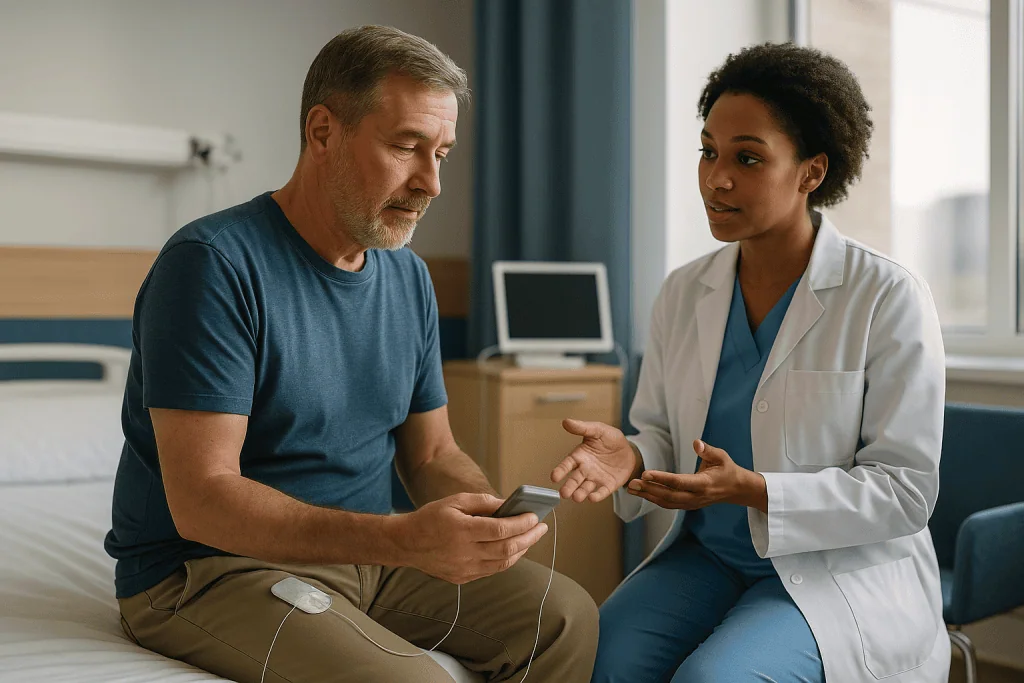
During those days you live as normally as the restrictions allow. Bending, twisting, lifting and showering are usually off-limits so the leads do not shift. You keep a pain diary, note sleep, walking distance and medicine use, and report back.
The pass mark most teams use is a reduction in pain of roughly half or more, together with improvement in function, a threshold cited by Cleveland Clinic and Johns Hopkins. Two questions sharpen this:
- “Which measures will you use to decide, and will I see them?”
- “If the result is borderline, who makes the call, and can the trial be repeated?”
At the end, the leads are pulled out in clinic, which takes moments. A failed trial does not mean failed treatment; it means the device did not help enough to justify surgery, and that is exactly the information the trial exists to provide.
Deep brain stimulation has no take-home trial. Instead, Mayo Clinic describes testing on the operating table, where stimulation is switched on and tremor or stiffness is assessed before the lead position is finalized. Vagus nerve and sacral nerve systems vary; sacral stimulation usually includes a short external test phase, while vagus nerve stimulation generally does not. Ask which model applies to you.
How is a neurostimulator implanted? A walk-through for spine, brain and vagus nerve systems
The implant is usually a shorter, more predictable operation than people imagine, though the details differ by target.
Spinal cord stimulator. Permanent leads are placed one of two ways. Percutaneous leads, wire-thin and threaded through a needle, go in much like the trial leads. Paddle leads, flat and wider, need a laminotomy, a small window cut in the bony arch of a vertebra, so a surgeon can position them directly. Either way, the lead is tunneled under the skin to a pocket, commonly in the upper buttock, flank or abdomen, where the pulse generator sits. Johns Hopkins and Cleveland Clinic describe the procedure as taking roughly one to two hours under sedation or general anesthesia, with many people going home the same day or after one night.
Deep brain stimulator. This is a two-part process in most centers. In the first stage, a frame or a frameless guidance system holds the head still while a burr hole, a small opening in the skull, is made on each side needing treatment. Electrodes are advanced to the target using imaging, sometimes with microelectrode recording to listen to cell activity. Mayo Clinic notes this part may be done awake, so you can report sensations and the team can test stimulation, or asleep with image guidance. In the second stage, usually days later, the pulse generator is placed under the skin below the collarbone and connected by a wire tunneled behind the ear and down the neck.
Vagus nerve stimulator. Two incisions: one in the neck to coil the lead around the nerve, one in the chest for the generator. Mayo Clinic describes it as outpatient or overnight surgery.
Ask who performs each stage, how many incisions to expect and where the generator will sit. Its position affects how you sleep, wear a belt and recharge.
What is the downside of deep brain stimulation? The risks people are not always told
Deep brain stimulation can transform tremor and stiffness for the right person. It also carries costs that deserve plain language, and they come in three groups.
Surgical risk. Any operation on the brain carries a small risk of bleeding, stroke, infection or seizure. Mayo Clinic lists these alongside breathing problems, heart problems and confusion after surgery. The risk is low in experienced hands, but it is never zero, and it is not a risk a spinal cord stimulator shares.
Stimulation side effects. Because the electrodes sit among circuits that handle speech, balance, mood and attention, the pulses can spill over. Mayo Clinic describes possible speech difficulty, balance problems, numbness or tingling, muscle tightness, mood changes, and effects on thinking. Many of these are adjustable with programming, which is why follow-up visits matter so much. Some are not.
What it does not do. Stimulation does not slow Parkinson’s disease. The NHS is explicit that it treats symptoms rather than the underlying condition. Symptoms that respond poorly to levodopa, including freezing of gait, speech problems and most non-motor symptoms such as memory decline, generally respond poorly to stimulation too. Expecting otherwise is the most common source of disappointment.
Then come the practical downsides: hardware that can fracture or move, a generator that needs surgical replacement when its battery is spent, restrictions on some MRI scans and on diathermy (deep heat treatment, which must never be used with an implant), and a lifetime of programming appointments.
If a clinician cannot name these without prompting, that is itself an answer worth noting. A balanced team volunteers the downside before you ask.
How long does a neuromodulation device last, and what does replacement involve?
“Device life” really means two things: how long the pulse generator runs before its battery is spent, and how long the leads stay in place and intact. Leads are intended to last indefinitely if they do not move or break, so the generator usually dictates the replacement schedule.
| System | Non-rechargeable generator | Rechargeable generator | Source |
|---|---|---|---|
| Spinal cord stimulator | Several years before replacement | Often longer; recharging needed every few days to weekly | Cleveland Clinic |
| Deep brain stimulator | About 3–5 years, varying with settings | Longer, often many years | MedlinePlus; Mayo Clinic |
| Vagus nerve stimulator | Several years, varying with settings | Not typically rechargeable | Mayo Clinic |
Higher-energy settings drain batteries faster, so two people with identical devices can have different replacement timelines. Ask your team for an estimate based on the settings they expect to use, not the brochure figure.
Replacing a generator is a smaller operation than the original implant. The old pocket is reopened, the unit swapped and the existing leads reconnected, usually as a day case. The leads themselves are not disturbed unless they have failed.
Rechargeable systems trade fewer operations for a daily or weekly routine: a charging paddle held over the generator for a period of time, often while watching television. The honest question is whether you, or someone who helps you, will keep that routine up for years. For some people a non-rechargeable unit with a predictable replacement is the better fit. Neither choice is wrong; the wrong choice is the one nobody discussed with you.
What do the first days and weeks after a neuromodulation implant usually look like?
The pattern is the same across systems: soreness at the incision sites first, then a stretch of protecting the leads while scar tissue anchors them, then the real work of programming.
For a spinal cord stimulator, Cleveland Clinic describes incision discomfort that eases over days and a period of about six weeks in which bending, twisting, reaching overhead and lifting are restricted so the leads do not migrate. The generator pocket can feel like a bruise for a while, and some people notice the unit’s outline under the skin as swelling settles. The stimulator may be switched on before discharge or at the first follow-up, and early settings are deliberately conservative.
For deep brain stimulation, Mayo Clinic notes that the device is usually not switched on immediately. Programming typically begins a few weeks after surgery, once brain swelling has settled, and takes several visits over months to refine. Many people are surprised that the first weeks can feel like a step backward: tremor is unchanged, the head is sore, and the neurologist is adjusting medicines in parallel. That is normal, and those medicine changes are made by the prescribing clinician, not by the patient.
Vagus nerve stimulation follows a similar logic: a short recovery from the neck and chest wounds, then gradual increases in stimulation at clinic visits. Mayo Clinic describes hoarseness, throat tingling or cough during stimulation pulses as common early on and often easing.
Across all three, the practical questions are the same. When can I shower? When can I drive? When can I return to desk work, and when to physical work? Ask for a written timeline, and ask who to contact if the wound looks different from what you were told to expect.
What does long-term follow-up involve: programming, recharging, MRI and travel?
An implant is not a one-time event. It is a relationship with a clinic, and it helps to know the shape of that relationship before you sign.
Programming. Settings are refined over the first months and then checked at routine intervals. Some pain systems allow remote adjustments through a handset; deep brain stimulation nearly always requires in-person visits, which Mayo Clinic describes as continuing long term because needs change as the underlying condition evolves.
Recharging. If your generator is rechargeable, you will have a charging routine for life. Missing it entirely can drain the battery to a point where it needs a clinic visit or, rarely, replacement. Ask what happens if you forget for a week.
MRI. Many modern systems are “MRI conditional,” meaning scans are allowed only under specific conditions: particular scanner strengths, particular body regions, particular device settings. Cleveland Clinic advises confirming this before any scan. Carry your device identification card and tell every clinician, dentist and radiographer you meet.
Everyday life. Airport security arches can trigger or be triggered by a device; the ID card and a request for a hand check usually solve it. Diathermy, the deep-heat treatment used by some therapists, is contraindicated with any implant. Household electronics are generally fine. Mayo Clinic suggests keeping cell phones and strong magnets away from the generator site.
Driving. Advice varies by system and country. Some teams ask people to switch stimulation off while driving in case a sudden change in sensation distracts them; others do not. Ask directly rather than assuming.
Skin checks. Over years, a generator can erode toward the skin, especially in thin people. Report any redness, thinning or exposed hardware promptly.
What are the main risks of neuromodulation, and which ones are reversible?
Risk conversations go better when they separate what is fixable from what is not.
Usually fixable with a procedure. Lead migration, where the lead shifts and stimulation changes or fades, is the most common hardware problem with spinal cord stimulators according to Cleveland Clinic and Johns Hopkins. Lead fracture, connector failure and generator pocket discomfort are similar: annoying, sometimes requiring a revision operation, rarely dangerous. Loss of effect over time can sometimes be recovered by reprogramming or repositioning, and sometimes not.
Serious but uncommon. Infection around the hardware is the complication teams fear most because it often means removing the whole system, treating the infection, and reimplanting later. Bleeding in the epidural space or brain, spinal fluid leak causing a headache that is worse upright, nerve injury and, for deep brain stimulation, stroke, all sit in this group. Mayo Clinic and MedlinePlus list each of these without attaching numbers, and this article will not invent any; your surgeon should be able to quote the figures from their own audit or from published series.
Stimulation-related. Unwanted tingling, muscle twitching, hoarseness with vagus nerve stimulation, and the speech, balance and mood effects of deep brain stimulation are largely adjustable with programming, and they stop when stimulation stops.
Two questions bring this into focus. “What is your rate of infection and lead revision, and how does it compare with published figures?” And, “If I want the device out in two years, what does removal involve?” The second question tends to reassure rather than alarm: pulling leads and a generator is usually straightforward, though scar tissue around long-standing paddle leads or brain electrodes can make removal more involved.
What are the alternatives to neuromodulation, and when are they the better choice?
Neuromodulation is rarely the only door, and a good care team will have walked you through the others before offering an implant. Decisions about any of these sit with the treating clinician.
For chronic pain. Structured physical therapy and graded activity programs, psychological approaches such as cognitive behavioral therapy for pain, and multidisciplinary pain management remain the foundation. Medicines used for nerve pain fall into classes such as certain anticonvulsants and certain antidepressants, which act on nerve signaling rather than on inflammation; their effect typically builds over weeks and is judged by the prescriber. Radiofrequency ablation, which uses heat to interrupt small pain-carrying nerves, suits some joint-related spinal pain. An intrathecal pump, which delivers medicine directly into the fluid around the spinal cord, is itself a form of neuromodulation used for selected people.
For movement disorders. Adjusting medicine timing and combinations can extend good control for years. Focused ultrasound, which creates a precise lesion in the thalamus without an incision, is an option for some people with tremor on one side, though unlike stimulation it is not reversible.
For epilepsy. Further medicine trials, dietary therapies under specialist supervision, and resective surgery to remove a seizure focus may be considered. Where a focus can be removed safely, surgery often offers more than stimulation; where it cannot, stimulation becomes relevant.
The alternative that gets overlooked is doing nothing new for now and reassessing at a defined interval. That is a legitimate plan, not a failure, especially when symptoms are stable or when a trial result was borderline. Ask what the natural course of your condition looks like without an implant, and compare that with the realistic benefit on offer.
What people often get wrong about neuromodulation
The myths here are stubborn because each contains a grain of truth.
“It is a last resort, so I should wait as long as possible.” Stimulation is offered after conventional care, but waiting many years with worsening function and growing medicine use does not improve the odds. Johns Hopkins describes selection as a matter of fit, not of exhausting every possible option first.
“A good trial means a good long-term result.” A trial predicts, it does not guarantee. Benefit can fade as scar tissue forms, leads shift or the underlying condition changes. That is why follow-up exists.
“The device fixes the problem.” It modulates signals. The disc, the nerve or the brain circuit is unchanged. Expect to continue exercise, pacing and, often, some medicines.
“You can never have an MRI again.” Most modern systems are MRI conditional, not MRI forbidden. The conditions are specific, and your card lists them.
“Deep brain stimulation stops Parkinson’s progressing.” The NHS states plainly that it controls symptoms; it does not alter the course of the disease.
“It is irreversible.” Stimulation can be turned off in seconds and hardware removed surgically. Reversibility is the field’s defining feature.
“Newer always means better.” Waveforms and devices evolve quickly, and marketing follows. The question is whether the evidence for a given approach matches your diagnosis, not whether it is the latest model.
“Once it is in, I can stop coming to clinic.” The opposite is true. Programming, recharging checks, skin checks and generator replacement all need a clinic that knows your device.
If one belief deserves correcting above the rest, it is the first. Timing is a clinical judgment, and “later” is not automatically safer than “now.”
Questions to ask your care team about neuromodulation before you decide
Bring this list, or your own version of it, to the planning visit. The answers matter less than whether the team is comfortable giving them.
- Which type of neuromodulation are you proposing, and is my diagnosis an established indication or one still under study?
- Will I have a trial? What will it measure, what counts as a pass, and who decides a borderline result?
- How is the permanent device implanted, how many incisions are involved, and where will the generator sit?
- Is the generator rechargeable? With the settings you expect, how long before it needs replacing, and what does that operation involve?
- Is the system MRI conditional, and which scans would still be possible?
- What restrictions apply in the first six weeks, and when can I drive, shower, work and travel?
- How many programming visits should I expect in the first year, and can adjustments be made remotely?
- What are your own rates of infection, lead revision and removal, and how do they compare with published series?
- What symptoms would make you want to see me urgently?
- Which of my current medicines might change, and who will manage that?
- If the device stops helping in a few years, what are the next options?
- What would you expect my condition to look like without the implant?
Add two more that are easy to forget. “Who is my point of contact if something goes wrong at the weekend?” And, “May I talk to someone who has lived with this device for a few years?” Many services can arrange the second, and it is often more useful than any leaflet.
Write the answers down during the appointment. Memory under stress is unreliable, and these are details you will want to check against later.
When to call your doctor after neuromodulation: red-flag signs
Most recovery is uneventful, which is exactly why the exceptions need to be recognized fast. Contact your implanting team the same day, or seek urgent care if they cannot be reached, for any of the following, drawn from guidance published by Cleveland Clinic, Mayo Clinic and MedlinePlus:
- fever, chills, or spreading redness, warmth, swelling or discharge at an incision or over the generator pocket;
- skin over the hardware that is thinning, discolored or has broken open;
- a headache that is much worse when upright and eases lying down, which can signal a spinal fluid leak;
- new weakness, numbness or trouble controlling the bladder or bowel after a spinal implant;
- after deep brain stimulation: sudden severe headache, confusion, a seizure, new difficulty speaking, facial drooping or weakness on one side;
- a sudden change in stimulation, such as painful jolts, stimulation that cannot be switched off, or stimulation that has stopped entirely;
- chest pain, shortness of breath, or a swollen, painful calf in the weeks after any operation, which can indicate a blood clot.
Less urgent but still worth a call within a day or two: stimulation that has gradually faded or moved to a different area, new hoarseness or cough that does not settle with vagus nerve stimulation, low mood or unusual thoughts after deep brain stimulation, or a charging routine that no longer seems to work.
Keep your device identification card with you at all times. Emergency clinicians need to know what is implanted before ordering scans or treatments, and the card tells them. Every decision about adjusting, pausing or removing the device rests with your treating team; your job is to report early and clearly.
Frequently asked questions
What is neurostimulation?
Neurostimulation is the use of small electrical pulses, delivered through an implanted lead and generator, to change how nerves or brain circuits fire. It is the electrical branch of neuromodulation. Spinal cord stimulation targets pain pathways in the spine, deep brain stimulation targets movement circuits, and vagus nerve stimulation targets a nerve in the neck. Settings can be adjusted or switched off, which separates it from surgery that permanently alters tissue.
What is the downside of deep brain stimulation?
The main downsides are the risks of brain surgery, including bleeding, stroke and infection, plus stimulation side effects such as speech, balance or mood changes that may need reprogramming. It does not slow Parkinson’s disease and helps little with freezing, speech or memory symptoms. Lifelong follow-up, generator replacement operations and MRI restrictions are part of living with the device, according to Mayo Clinic and the NHS.
How is a neurostimulator implanted?
For a spinal cord stimulator, leads are threaded through a needle or placed through a small bony window under X-ray, then tunneled to a generator pocket in the buttock or abdomen, usually in one to two hours. Deep brain stimulation involves small skull openings to place electrodes, often awake for testing, with the generator placed under the collarbone in a second stage. Vagus nerve systems use neck and chest incisions.
What conditions can neuromodulation treat?
Established indications include chronic neuropathic pain after spinal surgery, complex regional pain syndrome, Parkinson’s disease, essential tremor, dystonia, drug-resistant epilepsy, overactive bladder and bowel incontinence. Smaller evidence bases exist for treatment-resistant depression and obsessive-compulsive disorder. Cluster headache, migraine and angina remain under study. Evidence strength varies, so ask whether your diagnosis is an established target or an investigational one.
How long does a spinal cord stimulator trial last?
Typically about a week. Cleveland Clinic describes five to seven days with temporary leads connected to an external stimulator worn on a belt. During that time you keep a diary of pain, sleep, activity and medicine use while avoiding bending, lifting and showering so the leads stay put. The leads are removed in clinic afterward, and the result guides whether a permanent implant is offered.
Can I have an MRI with a neurostimulator?
Often yes, under specific conditions. Many current systems are MRI conditional, meaning certain scanner strengths, body regions and device settings are permitted while others are not. Your device identification card lists the rules, and the radiology team must confirm them before scanning. Older or some paddle-lead systems may not be eligible. Always tell every clinician you have an implant before imaging is ordered.
Is neuromodulation for chronic pain the same as a spinal cord stimulator?
A spinal cord stimulator is the most common form, but not the only one. Neuromodulation for chronic pain also includes dorsal root ganglion stimulation targeting a nerve cluster near the spine, peripheral nerve stimulation near a single nerve, and intrathecal pumps delivering medicine into spinal fluid. Each suits different pain patterns, and the choice depends on diagnosis, prior treatment and the trial result.
How often does the battery in a neurostimulator need replacing?
It depends on the system and settings. MedlinePlus notes non-rechargeable deep brain stimulation generators typically last about three to five years; higher-energy settings shorten that. Rechargeable units last longer but require regular charging through the skin. Replacement is a smaller day-case operation that swaps the generator and leaves existing leads in place unless they have failed. Ask for an estimate based on your expected settings.
Do I need to switch the stimulator off to drive?
Advice varies by device and country. Some teams ask people with spinal cord stimulators to switch stimulation off while driving in case a sudden change in sensation, such as when the spine moves, becomes distracting. Others allow driving with newer paresthesia-free settings. Deep brain stimulation is generally left on. Follow your implanting team’s written guidance and local driving regulations.
What happens if the neuromodulation trial fails?
The temporary leads are removed in clinic, nothing has been implanted, and you return to your existing care plan with useful information. A failed trial sometimes reflects lead position rather than the therapy itself, so a repeat trial or a different target may be discussed. Alternatives include continued multidisciplinary pain management, radiofrequency ablation or other procedures. The decision rests with your treating team.
References
This article is for general information only and is not a substitute for professional medical advice. Please consult a qualified doctor about your individual situation.

More from the Blog

How Long Does Relief From an Epidural Injection Usually Last and What Affects It?
Relief from an epidural steroid injection usually begins within a few days and, when it works, commonly lasts from several weeks to a few…

When to Seek a Second Opinion for Chronic Pain and How to Read a Treatment Plan
Seek a second opinion for chronic pain when pain has lasted more than three months without a clear working diagnosis, when a plan has…

Interventional Pain Management vs Spine Surgery: When a Needle Comes Before a Scalpel
Interventional pain management uses image-guided injections, nerve blocks or radiofrequency treatments to calm or interrupt a pain source without cutting; spine surgery removes or…

Diagnostic Nerve Blocks: How a Temporary Block Helps Find the Source of Your Pain
A diagnostic nerve block is a short-acting local anesthetic injected near a specific nerve to test whether that nerve carries your pain. If the…

The Day After an Epidural Injection: Soreness, a Brief Pain Flare and Getting Back to Activity
Mild soreness at the injection site and a short-lived increase in pain are common in the first one to three days after an epidural…

Spinal Cord Stimulator Recovery: Bending and Lifting Limits, Wound Checks and Programming
Spinal cord stimulator recovery usually means walking on the day of surgery, keeping incisions dry and inspected daily, and avoiding bending, twisting and lifting…