

Questions to Ask Before Wisdom Teeth Removal: Nerve Risk, Sedation and Follow-Up
Key Takeaways
- UK national guidance reflected in NHS advice is that healthy, symptom-free impacted wisdom teeth should generally be left in place and monitored rather than removed.
- Nerve injury is a risk mainly of lower wisdom teeth, because their roots sit near the nerves supplying the lip, chin and tongue; resulting numbness is usually temporary but can be permanent in rare cases (NHS).
- A panoramic X-ray cannot show whether a root is truly touching the nerve canal; a 3D CBCT scan is the test that answers that question when warning signs appear.
- Most wisdom teeth are removed under local anesthetic with or without sedation, and general anesthesia is used only occasionally for complex cases (NHS).
- Dry socket is the most common complication and typically announces itself as pain that worsens around days three to five, when a clinician can treat it with cleaning and a dressing (NHS).
- Full recovery usually takes up to about two weeks, with swelling peaking on days two to three and jaw stiffness lasting around 7 to 10 days (NHS, Cleveland Clinic).
Before wisdom teeth removal, ask why the teeth need to come out now, how close the roots sit to the lower jaw nerve, which type of anesthesia is proposed and why, what the plan is if a complication occurs, and who you call afterward. Seeking a wisdom teeth second opinion is routine and reasonable, especially for teeth that are not causing symptoms; the final decision rests with you and your treating team.
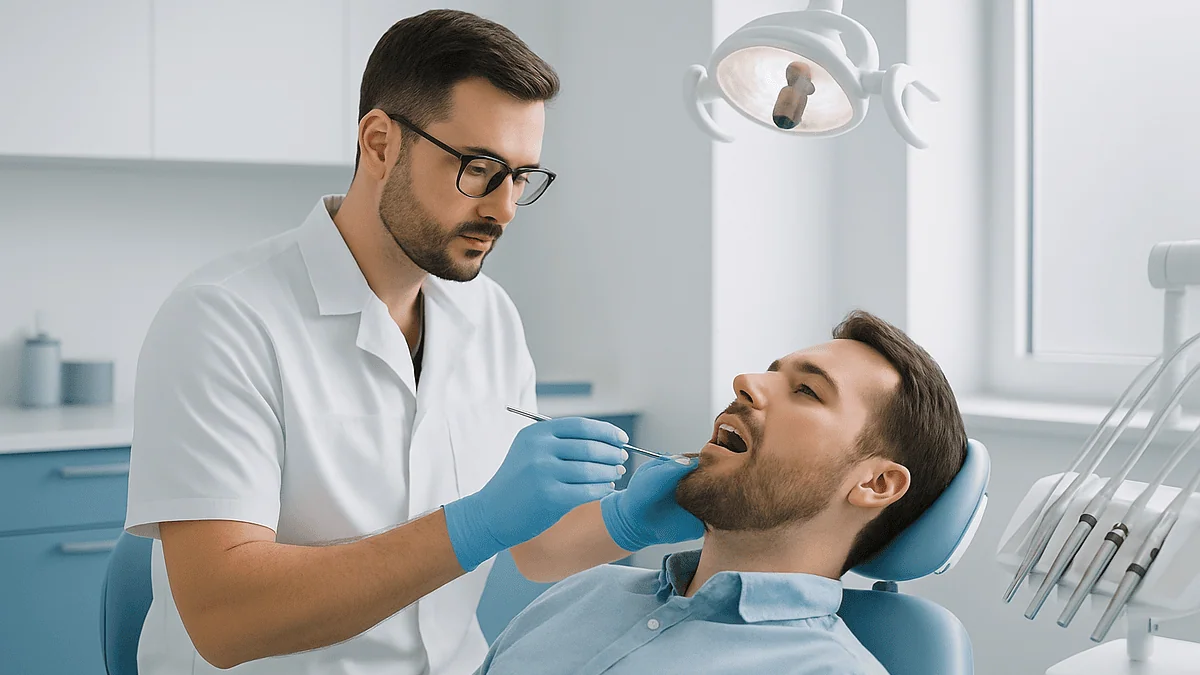
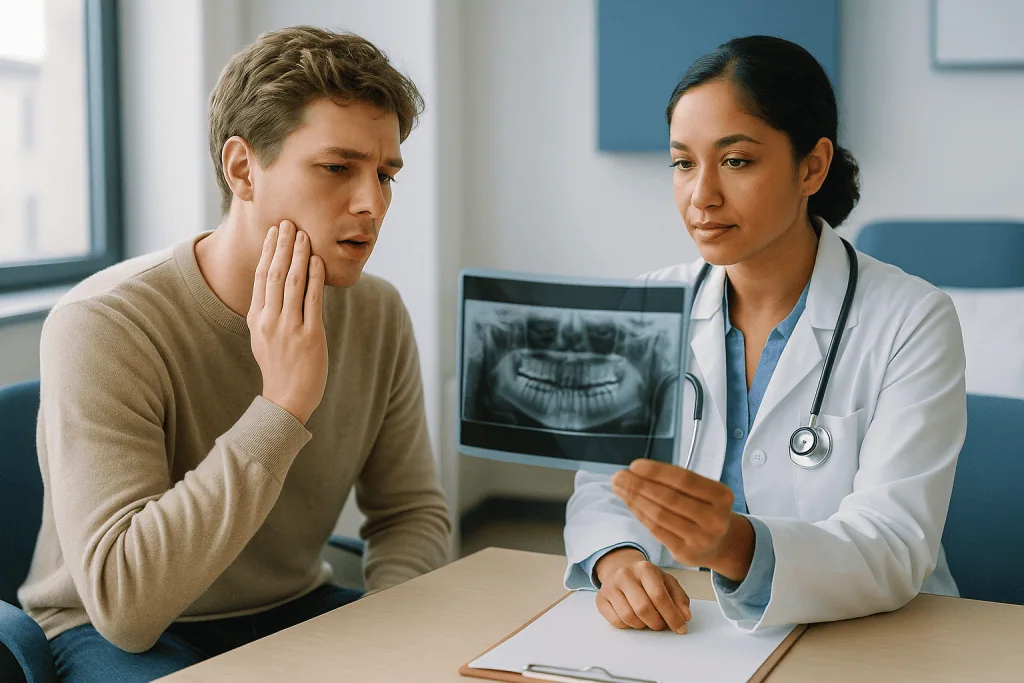
The screen shows a wide, grainy arc of teeth, and somewhere near the bottom corners two molars lean sideways like books that never made it onto the shelf. The dentist taps them with a pen and says all four should come out, ideally before the semester starts. Nothing hurts. Nothing has ever hurt. And yet the appointment card is already half written.
That is the moment many people start typing wisdom teeth second opinion into a search bar on the drive home. The instinct is sound. Wisdom tooth surgery is common, usually safe and often genuinely necessary, but it is still surgery on bone close to nerves, and it is frequently proposed to people who feel perfectly well.
This explainer walks through what the procedure involves, where the real risks sit, how sedation choices differ and which questions tend to separate a well-informed yes from a rushed one.
Why a wisdom teeth second opinion is a normal part of care
A second opinion is not a vote of no confidence. It is a second set of trained eyes on the same X-ray, and in medicine that is considered good practice for any planned, non-urgent operation. Wisdom tooth removal fits that description almost perfectly: the teeth have usually been there for years, the surgery is scheduled weeks ahead, and the reasons for doing it range from unarguable (a tooth that keeps getting infected) to debatable (a tooth that sits quietly under the gum and has never caused trouble).
Wisdom teeth, known clinically as third molars, are the last teeth to come through, typically between the ages of 17 and 25 (NHS). Many people have four, some have fewer, and a minority never develop them at all (Cleveland Clinic). When the jaw lacks room, a tooth can become impacted, meaning it is blocked from erupting fully and sits at an angle against the neighboring molar or stays buried in bone (MedlinePlus).
The reason a second opinion carries real weight here is that two reasonable clinicians can look at the same impacted tooth and reach different conclusions about timing. One may favor early removal while roots are short and bone is more flexible; another may prefer monitoring because the tooth is symptom-free and the roots are close to a nerve. Neither position is wrong on its face. What matters is that you hear the reasoning, see the images and understand what each path involves.
Think of the second visit less as a referee and more as a translation service. You should leave it able to say, in your own words, why these teeth need to come out, why now, and what could happen if they stay.
Do I need my wisdom teeth removed? What the guidance actually says
Here is the sentence that surprises people: wisdom teeth that are healthy and not causing problems generally do not need to be removed. UK national guidance, reflected in NHS advice, is that impacted wisdom teeth should be left alone unless they are causing symptoms or disease, because there is no reliable evidence that routine removal of trouble-free teeth brings a benefit that outweighs the risks of surgery (NHS).
That does not mean removal is rarely justified. The NHS lists clear reasons a dentist may recommend taking a wisdom tooth out, including repeated episodes of infection in the gum flap over a partly erupted tooth (a condition called pericoronitis), decay that cannot be filled because the tooth is too hard to reach, gum disease around the tooth, a cyst forming around it, or damage to the neighboring molar (NHS, Mayo Clinic).
So the honest answer to the question is: it depends on what the tooth is doing, not simply on the fact that it exists. A tooth that has fully erupted, can be brushed and flossed, and bites against a partner tooth is, functionally, just another molar. A tooth that is half buried under a flap of gum that traps food and flares up twice a year is a different story, and most clinicians would agree it is a reasonable candidate for removal.
The gray zone sits in between: fully buried teeth with no symptoms, or teeth with a theoretical risk of future problems. This is exactly where a second opinion earns its keep, because the right answer may be active monitoring with periodic X-rays rather than a surgery date. Ask which category your tooth falls into, and ask the clinician to point to the feature on the image that puts it there.
What actually happens during wisdom teeth removal
The mechanics are more straightforward than the anxiety suggests. Once the area is numb, the surgeon makes a small cut in the gum if the tooth is not fully through, and may remove a small amount of bone covering it. A tooth that is firmly wedged is often divided into sections so each piece can be lifted out through a smaller opening rather than forcing the whole tooth out at once (Mayo Clinic).
After the tooth is out, the socket is cleaned of debris, and the gum may be closed with stitches. Many surgeons use dissolving stitches, which typically disappear on their own in about 7 to 10 days (NHS). Gauze is placed over the site and you bite down to encourage a blood clot to form; that clot is the foundation of healing, which is why so much aftercare advice is about protecting it.
Timing varies with difficulty. A simple extraction of an erupted tooth may take only a few minutes, while a more complex impacted tooth can take longer than 20 minutes (NHS). You should feel pressure but not sharp pain; if you do feel pain, say so, because more local anesthetic can be given.
A less familiar alternative worth knowing about is a coronectomy: the crown of the tooth is removed but the roots are deliberately left in place. Surgeons sometimes propose this when the roots wrap around or sit directly on the nerve canal, so that pulling them would carry a high risk of nerve injury. It is not suitable for every tooth, particularly if the tooth is infected or decayed into the root, and it is a judgment call that belongs to the surgeon. If your X-ray shows roots very close to the nerve, asking whether a coronectomy was considered is a fair question.
Who is usually offered removal, and who is usually asked to wait
Patterns emerge when you look at who ends up on the surgical list. People with recurrent gum infections around a partly erupted lower tooth are the classic case. So are those whose wisdom tooth is decayed beyond repair, or where decay has started in the back surface of the second molar in front because the wisdom tooth presses against it and traps plaque (NHS). A cyst or other growth around an unerupted tooth seen on X-ray is another firm reason, as is a tooth that is interfering with planned orthodontic or other dental work.

Who is usually asked to wait, or simply to keep an eye on things? Someone whose wisdom teeth are fully buried, symptom-free and showing no signs of disease on imaging falls here under UK guidance (NHS). So does someone with an erupted, functional tooth that can be cleaned. In practice, monitoring means periodic dental checks and repeat X-rays at intervals your dentist sets, so that a change in the tooth or the bone around it is caught early.
Age shifts the conversation but does not decide it. Roots are often still forming in the late teens and bone is denser in later adulthood, so surgeons sometimes describe removal as technically easier in younger patients (Cleveland Clinic). Easier is not the same as necessary, though, and a healthy tooth is not made more worthy of removal by the calendar.
Certain health factors prompt extra planning rather than automatic refusal: blood-thinning medicines, conditions that affect healing or immunity, a history of jaw radiotherapy, or medicines that affect bone turnover. These are reasons to involve your physician and to ask how the surgical team will adapt, never reasons to hide a medication from the pre-operative questionnaire.
Wisdom teeth nerve damage risk: what the evidence shows
Two nerves matter most. The inferior alveolar nerve runs through a canal inside the lower jaw, directly beneath the roots of the lower molars, and supplies feeling to the lower lip, chin, lower teeth and gums. The lingual nerve runs just inside the jaw on the tongue side and supplies sensation and some taste to the front two-thirds of the tongue. Lower wisdom tooth roots can sit very close to either, which is why nerve injury is a recognized complication of lower, but rarely upper, wisdom tooth removal (NHS).
What does injury feel like? Numbness, tingling or altered sensation in the lip, chin, tongue or gums. The NHS describes this as usually temporary, lasting a few weeks or months, while noting it can be permanent in rare cases (NHS). Permanent injury is uncommon, but it is not trivial: people describe biting the lip without feeling it, drooling from one side, or a persistent pins-and-needles sensation.
The risk is not the same for every tooth, which is the single most useful thing to understand. A tooth whose roots are well above the nerve canal on the X-ray carries a lower risk than one whose roots darken, narrow or deviate where they cross the canal, signs radiologists read as the root and nerve being in intimate contact. Deeply buried teeth and horizontally angled teeth tend to be harder to remove and sit closer to these structures.
So when you ask about nerve risk, ask about your tooth, not the national average. A good answer sounds like: here is where the canal runs, here is where your root ends, this is why I think the risk is lower or higher than typical, and this is what we would do differently if the risk were high. If the answer is only a reassurance that it almost never happens, you have not yet had the conversation.
How imaging changes the plan: panoramic X-ray versus 3D scan
Almost every wisdom tooth consultation begins with a panoramic radiograph, the wide, curved X-ray that shows both jaws on one film. It is excellent for seeing how the tooth is angled, how deep it sits and roughly where the nerve canal runs. It is also a flat picture of a curved object, so it cannot tell you whether a root sits in front of, behind or truly on the nerve.
That is where cone-beam computed tomography, usually shortened to CBCT, enters the discussion. A CBCT is a low-dose three-dimensional dental scan that shows bone and tooth in slices, letting the surgeon see the exact relationship between root and canal. It is not needed for every wisdom tooth. It uses more radiation than a single flat X-ray, and for a tooth sitting well clear of the nerve it adds little. The usual trigger for ordering one is a panoramic film that shows warning signs of overlap with the canal.
Why does this matter for a second opinion? Because imaging is portable. You are entitled to copies of your X-rays and reports, and a second clinician can review the same images without repeating them. If the first opinion was based on a panoramic view that showed close contact with the nerve and no further imaging was offered, asking the second clinician whether a CBCT would change the plan is a precise, answerable question.
Imaging also helps set expectations about the surgery itself. A tooth that looks deep and horizontal on the film is more likely to need bone removal and sectioning, which in turn predicts more swelling and a longer recovery. Seeing that in advance tends to make the days afterward feel less alarming, because they match what you were told.
Sedation for wisdom teeth removal: comparing your options
People often arrive assuming they will be asleep. In fact, three broad approaches are used, and the right one depends on how many teeth are coming out, how difficult they look, your health, and how you feel about being awake (Mayo Clinic).
| Approach | What it involves | What you experience | Typical considerations |
|---|---|---|---|
| Local anesthetic only | Numbing injections around the tooth | Awake, aware of pressure and sounds, no sharp pain | Common for straightforward teeth; you can usually travel home normally |
| Local plus conscious sedation | Sedative medicine, usually through a vein or inhaled, alongside numbing | Drowsy, relaxed, often little memory of the procedure, still able to respond | Needs fasting as instructed and an adult escort; no driving afterward |
| General anesthetic | Fully unconscious, given by an anesthesia specialist, usually in a hospital setting | No awareness at all | Reserved for complex cases, multiple difficult teeth or particular medical or anxiety needs |
Each step up adds monitoring, preparation and recovery time, so more sedation is not automatically better. The NHS notes that general anesthesia is used only occasionally for wisdom teeth and that most removals happen under local anesthetic, with or without sedation (NHS). After sedation or a general anesthetic you must not drive, and NHS guidance is to avoid driving for 24 hours after sedation and for 48 hours after a general anesthetic; you will also need someone to take you home and ideally stay with you (NHS).
The questions that matter: Who will give the sedation and monitor me? What training do they have? What happens if I react badly? Is the facility equipped for emergencies? These are not rude. They are the same questions an anesthesiologist would want you to ask, and a confident team answers them without hesitation.
What don't they tell you about wisdom teeth?
Not because anyone is hiding it, but because consultations are short, several things tend to go unsaid.
First, the quietest teeth sometimes get the most confident recommendations. Because asymptomatic teeth have no story attached, the conversation can skip straight to logistics. If you have no symptoms, it is worth asking the clinician to explain specifically what they expect to go wrong if the tooth stays, and how likely that is.
Second, lower teeth and upper teeth are not the same operation. Upper wisdom teeth sit in softer bone, usually come out more easily and carry little nerve risk. Lower teeth sit in dense bone beside two important nerves. A plan to remove all four at once is common and reasonable, but the risk profile belongs almost entirely to the bottom two.
Third, the socket keeps healing long after you feel better. The gum closes over in a week or two, but bone fills in over months. That is why the back of the jaw can feel slightly different for a while and why food can lodge in the hollow until it fills.
Fourth, swelling peaks later than people expect, typically on the second or third day rather than the evening of surgery (Cleveland Clinic). Knowing this spares a lot of late-night worry.
Fifth, a second molar that has been leaned on for years may have a shallow pocket or a worn surface behind it after the wisdom tooth comes out. That is a reason for follow-up, not a sign that something went wrong.
Finally, follow-up itself is often the thinnest part of the plan. Ask who you will see afterward, when, and whether a review is standard or only if you call. The answer tells you a lot about how the team thinks about aftercare.
What the first two weeks after wisdom teeth removal usually look like
Recovery has a recognizable shape, and the NHS puts the whole arc at up to around two weeks for most people (NHS). The details vary with how difficult the extraction was, so treat the following as typical rather than promised.
Day of surgery: numbness fades over a few hours. Gentle oozing is normal; a folded gauze pad with firm biting pressure helps. You rest, keep your head raised and avoid rinsing, spitting, smoking or drinking through a straw, all of which can disturb the clot (NHS, Mayo Clinic). Soft, cool foods are easiest.
Days one to three: swelling of the cheek and jaw builds and usually peaks around days two to three (Cleveland Clinic). Jaw stiffness, called trismus, can make opening wide uncomfortable. Pain is typically managed with over-the-counter or prescribed medicines chosen by your clinician; follow their instructions rather than a friend’s. From about 24 hours after surgery, gentle warm salt-water rinses are usually advised to keep the area clean (NHS).
Days four to seven: swelling recedes and bruising, if it appears, may spread toward the neck and then fade. Many people return to work or school in this window. A stiff, sore jaw can persist for 7 to 10 days (NHS).
Second week: dissolving stitches have usually gone, visible bruising fades, and eating is close to normal, though the sockets may still trap food. Mild bruising can linger up to two weeks (NHS).
Pain should follow a downward slope. Pain that improves and then sharply worsens around day three to five, or pain that never settles, is a signal to call rather than to wait it out, and the next section explains why.
Dry socket, infection and other complications to understand beforehand
Dry socket, known clinically as alveolar osteitis, is the complication most people will have heard of, and the NHS identifies it as the most common one after wisdom tooth removal (NHS). It happens when the blood clot in the socket fails to form or is lost early, exposing bone and nerve endings to air, food and saliva (Mayo Clinic). The hallmark is a dull, throbbing ache that often radiates toward the ear, beginning or worsening a few days after surgery, typically around days three to five, sometimes with a bad taste or odor and a visibly empty socket (NHS, Mayo Clinic).
Risk rises with smoking, poor oral hygiene, a previous dry socket, difficult extractions and, in some evidence, the use of combined oral contraceptives (Mayo Clinic). Treatment is straightforward: the clinician cleans the socket and places a soothing dressing, which is usually changed over several days. Dry socket is painful but is not an infection and does not usually leave lasting damage.
Infection is less common. Signs include worsening swelling after the expected peak, fever, pus, or difficulty swallowing. Bleeding that soaks through gauze repeatedly despite pressure is uncommon and needs a call. Rarely, the roots of an upper tooth communicate with the sinus above, which can cause air or fluid to pass between nose and mouth; this usually heals but should be reported.
Nerve injury, discussed earlier, is the complication that justifies the most careful pre-operative conversation for lower teeth, because it is the one most influenced by anatomy and planning rather than aftercare (NHS).
None of this is an argument against surgery that is needed. It is an argument for knowing the names of the likely problems in advance, so that if one appears you recognize it and ring the right number quickly instead of searching symptoms at midnight.
What people often get wrong about wisdom teeth
Myth: everyone needs their wisdom teeth out eventually. The evidence does not support routine removal of healthy, symptom-free teeth, and UK guidance explicitly advises against it (NHS). Plenty of people keep functional third molars for life.
Myth: wisdom teeth push the front teeth crooked. This idea is persistent and intuitive, but mainstream dental opinion does not treat erupting wisdom teeth as a proven cause of lower front-tooth crowding, which tends to develop in adulthood whether or not wisdom teeth are present. Removing them to protect orthodontic results is not, on its own, an evidence-based reason.
Myth: being asleep is safer. General anesthesia carries its own, small risks and recovery burden, and most wisdom teeth are removed under local anesthetic with or without sedation (NHS). The safest choice is the lightest option that lets the surgeon work well and lets you cope.
Myth: a second opinion means starting over. You can bring your existing X-rays and notes, and a second clinician can review them without repeating imaging unless something new is needed.
Myth: if it does not hurt, it is fine. Pain is a poor guide here. Decay in a wisdom tooth or the molar in front can progress quietly for a long time, which is why monitoring involves X-rays and not just asking how you feel.
Myth: numbness after surgery always means permanent damage. Most nerve-related numbness is temporary and resolves over weeks to months (NHS). It still needs to be reported and documented, because recovery is tracked over time.
Myth: a complication means the surgeon did something wrong. Dry socket, swelling and temporary numbness occur even in textbook operations. What distinguishes good care is how quickly and clearly the team responds when you call.
Do dentists get upset when you ask for a wisdom teeth second opinion?
The short answer is that a professional should not, and most do not. Second opinions are a standard part of how medicine protects patients, and a clinician who is confident in a recommendation generally welcomes another colleague agreeing with it. If you feel awkward, a plain sentence works: I would like to think this over and get another opinion before I book; could I have copies of my X-rays?
You are entitled to your records and images. Requesting them is not an accusation, and a calm, prompt response is itself reassuring.
People also ask how to recognize a consultation that has not served them well. Rather than labeling anyone, look at what was and was not offered. Warning signs include being given a surgery date without being shown the X-ray or having the findings explained; pressure to decide the same day for a non-urgent tooth; no discussion of leaving the tooth and monitoring it when you have no symptoms; no mention of nerve risk for lower teeth; a sedation plan that was not explained or chosen with you; vague answers about who provides and monitors sedation; no written aftercare instructions; and no clear route for contacting someone if a problem arises after hours.
Reassuring signs are the mirror image: a clinician who walks you through the image, names the specific reason for removal, raises the alternatives themselves, describes the realistic recovery, and tells you how follow-up works.
If the two opinions differ, that is information, not a crisis. Ask each clinician to explain what they would need to see to change their mind. Often the disagreement is about timing rather than whether, and you can choose a path that feels proportionate, with the understanding that the final clinical judgment rests with the team you proceed with.
Questions to ask your care team
Bring these to either appointment. You do not need all of them; pick the ones that fit your situation, and write the answers down.
- Which specific problem is this tooth causing or likely to cause, and can you show me on the X-ray?
- If I have no symptoms, what would happen if we monitored instead, and how often would you re-check?
- For the lower teeth, how close are the roots to the nerve canal, and does that change your approach?
- Would a 3D scan (CBCT) change the plan, and if not, why not?
- Was a coronectomy considered for a high-risk lower tooth?
- Which anesthesia or sedation do you recommend, why that one, and who will administer and monitor it?
- What is your plan if there is a complication during the procedure?
- Do you expect to remove bone or section the tooth, and what does that mean for my recovery?
- What will the first week realistically look like, and when can I expect to return to work or study?
- What signs mean I should call, and what number do I call outside working hours?
- Is a follow-up visit routine, and when?
- How do my medicines or health conditions affect the plan, and should my physician be involved?
- Could I have copies of my X-rays and the written treatment plan?
A thoughtful team will have heard every one of these before. Their answers do not need to be long, but they should be specific to you, and you should leave able to repeat them to someone at home. If you cannot, that is a sign to ask again rather than to proceed on trust alone.
When to call your doctor
Most recoveries follow the slow, undramatic slope described above. Some do not, and the difference between a minor problem and a more serious one often comes down to how quickly you make the call. Contact your dental or surgical team promptly if you notice any of the following.
- Bleeding that continues to soak through gauze despite firm biting pressure for a sustained period, or bleeding that restarts heavily days later.
- Pain that was improving and then sharply worsens around three to five days after surgery, especially with a bad taste or smell, which may indicate dry socket (NHS, Mayo Clinic).
- Swelling that keeps increasing after the second or third day rather than settling, or swelling that spreads toward the eye or down the neck.
- Fever, chills, pus from the socket, or feeling generally unwell.
- Numbness or tingling of the lip, chin or tongue that is still present once the local anesthetic should have worn off; this needs documenting and monitoring even though most cases resolve (NHS).
- Fluid or air passing between your mouth and nose after an upper tooth removal.
- Any reaction you think may be related to a medicine you were given.
Seek emergency care immediately, rather than waiting for a callback, if you have difficulty breathing or swallowing, cannot open your mouth enough to drink, develop rapidly expanding swelling under the jaw or in the floor of the mouth, or feel faint with heavy bleeding. These are uncommon, but they are the situations where minutes matter.
Every decision about treatment, including whether and when to remove a wisdom tooth, which anesthesia to use and how to manage a complication, belongs to you and the clinicians who have examined you. This article is a guide to the conversation, not a substitute for it.
Frequently asked questions
Is it reasonable to get a second opinion for wisdom teeth that do not hurt?
Yes, and it is one of the situations where a second opinion is most useful. Guidance reflected in NHS advice does not support routinely removing healthy, symptom-free wisdom teeth, so a recommendation to remove quiet teeth deserves a clear explanation. Bring your X-rays, ask what specific problem is expected and how likely it is, and ask whether monitoring with periodic imaging is a reasonable alternative.
Do doctors get upset when you ask for a second opinion?
A professional should not, and most welcome it. Second opinions are a normal part of safe care for any planned operation, and clinicians routinely review one another’s cases. You are entitled to copies of your X-rays and treatment plan. If a request for records or time to think is met with pressure or irritation, that reaction is itself useful information about whether this is the team you want to proceed with.
How high is the wisdom teeth nerve damage risk?
It depends on the individual tooth more than on any average. Lower wisdom teeth whose roots lie close to or on the nerve canal carry a higher risk than teeth sitting well clear of it. The NHS describes nerve-related numbness after removal as usually temporary, lasting weeks or months, and permanent only in rare cases. Ask your surgeon to show you where your roots sit relative to the canal on the X-ray.
What sedation is used for wisdom teeth removal?
Three approaches are common: local anesthetic alone, local anesthetic with conscious sedation given through a vein or inhaled, and, less often, general anesthesia for complex cases (Mayo Clinic, NHS). Most removals use local anesthetic with or without sedation. After sedation or a general anesthetic you must not drive and will need an adult to take you home. Ask who administers and monitors the sedation and what training they have.
What don't they tell you about wisdom teeth?
Several things often go unsaid: upper and lower teeth are very different operations, with nearly all the nerve risk in the lower jaw; swelling peaks on the second or third day rather than the evening of surgery; the gum heals in a week or two but the bone fills in over months; and follow-up arrangements are frequently the vaguest part of the plan. Asking about each of these before you book removes most surprises.
What are red flags that a dental consultation did not serve me well?
Look at what was missing rather than judging the person. Concerning signs include not being shown or talked through your X-ray, pressure to book the same day for a non-urgent tooth, no discussion of monitoring instead of removal, no mention of nerve risk for lower teeth, a sedation plan that was not explained, no written aftercare instructions, and no clear number to call if something goes wrong afterward.
Do your wisdom teeth make you wise?
No. The name comes from timing, not intellect. Third molars usually come through between about 17 and 25 (NHS), an age once described as the arrival of wisdom, so the teeth inherited the label. They have no effect on thinking, memory or judgment, and removing them changes nothing except the back of the jaw. The phrase is a pleasant piece of folklore and nothing more.
Do I need my wisdom teeth removed if they are fully buried?
Not necessarily. A fully buried tooth that is causing no symptoms and shows no sign of disease on X-ray is generally monitored rather than removed under UK guidance reflected by the NHS. Removal becomes more reasonable if imaging shows a cyst, damage to the neighboring tooth, or other change. Ask what your dentist would need to see on a future X-ray to recommend surgery.
How long does recovery from wisdom teeth removal take?
The NHS puts full recovery at up to about two weeks, though simple extractions often feel settled sooner. Swelling typically peaks around days two to three (Cleveland Clinic), jaw stiffness can last 7 to 10 days, dissolving stitches usually disappear in 7 to 10 days, and mild bruising may linger up to two weeks (NHS). Pain should steadily improve; pain that worsens after day three needs a call.
Can I bring my X-rays to a second dentist instead of having new ones?
Yes. Your images and notes are your records, and a second clinician can review the same panoramic X-ray or CBCT scan without repeating it, avoiding extra radiation. Ask the first practice for digital copies in a standard format. New imaging is only needed if the existing views are old, unclear, or do not answer a specific question such as how close a root sits to the nerve canal.
References
This article is for general information only and is not a substitute for professional medical advice. Please consult a qualified doctor about your individual situation.

More from the Blog

How Metal Braces Are Fitted: Bracket Bonding, Wires and the First Adjustment
Getting metal braces fitted usually takes one to two hours in a single visit. The orthodontist cleans and lightly etches each tooth, glues a…

Do Braces Hurt, and How Long Do They Take?
Braces are usually not painful to put on, but most people feel a dull ache and tender teeth for a few days after fitting…

Gingivectomy vs Crown Lengthening in Gingival Aesthetics: Which Reshapes What?
A gingivectomy removes excess gum tissue only, so it suits cases where the gum is thick or overgrown but the underlying bone sits at…
Composite vs Amalgam Dental Fillings: Appearance, Durability and How Dentists Choose
Composite fillings are tooth-colored resins bonded to the tooth; amalgam fillings are a silver-colored metal alloy packed into a prepared cavity. Composite blends in…

Realistic Smile Makeover Results: Natural Proportions Over a Single Bright Shade
Realistic smile makeover results mean teeth that look like they belong to your face: graduated widths, slight translucency at the edges, a shade close…

Which Tooth Decay Treatment Fits the Damage? Filling, Inlay, Crown or Root Canal
The right tooth decay treatment depends on how much healthy tooth is left, not on how much the cavity hurts. Small to moderate cavities…