

Reading a Dental Prosthetics Plan: Materials, Sequence of Visits and Questions Worth Asking

Key Takeaways
- A treatment plan is a proposal, not a promise, and any timeline in it should read as a range because bone and gum healing set their own pace.
- Mayo Clinic describes the full implant process, from placement through osseointegration to the final tooth, as taking many months, most of it healing time.
- The same material name can appear in different roles; zirconia may describe an implant, an abutment or a crown, and each choice should be explained for that tooth's position.
- Implants can develop peri-implantitis, a plaque-driven inflammation of surrounding gum and bone, which is why they need the same daily cleaning and reviews as natural teeth.
- Antibiotic prophylaxis before dental procedures is advised by the American Heart Association only for the highest-risk heart conditions, such as prosthetic valves or previous endocarditis.
- Spreading swelling into the neck, difficulty breathing or swallowing, or high fever after dental surgery are emergency signs, not things to wait out until the next visit.
A dental prosthetics treatment plan sets out which teeth are being replaced, the type of prosthesis proposed (crown, bridge, denture or an implant-supported restoration), the materials, the order and number of visits, expected healing intervals, and the risks and alternatives. Reading it well means checking that each item is explained in plain language, that timelines are given as ranges rather than promises, and that your questions are answered by the treating team before you consent.
The envelope is thicker than expected. Inside are three pages: a diagram of teeth numbered like seats on a plane, a column of words such as zirconia, abutment and interim prosthesis, and a sequence of appointments stretching across a season. The person holding it wanted one thing, a way to chew on the left side again, and now has a document that reads like a contract written in another language.
That moment, at the kitchen table with a plan and a pen, is where most dental prosthetics treatment plan questions are born. Not in the chair, where the light is bright and the clock is running, but afterwards, when the details start to matter. Which of these visits involves surgery? Why is there a gap of months in the middle? What is the difference between the two materials listed for the same tooth?
This guide is written for that table. It explains what each part of a typical plan means, what the evidence says about healing and risk, and which questions are worth taking back to the team before anything is signed.
What a dental prosthetics treatment plan actually tells you
A treatment plan is a proposal, not a guarantee. It records what the dentist or prosthodontist has found, what they suggest doing about it, and in what order. A prosthodontist is a dentist with additional training in replacing missing or damaged teeth. Most plans, whether on paper or in a patient portal, contain the same building blocks even when the layout differs.
First comes the diagnosis: which teeth are missing, failing or heavily filled, and why. Then the proposed prosthesis for each site, identified by a tooth number so that nothing is ambiguous. Next, the materials, usually named by type rather than manufacturer. After that, the sequence of visits, with any surgical steps flagged and healing intervals shown as estimated ranges. A good plan also lists the risks discussed, the alternatives considered (including doing nothing for now), and the maintenance you will be expected to keep up afterwards.
The most useful dental prosthetics treatment plan questions are the ones that test whether each of those blocks is present and clear. If a material is listed without a reason, ask why it was chosen over the alternative. If a visit is listed without a purpose, ask what happens at it. If a timeline appears as a single number rather than a range, ask what could stretch it.
The NHS advises that a dentist should explain the options and give a written plan before treatment begins, and that you should feel able to ask for clarification at any point. That principle holds in any setting. A plan you cannot read is not yet a plan you can consent to, and the team writing it should expect to walk you through it.
What is a dental prosthesis, and what are the main types of dental prosthetics?
A dental prosthesis is any made-to-measure device that replaces a missing tooth, part of a tooth, or several teeth at once. The word covers a wide range, from a single cap to a full arch of teeth, so the first task when reading a plan is to identify which type is being proposed for each site.
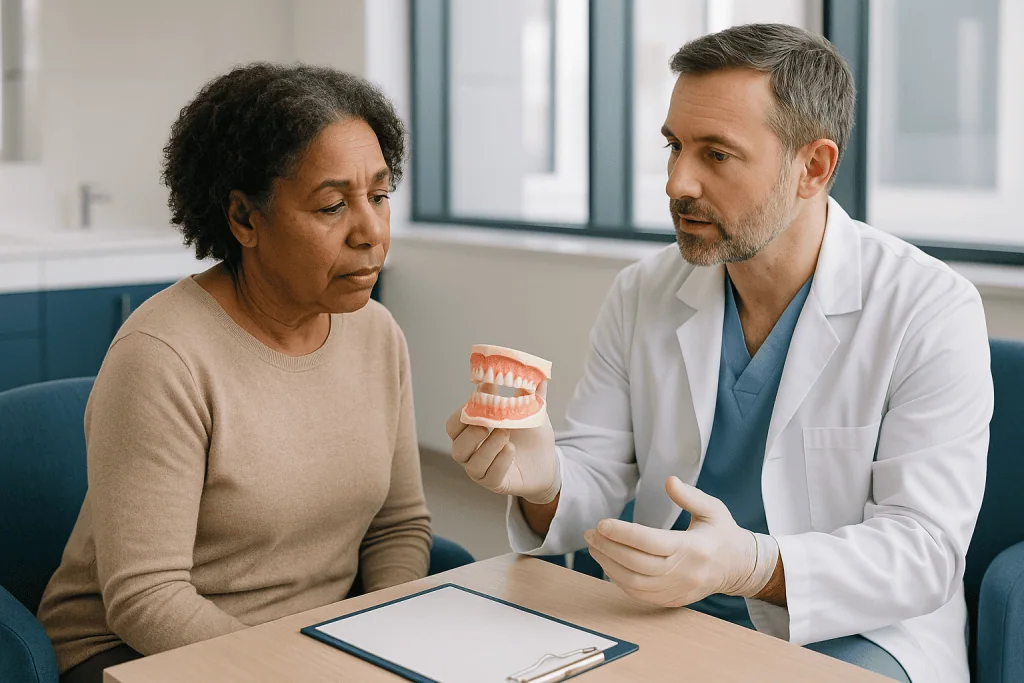
A crown is a cover shaped like a tooth that fits over a prepared natural tooth or over an implant. A bridge replaces one or more missing teeth by anchoring artificial teeth to the neighbours on either side, which are usually crowned to hold it. A partial denture is a removable plate carrying some teeth, held by clasps or precision attachments. A complete denture replaces every tooth in an arch and rests on the gums. A dental implant is a small post, most often titanium, placed into the jawbone to act as an artificial root; a crown, bridge or denture is then attached to it. Cleveland Clinic describes these categories and the situations in which each is typically considered.
Plans often group prostheses as fixed or removable. Fixed means cemented or screwed in place and cleaned in the mouth; removable means taken out for cleaning and at night. A third group, implant-retained or implant-supported dentures, sits between the two: the denture clips onto implants for stability but still comes out.
Why does this matter for reading the document? Because the type sets the whole sequence. A crown on a natural tooth may involve two visits. An implant-supported bridge may involve surgery, a healing gap and several fitting appointments. If the plan lists a type you cannot place in one of these groups, that is the first question to ask.
How the process works: from assessment to final fit
Every prosthesis, however simple, moves through the same broad phases: assessment, preparation, fabrication, fitting and review. Understanding those phases makes the visit list far less mysterious.
Assessment begins with an examination of the teeth, gums and bite, and almost always with imaging. Standard X-rays show tooth roots and bone height. For implant planning, many teams add a cone beam CT, a low-dose three-dimensional scan that maps bone width and the position of nerves and sinuses. Mayo Clinic notes that this planning stage may involve several specialists depending on the case, including oral surgeons, periodontists (gum specialists) and prosthodontists.
Preparation depends on the type. For a crown or bridge, the natural tooth is reshaped so the restoration has room to sit. For an implant, the surgical steps happen here. For dentures, the mouth is measured in detail.
Fabrication is the part patients rarely see. Impressions, either putty moulds or digital scans, go to a dental laboratory where technicians build the prosthesis to the specification in your plan. This is where the material choice becomes physical, and it is why there is often a gap of days to weeks between preparation and fitting.
Fitting involves trying the prosthesis in, checking the bite, colour and contact with neighbouring teeth, and then cementing, screwing or adjusting it. A final review checks comfort and function once you have used it in real life.
The mechanism that makes implants possible deserves one plain sentence: osseointegration is the process by which living bone grows directly onto the surface of a titanium or zirconia post, locking it in place without any cement. It cannot be rushed, which is why implant plans contain a long pause that other plans do not.
Who a fixed prosthesis is usually for, and who is usually asked to wait
Plans are individual, but the criteria teams use are broadly consistent across mainstream guidance. Mayo Clinic summarises the typical profile of someone considered for implants: one or more missing teeth, a jawbone that has finished growing, adequate bone or the ability to receive a graft, healthy oral tissues, no health conditions that would impair bone healing, an unwillingness or inability to wear dentures, and a commitment to several months of treatment. Many of the same points apply to fixed bridges and crowns, minus the surgical element.

Being asked to wait is not the same as being turned down. Common reasons include active gum disease, which needs treating first because infection around a new restoration undermines it; poorly controlled diabetes, since high blood glucose slows healing; and heavy smoking, which Mayo Clinic lists among the factors linked to implant complications and failure. Adolescents are usually asked to wait until jaw growth is complete, because an implant placed in a growing jaw stays put while the surrounding bone keeps moving.
A few medical histories prompt a longer conversation rather than a pause. Previous radiotherapy to the head or neck alters bone blood supply. Some medicines used for osteoporosis or certain cancers, the bisphosphonate class and related drugs, slow bone turnover; in rare cases this is associated with poor healing of jawbone after dental surgery. The plan should record whether the team has considered this, and any change to those medicines is a decision for the prescriber, never something to attempt alone.
Age by itself is not an exclusion. What matters is healing capacity, hygiene and the ability to attend visits. If a plan defers treatment, the useful question is what specifically needs to change and how the team will know when it has.
Dental implant treatment stages explained
Implant plans look intimidating mostly because they are long. Mayo Clinic describes the sequence in six broad steps: removal of the damaged tooth if it is still present, jawbone grafting when there is not enough bone, placement of the implant, a period of bone growth and healing, placement of the abutment, and finally placement of the artificial tooth. Not every plan includes every step.
Extraction is straightforward when a failing tooth remains. Bone grafting adds material, from your own body, a donor source or a synthetic substitute, where the jaw has shrunk after tooth loss. Mayo Clinic notes that a graft may need several months to mature before an implant can be placed, though minor grafting is sometimes done in the same appointment as the implant.
Implant placement is a surgical procedure, usually under local anaesthesia with or without sedation, in which the post is set into the bone. Then comes the pause. Mayo Clinic describes osseointegration as taking several months and states that the entire implant process can take many months, most of it healing. The number in your plan should be a range, and it may lengthen if healing is slower than hoped.
The abutment is a connector piece that sits on top of the implant and holds the crown. Placing it is a minor procedure to expose the implant if it was buried under the gum. Some plans skip this as a separate visit by fitting the abutment at the time of implant placement.
The final stage is impressions and fitting of the crown, bridge or denture. Where the plan mentions immediate loading, meaning a temporary tooth attached on the day of surgery, ask what criteria the team used to decide it was suitable, since Mayo Clinic notes this is offered only in selected cases with sufficient bone stability.
Reading the materials list: what the names mean
Materials in a plan are usually listed by type, and the same word can appear in more than one role. Zirconia, for instance, may describe an implant post, an abutment or a crown. The table below sets out the materials most often named and the practical question each one invites. None is universally best; the right choice depends on the tooth position, the bite forces, the space available, aesthetics and any known sensitivities.
| Material | Where it appears | What it is known for | Worth asking |
|---|---|---|---|
| Titanium alloy | Implant posts, abutments, denture frameworks | Long record of bone integration, strength | Is a metal-free option relevant for me? |
| Zirconia (a ceramic) | Crowns, bridges, some implants and abutments | High strength, tooth-coloured, no metal margin | Full-contour or layered with porcelain? |
| Porcelain fused to metal | Crowns and bridges | Strength from a metal core, porcelain surface | Which metal is in the core? |
| Glass ceramic (e.g. lithium disilicate) | Single crowns, veneers | Natural translucency for front teeth | Is it strong enough for this bite position? |
| Acrylic resin | Denture bases and teeth, temporaries | Adjustable, repairable, lightweight | How long is a temporary expected to last? |
| Cobalt-chromium alloy | Partial denture frameworks | Thin, rigid, holds clasps well | Any known metal sensitivity to flag? |
Two habits help when reading this list. First, ask why a material was chosen for that particular tooth: a molar that takes heavy chewing load and a front tooth that shows when you smile pose different demands. Second, ask what the alternative would be and what trade-off it carries. Cleveland Clinic describes these material families for crowns and notes that the choice balances durability, appearance and how much natural tooth remains. A plan that explains its choices in those terms is one you can reason with.
How to decode the sequence of visits
The visit list is the part of a plan people most often skim, and the part that most repays a slow read. Each line should answer three questions: what happens, whether anaesthesia or sedation is involved, and what you will leave with.
A typical crown sequence, as Cleveland Clinic describes it, runs to two main visits: one to reshape the tooth, take impressions and fit a temporary crown, and a second, after the laboratory has made the final crown, to remove the temporary and cement the permanent one. Some practices make crowns on site in a single visit using digital scanning and milling; the plan should say so if that is the intention.
Bridges follow a similar two-stage rhythm with more teeth involved. Dentures usually need several appointments: initial impressions, more detailed secondary impressions, a bite registration to record how your jaws meet, a wax try-in where you check the appearance before the teeth are set in acrylic, the fitting itself, and then adjustment visits for sore spots.
Implant sequences are the longest, and the visits cluster at both ends with a healing gap in the middle. Read carefully for the word interim or temporary: it tells you whether you will have a tooth in the space during healing, and if so, what kind. A removable flipper, a bonded temporary and an immediately loaded temporary crown are very different daily experiences.
Three practical checks are worth doing at the table. Count how many visits involve surgery and plan rest afterwards. Note which visits depend on laboratory turnaround, since those dates can move. And identify the review appointments, because a plan without any follow-up after the final fit is missing a step that mainstream guidance treats as routine.
What the following days and weeks usually look like
Recovery depends entirely on which step you have just had, so it helps to read the plan with a timeline for each type in mind rather than one expectation for the whole course.
After implant surgery or a graft, Mayo Clinic lists the usual short-term effects: swelling of the gums and face, bruising of the skin and gums, pain at the site and minor bleeding. Most people are advised to eat soft foods while the site heals, and stitches, if used, are either dissolving or removed at a review visit a week or two later. Discomfort that improves day by day is the expected pattern. The long middle stretch of an implant plan, the months of osseointegration, is usually uneventful from the patient’s side: you look after the area, attend any check, and wait.
After a crown or bridge, sensitivity to hot and cold is common for a few days to weeks while the tooth settles, and a bite that feels slightly high should be adjusted promptly rather than tolerated. Cleveland Clinic notes that a new crown may feel unfamiliar at first and that persistent discomfort on biting warrants a return visit.
New dentures bring their own adjustment period. Cleveland Clinic describes sore spots, increased saliva and changes to speech as normal in the first weeks, easing as the mouth adapts and as the dentist relieves pressure points. Practising reading aloud and starting with softer foods cut into small pieces are ordinary advice.
Whichever prosthesis you have, the plan should tell you what normal looks like, what the team wants to hear about, and how to reach them. If it does not, that is a question for the first appointment, not the last.
What are the side effects of treatment?
This is among the most searched questions about any procedure, and the honest answer for dental prosthetics is that side effects fall into two groups: the expected and temporary, and the uncommon but important.
The expected group covers the soreness, swelling, bruising and sensitivity described in the section above. These follow the pattern of any minor surgery or tooth preparation and settle as tissues heal.
The uncommon group is where a plan’s risk section earns its place. For implants, Mayo Clinic lists infection at the implant site, injury or damage to surrounding structures such as neighbouring teeth or blood vessels, nerve damage causing pain, numbness or tingling in the natural teeth, gums, lips or chin, and sinus problems when upper-jaw implants protrude into a sinus cavity. Failure of the bone to integrate with the implant can also occur, more often in people who smoke, and if it does the implant is removed and the site may be retried after healing.
Longer term, implants can develop peri-implantitis, an inflammation of the gum and bone around an implant that behaves much like gum disease around a natural tooth and is driven by plaque. Bridges carry the specific cost of reshaping healthy neighbouring teeth to serve as anchors. Dentures can cause pressure sores and, if worn continuously without cleaning, a fungal irritation of the palate known as denture stomatitis. Allergic reactions to dental metals or acrylics are rare but documented, and any known sensitivity belongs on the plan.
What a plan cannot do is attach a personal probability to any of these. Ask instead which risks apply particularly to you given your anatomy and health, what the team does to reduce them, and what the response would be if one occurred.
Fixed versus removable: how to read the trade-offs
Many plans offer a choice between a fixed and a removable solution for the same gap, and the document may not spell out why one is listed first. The evidence-based way to compare them is by trade-off, not by ranking.
Fixed restorations, whether tooth-supported bridges or implant-supported crowns and bridges, stay in place, feel closest to natural teeth and do not need to be removed for cleaning. In exchange they require either surgery (implants) or the reshaping of healthy neighbouring teeth (bridges), and they are cleaned with floss threaders or interdental brushes around and under the prosthesis, which takes practice. Repairs usually mean a laboratory visit and a temporary in the meantime.
Removable partial or complete dentures avoid surgery, spare the neighbouring teeth from preparation, and are relatively simple to adjust, reline or repair. Against that, they move more during eating and speaking, rest on gums that continue to change shape, and Cleveland Clinic notes that they typically need relining or remaking over the years as the jaw remodels. Some people never fully adapt to a plate in the mouth; others find it entirely comfortable.
Implant-retained dentures are the compromise many plans now list: a small number of implants stabilise a denture that still comes out for cleaning. They keep the surgical step but reduce it, and they address the movement problem of a conventional lower denture in particular.
When reading the options, look for the reasons behind the order. Bone volume, the health of neighbouring teeth, the number of missing teeth, your general health and how you feel about surgery or about a removable appliance all legitimately push the recommendation one way or another. The plan should show its working, and you are entitled to ask for it.
Medications, medical history and why the plan asks about your heart
Somewhere in most plans is a page that has nothing to do with teeth: a medical history with tick boxes for heart conditions, blood thinners, diabetes, bone medicines and allergies. It is easy to treat as paperwork. It is, in practice, the part of the document that most changes how the clinical steps are carried out.
Anticoagulant and antiplatelet medicines, the classes that reduce clotting, matter for any step that involves bleeding, from an extraction to implant placement. Teams plan around them with local measures and, where needed, advice from the prescriber. Stopping such a medicine before dental work without medical direction is not something patients should do; the risk of a clot elsewhere is usually greater than the bleeding risk in the mouth.
Bisphosphonates and related bone-modifying drugs, taken for osteoporosis or some cancers, slow the natural turnover of bone. Their relevance is a rare complication in which jawbone heals poorly after surgery. The plan should note the medicine, the reason and how long it has been taken, and any decision about timing rests with the prescribing doctor and the dental team together.
The heart question relates to infective endocarditis, an infection of the heart’s inner lining or valves. The American Heart Association advises antibiotic prophylaxis before certain dental procedures only for people at the highest risk, such as those with prosthetic heart valves, a previous episode of endocarditis, specific congenital heart conditions, or a heart transplant with valve disease. For most people with heart conditions, it is not recommended. If the plan mentions prophylaxis, it should say which criterion applies; if you fall into one of those groups and it does not mention it, raise it.
What people often get wrong about dental prosthetics
Some misunderstandings surface so often at the planning stage that they are worth correcting directly.
The first is that implants, once healed, are permanent and maintenance-free. Titanium does not decay, but the gum and bone around an implant can become inflamed by plaque in the same way natural gums do. Mayo Clinic is explicit that implants need the same brushing, interdental cleaning and regular dental visits as natural teeth, and that smoking works against them.
The second is that dentures mean the end of dental appointments. Cleveland Clinic notes that dentures should be checked regularly, that the gums and jaw beneath them continue to change, and that relines and eventual replacement are expected rather than a sign that something went wrong.
The third is that the newest material is automatically the right one. Each material in the table above carries strengths in some positions and weaknesses in others. A plan that recommends different materials for different teeth is usually showing judgement, not inconsistency.
The fourth is that a treatment plan is a fixed schedule with a guaranteed end date. Healing is biological. Mayo Clinic frames the implant process as taking many months precisely because bone sets its own pace, and a plan that quotes a single completion date rather than a range is presenting an estimate as a promise.
The fifth is that same-day teeth are available to anyone who asks. Immediate loading of implants is offered in selected cases based on bone quality and initial stability, and many people are not suitable for it.
Finally, being older is not a reason to expect refusal. Healing capacity, gum health and the ability to keep up maintenance matter more than age itself.
Dental prosthetics treatment plan questions to ask your care team before dental implants or dentures
Good questions do two things: they fill gaps in the document and they reveal how the team thinks. The list below is deliberately specific. Take it to the appointment, and expect clear answers rather than reassurance.
- For each tooth listed, why this type of prosthesis rather than the alternative, and what would change your recommendation?
- Which material is proposed for each restoration, why that one for that position, and what is the trade-off of the other option?
- Which visits involve surgery or sedation, and what should I arrange for afterwards?
- Where are the healing gaps, what range do you expect, and what would make them longer?
- Will I have a temporary tooth or denture during healing, and what kind?
- Which of the general risks apply particularly to my anatomy or health, and how do you reduce them?
- What would you do if an implant did not integrate, or a crown or denture did not fit at try-in?
- Which of my medicines or conditions affect this plan, and have you discussed them with my doctor?
- What daily cleaning will this prosthesis need, and how often will it need professional review?
- What is the expected maintenance over the years: relines, replacement of parts, or repairs?
- What happens if I choose to wait, and what would you monitor in the meantime?
- Who do I contact if something feels wrong between visits, including out of hours?
Two habits make the conversation more productive. Write the answers on the plan itself, next to the line they refer to, so the document becomes your annotated record. And if an answer relies on a technical term you do not recognise, ask for the plain-language version before moving on. Every decision in the plan belongs to you and the treating team together, and understanding the reasoning is what makes consent meaningful.
When to call your doctor
Most recovery after prosthetic dental work follows a predictable curve: discomfort peaks in the first day or two and then eases. The signs below fall outside that curve and warrant a same-day call to your dental team or, where marked, urgent medical care.
Seek emergency care immediately if you develop swelling that spreads into the neck or under the tongue, any difficulty breathing or swallowing, or a high fever with rigors. Swelling in these areas can compromise the airway and is treated as an emergency in every mainstream guideline.
Call your dental team the same day if bleeding does not slow with firm pressure on a gauze pad, if pain is worsening after the third day rather than improving, if you notice pus, a foul taste or a bad smell from the site, or if swelling and redness are increasing rather than settling. Mayo Clinic advises contacting the surgeon if swelling, discomfort or any other problem gets worse in the days after implant surgery.
Numbness or tingling of the lip, chin or tongue that lasts beyond the expected wearing-off of the local anaesthetic should be reported promptly, since early assessment matters for nerve-related concerns. So should a new implant, crown or bridge that feels loose or moves, a denture that causes an ulcer that has not healed within two weeks, or a bite that remains uncomfortable after adjustment.
For people with the highest-risk heart conditions described earlier, the American Heart Association advises reporting unexplained fever, night sweats or fatigue after dental procedures to a doctor, since these can be early signs of endocarditis.
None of these signs means something has gone irreversibly wrong. They mean the team needs to look. A plan should include a contact route for exactly this purpose, and using it early is always the right call.
Frequently asked questions
What is a dental prosthesis in plain terms?
A dental prosthesis is any custom-made device that replaces a missing tooth, part of a tooth or several teeth. The term includes crowns, bridges, partial and complete dentures, dental implants and the restorations attached to implants. Plans usually sort them into fixed types, which stay cemented or screwed in place, and removable types, which come out for cleaning.
What are the main types of dental prosthetics I might see on a plan?
The most common entries are crowns, bridges, partial dentures, complete dentures, implants with abutments, and implant-supported crowns, bridges or overdentures. Each has a different sequence of visits and maintenance pattern. If a plan lists a type you cannot match to one of these, ask the team to explain what it replaces and how it is held in place.
What are the dental implant treatment stages, in order?
Mayo Clinic describes six broad steps: removal of a damaged tooth if present, bone grafting when needed, placement of the implant, a healing period during which bone integrates with the post, placement of the abutment, and fitting of the final crown, bridge or denture. Not every plan includes every step, and the healing period is the longest part.
What are the side effects of treatment for dental prosthetics?
Common short-term effects include swelling, bruising, soreness, minor bleeding and tooth sensitivity, which settle as tissues heal. Less common risks listed by Mayo Clinic for implants include infection, damage to nearby teeth or vessels, nerve injury causing numbness, and sinus problems with upper implants. Dentures can cause sore spots; bridges require reshaping of neighbouring teeth.
What questions to ask before dental implants matter most?
Ask why an implant is recommended over a bridge or denture for you, whether you need a graft, how long the healing ranges are, what temporary tooth you will have, which risks apply to your anatomy, what happens if the implant does not integrate, and how your medicines and heart or bone health were taken into account.
How long does a dental prosthetics treatment plan usually take from start to finish?
It depends on the type. Cleveland Clinic describes crowns as typically needing two visits with a laboratory gap between them. Dentures usually take several appointments over weeks. Mayo Clinic states that the entire implant process can take many months because bone needs time to integrate. Any figure in your plan should be an estimated range.
Why does my plan list different materials for different teeth?
Because different positions place different demands on a restoration. Back teeth take heavy chewing forces and favour strength; front teeth are visible and favour translucency. A plan that varies the material by tooth is usually applying judgement rather than being inconsistent. Ask the team to state the reason for each choice and the trade-off of the alternative.
Do I need antibiotics before dental prosthetic work if I have a heart condition?
For most heart conditions, no. The American Heart Association recommends antibiotic prophylaxis before certain dental procedures only for people at the highest risk of infective endocarditis, including those with prosthetic heart valves, previous endocarditis, specific congenital heart conditions or a heart transplant with valve disease. Your dental team and doctor decide together based on your history.
Can I have dental implants if I smoke or have diabetes?
Often a team will ask you to address these first rather than decline outright. Mayo Clinic lists smoking among factors linked to implant complications and failure, and uncontrolled diabetes slows healing. Well-controlled diabetes is usually not a barrier. The plan should record how the team assessed these factors and what would need to change before proceeding.
What ongoing care will my prosthesis need after the plan is finished?
All prostheses need maintenance. Implants and fixed bridges require daily cleaning around and under them and regular professional reviews, because plaque can inflame surrounding gum and bone. Cleveland Clinic notes that dentures need periodic checks and relining as the jaw changes shape. A complete plan should describe this aftercare rather than ending at the final fitting.
References
This article is for general information only and is not a substitute for professional medical advice. Please consult a qualified doctor about your individual situation.

More from the Blog
Who Needs a Dental Bone Graft Before Implants? Ridge Width, Height and Timing After Extraction
A dental bone graft is usually suggested before implants when the jaw ridge is too thin, too short, or has shrunk after tooth loss,…

Non-Surgical vs Surgical Peri-Implantitis Treatment: How Dentists Decide Which You Need
Dentists usually try non-surgical peri-implantitis treatment first: cleaning the implant surface below the gum with instruments designed for titanium, followed by re-evaluation. Surgery is…

Maxillofacial Prosthetics After Radiotherapy: Dry Mouth, Tissue Changes and Timing the Fitting
Maxillofacial prosthetics after radiotherapy are custom devices, such as palatal obturators, facial prostheses and implant-retained dentures, that replace parts of the mouth or face…
Zygomatic Implant Surgery Step by Step: Cheekbone Anchoring, Sinus Path and Same-Day Teeth
Zygomatic implant surgery replaces upper teeth when the jawbone is too thin for standard implants. A surgeon plans the route on 3D scans, then…
Does a Cracked Tooth Always Need a Dental Crown? Repair, Monitoring and How Dentists Decide
No. Whether a cracked tooth needs a crown depends on how deep the crack runs, where it sits, whether it causes pain on biting,…
Dental Robotics Myths: Does the Robot Operate Alone, and What Does the Surgeon Still Control?
No, a dental robot does not operate alone. In robot-assisted implant surgery, the surgeon plans the implant position on a 3D scan, then holds…