

Rowing Machine Benefits: Why Rowing Is the Full-Body Cardio Doctors Like

Key Takeaways
- Thirty minutes of moderate rowing burns about 252 kcal for a 155-pound person, roughly the same as running a 12-minute mile for the same time, with far less joint impact.
- On energy alone, 30 minutes of moderate rowing equals about 5,000 to 6,000 steps, not 10,000; matching a full 10,000 takes closer to 50 to 60 minutes.
- Twenty minutes of vigorous rowing five days a week exceeds the 75-minute weekly vigorous target set by WHO, CDC and NHS; at moderate pace it reaches two-thirds of the 150-minute floor.
- About 60 percent of rowing power should come from the legs, and the sequence legs, body, arms is the single biggest protector of the lower back.
- Aerobic exercise reduces deep visceral fat modestly over months in randomized trials, but no study shows rowing removes abdominal fat preferentially or beats cycling at equal effort.
- Rowing is not weight-bearing, so people concerned about bone density still need walking, stair climbing or resistance training alongside it.
A rowing machine delivers low-impact, full-body cardio that works the legs, hips, back and arms in one movement while raising heart rate into the aerobic range. Strong evidence supports aerobic exercise for heart health, blood pressure and mood; rowing-specific trials are smaller but consistent. Twenty to thirty minutes most days meets guideline targets. Anyone with heart, back or joint conditions should check with their clinician first.
Scroll through fitness feeds this spring and you will see the same stubborn claim recycled a hundred ways: thirty minutes on a rowing machine equals 10,000 steps, torches belly fat and works 86 percent of your muscles. As of spring 2025, searches for the phrase have climbed again, driven less by any new trial than by a wave of short videos and the quiet fact that gyms keep adding rowers next to the treadmills.
The irony is that the machine does not need the hype. Rowing has a genuinely good evidence story, and a few parts of the viral version are wrong in ways that matter if you have a sore lower back or a heart that has not been asked to work hard in a decade.
So here is the honest version: what rowing does to the body, how it compares with running and walking, what twenty minutes buys you, and the signs that mean you should stop and talk to a doctor rather than push through.
What changed recently: why the rowing machine is trending again
Nothing dramatic happened in a laboratory. No landmark rowing trial landed, and no guideline singled out the machine. What shifted was the backdrop against which rowing suddenly looks sensible.
In June 2024 the World Health Organization published updated activity data showing that about 31 percent of adults worldwide, roughly 1.8 billion people, did not meet recommended activity levels in 2022, up from 26 percent in 2010. The WHO target itself has not moved since the November 2020 guideline update: 150 to 300 minutes of moderate aerobic activity a week, or 75 to 150 minutes of vigorous activity, plus muscle-strengthening work on two or more days. The CDC and the American Heart Association echo the same numbers in the United States.
That two-part prescription, aerobic plus strengthening, is the hook. Most cardio machines tick only the first box. A rower pulls at both, which is why physicians and physical therapists have been recommending it for years to people who cannot run and do not love lifting.
Layer on the home-fitness habit that stuck after 2020, a steady flow of “zone 2” content explaining easy aerobic training, and a handful of viral comparisons with walking, and you get a search spike. The claims traveling fastest are the ones worth checking: that rowing burns more than running, that it melts abdominal fat, and that a short session replaces a full day of steps. Each contains a grain of truth wrapped in a layer of exaggeration, and the sections below separate the two.
What are the main rowing machine benefits?
Watch someone row well and the appeal becomes obvious. One stroke recruits the quadriceps, glutes and hamstrings on the push, the core on the swing, and the upper back, shoulders and arms on the pull. Then the whole chain reverses to glide forward. Few single movements ask that much of the body in a seated, controlled position.
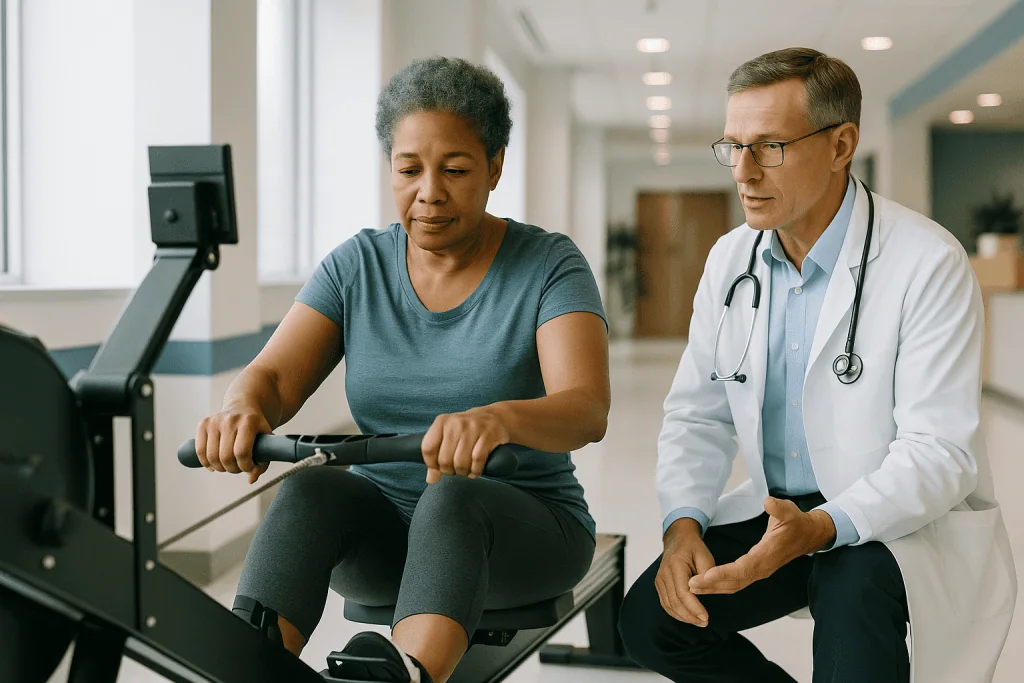
The benefits that follow are mostly the benefits of any sustained aerobic exercise, which the evidence supports strongly. Mayo Clinic lists the familiar group: lower resting blood pressure, improved cholesterol profile, better blood sugar control, lower risk of heart disease, stroke and type 2 diabetes, better sleep and mood. Rowing earns those because it keeps a large muscle mass working against resistance for twenty or thirty minutes at a time.
What rowing adds is the strength component. Each drive is a loaded leg press; each finish is a horizontal pull. The load is modest compared with a barbell, but it is enough for an untrained person to build muscular endurance in the back and hips, the two areas that tend to weaken with desk work. Posture often improves simply because the upper back is asked to do something.
Then there is impact, or rather the lack of it. The seat carries body weight, so knees, hips and ankles never take the pounding that running imposes. People with mild knee osteoarthritis, those carrying extra weight, and older adults rebuilding fitness after illness can often row comfortably when jogging is off the table.
One caution on the popular figure that rowing works 86 percent of your muscles: no mainstream clinical source documents that number, and we treat it as marketing rather than measurement. “Most major muscle groups” is accurate and sufficient.
Why do doctors like rowing for heart health?
Cardiologists talk about aerobic exercise in terms of what it does to the plumbing. Over weeks, regular sessions make the heart pump more blood per beat, so resting heart rate drops. Blood vessels become more responsive, which nudges blood pressure down. Muscles get better at pulling glucose from the bloodstream, which helps insulin work. Johns Hopkins summarizes it plainly: exercise lowers blood pressure, improves cholesterol, helps control weight and blood sugar, and reduces inflammation.
A rowing machine gets you there efficiently because it engages so much muscle at once. More working muscle means more oxygen demand, so the heart rate rises quickly without the perceived strain of sprinting. For a deconditioned person this is useful: you can reach a moderate intensity, the level where you can talk but not sing, at a leisurely 20 to 24 strokes per minute.
Stroke rate is simply how many pulls you take each minute, shown on the monitor. Beginners often assume higher is better. Clinicians and coaches prefer the opposite: a low stroke rate with a strong leg drive produces a steady heart-rate response and far less back fatigue than frantic, short strokes.
The American Heart Association frames intensity with heart-rate zones. Moderate activity sits around 50 to 70 percent of your estimated maximum heart rate, and vigorous activity around 70 to 85 percent. The rough estimate for maximum is 220 minus your age, so a 50-year-old would aim for roughly 85 to 119 beats per minute for moderate work. These are estimates, not prescriptions, and anyone on heart-rate-affecting medicines such as beta blockers should ask their clinician what targets make sense, because the standard formula will not apply.
Rowing vs running: which is the better cardio?
The honest answer is that the better cardio is the one you will do three or four times a week for the next ten years. On paper, though, the two differ in useful ways.

Harvard Health publishes a widely used table of calories burned in 30 minutes by body weight. It puts moderate stationary rowing close to running at a 12-minute-mile pace, and vigorous rowing a little below running at a 10-minute-mile pace. Running wins on raw calories at higher speeds; rowing wins on joint load and muscle coverage.
| Activity (30 minutes) | 125 lb person | 155 lb person | 185 lb person | Impact on joints | Main muscles |
|---|---|---|---|---|---|
| Rowing, moderate | 210 kcal | 252 kcal | 294 kcal | Low | Legs, hips, back, arms, core |
| Rowing, vigorous | 255 kcal | 316 kcal | 377 kcal | Low | Legs, hips, back, arms, core |
| Running, 5 mph | 240 kcal | 288 kcal | 336 kcal | High | Legs, hips |
| Running, 6 mph | 295 kcal | 360 kcal | 420 kcal | High | Legs, hips |
| Stationary cycling, moderate | 210 kcal | 252 kcal | 292 kcal | Low | Legs |
| Walking, 4 mph | 135 kcal | 175 kcal | 189 kcal | Low to moderate | Legs |
Figures are estimates from Harvard Health and vary with technique and fitness.
Running builds bone density in the legs and hips because of impact, something rowing cannot offer. Rowing strengthens the upper back and spares the knees. For people with osteoarthritis, a history of stress fractures, or significant extra weight, that trade favors the rower. For a healthy 30-year-old who enjoys running, there is no medical reason to switch. Many clinicians suggest the obvious compromise: alternate.
Is rowing good for belly fat? Rowing for weight loss, honestly
The question people type is “is rowing good to lose belly fat,” and the body does not cooperate with the way it is phrased. There is no exercise that removes fat from one chosen area. Fat loss happens across the whole body when energy burned exceeds energy eaten over weeks, and where it leaves first is set by genetics and hormones, not by which muscles are working.
That said, abdominal fat deserves attention because the deep type, called visceral fat, sits around the organs and is linked to heart disease and type 2 diabetes. Here the evidence is encouraging. Multiple randomized trials and pooled analyses show that regular aerobic exercise reduces visceral fat modestly, sometimes even when the scale barely moves. Harvard Health notes that moderate activity for about 30 minutes most days is enough to make a difference in visceral fat over time.
Rowing is a reasonable tool for this because it burns energy at a solid rate and is sustainable for people who cannot run. It is not uniquely effective. No credible trial shows rowing beating cycling or brisk walking for abdominal fat at equal energy expenditure.
So what should a realistic plan look like? Thirty minutes of moderate rowing burns roughly 250 kcal for a 155-pound person. Four sessions a week is about 1,000 kcal, which, alongside sensible eating, supports gradual loss in the range of a pound every one to two weeks. The strength element helps preserve muscle while weight comes down, which matters for keeping it off.
Anyone with a history of disordered eating, or who is losing weight rapidly without trying, should talk with a clinician rather than add more exercise.
Is 20 minutes of rowing a day enough?
Twenty minutes a day on a rowing machine adds up to 140 minutes a week, just under the 150-minute floor that the CDC, NHS and WHO set for moderate aerobic activity. Row at a moderate pace five days and rest two, and you land at 100 minutes, which is two-thirds of the way there. Row at a vigorous pace, where speaking is hard, and 20 minutes five times a week comfortably exceeds the 75-minute vigorous target.
So the practical answer is yes, with two conditions. The intensity has to be real, meaning your heart rate is up and breathing is noticeably heavier. And the guidelines also ask for muscle-strengthening activity on two days a week. Rowing contributes to that, but most exercise physiologists would not count it as a complete substitute for resistance training, because the load on each stroke is light compared with what muscles need to grow meaningfully.
There is also good news for people who cannot manage even that. The 2020 WHO update dropped the old requirement that activity come in bouts of at least 10 minutes. Every minute now counts. The dose-response data, mostly from large observational cohorts, show the steepest health gains when someone moves from nothing to a little. Ten minutes of easy rowing on a tired evening is not failure; it is most of the benefit.
A sensible beginner structure: three sessions of 15 to 20 minutes in the first two weeks, mostly at a conversational pace, then add minutes before adding intensity. If the lower back aches afterward, shorten the sessions and revisit technique rather than pushing through.
How much rowing is equal to 10,000 steps?
The viral number is 30 minutes, and it does not survive arithmetic. Start with the steps themselves. For an average stride, 10,000 steps covers roughly five miles. Walking that distance burns somewhere around 400 to 500 kcal for a 155-pound person, depending on pace and terrain.
Harvard Health’s table puts moderate rowing at about 252 kcal per 30 minutes for the same person, and vigorous rowing at about 316 kcal. On energy alone, then, matching 10,000 steps takes roughly 50 to 60 minutes of moderate rowing or 40 to 45 minutes of hard rowing. Thirty minutes equals something closer to 5,000 or 6,000 steps.
Does that make rowing the weaker option? Not really, because the step count was never a physiological threshold. The 10,000 figure traces back to a pedometer marketed in Japan in the 1960s, and the research since, including large NIH-supported cohort studies, suggests that the mortality benefits of walking rise steeply up to about 7,000 to 8,000 steps a day and then level off, especially in adults over 60.
A fairer comparison is time at moderate intensity. Thirty minutes of brisk walking and 30 minutes of moderate rowing both count as 30 minutes toward the weekly 150, and the rowing session also loads the back and hips. Neither replaces the other entirely: walking is weight-bearing and good for bones, while rowing is seated.
If you track steps, there is no need to convert. Count the rowing session as aerobic minutes, keep walking during the day, and let the two add up rather than compete.
What are the rowing machine disadvantages?
Every exercise has a cost column, and pretending otherwise is how people get hurt. Rowing’s costs are specific and mostly manageable.
The lower back leads the list. In competitive rowers, low back pain is the most commonly reported injury, and the mechanism translates to the gym: pulling with a rounded spine, leaning too far back at the finish, or opening the hips before the legs have finished driving. Beginners who rush the stroke rate tend to do all three. The fix is technique and patience, not a different machine, but someone with a known disc problem should ask a clinician or physical therapist before starting.
Wrists, forearms and knees come next. A death grip on the handle fatigues the forearms and can irritate the tendons at the wrist. Letting the knees splay outward on the drive stresses the inner knee. Both respond to coaching.
Rowing is also not weight-bearing. Bones adapt to impact and load through the skeleton, and a seated machine provides little of that. People concerned about bone density, especially postmenopausal women, still need walking, stair climbing or resistance work.
The learning curve is real. Unlike a treadmill, where the body already knows the movement, rowing requires sequencing that takes a few sessions to feel natural. Early workouts often feel harder than they are because effort goes into coordination.
And it is repetitive and seated, which some people find tedious. Boredom is a legitimate disadvantage if it means the machine becomes a coat rack. Interval formats, music and short sessions help; so does accepting that rowing can be one tool in a rotation rather than the whole program.
How to use a rowing machine properly: the four-part stroke
Coaches describe the stroke in four phases, and most back complaints come from blurring them together.
The catch is the starting position: shins vertical, arms straight, shoulders relaxed and slightly ahead of the hips, spine long rather than slumped. Think of sitting tall at the front of a chair.
The drive begins with the legs only. Push the footplate away as if doing a leg press while the arms stay straight and the torso holds its angle. Once the legs are nearly extended, swing the torso back to about the eleven o’clock position, then finally pull the handle to the lower ribs. The usual coaching shorthand is legs, body, arms, and the legs should contribute roughly 60 percent of the power. If your arms are tired before your thighs, the order is wrong.
The finish is a brief moment with legs flat, torso leaning slightly back, handle at the ribs and elbows drawn past the body. Avoid leaning back past that; the extra lean adds nothing but lumbar strain.
The recovery reverses the sequence: arms extend first, torso pivots forward from the hips, then the knees bend to slide back to the catch. It should take about twice as long as the drive, which is why good rowing looks unhurried.
Two monitor terms confuse newcomers. Stroke rate, shown as strokes per minute, is best kept around 20 to 26 for steady work. Split time, shown as minutes per 500 meters, is your pace; lower means faster. On air rowers, the damper lever changes how the fan feels, and the common mistake is setting it to maximum. Most coaches suggest a middle setting so the stroke stays smooth and the back is spared.
What the evidence actually says about rowing machine benefits
Grading the evidence matters here because rowing borrows much of its reputation from exercise research in general. Separating the two is fair to the machine and to the reader.
Strong evidence, from randomized trials and very large observational cohorts: regular aerobic exercise lowers blood pressure, improves cholesterol and glucose handling, reduces risk of cardiovascular disease, type 2 diabetes and several cancers, improves mood and sleep, and lowers all-cause mortality in a dose-dependent way. These findings underpin the WHO, CDC and AHA guidelines and apply to rowing as fully as to walking or cycling, because the body responds to sustained oxygen demand, not to the brand of machine.
Moderate evidence, from smaller trials: rowing specifically improves aerobic capacity (often measured as VO2 max, the maximum rate at which the body uses oxygen) and leg and trunk strength in untrained and older adults within eight to twelve weeks. Several trials in people over 60 have shown gains in both fitness and muscle strength, which is unusual for a single modality. Trials are typically small, often fewer than 50 participants, so effect sizes are imprecise.
Limited evidence or expert opinion: that rowing is superior to other cardio for fat loss, that it works a specific percentage of muscles, and that it protects the spine. The spine claim cuts both ways; rowing strengthens the back extensors, yet poor technique is a recognized cause of low back pain in the sport.
No good evidence: that rowing replaces strength training for bone health, or that short-interval rowing produces unique metabolic effects beyond those of comparable intervals on a bike.
Read that way, rowing is an excellent delivery vehicle for well-proven benefits, with a modest bonus in strength, and no magic.
Common myths about the rowing machine, corrected
Myth: rowing works 86 percent of your muscles. The number appears on product pages and in captions, never in a clinical source. Rowing engages most major muscle groups, which is impressive enough without a decimal point attached.
Myth: 30 minutes of rowing equals 10,000 steps. By energy, 30 minutes of moderate rowing is closer to 5,000 or 6,000 steps. Both count as 30 minutes of aerobic activity, which is the measure the guidelines actually use.
Myth: rowing is bad for your back. Rowing with a rounded spine or an exaggerated layback is bad for your back. Rowing with a long spine and legs-first drive strengthens the muscles that support it. Technique is the variable, not the machine.
Myth: rowing is all arms. Roughly 60 percent of the power should come from the legs. If a workout leaves the biceps sore and the thighs fresh, the stroke order needs attention.
Myth: faster strokes mean a better workout. Flailing at 36 strokes per minute usually means short, weak pulls. A controlled 22 to 26 with a full leg drive produces more work and a steadier heart rate.
Myth: rowing melts belly fat. Aerobic exercise does reduce deep abdominal fat modestly over months, and rowing qualifies. It does not target the midsection, and it is not shown to beat walking or cycling at equal effort.
Myth: a rower replaces the weight room. It contributes to the two days of muscle-strengthening activity guidelines ask for, but the loads are light. People seeking muscle growth or bone density still need progressive resistance and some weight-bearing movement.
Myth: anyone can jump on and go hard. Deconditioned adults, and anyone with heart, lung or spine conditions, benefit from a conversation with a clinician and a gentle first month.
Who should be cautious with a rowing machine?
Most adults can row safely, and the groups below are not being told to avoid it. They are the people for whom a short conversation with a clinician, and a slower start, pays off.
People with known heart disease, a history of heart rhythm problems, uncontrolled high blood pressure, or symptoms such as chest discomfort on exertion should have their exercise plan shaped by the treating clinician. Rowing raises heart rate quickly and involves the arms, which can push blood pressure higher than leg-only cardio at the same perceived effort.
Anyone with a disc herniation, spinal stenosis, recent back surgery or a spinal fracture history needs individual advice. Rowing can be part of rehabilitation under supervision, but the forward-bent catch position is exactly what some back conditions dislike.
People with significant knee or hip osteoarthritis usually do well, provided range of motion is comfortable. If the catch position compresses a swollen knee painfully, shortening the slide, meaning stopping the forward glide a little earlier, often solves it.
During pregnancy, moderate aerobic activity is encouraged for most people, and rowing is low impact. The catch position becomes awkward later in pregnancy, and anyone with pregnancy complications should follow their obstetric team’s guidance.
Older adults starting from inactivity gain the most and should progress the most gradually. Balance is not a problem on a rower, but getting on and off a low seat can be; a hand on a stable object helps.
People with recent abdominal or hernia surgery, uncontrolled diabetes, or a history of fainting with exercise fall into the same category: row, most likely, but after a clinician has weighed in on timing and intensity.
How to build a rowing routine that fits the guidelines
Guidelines are weekly totals, and the simplest way to meet them on a rowing machine is to decide how many days you will show up, then let the minutes grow.
Weeks one and two: three sessions of 15 minutes at a conversational pace, stroke rate around 20 to 22. The goal is to groove the legs-body-arms sequence and to find out how your back feels the next morning. Boring is correct.
Weeks three and four: four sessions of 20 minutes. Add one short block of harder effort, such as two minutes at a pace where talking is difficult, followed by three easy minutes, repeated twice. That small dose of vigorous work has an outsized effect on fitness in untrained people, according to the trial literature on interval training.
Weeks five onward: aim for 150 minutes of mostly moderate rowing a week, or a mix such as three 30-minute steady sessions plus one 20-minute interval session. High-intensity interval training, often shortened to HIIT, simply means alternating brief hard efforts with recovery. On a rower it should be used once or twice a week, not daily, because the back fatigues before the heart does.
Fill the second strengthening day with something else: bodyweight squats, push-ups, resistance bands or free weights. Keep walking for bone health.
Two signals tell you the plan is working. Your split time at the same heart rate gets faster, meaning the heart delivers more oxygen per beat, and your resting heart rate drifts down a few beats over two to three months. Neither needs an app; a watch and a notebook do fine.
If progress stalls or pain appears, back off for a week before adding anything.
When to see a doctor about rowing or exercise symptoms
Stop rowing and seek emergency care immediately for chest pain, pressure or tightness, especially if it spreads to the arm, jaw, neck or back; for sudden severe shortness of breath out of proportion to effort; for fainting or near-fainting; for a racing or irregular heartbeat that does not settle within a few minutes of stopping; or for sudden weakness, numbness, facial drooping or trouble speaking.
Seek urgent same-day care for very dark or cola-colored urine with severe muscle pain and weakness after an unusually hard session. This can signal rhabdomyolysis, a breakdown of muscle tissue that can harm the kidneys, and it has been reported after extreme indoor rowing and spinning workouts in people unaccustomed to the intensity.
Make an appointment, and pause rowing until seen, for back pain that radiates down a leg, back pain with numbness or weakness in the legs, or any new change in bladder or bowel control; for knee or hip pain that swells or persists beyond a few days; for wrist or forearm pain with tingling in the fingers; or for dizziness, unusual breathlessness or fatigue that is new and not explained by the workout.
Talk with your clinician before starting if you have known heart, lung or kidney disease, uncontrolled blood pressure or diabetes, a spinal condition, a recent surgery, or you are pregnant with complications. If you take medicines that affect heart rate or blood pressure, ask how they change your exercise targets rather than relying on generic formulas.
None of this is a reason to avoid the machine. It is the difference between training and gambling. Any decision about exercising with a medical condition, or about adjusting medicines around exercise, belongs to the prescribing clinician who knows your history.
Frequently asked questions
Is rowing good to lose belly fat?
Rowing helps reduce overall body fat, including deep abdominal fat, when done regularly alongside sensible eating, but it does not target the belly specifically. Trials show aerobic exercise lowers visceral fat modestly over months regardless of which machine is used. Rowing’s advantage is that it is sustainable for people who cannot run, which is what actually drives results.
Is 20 minutes of rowing a day enough?
Yes, if the effort is real. Twenty minutes of vigorous rowing five days a week exceeds the 75-minute weekly vigorous guideline, and moderate rowing for 20 minutes daily totals 140 minutes, just under the 150-minute moderate target. Add two days of other muscle-strengthening work and some walking for bone health to round out the guidelines.
What are the disadvantages of using a rowing machine?
The main drawbacks are lower back strain from poor technique, wrist and forearm fatigue from gripping too hard, a learning curve of several sessions, and the fact that rowing is seated and not weight-bearing, so it does little for bone density. Some people also find it repetitive. Most of these are manageable with coaching and by rotating rowing with other activities.
How much rowing is equal to 10,000 steps?
Roughly 50 to 60 minutes of moderate rowing, or 40 to 45 minutes of vigorous rowing, matches the 400 to 500 kcal a 155-pound person burns walking 10,000 steps. The viral 30-minute figure is about half that. Guidelines count time at moderate intensity rather than steps, so a 30-minute row and a 30-minute brisk walk are equivalent on that measure.
Rowing vs running: which burns more calories?
Running at six miles per hour burns more, about 360 kcal per 30 minutes for a 155-pound person, compared with roughly 316 kcal for vigorous rowing and 252 kcal for moderate rowing, according to Harvard Health estimates. Rowing works more muscle groups and spares the knees and hips, so the better choice depends on your joints and what you will stick with.
What are the rowing machine benefits for older adults?
Small trials in adults over 60 show rowing improves aerobic capacity and leg and trunk strength within eight to twelve weeks, a combination few single activities offer. It is seated and low impact, which suits arthritic joints. Older adults should progress slowly, use a hand on a stable object to get on and off the low seat, and check with a clinician if they have heart or spine conditions.
Does rowing for weight loss work without changing diet?
It can produce modest loss, but exercise alone usually moves the scale slowly because appetite often rises to match. Four 30-minute moderate sessions a week burn about 1,000 kcal for a 155-pound person. Combined with reasonable eating, that supports gradual loss while the strength element helps preserve muscle, which matters for keeping weight off long term.
Is a rowing machine bad for your back?
Not when used correctly. Low back pain is the most common complaint in rowing, but it stems from pulling with a rounded spine, leaning too far back, or letting the hips open before the legs finish driving. Rowing with a long spine and legs-first sequence strengthens the back extensors. People with disc problems or spinal stenosis should ask a clinician or physical therapist first.
What stroke rate and damper setting should beginners use?
Aim for 20 to 24 strokes per minute for steady work, with a long leg drive on each pull. On air rowers, set the damper lever to a middle position rather than maximum; a high setting makes each stroke feel heavy and loads the back without improving the workout. Focus on a smooth sequence of legs, body, arms, then reverse it slowly on the recovery.
Can I row every day?
Most healthy adults can row daily at a moderate pace, since the low impact makes recovery easier than running. Hard interval sessions are best limited to once or twice a week because the lower back fatigues before the heart does. Watch for persistent back ache or a rising resting heart rate, both signs to take a lighter day or rest.
References
This article is for general information only and is not a substitute for professional medical advice. Please consult a qualified doctor about your individual situation.

More from the Blog
The 12-3-30 Workout: What the Viral Treadmill Routine Does, and Who Should Modify It
The 12-3-30 workout is a treadmill routine: walk at a 12 percent incline, at 3 miles per hour, for 30 minutes. It provides moderate-to-vigorous…

Strength Training for Women: Why Lifting Heavy Does Not Make You Bulky, and What It Does for Bone
Strength training for women does not cause bulky muscle because women produce far less testosterone than men, and visible size requires years of deliberate…

Morning Stretches: A 10-Minute Routine Built From Physiology, Not Instagram
Gentle morning stretching is safe for most people and helps ease overnight stiffness, which comes from cooled muscles, thickened joint fluid, and fluid absorbed…

Muscle Memory Is Real: The Cell Biology Behind Getting Strong Again Faster
Muscle memory is real, and it works on two levels. In the brain, practiced movements are stored as procedural memory, so skills like a…
Kettlebell Swings: Form, Benefits and the Back-Pain Mistake
A kettlebell swing is a hip-hinge exercise that trains the glutes, hamstrings and back muscles while raising heart rate, and small trials show it…

How Long Does It Take to Walk a Mile? Pace, Age and What It Says About Fitness
Most adults walk a mile in about 15 to 22 minutes, which works out to roughly 3 miles per hour. A brisk pace covers…