

Running and Squatting After Meniscus Surgery: How Return to Sport Is Cleared Stage by Stage
Key Takeaways
- Partial meniscectomy removes torn tissue and needs no healing time for sutures, which is why patient references describe its recovery in weeks while meniscus repair is described in months.
- Running is unlocked by criteria, not dates: settled swelling, full knee extension, a firing quadriceps, limp-free walking and single-leg strength near the other side come first.
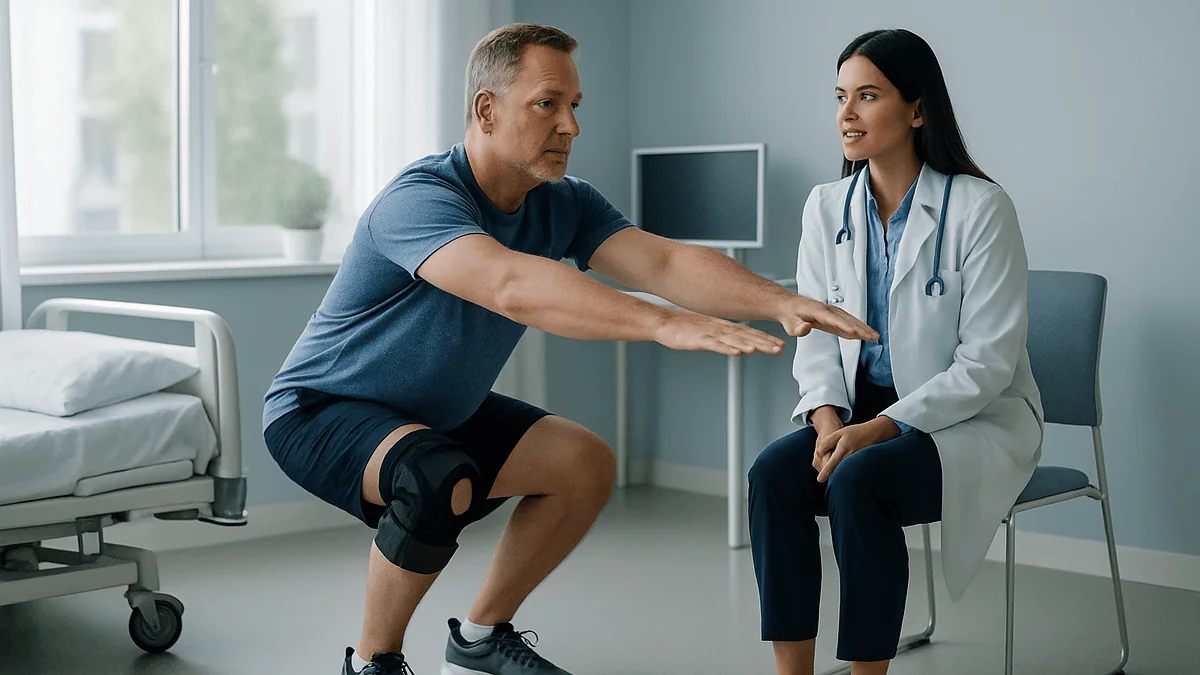
- Deep, loaded squats compress the back of the meniscus, so bending under load is commonly restricted after repair for weeks and progressed by range, then bodyweight, then load.
- Fluid in the joint reflexively weakens the quadriceps, which is why controlling swelling is treated as the gatekeeper for every later stage of return to sport.
- Only the outer third of the meniscus has a blood supply, so many tears cannot be repaired and are trimmed instead, changing both the timeline and the long-term outlook.
- Loss of meniscal tissue is linked to higher long-term osteoarthritis risk in that knee, which is why keeping the thigh and hip muscles strong matters long after clearance.
Running after meniscus surgery is cleared in stages rather than on a fixed date. Surgeons and physical therapists typically look for a knee that is no longer swollen, straightens fully, and has regained strength and single-leg control before allowing impact. Partial meniscectomy usually reaches that point sooner than meniscus repair, which needs months of protected healing. Your treating team decides each step.
Six weeks after his knee arthroscopy, a patient stands at the front door with his running shoes in one hand and his phone in the other, scrolling a forum thread where one person ran a half marathon at week eight and another was told to wait until spring. Both stories are true. Neither one is his.
That is the honest problem with running after meniscus surgery: the meniscus is a small, C-shaped cushion of cartilage, but the operations done on it are not one procedure, and the knees they are done on are not one knee. Trimming a frayed edge and stitching a torn rim back to bone lead to very different recoveries. Squats sit on the same fault line, because depth and load ask the meniscus to do exactly what surgery just interrupted.
What follows is how clearance actually works: a ladder of tests and milestones, climbed one rung at a time, with the treating team holding the final word at every step.
What actually happens during meniscus surgery
Each knee has two menisci, wedge-shaped rings of fibrocartilage that sit between the thigh bone and shin bone, spreading load and steadying the joint. When one tears, the two common operations are done through arthroscopy, a keyhole procedure using a pencil-thin camera and instruments through small incisions, as described by MedlinePlus.
A partial meniscectomy removes the torn, unstable fragment and smooths the remaining edge. Nothing has to knit back together afterward, which is why walking without crutches often resumes quickly. The trade-off is permanent: the knee keeps slightly less shock absorber than it was born with, and the remaining cartilage carries more of the load on every stride.
A meniscus repair keeps the tissue and stitches the torn edges together so they can heal. Healing is only realistic in tears near the outer rim, where the meniscus has a blood supply; the inner two-thirds is largely without one, which the Mayo Clinic notes limits repair options for many tears (Mayo Clinic). Sutures hold the tissue in position, but biology does the actual mending, and biology cannot be hurried by enthusiasm.
That single distinction explains almost everything about return to sport. After meniscectomy, the knee is being retrained. After repair, the knee is being protected while it heals and then retrained. Bending deeply or twisting under load in the early months can pull a healing repair apart, so the calendar for squats and running stretches accordingly. Some patients also have a root repair, where the meniscus is reattached to bone, or a repair combined with ligament reconstruction; those knees follow the slowest pathway of all.
Why running after meniscus surgery is cleared in stages, not by the calendar
Ask a surgeon when you can run and you will often hear a range rather than a date, followed by the word “depending.” That is not evasiveness. Running loads the knee at several multiples of body weight on each footstrike, and a knee that is still swollen or weak absorbs that load badly, shifting stress onto the healing tissue and the joint surface.
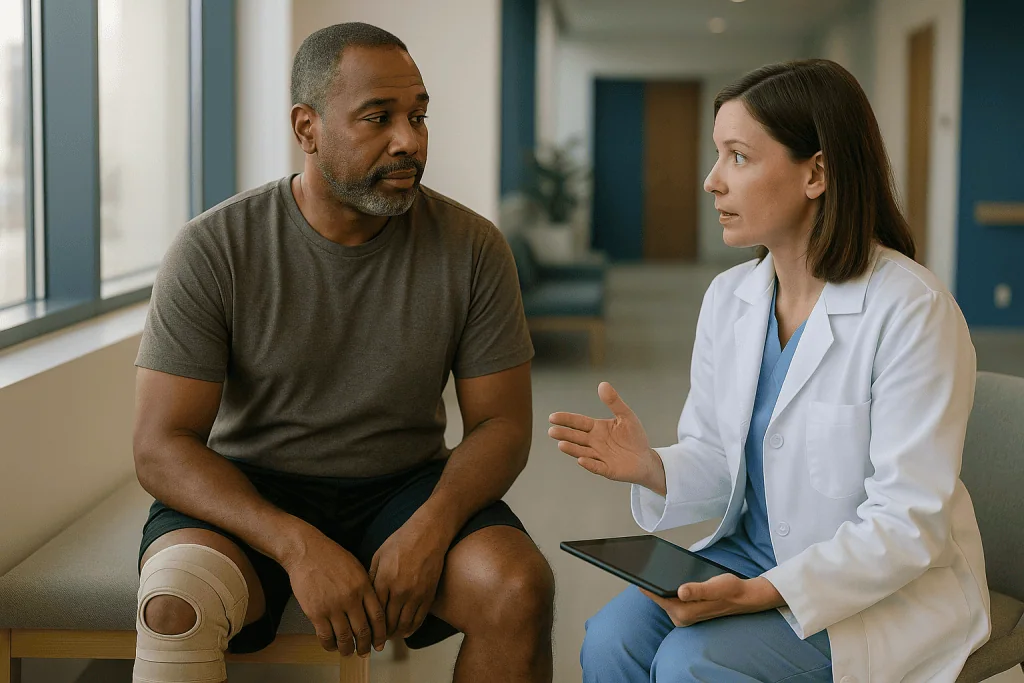
Criteria-based progression means each stage is unlocked by what the knee can demonstrate, not by how many weeks have passed. The usual gates, in the order most rehabilitation programs use them, are:
- Swelling settled to a stable, small amount that does not increase after activity.
- Full extension, meaning the knee straightens as completely as the other side, and bending that is comfortable through everyday range.
- A quadriceps muscle that fires on command, seen when the kneecap lifts during a straight-leg squeeze.
- Walking without a limp for the distances of daily life.
- Single-leg strength and balance close to the uninjured side.
- Tolerance of gentle impact, such as double-leg hops, without a flare of pain or fluid the next morning.
Swelling is the gatekeeper because fluid inside the joint reflexively switches off the quadriceps, and a knee without a working quadriceps cannot control landing. MedlinePlus aftercare guidance emphasizes rest, ice, compression and elevation to bring swelling down before activity is built up (MedlinePlus). Clear the gates in sequence and running becomes a low-drama addition. Skip them and the knee tends to reply with a flare that costs more weeks than patience would have.
Running after meniscectomy vs after meniscus repair: two different clocks
Patient references from Cleveland Clinic and Mayo Clinic describe recovery from partial meniscectomy in terms of weeks and recovery from repair in terms of months (Cleveland Clinic; Mayo Clinic). The table below summarizes the typical patterns those sources and standard rehabilitation practice describe. Every row is a common range, not a promise, and individual protocols vary widely with tear pattern and surgeon preference.
| Milestone | Partial meniscectomy (typical) | Meniscus repair (typical) |
|---|---|---|
| Weight-bearing | Usually allowed as tolerated from the first days | Often limited or protected, sometimes with a brace, for several weeks |
| Crutches | Days to a week or two | Several weeks, per surgeon protocol |
| Knee bend beyond a right angle under load | Progressed as swelling allows | Commonly restricted for the first weeks to protect sutures |
| Stationary cycling | Early weeks | Once bend and protocol permit |
| Straight-line jogging | Often within roughly a month or two if criteria are met | Often not before several months |
| Pivoting and cutting sport | After running and hop tests are tolerated | Typically the last stage, many months out |
Two knees can therefore have identical incision scars and be a season apart in clearance. The forum runner at week eight almost certainly had a meniscectomy; the one waiting until spring almost certainly had a repair. Comparing yourself with either is like comparing a sprained ankle with a fracture because both needed the same boot.
The slower clock is not a penalty. A repaired meniscus that heals keeps its load-sharing job for decades, which is the entire reason surgeons accept the longer road when the tear allows it.
Who is usually cleared to run first, and who is usually asked to wait
Speed of clearance clusters around a handful of features that surgeons and physical therapists weigh at every visit.

Earlier clearance tends to follow a small, clean partial meniscectomy in a knee whose joint surface looked healthy at surgery, in someone whose quadriceps was strong before the operation and who arrives at rehabilitation without a lingering limp. A prior running habit helps too, not because it hurries healing, but because the movement pattern is already wired in and only needs strength restored beneath it.
Longer waits are usual when any of the following apply:
- A meniscus repair, especially a root repair or a repair of a large tear, where sutures must be protected while tissue heals.
- A combined procedure, such as ligament reconstruction or a cartilage procedure, which follows its own longer protocol.
- Cartilage wear seen on the joint surface, which changes how much impact the knee can be asked to absorb.
- Persistent swelling or a knee that will not fully straighten, both of which block the later stages regardless of the operation.
- Heavier loads on the joint from any cause, which raise the per-stride force the healing tissue must share.
The NHS describes arthroscopy recovery as highly variable, with time off sport ranging from weeks to months depending on what was done inside the joint (NHS). That variability is the point. A clinician who asks you to wait is usually reading one of the features above, not doubting your motivation. If the reasoning is unclear, ask which specific criterion is unmet; a good answer names a test, not a date.
What the first days and weeks after meniscus surgery usually look like
The ride home is often the most vivid memory: a bulky dressing, a knee that feels full rather than sharply painful while the local anesthetic lingers, and printed instructions about ice and elevation. MedlinePlus aftercare guidance describes keeping the leg raised, applying cold in short intervals with a barrier against the skin, and keeping the incisions clean and dry until the surgeon says otherwise (MedlinePlus).
By the end of the first week most people after meniscectomy are walking indoors without crutches and doing simple exercises: squeezing the thigh muscle, sliding the heel to bend the knee, lifting the straight leg. After repair, the same exercises are done inside whatever range the protocol allows, with crutches and often a brace still in place. Stiffness on waking is common and usually eases with movement.
Weeks two to four bring physical therapy in earnest. Sessions focus on restoring full straightening, coaxing the quadriceps back to life, and normalizing walking so a limp does not become a habit. Stationary cycling with a high seat often appears once bend allows. Swelling should trend downward; a knee that balloons after an active day is asking for a quieter one.
Follow-up appointments typically check the incisions and range of motion, and for repairs confirm whether bending and weight-bearing restrictions can be loosened. Driving, returning to desk work and climbing stairs all have individual answers that depend on the leg involved, medicines in use and how the knee responds, so they belong in conversation with the surgical team rather than on a generic checklist.
Nobody runs in this phase. The job is to earn a quiet, straight, controllable knee, because everything that follows is built on it.
The stage-by-stage return-to-run ladder
Once the early gates are cleared, most rehabilitation programs climb a similar ladder. The rungs are illustrative; the treating team sets the exact version.
Stage one: walking as training. Brisk, level walking builds tolerance to repetitive load with the lowest impact. The test is simple: no limp during, and no increase in swelling the next morning.
Stage two: strength under control. Leg presses, step-ups, bridges, calf raises and shallow squats rebuild the quadriceps, hamstrings and hip muscles that steer the knee. Single-leg balance and slow single-leg sit-to-stand movements expose the side-to-side gap that running would otherwise hide.
Stage three: low impact conditioning. Cycling, swimming with a straight-leg kick, or an elliptical machine maintain fitness so that the first run is limited by the knee, not the lungs.
Stage four: impact rehearsal. Double-leg hops, then small single-leg hops, then hopping forward and sideways teach the knee to absorb landing. A sore or swollen knee the following day sends the program back one rung.
Stage five: walk-run intervals. Short jogs alternated with walking on a flat, forgiving surface, usually a few minutes total at first, with total running time increased gradually and only when the previous session left no flare.
Stage six: continuous running, then sport. Duration comes before speed, speed before hills, and straight-line running before any pivoting or cutting. Return to a specific sport is a separate clearance with its own drills.
The Mayo Clinic notes that rehabilitation after meniscus surgery centers on restoring motion and strength before activities are resumed (Mayo Clinic). Every rung above is that sentence made specific.
Squats after meniscus surgery: depth, load and when they come back
Squatting worries people almost as much as running, and for a sound reason. As the knee bends deeper, the menisci are pushed toward the back of the joint and compressed between the bones; add a barbell and the compression rises further. The posterior horn, the rear portion of the meniscus, is the region most often torn and most often repaired, so deep loaded flexion is precisely the stress a healing repair is shielded from.
After partial meniscectomy, bodyweight squats to a comfortable depth typically return early in rehabilitation as swelling settles, because there is no suture line to protect. Depth and load are then progressed by the same rule as everything else: no pain during, no swelling after.
After repair, protocols commonly cap bending under load, often somewhere around a right angle, for the first several weeks, and delay deep or heavily loaded squats for months. Cleveland Clinic patient guidance describes repair recovery lasting several months, during which twisting and deep bending are limited (Cleveland Clinic). The exact angle and timeline are the surgeon’s call and vary with tear location.
Form matters as much as depth. A squat in which the knees drift inward or the torso folds forward shifts shear and rotation onto the joint; a controlled descent with the knees tracking over the feet keeps force compressive and predictable. Physical therapists often rebuild squatting from a box or a chair, teaching depth by feel before adding weight.
For lifters, the honest message is that the barbell comes back, but the order is fixed: range first, bodyweight second, load third, and full depth last. Kneeling, deep lunges and pistol squats belong at the top of that ladder, not the bottom.
Can you run a 5K with a torn meniscus? Running with a torn meniscus before surgery
Some people finish a 5K on a torn meniscus and only learn the diagnosis months later. Others cannot jog to the mailbox. Whether running is possible depends on the tear pattern and on what the knee does when it is loaded.
Small degenerative tears, the frayed kind that accompany middle age and are often found on imaging in knees without symptoms, may allow running with little more than an ache. Mechanically unstable tears behave differently: a displaced flap can catch between the bones, producing locking, giving way or a sudden sharp pain mid-stride. The Mayo Clinic lists locking, a feeling of the knee giving way, and inability to straighten fully among the features that prompt evaluation (Mayo Clinic).
Running on a knee that catches or gives way is risky not because it will always worsen the tear, though it can, but because an unexpected lock at speed is a fall waiting to happen. Running on a knee that swells with each session is a slower problem: fluid switches off the quadriceps, mechanics deteriorate, and the joint surface takes more of the load.
Not every tear needs surgery. Many degenerative tears are managed with rehabilitation alone, and the NHS notes that cartilage damage is often treated first with rest, physiotherapy and activity modification (NHS). A supervised strengthening program can let some runners return to distance without an operation.
The 5K question, then, is really two questions. Can this particular knee tolerate impact without locking or swelling? And is the gain worth the risk to a joint that has already signaled trouble? Both deserve an examination and a conversation with a clinician before the race bib goes on.
Can I walk 2 miles with a torn meniscus? Walking as test and tool
Walking asks less of the meniscus than running does, and for most people with a tear, before or after surgery, it is both permitted and useful. Whether two miles is comfortable is something the knee will tell you more reliably than any article can.
Before surgery, walking on a stable tear is generally reasonable if the knee does not lock, give way or swell afterward. Pain that appears at a predictable distance and fades with rest is information; pain that lingers into the next day with visible swelling is a signal to shorten the walk and raise the issue with a clinician. Level ground, supportive shoes and a pace that keeps the stride smooth all reduce the twisting forces a torn edge dislikes.
After partial meniscectomy, walking is the earliest form of training, and distance typically climbs quickly through the first weeks as swelling fades. After repair, walking is limited by the weight-bearing and brace instructions in the protocol; a two-mile walk may be weeks away, and that restraint protects the sutures, not the ego.
Two features make walking a valuable test throughout recovery. It is repeatable, so the same route on different days shows whether the knee is improving. And it is low enough in impact that a flare after walking is a clear message: the knee is not ready for anything harder. MedlinePlus aftercare guidance frames activity after meniscus surgery as gradual, guided by pain and swelling (MedlinePlus).
For those who love a daily walk, one practical habit helps: note distance, surface and how the knee feels the next morning. A week of those notes gives the physical therapist better data than any single appointment can.
What not to do after meniscus repair surgery
The repaired meniscus fails in predictable ways, which is good news, because predictable hazards can be avoided. The list below is the common ground of most repair protocols; the specific version comes from the surgeon.
- Do not bend the knee deeply under load before the protocol allows it. Sitting back on the heels, deep lunges and squatting to pick things up compress the repair.
- Do not pivot or twist on a planted foot. Turning to reach behind you, stepping into a car with the knee rotated, and any cutting movement place shear across the suture line.
- Do not abandon the brace or crutches early because the knee feels fine. Absence of pain is not evidence of healing; sutures hold long before tissue does.
- Do not run, jump or descend stairs two at a time until formally cleared. Eccentric loading on stairs is harder on the knee than most people expect.
- Do not skip physical therapy sessions or home exercises. Stiffness and quadriceps weakness are the two complications most likely to delay clearance and both are prevented by boring, daily work.
- Do not soak the incisions in baths, pools or hot tubs until the surgical team confirms they are sealed.
- Do not ignore new locking, a knee that will not straighten, or a sudden increase in swelling, which can signal a repair problem.
The Mayo Clinic describes repair recovery as requiring protected motion and a gradual return to activity over months (Mayo Clinic). Most of the list above translates that sentence into the movements of ordinary life.
One item is easy to overlook: the uninjured side. Compensating heavily with the other leg for months can leave it sore and overloaded. Balanced, therapist-guided work on both limbs protects the good knee while the repaired one heals.
Will your knee ever be the same after meniscus surgery? What the evidence says
It is the question underneath every other question, and it deserves an answer without spin.
After partial meniscectomy, many people return to walking, cycling, gym work and running with a knee that feels normal in daily life. But the meniscus removed is not replaced, and Mayo Clinic and Cleveland Clinic patient guidance both note that loss of meniscal tissue is associated with a higher long-term risk of osteoarthritis in that knee (Mayo Clinic; Cleveland Clinic). That risk rises with the amount removed and with any cartilage wear already present. Published cohorts of recreational runners after meniscectomy show that return to regular running is common but far from universal, and that some who could run choose not to because of intermittent aching or concern about the joint.
After successful repair, the outlook for the joint surface is generally considered better precisely because the cushion is preserved, but healing is not guaranteed for every tear, and some repairs re-tear or fail to heal, which may lead to further surgery. Recovery is also longer and more demanding.
“The same” is therefore the wrong yardstick. A more useful one: can the knee do the things that matter to you, without swelling afterward, for years? For many people the answer is yes, sometimes with adjustments such as running fewer weekly miles on softer surfaces, alternating running with cycling, and keeping the quadriceps and hips strong indefinitely. Strong muscles around a knee that has lost some cushion are the closest thing to a replacement the body offers.
Where the evidence is thin is on individual prediction. No test at the time of surgery reliably tells one person they will run marathons and another they will not. That uncertainty is not a failure of medicine; it is the honest shape of the data.
Pain, swelling and medicines during the return to running
A little discomfort while retraining a knee is expected. The useful distinction is between muscle soreness that fades within a day and joint pain with swelling that lingers, because only the second one means the knee has been overloaded.
Cold applied for short periods after activity, elevation, and a compression sleeve are the first-line tools, and MedlinePlus aftercare guidance lists them as standard measures after meniscus surgery (MedlinePlus). They are not merely comfort measures: reducing joint fluid restores quadriceps activation, which directly improves how the knee handles the next session.
Medicines fall into two familiar classes. Acetaminophen acts on pain signaling without meaningfully reducing inflammation. Non-steroidal anti-inflammatory drugs, such as ibuprofen or naproxen, block enzymes that produce prostaglandins, the chemical messengers that drive swelling and pain sensitivity. Whether either is appropriate, for how long, and in what way depends on your medical history, kidney function, stomach history, other medicines and the surgeon’s preferences, and those decisions sit with the prescribing clinician. Some surgeons also have views about anti-inflammatory use in the early weeks after a repair, so the question is worth asking directly rather than assuming.
Two cautions apply to anyone chasing a return to running. First, medicine that blunts pain can hide the signal that a session was too much; a knee that only feels fine because it is medicated is not a cleared knee. Second, persistent reliance on pain relief to get through runs is a sign to step back a rung, not a strategy.
Swelling that returns after every run, weeks into the program, is a conversation for the treating team. It may mean the progression is too steep, or it may mean something else is going on inside the joint that warrants examination.
What people often get wrong about running after meniscus surgery
“Six weeks is the number.” There is no single number. Weeks-long recovery describes partial meniscectomy in patient references; repairs are described in months (Cleveland Clinic). Even within one operation, the knee that clears its criteria sets the pace, not the calendar.
“If it does not hurt, it has healed.” Sutures hold a repair long before tissue heals, and arthroscopic incisions look healed within days. Pain-free is a necessary condition for progress, not proof of readiness.
“A brace will let me run sooner.” Braces are sometimes prescribed after repair to limit bend or protect the joint, but no brace substitutes for strength, and no brace shortens tissue healing. A sleeve may reduce the sensation of instability; it does not change the biology inside.
“Running will wear the knee out, so I should stop forever.” The evidence links meniscal loss to higher arthritis risk, but it does not show that moderate running in a strong, well-rehabilitated knee accelerates that process for everyone. Weakness and inactivity carry their own costs for joints and hearts alike. The decision is individual and belongs with the treating team.
“Squatting is dangerous after meniscus surgery.” Deep, loaded bending is restricted early, especially after repair, because it compresses the healing region. Progressive squatting within cleared range is, in fact, one of the main ways strength is rebuilt.
“My surgeon said I can run, so I am back to normal.” Clearance to run means clearance to begin the running stage, usually walk-run intervals on flat ground. Sport-specific cutting, hills and speed each have their own gates.
“The other person online had the same surgery.” They almost never did. Tear location, size, repair versus removal, cartilage condition and baseline strength differ so widely that another person’s timeline is anecdote, not guidance.
Questions to ask your care team about running and squatting after meniscus surgery
The most useful appointment is the one you arrive at with specific questions. The list below turns the vague “when can I run?” into answers the team can actually give.
- Which operation was done, exactly: partial meniscectomy, repair, root repair, or a combination? How much tissue was removed or repaired, and where?
- What did the joint surface look like during surgery? Was any cartilage wear noted, and does it change the plan?
- What are my specific weight-bearing, brace and bending limits right now, and what has to be true for each to be lifted?
- Which measurable criteria will you use to clear jogging: swelling, full extension, strength symmetry, hop tests, or others?
- What is the typical range for someone with my procedure to reach walk-run intervals, and what would make me faster or slower than that range?
- How deep and how heavy may I squat at each stage, and when do lunges, kneeling and loaded deep squats return?
- Are there activities you would prefer I avoid in the long term, and why?
- If the knee swells after a run, what should I do first, and when does it become a reason to call?
- Do you have a preference about anti-inflammatory medicines during healing?
- What signs would suggest the repair has not healed, and how would that be assessed?
Physical therapists appreciate the same specificity. Bringing a short log of walks, exercises and next-morning swelling turns a subjective “it felt okay” into a trend they can act on. The NHS notes that recovery after arthroscopy depends heavily on following the individualized advice given by the surgical and rehabilitation team (NHS), and good questions are how that advice becomes yours rather than generic.
When to call your doctor
Most recoveries are uneventful, and most flares after an ambitious session settle with a few quieter days. A short list of signs, however, should prompt a same-day call to the surgical team or urgent care rather than waiting for the next appointment. MedlinePlus and the NHS both list these among the warning features after knee arthroscopy (MedlinePlus; NHS).
- Calf pain, tenderness, warmth or swelling in the operated leg, which can indicate a blood clot in a deep vein.
- Sudden shortness of breath, chest pain, or coughing up blood, which are emergency signs and warrant calling emergency services immediately.
- Fever, chills, or spreading redness, warmth, or pus-like drainage at the incisions.
- Severe or rapidly increasing swelling of the knee, especially if the joint becomes tense and very painful.
- Numbness, tingling, or a pale or cold foot on the operated side.
- A knee that suddenly locks and will not straighten, or gives way repeatedly, particularly after a repair.
- Pain that is escalating despite rest and the measures your team advised, or pain that wakes you at night and is not improving.
Some symptoms are less dramatic but still worth a call within a day or two: swelling that returns after every run weeks into the program, a new clicking that comes with pain, or a plateau where strength stops improving despite consistent work. None of these is an emergency, but each may change the plan, and early conversations tend to cost less time than late ones.
The general rule holds throughout recovery: if you are unsure whether something is normal, the treating team would rather hear from you than not. They know the inside of your knee; the internet does not.
Frequently asked questions
Can you run a 5K with a torn meniscus?
Some people can, depending on the tear. Small, stable degenerative tears may tolerate running with little more than an ache, while unstable tears that lock, catch or make the knee give way carry a real risk of a fall mid-run and of further damage. A knee that swells after each run is also signaling overload. An examination and a conversation with a clinician should come before any race.
How soon does running after meniscectomy usually begin?
Patient references describe recovery from partial meniscectomy in terms of weeks, and straight-line jogging is often introduced within roughly a month or two once the knee is no longer swollen, straightens fully, walks without a limp and shows single-leg strength close to the other side. The exact timing is individual and is decided by the surgeon and physical therapist based on those criteria rather than a date.
When are squats after meniscus surgery allowed?
After partial meniscectomy, bodyweight squats to a comfortable depth usually return early as swelling settles. After repair, protocols commonly limit bending under load for the first weeks to protect the sutures and delay deep or heavily loaded squats for months. In both cases depth is added before load, and any squat that causes pain during or swelling afterward is a sign to step back.
What does meniscus repair return to sport look like?
It is the slowest of the meniscus pathways. Weight-bearing and bending are typically protected for several weeks, strength and range are rebuilt over the following months, straight-line running is often not introduced until several months after surgery, and pivoting or cutting sport is the final stage. Each step is cleared by the treating team when the knee meets specific criteria, not by the calendar.
Will your knee ever be the same after meniscus surgery?
Many people return to running, gym work and daily life with a knee that feels normal, but a partial meniscectomy permanently reduces the joint’s cushion and is associated with a higher long-term risk of osteoarthritis in that knee. Successful repair preserves the tissue, though not every repair heals. A more useful question is whether the knee can do what matters to you without swelling, over years.
Can I walk 2 miles with a torn meniscus?
Often yes, if the knee does not lock, give way or swell afterward, because walking loads the meniscus far less than running. Level ground and a smooth stride reduce twisting forces. Pain that lingers into the next day with visible swelling means the distance is too much for now. After a meniscus repair, walking distance is set by the protocol’s weight-bearing and brace instructions.
What not to do after meniscus repair surgery?
Avoid deep bending under load, pivoting or twisting on a planted foot, running or jumping before clearance, abandoning the brace or crutches early, soaking the incisions before they are confirmed sealed, and skipping physical therapy. Sutures hold the repair long before the tissue heals, so feeling fine is not evidence of readiness. New locking or a sudden increase in swelling should be reported promptly.
Is running with a torn meniscus making it worse?
It can, particularly with unstable tears that catch or lock, because a displaced flap can be damaged further and cause a fall. Running that leaves the knee swollen also weakens the quadriceps reflexively, which worsens mechanics over time. Stable degenerative tears are sometimes managed without surgery through strengthening and activity modification, so whether running is reasonable depends on examination and a clinician’s advice.
Do I need a brace to run after meniscus surgery?
Usually not for running itself. Braces are sometimes prescribed after repair to limit bending during healing, and some people find a compression sleeve reduces the sensation of swelling or instability. No brace shortens tissue healing or replaces quadriceps and hip strength, which are what actually protect the joint during running. Whether any support is useful for you is a question for your surgeon or physical therapist.
Why does my knee swell after running weeks after meniscus surgery?
Swelling after running usually means the joint was loaded beyond what it can currently tolerate, and the standard response is to step back a stage, manage the swelling with cold, elevation and compression, and rebuild more gradually. If swelling returns after every run despite a slower progression, or comes with locking or giving way, the treating team should examine the knee to rule out a problem inside the joint.
References
- MedlinePlus – Knee arthroscopy
- MedlinePlus – Meniscus tears: aftercare
- Cleveland Clinic – Torn meniscus
- NHS – Arthroscopy
This article is for general information only and is not a substitute for professional medical advice. Please consult a qualified doctor about your individual situation.

More from the Blog

How Tenosynovitis Starts: Why a Tendon Sheath Swells and How Care Is Planned
Tenosynovitis usually starts when the thin, fluid-lined sheath around a tendon becomes irritated, most often from repeated gripping, twisting or lifting, and less often…
Arthroscopy Complications Explained: Portal Infections, Swelling, Clots and When to Call
Arthroscopy complications are uncommon but real. Most people have some bruising, swelling and soreness for one to two weeks, which is expected. Warning signs…

Does Every Meniscus Tear Need Surgery? Degenerative vs Traumatic Tears and the Decision Path
No, most meniscus tears do not need surgery. Degenerative tears, which develop gradually with age-related wear, are usually managed first with physical therapy and…
Ganglion Cyst Aspiration vs Surgical Removal: Recurrence, Recovery and How Doctors Choose
Aspiration drains a ganglion cyst with a needle in minutes and needs little recovery, but the cyst returns in roughly half of cases because…

Shoulder Dislocation in Teen Athletes vs Older Adults: Why Age Changes the Treatment Plan
Age changes the treatment plan for a dislocated shoulder because the injury damages different structures at different ages. In teenagers, the first dislocation often…

When a Repaired Tendon Ruptures Again: Warning Signs and What Re-Repair Involves
A repaired tendon can rupture again, most often in the early months when healing tissue is weakest and loading outpaces strength. Warning signs are…