

Schroth Method Results: What Consistent Practice Can Realistically Change and What It Cannot

Key Takeaways
- Scoliosis is diagnosed at a Cobb angle above 10 degrees, and roughly 2 to 3 percent of people have some degree of it, most of them mild and never needing more than monitoring.
- The results Schroth changes most reliably are posture, trunk symmetry, breathing mechanics, and back-muscle endurance, none of which appear on an X-ray.
- Small randomized trials in growing adolescents found modest Cobb-angle differences over about six months with Schroth added to standard care, a few degrees rather than a straightened spine.
- Bracing, commonly considered for growing children with curves of roughly 25 to 40 degrees and worn about 13 to 16 hours a day, remains the evidence-based way to stop progression; exercise supports it rather than replacing it.
- The organ most affected by scoliosis is the lung, and only in severe thoracic curves; typical mild and moderate curves do not meaningfully impair breathing or heart function.
- Idiopathic scoliosis is not caused by posture or backpacks, so posture training improves how a person looks and feels without addressing a cause that was never there.
Consistent Schroth practice most reliably changes posture, trunk symmetry, breathing mechanics, muscle endurance, and how a person feels about their back. Small randomized trials in growing adolescents have reported modest Cobb-angle differences over about six months compared with usual care, but the evidence base is small. Schroth does not straighten a fixed structural curve or replace bracing or surgery when a curve is progressing. Your spine team decides how it fits.
The clinic hallway has a full-length mirror, and a fourteen-year-old is standing in front of it with one hand on her hip, the other pressed against a wall. She is trying to breathe into the left side of her rib cage on purpose. It looks like nothing. Her physical therapist tells her that is exactly the point.
Her mother, meanwhile, is doing what most parents do the night before an appointment: searching for schroth method results, scrolling past before-and-after photos with suspiciously good lighting, and trying to figure out whether ten hours of exercise a month can hold back a curve that a growth spurt is trying to push forward.
That gap, between what a photo implies and what a study actually measured, is where this explainer lives. The honest answer is more interesting than either the hype or the dismissal, and it depends heavily on who is doing the exercises, at what age, alongside what else.
What realistic schroth method results actually look like
Scoliosis is a sideways curve of the spine that also twists; a Cobb angle is the number, measured on an X-ray, that describes how far the spine bends, and a curve of more than 10 degrees is the threshold for a diagnosis (MedlinePlus). The Schroth method is a scoliosis-specific exercise program built around that twist. It teaches people to elongate the spine, rotate the trunk away from the curve, and breathe into the collapsed side of the rib cage while holding corrected positions.
What consistently improves in people who practice it is the part you can see and feel rather than the part that shows up on film. Studies and clinical descriptions point to better postural awareness, more symmetrical shoulders and waist, greater back-muscle endurance, and higher self-reported quality of life (Johns Hopkins Medicine). Those are real outcomes. For a teenager who has spent two years hunching to hide a rib hump, standing taller is not a consolation prize.
The Cobb angle is a different story. In growing adolescents with mild to moderate curves, small randomized trials have found that adding Schroth exercises to standard care produced modest differences in curve measurement compared with standard care alone, over roughly a six-month window. The word to hold onto is modest. These were differences of a few degrees, in small groups, measured over months rather than years.
In adults, whose bones have stopped growing, the realistic goal shifts again: less pain, better function, and slowing of the slow drift that some adult curves show over decades. Nobody credible promises an adult a straighter X-ray.
So the results are real, layered, and unevenly distributed. Posture and function respond most. Curve angle responds a little, mainly in the young. Structural anatomy does not reverse. Everything that follows is a closer look at each layer.
How the Schroth method works: elongation, de-rotation, and breathing
Most people picture scoliosis as a spine shaped like the letter S when viewed from behind. That is only one dimension. The vertebrae also rotate around their long axis, which is why one side of the rib cage pushes backward into a hump while the other side flattens and sinks forward. Schroth was designed to address all three planes at once (Johns Hopkins Medicine).
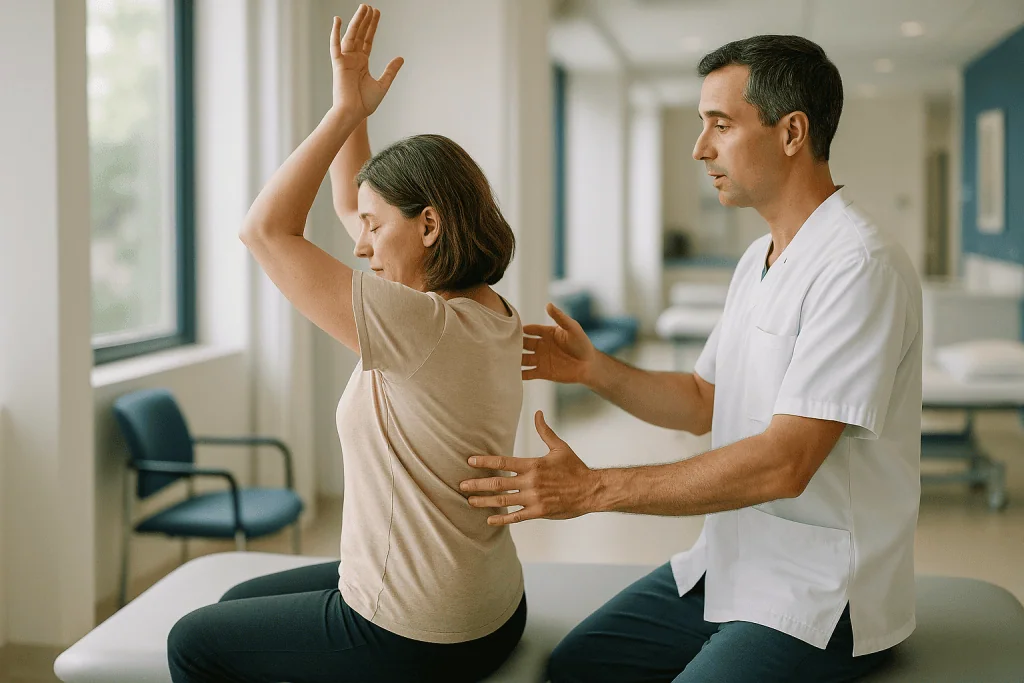
A session starts with classification. The therapist identifies where the curves sit and which way each one rotates, then assigns a corrective posture tailored to that pattern. From there the work has three parts that happen simultaneously.
Elongation means actively lengthening the spine, imagining the top of the head reaching toward the ceiling while the pelvis stays anchored. De-rotation means using the trunk muscles, sometimes with a hand on a wall bar or a pole for leverage, to turn the rib cage back toward the midline. The signature piece is what Schroth practitioners call rotational angular breathing: directing the inhale into the sunken, compressed side of the chest so the ribs on that side expand outward and back, physically opening the concavity.
Once a person can find the corrected position with help, the goal is to hold it against gravity, then against resistance, then without the mirror, and finally to carry fragments of it into ordinary life: sitting at a desk, carrying a bag, standing in line. That last step is where the method stops being an exercise and becomes a habit.
The mechanism is neuromuscular, not orthopedic. Schroth does not push on bone the way a brace does. It trains the nervous system and the deep trunk muscles to hold a better-aligned position for more hours of the day. That distinction explains most of what the method can and cannot do.
Who Schroth exercises for scoliosis are usually for, and who is asked to wait
Scoliosis-specific exercise is most often offered to growing children and adolescents with idiopathic scoliosis, meaning the common type with no identifiable cause, whose curves are mild to moderate. Roughly 2 to 3 percent of people have scoliosis (Cleveland Clinic), and the large majority of those curves are small and never need more than monitoring. For that group, exercise is a low-risk way to build posture and strength while the spine team watches the X-rays.
The middle group, growing adolescents with moderate curves, is where Schroth is most studied. Bracing is commonly considered when a curve in a still-growing child reaches roughly 25 to 40 degrees (Cleveland Clinic), and this is also the population in which trials have combined Schroth with bracing or with observation.
Adults with degenerative or long-standing curves make up a third group. Their goals are different, but they are not excluded. Johns Hopkins Medicine notes the method can be adapted for patients of any age and at any stage.
Who is usually asked to wait, or steered elsewhere? A child whose curve is progressing quickly despite bracing, or whose Cobb angle is approaching the range where surgery is discussed, generally around 45 to 50 degrees (Cleveland Clinic), needs a surgical consultation first, and exercise then becomes supportive rather than primary. Someone with scoliosis caused by a neuromuscular condition such as cerebral palsy, or a congenital malformation of the vertebrae, needs a program designed around that diagnosis rather than the standard idiopathic protocol. Anyone with new neurological symptoms, unexplained pain, or a curve that changed rapidly needs evaluation before any exercise program starts.
None of these judgments belong to a search engine. They sit with the orthopedic specialist and the physical therapist who can see the film and the child.
Does Schroth reduce the Cobb angle? What the evidence really shows
This is the question underneath every other question, so it deserves a direct look.
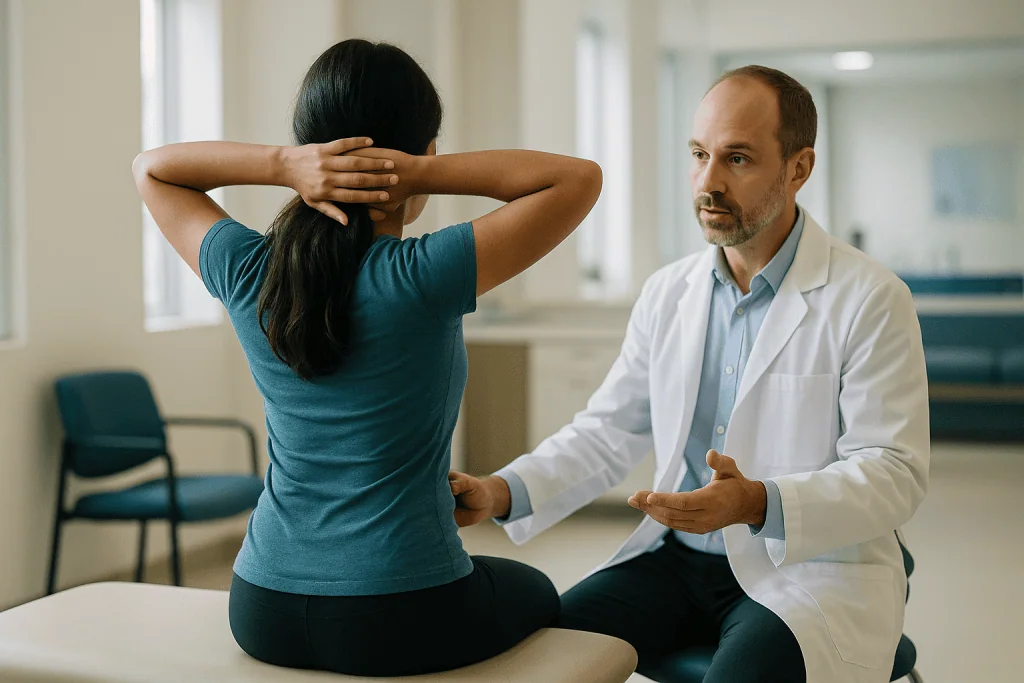
The strongest data come from a small number of randomized controlled trials in adolescents. The best known compared standard care alone with standard care plus a supervised Schroth program and home practice over about six months. The Schroth group showed better back-muscle endurance and self-image scores, and a statistically significant difference in Cobb angle compared with the control group, whose curves drifted slightly in the other direction. The size of that difference was small, in the range that many radiologists would call measurement noise on a single film.
Systematic reviews that pool these trials generally reach the same cautious conclusion: scoliosis-specific exercises, including Schroth, appear to have a small favorable effect on curve progression in growing adolescents with mild to moderate idiopathic scoliosis, but the studies are few, small, short, and often unblinded. Mainstream patient guidance reflects that uncertainty. Mayo Clinic notes that exercise has not been shown to prevent or reverse scoliosis, while Johns Hopkins Medicine describes Schroth as a legitimate nonsurgical option aimed at improving posture and slowing progression.
Both statements can be true. Exercise does not reverse a structural curve. Exercise may nudge the trajectory of a growing curve by a few degrees, which for a child sitting near a bracing threshold could matter.
What the evidence does not support is any claim of a specific percentage improvement, a guaranteed number of degrees, or a promise that a curve will stop. Any clinic or website offering those figures is quoting something other than the published literature.
The fairest summary: the Cobb-angle effect is plausible, probably small, and best documented in adolescents who practice consistently for months. It is not the main reason most spine teams recommend the method.
How long does the Schroth method take to work?
It depends on which result you are waiting for, because they arrive on different clocks.
Awareness comes first. Within the first few sessions, most people can feel the difference between their habitual slump and their corrected posture, even if they cannot hold the correction long. That is the foundation, and it is fast.
Visible changes in standing posture and trunk symmetry tend to follow over weeks. Trunk-muscle endurance, measured as how long someone can hold a position, improves on a similar timeline once daily practice is established. These are the changes families notice in photos and clothing fit, and they are also the changes with the most consistent support in studies.
Any effect on the Cobb angle unfolds over months, and it is judged by comparing X-rays taken at intervals a spine team sets. The trials that reported curve differences followed adolescents for about six months. A curve does not visibly change on film in a fortnight, and repeated early imaging adds radiation without adding information. Mayo Clinic describes follow-up X-rays for growing children with mild curves typically every four to six months, and that rhythm, not the exercise calendar, is what determines when anyone can say the curve has held.
Pain in adults sits somewhere in between. Some people report easing within weeks as they learn to unload irritated tissue; for others it is a slower shift alongside general conditioning.
One more clock matters more than all the others: the growth clock. In a child, results are measured against what the curve would have done during a growth spurt, which can push a curve forward several degrees in a season. Holding steady during that window is a result, even though it looks like nothing happened.
What the first weeks and months of practice usually look like
The opening phase is heavy on supervision. A certified therapist typically sees a new patient for a block of sessions to classify the curve, teach the corrective posture, and coach the breathing. Expect to spend a surprising amount of time barely moving, with a hand on a rib, being asked to breathe into a spot you have never consciously breathed into. Photographs and posture measurements are usually taken at the start so later comparisons are honest rather than remembered.
Home practice begins early. Programs vary, but the pattern is a daily set of positions held for time, often in front of a mirror, plus reminders to catch and correct posture during the day. The therapist adjusts the exercises as strength improves and as the person becomes able to self-correct without cues.
Soreness in the trunk muscles is common in the first couple of weeks, the ordinary ache of muscles working in a new way. Sharp pain, pain radiating into a leg, numbness, or symptoms that worsen with each session are not part of the process and should be reported.
By the second or third month, most people who have practiced consistently can hold corrections longer, breathe more symmetrically, and notice that sitting straight has become less effortful. Supervised sessions usually thin out to periodic check-ins. If the person is also wearing a brace, the therapist coordinates exercises with brace-off time and teaches corrections that work inside the brace as well.
Follow-up X-rays are scheduled by the spine specialist, not the therapist, on the usual monitoring rhythm for that child’s age and curve. The exercise program does not change that schedule. It simply gives the family something active to do between films, which many parents say is the part they value most.
Schroth method vs bracing vs surgery: what each one aims to change
Families often frame these as competitors. Spine teams see them as tools for different jobs, sometimes used together. The table sorts what each is designed to do, drawing on standard patient guidance from Mayo Clinic, Cleveland Clinic, and the NHS.
| Approach | Primary goal | Typical candidates | What it can realistically change | What it cannot do |
|---|---|---|---|---|
| Schroth exercises | Improve posture, trunk symmetry, breathing, endurance; possibly slow progression | Any age; most studied in growing adolescents with mild to moderate curves | Postural alignment, muscle endurance, self-image, possibly a few degrees of curve trajectory | Straighten a fixed structural curve; substitute for bracing or surgery when a curve is progressing |
| Bracing | Stop a moderate curve from worsening during growth | Growing children with curves roughly 25 to 40 degrees | Progression risk, when worn for the prescribed hours | Reverse the curve; help once growth has finished |
| Spinal fusion surgery | Correct and permanently stabilize a severe curve | Curves approaching 45 to 50 degrees or progressing despite other measures | Cobb angle substantially; trunk balance | Restore full motion at fused segments; carry zero risk |
| Observation | Watch a small curve over time | Mild curves, especially near the end of growth | Nothing directly; detects change early | Prevent progression if it begins |
Two patterns stand out. First, only bracing and surgery act mechanically on bone; Schroth acts on muscle and habit. Second, most of what Schroth changes is not on the X-ray at all, which is why it can be worthwhile even when the curve number does not move.
The NHS notes that braces are worn for many hours a day and that exercise alone is not usually recommended as the treatment for a progressing curve in a child. That is the frame most guideline-level advice uses: exercise as a companion, occasionally as the sole approach for small curves, rarely as a replacement.
Does Schroth add anything during bracing?
A brace is a rigid or semi-rigid plastic shell fitted around the torso to hold a growing spine in a corrected position; Mayo Clinic notes most are worn between 13 and 16 hours a day. Bracing has the strongest evidence of any nonsurgical treatment for stopping curve progression in growing children. So why add exercise?
Three practical reasons come up in the clinic. Muscle deconditioning is the first. A trunk held by plastic for most of the day does less work of its own, and therapists worry about weakness and stiffness that make brace-off hours harder. Schroth exercises done during brace-off time aim to keep the muscles that hold the correction active and strong.
Carryover is the second. Bracing ends when growth ends. If the only thing holding the correction was the brace, the corrected posture can drift once it comes off. Teaching the nervous system to find and hold the corrected position independently is, in theory, a way to preserve some of what the brace achieved.
Adherence is the third and least discussed. Wearing a brace through adolescence is hard. Families often report that having an active role, something to do rather than something to endure, improves morale, and morale drives wear time.
What does the research say? A small preliminary study, awarded by an international society for conservative scoliosis treatment, compared bracing plus Schroth with bracing alone and reported better curve outcomes in the combined group. Preliminary is the operative word: the study was small and short, and its findings need confirmation in larger trials before anyone can state them as fact.
The practical position most spine teams take is that Schroth during bracing is reasonable and low-risk, may help preserve strength and posture, and should be coordinated so that exercise never becomes a reason to shorten brace hours. The brace remains the treatment; the exercises support it.
Schroth method for adults: pain, function, and the slow drift
Adult scoliosis comes in two flavors. Some adults carry an adolescent curve into midlife; others develop a new curve as spinal discs and joints wear unevenly, a pattern called degenerative scoliosis. In both, the skeleton is mature, so the brace-and-growth logic of pediatric care no longer applies. The question becomes whether exercise can change how the back feels and functions.
Here the realistic results shift almost entirely away from the X-ray. Adults practicing Schroth typically report improvements in pain, in the ability to stand and walk for longer without fatigue, and in confidence about their posture. The corrective breathing can also matter for adults with large thoracic curves who feel short of breath on exertion, since expanding the compressed side of the chest changes how the ribs move.
Curve angle is a different matter. Adult curves do not reverse with exercise, and no guideline-level source suggests they do. Some adult curves progress slowly over decades; whether scoliosis-specific exercise slows that drift is plausible but not established in trials.
The comparison that matters for an adult is not Schroth against bracing. It is Schroth against general exercise, core strengthening, or standard physical therapy for back pain. The evidence that scoliosis-specific exercise outperforms good general conditioning in adults is thin. Some therapists blend approaches, using Schroth positions to teach alignment and general strengthening to build capacity.
Red lines are the same at any age. New leg weakness, numbness, bladder or bowel changes, or pain that wakes a person at night are reasons to stop and see a doctor, not reasons to try a harder exercise. Adults with osteoporosis or prior spinal surgery need their program adapted, and the treating physician should know exercise is being started.
Schroth method before and after: how to read the photos honestly
Before-and-after images are the currency of the internet’s version of this method, and they deserve a skeptical, specific eye rather than reflexive dismissal.
Start with what a standing photograph can show. Shoulder height, waist crease, rib prominence, and head position are all genuinely affected by Schroth training, and a person who has learned to hold a corrected posture will look more symmetrical in a photo. That is a real result, and in many cases the photo is honest.
Now consider what a photograph cannot show. Posture is a snapshot of muscle activity, not bone. A person can stand in active correction for the camera and slump five minutes later. The Cobb angle lives on an X-ray, and even X-rays vary by several degrees depending on how the person stands and how the film is read. Two X-rays a few degrees apart may reflect measurement variation rather than change.
Look for the tells. Different lighting, different clothing, different camera angle, or a before image taken with the person deliberately relaxed and an after image in active correction. None of these are necessarily deceptive, but they all inflate the apparent difference. Ask whether the images were taken under the same conditions and whether an X-ray comparison accompanies them.
Consider growth. In a child, an after photo taken a year later shows a body that has changed for many reasons. Attribution is genuinely hard.
The most trustworthy before-and-after data come from studies that used standardized photography, blinded assessors who did not know which group a participant was in, and radiographs read by the same protocol. Those studies exist, and they show the modest, layered picture described throughout this article: posture and endurance clearly better, curve angle slightly better in adolescents, nothing straightened.
What the Schroth method cannot change
Honest expectations protect people from disappointment and, more importantly, from delaying treatment that works. So here is the list plainly.
Schroth cannot straighten a structural curve. The vertebrae in a scoliotic spine are themselves wedge-shaped and rotated, and no exercise reshapes bone. A person in active correction is holding a better position, not owning a different anatomy.
It cannot substitute for bracing when a spine team has recommended one for a growing child. The NHS and Mayo Clinic both describe bracing as the standard approach for moderate progressing curves in children who are still growing. A family that chooses exercise instead of a recommended brace is not choosing a gentler version of the same treatment; they are choosing a different treatment with weaker evidence for that specific job.
It cannot replace surgery for severe curves. Curves large enough to compromise trunk balance, or approaching the range where surgery is discussed, need a surgical opinion. Exercise before and after surgery can help with conditioning and recovery, but it does not close the gap.
It cannot fix the rib hump completely. The prominence softens as the trunk de-rotates in active correction, and clothing fits better, but the underlying rib deformity remains.
It cannot be done passively. The method is demanding. Results in studies came from people who practiced daily for months. Occasional sessions produce awareness, not endurance.
It cannot promise a number. No responsible practitioner can say how many degrees a curve will change or guarantee that it will hold. Anyone who does is selling certainty the literature does not contain.
Knowing these limits is not a reason to skip the method. It is the reason to place it correctly, as a strong tool for posture, function, and possibly slowing progression, inside a plan the spine team owns.
What people often get wrong about Schroth results
Some myths circulate so widely that they deserve individual correction.
The first is that a famous athlete proves the method. Sprinter Usain Bolt has spoken publicly about having scoliosis and about keeping his core and back strong throughout his career. He has not, to public knowledge, credited any named exercise system, and even if he had, one elite athlete’s regimen is an anecdote, not evidence. What his story does illustrate is legitimate: many people with scoliosis remain highly active, and strengthening the trunk is compatible with living fully.
The second is that scoliosis is mainly a heart problem. When people ask which organ is most affected, the honest answer is the lungs, and only in severe curves. A large thoracic curve rotates the rib cage and reduces the space available for the lungs to expand; Mayo Clinic lists breathing problems among the complications of severe scoliosis. Mild and moderate curves, the vast majority, do not meaningfully affect the heart or lungs. Fear about organs is often used to sell urgency; the evidence does not support it for typical curves.
The third is that scoliosis is caused by bad posture or heavy backpacks and can therefore be undone by good posture. Idiopathic scoliosis has no identified cause; MedlinePlus and Mayo Clinic both note it is not caused by slouching or carrying things. Posture training helps how a person looks and feels; it did not cause the curve and will not erase it.
The fourth is that Schroth is either miraculous or useless. The trial data sit stubbornly in the middle: clear gains in posture and endurance, a small possible effect on curve angle in adolescents, nothing structural. People on both extremes are arguing with a study they have not read.
Questions to ask your care team about Schroth
A good consultation leaves a family clearer about the plan and the reasoning. These questions tend to open the right conversations.
- What is the current Cobb angle for each curve, and how much growth remains? The answer frames everything else, because exercise effects are most plausible in a spine that is still growing.
- Is exercise being suggested alongside monitoring, alongside a brace, or instead of one? If instead, what is the reasoning, and at what point would that decision be revisited?
- What specific results are you expecting from this program, and how will we measure them? Ask separately about posture, endurance, pain, and curve angle, because they move on different timelines.
- When is the next X-ray, and what change on that film would prompt a different plan?
- Who will supervise the program, what training do they have in scoliosis-specific exercise, and how will home practice be checked?
- How should exercise be coordinated with brace-off hours, sports, or other therapy?
- Which symptoms during practice should make us stop and call?
Notice that none of these questions ask whether Schroth works. That framing invites a yes or no that the evidence cannot supply. Asking what it is expected to change, and how the team will know, produces answers that can actually be checked at the next visit.
Bring a notebook or record the answers. Families often remember the reassurance and forget the thresholds, and the thresholds are what determine the next step.
When to call your doctor
Scoliosis-specific exercise is low risk, and most discomfort along the way is ordinary muscle fatigue. Some signs, though, are never part of the process and need prompt attention from the treating team rather than a program adjustment.
Call your doctor or the spine team the same day if any of these appear, whether or not they seem linked to exercise: new weakness, numbness, or tingling in the legs or feet; pain that shoots down a leg; any change in bladder or bowel control; back pain that is severe, constant, or wakes a person from sleep; unexplained fever or weight loss alongside back pain; or new shortness of breath at rest or with mild activity. Mayo Clinic and MedlinePlus note that idiopathic scoliosis is usually painless in children, so significant pain in a child with a curve deserves evaluation rather than reassurance.
Seek care within days, without waiting for the next scheduled visit, if a child’s posture or rib prominence seems to change noticeably over a few weeks, if a brace suddenly fits differently, or if exercises that were comfortable become consistently painful.
Emergency care is warranted for sudden loss of leg strength, inability to pass urine, or loss of bowel control, since these can signal pressure on the spinal cord or nerves regardless of cause.
Between emergencies and routine visits sits the more common situation: a family unsure whether a change is meaningful. The right response is a call, not a search. The spine specialist knows the curve, the growth stage, and the plan, and every decision about continuing, adjusting, adding a brace, or considering surgery belongs to that team and the person living with the curve.
Frequently asked questions
How long does the Schroth method take to work?
Postural awareness changes within the first few sessions, visible symmetry and muscle endurance improve over weeks of daily practice, and any effect on curve angle is judged over months by comparing X-rays on the schedule your spine team sets. Trials reporting curve differences followed adolescents for about six months. A curve that holds steady through a growth spurt counts as a result even though nothing looks different.
How effective is the Schroth method for scoliosis?
It is effective for posture, trunk symmetry, back-muscle endurance, and self-image, with consistent support in studies. For curve angle, small randomized trials in growing adolescents show a modest favorable difference compared with usual care, but the evidence is limited, short-term, and cannot support any specific percentage. It does not reverse a structural curve and is not a substitute for bracing or surgery when a curve is progressing.
How did Usain Bolt treat scoliosis?
Usain Bolt has said publicly that he has scoliosis and that he focused on keeping his core and back strong throughout his career; he has not publicly credited any named exercise method. One athlete’s regimen is an anecdote rather than evidence. His story does illustrate something accurate: many people with scoliosis stay highly active, and trunk strengthening is compatible with a demanding physical life.
What organ is most affected by scoliosis?
The lungs, and only in severe cases. A large curve in the thoracic spine rotates the rib cage and reduces the room the lungs have to expand, which is why Mayo Clinic lists breathing problems among the complications of severe scoliosis. Mild and moderate curves, which are the overwhelming majority, do not meaningfully affect the lungs or heart. Claims that typical scoliosis threatens organs are not supported by evidence.
Can Schroth exercises for scoliosis replace a brace?
Not when a spine team has recommended bracing for a growing child with a moderate progressing curve. Bracing has the strongest evidence for stopping progression during growth, and guideline-level sources such as the NHS and Mayo Clinic describe it as the standard nonsurgical approach in that situation. Schroth is often used alongside a brace to maintain strength and posture, and that combination should be coordinated by the treating team.
Are Schroth method before and after photos reliable?
They can honestly show improved standing posture and symmetry, which are real results of the training. They cannot show bone, and posture in a photo reflects muscle activity at that moment, not the Cobb angle on an X-ray. Look for identical lighting, clothing, and stance, and for an accompanying radiograph read the same way both times. Studies using blinded assessors give the most trustworthy comparisons.
Does the Schroth method for adults reduce the curve?
No. Adult skeletons are mature, and no guideline-level source suggests exercise reverses an adult curve. Realistic goals for adults are less pain, better standing and walking tolerance, improved breathing mechanics in large thoracic curves, and possibly slowing the slow drift some adult curves show. Whether scoliosis-specific exercise outperforms good general conditioning in adults remains unproven, and many therapists blend the two.
What are realistic schroth method results for a teenager?
Better posture, more symmetrical shoulders and waist, stronger trunk endurance, and higher self-reported quality of life are the most consistent findings. Curve angle may shift by a few degrees compared with what it would have done, based on small trials over about six months, and holding steady during a growth spurt is itself a meaningful outcome. The spine team judges this against scheduled X-rays.
Can Schroth make scoliosis worse?
There is no evidence that correctly supervised scoliosis-specific exercise worsens a curve. Ordinary muscle soreness in the first weeks is expected. What can cause harm is using exercise to delay a recommended brace or surgical consultation while a curve progresses. Sharp pain, symptoms radiating into a leg, numbness, or worsening with each session are not normal and should prompt a call to the treating team.
Who should not start Schroth without a specialist review?
Anyone with new neurological symptoms, unexplained or night-time back pain, a rapidly changing curve, scoliosis from a neuromuscular or congenital cause, osteoporosis, or prior spinal surgery needs assessment first so the program can be adapted or other treatment prioritized. Children whose curves are approaching the range where surgery is discussed should have a surgical opinion before exercise is positioned as the main plan.
References
This article is for general information only and is not a substitute for professional medical advice. Please consult a qualified doctor about your individual situation.

More from the Blog

When Does a Herniated Disc Need Surgery? Weakness, Persistent Sciatica and Time Limits
A herniated disc usually needs surgery only when a nerve is being damaged or when pain has outlasted a fair trial of nonsurgical care.…

Juvenile Scoliosis Between Ages Four and Ten: How Growth Drives the Curve and Shapes Care
Juvenile scoliosis is a sideways spinal curve first identified between ages four and ten. Because these children still have most of their growth ahead,…

Is Leg Pain After a Disc Operation Normal? Pain That Fades, Pain That Returns and When to Call
Some leg pain after disc surgery is common and usually not a sign that anything has gone wrong. A nerve that has been compressed…

Is Soreness After Schroth Exercises Normal? What Is Expected and Which Symptoms to Report
Mild, dull muscle soreness after Schroth exercises is common, especially in the first few weeks, because the method asks underused trunk muscles to hold…
Endoscopic Disc Surgery vs Microdiscectomy: What the Smaller Incision Changes
Endoscopic disc surgery and microdiscectomy both remove the fragment of a herniated disc that is pressing on a spinal nerve. Microdiscectomy works through an…

Spinal Cord Stimulator Cost: The Trial, the Implant and the Evidence
A spinal cord stimulator involves two separately billed stages: a short trial with temporary leads, then surgical implantation of a pulse generator. Total cost…