

Shingles Vaccine Age: When Shingrix Is Recommended and Why Timing Matters

Key Takeaways
- The CDC recommends Shingrix for all adults 50 and older and for immunocompromised adults from age 19, with no upper age limit.
- Healthy adults under 50 are not eligible because the pivotal randomized trials began at 50, leaving no efficacy or safety data for younger healthy people.
- In randomized trials, Shingrix prevented about 97 percent of shingles cases in adults 50 and older and about 91 percent in adults 70 and older.
- Long-term follow-up shows protection above 70 percent eleven years after vaccination, and no booster is currently recommended.
- The 2025 Welsh and Australian studies linking shingles vaccination to roughly 20 percent fewer dementia diagnoses are observational and have not changed any age recommendation.
- The NHS lowered its routine starting age from 70 to 65 in September 2023, while the US threshold of 50 remains among the most inclusive in the world.
In the United States, the CDC recommends the Shingrix shingles vaccine for all adults aged 50 and older, and for adults 19 and older whose immune systems are weakened by disease or treatment. Healthy adults under 50 are not currently eligible because shingles risk and vaccine trial data begin at that age. There is no upper age limit, and no booster is recommended at present.
A reader wrote to us last month with a question we now hear at nearly every family gathering: her 47-year-old brother had just spent three weeks with a burning band of blisters across his ribs, and she wanted to know why her pharmacist had turned her away from the shingles shot the year before. The answer sits in a single number, and that number has become one of the most searched health terms of the year.
As of September 2025, shingles vaccine age is trending for two reasons. In spring 2025, two large studies, one from Wales published in Nature and one from Australia published in JAMA, reported that people who received a shingles vaccine were about a fifth less likely to be diagnosed with dementia over the following seven years. Meanwhile, eligibility rules have quietly shifted on both sides of the Atlantic.
So who should be rolling up a sleeve, when, and what happens if you ask early? Here is what the evidence supports, and where it runs out.
What changed recently with shingles vaccine recommendations
Three developments explain why this topic has climbed the search charts, and none of them is a rumor.
First, the science. In April 2025 a research team used a quirk of Welsh vaccination policy as a natural experiment. A natural experiment is a study in which circumstances, rather than researchers, divide people into comparable groups. In Wales, people born on or after September 2, 1933 were eligible for the older live shingles vaccine, while those born a week earlier were not. Comparing the two groups, the vaccinated cohort had roughly 20 percent fewer new dementia diagnoses over seven years. Weeks later, an Australian team reported a similar pattern using Queensland records. Both built on a 2024 Oxford analysis in Nature Medicine suggesting the newer recombinant vaccine, Shingrix, was linked to more dementia-free time than the older live vaccine.
Second, the eligibility landscape. In the United States, the Advisory Committee on Immunization Practices, the expert panel that advises the CDC, expanded Shingrix in October 2021 to adults 19 and older who are or will be immunocompromised. That recommendation, published in the CDC’s Morbidity and Mortality Weekly Report in January 2022, remains the current standard. In England, Scotland and Wales, the NHS lowered its routine starting age from 70 to 65 beginning September 1, 2023, with a ten-year phase-in that gradually extends the offer into the early 60s, and made Shingrix available from age 50 for people with severely weakened immunity.
Third, durability data. Follow-up from the original Shingrix trials, which the CDC summarizes on its vaccine considerations page, now stretches beyond a decade, and protection has held up well enough that no booster has been added to the schedule.
What has not changed is the core number. For healthy adults, the shingles vaccine age in the US is still 50. The dementia findings, intriguing as they are, come from observational data and have not altered any official age cutoff. Keep that distinction in mind as you read the headlines.
What is the recommended shingles vaccine age in the United States?
Start with the plain rule, because everything else is a footnote to it. The CDC recommends Shingrix, the recombinant zoster vaccine, for every adult aged 50 and older. Recombinant means the vaccine contains a single lab-made protein from the virus rather than the virus itself, so it cannot cause shingles.
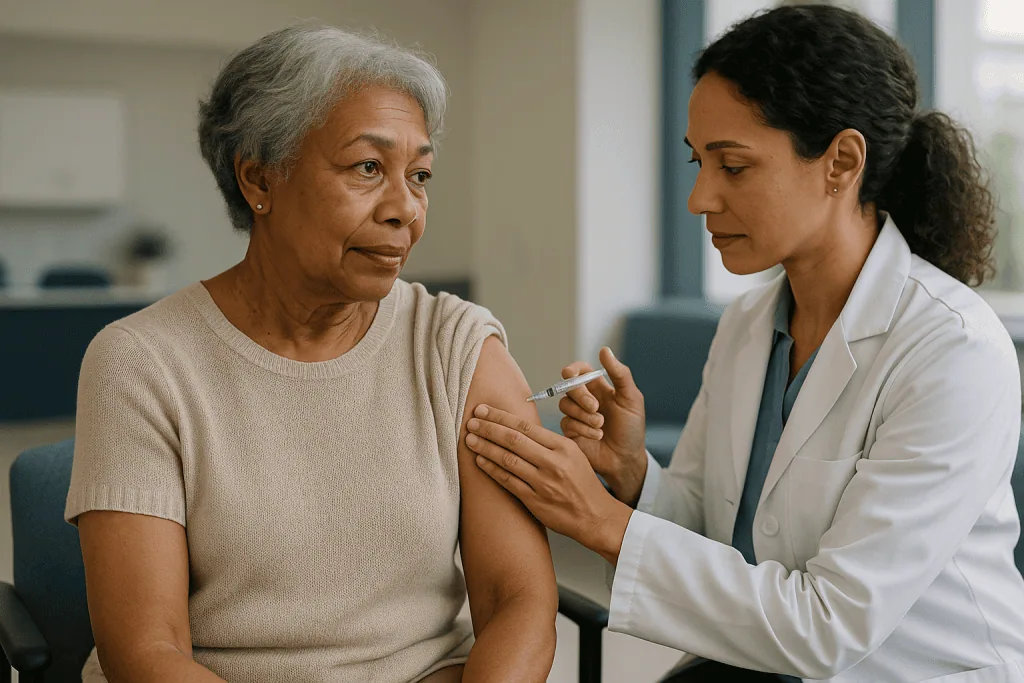
Shingles is the medical name for herpes zoster, a painful rash caused when varicella-zoster virus, the same virus that causes chickenpox, wakes up after decades of dormancy in nerve roots beside the spine. Roughly one in three people in the US will develop shingles in their lifetime, and about one million cases occur each year, according to the CDC.
The 50-and-older recommendation applies regardless of whether you remember having chickenpox. More than 99 percent of Americans born before 1980 carry the dormant virus, so the CDC does not ask for proof of prior infection or a blood test before vaccination. It also applies if you have already had shingles once; a past episode does not reliably protect against a second one.
Shingrix is given as a short series rather than a single shot, and the spacing between appointments is set by CDC guidance and your clinician. Completing the full series is what the trial data were built on; partial series were not studied for long-term protection.
A second track exists for younger adults whose immune defenses are reduced by illness or medication. For them, the shingles vaccine age drops to 19. We cover exactly who qualifies in a dedicated section below, because the definition matters and is often misunderstood.
One product, two entry points: 50 for the general population, 19 for people with compromised immunity. The older live vaccine, Zostavax, is no longer available in the US, so Shingrix is the only option on the American schedule. If a friend mentions getting a single-shot shingles vaccine years ago, that was almost certainly Zostavax, and current guidance treats them as due for Shingrix regardless.
Why does the shingles vaccine age start at 50?
Picture the immune system as a security team that has been on duty against varicella-zoster virus since childhood. For decades the team keeps the virus locked in nerve cells. Somewhere in midlife the roster starts thinning. Immunologists call this immunosenescence: the gradual, age-related decline in the specialized T cells that recognize and suppress a particular virus.
The consequence shows up clearly in the numbers. Shingles incidence in the US rises from a low baseline in young adulthood to a steep climb after 50, and the CDC notes that about half of all cases occur in people aged 60 and older. The risk of postherpetic neuralgia, the nerve pain that can linger for months or years after the rash heals, tracks the same curve. Postherpetic neuralgia is uncommon before 40 and affects a meaningful share of people who get shingles in their 70s and 80s.
The vaccine cutoff mirrors that curve, and it mirrors the trials. Shingrix was tested in two large randomized controlled trials, the gold standard design in which participants are assigned by chance to vaccine or placebo. The ZOE-50 trial enrolled adults 50 and older; ZOE-70 enrolled adults 70 and older. Together they included more than 30,000 people. Regulators approve vaccines for the populations in which they were studied, and advisory committees recommend them the same way. Healthy 45-year-olds were not in those trials, so there is no efficacy or safety data set to point to for that group.
Timing also involves a trade-off between protection and durability. Vaccinating at 50 places peak immunity across the years when risk begins to accelerate, and current follow-up shows protection persisting for more than a decade. Vaccinating much earlier would spend some of that protective window during years when shingles is relatively uncommon.
None of this means 50 is a magic biological threshold. It is a practical line drawn where risk, trial evidence and vaccine durability meet. Understanding that helps make sense of the next question, which is the one readers ask most.
Can I get the shingles vaccine at 45? The shingles vaccine under 50, explained
The honest answer for a healthy 45-year-old in the US is no, not under current recommendations. Pharmacies and clinics follow CDC guidance, and Shingrix is licensed by the FDA for adults 50 and older plus adults 18 and older at increased risk because of immunodeficiency or immunosuppression. A healthy 45-year-old fits neither category.

That frustrates people who have watched a younger relative suffer through shingles. Shingles does occur in the 40s, and occasionally in the 20s and 30s, particularly during periods of stress or illness. The distinction the guidelines draw is between individual cases, which happen, and population-level benefit, which is where vaccine policy lives.
Why not simply allow it anyway? Several reasons, each grounded in how vaccine science works. The pivotal randomized trials began at age 50, so efficacy below that age is extrapolated rather than measured. Safety was also characterized in that age range; Shingrix produces noticeable short-term reactions, and the profile in a broader young population has not been formally established outside immunocompromised groups. Duration of protection is finite, even if long, and starting earlier could mean waning protection just as risk peaks in the 70s. Advisory committees weigh all three before drawing a line.
A few readers ask whether a clinician could give it off-label at 45. Off-label means using a licensed product outside the specific population or purpose on its approval. In principle US clinicians may exercise that judgment, but it would fall outside CDC recommendations, insurance coverage generally follows those recommendations, and there is no trial evidence to guide the decision. That conversation belongs entirely with your own physician, who can weigh your specific history.
If you are under 50 and healthy, the most useful step is to note your fiftieth birthday as the date to book, and in the meantime to know what shingles looks like so you can seek care quickly if it appears. Antiviral treatment works best when started early, and that is a decision for a clinician, not a pharmacy counter.
Shingrix age requirements for people who are immunocompromised
For one group, the shingles vaccine age is 19, not 50. Immunocompromised means the body’s defenses are reduced by a medical condition or by treatment, leaving it less able to keep dormant viruses in check. Because varicella-zoster virus reactivates when immune surveillance weakens, these adults face shingles rates several times higher than their healthy peers, and more severe disease when it happens.
The CDC’s January 2022 recommendation, based on an October 2021 vote by the Advisory Committee on Immunization Practices, names the categories. They include people undergoing or about to undergo hematopoietic stem cell transplant, a procedure that replaces bone marrow; people with hematologic cancers such as leukemia or lymphoma; people with solid tumors receiving chemotherapy; recipients of solid organ transplants taking anti-rejection medicines; people living with HIV; and people taking immunosuppressive medications for conditions like rheumatoid arthritis, inflammatory bowel disease or psoriasis, including biologics and higher-dose corticosteroids. The Shingrix label itself sets the floor at 18, and the CDC recommendation applies from 19.
The evidence here is thinner than for healthy older adults, and worth stating plainly. Randomized trials in stem cell transplant recipients showed roughly 68 percent efficacy against shingles, and a trial in people with blood cancers showed about 87 percent. Smaller studies in kidney transplant, solid tumor and HIV populations measured immune responses rather than shingles cases and found the vaccine produced strong antibody and T-cell responses. Those are supportive but indirect findings.
Timing matters more in this group than any other. The CDC advises giving Shingrix before planned immunosuppression when possible, because a healthier immune system mounts a better response, and completing the series in a shorter window may be considered for people who are about to start treatment. Those adjustments are precisely why the decision must sit with the treating specialist, whether oncologist, transplant team, rheumatologist or infectious disease physician.
If you fall into one of these categories and are under 50, you are not asking for an exception. You are asking for the recommended schedule.
Is there an age when it is too late? Shingles vaccine in your 70s, 80s and beyond
No upper age limit exists in CDC guidance, and the trial data support that. This is one of the few vaccines whose evidence base was deliberately built to include the very old.
The ZOE-70 trial enrolled adults 70 and older and included participants in their 80s and 90s. In the pooled analysis, efficacy against shingles was about 91 percent in people aged 70 and older, and roughly 89 percent in those 80 and older. Efficacy against postherpetic neuralgia in the 70-plus group was similar. For a vaccine given to an age group whose immune systems respond weakly to many other shots, those figures are unusually high, and they are the main reason Shingrix replaced the older live vaccine, whose protection fell sharply after 70.
The mechanism helps explain why. Shingrix pairs its viral protein with an adjuvant, an ingredient that amplifies the immune response by alerting the innate immune system. The adjuvant is doing much of the work in older adults, effectively compensating for immunosenescence.
Age also shifts the risk-benefit calculation in favor of vaccination. Shingles in the 80s carries a higher likelihood of postherpetic neuralgia, of eye involvement when the rash affects the forehead and eye, and of hospitalization. A vaccine that prevents nine in ten cases in this group prevents a large share of the most disabling outcomes.
Side effects are a legitimate concern for frail older adults, and the data are reassuring in an unexpected direction: in the trials, short-term reactions such as sore arm, fatigue and muscle aches were somewhat less frequent in participants over 70 than in those aged 50 to 69. The CDC’s post-licensure monitoring identified a small increased risk of Guillain-Barré syndrome, a rare nerve disorder, in adults 65 and older, on the order of a few excess cases per million doses. The CDC judged that the benefits continue to outweigh that risk and did not change its recommendation.
If a parent or grandparent in their 80s has never been vaccinated, the guidance is simple: the recommended age is any age past 50, and later is still worthwhile.
How the UK and other countries set the shingles vaccine age
Americans are sometimes surprised to learn that the shingles vaccine age abroad is often higher, not lower. The difference reflects how publicly funded programs set priorities, not a disagreement about who can benefit.
In England, Scotland and Wales, the NHS shingles program moved on September 1, 2023 from a starting age of 70 to a new starting age of 65. Because the change is being phased in over ten years, eligibility currently depends on birth date: people who turned 65 on or after that date are invited, along with everyone aged 70 to 79, and the program is scheduled to extend into the early 60s toward the end of the decade. Adults with a severely weakened immune system are eligible from age 50. The NHS now uses Shingrix for everyone in the program, having retired the live vaccine.
The NHS offer is age-based rather than request-based, which means a healthy 55-year-old in the UK is not routinely vaccinated even though the same person in the US would be. That gap generates a good deal of confused searching from expatriates and dual-nationals.
The World Health Organization has not issued a universal recommendation on shingles vaccination. Its position is that countries with aging populations may consider introducing the vaccine after assessing local burden and resources, which is why national ages vary. Canada recommends Shingrix from 50 with provincially funded programs typically starting later, and Australia funds it from 65, with earlier eligibility for certain high-risk groups.
What unites these programs is the evidence base: all rely on the same randomized trials that began at 50, and all extend eligibility to younger adults only when immunity is impaired. Where they differ is in how far above 50 they draw the line for routine funding.
For a US reader, the practical point is that the CDC’s 50-and-older recommendation is among the most inclusive in the world, and there is no evidence-based reason to wait longer than that if you are eligible.
What the evidence actually says, graded by strength
Not all findings in this field carry equal weight, so here is how a cautious reader should sort them.
Strong evidence from randomized controlled trials. Shingrix prevents shingles in adults 50 and older with roughly 97 percent efficacy in the first years after vaccination, and about 91 percent in adults 70 and older. It prevents postherpetic neuralgia in the 70-plus group with about 89 percent efficacy. These figures come from two blinded, placebo-controlled trials with more than 30,000 participants across 18 countries, the highest tier of clinical evidence. The safety profile of frequent but short-lived reactions was characterized in the same trials.
Strong to moderate evidence for durability. Long-term follow-up of the original trial participants, an extension study rather than a fresh randomization, shows protection of roughly 79 percent averaged over the first eight years and above 70 percent through year eleven. Because the placebo group was eventually offered vaccine, later comparisons rely on statistical modeling, which lowers the certainty slightly.
Moderate evidence in immunocompromised adults. Randomized trials exist for stem cell transplant recipients and people with blood cancers. For other immunocompromised groups, the evidence is immunogenicity data, meaning measured immune responses rather than prevented cases. The CDC rated this evidence as adequate to recommend vaccination but acknowledged the gaps.
Observational evidence for benefits beyond shingles. The dementia findings from Wales, Australia and Oxford are quasi-experimental or observational. They are well designed and consistent with one another, but none randomly assigned people to vaccine. The same applies to cohort studies linking vaccination with fewer strokes and heart attacks. These findings generate hypotheses and support the existing recommendation; they do not by themselves justify changing the age.
Expert opinion. The specific spacing rules, guidance on giving Shingrix before immunosuppression, and the absence of a booster recommendation rest on expert interpretation of the above data rather than dedicated trials.
If you remember one thing, make it this: the case for vaccinating at 50 stands on randomized trials, and the case for any other age stands on far less.
Shingles vaccine age at a glance: eligibility and evidence compared
Readers who want the whole picture on one screen asked for a summary, and this is one of the rare moments where a table earns its place. The rows reflect CDC and NHS guidance as of September 2025; the evidence column reflects the grading in the previous section.
| Group | US (CDC) | UK (NHS) | Strength of supporting evidence |
|---|---|---|---|
| Healthy adults under 50 | Not recommended | Not offered | No trial data in this population |
| Immunocompromised adults 19 to 49 | Recommended from age 19 | Eligible from age 50 if severely immunosuppressed | Randomized trials in transplant and blood cancer; immune-response data in other groups |
| Healthy adults 50 to 64 | Recommended | Not routinely offered | Randomized trials, about 97% efficacy |
| Adults 65 to 69 | Recommended | Being phased in since September 2023 | Randomized trials |
| Adults 70 to 79 | Recommended | Offered | Randomized trials, about 91% efficacy |
| Adults 80 and older | Recommended, no upper limit | Offered if previously missed under certain rules | Randomized trial subgroup, about 89% efficacy |
| Previously had shingles | Recommended once rash has resolved | Eligible per age rules | Expert opinion plus safety data |
| Previously had Zostavax | Recommended to receive Shingrix | Recommended to receive Shingrix when eligible | Immune-response studies |
Two things stand out. The first is how much wider the US net is between 50 and 64, a difference driven by program funding rather than by disagreement over the science. The second is that every row where the recommendation is strongest, from 50 upward, is also the row backed by randomized trials. The gaps in the table, particularly for healthy adults under 50, are gaps in the research, and until they are filled the recommendation will not move.
Eligibility rules do change, as the NHS phase-in shows, so treat the table as a snapshot rather than a permanent map, and confirm your own status with a clinician or pharmacist.
How long does Shingrix last? Is it a lifetime vaccination?
The question behind the question is usually this: if I get vaccinated at 50, will I still be protected at 78 when my risk peaks? The data are encouraging without being complete.
Researchers followed the original ZOE trial participants for more than a decade in an extension study. Protection against shingles averaged around 79 percent across the first eight years after vaccination, and remained above 70 percent through year eleven, the most recent published time point. Those figures come from adults who were 50 and older when vaccinated, so the oldest have now been followed into their 80s with protection largely intact.
Compare that to the older live vaccine, whose protection fell to roughly 35 percent within about six years and drifted toward zero within a decade, and the difference is stark. The adjuvant in Shingrix appears to generate a more robust and longer-lasting population of virus-specific T cells.
Does that make Shingrix a lifetime vaccination? Not quite, and the honest phrasing matters. The CDC currently recommends completing the series once and does not recommend a booster, because the available follow-up shows durable protection and no trial has tested whether a booster adds benefit. Whether protection lasts thirty years is unknown, because the vaccine has not existed that long. If future data show meaningful waning, the recommendation could change, as it has for other adult vaccines.
For now, the practical guidance is straightforward. Complete the full series, because the durability data were generated in people who did. Keep a record of when you finished, which will matter if a booster is ever recommended. And do not delay vaccination in the hope of timing protection to a later decade; the evidence shows protection at eleven years remains well above the level the older vaccine achieved at one.
People who are immunocompromised are a partial exception. Protection may be shorter in this group, and their specialists monitor emerging data closely. Any decision about additional doses in that setting belongs to the treating clinician.
Already had shingles, or had Zostavax? When timing changes
Two common histories shift the timing conversation without changing the age rule.
If you have already had shingles. A prior episode does not rule out vaccination; the CDC recommends Shingrix for eligible adults regardless. Second episodes are less common than first ones but do occur, particularly with age and reduced immunity, and there is no way to predict who will have one. The guidance is to wait until the acute illness has resolved and the rash has fully healed before vaccinating. No fixed waiting period is specified in CDC guidance beyond recovery, though some clinicians prefer a gap of several months, a judgment call that reflects expert opinion rather than trial data. Vaccination is not a treatment for an active or recent episode and will not shorten postherpetic neuralgia already present.
If you received Zostavax. The live shingles vaccine was used in the US from 2006 until 2020 and in the UK until 2023. Its protection was modest at the outset and faded within a decade. The CDC recommends that everyone who had Zostavax receive Shingrix, and studies show the recombinant vaccine produces a strong immune response in previously vaccinated people. CDC guidance suggests waiting at least eight weeks after Zostavax, a point that is now moot for most, since the live vaccine has not been given in the US for several years.
If you are not sure whether you had chickenpox. Testing is not required. The CDC notes that nearly all adults born before 1980 in the US were infected, often without a memorable illness, and recommends vaccination without serology. People who received the chickenpox vaccine as children, now entering their 30s and 40s, will eventually raise new questions about the appropriate shingles vaccine age, since their risk may differ, but that cohort has not yet reached 50 in large numbers and no separate guidance exists.
In every one of these scenarios the eligibility age holds. What shifts is the moment within eligibility that makes the most sense, and that timing is a conversation for your clinician.
What about the dementia and heart-health headlines?
The claim circulating widely this year is that the shingles vaccine prevents dementia. That overstates what the studies found, though what they found is genuinely interesting.
The Welsh study in Nature took advantage of a sharp eligibility cutoff by birth date. Because people born a week apart are otherwise similar, comparing them approximates a randomized trial. Over seven years, those eligible for the live shingles vaccine had about a 20 percent lower rate of new dementia diagnoses, with the effect apparently larger in women. The Australian replication using Queensland data found a comparable pattern. The 2024 Oxford analysis, which compared people who happened to receive Shingrix versus Zostavax as the US switched between them, reported that Shingrix recipients had about 17 percent more time free of a dementia diagnosis over six years.
Several mechanisms are plausible. Reactivating varicella-zoster virus may inflame blood vessels and neural tissue; preventing that reactivation could reduce cumulative damage. The vaccine might also shift immune activity in ways that are protective independent of the virus.
Here is the caution. These are observational and quasi-experimental studies. They are stronger than typical observational work because of their clever designs, but they did not randomly assign vaccination, they measured dementia diagnoses rather than confirmed disease, and they cannot fully exclude differences in health-seeking behavior. A randomized trial designed to test dementia as an outcome has not been completed. The appropriate reading is that the findings are promising, consistent, and worthy of further research, and that they add to, rather than create, the case for vaccination at the recommended age.
Cardiovascular findings sit in the same tier. A 2025 Korean cohort study of more than a million adults reported about 23 percent fewer heart attacks, strokes and related events among vaccinated people. Cohort studies follow groups forward in time but cannot prove causation.
None of these studies changes who should be vaccinated or when. They offer a reason for eligible adults who have been putting the shot off to stop putting it off, and that is a reasonable thing to take from them.
Common myths about shingles vaccine age, corrected
Viral posts and family lore have produced a cluster of misconceptions. Here are the ones our readers raise most, each set against what the evidence supports.
Myth: The vaccine is only for elderly people. The US recommendation begins at 50, and immunocompromised adults are eligible from 19. Half of shingles cases occur before 60. Waiting until retirement means spending a decade or more unprotected during years when risk is already climbing.
Myth: If you never had chickenpox, you do not need it. Almost everyone born before 1980 carries the virus, often after an infection too mild to remember. The CDC recommends vaccination without testing. The exception is a person confirmed by blood test never to have been infected, a rare situation that a clinician can assess.
Myth: It is a live virus that can give you shingles. That was a reasonable question about the older vaccine, which contained weakened live virus and was avoided in people with weakened immunity. Shingrix contains a single viral protein and cannot cause infection, which is precisely why it can be given to immunocompromised adults.
Myth: One dose is enough. The efficacy figures come from people who completed the full series. Partial vaccination has not been studied for long-term protection.
Myth: If you had shingles, you are immune for life. Recurrence happens, and the vaccine is recommended after recovery.
Myth: The vaccine prevents dementia, so everyone should get it young. The dementia data are observational, come from people vaccinated in their 70s, and have not changed any age recommendation. A healthy 40-year-old has no trial evidence to rely on.
Myth: Side effects mean it is unsafe. Shingrix is reactogenic, meaning short-term arm pain, fatigue and aches are common and about one in six people report reactions strong enough to disrupt a day of activity. Those reactions resolve within two to three days and reflect the immune response the vaccine is designed to provoke. Serious adverse events were not more common than placebo in the trials.
Each of these myths tends to push people toward delay. The evidence pushes the other way.
What to expect after the shot at different ages
Readers who have had Shingrix often describe it as the most noticeable vaccine they have received, and the trial data agree, so it helps to know what is normal before you book.
Local reactions are the most common. In the trials, about 78 percent of participants reported arm pain, a third reported redness, and a quarter reported swelling. Systemic reactions were also frequent: roughly 45 percent reported fatigue, 45 percent muscle aches, 38 percent headache, and about 20 percent fever or shivering. The CDC summarizes this as about one in six people experiencing reactions severe enough to prevent normal activities for a day or two.
Age changes the picture modestly. Participants aged 50 to 69 reported these reactions somewhat more often than those 70 and older, likely because a more vigorous immune system mounts a more vigorous response. Reactions were typically short, resolving within two to three days, and were similar after each appointment in the series, so a strong reaction the first time does not predict a worse one later.
Practical planning follows from that. Many people schedule their appointment when the following day is light on commitments. Rest, fluids and a cool compress on the arm are reasonable comfort measures. If you take any medicine for discomfort, follow the directions on the label or your clinician’s advice; this article deliberately offers no specific recommendation.
Serious reactions are rare. Severe allergic reactions can occur with any vaccine and are the reason clinics observe you briefly afterward. Post-licensure surveillance identified a small increase in Guillain-Barré syndrome among adults 65 and older, estimated at a few excess cases per million doses, and the CDC concluded the benefits clearly outweigh that risk.
Shingrix can be given at the same visit as other adult vaccines, including influenza and COVID-19, typically in different arms. Some people prefer to space them to distinguish which caused any reaction; either approach is acceptable under CDC guidance, and your clinician or pharmacist can advise based on your history.
When to see a doctor about shingles vaccine age and timing
Every question in this article ends in the same place: a conversation with your own clinician, who knows your history. Here is when that conversation is not optional.
Before vaccination, see a doctor if:
- You are under 50 and have any condition or treatment that weakens immunity, including cancer therapy, transplant, HIV, or medicines for autoimmune disease. You may be eligible now, and timing relative to treatment matters.
- You are about to start immunosuppressive treatment. The CDC advises vaccinating beforehand where possible, and only your specialist can fit that into your plan.
- You have ever had a severe allergic reaction to any vaccine or vaccine component.
- You currently have shingles or are recovering from a recent episode. Vaccination waits until the rash has fully healed.
- You are pregnant or breastfeeding. Shingrix has not been studied in pregnancy, and the CDC suggests deferring; your obstetric clinician can advise.
- You are moderately or severely ill with a fever. Mild illness is not a reason to delay, but anything more should be assessed.
After vaccination, seek care promptly if you notice:
- Signs of a severe allergic reaction within minutes to hours: difficulty breathing, swelling of the face or throat, rapid heartbeat, widespread hives, or dizziness. Call emergency services.
- Weakness, tingling or numbness that spreads, especially starting in the feet or legs, or difficulty walking, in the weeks after vaccination. These can be early signs of Guillain-Barré syndrome, which is rare but needs urgent evaluation.
- Fever, arm pain or fatigue that persists beyond three days or worsens rather than improves.
Regardless of vaccination status, see a doctor within a day if you develop:
- A painful, burning or tingling patch of skin on one side of the body, followed by a rash of blisters. Early antiviral treatment, prescribed by a clinician, is most effective when started quickly.
- Any rash near the eye, forehead or nose, which can threaten vision.
- Pain that continues after a shingles rash has healed.
The decision to vaccinate, and when, rests with you and your prescribing clinician. This article is a map of the evidence, not a substitute for that visit.
Frequently asked questions
Why can't people under 50 get the shingles vaccine?
Healthy adults under 50 are outside the population in which Shingrix was tested and approved. The two large randomized trials enrolled people aged 50 and older, so efficacy, safety and duration of protection below that age have not been measured. Shingles risk also rises sharply after 50, which is where advisory committees judged the benefit clearly justified routine vaccination. Adults from 19 with weakened immunity are the recognized exception.
Why do I have to wait until I'm 50 to get the shingles vaccine?
The age of 50 marks where three things converge: shingles incidence begins to climb steeply, the randomized trial evidence starts, and the vaccine’s decade-plus of durable protection covers the highest-risk years. Vaccinating earlier would rely on extrapolation rather than data and could spend part of the protective window during lower-risk years. If you have a condition or treatment that weakens immunity, the recommended age drops to 19 and you should ask your clinician now.
Can I get the shingles vaccine at 45?
Under current CDC guidance, a healthy 45-year-old is not eligible, and pharmacies follow that guidance. The exception is anyone 19 or older who is immunocompromised because of illness such as cancer, HIV or transplant, or because of immunosuppressive medicines; those adults are recommended to receive Shingrix regardless of age. Any question about vaccination outside these categories should go to your own physician, who can weigh your specific history.
Is Shingrix a lifetime vaccination?
Shingrix is currently given as a single completed series with no booster recommended. Follow-up of trial participants shows protection above 70 percent eleven years after vaccination, far more durable than the older live vaccine. Whether protection lasts a full lifetime is unknown, because the vaccine has only existed since 2017. If future data show meaningful waning, the CDC could add a booster, so keep a record of your vaccination dates.
How long does Shingrix last after the series is complete?
Published follow-up shows Shingrix protection averaging about 79 percent over the first eight years and remaining above 70 percent through year eleven. The oldest trial participants, now in their 80s, retain substantial protection. By comparison, the older Zostavax vaccine fell to roughly 35 percent within six years. Because monitoring is ongoing, the answer beyond eleven years is still being written, and no booster is recommended at present.
What are the Shingrix age requirements for people with weakened immune systems?
The CDC recommends Shingrix from age 19 for adults who are or will be immunocompromised. Recognized groups include people receiving chemotherapy, stem cell or solid organ transplant recipients, people with blood cancers, people living with HIV, and people taking immunosuppressive medicines for autoimmune conditions. The vaccine is best given before immunosuppression begins where possible. Your specialist decides timing within your treatment plan.
Is there a shingles vaccine under 50 option in the UK?
In England, Scotland and Wales the NHS offers Shingrix from age 50 only to people with a severely weakened immune system. Healthy adults become eligible under an age-based schedule that began lowering from 70 to 65 in September 2023 and is being phased in over ten years. A healthy adult in their 50s in the UK is therefore not routinely offered the vaccine, unlike in the United States.
Can I get the shingles vaccine if I already had shingles?
Yes. The CDC recommends Shingrix for eligible adults regardless of a past episode, because shingles can recur and prior infection does not guarantee lasting immunity. Vaccination should wait until the acute illness has resolved and the rash has healed completely. The vaccine does not treat an active episode or relieve nerve pain that is already present. Your clinician can advise on the best interval after recovery.
Do I need a blood test to prove I had chickenpox before Shingrix?
No. The CDC does not require testing, because more than 99 percent of Americans born before 1980 have been infected with varicella-zoster virus, often without a memorable illness. Shingrix is recommended for eligible adults whether or not they recall chickenpox. In the uncommon event that a prior blood test confirmed you were never infected, discuss with your clinician, who may consider chickenpox vaccination instead.
Does the shingles vaccine really reduce dementia risk?
Studies from Wales, Australia and Oxford published in 2024 and 2025 found people who received a shingles vaccine were about 17 to 20 percent less likely to be diagnosed with dementia over six to seven years. These are observational and quasi-experimental designs, not randomized trials, so they suggest rather than prove a protective effect. The findings support vaccination at the recommended age but have not changed who is eligible.
References
- CDC: Shingles (Herpes Zoster) Vaccination
- CDC MMWR: Use of Recombinant Zoster Vaccine in Immunocompromised Adults Aged 19 Years and Older, 2022
- CDC MMWR: Recommendations of the Advisory Committee on Immunization Practices for Use of Herpes Zoster Vaccines, 2018
- NHS: Shingles vaccine
This article is for general information only and is not a substitute for professional medical advice. Please consult a qualified doctor about your individual situation.

More from the Blog

Food Sensitivity Tests: Why IgG Kits Fail the Evidence Test
Food sensitivity tests that measure IgG antibodies to foods are not supported by current evidence. IgG against a food usually signals normal exposure and…

CRP and ESR: The Inflammation Blood Tests Explained
A CRP test measures C-reactive protein, a substance the liver releases within hours when the body is inflamed by infection, injury or inflammatory disease.…
Celiac Testing: The Blood Tests, the Biopsy, and Why You Must Not Go Gluten-Free First
Celiac disease is diagnosed in two steps: a blood test that looks for antibodies, most often tissue transglutaminase IgA (tTG-IgA), followed, for most adults,…

Calprotectin Stool Test: How It Separates IBS From Inflammatory Bowel Disease
Calprotectin is a protein released by white blood cells into the gut when the bowel lining is inflamed. A stool test measures it in…
FibroScan: The Liver Stiffness Test Explained
FibroScan is a painless, non-invasive scan that uses a brief vibration and ultrasound to measure how stiff the liver is, reported in kilopascals (kPa),…

The PSA Test: What Levels Mean by Age, and Why Context Is Everything
There is no single normal PSA. Commonly used age-referenced upper limits are roughly 2.5 ng/mL for men in their 40s, 3.5 in their 50s,…