

Shock Wave Therapy vs Surgery for Chronic Tendon Pain: Where ESWT Fits in the Sequence

Key Takeaways
- Shockwave therapy delivers acoustic pressure waves through the skin to provoke a small controlled irritation that may restart healing in a stalled tendon; it is not electricity, heat or acupuncture.
- The Mayo Clinic describes ESWT as an option for chronic plantar fasciitis that has not responded to conservative care, with promising but not consistently effective study results.
- Surgery for tendon conditions is generally considered only after roughly 6 to 12 months of persistent symptoms despite non-operative treatment, and is rarely needed for plantar fasciitis.
- ESWT is usually given as a short series of sessions, and the response is judged weeks to a few months after the final session rather than on the day.
- Because nothing is cut, shockwave therapy keeps the surgical option open, whereas surgery changes the anatomy and makes revision harder.
- Repeated corticosteroid injections are not recommended for plantar fasciitis because they can weaken the fascia; ESWT puts mechanical energy into the tendon without injecting anything.
Shockwave therapy and surgery are not rivals; they sit at different points in the care sequence for chronic tendon pain. Extracorporeal shock wave therapy (ESWT) is a non-invasive option usually considered after months of structured exercise and load management have not helped, while surgery is generally reserved for persistent cases after roughly 6 to 12 months of conservative care. The treating team decides the order.
The physiotherapist has just said the word nobody wants to hear in a tendon clinic: “still.” Still tender under the heel at the first step of the morning. Still that pull at the outside of the elbow when the kettle comes off the hob. Ten months of calf raises, heel drops, new shoes and a wedge of foam under the desk, and the pain has moved from a six to a four and then parked there.
Somewhere in that conversation two options surface at once: a short course of shockwave therapy, or a referral to a surgeon. Put like that, it sounds like a fork in the road. It rarely is. When people search “shockwave therapy vs surgery”, what they usually want to know is not which one wins, but which one comes first, how much time each buys, and whether choosing one closes the door on the other.
The honest answer is more orderly than the internet suggests. Chronic tendon pain has a sequence, and both treatments have a place in it.
How does shockwave therapy actually work on a tendon?
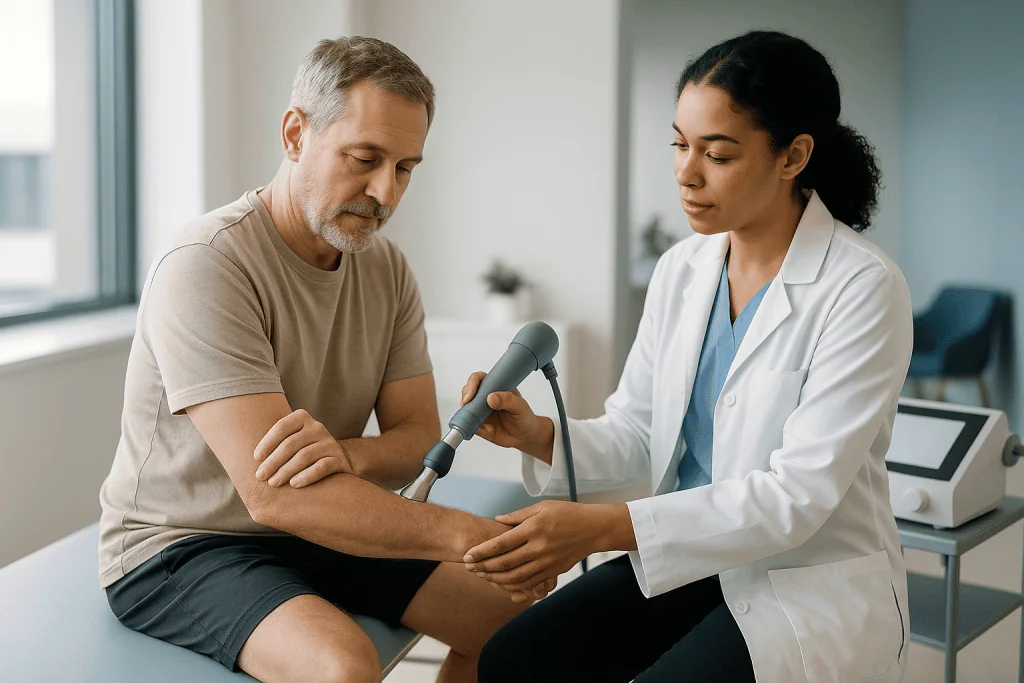
Extracorporeal shock wave therapy, usually shortened to ESWT, is a treatment in which a handheld device delivers pulses of acoustic energy through the skin into a painful tendon or its attachment to bone. “Extracorporeal” simply means the energy is generated outside the body. The pulses are physical pressure waves, not electricity and not heat.
What those waves do once they arrive is the subject of a great deal of laboratory work and a smaller amount of certainty. The leading explanation is that the mechanical stress creates a controlled, tiny irritation in tissue that has settled into a stalled, poorly organized state. A chronic tendon problem, often called tendinopathy, is less an active inflammation than a failed repair: disorganized collagen, new fragile blood vessels, and nerve endings that have become sensitized. Shock waves appear to nudge local blood flow, stimulate cells that build collagen, and reduce the activity of the small nerve fibers that carry pain signals. The Mayo Clinic describes the aim plainly: sound waves directed at the painful area to stimulate healing.
In practice, a session is short. The clinician finds the tender spot by pressing, applies gel, and delivers a set number of pulses while adjusting pressure to what you can tolerate. Most people describe it as a rapid tapping that becomes sharp over the sore spot, then eases. Two broad device families exist. Focused shock waves converge on a point at a chosen depth; radial pressure waves spread outward from the applicator and act on tissue nearer the surface. Which is used depends on the tendon, the depth of the problem and clinic protocol, not on one being universally better.
One detail matters for expectations. ESWT is rarely a single appointment. It is typically delivered as a short series spaced about a week apart, with the response judged in the weeks after the last session rather than on the treatment table.
Shockwave therapy vs surgery: two tools doing different jobs
Framing this as shockwave therapy vs surgery suggests two equivalent choices for the same moment. They are not. One is a non-invasive stimulus that tries to restart a healing process while the tendon stays intact. The other physically changes the tendon, removes degenerated tissue, releases a tight attachment or repairs a partial tear.

That difference drives everything downstream. Shockwave does not involve anesthesia, incisions or stitches. The risks are correspondingly modest: bruising, temporary soreness, skin redness, occasionally a flare of pain for a few days. Because nothing is cut, it does not close off later options; a person who has ESWT and does not improve can still be assessed for surgery.
Surgery carries the risks that come with any operation: infection, wound problems, nerve irritation, blood clots, reaction to anesthesia, and the possibility that pain persists despite a technically good procedure. It also commits you to a recovery that is measured in months rather than days, with time away from work or sport.
The flip side is that surgery can address things shockwave cannot. A chronically thickened plantar fascia, a bone spur that genuinely catches on a tendon, a large area of degenerated tissue, or a partial tear that has not knitted may need a scalpel rather than a pressure wave. Surgeons generally do not offer those procedures first, and guideline-level advice from the Mayo Clinic for tennis elbow reflects the pattern across tendon conditions: surgery is considered when symptoms have not improved after roughly 6 to 12 months of extensive non-operative treatment.
So the useful question is not “which is better”, but “what has already been tried, for how long, and what would each option add now?” That is a question for the treating team, and it is the question this article tries to prepare you to ask.
Where ESWT fits in the sequence of tendon pain treatment
Picture tendon care as a staircase rather than a menu. Each step is tried properly before the next is considered, because each carries more cost in time, risk or both.
The first step is almost always load management and exercise. For plantar fasciitis, Achilles tendinopathy, tennis elbow and patellar tendinopathy, the core treatment is a graded program that loads the tendon progressively so it adapts. Stretching, footwear changes, temporary activity modification and simple analgesia chosen with a clinician support that program. The NHS and MedlinePlus both describe this conservative foundation, and the Mayo Clinic notes that most people with plantar fasciitis recover within several months on it.
The second step is for the stubborn minority. If a well-run program has had a fair trial, usually several months, and pain is still limiting, the options widen: shockwave therapy, certain injection therapies, bracing, night splints or a formal physiotherapy review to check the exercise was progressed correctly. ESWT sits here, as an adjunct that may help a stalled tendon respond to loading, not as a replacement for the loading.
The third step is surgical opinion, typically after 6 to 12 months of persistent symptoms despite the earlier steps, per Mayo Clinic guidance for tennis elbow and plantar fasciitis, where surgery is described as rarely needed and reserved for severe pain after other treatments have failed.
Two implications follow. First, arriving at a surgeon’s clinic without having completed the earlier steps usually leads to being sent back to them. Second, asking for shockwave before any structured exercise has been tried is also out of sequence; the evidence base for ESWT rests mainly on people who had already failed conservative care. Order matters because it protects you from both unnecessary operations and wasted sessions.
Which chronic tendon problems is shockwave therapy used for?
The strongest and most studied use is plantar fasciitis, the thick band under the heel that becomes painful at the first steps of the day. The Mayo Clinic lists ESWT among treatments for chronic cases that have not responded to more conservative care, adding that some studies show promising results while it has not been shown to be consistently effective. That sentence, with its hedge, is a fair summary of the whole field.
Calcific tendinopathy of the shoulder, where calcium deposits form inside the rotator cuff tendons, is the other condition where focused shock waves have a clearer rationale: the energy appears to help break up and disperse the deposit, and many shoulder specialists consider ESWT before arthroscopic removal.
Beyond those, ESWT is used for:
- Mid-portion and insertional Achilles tendinopathy, where the tendon above the heel is thickened and sore.
- Lateral epicondylalgia (tennis elbow) and its medial counterpart (golfer’s elbow).
- Patellar tendinopathy, often called jumper’s knee.
- Greater trochanteric pain syndrome, the gluteal tendon problem felt at the outer hip.
- Some slow-healing bone problems, such as stress reactions and non-union fractures, which lie outside tendon care but share the same mechanism of stimulating repair.
Notice what is not on that list. Acute injuries in the first weeks, complete tendon ruptures, and pain whose cause has not been diagnosed are not candidates. Shock waves applied to the wrong problem are at best a delay and at worst harmful.
Across these conditions, the evidence quality varies widely. Plantar fasciitis and calcific shoulder have multiple randomized trials; hip and elbow data are thinner and more mixed. A clinician who is honest about which group your tendon belongs to is offering you something more valuable than a promise.
Who should not have shockwave therapy, and who is usually asked to wait
ESWT is often described as “low risk”, which is true, but low risk is not no risk, and there are people for whom it is routinely declined or postponed.
The usual exclusions are built around what high-energy pressure waves could do to tissues other than the tendon:
- Pregnancy, because of uncertainty about effects on a developing fetus when treating the trunk or pelvis.
- Bleeding disorders or blood-thinning medication, since the treatment can cause bruising and small bleeds; the prescribing clinician decides whether and how this is managed, never the patient alone.
- Active infection or open wounds over the treatment site.
- A known tumor in the area.
- Treatment directly over the lungs, major nerves, large blood vessels or, in children, the growth plates at the ends of long bones.
- A pacemaker or similar implanted device, depending on device type and the area being treated; this needs a specific check.
Then there are people who are not excluded but are asked to wait. Someone with a recent steroid injection into the same tendon is usually held back for a period, because the injection itself weakens tendon tissue temporarily. A person whose pain began only weeks ago is told to finish a proper course of exercise first; ESWT has not been shown to help acute tendon pain, and most acute cases settle anyway. A patient with undiagnosed pain, numbness, swelling or a suspected tear is sent for imaging before anyone switches on a machine.
Finally, a point that is easy to miss: ESWT is uncomfortable. It is done without local anesthetic in most protocols because numbing the area appears to blunt the effect. People with very high pain sensitivity or certain chronic pain conditions may be advised that the treatment is not a good fit, not because it is dangerous but because it is unlikely to be tolerated or to help.
What does the evidence actually show for ESWT?
Evidence for shockwave therapy has three awkward features that explain why reputable sources sound cautious.
First, the trials are inconsistent. Studies have used different devices, energy levels, pulse counts, numbers of sessions and outcome measures, so pooling them is like averaging recipes. Systematic reviews of plantar fasciitis trials tend to find a modest advantage over sham treatment for pain at a few months, while reviews for Achilles and elbow tendinopathy find smaller or less certain effects. The Mayo Clinic’s phrasing, promising but not consistently effective, is the accurate summary rather than a hedge for its own sake.
Second, the placebo response in tendon trials is large. Pain that has lasted months often fluctuates, people who enroll in trials tend to be at a bad point, and attention from a clinician helps. A treatment has to beat that background improvement to earn credit, and ESWT does so more convincingly for some tendons than others.
Third, most studies compare ESWT with sham, with exercise alone or with injections. Very few compare it directly with surgery, because the two are not offered at the same stage. Claims that one “beats” the other head-to-head are usually extrapolations.
What can be said with reasonable confidence:
- ESWT is safe for most adults, with side effects that are mild and short-lived.
- It appears most useful for chronic plantar fasciitis and calcific shoulder tendinopathy that have failed exercise-based care.
- It works best alongside a continuing loading program, not instead of one.
- Benefit, where it occurs, builds over weeks rather than instantly.
What cannot be said: that it reliably removes the need for surgery, that it works for every tendon, or that any particular brand or device name predicts a better result. If a clinic quotes a single success percentage without naming a review or guideline, treat it as marketing until shown otherwise.
What does surgery for chronic tendon pain involve?
“Tendon surgery” is a family of procedures, and the family is more varied than people expect. Which one is proposed depends on the tendon and what imaging shows.
For plantar fasciitis, the classic operation is a partial plantar fascia release, in which a surgeon cuts part of the fascia near the heel to reduce tension. It is done rarely; the Mayo Clinic describes it as generally an option only when pain is severe and other treatments have failed. Some surgeons instead lengthen the calf muscle, since a tight calf increases strain on the heel.
For Achilles tendinopathy, surgery may involve removing degenerated tissue from within the tendon, trimming a bony prominence at the heel, or, in insertional cases, detaching and reattaching the tendon. The Mayo Clinic notes surgery is suggested only if several months of conservative treatment do not work or the tendon has torn.
For tennis elbow, the degenerated part of the tendon is removed and healthy tissue reattached, either through a small open incision or arthroscopically with a camera. The Mayo Clinic also describes a minimally invasive alternative, ultrasonic tenotomy, where a fine probe guided by ultrasound breaks up damaged tissue.
For calcific shoulder tendinopathy, an arthroscopic procedure can remove the calcium deposit and, if needed, create more space under the acromion.
Common threads run through all of them. Surgery is usually a day procedure under regional or general anesthesia. A period of protection follows, from a walking boot or brace to a sling, and then rehabilitation that looks a lot like the exercise program that preceded the operation. The decision to proceed sits with the surgeon and the patient together, informed by how much the pain is limiting life, not by the calendar alone.
Shockwave therapy vs surgery at a glance
A table cannot make the decision, but it can show why the two options are rarely weighed against each other on the same day. The timing rows reflect typical patterns described by the Mayo Clinic for tendon conditions; individual plans differ.
| Feature | Shockwave therapy (ESWT) | Tendon surgery |
|---|---|---|
| What it is | Acoustic pressure waves delivered through the skin | Removal, release or repair of tendon tissue |
| Invasiveness | Non-invasive; no anesthesia in most protocols | Incision or arthroscopy under anesthesia |
| Usual place in sequence | After months of exercise-based care have not helped | After roughly 6–12 months of persistent symptoms despite conservative care |
| Typical course | Short series of sessions over a few weeks | One procedure, then staged rehabilitation |
| Time to judge response | Weeks to a few months after the last session | Several months, varying by tendon |
| Main risks | Bruising, soreness, temporary pain flare | Infection, nerve irritation, clots, persistent pain, stiffness |
| Effect on later options | Keeps surgery available | Changes anatomy; revision is harder |
| Evidence quality | Moderate for heel and calcific shoulder; mixed elsewhere | Established for selected cases; few head-to-head trials with ESWT |
| Who decides | Treating team, after conservative care | Surgeon with patient, after full sequence |
Read down the “usual place in sequence” row and the structure of the decision becomes clear. ESWT is a reasonable mid-sequence trial for someone who has done the exercise work and still hurts. Surgery is an end-of-sequence option for someone who has done that and tried the mid-sequence options too. Jumping the order in either direction is where people tend to regret decisions.
Two caveats belong next to the table. Individual tendons differ; calcific shoulder deposits respond to ESWT in a way the elbow often does not. And none of the entries above is a guarantee for any single person.
How long after shockwave therapy should you rest, and what do the first weeks look like?
The most searched practical question is how many days to rest after a session, and the honest answer is that no guideline gives a single number. Protocols vary, so the instruction comes from the clinician who treated you. The typical shape of the first weeks is more consistent than the exact figures.
The same day, expect the treated spot to feel bruised and warm. Walking out of the clinic is normal for heel and Achilles treatment. Most teams ask you to skip high-impact activity such as running or jumping for a short period after each session and to avoid anti-inflammatory medication and ice over the area, because the treatment works by provoking a small controlled irritation and blunting that irritation may blunt the effect. Any decision about pain relief or existing medication stays with your prescribing clinician.
Over the following days, soreness usually settles. Some people feel an early improvement that is probably a temporary numbing of pain fibers; it often fades before any lasting change appears, which can be disheartening if nobody warned you.
Between sessions, the loading exercise program continues. This is not optional. The evidence for ESWT comes largely from people who kept exercising, and shock waves on a tendon that is never asked to work have little to build on.
After the final session, the real wait begins. Tendon tissue remodels slowly; collagen takes weeks to reorganize. Clinicians typically review the response somewhere between about six weeks and three months after the course, and a flat response at two weeks is not evidence of failure. Equally, no improvement at three months is a signal to step back and reconsider the diagnosis and the next rung on the staircase, which may or may not be surgery.
What recovery after tendon surgery usually looks like
If shockwave recovery is counted in days and weeks, surgical recovery is counted in weeks and months, and that difference is often the deciding factor for people with jobs, children or sports they do not want to pause.
The first phase is protection. Depending on the tendon, that means a walking boot, a cast, a brace or a sling, with weight-bearing restricted or staged. Wound care, keeping the limb elevated and watching for signs of infection fill the first two weeks. For lower-limb surgery, clot prevention matters: moving the uninvolved joints, staying hydrated and following any specific advice from the surgical team about mobility and medication.
The second phase is restoring movement and early strength, usually guided by a physiotherapist. The exercises will look familiar; they are the same principles of graded load that were used before surgery, now applied to a tendon whose structure has changed.
The third phase is return to function. Walking without a limp, climbing stairs, gripping a tool, lifting a child. Return to running or sport comes last and is judged by strength and tolerance, not by the date on a calendar.
How long the whole arc takes depends on the operation. The Mayo Clinic describes several months of conservative treatment before Achilles surgery is considered and notes that recovery from tendon procedures requires a dedicated rehabilitation period; surgeons generally quote ranges of months for a full return to sport, and those ranges are estimates rather than promises. Persistent pain after surgery, stiffness and loss of strength are recognized outcomes for a minority of people, which is precisely why the procedure sits at the end of the sequence rather than the beginning.
Nobody should feel rushed into that timeline. A surgeon who is comfortable being asked “what happens if I wait another three months?” is giving you room to decide well.
Can shockwave therapy help you avoid surgery?
This is the question underneath most searches, and it deserves a careful rather than a hopeful answer.
For some people, yes. If ESWT, combined with continued loading, reduces pain enough to restore function, the reason to operate disappears. That is not the same as the tendon returning to the state it was in before the problem started; imaging often still shows thickening or degeneration in tendons that no longer hurt. The goal is a tendon you can live with, not a perfect scan.
For others, no. A deposit that will not disperse, a large tear, a bony spur mechanically catching on tendon, or pain that remains disabling after a full trial of ESWT are situations where surgery remains on the table. Shockwave in those cases has still done something useful: it has confirmed that the non-invasive route was tried properly, which makes the surgical decision cleaner.
What the evidence does not support is any claim that ESWT reliably replaces surgery. The two have rarely been compared directly, because they are offered at different stages. Statements like “most patients avoid surgery” circulate widely and are not traceable to a guideline or systematic review; where a percentage is quoted, ask which study produced it and in which tendon.
There is a sensible way to think about it. A short course of shockwave costs you a few weeks and some discomfort. If it works, you have avoided an operation. If it does not, you have lost little time, because the surgical pathway was always going to come after it anyway. Seen that way, ESWT is less a rival to surgery than a reasonable test that should usually be passed through on the way to it.
The decision about whether and when that test is appropriate for you belongs with your treating team, informed by diagnosis, imaging where needed, and how your tendon has behaved so far.
Shockwave therapy vs dry needling, injections and acupuncture: what is the difference?
Because ESWT sits in the middle of the sequence, it is often weighed against the other mid-sequence options, and the comparisons generate confusion of their own.
Dry needling is the insertion of thin needles into tender muscle knots, often called trigger points, without injecting anything. It targets muscle, not tendon. Shockwave is sometimes marketed for trigger points too, and here the evidence is thin: a handful of small trials, no guideline endorsement, and no reliable way to say it outperforms simpler approaches. Treat “shockwave for trigger points” as unproven rather than established.
Acupuncture also uses fine needles, placed according to a traditional framework. Beyond both being delivered by a clinician in a treatment room, it has nothing mechanically in common with ESWT. Shock waves are pressure pulses aimed at a specific structural problem in a tendon; acupuncture does not deliver energy into tissue in that sense. The two are not interchangeable and should not be described as similar.
Injection therapies are the comparison that matters most clinically. Corticosteroid injections can reduce pain quickly in tendon conditions but carry a risk of weakening tendon tissue; the Mayo Clinic cautions that repeated steroid injections are not recommended for plantar fasciitis because they can weaken the fascia and lead to rupture. Platelet-rich plasma, which uses a concentration of a person’s own platelets, has been studied for several tendons with mixed results, and the Mayo Clinic describes it as still under investigation for tennis elbow. Any decision about injections sits with the prescribing clinician.
The practical difference is this: injections put a substance into the tendon, dry needling puts a needle into muscle, and ESWT puts mechanical energy into tendon without breaking the skin. Each answers a different question, and a good clinician explains why one has been chosen over the others for your specific problem.
What people often get wrong about shockwave therapy and surgery
Myths cluster around tendon care because the condition is slow and frustrating, and slow, frustrating problems attract confident answers. A few corrections worth carrying into any consultation.
“Shockwave either works in the first session or it won’t.” The early relief some people feel is a temporary effect on pain fibers. The structural response takes weeks. Judging the treatment at session one is like judging a seed the day after planting.
“If a clinic offers shockwave, the evidence must be strong.” Availability reflects the device being on the market, not the strength of trials for your particular tendon. Heel and calcific shoulder have the best data; hip and elbow are less certain.
“Surgery fixes the problem for good.” Surgery changes the anatomy; it does not guarantee pain goes away, and a minority of people have persistent pain or stiffness afterward. That is why surgeons place it at the end of the sequence.
“Having shockwave means you can skip the exercise.” The reverse. ESWT appears to help tendons respond to load; without the load, there is less to respond to.
“Shockwave is basically acupuncture with a machine.” Different mechanism, different target, different evidence base. Needles are not pressure waves.
“More energy, more sessions, better result.” There is no clear dose-response relationship in the trials, and higher energy mainly increases discomfort and bruising.
“A specific device name guarantees better outcomes.” Brand comparisons drive a lot of online content. No guideline recommends one manufacturer over another, and head-to-head trials between branded devices are scarce and usually small.
The thread running through these is the same: tendons heal slowly, treatments are adjuncts to loading, and confident numbers without a named source should be questioned rather than believed.
Questions to ask your care team before choosing ESWT or surgery
A good consultation is a conversation, and the right questions turn it from a sales pitch or a hurried referral into a shared decision. Take these in, and write down the answers.
- What exactly is the diagnosis, and has imaging been used to rule out a tear or another cause?
- Which steps of conservative care have I completed, and were they done for long enough and progressed properly?
- For my particular tendon, how strong is the evidence that shockwave therapy helps, and which review or guideline is that based on?
- How many sessions are planned, how will we judge whether it has worked, and when?
- What should I do and avoid in the days after each session, and how does my existing medication fit in?
- What is the plan if shockwave does not help: more time, a different mid-sequence option, or a surgical opinion?
- If surgery is being proposed, which procedure, why that one, and what does the recovery timeline look like for someone with my job and activities?
- What are the specific risks of that procedure for me, including the chance that pain persists?
- What happens if I choose to wait another few months?
- Who coordinates my rehabilitation afterward, whichever option I choose?
Notice that none of these asks a clinician to make a promise. They ask for reasoning, evidence and a plan, which is what a treating team can actually provide. If a question about evidence is answered with a percentage and no source, it is fair to ask again. If a question about alternatives is answered with “this is the only option”, it is fair to ask why the staircase has only one step.
One more question, aimed at yourself: how much is the pain actually limiting your life right now? Surgery decisions are driven by function and quality of life, not by how long the problem has lasted. Being clear about that helps the team help you.
When to call your doctor: red-flag signs during tendon treatment
Most tendon pain is stubborn rather than dangerous, and most side effects of shockwave therapy are mild. A small number of signs mean the plan should pause and a clinician should look, whether you are mid-course with ESWT, waiting for surgery, or recovering from it.
Contact your care team promptly, or seek urgent care if severe, if you notice:
- A sudden snap or pop in the tendon followed by weakness, such as being unable to push off the foot or lift the arm; this can indicate a tendon rupture.
- Rapidly increasing swelling, redness and warmth over the area, especially with fever, which may signal infection.
- After surgery, a wound that leaks, gapes, smells or becomes increasingly painful.
- Calf pain, swelling or tenderness in one leg, or sudden breathlessness or chest pain, which can point to a blood clot and need emergency assessment.
- New numbness, tingling or loss of strength beyond the treated area, suggesting nerve involvement.
- Pain that escalates sharply rather than settling in the days after a shockwave session, or pain that wakes you from sleep and does not ease with rest.
- Any reaction to a medication prescribed around the procedure.
None of these should be handled by waiting for the next scheduled appointment. The NHS advises seeing a clinician if tendon pain is severe, does not improve with rest, or follows a sudden injury, and the same applies during treatment.
A quieter reason to call also belongs here. If three months after a course of ESWT you feel no better, or if you find yourself putting off a surgical consultation out of fear rather than reasoning, that is worth a conversation too. The sequence only works when someone is reviewing where you are on it, and that someone is your treating team.
Frequently asked questions
How many days should I rest after shockwave therapy?
There is no single guideline number; your clinician sets the rest period for your protocol. Most teams let you walk out the same day and ask you to avoid high-impact activity such as running for a short period after each session, while continuing gentle loading exercises. Soreness usually settles within days. Avoiding ice and anti-inflammatory medication over the area is commonly advised, but any medication decision belongs to your prescribing clinician.
Why does shockwave therapy cost so much?
This article does not quote prices, and they vary widely between settings, devices and the number of sessions planned. What you can do is ask your care team what the course includes, how the response will be judged, and whether coverage applies to your condition. A more useful question than cost alone is whether the evidence for your specific tendon justifies a trial before considering injections or a surgical opinion.
Is shockwave therapy effective for treating trigger points?
The evidence is thin. Trigger points are tender knots in muscle, not tendon, and the trials of shockwave for them are small and inconsistent, with no guideline endorsement. Shockwave has better support for chronic plantar fasciitis and calcific shoulder tendinopathy. If a clinic proposes it for muscle knots, ask which study supports that use; treat the application as unproven rather than established, and discuss simpler options with your care team first.
Is shockwave therapy similar to acupuncture?
No. Acupuncture inserts fine needles according to a traditional framework and delivers no energy into tissue. Shockwave therapy sends acoustic pressure waves through the skin into a specific tendon or bone attachment without breaking the skin. They differ in mechanism, target and evidence base, and are not interchangeable. The only shared feature is that both are delivered by a clinician in a treatment room over a series of appointments.
Can shockwave therapy help you avoid surgery for tendon pain?
Sometimes. If ESWT combined with continued loading reduces pain enough to restore function, the reason to operate disappears. It does not reliably replace surgery, and the two have rarely been compared directly because they are offered at different stages. Where a tear, bony spur or persistent disabling pain remains after a proper trial, surgery stays an option. Your treating team decides whether a trial is appropriate for your tendon.
Who should not have shockwave therapy?
It is usually declined in pregnancy, in people with bleeding disorders or on blood thinners without clinician review, over infected skin or open wounds, over a known tumor, and directly over lungs, major nerves, large vessels or children’s growth plates. People with recent steroid injections into the same tendon, acute pain of only a few weeks, or an undiagnosed problem are typically asked to wait or to have imaging first.
How long after shockwave therapy will I know if it worked?
Usually weeks to a few months after the final session. Tendon tissue remodels slowly, so clinicians commonly review the response somewhere between about six weeks and three months after a course. Early relief in the first days is often a temporary effect on pain fibers and may fade before lasting change appears. No improvement at three months is a signal to reconsider the diagnosis and the next step with your care team.
What is the difference between shockwave therapy vs dry needling?
Dry needling inserts thin needles into tender muscle knots without injecting anything; it targets muscle. Shockwave therapy delivers mechanical pressure waves into tendon through intact skin. They address different structures, rest on different evidence and are not substitutes. For chronic tendon pain that has failed exercise-based care, ESWT is the more studied of the two; for muscle-based pain, the comparison does not really apply.
Does shockwave therapy hurt?
Most people describe it as rapid tapping that becomes sharp over the sore spot and eases as the session continues. It is usually done without local anesthetic because numbing appears to reduce the effect, and clinicians adjust the pressure to what you can tolerate. Afterward the area often feels bruised and warm for a day or two. Severe or escalating pain after a session is a reason to contact your team.
When is surgery considered for chronic tendon pain?
Generally when symptoms remain disabling after roughly 6 to 12 months of extensive non-operative treatment, according to Mayo Clinic guidance for tennis elbow, or after several months for Achilles tendinopathy. For plantar fasciitis, surgery is rarely needed and reserved for severe pain after other treatments have failed. The decision rests on function and quality of life, discussed between you and the surgical team.
References
This article is for general information only and is not a substitute for professional medical advice. Please consult a qualified doctor about your individual situation.
Add us as a Preferred Source to see more of our trusted health content across Google Search, AI Overviews and Discover.

More from the Blog

Pain Scales Explained: How the Faces and Number Scales Work and What Your Score Tells Clinicians
The faces pain scale shows a row of six cartoon faces, from a calm face at 0 to a crying face at 10, and…

Preparing for a Nerve Block: Fasting for Sedation, Medicine Review and Arranging a Ride
Nerve block preparation usually means three things: following the fasting instructions your team gives if sedation is planned (often no solid food for about…

Who Is a Candidate for Interventional Pain Management When Other Treatments Have Not Helped?
Interventional pain management candidates are usually adults with pain lasting longer than about three months, a clear or probable source such as a spinal…

Questions to Ask Before Neuromodulation: Trials, Device Life and What Follow-Up Involves
Before agreeing to neuromodulation, ask what the trial will measure and what result counts as a pass, how the permanent device is implanted, how…

How Long Does Relief From an Epidural Injection Usually Last and What Affects It?
Relief from an epidural steroid injection usually begins within a few days and, when it works, commonly lasts from several weeks to a few…

When to Seek a Second Opinion for Chronic Pain and How to Read a Treatment Plan
Seek a second opinion for chronic pain when pain has lasted more than three months without a clear working diagnosis, when a plan has…