

Sleep Cycles Explained: The 90-Minute Rhythm, the Stages and Why Waking Time Matters
Key Takeaways
- An adult sleep cycle runs roughly 90 to 120 minutes, lengthens through the night and varies by person, so a fixed 90-minute calculator is an estimate, not a measurement.
- Deep N3 sleep is concentrated in the first third of the night while REM periods grow toward morning, which is why early rising cuts REM disproportionately.
- Grogginess after waking, called sleep inertia, is worst after abrupt waking from deep sleep and typically clears within 15 to 30 minutes.
- Consumer trackers estimate total sleep time reasonably well but misclassify individual stages a substantial share of the time when checked against polysomnography.
- Controlled experiments show that being awake around 17 to 19 hours impairs performance to a degree comparable with being near the legal alcohol limit for driving.
- The American Heart Association added 7 to 9 hours of sleep to its Life's Essential 8 cardiovascular health measures in June 2022, and the CDC reports about one in three US adults sleeps less than seven.
A sleep cycle is one pass through the light, deep and REM stages of sleep, lasting roughly 90 to 120 minutes in adults, with most people completing four to six cycles a night. Deep sleep clusters early, REM sleep grows toward morning, and waking from deep sleep tends to feel groggier. Total sleep time and consistency matter far more than hitting an exact cycle count.
Type “what time should I go to bed” into a search bar and you will meet a wall of sleep calculators. Pick a wake time, they say, and the tool counts backwards in neat 90-minute blocks, promising you will rise at the “end of a cycle” and feel reborn. As of January 2026, those calculators and the smart-alarm apps behind them are having a viral moment: short videos claim that waking at the wrong minute undoes a full night in bed, and that the right minute can rescue a short one.
The idea has a kernel of real physiology inside it. The sleep cycle is genuine, the stages are genuine, and the grogginess of being pulled out of deep sleep is something sleep laboratories have measured for decades. The marketing wrapped around it is where things go wrong.
So this is a careful look at what a cycle actually is, how the stages trade places across the night, what one night of three hours does to a brain, why some people surface every two hours, and what the evidence can and cannot promise about timing your alarm.
What changed recently: why the sleep cycle is trending again
The science of the sleep cycle has not shifted much in a generation. What has shifted is who is talking about it and how loudly. Three developments explain the surge.
First, in June 2022 the American Heart Association added sleep duration to its checklist of cardiovascular health measures, now called Life’s Essential 8, placing 7 to 9 hours a night for adults alongside blood pressure, cholesterol and physical activity. That decision moved sleep from a wellness afterthought to a measured risk factor, and it has steadily filtered into mainstream coverage since.
Second, the Centers for Disease Control and Prevention continues to report that roughly one in three US adults regularly sleeps less than the recommended seven hours. A large, tired audience is a receptive audience for anything promising a shortcut.
Third, wrist wearables and bedside apps that claim to detect your stages and wake you “at the lightest point” have become inexpensive and ubiquitous, and their marketing leans hard on cycle language. The National Institute of Neurological Disorders and Stroke, which maintains one of the most widely cited plain-language explainers on sleep architecture, describes four stages and cycles that repeat through the night. That accurate description has been compressed online into a single number, 90, and sold back to readers as a rule.
The honest summary is this: the guideline change is real and worth knowing, the public health numbers are real and sobering, and the viral “timing hack” sits on top of them with far less support than its confidence suggests. Each of those three strands gets its own weighing in the sections that follow.
What is a sleep cycle, and is it really 90 minutes long?
Picture sleep not as a flat line but as a staircase you walk down and partly back up, several times before dawn. One full descent and return is a sleep cycle: a progression from light sleep into deep sleep, then back up into REM, the stage in which most vivid dreaming happens. REM stands for rapid eye movement, named for the darting eyes visible under closed lids.
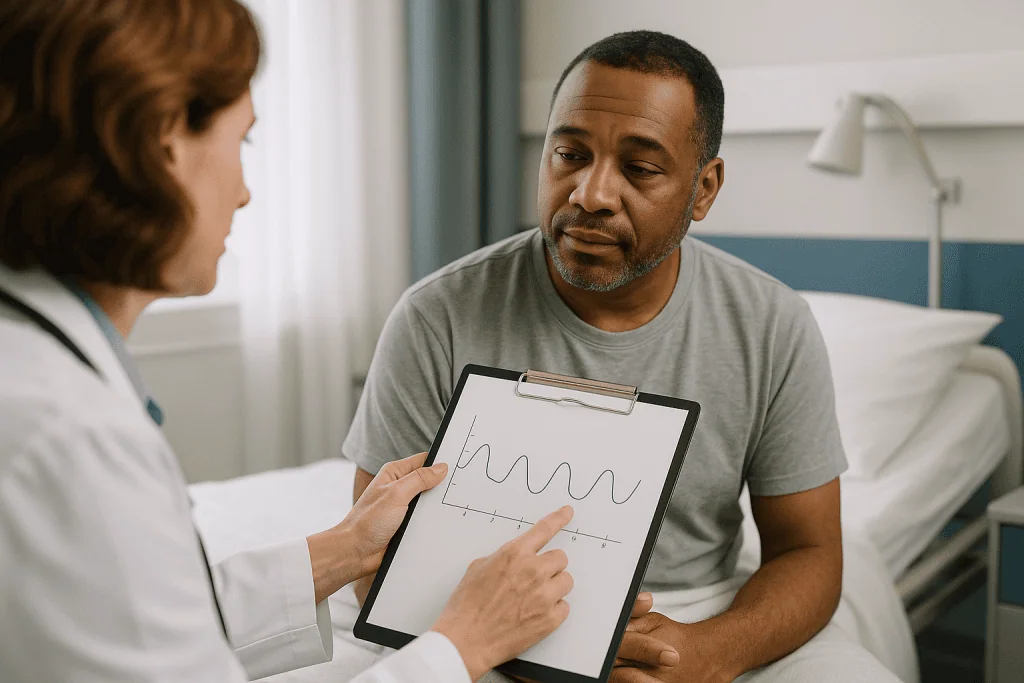
The 90-minute figure is an average across many adults studied in laboratories, where sleep is recorded with electrodes on the scalp, face and chin in a test called polysomnography. In those recordings the first cycle often runs shorter, around 70 to 100 minutes, and later cycles stretch toward 100 to 120 minutes. Between individuals the spread is wider still. A person whose cycles run 80 minutes and a person whose cycles run 110 minutes are both normal, and neither can know their figure from a calculator.
The length also moves night to night inside the same person. Alcohol, fever, jet lag, a late workout, pregnancy and simple sleep debt all reshape the staircase. Children have shorter cycles, roughly 50 to 60 minutes in infancy, lengthening toward the adult pattern through the school years.
This matters because every bedtime calculator assumes a fixed 90 minutes plus a fixed 15 minutes to fall asleep. Change either assumption by ten minutes and the “ideal” wake time drifts by an hour over a night. The sleep cycle is real. The precision is borrowed.
A better mental model: cycles are the rhythm, not the schedule. They tell you what sleep is made of and in what order, which turns out to be the useful part.
The four stages of sleep, and what each one does
Sleep specialists divide the night into four stages: three of non-REM sleep, labelled N1, N2 and N3, and REM. Each has a recognizable brain-wave signature and a distinct job.
N1 is the doorway. Lasting a few minutes, it is the drifting state where a sound still registers and a sudden jerk of the limbs can startle you awake. N2 is the workhorse, occupying close to half of adult sleep. Heart rate and body temperature fall, and the brain produces brief bursts of activity called sleep spindles, which are linked in laboratory studies to filing away new memories. N3 is deep sleep, also called slow-wave sleep because the brain settles into large, slow electrical waves. It is the stage from which you are hardest to rouse, the stage associated with growth hormone release and physical restoration, and the stage most reduced by age.
REM is the strange one. Brain activity looks closer to wakefulness, breathing and heart rate turn irregular, and the body’s skeletal muscles are temporarily switched off, a protective paralysis that stops you acting out dreams.
| Stage | Approximate share of adult night | What the body does | Where it clusters |
|---|---|---|---|
| N1 (light) | About 5% | Muscles relax, easy to wake | Start of night, after awakenings |
| N2 (light) | 45–55% | Temperature and heart rate fall, sleep spindles | Throughout, grows in later cycles |
| N3 (deep) | 15–25% | Slow brain waves, hardest to wake, tissue repair | First third of the night |
| REM | 20–25% | Vivid dreams, muscle paralysis, irregular breathing | Lengthens toward morning |
Those percentages come from polysomnography in healthy adults and are typical ranges, not targets. Nobody needs to hit them on a given night, and no consumer device can confirm whether you did.
How many sleep cycles a night do you need?
Most adults complete four to six cycles across a seven-to-nine-hour night. That arithmetic is where the question usually ends online, but it hides the more useful answer: you do not need to count cycles at all. You need enough total sleep, taken at a reasonably consistent time, for the cycles to sort themselves out.

The reason is that cycle count is a consequence of sleep length, not a separate goal. Give a healthy adult eight hours in a dark, quiet room and the brain will run its four to six cycles without instruction. Cut the night to five hours and it will run three, dropping most of the REM-rich later cycles and some of the lighter N2 sleep that would have filled the morning.
Public health guidance reflects this. The CDC and the American Academy of Sleep Medicine advise adults to sleep at least seven hours a night on a regular basis; the American Heart Association’s Life’s Essential 8 frames 7 to 9 hours as optimal for cardiovascular health. Teenagers are advised 8 to 10 hours, school-age children 9 to 12, and infants far more.
Age reshapes the cycles within that total. Older adults spend less time in deep N3 sleep, wake more often and tend to drift earlier in both bedtime and rising time. The widespread belief that people over 65 “need less sleep” is not supported; the recommended total stays around 7 to 8 hours, but it becomes harder to achieve in one block, and daytime napping often fills the gap.
So the honest count is this: however many cycles fit into enough hours. If you regularly wake unrefreshed after seven or more, the problem is unlikely to be the number of cycles, and more likely to be their quality, which is where the doctor section later in this article comes in.
Why the first half of the night is not the same as the second
If you remember only one fact from this article, make it this one: the night is lopsided. Deep sleep is front-loaded. REM sleep is back-loaded. That single asymmetry explains most of the practical advice that actually holds up.
In the first two cycles, the brain spends long stretches in N3, the slow-wave stage, sometimes 30 to 40 minutes at a time. The first REM period, by contrast, may last only five to ten minutes. By the fourth and fifth cycles the ratio flips: deep sleep nearly disappears, and REM periods can stretch to 30 minutes or more. Laboratory recordings show this pattern so consistently that specialists can often guess the clock time from the stage alone.
Two consequences follow. First, the pressure for deep sleep is the most urgent biological debt, so the brain pays it first; a shortened night sacrifices REM and light sleep disproportionately. Second, the stages people cut most often, by waking early for a flight or a shift, are exactly those REM-heavy morning cycles, which observational and experimental research links to emotional regulation and the consolidation of certain kinds of learning.
Everyday experiences line up with the physiology. The dream you recall at 6:30 a.m. was long because morning REM is long. The disoriented confusion of being woken at 1 a.m. by a phone call is deep sleep speaking. The second-half restlessness after a few drinks reflects alcohol suppressing REM early and the brain rebounding later.
This is also why going to bed earlier and rising later are not interchangeable fixes. An extra hour at the start of the night mostly adds deep sleep in someone already sleep-deprived; an extra hour at the end mostly adds REM. Both matter. Neither can be swapped for a cleverly timed alarm.
Does a 90 minute sleep cycle alarm help you wake up refreshed?
The claim behind every sleep calculator and smart alarm is that waking at a cycle boundary, in light sleep, avoids the fog that follows waking from deep sleep. Half of that is well supported. The other half is not.
The well-supported half is sleep inertia: the period of grogginess, slowed reaction time and poor judgement that follows waking. Sleep inertia is worse after abrupt waking from N3 deep sleep, worse when you are sleep-deprived, and worse in the early part of the night. Most people clear it within 15 to 30 minutes, though laboratory tests of alertness can detect lingering effects for an hour or more, and emergency workers and pilots are studied precisely because of this window. Waking from light N2 or from REM is, on average, gentler.
The weak half is the claim that an alarm set by a calculator or a wrist sensor can reliably find that boundary. The calculator assumes a fixed cycle length and a fixed time to fall asleep, both of which vary by tens of minutes. The wearable infers stage from movement and heart rate, and when compared with polysomnography these devices identify total sleep time reasonably well but misclassify individual stages a substantial share of the time. Several small randomized and crossover studies of smart alarms have found modest or inconsistent improvements in self-reported alertness, and few have measured performance objectively.
What does reduce sleep inertia with stronger support? Getting enough sleep in the first place, since a rested brain spends little of the early morning in deep sleep anyway; a consistent wake time, which trains the body’s internal clock to begin lightening sleep before the alarm; and bright light soon after rising.
Timing your alarm to the sleep cycle is a harmless experiment if it does not shorten your night. It becomes counterproductive when a calculator tells someone that 4.5 hours is “three full cycles” and therefore fine. It is not fine, and the next sections explain why.
What the evidence actually says about the sleep cycle
Not every claim in this article carries the same weight, so here is the grading, in rough order of strength.
The existence and sequence of the four stages, the roughly 90-to-120-minute cycle and the front-loading of deep sleep rest on decades of polysomnography in sleep laboratories around the world. This is settled descriptive science, as close to certain as physiology gets.
The link between short sleep and poor health is strong but largely observational. Large cohort studies followed for years consistently find that adults sleeping under seven hours have higher rates of obesity, type 2 diabetes, high blood pressure, coronary disease, depression and all-cause mortality. Observational studies cannot prove that short sleep causes these outcomes, since illness also disrupts sleep. Smaller controlled experiments that restrict sleep for days do show measurable rises in blood pressure, insulin resistance and appetite hormones, which strengthens the case for a causal contribution.
The cognitive effects of a single night of lost sleep are backed by randomized, controlled laboratory experiments and are among the most replicated findings in the field: slower reaction time, more attention lapses, poorer memory encoding and impaired judgement, with the person often unaware of the deficit.
Sleep inertia being worse after waking from deep sleep is supported by controlled experiments, though mostly in small samples.
Smart alarms and cycle-timed waking improving how you feel in the morning rest on a handful of small trials with mixed results. This is weak evidence, and the strongest commercial claims go well beyond it.
Finally, the idea that sleep accomplishes specific jobs in specific stages, memory in N2 and REM, physical repair in N3, is supported by animal work and human experiments but is still an active research area; the tidy stage-by-stage job descriptions in popular articles are simplifications of a more tangled picture.
Why am I waking up every 2 hours?
Waking two or three times a night surprises people, but polysomnography shows that healthy adults surface briefly, for a few seconds to a few minutes, at the end of many cycles. Most of those awakenings are forgotten by morning. The pattern becomes a problem when you are awake long enough to notice, check the clock and struggle to drift back.
Common, ordinary reasons come first. Alcohol is sedating early and fragmenting later; as it is metabolized the brain rebounds, often around the two-to-three-hour mark. Caffeine has a half-life of roughly five to six hours, so an afternoon coffee is still half active at bedtime. A bedroom that warms up overnight, a partner who snores, a pet, a streetlight and a phone that lights up all pull sleep into its lighter stages, where awakenings are more likely. A full bladder is a frequent culprit, and an evening fluid habit or a prostate or bladder condition can turn one trip into three.
Medical reasons deserve more attention. Obstructive sleep apnea, in which the airway repeatedly narrows during sleep, produces dozens of micro-awakenings an hour that the sleeper may experience only as unrefreshing sleep or a few remembered gasps. Acid reflux worsens lying flat. Chronic pain, restless legs, an overactive thyroid, asthma, heart failure and the hot flashes of menopause all fragment the night. Anxiety and depression are associated with early-morning waking in particular, and the frustration of lying awake can itself become a conditioned trigger, which is how short-term insomnia turns chronic.
Age changes the baseline too: lighter sleep and more awakenings after 60 are expected, not a disease.
A practical first step is a two-week sleep diary noting bedtime, awakenings, alcohol, caffeine and how you felt by day. It often reveals the pattern before any test does, and it is exactly what a clinician will ask for.
What happens if you only get 3 hours of sleep for one night?
A single three-hour night is survivable, and the body is remarkably good at prioritizing. In a night that short the brain runs roughly two cycles and spends an unusually high share of them in deep N3 sleep, protecting the stage it treats as most urgent. What gets cut is nearly all the REM and much of the N2 that would have filled hours four through eight.
The next day feels the way the research describes. Controlled laboratory studies that restrict adults to around three to four hours produce measurable slowing of reaction time, more frequent lapses of attention lasting a few seconds, impaired working memory and a worse ability to judge one’s own impairment. Mood is flatter and more irritable, and the emotional centers of the brain respond more strongly to negative images in brain-imaging experiments. Appetite hormones shift toward hunger, and glucose handling is slightly worse even after one night.
The comparison that public health agencies use most often comes from studies of extended wakefulness: being awake for around 17 to 19 hours impairs driving performance to a degree comparable with being at or near the legal alcohol limit in many countries. Someone who slept three hours and then drives home at 10 p.m. is in that territory.
Recovery is fast if the night is a one-off. The following night the brain rebounds, with more deep sleep and more REM than usual, and most measurable deficits resolve within a day or two. The long-term health associations described earlier belong to chronic short sleep, not a single bad night before an exam or a flight.
The one caution: the feeling of being fine is not reliable. People consistently underestimate their own impairment after a short night. If a drive is unavoidable, treat yourself as impaired, not as someone who “got through it.”
Signs of sleep deprivation that are easy to miss
The obvious sign is sleepiness, but the most common signs of sleep deprivation hide behind other explanations. Many chronically short sleepers have adapted to feeling average and would describe themselves as “not a morning person” rather than tired.
Daytime signals include falling asleep within minutes of lying down, which sleep specialists regard as a marker of sleep debt rather than a talent; dozing during passive activities such as reading, watching television or sitting as a passenger; and needing an alarm, then a second alarm, every day. The CDC lists difficulty concentrating, forgetfulness, slowed reaction time and reduced performance at work or school among the direct consequences of insufficient sleep. Microsleeps, lapses of a few seconds in which the eyes may stay open, are the most dangerous form and are a recognized cause of road crashes.
Emotional signals are subtler. Irritability, a shorter fuse, feeling easily overwhelmed and a flatter, less motivated mood are all reported in sleep-restriction experiments and in population surveys. Because these overlap with depression and anxiety, and because short sleep and mood disorders feed each other, the two often travel together.
Physical signals include heavier appetite, especially for high-energy foods, more frequent minor infections, puffiness around the eyes and headaches on waking. The weekend pattern is a tell: regularly sleeping two or more hours longer on days off suggests a weekday deficit that the body is trying to repay.
Then there is the paradox: some severely sleep-deprived people report feeling wired, not tired. Stress hormones rise with sleep loss and can mask fatigue until a quiet moment arrives. If you recognize three or four of these patterns and cannot explain them another way, a week of protected, longer nights is a reasonable, low-risk way to test whether sleep is the missing variable.
Can a wearable or app really track your sleep cycle?
Consumer sleep trackers work by inference. A wrist device records movement and, in most models, heart rate and its beat-to-beat variability; a phone app on the mattress records movement and sound. Software then guesses the stage from those signals. The gold standard they are imitating, polysomnography, records brain waves, eye movements, muscle tone, breathing and oxygen directly.
When researchers put both on the same sleepers, a consistent picture emerges. Trackers estimate total sleep time and the clock time of falling asleep fairly well, though they tend to count quiet wakefulness as sleep. They are far less reliable at the stages themselves, with studies finding they correctly label deep and REM sleep only around half to two-thirds of the time, depending on the device and the population. Night-to-night trends in one person are more trustworthy than any single night’s pie chart.
That accuracy profile has a practical upshot. A tracker can show you that you averaged six hours and ten minutes last month and went to bed an hour later on Fridays, which is genuinely useful. It cannot tell you that you had “only 38 minutes of deep sleep” with any confidence, and a smart alarm built on that stage estimate is working from a shaky foundation.
Sleep specialists have coined a term, orthosomnia, for the anxiety that develops when people chase perfect tracker scores and lie awake worrying about them. Several clinics now ask patients to take the device off for a while, because the worry itself is fragmenting the night.
None of this makes wearables useless. They are good diaries. Treat the stage breakdown as weather forecasting rather than a laboratory report, and if the device is keeping you up, that is a result in itself.
How to fix your sleep schedule without gimmicks
Resetting a drifting sleep schedule is less about bedtime and more about the body’s internal clock, the roughly 24-hour circadian rhythm that governs when you feel sleepy and alert. That clock is set mainly by light, and it responds to consistency more than to effort.
Anchor the morning first. A fixed wake time, within about 30 minutes seven days a week, is the single most effective lever, because it determines when the clock starts counting toward the next night’s sleepiness. Get outdoor light within an hour of waking; even an overcast sky is many times brighter than indoor lighting, and that signal advances the clock.
Move bedtime gradually. Shifting by 15 to 30 minutes every few nights lets sleep pressure build naturally. Going to bed two hours early in one jump usually produces lying awake, which teaches the brain to associate bed with wakefulness.
Protect the evening from the two things most likely to fragment the second half of the night: alcohol within three hours of bed, and caffeine after early afternoon. Keep the bedroom cool, dark and quiet, and keep screens out of the last 30 to 60 minutes, less because of blue light, where the evidence is modest, than because of the alerting content.
If you cannot fall asleep within about 20 minutes, the NHS and most sleep clinics advise getting up, doing something quiet in dim light and returning when sleepy. It feels counterintuitive and it works, because it preserves the bed-sleep association.
For persistent insomnia, the first-line treatment recommended by the NHS and major sleep societies is cognitive behavioral therapy for insomnia, a structured program that retrains sleep habits and the thoughts around them. Randomized trials show it outperforms sleep hygiene alone and produces benefits that last after the program ends. Sleep medicines have a place for some people, and that decision, including starting, changing or stopping one, belongs with your prescribing clinician.
Common myths about the sleep cycle, corrected
The viral version of sleep science travels faster than the careful one. Here are the claims that circulate most, and what the evidence supports instead.
“Everyone’s sleep cycle is exactly 90 minutes.” Ninety is a population average. Individual cycles range from roughly 70 to 120 minutes, lengthen through the night and vary with age, alcohol and sleep debt.
“Four and a half hours is three full cycles, so it counts as a complete sleep.” Three cycles contain most of the night’s deep sleep but little of its REM and N2 sleep. Controlled experiments show clear cognitive impairment after nights of that length, however neatly they divide.
“Waking at the wrong time ruins the whole night.” Waking from deep sleep causes temporary grogginess, usually clearing within 30 minutes. It does not erase the restoration that already happened.
“You only dream in REM.” Dreams are most vivid and narrative in REM, but people woken from non-REM sleep report dream-like thoughts as well.
“Older people need less sleep.” They tend to get less, in lighter and more fragmented form, but the recommended total stays around 7 to 8 hours.
“A nightcap helps you sleep.” Alcohol shortens the time to fall asleep and then fragments the second half of the night, suppressing REM early and triggering rebound awakenings.
“Snoring is harmless if you feel fine.” Loud, regular snoring with pauses or gasps is the classic presentation of obstructive sleep apnea, which is associated with high blood pressure, heart disease and stroke in large observational studies and is treatable once identified.
“Lost sleep can be fully repaid on the weekend.” Catch-up sleep restores alertness and is better than none, but the metabolic effects measured during sleep-restriction experiments do not fully reverse after two long nights, and the schedule swing itself disrupts the circadian clock.
When to see a doctor about your sleep
Most tired weeks have ordinary explanations and improve with the basics above. Some patterns do not, and they deserve a clinician’s attention rather than another calculator.
Seek medical advice if you notice any of these red flags:
- Loud snoring with pauses in breathing, choking or gasping reported by a partner, or waking with a dry mouth and morning headaches: these are hallmark features of obstructive sleep apnea.
- Falling asleep unintentionally during the day, especially while driving, in meetings or mid-conversation.
- Trouble falling or staying asleep at least three nights a week for three months or more, with daytime consequences: this meets the definition of chronic insomnia.
- Sudden muscle weakness triggered by laughter or strong emotion, or vivid hallucinations while falling asleep, which can indicate narcolepsy.
- Physically acting out dreams, shouting or striking out during sleep.
- An irresistible urge to move the legs in the evening, relieved by movement, suggesting restless legs syndrome.
- Chest pain, breathlessness or a racing heart that wakes you.
- Persistent low mood, loss of interest or thoughts of self-harm alongside the sleep change.
Seek urgent care the same day for chest pain, severe shortness of breath or confusion on waking that does not clear.
At the appointment, bring a two-week sleep diary and any tracker trends. Expect questions about medicines, alcohol, caffeine, mood, pain and shift work, and possibly a referral for a home sleep test or an overnight polysomnography study. If you already take a medicine that affects sleep, including sleeping tablets, antidepressants, antihistamines or stimulants, do not stop, start or change it on your own. Every decision about treatment belongs with your prescribing clinician, who can weigh your history and the test results together.
Frequently asked questions
How many sleep cycles a night is normal?
Most adults complete four to six sleep cycles in a seven-to-nine-hour night. The number is a result of how long you sleep, not a separate target, so the practical goal is enough total hours at a consistent time. A short night of five hours yields about three cycles and drops most of the REM-rich morning sleep that would have followed.
What are the signs of sleep deprivation?
The clearest signs are falling asleep within minutes of lying down, dozing during passive activities such as reading or riding as a passenger, needing repeated alarms and sleeping much longer on days off. Less obvious signs include irritability, trouble concentrating, forgetfulness, stronger appetite and a flatter mood. People consistently underestimate their own impairment, so the pattern matters more than how you feel.
What are the possible reasons for waking up every 2 hours?
Brief awakenings at the end of cycles are normal, but noticing them every two hours often points to alcohol wearing off, late caffeine, a warm or noisy bedroom, a full bladder or stress. Medical causes include obstructive sleep apnea, acid reflux, chronic pain, restless legs, thyroid problems, menopause hot flashes and depression. A two-week sleep diary usually reveals the pattern and is what a clinician will ask for.
What happens if you only get 3 hours of sleep for one night?
One three-hour night produces about two cycles heavy in deep sleep and almost no REM. The next day brings slower reaction time, attention lapses, poorer memory and irritability, with impairment comparable to being near the legal alcohol limit if you have been awake 17 hours or more. Most deficits resolve after a night or two of normal sleep; the long-term health risks belong to chronic short sleep.
Is it bad to wake up during deep sleep?
It is unpleasant rather than harmful. Waking abruptly from deep N3 sleep causes sleep inertia, a groggy, disoriented state with slowed thinking that usually clears within 15 to 30 minutes, though alertness tests can detect effects for longer. It does not erase the restoration already completed. Getting enough sleep and keeping a fixed wake time reduce how much deep sleep remains in the early morning.
Is a 90 minute sleep cycle alarm worth using?
It is a harmless experiment as long as it never shortens your night. The physiology behind it, that waking from light sleep feels gentler than waking from deep sleep, is sound, but calculators assume a fixed cycle length and wearables misjudge stages often, so the alarm cannot reliably find the boundary. Small trials of smart alarms show modest, inconsistent benefits. Consistent wake times have stronger support.
What are the stages of sleep in order?
Each cycle moves from N1, a few minutes of drifting light sleep, into N2, the stage that fills about half the night, then into N3 deep slow-wave sleep, and finally into REM, the dreaming stage with rapid eye movements and temporary muscle paralysis. Early cycles are dominated by deep sleep; later cycles are dominated by REM, which lengthens toward morning.
Do older adults need less sleep?
No. Adults over 65 are still advised around 7 to 8 hours, but age changes the architecture of sleep: less deep N3 sleep, more awakenings and an earlier drift in both bedtime and rising time. Many older adults get their total across a shorter night plus a daytime nap. Persistent unrefreshing sleep at any age is worth discussing with a clinician rather than attributing to aging.
Does alcohol change your sleep cycles?
Yes, in a two-phase way. Alcohol shortens the time to fall asleep and deepens the first part of the night, then as it is metabolized the brain rebounds, suppressing REM early and producing lighter, fragmented sleep with more awakenings in the second half. That is why a nightcap often feels helpful at 11 p.m. and unhelpful at 3 a.m.
Can you catch up on sleep at the weekend?
Partly. Longer weekend nights restore alertness and are better than staying short, but sleep-restriction experiments show that measures such as insulin sensitivity do not fully recover after two long nights, and swinging bedtimes by several hours disrupts the circadian clock, making Monday harder. A steadier schedule across all seven days is more effective than alternating deficit and repayment.
References
- Brain Basics: Understanding Sleep, National Institute of Neurological Disorders and Stroke (NIH)
- Healthy Sleep, MedlinePlus
- About Sleep, Centers for Disease Control and Prevention
- Insomnia, NHS
This article is for general information only and is not a substitute for professional medical advice. Please consult a qualified doctor about your individual situation.

More from the Blog
Is 7 Hours of Sleep Enough? What the Research Says About the Minimum That Protects Health
For most healthy adults, yes: seven hours of actual sleep a night is the minimum that major sleep medicine and public health bodies recommend,…
What Causes Lack of Sleep? The Medical, Hormonal and Lifestyle Reasons, Sorted
Lack of sleep usually has more than one cause. Doctors sort them into medical conditions (pain, reflux, sleep apnea, restless legs, thyroid disease), mental…
How Much REM Sleep Do You Need? What the Numbers on Your Tracker Mean
Most healthy adults spend about 20 to 25 percent of the night in REM sleep, which works out to roughly 90 to 120 minutes…
Weighted Blankets: What Trials Show for Sleep and Anxiety-Related Restlessness
A weighted blanket applies gentle, evenly spread pressure across the body, and the best available evidence suggests it can modestly ease insomnia symptoms and…
Sleep Inertia: Why You Wake Up Groggy and How to Shorten It
Sleep inertia is the temporary grogginess, slowed thinking, and disorientation many people feel right after waking. It typically fades within 15 to 60 minutes,…
Why Can’t I Sleep? A Checklist for Racing-Mind Nights
Most sleepless nights trace back to an overactive stress response, a state researchers call hyperarousal, often layered on top of practical triggers like late…