

Splint vs Physiotherapy for TMJ: How the Two Treatments Work Together
Key Takeaways
- TMD, the condition people call "TMJ," affects an estimated 5 to 12 percent of people and is most often a chewing-muscle problem, with disc or joint problems in a smaller group, according to NIH research.
- A stabilization splint manages nighttime clenching load on teeth and muscles; the NIH notes its mechanism is uncertain and any appliance that changes the bite or worsens pain should be stopped.
- Physiotherapy for the jaw targets daytime muscle tension, restricted opening, posture and habits, with active home exercise the best-supported element.
- The two treatments address different hours of the same 24-hour problem, which is why clinicians often combine them rather than choosing one.
- The NIH advises against irreversible bite changes such as grinding down teeth or orthodontics undertaken solely for TMD, because evidence does not support them.
- Painless clicking usually needs no treatment, and jaw pain that comes with chest discomfort or exertion is an emergency, not a dental issue.
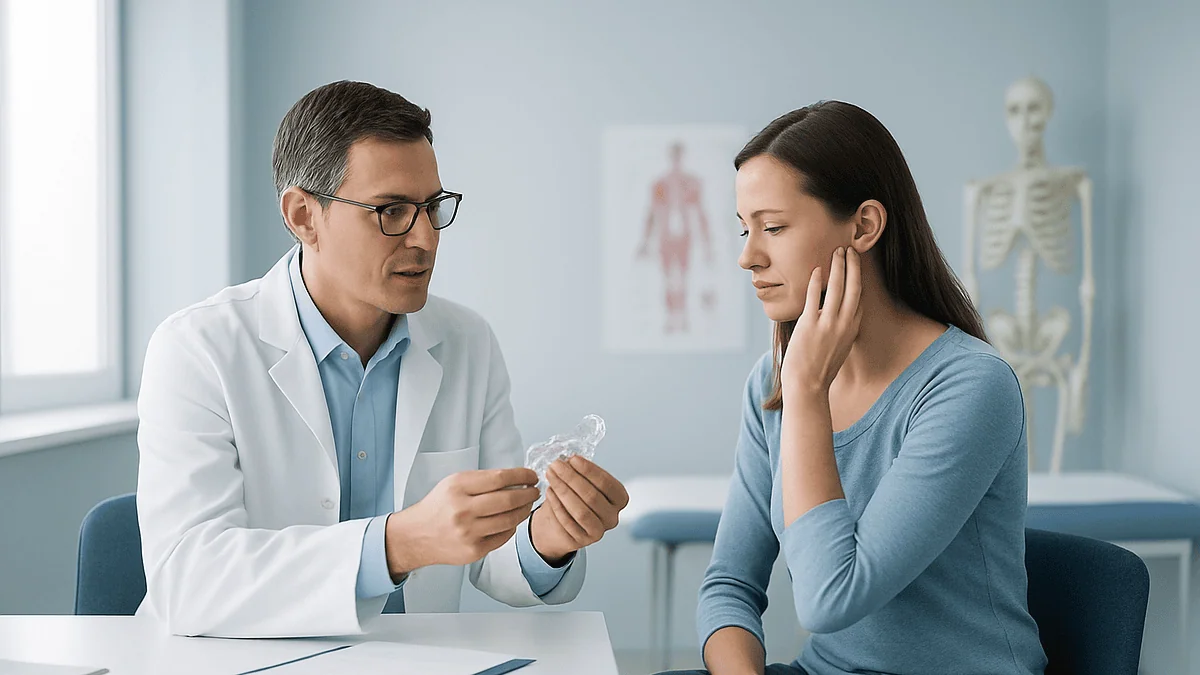
A TMJ splint and physiotherapy are not rivals; they address different parts of the same problem. A splint is a removable dental appliance that reduces tooth contact and clenching load, mainly at night. Physiotherapy retrains jaw and neck muscles, improves opening, and tackles daytime habits. Guidance from the NHS and NIH favors reversible, conservative care, and many clinicians combine both, with the plan decided by your treating team.
The dentist slides a mirror along the jawline, asks you to open wide, and the click arrives on cue, loud enough that you both pretend not to notice. Then come two suggestions in one breath: a night splint from the dental lab, and a referral to a physiotherapist who “does jaws.” You leave with a form in each hand and one question that nobody quite answered. Which one actually matters?
Search for tmj splint vs physiotherapy and you will find camps. Some pages promise that a custom appliance settles everything; others insist the real fix is exercise and posture. The honest picture, drawn from guidance published by the NHS, the NIH’s dental research institute, Mayo Clinic and Cleveland Clinic, is less tidy and more useful.
Jaw joint disorders are mostly a muscle-and-habit story, with a joint story layered on top. A splint speaks to one layer, physiotherapy to the other. This explainer walks through what each does, what the evidence genuinely supports, and how a care team decides when to use one, the other, or both.
What "TMJ" really means, and why the label muddles treatment choices
Strictly, TMJ is an anatomical address: the temporomandibular joint, the hinge just in front of each ear where the lower jaw meets the skull. Everyone has two of them. The condition people mean when they say “I have TMJ” is properly called temporomandibular disorder, or TMD, an umbrella term for pain and dysfunction in the joint, the chewing muscles, or both. The NIH’s National Institute of Dental and Craniofacial Research estimates TMD affects roughly 5 to 12 percent of the population, with women affected more often than men.
That umbrella matters because it hides three fairly different problems. Myofascial pain is soreness in the muscles that close the jaw, often the masseter at the angle of the jaw and the temporalis at the temple. Internal derangement means something mechanical inside the joint, most commonly the cartilage disc sitting slightly off its track, which produces the click or, in some people, a jaw that catches. Degenerative joint disease is wear within the joint surfaces, more common with age.
Most people with TMD have the first type, sometimes mixed with the second. This is the single most important fact in the splint-versus-physiotherapy debate, because a muscle problem and a disc problem do not respond to the same lever. A splint changes what the teeth and muscles do during clenching. Physiotherapy changes how the muscles and joint move through the day. Knowing which layer dominates in your jaw is the job of the assessing clinician, and it shapes everything that follows.
One reassurance belongs up front. Both the NHS and Mayo Clinic describe TMD as a condition that often settles on its own, or with simple measures, and the NIH guidance explicitly steers people toward reversible treatments first. Nothing in this article is a case for rushing.
How a TMJ splint works: what actually happens in your mouth
A splint, also called an occlusal splint, stabilization appliance, or bite guard, is a removable plate, usually made of hard acrylic, that sits over the upper or lower teeth. A dentist takes an impression, a laboratory shapes the plate, and it is adjusted in the chair so that the teeth meet it evenly. It is typically worn at night, sometimes for part of the day, and it is designed to be taken out, not fixed in place.

Three mechanisms are commonly proposed. First, the plate spreads bite forces across a flat surface, so that clenching no longer drives a few teeth hard against each other. Second, by adding a few millimeters of thickness between the teeth, it slightly changes the resting length of the jaw-closing muscles, which many patients and clinicians report as a reduction in morning stiffness. Third, the unfamiliar object may interrupt the automatic clench-and-grind reflex during sleep, acting as a kind of behavioral reminder.
Mayo Clinic is candid that although many people with jaw pain report benefit from a firm or soft device over the teeth, the reasons are not well understood. The NIH research institute goes further, noting that evidence for splints is mixed and that any appliance should be reversible, should not permanently change the bite, and should be stopped if it increases pain. That caveat separates a stabilization splint from so-called repositioning appliances designed to pull the jaw forward, which the NIH warns can cause lasting bite changes.
A splint, then, is a load-management tool for the hours you cannot control, chiefly sleep. It does nothing for the way you hold your jaw at a desk, the way your neck sits over a phone, or the habit of resting your teeth together while concentrating. Those are physiotherapy’s territory.
Is TMJ physiotherapy a real treatment, and what does it involve?
People ask “is TMJ physiotherapy?” partly because the phrase sounds like a brand. It is simply physiotherapy applied to the jaw and the structures that work with it: the chewing muscles, the joint capsule, and the neck and upper back, which share nerve pathways and posture with the jaw. Mayo Clinic, Cleveland Clinic and MedlinePlus all list physical therapy among standard conservative options for TMD.
A first session usually looks like detective work before it looks like treatment. The therapist measures how far the mouth opens, watches whether the jaw drifts to one side, feels the masseter and temporalis for tender bands, and checks neck movement and head posture. Many people are surprised when a jaw appointment spends ten minutes on the shoulders, but forward head posture pulls the jaw into a slightly open, muscle-loaded position all day long.
The treatment itself draws on a few families of techniques:
- Education and habit change: teaching the resting position of lips together, teeth apart, tongue on the palate, and spotting daytime clenching triggers.
- Exercises: gentle controlled opening, side-to-side glides, and strengthening of the muscles that open the mouth to balance the stronger closers.
- Manual therapy: hands-on release of tight muscle inside and outside the cheek, and gentle joint mobilization.
- Posture and neck work: addressing the upper cervical spine and shoulder girdle.
- Adjuncts such as heat, ice, or in some clinics ultrasound or laser, which the NIH describes as having limited evidence.
The emphasis is on active, self-managed care. A good program sends you home with a short routine rather than making you dependent on weekly hands-on sessions. That design is the main reason physiotherapy pairs so naturally with a splint: one covers the night, the other covers the waking day.
TMJ splint vs physiotherapy: what the evidence honestly shows
Here is the uncomfortable truth that top-ranking pages tend to skip: neither treatment has the kind of large, decisive trial evidence that, say, blood pressure medicines enjoy. The NIH’s dental research institute states plainly that scientific evidence for most TMD treatments is limited, and that this is precisely why reversible, conservative measures should come first.

What the mainstream sources do agree on can be summarized in a few lines. Splints are widely used and many patients report relief, especially those with nighttime grinding, but the mechanism is uncertain and studies show inconsistent results. Physiotherapy, including exercise, manual therapy and education, is recommended by Mayo Clinic and Cleveland Clinic as a core conservative option, with the strongest support for active exercise and self-management rather than passive gadgets. Both are considered low-risk when delivered appropriately.
Why do trials struggle to crown a winner? TMD is a moving target. The NHS notes that symptoms often ease on their own over time, which means any treatment tested over a few months looks good against the starting point. Patient groups are mixed, muscle pain alongside disc problems. And both treatments carry a sizeable expectation effect, which is real relief but hard to attribute.
So the fair reading of tmj splint vs physiotherapy is not “which is better” but “which problem is this, and which tool fits it.” A muscle-dominant TMD with daytime clenching leans toward physiotherapy and habit work. A night grinder with worn teeth and morning ache leans toward a splint. Most people sit somewhere between, which is why combined care is so common in practice. Your treating team weighs the pattern in front of them, not the average of a study population.
Who is usually offered a splint, who gets physiotherapy, and who is asked to wait
Clinicians rarely reach for either treatment on day one. The NHS advises a period of simple self-care first: softer foods, avoiding wide yawns and chewing gum, warmth over the jaw, and gentle rest. Mayo Clinic adds that in most cases TMD discomfort is temporary. Being asked to wait a few weeks is not dismissal; it is the first-line treatment, and it also lets the clinician see whether the problem is settling, stable or escalating.
A splint tends to enter the picture when:
- There are signs of nighttime grinding or clenching, such as worn enamel, a partner who hears grinding, or pain and stiffness worst on waking.
- Pain is persistent despite several weeks of self-care.
- The dentist wants to protect teeth and dental work from grinding load while other treatment proceeds.
Physiotherapy tends to be suggested when:
- Opening is restricted, or the jaw deviates to one side.
- Pain is clearly muscular, worsening through the workday or with stress.
- Neck pain, headache or posture issues travel with the jaw pain.
- The patient wants an active plan and is willing to practice exercises daily.
Some people are asked to pause or be assessed differently before either route. A jaw that locks closed or will not open, a joint swollen and hot, pain following an injury, or symptoms alongside unexplained weight loss, fever or numbness all warrant a medical review to rule out something other than ordinary TMD. People with significant tooth mobility or active dental disease may need that addressed before a splint is fitted. And anyone whose jaw pain radiates with exertion or is accompanied by chest discomfort needs urgent assessment, because jaw pain can occasionally signal a heart problem.
The decision about sequence and combination sits with your dentist, physician or oral medicine specialist, informed by the pattern in your particular jaw.
Splint vs physiotherapy for TMJ at a glance
A side-by-side view clarifies why the two are so often paired rather than pitted against each other. Each column answers a different question: what is being loaded, and when.
| Feature | Stabilization splint | Physiotherapy |
|---|---|---|
| Main target | Nighttime clenching and grinding load on teeth, muscles and joint | Daytime muscle tension, restricted movement, posture and habits |
| What it changes | Tooth contact, bite force distribution, muscle resting length during sleep | Muscle flexibility and control, joint mobility, neck alignment, awareness |
| Who delivers it | Dentist, with laboratory fabrication and chairside adjustment | Physiotherapist, sometimes with a dentist or oral medicine specialist |
| Patient role | Wear as instructed, attend adjustment visits, report any bite change | Daily home exercises, habit monitoring, posture changes |
| Reversibility | Reversible if a stabilization design is used and bite is monitored | Fully reversible |
| Evidence picture (NIH, Mayo) | Many report benefit; mechanism uncertain; study results mixed | Supported as core conservative care; active exercise best supported |
| Typical limitation | Does nothing for waking-hour habits or neck contribution | Cannot protect teeth from grinding during sleep |
Two observations follow. Neither column promises a permanent result, because the sources behind them do not. And the “typical limitation” row is the whole argument for combination: the blind spot of each is the strength of the other.
One caution on the table’s first column. It describes a flat stabilization splint. Soft, over-the-counter sports guards and online “night guards” are a different object; some clinicians find they encourage chewing on the material and increase clenching in certain patients. The NHS mentions mouth guards as something a dentist may provide, which is the safer route, since fit and bite can be checked.
How a splint and physiotherapy work together in a combined plan
Picture a 24-hour clock. Roughly eight hours belong to sleep, when the jaw is governed by reflex and you cannot intervene with awareness. The other sixteen are waking hours, when the jaw is governed by habit, posture and stress, and awareness is exactly the tool you have. A combined plan simply assigns the right tool to the right hours.
At night, the splint sits in. It cannot stop the grinding reflex, but it can distribute the force and protect enamel while the muscles are, over weeks, being taught a lower baseline tension by day. By day, the physiotherapy program takes over: the resting-position cue, the opening exercises, the hourly check on whether the teeth are touching, the chin tucks for neck posture, warmth on the masseter in the evening.
The pairing is not just additive; the two inform each other. A physiotherapist who notices that opening improves but morning pain persists will flag that nighttime load is unaddressed, nudging the dentist toward a splint. A dentist who sees a splint relieving morning stiffness but doing nothing for afternoon ache will send the patient toward daytime habit work. Each treatment makes the other’s gap visible.
Communication between the two professionals is the quiet ingredient. Ask whether your dentist and physiotherapist will share notes, or at least whether you can carry a simple written summary between them. A plan where each knows what the other is doing avoids duplicated advice and contradictory instructions about, for example, how wide to practice opening.
None of this is mandatory. Plenty of people improve with physiotherapy alone, and plenty with a splint alone, and the NHS reminds readers that many improve with neither. The combined route is for those whose pattern straddles night and day, and the treating team decides when that applies.
What the first days and weeks of treatment usually look like
The first week with a splint is mostly about strangeness. The plate feels enormous, speech is thick for the first evening or two, and saliva increases. Most people adapt within a few nights. Some wake with the jaw feeling oddly loose, which usually passes. What should not happen is a change in how the teeth meet when the splint is out, or a sharp increase in pain; the NIH guidance is explicit that an appliance causing either should be stopped and reviewed.
Physiotherapy begins gently. The home routine is typically short, a few minutes several times a day, because frequency matters more than intensity for muscle re-education. Early sessions may bring mild soreness, the ordinary ache of muscles doing new work. Tender spots in the cheek may feel sharper for a day after manual release.
Timeframes are honest ranges, not promises. Mayo Clinic describes TMD discomfort as temporary in most cases, and the NHS says symptoms often improve over time with simple measures. Clinicians commonly review splints after a few weeks for adjustment and reassess physiotherapy progress within a similar window. Improvement in these conditions tends to arrive as fewer bad days rather than a single switch flipping, which is why a simple pain-and-clicking diary across the first month is so useful.
Expect plateaus. Stress, a dental procedure that required a long open mouth, or a poor week of sleep can knock progress back. That is not failure of the treatment; it is information about triggers, and it belongs in the conversation at your next review. If nothing has shifted by the agreed review point, the care team may revisit the diagnosis, change the splint design, adjust the exercise plan, or consider other conservative options before anything more invasive is discussed.
Can stress cause TMJ? The clench-and-tension loop explained
Yes, with a precise wording: stress does not create the joint, but it is one of the best-recognized drivers of the muscle tension and clenching that produce TMD symptoms. Mayo Clinic, Cleveland Clinic and the NHS all list stress, along with jaw clenching and teeth grinding, among the recognized contributors. Johns Hopkins notes the same link.
The mechanism is worth understanding because it points directly at treatment. Under stress, the body’s threat response raises baseline muscle tone, and the jaw closers are among the most powerful muscles for their size. Many people respond to concentration or anxiety by holding the teeth lightly together, often without noticing. Held for hours, that light contact becomes sustained isometric work for the masseter and temporalis, which fatigue, develop tender bands, and begin to refer pain toward the ear, temple and teeth.
Then the loop closes. Jaw pain is itself stressful, disturbs sleep, and poor sleep lowers pain thresholds and increases nighttime grinding. The NHS highlights that poor sleep and stress can worsen symptoms, which is why its self-care advice includes relaxation and sleep hygiene rather than just jaw rest.
This is where the two treatments divide the work. Physiotherapy addresses the daytime half of the loop through awareness training, the lips-together-teeth-apart cue, and breathing or posture techniques that lower overall muscle tone. The splint addresses the nighttime half by protecting teeth and spreading force when conscious control is off. Cleveland Clinic also lists cognitive behavioral approaches and stress management among options for persistent cases, delivered by appropriate professionals.
A fair caveat: not all TMD is stress-driven. Injury, joint disease and some systemic conditions play a role for some people, which is why a clinician’s assessment, not a stress questionnaire alone, decides the direction of care.
What is the 3 finger test for TMJ, and what it can and cannot tell you
The three-finger test is a rough, self-administered gauge of mouth opening that clinicians sometimes describe to patients. You stack the index, middle and ring fingers of one hand vertically, knuckles together, and see whether that stack fits between the upper and lower front teeth when the mouth is fully open. Comfortably fitting three fingers is taken as a sign that opening is within an ordinary range; fitting only one or two suggests restriction worth mentioning to a dentist or physiotherapist.
Its appeal is obvious. It needs no equipment, and finger width scales roughly with body size, so it is a self-referenced measure. Physiotherapists use a related idea when they track opening at each visit, though they measure in millimeters with a ruler for precision.
Its limits are just as real, and this is where an honest explainer parts company with social media. The test does not diagnose TMD. Plenty of people with significant muscle pain open fully, and some people with restricted opening have no jaw disorder at all. It says nothing about clicking, locking, which muscles are tender, or whether the neck is contributing. It cannot distinguish muscle restriction from a disc problem. And forcing the jaw open to pass the test can aggravate an irritated joint.
Used well, it is a tracking tool rather than a diagnostic one. Checking it once a week during treatment, gently and without pushing, gives you and your care team a simple marker of whether physiotherapy is improving range. Used badly, it becomes a reason to self-diagnose from a video. If your opening is restricted, or restriction appeared suddenly, the next step is an examination by a dentist, physician or physiotherapist, who will assess the whole picture rather than one measurement.
Will a splint fix my TMJ? What people often get wrong
The most common misunderstanding is right there in the question. A splint manages load; it does not repair a joint or retrain a habit, and nothing in the NIH, NHS or Mayo Clinic guidance presents it as a permanent solution. For many people it reduces symptoms, particularly morning pain tied to grinding, and that is a worthwhile goal. Expecting more sets you up to abandon a useful tool when the daytime ache persists.
A second myth runs the other way: that a splint is pointless and only exercise counts. For someone who grinds heavily at night and is wearing down enamel, physiotherapy alone leaves teeth unprotected and the morning ache unaddressed. The NHS lists a dentist-provided mouth guard among standard measures for a reason.
Third: the bite must be “corrected.” The NIH’s dental research institute specifically cautions against irreversible treatments that permanently alter the bite, including grinding down teeth, extensive crowning, or orthodontics undertaken solely to treat TMD, because evidence does not show these help and they cannot be undone. A stabilization splint is popular precisely because it changes nothing permanently.
Fourth: the click must be eliminated. Painless clicking is common, and Cleveland Clinic and the NHS treat it as something that may not need intervention at all. Treatment aims at pain and function, not silence.
Fifth: an online guard is the same as a dental splint. Soft, bulky guards fitted by boiling and biting are a different device with no chairside bite check, and some clinicians observe increased clenching with them.
Finally, the belief that surgery is the real answer waiting at the end. Mayo Clinic and the NIH frame surgery as a rare last resort for specific structural problems after conservative care, not the inevitable destination of a clicking jaw.
Risks, side effects and the alternatives in plain language
Both treatments sit at the low-risk end of medicine, but low is not zero, and a patient deserves the specifics.
With a splint, the main concerns are bite change if the appliance is poorly designed or worn for very long periods without review, increased pain if the fit is wrong, tooth or gum irritation, and in some people a sense of dependency, where nights without it feel worse. Hygiene matters: an unwashed plate harbors bacteria and can contribute to gum inflammation. Regular review visits are the safeguard, and the NIH advice to stop any appliance that worsens pain or changes the bite applies throughout.
With physiotherapy, the risks are transient soreness after sessions, aggravation if exercises are pushed too hard or too early in an irritable joint, and occasionally discomfort from intraoral manual work. The main failure mode is simply not doing the home program, which is why realistic, short routines matter more than ambitious ones.
Where do medicines fit? Mayo Clinic lists short courses of anti-inflammatory pain relievers, muscle relaxants used briefly at night, and in persistent cases certain antidepressants prescribed for pain modulation rather than mood. Each works through a different mechanism: reducing inflammation, lowering muscle tone, or dampening pain signaling. They are typically used as a bridge while splint and physiotherapy do the structural work, and whether any of them is appropriate, for how long, and alongside what, is a decision for the prescribing clinician.
Other options your team may discuss include stress-focused approaches such as cognitive behavioral therapy, which Cleveland Clinic lists, and for selected cases injections into the joint or muscle, arthrocentesis (flushing the joint with sterile fluid), or surgery for defined structural problems. The NIH is clear that these more invasive steps belong after conservative care has been genuinely tried.
Questions to ask your care team before choosing a splint, physiotherapy or both
A good consultation is a two-way exchange, and the quality of your questions shapes the quality of the plan. These are the ones that tend to unlock useful answers.
- Which type of TMD do you think I have: muscle pain, a disc problem, joint wear, or a mix? How does that steer the choice between a splint and physiotherapy?
- Do I show signs of nighttime grinding, such as tooth wear? If not, what is the case for a splint?
- If you recommend a splint, is it a flat stabilization design? Will it change my bite, and how will we check for that?
- How long is the trial period before we judge whether the splint is helping, and what would make you stop it?
- What would a physiotherapy program for my jaw actually include, and how much of it is home exercise versus clinic sessions?
- Should my neck and posture be assessed as part of this?
- Will you and the physiotherapist share notes, or should I carry a summary between you?
- What self-care should I be doing regardless of which route we choose?
- Are there signs that would mean the problem is not ordinary TMD and needs a different specialist?
- If this plan does not help by the review point, what are the next conservative options before anything irreversible is considered?
One practical habit helps more than any single question: bring a short diary. Two weeks of noting pain level on waking and in the afternoon, clicking or locking episodes, and anything that made the day worse gives your dentist or physiotherapist a pattern to read rather than a memory to reconstruct. It also makes the night-versus-day split visible, which is often the deciding factor in whether one tool or both is proposed. Whatever emerges from these conversations, the sequencing and the final call rest with your treating team.
When to call your doctor: red-flag signs with jaw pain
Most TMD is uncomfortable rather than dangerous, and the NHS and Mayo Clinic both describe it as a condition that often eases with time and simple care. A short list of situations, however, should move you from self-management to prompt contact with a doctor or dentist, and a few need emergency care.
Seek urgent or emergency help if:
- Jaw pain comes on with exertion, spreads to the chest, arm or neck, or arrives with breathlessness, sweating or nausea. Jaw pain can be a symptom of a heart attack, and this combination is an emergency.
- The jaw is locked open or closed and will not move.
- Pain follows a blow to the face, especially with swelling, bruising, teeth that no longer meet properly, or numbness of the lip or chin.
- There is rapidly increasing swelling, fever, or difficulty swallowing or breathing, which can point to a spreading dental infection.
Arrange a non-urgent appointment if:
- Pain has not improved after several weeks of self-care, or is steadily getting worse.
- Opening is becoming more restricted, or the jaw is starting to catch or lock intermittently.
- You notice your bite has changed, with or without a splint.
- A splint increases pain, or you develop new tooth or gum soreness.
- Jaw symptoms come with persistent ear pain, hearing change, unexplained weight loss, night sweats, or numbness in the face, any of which may signal a problem other than TMD.
- Clenching and pain are tied to anxiety, low mood or poor sleep that you are struggling to manage.
None of these lists is a diagnostic tool, and the absence of a red flag does not mean you must wait. If a symptom worries you, that is reason enough to ask. Your dentist, physician, physiotherapist or oral medicine specialist can examine the joint and muscles, decide whether imaging is needed, and set the plan. The decision about what comes next is theirs to make with you, not something a webpage can settle.
Frequently asked questions
Is TMJ physiotherapy, or is that a different treatment?
TMJ physiotherapy is ordinary physiotherapy applied to the jaw joint, the chewing muscles and the neck. It includes assessment of opening and muscle tenderness, education on jaw resting position, exercises to improve movement and control, hands-on muscle and joint work, and posture training. Mayo Clinic and Cleveland Clinic list physical therapy among standard conservative options for temporomandibular disorders.
What is the 3 finger test for TMJ?
It is a rough self-check of mouth opening: stacking three fingers vertically and seeing whether they fit between the front teeth with the mouth fully open. Fitting fewer may suggest restricted opening worth mentioning to a clinician. It does not diagnose TMD, cannot detect muscle pain, clicking or disc problems, and should never be forced. A clinician measures opening precisely as part of a full examination.
Can stress cause TMJ symptoms?
Stress is a recognized contributor. Mayo Clinic, Cleveland Clinic and the NHS list stress, clenching and grinding among factors that drive jaw muscle tension and pain. Under stress, many people hold the teeth together or clench at night, overloading the chewing muscles. Pain then disrupts sleep, which lowers pain thresholds and worsens grinding. Stress management, habit awareness and sleep hygiene are part of standard self-care advice.
Will a splint fix my TMJ?
A splint manages load rather than repairing the joint or retraining daytime habits. Mayo Clinic notes many people with jaw pain report benefit from a device over the teeth, though the reasons are not well understood, and the NIH describes the evidence as mixed. It is most often helpful where nighttime grinding is part of the picture and is usually combined with self-care and, where needed, physiotherapy.
Which is better for TMJ, a splint or physiotherapy?
Neither is better across the board, because they target different problems. A splint addresses nighttime clenching and protects teeth; physiotherapy addresses daytime muscle tension, restricted opening and posture. Mainstream guidance supports both as low-risk conservative options and does not crown a winner. Your dentist or physiotherapist decides based on whether your pattern is night-dominant, day-dominant or mixed.
Does a TMJ splint change your bite?
A flat stabilization splint is designed not to, and dentists check the bite at review visits. The NIH advises that any appliance causing a permanent change in how the teeth meet, or increasing pain, should be stopped and reassessed. Repositioning appliances that pull the jaw forward carry a higher risk of lasting bite change, which is one reason they are used far more cautiously.
Can I use an over-the-counter night guard instead of a dental splint?
They are not equivalent. Store-bought guards are usually soft, bulky and fitted by biting into warmed material, with no clinical check of how the teeth meet. Some clinicians observe increased clenching or chewing on soft guards in certain patients. The NHS refers to mouth guards provided by a dentist, which allows fit and bite to be checked and adjusted. Ask your dentist before using any device.
How long does TMJ physiotherapy take to show results?
Improvement usually arrives gradually, as fewer bad days rather than a sudden switch. Mayo Clinic describes TMD discomfort as temporary in most cases and the NHS says symptoms often improve over time with simple measures, but individual timelines vary. Clinicians typically set a review point a few weeks into a program to judge progress, and the treating team adjusts the plan if nothing has shifted.
Do jaw clicking sounds mean I need a splint or physiotherapy?
Not on their own. Clicking is common and, when painless and without locking, often needs no treatment, as the NHS and Cleveland Clinic note. Treatment is aimed at pain, restricted opening or locking, not at silencing the joint. If clicking is accompanied by pain, catching or a change in how your bite feels, a dentist or physiotherapist can assess whether a splint, exercises or both are appropriate.
When is surgery considered for TMJ disorders?
Rarely, and only after conservative care. Mayo Clinic and the NIH frame procedures such as arthrocentesis, injections or joint surgery as options for specific structural problems that have not responded to reversible treatments like self-care, splints and physiotherapy. The NIH stresses that irreversible treatments carry risks and limited supporting evidence. The decision rests with a specialist team after thorough assessment.
References
- NHS: Temporomandibular disorder (TMD)
- NIH National Institute of Dental and Craniofacial Research: TMD (Temporomandibular Disorders)
- Cleveland Clinic: Temporomandibular Disorders (TMD)
- MedlinePlus: Temporomandibular Joint Dysfunction
This article is for general information only and is not a substitute for professional medical advice. Please consult a qualified doctor about your individual situation.
Add us as a Preferred Source to see more of our trusted health content across Google Search, AI Overviews and Discover.

More from the Blog

Halitosis Myths: Mouthwash Fixes Everything, Stomach Is Always to Blame and More
Most halitosis myths fall apart on inspection. Mouthwash mostly masks odor for a short time; it does not remove the bacterial tongue coating or…
How Bruxism Wears Teeth and Strains the Jaw: Grinding and Clenching Explained
Bruxism is the habit of grinding or clenching the teeth, awake or during sleep, usually without being aware of it. The repeated force flattens…
Does a Dental Microscope Change a Root Canal? What Magnification Means for Hidden Canals
A dental operating microscope does not change what a root canal treatment is; it changes how much of the tooth's interior the clinician can…
In-Office vs Take-Home Teeth Whitening: Speed, Sensitivity and How Even the Shade Comes Out
In-office whitening uses a higher-concentration peroxide gel applied by a dental professional and typically lightens teeth within a roughly one-hour visit, while dentist-made take-home…

When Is It Better to Wait Before Clear Aligners? Growth, Gum Health and Combined Plans
It is usually better to wait before clear aligners when the jaws are still growing, when gum disease or untreated cavities are present, when…

Can the Tooth Be Saved Instead? How Dentists Weigh Root Canal, Crown and Extraction
Dentists usually favor saving a tooth when its root is intact, the surrounding bone and gum are healthy, and enough sound tooth remains to…