

Sports Rehabilitation Phases: From Protected Movement to Return-to-Play Testing

Key Takeaways
- Rehabilitation phases are gated by measurable criteria such as symmetry in strength and hop tests, not by the number of weeks since the injury.
- The NHS notes most sprains and strains feel better within about two weeks, yet strenuous activity such as running may need to be avoided for up to eight weeks.
- A swollen joint reflexively switches off surrounding muscles, which is why controlling swelling and re-teaching muscle activation come before strengthening.
- Tendons and ligaments remodel more slowly than muscle, so a program that adds load at the muscle's pace can outrun the tissue that actually failed.
- Straight-line running is a lower-demand task than decelerating, cutting and reacting, which is why those skills are tested before clearance for sport.
- Fear of reinjury changes how people move, so many return-to-play batteries include a confidence questionnaire alongside physical tests.
Sports rehabilitation usually moves through five overlapping phases: protected movement while swelling and pain settle, restoring range of motion and muscle activation, rebuilding strength and load tolerance, retraining power and change of direction, and finally sport-specific work with return-to-play testing. Progress is judged by what the tissue and the athlete can tolerate, not by the calendar, and the treating team decides when each gate opens.
The ankle has been wrapped for four days, and the runner is already scrolling through race entries. Her physical therapist has just said the word “phase” for the third time, and she has quietly translated it to “how long until I can run again.” That translation is understandable. It is also the reason so many people arrive back on the pitch, court or trail before their body is ready.
Sports rehabilitation phases exist to solve a specific problem: tissue heals on one timeline, fitness fades on another, and confidence follows a third. A program that respects all three looks slower at the start and faster at the end. One that ignores them tends to produce the same injury twice.
This explainer walks through what actually happens in each phase, what the return-to-play tests measure, where the common mistakes hide, and which warning signs mean you should stop and call your doctor rather than push through.
What are sports rehabilitation phases, and why does the order matter?
A rehabilitation phase is a block of time defined by what the injured tissue can safely tolerate and what the athlete needs to regain next. The phases overlap rather than switch on and off, but the sequence is deliberate: protect, restore motion, rebuild strength, retrain speed and power, then prove readiness under sport-like conditions.
The order follows biology. After a sprain, strain or surgical repair, the body moves through an inflammatory stage, then a repair stage in which new collagen is laid down, then a long remodeling stage in which that collagen reorganizes along the lines of stress placed on it. The National Institute of Arthritis and Musculoskeletal and Skin Diseases describes this healing process as gradual, which is why early loading has to be light and later loading has to be progressive rather than sudden.
Load is the lever. Too little and tissue stays weak and stiff; too much and the repair is disrupted. A good program adds stress in small, measurable steps and watches the response over the following day or two. Pain that settles quickly and swelling that does not return are the green lights. Pain that lingers, warmth or a puffier joint the next morning mean the step was too big.
This is also why phases are gated by criteria rather than dates. A person moves from the strength phase to the power phase when they can demonstrate specific things: near-symmetric strength with the other side, pain-free full motion, good control on a single leg. Whether that took four weeks or ten is secondary. The treating team sets those criteria, tests them, and owns the decision to advance.
Phase one: protected movement and settling the acute response
The first phase is often called the protection or acute phase. Its job is to limit further damage, control swelling and pain, and keep as much of the body moving as the injury allows. The NHS summarizes the early self-care approach as PRICE: protection, rest, ice, compression and elevation, applied for the first two to three days after a soft-tissue injury.
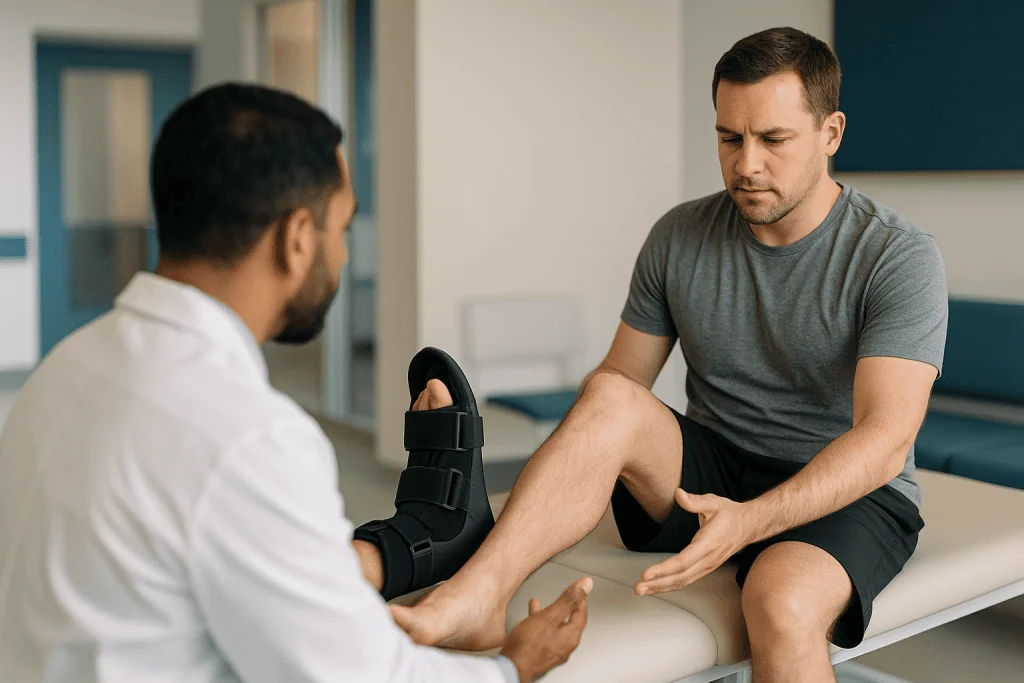
Protection does not mean total immobilization for most sprains and strains. A brace, tape or boot may shield the injured structure while adjacent joints keep moving, and gentle, pain-limited motion of the injured area itself usually starts within days. Prolonged rest carries its own cost: muscles lose strength and joints stiffen when unloaded, and the cardiovascular system deconditions. Cross-training the uninjured limbs, upper body or core is a normal part of this phase, not a luxury.
Swelling management matters because a swollen joint reflexively switches off the muscles around it. That is why a sprained knee can feel unstable even when the ligament is intact; the quadriceps simply stop firing well. Compression, elevation and early activation exercises, such as gentle quadriceps tightening, address that directly.
Medicines may come up here. Anti-inflammatory medicines work by dampening the chemical signals that drive swelling and pain, and simple pain relievers act on pain perception without affecting inflammation. Whether either is appropriate, and for how long, depends on the injury, your other health conditions and any medicines you already take. That decision sits with your prescribing clinician, not with a training partner.
Phase one ends when pain and swelling are controlled enough to work on motion without provoking a flare.
Phase two: restoring range of motion and waking the muscles up
Range of motion means how far a joint can move in each direction. In this phase, the goal is to reach the same arc as the uninjured side, or the target the surgeon set after a repair, without forcing anything.
Stiffness after injury has several sources. Swelling physically fills the joint. Scar tissue forms in and around the injured structure. Muscles guard by tightening. Each responds to a slightly different approach: swelling to compression and elevation, scar to gentle repeated movement and, where appropriate, hands-on techniques, and guarding to pain-free active exercise that reassures the nervous system.
Muscle activation is the second half of the phase. After a knee injury, for example, therapists spend time simply teaching the quadriceps to contract fully again, sometimes with biofeedback or electrical stimulation to help the person feel the muscle working. A muscle that cannot switch on cannot be strengthened later, so this unglamorous step protects everything downstream.
Walking pattern, or gait, is retrained here too. People limp for good reasons early on, but a limp that persists after pain has gone becomes a habit that loads other joints unevenly. Crutches or a boot are often weaned during this phase under guidance, based on how normally the person can walk rather than on a fixed date.
Common exercises are low load and high repetition: heel slides, ankle alphabets, stationary cycling with no resistance, isometric holds where the muscle tightens without the joint moving. None of it looks like sport. All of it is the foundation for sport.
The gate to phase three is usually full or near-full pain-free motion, minimal swelling, and a normal walking pattern.
Phase three: rebuilding strength and load tolerance
Strength is where the middle of rehabilitation lives, and it is where the most time is spent. The aim is not just to make the injured muscle group strong again but to restore the whole chain: hip, knee and ankle for a lower-limb injury; shoulder blade, rotator cuff and trunk for a shoulder.
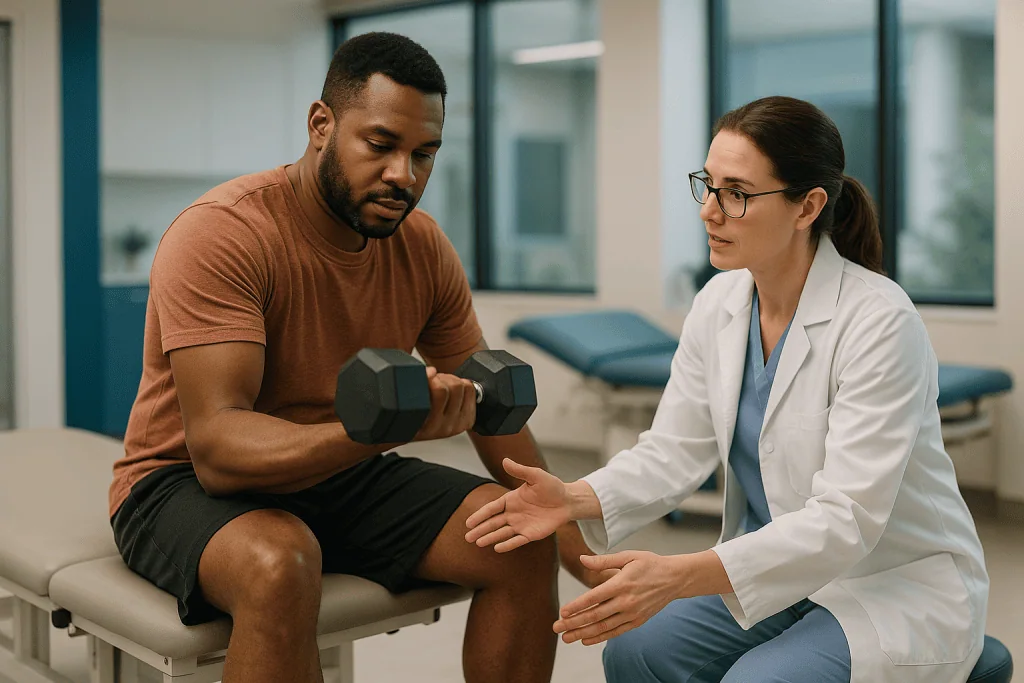
Load tolerance describes how much stress a tissue can absorb before it complains. Tendons and ligaments strengthen in response to gradually rising load, a process that takes weeks to months because their blood supply is modest and their remodeling is slow. Muscle adapts faster. A program that pushes the muscle at the tendon’s pace protects the slower tissue.
Progression follows a familiar strength-training logic. Exercises start with body weight and controlled tempo, advance to added resistance, then to heavier, slower work that builds tissue capacity. Single-leg and single-arm work matters because most sports are performed one limb at a time, and because it exposes asymmetries that two-legged exercises hide.
Therapists usually compare the injured side with the uninjured one, using handheld dynamometers, repeated-effort tests or gym-based measures, and set a symmetry target before moving on. The exact target varies with the injury and the sport; the principle is that a large strength gap is one of the more consistent findings in people who get reinjured.
Aerobic fitness is rebuilt alongside, using pool running, cycling or the elliptical trainer if impact is not yet permitted. Losing fitness during a long rehabilitation makes the eventual return harder and, some clinicians believe, riskier, because fatigue degrades movement quality.
The gate to phase four is strength close to symmetry, good single-leg control and no reactive swelling after heavier sessions.
Phase four: power, plyometrics and change of direction
Being strong is not the same as being fast. Power is the ability to produce force quickly, and it fades during rehabilitation even in people whose strength has returned. This phase reintroduces speed.
Plyometrics are jumping and hopping exercises that train the muscle-tendon unit to absorb and release energy rapidly. They begin conservatively: two-legged jumps onto a soft surface, landing and holding still, then small hops in place, then hops for distance, then single-leg versions. Landing quality is watched more closely than height. A knee that collapses inward or a trunk that leans heavily to one side on landing tells the therapist the person is not yet controlling the forces involved.
Running usually restarts here for lower-limb injuries, often as a walk-jog program that increases running time in small increments. Straight-line running is a lower-demand task than most people assume; the harder skills are decelerating, cutting and pivoting, which load ligaments and tendons in the directions that injured them in the first place.
Change-of-direction drills are therefore introduced progressively: planned cuts at low speed first, then higher speed, then unplanned cuts where a therapist calls the direction at the last moment. That final step matters because sport is reactive. An athlete who can execute a rehearsed cut may still be unprepared for the decision-making demands of a game.
Fatigue is added deliberately toward the end of the phase. Movement quality often deteriorates when a person is tired, and reinjuries cluster late in games and sessions. Testing control under fatigue is a way of rehearsing the conditions that carry the most risk.
The gate to the final phase is symmetric, well-controlled hopping and cutting, with no pain or swelling response.
Phase five: sport-specific training and return-to-play testing
The final phase closes the gap between the clinic and the sport. Drills now mirror the actual demands of the person’s position or event: a goalkeeper dives, a tennis player serves at full pace, a rower pulls at race rate. The therapist, the coach and often a strength and conditioning specialist coordinate so that clinic sessions and team training do not add up to more load than planned.
Return to play is usually staged. Return to training with no contact comes first, then full-contact training, then a substitute role in competition, then a full role. Each stage gives the team another window to watch how the body responds over the following days. A joint that swells after a first full session is information, not failure.
Testing anchors these decisions. A return-to-play battery typically combines strength measurements, hop or jump tests compared side to side, movement-quality assessments during landing and cutting, sport-specific performance measures and a questionnaire that captures how confident the person feels. No single test predicts reinjury reliably on its own, which is why the tests are used together and interpreted by a clinician who knows the person, the injury and the sport.
Timing is the sticking point. Many people feel ready before their tests say so, particularly after ligament surgery where the graft continues to mature long after pain has gone. For a reconstructed anterior cruciate ligament, for example, the timelines published by Cleveland Clinic run roughly nine to twelve months before full return to sport, and the testing criteria still have to be met inside that window.
Rehabilitation does not end at clearance. A maintenance program of strength and landing work, often continued through the season, is what most teams recommend to hold the gains.
How long does sports rehab take through each phase?
The honest answer is that duration depends on the tissue injured, the severity, the sport’s demands and the person’s age and general health. Timelines are ranges, not appointments, and the ranges are wide.
For minor soft-tissue injuries, the NHS advises that most sprains and strains feel better within about two weeks, while strenuous exercise such as running may need to be avoided for up to eight weeks to reduce the chance of further damage. That gap between “feels better” and “ready for full load” is the whole reason the phased approach exists.
Muscle strains sit in the middle. Mild strains often settle within a few weeks; more severe tears, particularly of the hamstring, can take considerably longer and carry a well-recognized tendency to recur if the athlete returns before strength and length are restored. Ligament injuries requiring surgery sit at the far end, with the multi-month timelines described in the previous section.
Several factors slow things down and none of them reflects effort or character. Older tissue remodels more slowly. Smoking impairs blood flow to healing structures. Poorly controlled diabetes delays wound and tissue healing. A previous injury to the same area means the baseline was already compromised. Sports that demand cutting, jumping or contact require more rehabilitation than sports that do not, because the return-to-play bar is higher.
Two useful reframes help. First, phases are measured by criteria met, so asking “what do I need to demonstrate to move on?” is more productive than “how many weeks?” Second, the phases lengthen toward the end. The protection phase is the shortest; strength and sport-specific work take the longest. People who budget for a fast finish are usually the ones who feel ambushed.
Who is phased rehabilitation usually for, and who is asked to wait?
Phased rehabilitation suits almost anyone recovering from a sports-related injury, whether a weekend hiker with a sprained ankle or a professional footballer after knee surgery. The framework scales: a mild injury may pass through all five phases in a few weeks, while a major one spends months in each.
People commonly referred into a formal program include those with ligament sprains that cause instability, muscle or tendon tears, post-operative repairs and reconstructions, stress fractures once bone healing is confirmed, and recurrent injuries where the pattern suggests an unaddressed weakness. Johns Hopkins Medicine notes that rehabilitation programs are also used after overuse injuries such as tendinopathy, where the problem is a tendon that has failed to adapt to load rather than a single traumatic event.
Some people are asked to wait before progressive loading begins, and the reasons are protective rather than punitive. A fracture needs radiographic evidence of healing before impact work. A surgical repair has a protection window set by the surgeon based on how the tissue was fixed and how strong it is likely to be at each stage; the therapist works inside that window. An acutely swollen, hot joint needs its swelling controlled, and sometimes investigated, before motion work starts.
Medical conditions can also change the plan. Cardiovascular disease may require clearance for higher-intensity work. A concussion sustained alongside a limb injury takes precedence, because its own graded return-to-activity protocol, described by the CDC, governs when exertion is safe. Pregnancy, uncontrolled blood pressure and certain medicines all shape what the program can include.
Children and adolescents follow the same phases with an added consideration: growth plates. Injuries near a growth plate are managed more conservatively, and a specialist decides when loading is safe.
The five sports rehabilitation phases side by side
Seeing the phases in one place shows how the emphasis shifts from protecting tissue to proving performance. The gates in the final column are examples of the kind of criteria teams use; the specific targets are set by the treating clinician for the individual injury.
| Phase | Main goal | Typical activities | Example gate to next phase |
|---|---|---|---|
| 1. Protection | Limit damage, control swelling and pain | PRICE for the first days, protective bracing, gentle pain-free movement, cross-training of uninjured areas | Swelling and pain controlled, able to begin motion work without a flare |
| 2. Motion and activation | Restore range of motion, re-establish muscle firing, normalize walking | Heel slides, isometric holds, stationary cycling, gait retraining, weaning off crutches or boot | Near-full pain-free motion, normal gait, minimal swelling |
| 3. Strength and load tolerance | Rebuild strength through the whole limb and trunk, restore aerobic fitness | Progressive resistance training, single-limb work, low-impact conditioning | Strength close to symmetry with the uninjured side, good single-leg control, no reactive swelling |
| 4. Power and change of direction | Retrain speed, landing control and cutting | Plyometric progression, walk-jog program, planned then reactive cutting, drills under fatigue | Symmetric hop tests, sound landing mechanics, no pain or swelling after high-speed work |
| 5. Sport-specific and return to play | Meet the demands of the sport and pass testing | Position-specific drills, staged return to training and competition, formal test battery | Criteria met across strength, hop, movement quality and confidence measures; clearance from the treating team |
Two features stand out. The activities in phases one and two look nothing like sport, and yet skipping them is the most common way to stall in phase three. And each gate includes a swelling or pain check, because the body’s reaction to yesterday’s session is the most reliable signal the team has about whether the load was right.
Return to play criteria: what the tests actually measure
Return-to-play criteria are the measurable standards a person meets before being cleared for full sport. They exist because pain and time are poor guides on their own; plenty of people are pain-free and still carry deficits that only show up when they are tested.
Strength testing compares the injured side with the uninjured side, often with a handheld or fixed dynamometer, which is a device that measures the force a muscle produces. Quadriceps and hamstring strength after knee injury, calf strength after Achilles injury and rotator cuff strength after shoulder injury are typical targets. The team sets a symmetry threshold in advance and holds to it.
Hop tests assess power and control in one movement. A single hop for distance, a triple hop, a crossover hop and a timed hop are frequently combined, and each is compared with the other leg. Landing mechanics are observed at the same time: does the knee drift inward, does the trunk lurch, does the person land stiff-legged?
Movement-quality screens, sometimes filmed and slowed down, look at how the whole body organizes itself during a squat, a landing or a cut. Sport-specific tests then check that the skills of the sport are back, whether that is throwing velocity, sprint time or agility on a set course.
Finally, questionnaires capture something the body cannot show: how ready the person feels. Fear and low confidence are associated with hesitant movement, and hesitant movement tends to be poorly controlled movement.
None of these tests is a guarantee. What they offer is a structured way to catch the deficits most consistently linked with reinjury before the athlete meets an opponent who will find them for free.
What the first days and weeks of rehabilitation usually look like
The first appointment is mostly conversation and measurement. The therapist asks how the injury happened, what has been done so far, what the sport demands and what the person’s goals are. They measure motion, swelling, strength where it is safe to test, and how the person walks. From that baseline they map the phases and explain the first gate.
In the opening days, sessions are short and homework is frequent. Compression and elevation continue. Small exercises are performed several times a day rather than in one long block, because frequent gentle movement manages swelling better than occasional hard effort. Mayo Clinic notes that for common sprains, light activity and gentle movement usually begin within the first few days once pain allows, with progressive exercises following as healing permits.
Expect some soreness. A useful distinction, and one to discuss with your therapist, is between muscle soreness that fades within a day and joint or injury-site pain that lingers or comes with new swelling. The first is the normal cost of adaptation. The second is a signal to scale back and report.
By the second and third week, for a moderate injury, motion is usually improving, walking is closer to normal and the first strengthening exercises appear. Cross-training keeps fitness ticking over. Sleep, protein intake and general health get more attention than people expect, because healing is metabolically demanding.
Frustration tends to arrive here too. The acute drama has passed, sport is still weeks away and the exercises feel repetitive. Recognizing this as a predictable stage, rather than a sign that something is wrong, helps people keep showing up for the unglamorous work that determines how the later phases go.
Psychological readiness to return to sport: where confidence fits
An athlete can pass every physical test and still hesitate at the moment of a tackle or a landing. That hesitation is not weakness; it is a normal response to having been hurt, and it has physical consequences. People who fear reinjury tend to move more stiffly, brace unnecessarily and shift load away from the injured side, all of which change how forces travel through the body.
Fear of reinjury, low confidence in the injured limb and anxiety about performance are among the most commonly reported reasons people do not return to their previous level of sport even when their bodies have recovered. Rehabilitation teams increasingly treat this as part of the program rather than an afterthought.
Several elements help. Graded exposure means rebuilding the feared movement in small, controlled steps, the same logic that governs the physical phases. A person frightened of landing after a knee injury starts with a two-legged jump onto a soft mat, watches themselves succeed, and progresses. Each step generates evidence that the knee can be trusted.
Education matters too. Understanding why the timeline is long, and that a settled joint is not a fragile one, tends to reduce catastrophic thinking. Goal setting that focuses on process, such as completing this week’s sessions, rather than outcome, such as the date of the first match, gives a sense of control during a period in which much feels outside it.
Questionnaires that measure readiness are often included in return-to-play testing for this reason. When scores are low despite good physical results, some teams involve a sports psychologist or delay full return while confidence is built. Whether that is appropriate is a judgment the treating team makes with the athlete.
What people often get wrong about sports rehabilitation phases
“No pain means healed.” Pain usually resolves well before tissue reaches full strength. Ligament grafts, tendons and bone continue remodeling for months after they stop hurting. Clearance rests on function and testing, not on the absence of symptoms.
“Rest is always safest.” Complete rest beyond the first days weakens muscle, stiffens joints and delays the very adaptations that protect against reinjury. The NHS guidance on sprains and strains emphasizes gentle movement once the acute period has passed and returning to activity gradually rather than stopping altogether.
“If I skip the boring exercises, I can get to the real work sooner.” The motion and activation phase is the real work. Muscles that never relearn to fire fully cannot be strengthened properly, and stiffness that is not addressed early becomes much harder to correct later.
“Ice and anti-inflammatories fix the injury.” Both can help with comfort and swelling in the early phase. Neither rebuilds strength, restores motion or retrains control. Whether anti-inflammatory medicines are appropriate for a given person is a conversation with the prescribing clinician, and it is not a substitute for the rest of the program.
“Straight-line running means I am ready.” Running in a line is one of the easier tasks. Decelerating, cutting and reacting to an opponent are the movements that stress healing structures, and they are the ones tested before clearance.
“The brace does the work.” Bracing and taping have a role in protection early on and sometimes in confidence later. They do not replace the muscular control that phases three and four build, and the team decides when and whether they remain useful.
“Once cleared, I am done.” Most teams continue a maintenance program through the season because deficits can reappear when training load rises.
Questions to ask your care team during rehabilitation
Rehabilitation goes better when the person understands the plan well enough to explain it to someone else. These questions help surface the reasoning behind each phase and keep decisions where they belong, with the treating team.
- Which structure is injured, how severe is it, and how does that shape the phases you have planned for me?
- What exactly do I need to demonstrate to move from this phase to the next? Can you show me how you will measure it?
- How will we tell the difference between normal training soreness and a sign that I am doing too much?
- What activities are off limits right now, what is encouraged, and how will that list change over the coming weeks?
- Is there a protection window set by my surgeon or doctor, and what does it restrict?
- How will we maintain my aerobic fitness while the injured area is protected?
- Which return-to-play tests will you use, and what results are you looking for before clearance?
- Do you plan to assess my confidence and fear of reinjury, and what happens if those scores lag behind my physical results?
- Who coordinates between you, my coach and any other clinicians so my total training load is managed?
- If I am taking medicines for pain or inflammation, who should I speak with about how long to continue and whether they affect training?
- What is the plan for staying strong and injury-resistant after I am cleared?
- Which symptoms mean I should stop and contact you or my doctor rather than wait for the next appointment?
Writing down the answers, especially the gate criteria, gives you a reference point on the days when progress feels invisible. It also makes it easier to notice if the plan drifts, so you can raise it early rather than late.
When to call your doctor during sports rehabilitation
Most of rehabilitation involves manageable soreness and gradual improvement. Some signs, however, point to a problem that needs medical assessment rather than a modified exercise session. Contact your doctor promptly, or seek urgent care, if you notice any of the following.
- A sudden pop, snap or giving way during an exercise, followed by new pain or an inability to bear weight or use the limb as before.
- Rapid new swelling, or a joint that becomes hot, red and increasingly painful, particularly with fever, which can suggest infection after surgery or a bleed into the joint.
- Calf pain, swelling or tenderness in one leg, especially after a period of reduced mobility or a boot or brace, or chest pain and breathlessness, which can indicate a blood clot and need emergency assessment.
- Numbness, tingling, weakness or a cold, pale or blue-tinged limb, which can signal nerve or blood-vessel involvement.
- A wound that opens, leaks, or shows spreading redness after surgery.
- Pain that is steadily worsening over days despite reduced activity, night pain that wakes you, or pain that is out of proportion to the exercise performed.
- Any head injury sustained during return to training, or symptoms such as headache, dizziness, confusion or nausea afterward, which require a separate assessment before continuing.
MedlinePlus advises seeking medical attention for sports injuries when there is severe pain or swelling, deformity, inability to bear weight, or symptoms that do not improve with initial care. The NHS similarly recommends seeing a doctor if a sprain or strain is not improving after about two weeks or if symptoms worsen.
When in doubt, err toward calling. A conversation with your therapist or doctor is a small cost; training through a warning sign is not. Every decision about pausing, investigating or restarting sits with your treating team, who know your injury and your history.
Frequently asked questions
What are the stages of injury recovery in sports rehabilitation?
Most programs describe five overlapping stages: protection while swelling and pain settle, restoration of range of motion and muscle activation, strength and load tolerance, power and change-of-direction work, and sport-specific training with return-to-play testing. Each stage has criteria that must be met before the next begins, and the treating team decides when those gates open.
How long does sports rehab take for a mild sprain versus a surgical repair?
It varies widely. The NHS says most sprains and strains feel better within about two weeks, with strenuous exercise avoided for up to eight weeks. Surgical repairs such as anterior cruciate ligament reconstruction run to many months, with published timelines from Cleveland Clinic in the region of nine to twelve months before full sport. Your team gives ranges specific to your injury.
What are return to play criteria and who decides if I meet them?
Return-to-play criteria are measurable standards, typically combining side-to-side strength comparison, hop tests, movement-quality assessment, sport-specific performance and a readiness questionnaire. No single test is decisive on its own. The treating clinician interprets the whole battery alongside your injury history and the demands of your sport, and clearance is their decision.
Is it safe to keep exercising during the protection phase?
Usually yes, for the parts of the body that are not injured. Cross-training the uninjured limbs, trunk and cardiovascular system is a normal part of early rehabilitation and helps limit deconditioning. The injured area itself is protected and moved gently within pain limits. Your therapist specifies what is permitted, and that list changes as healing progresses.
Why do I still fail tests when my injury no longer hurts?
Pain resolves before tissue regains full strength and before muscles regain full power and control. Ligament grafts, tendons and bone remodel for months after symptoms fade, and strength deficits can persist without any pain. Return-to-play testing exists precisely to detect these hidden gaps, which are among the more consistent findings in people who get reinjured.
Should I take anti-inflammatory medicines during rehabilitation?
That is a decision for your prescribing clinician. Anti-inflammatory medicines dampen the chemical signals that drive swelling and pain and can help with comfort in the early phase, but they do not restore motion, strength or control. Whether they are appropriate depends on your injury, other health conditions and existing medicines, so raise the question with your doctor.
What is the difference between normal soreness and a warning sign?
Muscle soreness that fades within about a day after a session is a normal response to progressive loading. Pain at the injury site that lingers, worsens, or arrives with new swelling, warmth or a sense of instability suggests the step was too large or something has changed. Report the second kind to your therapist, and seek medical care for the red flags listed above.
Can psychological readiness to return to sport really affect reinjury?
Fear of reinjury and low confidence are associated with stiffer, more guarded movement and with shifting load away from the injured side, both of which alter how forces travel through the body. Many teams therefore assess readiness with questionnaires and use graded exposure to rebuild trust in the injured limb. Whether to delay return while confidence improves is a judgment the treating team makes.
Do children go through the same sports rehabilitation phases?
Broadly yes, with extra caution around growth plates, the areas of developing bone near the ends of long bones. Injuries near a growth plate are managed more conservatively, and a specialist decides when loading is safe. Sessions are adapted for age and attention, and the emphasis on fun, confidence and gradual progression is even stronger.
What happens after I am cleared to play?
Most teams recommend a maintenance program of strength, landing and control work continued through the season, because deficits can reappear as training load rises. Return is often staged, from non-contact training to full competition, with the body’s response monitored after each step. Any new swelling, instability or pain should be reported so the plan can be adjusted.
References
- NHS: Sports injuries
- MedlinePlus: Sports Injuries
- Cleveland Clinic: ACL Tear
- NIH NIAMS: Sports Injuries
This article is for general information only and is not a substitute for professional medical advice. Please consult a qualified doctor about your individual situation.

More from the Blog
Preparing for Brain Injury Rehabilitation: Records, Routines and the Goals That Matter to You
Preparing for brain injury rehabilitation means gathering the medical records the rehab team will need, settling predictable daily routines for sleep, meals and rest,…

Aquatic Therapy: Why Rehab in Water Works When Land Hurts
Aquatic therapy is physical rehabilitation performed in a warm pool under a licensed therapist's guidance. Buoyancy can offload 50–90% of body weight, letting people…

Who May Benefit From Bobath Treatment? Cerebral Palsy, Stroke and Brain Injury Explained
Bobath therapy, also called neurodevelopmental treatment, is a hands-on physiotherapy approach used for cerebral palsy, stroke and acquired brain injury. It may suit people…

Physical Therapy Program Milestones: How Therapists Progress You From Pain Relief to Strength
Physical therapy program milestones are the checkpoints a therapist uses to move you through rehabilitation in stages: first calming pain and swelling, then restoring…

Your First Pulmonary Rehabilitation Assessment: Inhalers, Walking Tests and What to Wear
A first pulmonary rehabilitation appointment is an assessment, not a workout. A physiotherapist or respiratory therapist reviews your diagnosis, medicines and inhaler technique, asks…

Vestibular Rehabilitation: Retraining Balance After Dizziness
Vestibular rehabilitation therapy is an exercise-based program that retrains the brain to compensate for inner-ear balance problems. Guided by a specially trained physical therapist,…