

Sprain vs Strain: Which One You Have and What to Do First
Key Takeaways
- Ligaments connect bone to bone and tendons connect muscle to bone: that single anatomical line is the entire difference between a sprain and a strain.
- Bruising around a joint points toward a sprain, while muscle spasm or cramping points toward a strain, per Mayo Clinic guidance.
- A torn ligament is not a separate injury from a sprain: it is a grade 3 sprain, the most severe form on the three-level scale.
- A complete tear can temporarily hurt less than a partial one, so fading pain in the first hours is not proof the injury is minor.
- Ice for 15 to 20 minutes at a time with a cloth barrier, and avoid heat, alcohol, running, and massage for roughly the first 72 hours.
- Skipping balance and strengthening rehab after an ankle sprain leaves the joint's position sense impaired, which is a major reason repeat sprains are so common.
A sprain injures a ligament, the tough tissue that connects bones at a joint; a strain injures a muscle or the tendon that anchors it to bone. Joint bruising, swelling, and instability point to a sprain, while cramping or muscle spasm suggests a strain. For the first 48 hours, protect, rest, ice, compress, and elevate the area, and see a doctor if you cannot bear weight, heard a pop, or notice deformity or numbness.
It happens in half a second. You step off a curb while reading a text, your foot rolls inward, and by the time you catch yourself, your ankle is already announcing that something went wrong. Someone nearby asks the inevitable question: “Is it sprained, or did you just pull something?”
Most of us use those words interchangeably, and most of us are guessing. The two injuries can look nearly identical from the outside, pain, swelling, a limp you try to hide at work on Monday. Underneath the skin, though, they involve entirely different tissues, and that difference shapes how long you’ll be sidelined and what kind of care actually helps.
The good news: you don’t need a medical degree to make a reasonable first assessment. You need to know what each injury damages, which clues separate them, and, most urgently, what to do in the first two days, when your choices genuinely change the outcome.
What's the actual difference between a sprain and a strain?
The distinction comes down to one line of anatomy. Ligaments connect bone to bone, stabilizing your joints like the ropes on a tent. Tendons connect muscle to bone, transmitting the force that moves you. A sprain is a stretched or torn ligament. A strain is a stretched or torn muscle or tendon. That’s the whole difference, and it explains nearly everything else about these injuries, according to MedlinePlus.
Because ligaments live at joints, sprains happen at joints: ankles, wrists, knees, thumbs. They usually strike in a single violent moment: a rolled ankle, a fall onto an outstretched hand, a knee twisting while the foot stays planted. The joint gets forced beyond its normal range, and the ligament pays the price.
Strains follow the muscles, so they show up in the hamstrings, lower back, calf, and groin. They can be just as sudden: a sprinter’s hamstring giving out mid-stride, but they also develop gradually from repetitive overload, something sprains rarely do. A rower’s back or a tennis player’s forearm can strain over weeks of accumulated stress.
One vocabulary note that clears up endless confusion: a “pulled muscle” and a strain are the same injury. “Pulled” is simply the kitchen-table term. “Twisted,” on the other hand, usually describes the mechanism of a sprain. English didn’t do us any favors here, but the tissues underneath don’t care what we call them.
How do you know if you have a strain or a sprain?
Both injuries cause pain, swelling, and limited movement, which is why they’re so easily confused. The Mayo Clinic points to two clues that genuinely separate them: bruising around a joint favors a sprain, while muscle spasm or cramping favors a strain. Location is your third clue, pain centered on a joint suggests ligament; pain in the belly of a muscle suggests, well, muscle.
| Clue | More likely a sprain | More likely a strain |
|---|---|---|
| Where it hurts | At a joint (ankle, wrist, knee, thumb) | In the muscle itself (hamstring, back, calf) |
| Bruising | Common, around the joint | Possible, but less typical early on |
| Muscle spasm or cramping | Uncommon | Common |
| How it happened | A twist, roll, or fall in one moment | Sudden overexertion or repetitive overuse |
| Joint feels loose or unstable | Yes, with moderate to severe injuries | No, weakness, not looseness |
| A “pop” at the moment of injury | Possible with significant tears | Possible with significant tears |
Notice that last row. A pop or snap doesn’t settle the sprain-versus-strain question, it can happen with either, but it does raise the odds of a meaningful tear, and it’s a reason to get examined rather than guess. Weakness is another useful tiebreaker: if you can’t generate normal force with the muscle, think strain; if the joint wobbles or gives way under you, think sprain.
Is a torn ligament a sprain? Understanding the grades
Yes: a torn ligament is a sprain, just a serious one. Clinicians grade both sprains and strains on a three-level scale, and the grade matters far more for your recovery than which tissue you injured.
- Grade 1 (mild): The fibers are overstretched with only microscopic tearing. Expect soreness and mild swelling, but the joint stays stable and the muscle still works. Most people are noticeably better within a couple of weeks.
- Grade 2 (moderate): A partial tear. Swelling and bruising are more dramatic, the area hurts to use, and a sprained joint may feel slightly loose. Recovery is measured in weeks, not days.
- Grade 3 (severe): A complete rupture. The ligament or muscle-tendon unit has torn through. A grade 3 ankle sprain may be unable to bear weight; a grade 3 muscle tear sometimes leaves a visible dent or lump where the fibers have retracted. These injuries can take months and occasionally need surgical repair, per Johns Hopkins Medicine.
So when someone says “it’s not sprained, it’s torn,” they’re describing a distinction that doesn’t exist: the tear is the sprain, at its worst. This matters practically, because people often under-treat “just a sprain” that is, in fact, a partially ruptured ligament. Grade, not label, should drive how seriously you take it.
Where sprains usually happen, and why the ankle leads the list
The ankle is the most commonly sprained joint in the body, and the mechanics explain why. The joint is built to move up and down efficiently, but the ligaments on its outer edge are relatively thin. When your foot rolls inward, stepping on an opponent’s shoe, missing a stair, landing awkwardly from a jump: those lateral ligaments absorb forces they weren’t designed for. According to Harvard Health, this inward-roll pattern accounts for the overwhelming majority of ankle sprains.
Other joints have their own signature stories. Wrists sprain when you fall and instinctively throw a hand out to catch yourself. Thumbs sprain when they’re bent backward, skiers know this one from gripping a pole during a fall, which is why a torn thumb ligament earned the nickname “skier’s thumb.” Knees sprain when the foot plants and the body pivots, a pattern familiar to anyone who plays basketball, soccer, or flag football on weekends.
Age and history stack the deck. A previously sprained ankle heals with ligaments that may be slightly longer and less precise at reporting the joint’s position to the brain, which makes a second roll more likely. That’s not a reason for pessimism: it’s the strongest argument for doing rehabilitation properly the first time, a point worth returning to later.
Where strains usually happen, hamstrings, backs, and calves
Strains follow a different map. The muscles that tear most often share a common trait: they work hard while lengthening, which biomechanists call eccentric loading. Picture a sprinter’s hamstring at full stride: the muscle is contracting to control the leg while simultaneously being stretched to its limit. That combination is where fibers fail.
The most common sites, per the Mayo Clinic, are:
- Hamstrings, torn during sprinting, kicking, or sudden acceleration, and notorious for recurring if rushed.
- Lower back, strained by lifting with a rounded spine, twisting under load, or even a violent sneeze when the muscles are cold.
- Calf, which can give way with a sensation some patients describe as being kicked from behind, often during a push-off.
- Groin (adductors), injured in sports full of lateral cutting, hockey, soccer, tennis.
Two situations raise strain risk sharply: cold muscles and tired muscles. A muscle that hasn’t been warmed up is stiffer and less able to absorb sudden stretch, and fatigue late in a game degrades coordination just as forces peak. That’s why so many hamstring injuries happen in the final minutes of a match, and why “one more sprint” on exhausted legs is often the one that costs six weeks.
Which is more painful, a sprain or a strain?
Honest answer: neither category wins. Pain tracks with the grade of the injury and the location, not with whether the damaged tissue was ligament or muscle. A grade 1 ankle sprain might be a dull annoyance you walk off by Thursday; a grade 2 hamstring strain can make sitting in a desk chair miserable for weeks. Flip the grades and the comparison flips with them.
There’s also a counterintuitive wrinkle that trips people up. A complete grade 3 tear sometimes hurts less in the hours after injury than a partial grade 2 tear does. Once fibers rupture entirely, they’re no longer being tugged with every movement, and the initial pain can settle deceptively fast even as swelling blooms. Clinicians see patients who assume the injury “can’t be that bad because it stopped hurting,” only to discover a fully ruptured ligament on examination. Pain is a useful signal, but it’s an unreliable ruler.
What pain is good at is flagging function. Pain that prevents you from bearing weight, prevents the muscle from firing at all, or wakes you at night deserves professional eyes. Pain that fades steadily each day, in an area that works, weakly, but works, usually reflects a milder injury following the expected script. Track the trend rather than the peak: an injury that hurts less each morning is telling you something reassuring.
Which injury heals faster, a strain or a sprain?
Grade for grade, mild strains often edge out mild sprains, and biology explains why. Muscle is one of the best-supplied tissues in the body, rich in blood vessels that deliver the oxygen, nutrients, and repair cells healing requires. Ligaments are comparatively bland, white, and poorly vascularized. Less blood flow means slower repair, which is why a moderate ligament injury can outlast a moderate muscle injury by weeks.
Rough timelines, with the caveat that individual recovery varies widely:
- Grade 1 strain or sprain: noticeable improvement within days, most function back in one to two weeks.
- Grade 2 strain: commonly three to six weeks before confident return to sport.
- Grade 2 sprain: often four to eight weeks, longer for weight-bearing joints like the ankle.
- Grade 3 either: months, with medical supervision, and sometimes surgery, shaping the plan.
Two asterisks belong on this table. First, hamstring strains re-injure at stubbornly high rates when athletes return before regaining full strength, so a “fast” muscle recovery can turn slow if rushed. Second, the NHS notes that severe ankle sprains can leave lingering stiffness and instability for months without structured rehabilitation. Healing isn’t just the calendar running out; it’s tissue remodeling under gradually increasing load. Skip the loading, and the calendar lies to you.
What to do first: the first 48 hours, step by step
Whether it’s a sprain or a strain, the opening moves are identical, so you don’t need a diagnosis to start helping yourself. The classic framework is RICE, rest, ice, compression, elevation, with a modern emphasis on protecting the area rather than immobilizing yourself entirely.
- Protect and rest. Stop the activity that caused the injury and avoid movements that reproduce sharp pain. Rest doesn’t mean bed rest; gentle, pain-free movement is fine and often helpful after the first day or two.
- Ice for 15 to 20 minutes at a time, several times a day, with a towel between the ice and your skin. Longer sessions don’t help more and can damage skin.
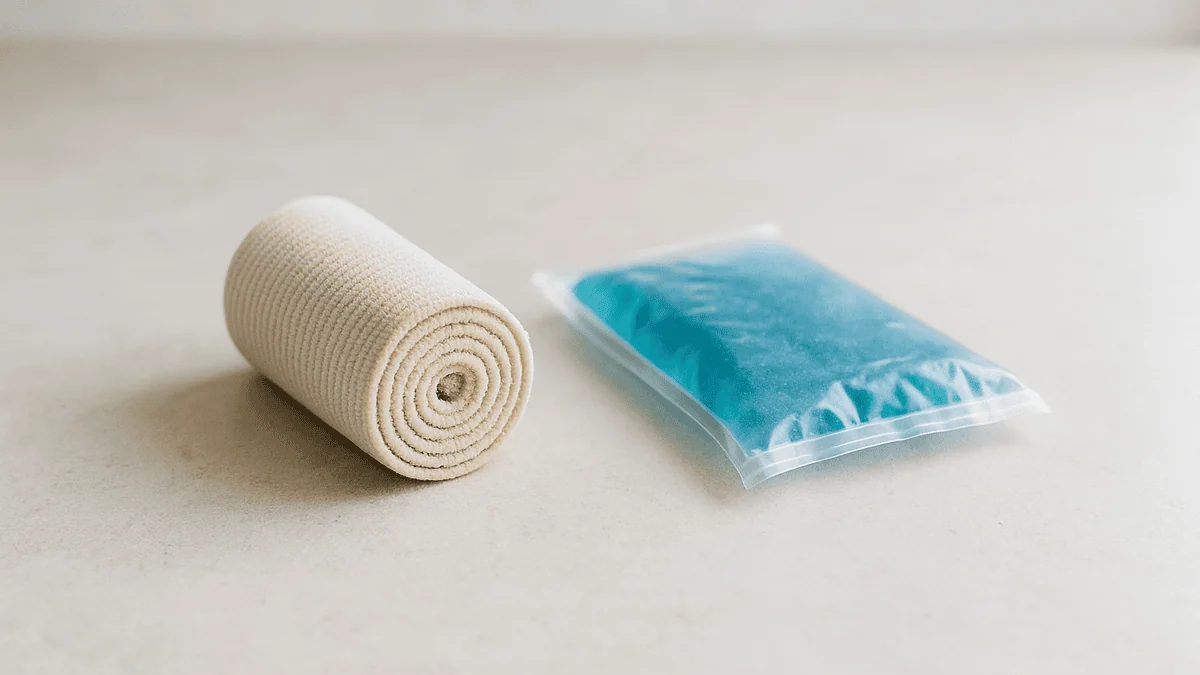
- Compress with an elastic bandage snug enough to limit swelling but never tight enough to cause numbness, tingling, or a color change below the wrap. Loosen it at night.
- Elevate the injured area above heart level when you’re sitting or lying down, prop that ankle on pillows, not just a coffee table.
Swelling is the enemy you’re managing here. Fluid pooling around the injury stretches tissues, amplifies pain, and slows the return of normal movement. A pharmacist can advise on over-the-counter pain relief options suited to your health history. And resist the urge to “test it” repeatedly on day one, every trial run restarts the swelling you just spent hours icing down.
What not to do in the first 72 hours
First aid has a shadow side: well-meaning habits that make swelling worse. The NHS summarizes them with the acronym HARM, heat, alcohol, running, massage, all best avoided for roughly the first 72 hours.
- Heat feels comforting, but hot baths, heating pads, and saunas dilate blood vessels and can increase bleeding and swelling in freshly injured tissue. Heat has a place later, once swelling has settled and stiffness becomes the main complaint, not on night one.
- Alcohol does the same thing chemically, widening vessels and blunting your judgment about how much the injury can handle. The post-game beer after a rolled ankle is working against your ice pack.
- Runningor any return to the provoking activity, risks converting a grade 1 injury into a grade 2. Adrenaline masks pain during play; the honest assessment comes an hour later.
- Massage of the injured area itself can aggravate bleeding within the tissue during the acute window. Save the deep tissue work for the recovery phase.
One more habit worth retiring: wrapping the joint so tightly it throbs. People sometimes equate compression with constriction, but a bandage that leaves toes or fingers pale, cold, or tingly is cutting off circulation, not controlling swelling. Snug, comfortable, and rechecked every few hours is the standard.
When to see a doctor
Most mild sprains and strains recover with home care, but certain signs mean the guessing should stop and an examination should start. Seek medical attention promptly if:
- You can’t bear weight on the injured leg or take more than a few steps without severe pain.
- The joint or limb looks deformed, or you have pain directly over a bone rather than soft tissue, both raise the possibility of a fracture, which can mimic a bad sprain almost perfectly.
- You heard or felt a pop at the moment of injury, especially in the knee or Achilles region.
- There’s numbness, tingling, or coldness below the injury, suggesting nerve or circulation involvement.
- The joint gives way or feels unstable when you try to use it.
- You can’t move the injured joint or contract the muscle at all.
- Pain and swelling aren’t improving after a few days of proper home care, or the area becomes increasingly red, warm, and painful.
Children deserve a lower threshold. What looks like a sprain in a child may actually be an injury to the growth plate, the softer zone near the ends of growing bones, which the Mayo Clinic flags as a reason to have kids’ joint injuries evaluated rather than watched. The same caution applies to older adults, in whom bone injuries are more common and less obvious. When in doubt, an exam is cheap insurance against months of complications.
How doctors tell the difference, and when you need an X-ray
Here’s a reassuring truth: most of the diagnostic work happens with hands, not machines. A clinician will ask exactly how the injury occurred (the mechanism is often the biggest clue), then press along bones and ligaments to map the tenderness, test the joint’s stability by gently stressing it, and check whether the muscle can generate force against resistance. A loose joint points to ligament; weakness with intact stability points to muscle or tendon.
X-rays enter the picture to answer one specific question, is a bone broken?, because X-rays don’t show ligaments or muscles at all. Emergency clinicians commonly use validated decision rules to decide when imaging is warranted; for ankles, the key factors are tenderness directly over specific bony landmarks and the inability to bear weight for four steps. If neither is present, a fracture is unlikely and an X-ray usually adds nothing but time and radiation.
When soft tissue itself needs a picture: a suspected complete ligament rupture, a possible tendon tear, an injury that isn’t healing on scheduleultrasound or MRI does the job. But these are the exception, not the routine. Most sprains and strains are diagnosed, graded, and managed based on the story and the exam. If you’re seen and sent home without imaging, that’s typically a sign your clinician found reassuring stability, not that corners were cut.
Why rehabilitation matters more than rest
If this article gets to have one opinion, it’s this: the biggest mistake people make with sprains and strains isn’t under-resting: it’s under-rehabbing. Waiting for pain to disappear and calling that recovery is how a two-week injury becomes a two-year nuisance.
Consider what a ligament actually does beyond holding bones together. It’s packed with position sensors that tell your brain, moment to moment, exactly where the joint sits in space: a sense called proprioception. A sprain damages those sensors along with the fibers. The tissue can knit back together while the joint’s positional GPS remains fuzzy, which is precisely why re-sprains are so common: the brain reacts a fraction of a second too late to the next awkward step. Harvard Health emphasizes that balance and strengthening exercises, not just time, restore that protective reflex after an ankle sprain.
Muscle strains follow a parallel logic. Torn fibers heal with scar tissue, which is stiffer and weaker than the original muscle until it’s remodeled by progressive loading. A hamstring that “feels fine” walking around may still be 30 percent weaker than its partner, an imbalance that only shows up, catastrophically, at sprint speed.
Practical translation: once sharp pain settles, begin gentle range-of-motion work, then gradual strengthening, then balance or sport-specific drills, ideally with guidance from a physical therapist for anything beyond a mild injury. Rest starts the healing. Loading finishes it.
Can you prevent sprains and strains?
Not entirely, nobody plans to miss a stair, but you can meaningfully shift the odds, and the levers are unglamorous and effective.
- Warm up before you demand. Five to ten minutes of light movement raises muscle temperature and makes tissue measurably more pliable. Cold muscles tear; warm muscles stretch.
- Build strength on both sides of a joint. Strong muscles act as dynamic shock absorbers, sparing ligaments from forces they’d otherwise take alone. For hamstrings specifically, exercises that load the muscle while it lengthens have solid evidence behind reducing strain risk.
- Train your balance. Single-leg stands, wobble-board work, and agility drills sharpen the proprioceptive reflexes that catch a rolling ankle before it fully rolls. This matters most if you’ve sprained before.
- Increase load gradually. The weekend athlete who jumps from zero to two hours of basketball is asking tissues to handle stress they haven’t adapted to. Ramp up over weeks, not days.
- Respect fatigue and footwear. Worn-out shoes and exhausted legs both degrade the coordination that protects joints: a bad combination in the final minutes of any game.
MedlinePlus adds a homely but underrated item to this list: keep walkways clear, light your stairs, and use handrails. A striking share of sprains happen not on courts but in kitchens and hallways, where a laundry basket on the stairs does what no opponent could.
The myth of "walking it off": an honest bottom line
“Walk it off” survives as advice because it occasionally appears to work. A grade 1 injury, blessed with adrenaline and luck, sometimes fades whether you treat it well or badly, and the story gets retold as proof of toughness. What the story leaves out are the people who walked a grade 2 sprain into a grade 3, or who returned a half-healed hamstring to the field and bought themselves a recurrence, statistically, re-injured hamstrings tend to be worse than the original.
The smarter script isn’t complicated. Stop when it happens. Assess honestly: Where exactly does it hurt, joint or muscle? Can you bear weight? Did you hear a pop? Does anything look wrong? Start protection, ice, compression, and elevation within the hour, keep heat and alcohol away for three days, and watch the trend. Improving daily? Continue home care and begin gentle movement as pain allows. Not improving, or ticking any of the red-flag boxes? Get examinedfractures impersonate sprains constantly, and only an exam or X-ray can tell them apart.
Sprain or strain, ligament or muscle, the tissue doesn’t care about your schedule, and it responds to the same two things: early respect and progressive rebuilding. Give it both, and most of these injuries become a footnote. Skip either, and a footnote can become a chapter.
Frequently asked questions
How do you know if you have a strain or a sprain?
Location and symptom pattern are the best clues. Pain centered on a joint, ankle, wrist, knee, thumb, with bruising and possible looseness suggests a sprain, meaning a ligament injury. Pain within a muscle such as the hamstring or lower back, especially with cramping or spasm, suggests a strain. Both cause swelling and limited movement, so if the picture is unclear or severe, a clinical exam settles it.
Which injury heals faster, a strain or a sprain?
Grade for grade, strains often heal somewhat faster because muscle has a much richer blood supply than ligament tissue. A mild strain may settle in one to two weeks, while a comparable sprain can take slightly longer, and moderate ankle sprains often need four to eight weeks. Severity matters far more than category: a severe tear of either tissue takes months, and rushed returns commonly cause re-injury.
Which is more painful, a sprain or a strain?
Neither is inherently more painful, pain depends on the grade and location of the injury, not on whether ligament or muscle was damaged. A moderate hamstring strain can hurt far more than a mild ankle sprain, and vice versa. Notably, a complete tear can hurt less at first than a partial one, because fully ruptured fibers are no longer tugged by movement, which makes pain an unreliable measure of severity.
Is a torn ligament a sprain?
Yes. A torn ligament is a sprain by definition, specifically a grade 3 sprain, the most severe level. Grade 1 means overstretched fibers with microscopic tearing, grade 2 means a partial tear, and grade 3 means a complete rupture. So “it’s torn, not sprained” is a distinction that doesn’t exist medically. Complete tears often cause joint instability, may need imaging or surgery, and always warrant medical evaluation.
Should I use ice or heat on a sprain or strain?
Ice first, heat later. For roughly the first 72 hours, ice for 15 to 20 minutes at a time, several times daily, with a towel between ice and skin: this limits swelling and eases pain. Heat during this window can widen blood vessels and worsen swelling, which is why the NHS advises avoiding hot baths and heat packs early on. Once swelling settles and stiffness dominates, gentle heat can help loosen the area.
Can you walk on a sprained ankle?
It depends on severity. With a mild sprain, walking as pain allows, often after a day or two of relative rest, is generally fine and can aid recovery. But if you cannot take more than a few steps, that’s a recognized red flag used by clinicians to decide who needs an X-ray, because inability to bear weight raises the possibility of a fracture or severe sprain. Don’t force painful walking; get examined instead.
How long does a sprain take to heal?
Mild sprains typically improve substantially within one to two weeks. Moderate sprains with partial ligament tearing often take four to eight weeks, and complete ruptures can take several months, occasionally requiring surgery. Ankles trend toward the longer end because they bear your full body weight. Feeling pain-free is not the finish line, though, strength and balance usually lag behind pain relief, which is why rehabilitation exercises matter.
Do I need an X-ray for a sprain or strain?
Usually not. X-rays show bone, not ligaments or muscles, so they’re used to rule out fractures rather than confirm sprains or strains. Clinicians typically order one when there’s tenderness directly over bone, visible deformity, or an inability to bear weight for a few steps. Most soft-tissue injuries are diagnosed by history and physical exam alone; MRI or ultrasound is reserved for suspected complete tears or injuries that aren’t healing as expected.
Is a pulled muscle the same as a strain?
Yes, “pulled muscle” is the everyday term for a muscle strain. Both describe overstretched or torn fibers in a muscle or its tendon, most often in the hamstring, lower back, calf, or groin. The injury typically happens during sudden exertion, especially when a working muscle is forced to lengthen, or through repetitive overuse. Treatment follows the same path as any strain: protect, ice, compress, elevate, then rebuild strength gradually.
When should I see a doctor for a sprain or strain?
See a doctor if you can’t bear weight, the area looks deformed, you have pain directly over a bone, you heard a pop at injury, or there’s numbness, coldness, or a joint that gives way. Also seek care if symptoms aren’t improving after a few days of home treatment. Children with joint injuries deserve a lower threshold, since what resembles a sprain can involve the growth plate near developing bones.
References
This article is for general information only and is not a substitute for professional medical advice. Please consult a qualified doctor about your individual situation.

More from the Blog

How Long Does Eye Dilation Last? What to Expect After the Drops
For most adults, eye dilation from routine exam drops wears off in about four to six hours, though blurry near vision and light sensitivity…

What a Squint (Strabismus) Is, and How It Is Treated
A squint, called strabismus in the US, is a condition in which the two eyes do not point in the same direction: one looks…

Are Swollen Feet Dangerous? When Puffiness Is a Signal
Most swollen feet aren't dangerous, long days standing, heat, salty meals, and pregnancy commonly cause temporary puffiness that improves with rest and elevation. Swelling…

Is Asthma Hereditary? Genetics, Environmental Triggers and Family Risk Explained
Asthma is partly genetic but not purely inherited. Having a parent or sibling with asthma raises your risk, and many gene regions have been…

What a Hernia Feels and Looks Like (and What Gets Mistaken for One)
A hernia usually feels like a dull ache, heaviness, or burning around a soft lump, most often in the groin or near the navel,…

Can Epilepsy Be Cured, Go Away, or Be Grown Out of?
Epilepsy can sometimes go away, but doctors rarely use the word cured. Some childhood epilepsies resolve with age, and specialists consider epilepsy resolved after…