

What a Squint (Strabismus) Is, and How It Is Treated
Key Takeaways
- In medicine a squint means misaligned eyes, not narrowing the eyes against bright light; the clinical term is strabismus.
- The NHS estimates squints affect about 1 in 20 children, and brief eye crossing is normal only in the first few months of life.
- A young child's brain often switches off the image from the turned eye, which prevents double vision but can cause permanent lazy eye (amblyopia) if not treated early.
- Farsightedness can drag the eyes inward through the focusing reflex, which is why the correct glasses alone straighten some childhood squints.
- Muscle-weakening injections into an eye muscle wear off after roughly 3 months according to the NHS, making them useful as a trial before surgery.
- A sudden new squint with double vision, severe headache, a drooping eyelid or limb weakness needs same-day medical assessment.
A squint, called strabismus in the US, is a condition in which the two eyes do not point in the same direction: one looks straight ahead while the other turns in, out, up or down. It is common in young children and can also start in adulthood. Treatment depends on the cause and may include glasses, patching for a weak eye, prism lenses, muscle-relaxing injections or surgery on the eye muscles.
It usually shows up in a photograph first. A grandparent scrolls through birthday pictures and pauses: in three of them, the child’s left eye seems to be looking somewhere just past the camera. Nobody noticed at the party. The child certainly didn’t complain. Yet the picture is doing what family snapshots have quietly done for decades, catching a small misalignment that the brain of a two-year-old has already learned to ignore.
Adults meet the same condition from the other side. A man in his fifties wakes with two of everything: two coffee cups, two door frames, a road that splits in half when he tries to drive. That is the same underlying problem, but the experience could not be more different, and the reason for that difference sits at the heart of how squints are understood and treated.
Here is what the evidence says about eyes that do not line up, why age matters so much, and what the options actually involve.
What exactly is a squint, and is it the same as strabismus?
The word trips people up before anything else. In everyday American English, to squint means to narrow your eyes against bright sun. In medicine, and in British usage, a squint is something quite different: a condition in which the eyes are not aligned. One eye fixes on the object you are looking at; the other points somewhere else. The clinical term is strabismus, and you will also hear “crossed eyes,” “wall eyes” or “a turn in the eye.” They all describe the same thing.
Each eye is moved by six small muscles, and the brain normally coordinates all twelve so both eyes aim at the same target. When that coordination fails, the two eyes send the brain two slightly different pictures. What happens next depends on age. A young child’s visual system is still wiring itself, so the brain often simply switches off the image from the wandering eye. An adult’s brain has no such flexibility, so the two pictures overlap and the person sees double.
A squint can be present all the time or only sometimes, for instance when a child is tired or focusing on something close. It can involve the same eye each time or alternate between the two. None of these variations is a sign that a child is not paying attention or that an adult is being careless. It is a mechanical and neurological alignment problem, and it deserves the same matter-of-fact attention as a knee that does not bend properly.
How common is a squint, and who gets it?
Far more common than the rarity of the word suggests. The NHS estimates that squints affect about 1 in 20 children, which in a typical elementary school class works out to roughly one child per room. Most appear before the age of five, and many are picked up at routine vision checks rather than by worried parents.
Adults are not exempt. Some carry a childhood squint that was never treated, or one that was corrected and has drifted back years later. Others develop a new misalignment in mid or later life because something has interfered with the nerves or muscles that steer the eyes. The Cleveland Clinic notes that strabismus can occur at any age, and that adult-onset cases nearly always announce themselves with double vision because the mature brain cannot suppress the second image.
Certain groups are at higher risk. Children born prematurely or at low birth weight, children with cerebral palsy, Down syndrome or other neurological conditions, and children with a parent or sibling who had a squint all have higher rates, according to MedlinePlus. Significant farsightedness is another well-established contributor, for reasons explained further on.
It is worth saying plainly that a squint is not caused by reading in dim light, sitting too close to a screen or crossing the eyes on purpose. These beliefs are stubborn, and they sometimes lead families to feel responsible for something no one could have prevented.
Which way can the eye turn? The main types of squint
Eye specialists describe a squint by the direction the misaligned eye points, by whether it is constant or intermittent, and by whether the angle stays the same in every direction of gaze. The direction is the part most people want to know first.
| Medical term | Direction the eye turns | Everyday description |
|---|---|---|
| Esotropia | Inward, toward the nose | Crossed eyes; the most common type in young children |
| Exotropia | Outward, toward the ear | Wall eye or wandering eye; often intermittent at first |
| Hypertropia | Upward | One eye sits higher than the other |
| Hypotropia | Downward | One eye sits lower than the other |
Beyond direction, the second useful distinction is between a concomitant squint, where the angle is roughly the same wherever the person looks, and an incomitant squint, where the angle changes with the direction of gaze. Concomitant squints are typical of childhood. Incomitant squints often point to a problem with a specific muscle or the nerve that drives it, which is why a new incomitant squint in an adult prompts a more searching medical work-up.
Johns Hopkins also distinguishes squints that are present from very early infancy from those that appear later in childhood, because the two groups tend to have different causes and are managed differently. This is one reason a good eye examination records not only what the eyes are doing now but when the family first noticed a change.
What causes a squint?
There is rarely a single villain. Most childhood squints arise from a mismatch between how the eyes focus and how the brain coordinates them, layered on top of a genetic tendency.
The clearest example is the link with farsightedness. A farsighted child has to work hard to focus on close objects. The focusing effort and the inward turning of the eyes are wired together in the brain, so heavy focusing drags the eyes inward more than the target requires. The result is an inward squint that appears when the child looks at something near, and often eases when the focusing effort is removed by the right glasses. MedlinePlus lists uncorrected refractive error among the most frequent contributors to childhood strabismus.
Other childhood causes involve the nerve pathways themselves. Conditions affecting the brain, including cerebral palsy, hydrocephalus and some genetic syndromes, raise the likelihood that eye movements will not be coordinated. Prematurity does the same. Occasionally a squint is the first visible sign of a problem inside the eye, such as a cataract or, rarely, a tumor, which is why every new squint in a child warrants a full eye examination rather than a wait-and-see approach.
Adult-onset squints tend to have more concrete triggers. The Cleveland Clinic lists stroke, head injury, thyroid eye disease, diabetes affecting the small nerves that control the eye muscles, and conditions affecting nerve-muscle communication. In these cases the squint is a symptom of something else, and the treating team will usually want to find that something before deciding how to manage the eyes.
Why do newborns' eyes wander, and when should it settle?
Watch a baby in the first weeks of life and you will often see the eyes drift apart, cross briefly, or seem to look in two directions at once. This is normal. Coordinated eye movement is a skill the brain acquires, not one it is born with, and MedlinePlus notes that intermittent crossing in the first few months is expected as that control develops.
The question every parent asks is how long to wait. The NHS advice is specific: seek an assessment if a baby’s squint is present all the time, or if a squint that comes and goes is still noticeable after the age of 3 months. By that point the visual system should be steering both eyes together reliably, and a persistent turn deserves a proper look rather than reassurance from a distance.
There is also a common false alarm. Many babies have a broad, flat bridge to the nose and an extra fold of skin at the inner corner of each eye. Both features can hide part of the white of the eye on the nasal side and make the eyes look crossed when they are perfectly straight. Clinicians call this pseudostrabismus, and it fades as the face grows. The cover test described later separates a true squint from this optical illusion in a matter of seconds.
What parents notice at home still matters enormously. A phone photograph in which one eye’s pupil reflects light differently from the other, a head that habitually tilts to one side, or a child who shuts one eye in bright sunlight are all worth mentioning at the next appointment.
Squint vs lazy eye: what is the difference?
People use the two terms interchangeably, and the confusion is understandable, but they describe different problems that frequently travel together.
A squint is about direction: the eyes point different ways. Lazy eye, medically amblyopia, is about vision: one eye sees poorly even with the best possible glasses, not because of any fault in the eye itself but because the brain has stopped paying attention to it. The National Eye Institute describes amblyopia as reduced vision from abnormal visual development, and strabismus is one of its two leading causes, the other being a large difference in prescription between the two eyes.
The mechanism links them. When a young child’s eyes point in different directions, the brain receives two mismatched images. Rather than tolerate double vision, it suppresses the image from the turned eye. Do that for months during the years when visual pathways are still being built, and the suppressed eye never develops sharp sight. The eye is structurally healthy. The connection to the brain is what has withered.
This is why the timeline matters so much in children. The Mayo Clinic notes that amblyopia treatment is most effective when started early, and the NHS advises that it tends to work best if begun before around age 7, when the visual system is still adaptable. Treat the squint and you may straighten the eyes; treat the amblyopia and you protect the sight in the weaker eye. Both jobs usually need doing, and the second is often the more urgent of the two.
What are the symptoms of a squint?
The obvious sign is the one you can see: eyes that do not line up, either constantly or when the person is tired, unwell or concentrating on something near. What is easy to miss is how differently children and adults experience the same misalignment.
Children rarely complain, and that silence is the problem. Because their brains suppress the image from the turned eye, they do not see double and have no sense that anything is wrong. Indirect clues carry more weight. A child may tilt or turn the head to one side to line the eyes up, close or cover one eye in bright light, or seem clumsy with tasks that rely on depth perception such as catching a ball or pouring a drink. The NHS lists reduced vision in the affected eye and double vision as possible consequences, but for most young children the loss of depth perception and the risk of amblyopia are the quiet costs.
Adults almost always notice. A new squint produces double vision, sometimes side by side, sometimes one image above the other, sometimes tilted. Reading becomes exhausting. Stairs and curbs are misjudged. Some people develop headaches or eye strain from the constant effort to fuse two pictures into one. Others close one eye without realizing they are doing it.
Adults who have carried a squint since childhood describe a different set of symptoms altogether: difficulty with eye contact, self-consciousness in photographs, and the small daily friction of people not being sure which eye to look at. These are legitimate reasons to seek assessment, and the Cleveland Clinic notes that adult strabismus can be treated at any age.
How is a squint diagnosed?
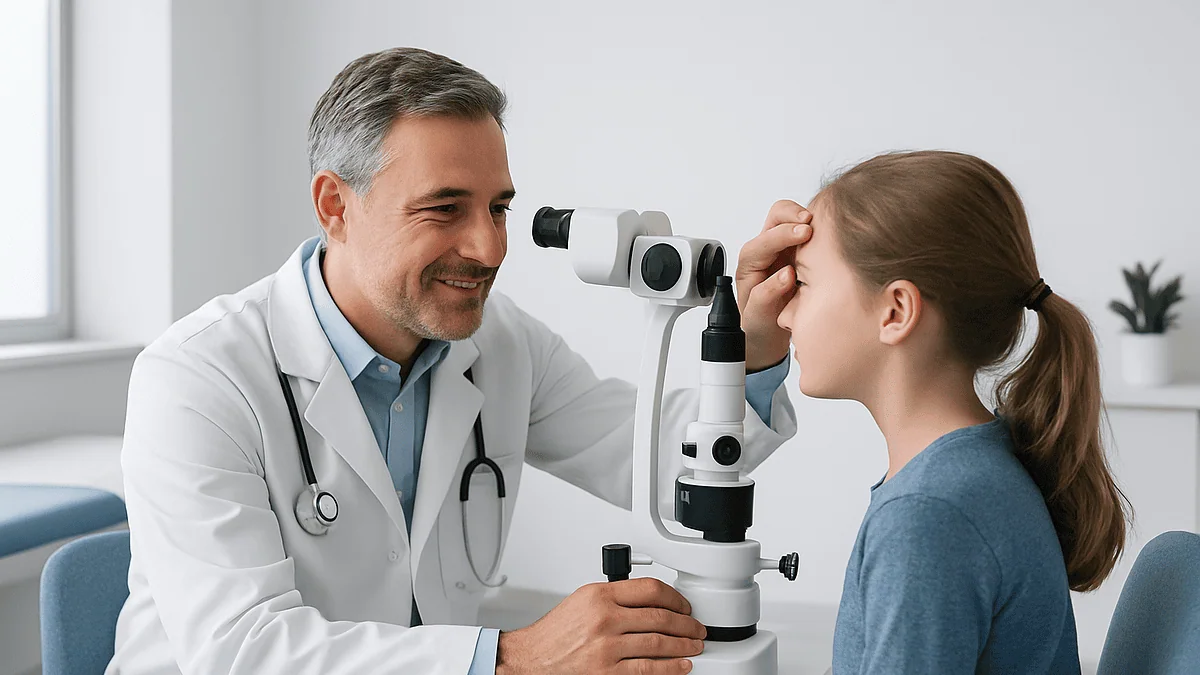
The examination is low-tech, fast and remarkably informative. Most of it can be done with a penlight, a small occluder and a set of handheld prisms.
The corneal light reflex test comes first. The examiner shines a light toward both eyes and looks at where the reflection falls on each cornea. In straight eyes the two reflections sit in the same spot; in a squint, one is off-center. Then comes the cover test, the workhorse of squint assessment. The child or adult looks at a target while the examiner covers one eye and watches the other. If the uncovered eye jumps to take up fixation, it was not pointing at the target beforehand. Alternating the cover between the eyes reveals squints that only appear when the eyes are prevented from working together.
Vision is measured in each eye separately, using pictures or matching games for children too young to read letters, because detecting amblyopia is as important as measuring the angle. Prisms are then held in front of the eye to quantify the misalignment, and the movement of each eye in all directions is checked to identify a muscle that is not pulling its weight.
The examiner will also want to look inside the eye. Drops that widen the pupil allow the retina and optic nerve to be inspected and the true focusing power of the eye to be measured without the child’s own effort interfering. Johns Hopkins notes this dilated examination is standard, because a squint occasionally signals a structural problem that changes the whole plan. Older children and adults with a new squint may be referred for imaging or blood tests if the pattern suggests a neurological or thyroid cause.
Can glasses fix a squint?
Sometimes completely, and they are almost always the first step. The reason lies in the focusing link described earlier. When a farsighted child strains to focus, the eyes are pulled inward. Give that child the correct lenses and the focusing effort disappears, taking the inward pull with it. For this group, often called accommodative esotropia, glasses alone may hold the eyes straight for as long as they are worn, which is why a parent may notice the eyes cross the moment the glasses come off.
The NHS lists glasses as the first-line treatment when a squint is caused by a refractive error, and the same logic applies to a large prescription difference between the two eyes: correcting it removes one of the drivers of amblyopia at the same time.
Glasses do not straighten every squint. An eye that turns because of a muscle or nerve problem will keep turning whether the world is in focus or not. Even so, the right lenses are usually prescribed before any other intervention, for two reasons. First, they may reduce the angle enough to change what else is needed. Second, surgeons want to know the true residual misalignment with the eyes fully corrected before they plan an operation.
For adults with small, stable squints, prism lenses offer a different kind of fix. A prism ground into the spectacle lens bends light so that the image lands on the right part of the retina despite the eye’s misalignment. It does not move the eye; it moves the picture. The Cleveland Clinic includes prism glasses among the non-surgical options for adults with double vision, and for many people they are enough.
Patching and eye drops: how a lazy eye is treated
If a squint has led to amblyopia, straightening the eyes is not enough. The brain has to be persuaded to use the eye it has been ignoring, and the tools for that are deliberately simple.
Patching is the best known. A soft patch covers the stronger eye for part of each day, forcing the brain to rely on the weaker one and rebuild the connection. The NHS describes wearing a patch for a few hours a day, usually alongside glasses, and the length of treatment is measured in months rather than weeks. Children are often asked to do visually demanding tasks while patched, since reading, drawing or detailed play gives the weak eye more to work with than staring at a wall.
The alternative is eye drops placed in the stronger eye. These temporarily blur its near vision by relaxing the focusing muscle, which achieves a similar effect to a patch without something the child can pull off. The Mayo Clinic lists both approaches as standard, and the choice between them usually depends on the child’s age, the degree of amblyopia and what the family can realistically sustain. Any decision about drops, including how often they are used, sits with the prescribing clinician.
Two points deserve honesty. Patching is hard for families; the stronger eye is covered and the child is asked to spend hours seeing poorly. It works, but only if it is done. And the window matters: the National Eye Institute emphasizes that amblyopia responds best during early childhood while the visual pathways are still developing, though older children can still improve and should not be written off.
Do eye exercises work for a squint?
This is where hope and evidence part company, and it is worth being precise about where the line falls.
For most squints, exercises do not straighten the eyes. A constant inward turn in a toddler, or an outward drift caused by a weak muscle, is not a fitness problem. The muscles are not weak in the gym sense; the signal telling them how far to pull is miscalibrated. No amount of pencil push-ups will recalibrate it. MedlinePlus and the NHS both list glasses, patching, injections and surgery as the treatments with an evidence base, and neither positions general eye exercises as a cure for strabismus.
There is one genuine exception. Convergence insufficiency is a condition in which the eyes struggle to turn inward together for near tasks, producing eye strain, blurred print and sometimes intermittent double vision when reading. Structured convergence exercises, supervised by an orthoptist or optometrist, have reasonable evidence for this specific problem, and the Cleveland Clinic includes vision therapy among options for certain types of misalignment. It is a narrow indication, not a general remedy.
The practical advice is to ask two questions of anyone offering exercises. What type of squint do I or my child have, and what does the evidence say exercises can do for that type? A clear answer to both is reassuring. A promise that exercises will make surgery unnecessary for every squint is not. Meanwhile, time spent on unproven programs is time in which a child’s amblyopia may be quietly deepening, and that trade-off is the real cost.
What happens in squint surgery?
When glasses and other measures leave a significant misalignment, surgery on the eye muscles is the standard option for children and adults alike. The idea is mechanical: loosen a muscle that pulls too hard, tighten one that pulls too little, or both, so the resting position of the eye moves toward straight.
The operation is performed on the outside of the eyeball. The surgeon makes a small opening in the conjunctiva, the thin membrane covering the white of the eye, reaches the muscle where it attaches and either moves the attachment point further back to weaken its pull or shortens the muscle to strengthen it. Nothing is done inside the eye itself. Children have the procedure under general anesthesia; adults may have general or local anesthesia depending on the plan. The NHS describes squint surgery as usually done as a day case, with the patient going home the same day.
Recovery is generally straightforward but not instant. The eye is red and sore for a period afterward, and the NHS notes it usually takes a few weeks to recover fully, with advice to avoid swimming and to keep the eye clean during that time. Some adults are fitted with an adjustable suture that allows fine-tuning of the muscle position once they are awake.
The honest caveat is that a single operation does not guarantee permanently straight eyes. The NHS states that some people need more than one procedure, either because the initial correction settles short of the target or because the alignment drifts over years. Risks the surgeon will discuss include over- or under-correction, temporary double vision, infection and, rarely, damage to the eye. Whether surgery is right, and when, is a decision for the treating team with the family.
Injections into the eye muscle: a temporary alternative
For some squints, particularly in adults and in certain patterns of misalignment in children, a muscle-weakening injection offers a middle path between glasses and surgery.
The mechanism is straightforward. A small amount of a nerve-blocking agent is injected directly into the eye muscle that is pulling too strongly. The injection interrupts the signal between nerve and muscle, so the overactive muscle relaxes and the opposing muscle is able to pull the eye toward the center. The effect builds over days and then fades, which is both its limitation and its appeal.
The NHS notes that the effects of these injections usually last around 3 months. In some people the eyes settle into a new, straighter position that persists after the drug has worn off, because the brain has had a window in which to re-establish binocular vision. In others the squint returns and the injection can be repeated, or the information gained is used to plan surgery with more confidence. Clinicians sometimes use an injection specifically as a trial, to see how a person’s double vision changes when the eye is straighter before committing to an operation.
Side effects are mostly local and temporary. A drooping eyelid or a period of over-correction, in which the eye turns the opposite way for a few weeks, are the ones most often mentioned. As with any medication, the choice of agent, whether it is appropriate and how often it might be repeated are matters for the prescribing specialist, and this article deliberately avoids product names or amounts.
When should you see a doctor about a squint?
The short version: any squint that persists beyond early infancy, and any new squint at any age, should be examined. The NHS advice for children is to seek assessment if a baby’s squint is constant, or if an intermittent squint is still present after 3 months of age. Older children who develop a turn, tilt their head to see, cover one eye or seem to lose interest in detailed play should also be seen. Waiting rarely helps and, because of the amblyopia window, can cost vision that is hard to recover later.
Some situations need urgent attention rather than a routine appointment. Seek same-day care if a squint appears suddenly in an adult or older child together with double vision, especially if it comes with a severe headache, a drooping eyelid, weakness or numbness in the face or limbs, difficulty speaking, or a pupil that has changed size. These combinations can signal a stroke, a bleed, raised pressure inside the head or a nerve problem that needs rapid assessment. A white or unusual reflection in a child’s pupil in photographs, rather than the normal red, should also be checked promptly, since it can indicate a problem inside the eye.
For everything else, the pathway is calmer. A primary care clinician or optometrist can confirm whether a squint is present and arrange referral to an orthoptist or ophthalmologist. Adults who have had a squint since childhood and want to discuss options should not assume they have missed the boat; the Cleveland Clinic is explicit that strabismus can be treated at any age, and the goals simply shift from protecting developing vision toward restoring alignment, relieving double vision and improving comfort.
Living with a squint as an adult
Grown-ups with a squint carry two separate burdens, and medicine has historically taken the first more seriously than the second.
The first is functional. Double vision interferes with reading, driving and walking on uneven ground. Loss of depth perception makes judging distances harder, which matters for everything from parking to pouring. Prisms, injections and surgery each address these problems in different ways, and the choice between them depends on the size and stability of the squint, the cause, and what the person most wants to fix.
The second burden is social, and it is real. Eye contact is the currency of conversation, and a visible misalignment can leave people unsure where to look, which some adults with a squint say they feel in every meeting and every photograph. For years this was dismissed as cosmetic. The current view, reflected in patient information from major centers including Johns Hopkins, is that restoring alignment in adults carries genuine benefits for communication, confidence and quality of life, and that these are legitimate reasons to seek treatment. Surgery in adults is not purely cosmetic in the way the word is often used; it is reconstructive.
Expectations should still be realistic. An adult whose squint began in childhood may never regain full three-dimensional vision, because the brain’s ability to fuse two images was set decades ago. What can usually be achieved is straighter eyes, a wider field of single vision and relief from the effort of managing a misalignment all day. Discussing which of those outcomes matters most, and which are realistically on offer, is the conversation worth having with the treating team before any decision is made.
Frequently asked questions
Is a squint the same as a lazy eye?
No. A squint is a misalignment of the eyes, while a lazy eye (amblyopia) is reduced vision in one eye because the brain has stopped using it. A squint is one of the main causes of lazy eye, since the brain suppresses the image from the turned eye, so the two often occur together and both usually need treatment.
Can a squint go away on its own?
Occasional eye crossing in newborns usually resolves within the first few months as coordination develops. A true squint that persists past about 3 months of age, or that appears later in childhood or adulthood, does not typically correct itself and should be assessed, because untreated misalignment in a young child risks permanent vision loss in the affected eye.
What causes a squint in adults?
Adult-onset squints are usually symptoms of another condition affecting the nerves or muscles that move the eyes. Common causes include stroke, head injury, thyroid eye disease and diabetes affecting the small nerves. Some adults also have a childhood squint that was never treated or has drifted back. New double vision in an adult should always be checked.
How is a squint diagnosed in a baby?
An examiner shines a light at both eyes and checks whether the reflection sits in the same place on each cornea, then covers each eye in turn to see whether the other moves to take up fixation. Vision is checked in each eye, and drops are used to widen the pupils so the back of the eye and the true prescription can be assessed.
Do glasses cure a squint?
For squints driven by farsightedness, the right glasses can hold the eyes straight for as long as they are worn, because they remove the focusing effort that pulls the eyes inward. Squints caused by muscle or nerve problems are not corrected by glasses alone, though lenses are still usually prescribed first to reduce the angle and clarify what else is needed.
How long does a child need to wear an eye patch?
Patching for a lazy eye is typically worn for a few hours each day over a period of months, alongside glasses if needed, with progress checked at regular appointments. The exact schedule is set by the treating clinician based on the child’s age and vision. Treatment tends to be most effective when started in early childhood.
Is squint surgery done under general anesthesia?
Children have squint surgery under general anesthesia. Adults may have general or local anesthesia depending on the surgical plan, and some are fitted with an adjustable suture that lets the surgeon fine-tune the eye position afterward. The procedure is usually done as a day case, and the operation takes place on the muscles outside the eyeball, not inside the eye.
How long is recovery after squint surgery?
The eye is usually red and sore for a while after surgery, and the NHS notes that full recovery generally takes a few weeks, with advice to avoid swimming and keep the eye clean during that period. Most people return to school or work within days. Some individuals need more than one operation over time if alignment settles short of the target or drifts later.
Can eye exercises fix a squint?
For most squints, no. Exercises do not correct a constant inward or outward turn caused by miscalibrated nerve signals or a weak muscle. The exception is convergence insufficiency, a specific difficulty turning the eyes inward for near work, where supervised exercises have reasonable evidence. Ask what type of squint is present before starting any exercise program.
Is it too late to treat a squint as an adult?
No. Strabismus can be treated at any age with prism glasses, muscle-weakening injections or surgery. Adults may not regain full depth perception if the squint began in childhood, but straighter eyes, relief from double vision and easier eye contact are realistic goals. Major medical centers now recognize these as genuine functional benefits rather than purely cosmetic ones.
References
- NHS – Squint
- MedlinePlus – Strabismus
- Cleveland Clinic – Strabismus (Crossed Eyes)
- National Eye Institute (NIH) – Amblyopia (Lazy Eye)
This article is for general information only and is not a substitute for professional medical advice. Please consult a qualified doctor about your individual situation.

More from the Blog

Are Swollen Feet Dangerous? When Puffiness Is a Signal
Most swollen feet aren't dangerous, long days standing, heat, salty meals, and pregnancy commonly cause temporary puffiness that improves with rest and elevation. Swelling…

Is Asthma Hereditary? Genetics, Environmental Triggers and Family Risk Explained
Asthma is partly genetic but not purely inherited. Having a parent or sibling with asthma raises your risk, and many gene regions have been…

What a Hernia Feels and Looks Like (and What Gets Mistaken for One)
A hernia usually feels like a dull ache, heaviness, or burning around a soft lump, most often in the groin or near the navel,…

Can Epilepsy Be Cured, Go Away, or Be Grown Out of?
Epilepsy can sometimes go away, but doctors rarely use the word cured. Some childhood epilepsies resolve with age, and specialists consider epilepsy resolved after…

Upper Stomach Pain: Causes and When It Needs a Doctor
To ease upper stomach pain quickly, sit upright, loosen tight clothing, and sip water or a warm non-caffeinated drink; gentle warmth on the abdomen…
Can Stress Cause a Stroke? What the Evidence Says and How to Lower Your Risk
Stress by itself rarely causes a stroke directly, but sustained stress is linked with higher stroke risk. Large international studies show people reporting chronic…