Strabismus
Strabismus is eye misalignment that can affect vision, depth perception and eye comfort. Learn symptoms, causes, diagnosis and treatment.
Quick answer
Strabismus is a condition in which the eyes do not align properly, causing one eye to turn inward, outward, upward, or downward and potentially affecting vision and depth perception. Treatment depends on the cause and severity and may include glasses, eye exercises, prism lenses, or surgery; at Acibadem in Turkey, care is planned after a detailed eye examination by ophthalmology…
What is strabismus?
Strabismus is the medical term for misaligned eyes, a condition in which the two eyes do not point in the same direction at the same time. While one eye looks straight at an object, the other eye may turn inward (toward the nose), outward (toward the ear), upward, or downward. People often describe this condition as “crossed eyes,” “a squint,” or a “wandering eye,” although those everyday terms cover only some of its forms.
To understand what is strabismus and why it matters, it helps to know how normal vision works. Each eye captures a slightly different picture, and the brain merges these two pictures into a single, three-dimensional image. This merging process is called binocular vision. Six small muscles attached to each eye keep both eyes aimed at the same target. When those muscles, the nerves that control them, or the brain centers that coordinate them do not work together properly, the eyes drift out of alignment and strabismus results.
Strabismus most often begins in infancy or early childhood, and it is one of the most common eye conditions seen in young children. However, it can also appear for the first time in adults, sometimes as a result of another medical condition. The pattern of eye turn is used to describe the type: esotropia (an inward turn), exotropia (an outward turn), hypertropia (one eye higher than the other), and hypotropia (one eye lower than the other). The misalignment may be constant, present all the time, or intermittent, appearing only when a person is tired, unwell, or focusing on something very near or very far away.
Strabismus is more than a cosmetic issue. In children, an untreated eye turn can interfere with normal visual development and lead to amblyopia, often called “lazy eye,” in which the brain begins to ignore the image from the turned eye and vision in that eye becomes permanently reduced. In adults, new strabismus usually causes double vision and can occasionally signal an underlying neurological or medical problem. For these reasons, any suspected eye misalignment deserves a professional evaluation.
Symptoms of strabismus
Strabismus symptoms vary depending on the person’s age, the type of eye turn, and whether the misalignment is constant or comes and goes. The most recognizable sign is visible: the eyes simply do not appear to look in the same direction. Other symptoms are less obvious and may be noticed only by a parent, teacher, or eye specialist.
Common strabismus symptoms include:
- Visible eye misalignment: one eye turning in, out, up, or down while the other looks straight ahead, either constantly or intermittently.
- Double vision (diplopia): seeing two images of a single object, most common in adults or older children who develop strabismus after their visual system has matured.
- Squinting or closing one eye: especially in bright sunlight or when concentrating, as a way of suppressing a confusing second image.
- Abnormal head posture: tilting or turning the head to keep the eyes aligned and avoid double vision.
- Eye strain, headaches, or tired eyes: particularly after reading or other close work, which is common in intermittent forms.
- Poor depth perception: difficulty judging distances, catching a ball, or pouring liquids accurately.
- Reduced vision in one eye: when strabismus has led to amblyopia, the affected eye may see less clearly even with glasses.
Symptoms often differ by type and stage. In infants and toddlers, the eye turn itself is usually the only sign, because young children rarely complain of double vision; their developing brains quickly suppress the image from the turned eye. This suppression protects them from seeing double but puts them at risk of amblyopia. In intermittent exotropia, one of the most common childhood forms, the outward drift may appear mainly when the child is tired, daydreaming, or ill, and the eyes may look perfectly straight at other times. Early on, parents may notice the drift only in photographs or in bright light when the child squints one eye.
In adults, new-onset strabismus behaves differently. Because the adult brain cannot easily suppress one image, double vision is usually the dominant complaint. Adults may also report that the double vision changes with the direction of gaze, or that it began suddenly. Sudden misalignment or double vision in an adult should always be evaluated promptly, because it can sometimes indicate a problem with the nerves that control the eye muscles.
It is worth noting that some babies under a few months of age have eyes that occasionally seem to wander; this can be part of normal early development. A constant eye turn at any age, or any turn that persists beyond early infancy, is not normal and should be assessed by an eye specialist.
Causes and risk factors
There is often no single, identifiable cause. Strabismus causes generally fall into a few broad categories, and in many children the condition arises from a problem with the way the brain coordinates the eye muscles rather than from a defect in the muscles themselves.
- Problems with brain control of eye alignment: the most common situation in childhood strabismus, in which the brain’s system for keeping the eyes aligned does not develop or function normally.
- Uncorrected refractive errors: significant farsightedness (hyperopia) in children can cause a form of inward eye turn called accommodative esotropia, because the extra focusing effort needed to see clearly pulls the eyes inward.
- Family history: strabismus often runs in families, suggesting a genetic contribution, although the exact inheritance pattern is not fully understood.
- Nerve or muscle problems: weakness or paralysis of one of the cranial nerves that move the eyes (a “palsy”) can cause misalignment, particularly in adults. Conditions affecting the eye muscles themselves, such as thyroid eye disease, can also cause strabismus.
- Neurological and developmental conditions: strabismus is more common in children with cerebral palsy, Down syndrome, hydrocephalus, and other conditions affecting the brain, as well as in children born prematurely or with low birth weight.
- Poor vision in one eye: any condition that severely reduces vision in one eye, such as a cataract or, rarely, a tumor inside the eye, can cause that eye to drift, because the brain has less incentive to keep it aligned.
- Medical conditions in adults: diabetes, high blood pressure, stroke, head injury, and certain neuromuscular disorders such as myasthenia gravis can cause new strabismus in adulthood.
Risk factors, then, include a family history of strabismus or amblyopia, prematurity, significant uncorrected farsightedness, and certain neurological or genetic conditions. That said, many children who develop strabismus have none of these risk factors, and most children with a risk factor never develop the condition. Strabismus is not caused by reading in dim light, sitting too close to a screen, or “crossing the eyes on purpose,” despite common beliefs.
Diagnosis
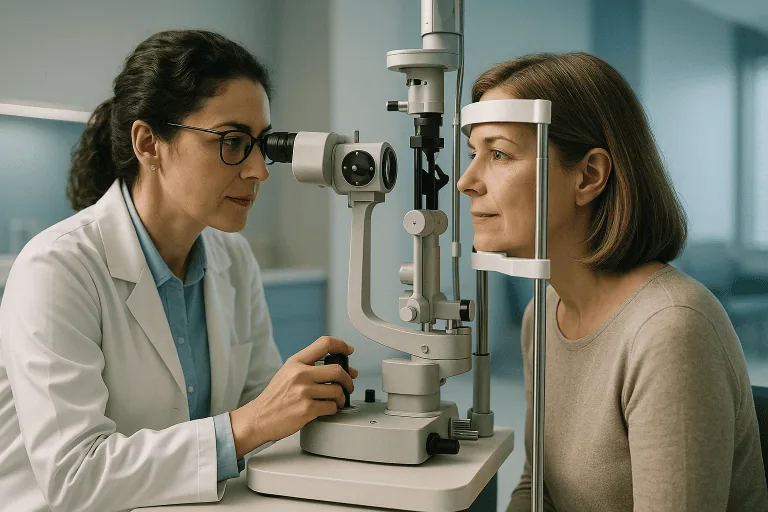
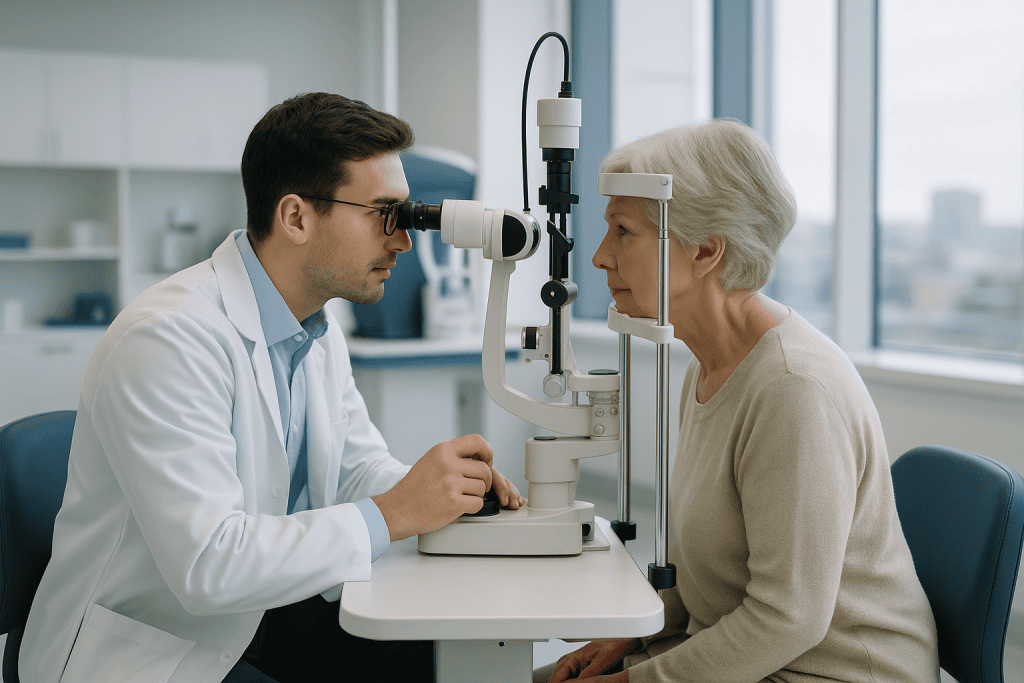
Strabismus diagnosis is made through a clinical eye examination rather than through blood tests or, in most cases, imaging. An ophthalmologist (a physician specializing in eye and vision care) or, for children, a pediatric ophthalmologist typically performs the assessment. Orthoptists, specialists in eye movement and binocular vision, often assist with the measurements.
A typical evaluation includes several steps:
- History: when the eye turn was first noticed, whether it is constant or intermittent, which eye is affected, any double vision, family history, and general health, including birth history in children.
- Visual acuity testing: measuring how well each eye sees, using age-appropriate methods such as picture charts for young children or letter charts for older children and adults. This helps detect amblyopia.
- Corneal light reflex test (Hirschberg test): the examiner shines a small light at the eyes and checks whether the reflection sits symmetrically on both corneas; an off-center reflection suggests misalignment.
- Cover tests: the examiner covers one eye and watches whether the other eye moves to pick up fixation, then alternates the cover between the eyes. These simple tests reveal both obvious and hidden misalignments and help distinguish a true eye turn (tropia) from a latent tendency to drift (phoria).
- Prism measurements: prisms of different strengths are used to measure the size of the deviation precisely, in different directions of gaze and at near and far distances. These measurements guide treatment planning, especially before surgery.
- Refraction with dilating drops: in children, eye drops are used to relax the focusing muscles so the examiner can measure the full refractive error accurately. This step is essential, because significant farsightedness is a treatable cause of inward eye turn.
- Examination of the inside of the eye: the retina and optic nerve are checked to rule out structural problems that could reduce vision and cause a secondary eye turn.
Imaging such as an MRI or CT scan of the brain is not needed for most childhood strabismus. Your doctor may order imaging when the misalignment appears suddenly, is accompanied by other neurological signs, follows a head injury, or has features suggesting a nerve palsy, particularly in adults. Blood tests may be considered when a condition such as thyroid disease or myasthenia gravis is suspected.
Because early detection protects a child’s visual development, routine vision screening in infancy and the preschool years plays an important role. Any child who fails a screening, or whose parents notice an eye turn, should have a full examination rather than a wait-and-see approach at home.
Treatment options
Strabismus treatment is tailored to the person’s age, the type and size of the eye turn, its cause, and whether amblyopia or double vision is present. The goals are to protect or restore vision in each eye, realign the eyes, rebuild binocular vision where possible, and relieve symptoms such as double vision. Care is usually coordinated within an ophthalmology department, where pediatric ophthalmologists and orthoptists work together; at Acibadem, for example, strabismus is managed within this specialty. Common approaches include the following:
- Glasses or contact lenses: correcting a significant refractive error is often the first step. In accommodative esotropia, the right glasses alone can straighten the eyes in many cases, sometimes fully. Bifocal lenses are occasionally used when the turn is worse at near distances.
- Treatment of amblyopia: when the turned eye has become weaker, patching the stronger eye for set periods each day, or blurring it with atropine eye drops, encourages the brain to use the weaker eye. Treating amblyopia is a priority in children and often precedes surgery.
- Prism lenses: prisms built into or attached to glasses bend light so that the two images can merge, which can relieve double vision, particularly in adults with smaller or stable deviations.
- Orthoptic exercises (vision therapy): structured eye exercises can help in selected situations, most notably convergence insufficiency, a condition in which the eyes struggle to work together for near tasks. Exercises are not effective for most other forms of strabismus, and your doctor can advise whether they are appropriate.
- Botulinum toxin injections: injecting a small dose of botulinum toxin into an overacting eye muscle temporarily weakens it and can improve alignment. This option is used in selected cases, sometimes as a diagnostic step or as an alternative to surgery; the effect wears off over months and may need repeating.
- Strabismus surgery: when glasses and other measures are not enough, surgery on the eye muscles can realign the eyes. The surgeon loosens (recesses) or tightens (resects) specific muscles, or repositions them, to balance the pull on the eye. Surgery is performed on the muscles outside the eyeball; the eye itself is not removed or opened. It is usually done under general anesthesia in children and often as a day procedure. Some people need more than one operation over their lifetime to achieve or maintain good alignment, and glasses may still be needed afterward.
- Watchful waiting: in some situations, such as small or well-controlled intermittent deviations that are not affecting vision, your doctor may recommend regular monitoring rather than immediate intervention.
Timing matters, especially in children. Treating amblyopia and realigning the eyes during the years when the visual system is still developing offers the best chance of building binocular vision. However, treatment is not only for children: adults with long-standing or new strabismus can also benefit from surgery or prisms, both to relieve double vision and to restore normal eye alignment, which can meaningfully improve daily functioning and social comfort. Realignment in adults is considered reconstructive, not merely cosmetic.
No single treatment works for everyone, and results cannot be guaranteed. Many people need a combination of approaches over time, along with regular follow-up to catch any drift back toward misalignment.
Living with strabismus and outlook
The outlook for strabismus depends largely on the cause, the age at which treatment begins, and how consistently treatment is followed. In many children, early treatment leads to straight or nearly straight eyes, good vision in both eyes, and useful binocular vision. When treatment starts late, vision in the turned eye may remain reduced despite best efforts, and depth perception may be limited, although alignment can often still be improved.
Strabismus can recur or change over time, even after successful treatment. For this reason, children usually need follow-up visits for years, with periodic checks of vision, alignment, and glasses prescriptions. Parents play a central role: consistent use of glasses, faithful patching schedules, and keeping appointments make a real difference to outcomes.
For older children and adults, the psychological and social dimensions matter too. Noticeable eye misalignment can affect self-confidence, eye contact, and social interaction. It is reasonable to raise these concerns with your eye doctor, because alignment surgery or prisms may help even when the condition has been present for decades. Adults who develop double vision may face practical challenges with driving, reading, and work; temporary measures such as patching one eye or stick-on prisms can help while a longer-term plan is made.
Living well with strabismus generally involves protecting the vision you have: attending regular eye examinations, wearing prescribed glasses, reporting any new drift or double vision promptly, and, for people whose strabismus is linked to another condition such as diabetes or thyroid disease, managing that underlying condition with their medical team.
Frequently asked questions
What is strabismus in simple terms?
Strabismus means the two eyes are not aligned: one eye looks at the target while the other points inward, outward, upward, or downward. It happens when the eye muscles, the nerves controlling them, or the brain’s coordination system do not keep the eyes working together. It can be constant or intermittent, and it affects both children and adults.
Can strabismus go away on its own?
True strabismus rarely resolves without treatment. Brief, occasional eye wandering can be normal in very young babies, but a constant turn, or any turn persisting beyond early infancy, generally will not correct itself and can harm a child’s visual development if left untreated. An examination by an eye specialist is the safest way to tell the difference.
Is strabismus serious?
It can be. In children, untreated strabismus is a leading cause of amblyopia, in which vision in one eye becomes permanently reduced. In adults, sudden new misalignment or double vision can occasionally signal a neurological problem and should be evaluated promptly. Many cases, however, respond well to treatment, especially when it starts early.
Can adults be treated for strabismus, or is it too late?
It is not too late. Adults with strabismus, whether long-standing or new, can often be helped with prisms, botulinum toxin injections, or eye muscle surgery. While amblyopia that developed in childhood usually cannot be fully reversed in adulthood, eye alignment can often be improved at any age, which may relieve double vision and improve depth perception, appearance, and comfort.
What does strabismus surgery involve, and how long is recovery?
Strabismus surgery adjusts the position or tension of the small muscles on the outside of the eyeball to improve alignment. It is often performed as a day procedure, under general anesthesia in children. Afterward, the eye is typically red and mildly sore for a period of days to weeks, and most people gradually return to normal activities as advised by their surgeon. Some people need additional procedures later, and glasses may still be required.
Are strabismus symptoms always visible?
No. Small or intermittent deviations may not be obvious to family members, and young children usually do not report double vision because their brains suppress the second image. Subtle signs such as head tilting, closing one eye in sunlight, eye strain, or poor depth perception may be the only clues, which is why routine childhood vision screening is important.
Does screen time cause strabismus?
There is no established evidence that screens cause strabismus, and habits such as sitting close to the television do not cross the eyes. Strabismus arises from problems in the muscles, nerves, or brain systems that align the eyes, or from uncorrected refractive errors. That said, prolonged near work can make an existing tendency to drift more noticeable, and any persistent eye turn deserves evaluation.
When to see a doctor
Any suspected eye misalignment, at any age, warrants a professional eye examination. Early assessment is especially important for children, because delays can allow amblyopia to develop during the critical years of visual development.
Seek medical attention urgently if you or your child experience any of the following red flags:
- Sudden onset of double vision or a new eye turn in an older child or adult, especially if it developed over hours or days.
- Eye misalignment after a head injury.
- Misalignment accompanied by a drooping eyelid, unequal pupils, severe headache, weakness, numbness, difficulty speaking, or loss of balance, which may indicate a neurological emergency.
- A white or gray reflection in a child’s pupil (instead of the normal red reflex in photographs), which requires prompt evaluation to rule out serious eye disease.
- Pain in or around the eye together with double vision.
- A constant eye turn in a baby beyond the first few months of life, or any eye turn that appears or worsens in a previously straight-eyed child.
- Sudden loss or worsening of vision in one or both eyes.
Even without these warning signs, an eye turn that comes and goes, unexplained squinting or head tilting, or a family history of strabismus or amblyopia are all good reasons to arrange an eye examination. Timely diagnosis gives the best chance of protecting vision and restoring comfortable, aligned eyes.
Medically reviewed by the Acıbadem International Medical Board September 2, 2026
See our medical review board →
Update history
- PublishedJune 9, 2026
- Medical review approvedSeptember 2, 2026
- Last content updateSeptember 2, 2026