

Supplements, Herbal Products and Chemotherapy: Why Your Oncologist Asks Before You Start

Key Takeaways
- In a cooperative-group breast cancer trial cohort, antioxidant supplement use before and during chemotherapy was associated with roughly 41 percent higher recurrence risk, while multivitamins showed no association.
- St. John's wort speeds up the liver enzyme CYP3A4 and can lower blood levels of several chemotherapy drugs, which is why it is generally stopped before treatment on the prescriber's timeline.
- White blood cells typically reach their lowest point 7 to 14 days after a chemotherapy dose, and much of the cycle-specific supplement and food-safety advice is built around that window.
- Nearly all interaction concern attaches to concentrated capsules and extracts rather than to whole foods, with grapefruit and its relatives the main dietary exception because they inhibit CYP3A4.
- Oncology teams prescribe vitamins routinely, including folic acid and B12 with certain antifolate drugs, so extra shop-bought versions of the same nutrients should never be added on top.
- Dietary supplements are not reviewed for safety or effectiveness before sale, so a label cannot tell you whether a product is compatible with a specific chemotherapy regimen.
Oncologists ask about supplements during chemotherapy because some vitamins, herbs and extracts can change how chemotherapy drugs are absorbed, broken down or cleared, raise bleeding or liver risk, or may blunt the drugs' effect in the body. Evidence is strongest for interactions with a small number of herbs; for most vitamins the concern is high doses, not ordinary food-level intake. Decisions rest with the treating team.
The bag on the kitchen counter tells a story. A bottle of turmeric capsules a neighbor dropped off, a green powder a cousin swears by, the multivitamin that has been in the cupboard for years, and a printout about high-dose vitamin C that arrived by text at 11 p.m. Everyone means well. Nobody has checked whether any of it belongs in the same body as the chemotherapy that starts on Tuesday.
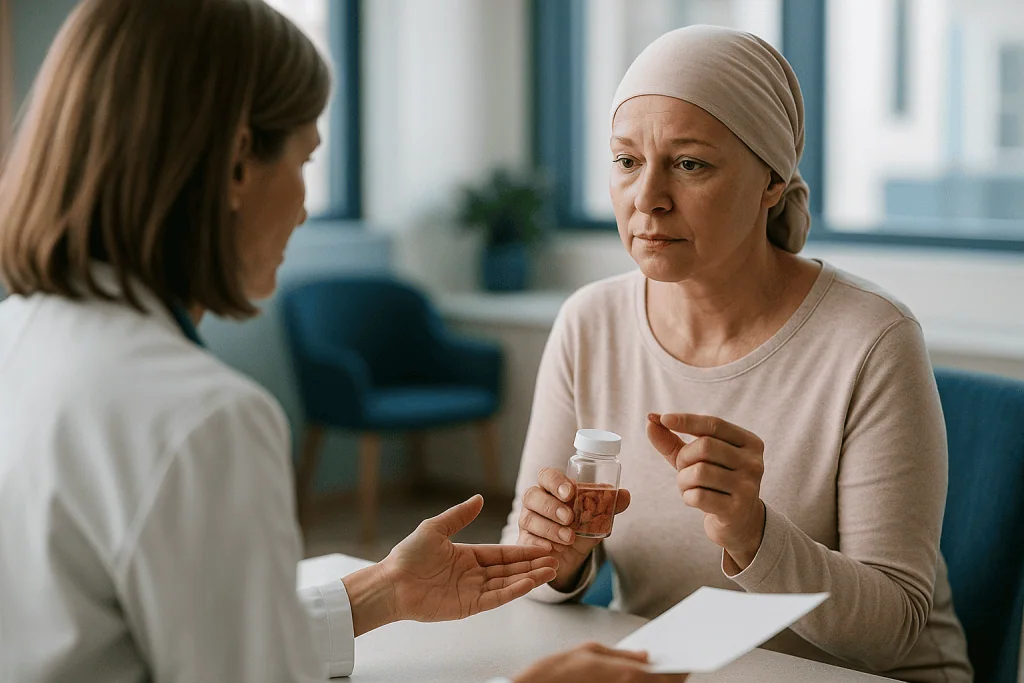
Then comes the appointment, and the question that sounds almost like an accusation: “Are you taking anything else? Vitamins, herbs, anything from a health shop?” The honest answer is usually a shrug and a list that trails off.
This article explains why that question matters so much, what the research on supplements during chemotherapy actually shows, which products draw the most concern and why, and how to bring the whole bag into the conversation without embarrassment. The goal is not to frighten anyone away from a vitamin. It is to make the decision an informed one, made together with the people who prescribe the treatment.
Why supplements during chemotherapy can change how the drugs work
Chemotherapy drugs are chosen and dosed to hit a narrow target: enough drug to damage rapidly dividing cancer cells, not so much that healthy tissue cannot recover. Anything that nudges the blood level of that drug up or down can shift the balance in either direction. Supplements can do exactly that, through several distinct routes.
The first is the liver. Many chemotherapy agents are broken down by a family of enzymes called cytochrome P450, the liver’s main chemical processing system. Some herbs speed these enzymes up, so the drug is cleared faster and less of it reaches the tumor. Others slow them down, so the drug lingers and side effects intensify. St. John’s wort is the textbook example of an accelerator; grapefruit compounds are a familiar example of a brake.
The second route is transport. Proteins in the gut wall and in cells act as gates and pumps for drugs. Certain plant compounds alter those gates, changing how much drug is absorbed or pushed out of cells.
The third is the drug’s own mechanism. Several chemotherapy classes and radiation therapy work partly by generating reactive oxygen molecules that damage cancer cells. Antioxidant supplements are designed to mop up exactly those molecules. Whether that protects the tumor in real patients is still debated, but the biological logic is why oncologists pause over high-dose antioxidants.
Finally, supplements add their own risks to a body already under strain: bleeding tendency from vitamin E, fish oil or ginkgo when platelets are low; liver stress from concentrated extracts; and, for live-bacteria products, a theoretical infection risk when white cell counts fall. The NIH Office of Dietary Supplements notes that supplements are not reviewed for safety or effectiveness before sale, which is why the label alone cannot answer these questions.
What supplements should not be taken during chemotherapy?
There is no single banned list that applies to every regimen, and any article that offers one is simplifying. What oncology teams tend to ask about falls into recognizable groups, each for a specific reason.

- Enzyme-changing herbs. St. John’s wort is the clearest case; it can markedly lower blood levels of several chemotherapy drugs by speeding up liver enzymes. Ginseng, echinacea, goldenseal, milk thistle and kava have shown enzyme effects in laboratory or small human studies and are usually reviewed individually.
- High-dose antioxidants. Large amounts of vitamin C, vitamin E, beta-carotene, selenium, coenzyme Q10 and similar products taken in capsule form are the group most often asked to pause, because of the mechanism described above and the observational signal discussed later in this article.
- Products that affect bleeding or clotting. Fish oil, vitamin E, ginkgo, garlic extracts and high-dose turmeric can each modestly increase bleeding tendency. On their own that rarely matters; combined with low platelets or a blood thinner, it can.
- Concentrated extracts with liver signals. Green tea extract, kava and some bodybuilding or weight-loss blends have been linked to liver injury in case reports. Chemotherapy already asks a great deal of the liver.
- Iron and B vitamins taken without a measured need. Iron given when there is no deficiency can worsen oxidative stress and constipation, and B12 and folic acid interact with specific drugs in ways that need a prescriber’s judgment, not a shop-bought decision.
- Anything unlabeled or blended. Multi-herb “immune” formulas, imported traditional remedies and powders with proprietary blends cannot be assessed because nobody knows precisely what is in them.
The MedlinePlus herbal medicine overview makes the broader point: “natural” says nothing about interaction potential. The correct response to any of these is not to stop or start on your own but to bring the bottle to the team.
What vitamins are safe to take during chemo?
People asking this question usually want reassurance that the ordinary multivitamin they have taken for a decade is not sabotaging their treatment. In most cases, a standard once-a-day multivitamin that supplies roughly food-level amounts of nutrients is not the product that worries oncologists. Many teams are comfortable with it, though “many” is not “all”, and some regimens come with specific instructions.
The distinction that matters is between replacing what is missing and adding large amounts hoping for a benefit. Replacement, guided by a blood test, is routine cancer care. Vitamin D deficiency is common in people with cancer and can be checked and corrected under supervision. Iron deficiency anemia, folate deficiency and B12 deficiency are all treatable and are treated because they matter for energy, for bone marrow recovery and for tolerating treatment. Some chemotherapy protocols require particular vitamins to be given deliberately, for example folic acid and B12 alongside certain antifolate drugs to reduce toxicity, and these are prescribed and timed by the team rather than bought over the counter.
Where the evidence gets thin is megadosing. A high-dose antioxidant capsule is a different intervention from a serving of berries, even though the nutrient name is the same. The NIH fact sheet on vitamin C describes both the everyday role of the vitamin and the uncertainty around large intravenous or oral doses in cancer, which remain a research question rather than an established therapy.
So the honest answer to “which vitamins are safe during chemo” is: those your team knows about, at amounts your team has agreed, ideally for a reason a blood test has revealed. A vitamin is not automatically safe because it is a vitamin, nor automatically harmful because it comes in a bottle.
Antioxidants during chemotherapy: what a large trial cohort actually showed
Much of the caution about antioxidants during chemotherapy became concrete with an analysis of women treated for early breast cancer within a large cooperative-group clinical trial. Participants were asked about supplement use both before chemotherapy started and during treatment, and were then followed for recurrence and survival.
The published analysis in PubMed reported that women who took antioxidant supplements, meaning vitamins A, C and E, carotenoids or coenzyme Q10, both before and during chemotherapy had a roughly 41 percent higher risk of recurrence than non-users, with a smaller and statistically less certain increase in the risk of death. Iron supplements taken during treatment were associated with about a 79 percent higher recurrence risk, and vitamin B12 use was linked to worse survival. Multivitamin use showed no such association in either direction.
Two things need saying plainly. First, this was an observational analysis inside a trial, not a randomized comparison of supplement versus no supplement. People who choose to take antioxidants may differ in ways the statistics cannot fully adjust for, so the findings show association, not proof of harm. Second, the numbers of supplement users were small, which is why the confidence intervals were wide.
What the study does is turn a theoretical worry into a documented signal that points in the same direction as the biology. That is why most oncology guidance now treats high-dose antioxidant capsules as something to avoid during active chemotherapy unless a clinician has a specific reason, while not extending that caution to fruit, vegetables or a basic multivitamin. It is also why the answer changes once treatment ends; the question of what to take afterward is a separate conversation with the same team.
Herbal supplements and chemotherapy interactions: the products asked about by name
A handful of herbs come up in nearly every pre-chemotherapy medication review because their interaction potential is well described.
St. John’s wort, taken for low mood, is the one oncologists most want to know about. It induces the liver enzyme CYP3A4 and a gut transporter protein, which can lower blood levels of several chemotherapy drugs enough to reduce their effect. It is generally stopped well before treatment begins, on the prescriber’s timeline, because the enzyme effect takes time to fade.
Green tea extract in concentrated capsule form has two concerns: case reports of liver injury, and laboratory work suggesting its main compound can bind to and inactivate a specific class of drugs used in blood cancers. Brewed tea in ordinary amounts is a different matter and is usually fine.
Turmeric or curcumin is popular for its anti-inflammatory reputation. In supplement doses it can affect platelet function and has shown enzyme effects in the laboratory; human data during chemotherapy are limited and mixed. Cooking with the spice is not the issue.
Ginseng, echinacea and goldenseal are often taken for “immunity” or energy and each has evidence of altering drug-metabolizing enzymes. Ginkgo and garlic extracts add bleeding risk. Kava carries a recognized liver-toxicity warning. Milk thistle, ironically taken to protect the liver, has enzyme effects that remain under study.
Ginger deserves a fairer mention. Small trials of ginger for chemotherapy-related nausea have shown modest and inconsistent benefit; it is one of the few herbs many teams are relaxed about in culinary or tea form, though capsules still warrant a conversation because of mild effects on clotting.
The MedlinePlus guidance applies to every one of these: tell the team, bring the label, and let the pharmacist check the specific regimen.
Supplement categories at a glance: concern, evidence and the usual approach
The table below summarizes how oncology pharmacists commonly think about the main categories. It is a framework for conversation, not a set of instructions; the same product can be fine in one regimen and a real problem in another.
| Category | Main concern | Strength of evidence | Typical team approach |
|---|---|---|---|
| Standard multivitamin | Little; occasionally duplicated nutrients | Observational data show no clear harm | Often permitted; confirm with team |
| High-dose antioxidants (C, E, beta-carotene, CoQ10, selenium) | May blunt oxidative mechanism of some drugs | Biological plausibility plus observational signal | Usually paused during active treatment |
| St. John’s wort | Speeds drug clearance via liver enzymes | Well documented human interactions | Generally stopped before treatment |
| Other herbs (ginseng, echinacea, milk thistle, kava, green tea extract) | Enzyme effects, liver stress | Laboratory and case-report data | Reviewed individually; often paused |
| Fish oil, ginkgo, garlic extract, high-dose vitamin E | Bleeding tendency with low platelets | Moderate; effect is modest alone | Often paused around low-count periods or procedures |
| Iron, B12, folic acid | Interactions with specific drugs; harm if no deficiency | Mechanistic and observational | Given only for measured need, prescribed by team |
| Vitamin D | Low risk at replacement amounts | Deficiency common; benefit of correction studied | Tested and corrected under supervision |
| Probiotics (live bacteria) | Theoretical infection risk when white cells low | Case reports; limited trials | Discussed individually; often avoided in neutropenia |
| Multi-herb blends, imported remedies | Unknown contents, contamination | Cannot be assessed | Usually asked to stop |
Notice how often “paused” rather than “forbidden” appears. Chemotherapy is delivered in cycles, and many teams distinguish between what is reasonable on treatment days, in the low-blood-count window, and in the recovery week. The Mayo Clinic chemotherapy overview describes this cyclical rhythm, and supplement advice generally follows it. The decision about any single row belongs to the prescribing team.
Who usually continues, and who is usually asked to wait
The people most likely to be told “carry on” are those taking a single, plain product for a documented reason. Someone on vitamin D because a blood test showed deficiency, or on a prescribed iron replacement for confirmed anemia, is doing the kind of supplementation oncology teams initiate themselves. A basic multivitamin without extra-strength claims usually sits in this group as well, once the team has seen the label.
The people most often asked to pause fall into a few patterns. Anyone taking high-dose antioxidants, whether as single vitamins or a combination “cellular health” formula, will usually be asked to hold them for the duration of active treatment. Anyone taking St. John’s wort will be asked to stop it, with the prescriber managing how and when so that mood is not left unsupported. Anyone on multiple herbal products is generally asked to strip back to what can be identified and checked.
Some treatment situations carry their own rules. Regimens built on drugs cleared by CYP3A4 are especially sensitive to enzyme-changing herbs and to grapefruit. Treatments known to lower platelets prompt caution about bleeding-related products. Protocols that deliberately include a vitamin, such as folic acid with certain antifolate drugs, require that nothing extra be added on top. People with existing liver disease or on blood thinners are asked to be particularly conservative.
Then there is the group nobody should overlook: people who have stopped eating well. Nausea, taste changes and mouth soreness can quietly turn a balanced diet into toast and tea. For them, the more valuable conversation is not about capsules but about a dietitian referral and, where needed, a medical nutrition product chosen by the team. The NHS guide to chemotherapy side effects lists appetite loss among the common effects precisely because it is so often the real nutritional problem.
What is the "7 day rule" in chemotherapy?
This phrase circulates widely online, yet there is no formal “7 day rule” in any major oncology guideline. When people use it, they usually mean one of three quite different things, and it is worth untangling them.
The most common meaning relates to blood counts. After a chemotherapy dose, white blood cells typically fall to their lowest point, called the nadir, roughly 7 to 14 days later, before recovering ahead of the next cycle; the NHS describes this window as the period of highest infection risk. Some people have compressed that into “the 7 day rule”: be especially careful about crowds, food hygiene and fever from about a week after treatment. That is sensible, but the exact timing depends on the regimen, so the team’s own guidance beats any rule of thumb.
A second meaning comes from surgical practice, where patients are often asked to stop herbal products and certain supplements a week or more before an operation because of bleeding and anesthesia interactions. That advice has migrated, loosely, into chemotherapy conversations. Some enzyme-inducing herbs do need to be stopped in advance because their effect on the liver takes days to wear off, but the interval is set by the prescriber, not by a fixed number.
A third usage appears on wellness sites suggesting a supplement can be taken for seven days and then paused around infusion. There is no evidence base for that pattern, and it is not something to adopt without asking.
The useful lesson inside the phrase is real: chemotherapy has a rhythm, and what is reasonable to take or do changes across the cycle. The number itself is folklore. Ask the team what the actual timeline for your regimen looks like.
What the days and weeks around a cycle usually look like
Most chemotherapy is given in cycles, a treatment day or days followed by a rest period, repeated several times over months. The Mayo Clinic notes that cycle lengths and the number of cycles vary widely by drug and cancer type. Within that structure, supplement questions tend to cluster at predictable points.
Before the first cycle. This is the review. A pharmacist or nurse goes through every product, ideally with the bottles present. Herbs with lingering enzyme effects are stopped on the prescriber’s schedule so the liver has returned to baseline by the first dose. Blood tests establish whether any vitamin or mineral is genuinely low.
Treatment day and the two or three days after. Anti-nausea medicines, steroids and the chemotherapy itself are all in the system. Teams usually prefer nothing extra added here; even something as ordinary as ginger tea is worth mentioning because of the volume of drugs being processed.
Days 7 to 14. The nadir window described by the NHS. Infection precautions matter most now. Live-bacteria products and anything that could add bleeding risk are the usual points of caution if platelets are also low.
The recovery week. Appetite often returns and counts climb. This is when a repeat conversation about nutrition is most productive, and when a dietitian can help someone who lost ground.
After the final cycle. The rationale for pausing antioxidants during active treatment no longer applies in the same way, but that does not mean everything can restart automatically. Follow-up blood tests, ongoing hormone or targeted therapy, and recovery of the liver all influence what makes sense. The end-of-treatment appointment is the right place to ask.
What people often get wrong about supplements during chemotherapy
“If it’s natural, it can’t interfere.” Digoxin, morphine and several chemotherapy drugs are themselves plant-derived. Natural origin says nothing about potency or interaction potential. The most powerful interactions on the oncology pharmacist’s list belong to herbs.
“Antioxidants protect my healthy cells, so they must help.” That is the hope, and small studies have explored it. But the same molecules that might shield healthy cells may shield cancer cells from the oxidative damage certain drugs rely on, and the observational data discussed earlier point the wrong way. Uncertain is not the same as beneficial.
“My oncologist doesn’t believe in supplements.” Oncology teams prescribe vitamins regularly: folic acid alongside specific drugs, vitamin D for deficiency, iron for anemia. The objection is to unknown products at unknown doses added without a reason, not to nutrition.
“I’ll just not mention it.” Roughly the worst option. An unexpected drop in drug levels or a bleeding episode is far harder to interpret when a key variable is hidden. Nobody is judged for having a cupboard full of bottles; almost everyone does.
“A juice or smoothie is the same as a supplement.” Whole foods deliver nutrients in food-level amounts with fiber and water. A capsule concentrates one compound far beyond what a plate provides. The caution in this article is about the capsule.
“Stopping my supplements means giving up on doing anything for myself.” Eating well, moving as much as energy allows, sleeping, managing stress and turning up to every appointment are the self-directed actions with evidence behind them. A supplement pause is not passivity.
“Once treatment ends, everything is back on the table.” Possibly, but ongoing therapies and recovering organs mean the question deserves its own appointment rather than an assumption. The NIH reminder stands at every stage: check with a health professional before combining supplements with medicines.
Food versus capsules: what to avoid during chemo and what to keep on the plate
The most reassuring fact in this whole subject is that nearly all the concern attaches to concentrated products, not to meals. Fruit, vegetables, herbs used in cooking, tea and coffee in ordinary amounts are, with a few named exceptions, encouraged rather than restricted.
The exceptions are worth knowing. Grapefruit and grapefruit juice, along with Seville oranges and pomelo, contain compounds that inhibit the gut and liver enzyme CYP3A4 and can raise blood levels of a range of medicines, including some used in cancer care and supportive treatment. Many teams ask patients to skip them during treatment; the pharmacist can say whether a particular regimen is affected. Alcohol adds to liver workload and can worsen mouth soreness and dehydration; guidance is regimen-specific. Raw or undercooked foods, unpasteurized dairy and unwashed produce carry infection risk that matters more when white cells are low, which is why food-safety advice tightens around the nadir.
What to keep on the plate is more interesting than what to leave off. Protein supports the bone marrow’s job of rebuilding blood cells between cycles. Fluids matter because several drugs are cleared by the kidneys and because nausea and diarrhea drain reserves. Small, frequent meals often beat three large ones when appetite is unreliable. Cold foods can be easier when smell triggers nausea. Bland does not have to mean joyless; texture and temperature matter as much as flavor.
For people who cannot maintain intake, a dietitian on the oncology team can recommend an appropriate nutrition product. That is a form of supplementation, chosen for a measured need, and it sits comfortably within the same principle running through this article. The Cleveland Clinic chemotherapy overview stresses that supportive care, nutrition included, is part of treatment rather than an add-on.
What are some good things to do during chemo infusions?
Infusion visits can run from under an hour to most of a day, and the question of how to spend that time is asked far more often than the medical literature would suggest. Since supplements are firmly off the agenda in the infusion chair, here is what people who have done many cycles tend to recommend.
Bring the list. The infusion visit is a natural moment to hand the nurse an updated note of everything taken at home since the last cycle, including any new tea, powder or capsule. It takes two minutes and closes the gap that this whole article is about.
Eat and drink as advised. Many units encourage light snacks and steady fluids during infusion; the nursing team will say what suits the drugs being given. Sucking ice chips during certain drugs is sometimes suggested to reduce mouth soreness, another example of a supportive step that comes from the team rather than a shop.
Dress for the port and the temperature. Layers, a front-opening top and warm socks address the two most common complaints: cold rooms and awkward access to a port or arm.
Occupy the mind gently. Audiobooks, podcasts, a series saved for the chair, knitting, puzzles or simply a companion who is happy to talk or not talk. Fatigue and steroid jitters vary from cycle to cycle, so a range of low-demand options beats one plan.
Move a little. Where the unit allows, short walks with the drip stand help circulation and stiffness. Ankle circles and shoulder rolls work when walking is not practical.
Watch and report. Itching, flushing, breathlessness, chest tightness or pain at the drip site during infusion should be mentioned immediately, not saved for the end. Reactions are usually manageable when caught early.
The NHS overview of chemotherapy describes what a treatment session involves; the best practical tips, though, tend to come from the nurses and the person in the next chair.
Questions to ask your care team about supplements and herbal products
The single most useful preparation for the medication review is to put every bottle, sachet and powder in a bag and bring it, or photograph each label including the ingredients panel. Then the following questions turn a one-way warning into a real conversation.
- Which of the products I currently take can I continue, which should I pause, and for how long?
- For anything I am asked to stop, is there a timeline for stopping it, and is there anything I should watch for as I do?
- Are any of my chemotherapy drugs cleared by liver enzymes that herbs or grapefruit affect?
- Will my blood be tested for vitamin D, iron, B12 or folate, and if any are low, how will that be corrected?
- Does my protocol deliberately include any vitamin, so that I know not to add more from a shop?
- Are there periods in the cycle, such as the low-blood-count window, when advice about probiotics, fish oil or other products changes?
- Is a basic multivitamin acceptable with my regimen, and if so, what should I look for on the label?
- Is there an oncology pharmacist or dietitian I can contact between visits if a family member offers me something new?
- What about tea, spices and juices; are any of them a concern with my specific drugs?
- When treatment finishes, when should we revisit this list?
Write the answers down. Advice given in a busy clinic room is easy to misremember by the time a well-meaning relative arrives with the next bottle. If the answer to any question is “we’re not sure”, that is an honest and acceptable response; it usually means the team will check the specific interaction data or refer the question to a pharmacist. The NIH Office of Dietary Supplements encourages exactly this kind of documented conversation, and it applies to every clinician involved, including the family doctor and any dentist.
When to call your doctor
Most supplement-related problems during chemotherapy are quiet, showing up as an unexpected blood test rather than a dramatic event. A few situations, though, need a same-day call to the oncology team or its out-of-hours line, whether or not a supplement is suspected.
- Fever, usually defined by the team as a temperature at or above the threshold on your chemotherapy card, or feeling shivery and unwell even without a confirmed temperature. In the low-blood-count window this is treated as an emergency until proven otherwise; the NHS advises immediate contact.
- Bleeding that does not stop, unexplained bruising, blood in urine or stool, or a rash of tiny red or purple spots, all of which can signal low platelets, a risk that some supplements can add to.
- Signs of liver strain: yellowing of the skin or eyes, dark urine, pale stools, pain under the right ribs, or new itching. Concentrated herbal extracts are among the causes a team will consider.
- Severe or persistent vomiting or diarrhea that prevents keeping fluids down, or signs of dehydration such as dizziness and very little urine.
- A reaction during or soon after infusion: hives, facial swelling, wheeze, chest tightness or a racing heart.
- New confusion, severe headache, sudden weakness or difficulty speaking, which always warrant emergency care.
- Side effects that feel sharply worse than in previous cycles, since a change in how a drug is cleared can present simply as “this round hit much harder”.
Call, too, if you realize you have taken something that was on the pause list, or if someone has given you a product you cannot identify. There is no penalty for the phone call and considerable value in it. Whatever the cause turns out to be, the response, from a dose adjustment to a reassuring “that’s fine”, is the treating team’s to make.
Frequently asked questions
What supplements should not be taken during chemotherapy?
The products most often paused are high-dose antioxidants, enzyme-changing herbs such as St. John’s wort, concentrated extracts linked to liver injury like green tea extract and kava, and anything that adds bleeding risk when platelets are low, including fish oil and ginkgo. Multi-herb blends with unlisted contents are usually stopped because they cannot be assessed. Every decision depends on the specific regimen, so the list belongs with your oncology pharmacist.
Which vitamins are safe during chemo?
A standard multivitamin supplying food-level amounts is often acceptable, and vitamins given to correct a measured deficiency, such as vitamin D or B12, are part of routine care. The concern is megadosing, particularly of antioxidant vitamins, during active treatment. Safe in this context means known to your team, taken for a reason, and at an amount they have agreed.
What is the 7 day rule in chemotherapy?
There is no formal 7 day rule in oncology guidelines. The phrase usually refers to the low-blood-count window, which typically begins about a week after a dose and lasts several days, when infection precautions matter most. It is sometimes confused with surgical advice to stop herbs a week before an operation. Ask your team for the actual timeline of your regimen.
Are antioxidants during chemotherapy harmful?
The evidence is not definitive, but it leans toward caution. Some chemotherapy drugs work partly by generating reactive oxygen molecules, and antioxidant supplements neutralize those molecules. An observational analysis within a large trial found higher recurrence among antioxidant supplement users. Fruit and vegetables are not the concern; concentrated capsules taken during active treatment are, and most teams ask patients to pause them.
Can herbal supplements and chemotherapy interactions really change drug levels?
Yes, for certain herbs. St. John’s wort is the clearest example, speeding up liver enzymes so that some chemotherapy drugs are cleared faster and less reaches the tumor. Other herbs slow the same enzymes, raising drug levels and side effects. The effect can persist for days after stopping the herb, which is why timing is managed by the prescriber.
What should I avoid during chemo besides supplements?
Grapefruit, Seville orange and pomelo can inhibit the enzyme CYP3A4 and raise blood levels of several medicines, so many teams ask patients to skip them. Raw or undercooked foods and unpasteurized products carry infection risk that matters more when white cells are low. Alcohol adds to liver workload. Your team will tailor these points to your regimen.
Is it okay to take vitamin D during chemotherapy?
Vitamin D deficiency is common in people with cancer, and correcting it under supervision is routine. Most teams test blood levels and prescribe replacement if needed rather than leaving it to guesswork. Taking high amounts without a measured need is a different matter, so mention any vitamin D product you already use.
Can I take probiotics while on chemo?
Live-bacteria products raise a theoretical infection risk when white blood cell counts are low, and there are case reports of bloodstream infections in immunocompromised people. Trial evidence is limited. Many teams advise avoiding them around the low-count window and discussing any use individually, particularly if a central line is in place.
What are some good things to do during chemo infusions?
Hand the nurse an updated list of everything taken at home, eat and drink as advised, dress in warm layers with easy access to the port or arm, and bring low-demand distractions such as audiobooks or a companion. Short walks with the drip stand help circulation. Report itching, flushing or breathlessness immediately rather than waiting.
Should I tell my oncologist about supplements I stopped weeks ago?
Yes. Some herbs alter liver enzymes for days after the last dose, and knowing what was taken helps interpret unusual blood results or side effects. A full history, including products recently stopped, lets the pharmacist check for lingering effects and gives the team an accurate baseline before treatment begins.
References
This article is for general information only and is not a substitute for professional medical advice. Please consult a qualified doctor about your individual situation.

More from the Blog

Liver Cancer Treatment When Cirrhosis Is Present: How the Plan Protects Liver Function
Liver cancer treatment with cirrhosis is planned around two questions at once: how far the cancer has spread and how much working liver tissue…

How Prostate Brachytherapy Is Done: Anesthesia, Ultrasound Guidance and Seed Placement
Prostate brachytherapy is done under general or spinal anesthesia, usually as a day or overnight procedure. A rectal ultrasound probe shows the prostate in…

Does Every Thyroid Cancer Need Surgery Right Away? How Doctors Decide the Extent
Not every thyroid cancer needs surgery right away. Surgery is the main treatment for most confirmed thyroid cancers, but very small, low-risk papillary cancers…

Lymphoma Chemotherapy Cycle by Cycle: Infusion Days, Rest Days and Blood Count Checks
Lymphoma chemotherapy is given in repeating cycles, most commonly two to four weeks long, each with one or more infusion days followed by rest…

Acute Lymphocytic Leukemia in Children: How Families Are Guided Through the Care Pathway
Childhood acute lymphocytic leukemia is usually treated along a structured, risk-adapted pathway of chemotherapy phases: induction to reach remission, consolidation and intensification to deepen…

Is a Second Opinion Helpful in Multiple Myeloma? What a Specialist Review Can Add
A second opinion is generally considered reasonable and often helpful in multiple myeloma, because diagnosis, risk grouping and treatment sequencing rest on specialist interpretation…