

Surgical Oncology Preparation: Staging Scans, Blood Tests and the Anesthesia Assessment

Key Takeaways
- Staging scans use the TNM system (tumor, nodes, metastasis) to decide whether surgery, drug treatment or radiation should come first, and the stage is sometimes refined after pathology examines the removed tissue.
- Pre-operative blood tests check red cells, kidney and liver function, clotting and blood type, and an abnormal result more often changes how the team prepares than whether the operation happens.
- The anesthesia assessment assigns a physical status grade that reflects overall health and determines the level of monitoring and specialist input, not the likelihood of any single outcome.
- The two-week and 62-day rules are NHS waiting-time standards for urgent referral and time to first treatment, not biological thresholds, and similar timeliness targets exist in other systems under other names.
- NHS guidance describes stopping food about six hours before a general anesthetic and allowing clear fluids until about two hours before, with the hospital's specific times taking priority.
- Common supplements including fish oil, ginkgo, garlic extract, ginseng and St John's wort can affect bleeding or interact with anesthetic drugs, so every product you take belongs on the list you bring to the anesthesia assessment.
Preparing for cancer surgery usually means three things happening in parallel: staging scans such as CT, MRI or PET-CT to map where the cancer is, blood tests to check your blood counts, kidney and liver function and clotting, and an anesthesia assessment that reviews your heart, lungs, medicines and fitness. Your surgical team uses these results to decide the safest plan and timing for you.
The letter arrives with a paper clip holding four appointment slips together: a CT scan on one day, blood tests on another, a phone call from an anesthesia nurse, and then a date with a surgeon’s name on it. For many people the surgeon’s date is the only one that feels real. The rest look like paperwork.
They are not. Preparing for cancer surgery is the part of treatment where the team learns exactly what it is operating on and exactly who it is operating on, and where you have more influence than you might expect. The scans decide whether an operation is the right first move. The blood tests and the anesthesia review decide how safely your body can carry you through it.
This explainer walks through each of those appointments in plain language, separates the evidence from the folklore, and leaves every decision where it belongs, with the people who have your results in front of them.
How to prepare for cancer surgery: what actually happens between diagnosis and the operating room
Once a biopsy has confirmed cancer, the pathway splits into two tracks that run at the same time. One track is about the tumor. The other is about you.
The tumor track is called staging. Staging is the process of working out how big a cancer is and whether it has spread beyond where it started. It uses imaging, sometimes further biopsies, and occasionally a small exploratory procedure. The results feed into a multidisciplinary team meeting, a regular discussion where surgeons, oncologists, radiologists and pathologists look at a case together and agree what to recommend. According to the National Cancer Institute, stage is one of the main factors used to plan treatment and to decide whether surgery, drug treatment or radiation should come first.
The patient track is called pre-operative assessment. Here the question changes from “where is the cancer?” to “how will this particular person tolerate an anesthetic and an operation?” It involves blood tests, a review of every medicine and supplement you take, questions about your heart, lungs, breathing during sleep, previous anesthetics and mobility, and often an electrocardiogram, which is a quick recording of the heart’s electrical rhythm.
Between the two tracks sits a consent conversation. A surgeon explains what the operation involves, the intended benefit, the realistic risks and the alternatives, including the option of not operating. Consent is not a signature; it is an understanding you are entitled to take time over.
The order of these steps varies by cancer type and by hospital system, and the whole sequence can feel slow when you want the cancer gone tomorrow. The waiting is rarely idle time. It is usually the period when the team is confirming that surgery is the right tool and that you are as ready for it as you can be.
Why staging scans come before cancer surgery
Surgeons like to say they never want to be surprised in the operating room. Staging scans are how they avoid it.
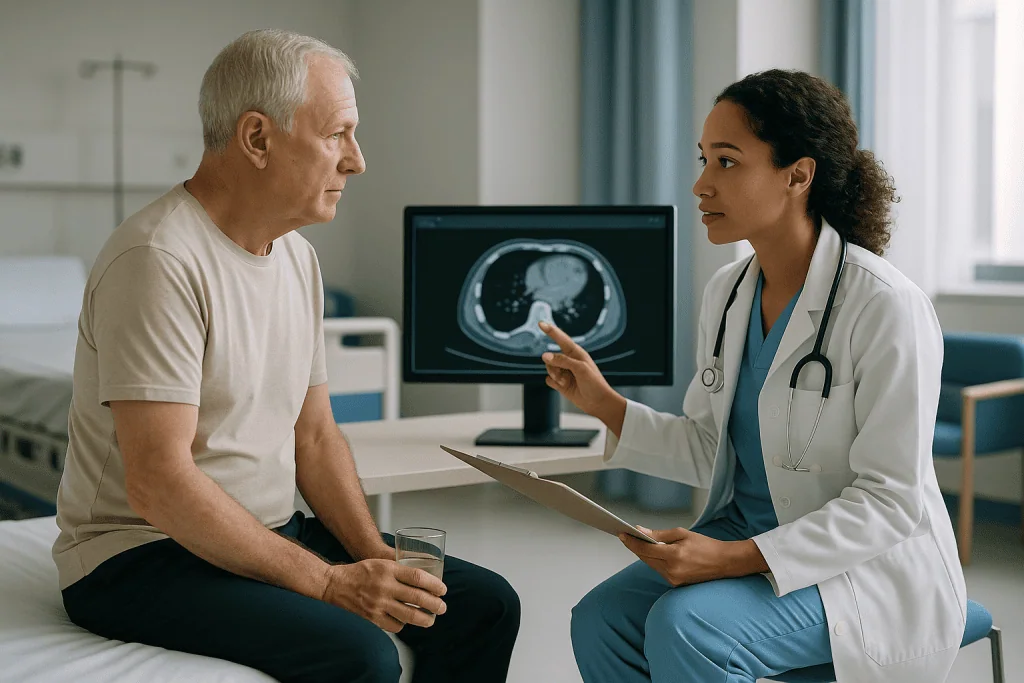
Most solid cancers are staged using the TNM system, which the National Cancer Institute describes as the most widely used framework. T stands for the size and extent of the main tumor, N for whether nearby lymph nodes contain cancer, and M for metastasis, meaning spread to distant parts of the body. Those three letters combine into an overall stage, and that stage shapes whether an operation is likely to remove all visible disease or whether another treatment should come first.
Different scans answer different questions. A CT scan uses X-rays taken from many angles to build cross-sectional pictures; it is fast and good at showing the chest, abdomen and pelvis. An MRI uses magnetic fields rather than radiation and gives finer detail of soft tissue, which is why it is often chosen for the pelvis, brain, liver and breast. A PET-CT combines a CT scan with an injection of a mildly radioactive sugar tracer; areas that take up more sugar, which many cancers do, light up. A bone scan looks for spread to the skeleton. An ultrasound, which uses sound waves, is often used to guide a needle biopsy of a lymph node.
Not everyone needs every scan. The choice depends on cancer type, the information already available, kidney function (some contrast dyes are avoided when the kidneys are struggling) and whether you have metal implants that rule out MRI.
One honest caveat: scans have limits. Very small deposits of cancer can fall below what any imaging can detect, which is why the final stage is sometimes revised after surgery, once a pathologist has examined the removed tissue under a microscope. A change in stage after the operation is not a sign that anyone missed something. It reflects the difference between a picture and the tissue itself.
Pre op tests before cancer surgery: what the blood tests are checking
The blood tests before an operation are less about the cancer and more about the machinery that has to keep working while you are asleep and healing afterward.
A full blood count measures red cells, white cells and platelets. Low red cells (anemia) matter because red cells carry oxygen and because surgery involves some blood loss; identifying anemia early sometimes allows it to be treated before the operation rather than during it. Kidney and liver tests check the organs that clear anesthetic drugs and painkillers from the body. Clotting tests estimate how quickly your blood forms a clot, which is critical information for anyone taking blood thinners. A group-and-save test records your blood type so that matched blood is available if it is ever needed. Many centers also check blood sugar and, for people with diabetes, HbA1c, a measure of average glucose over roughly the previous few months.
Some cancers have tumor markers, substances in the blood that certain cancers release. A baseline measurement can be useful for comparison later, though markers are rarely used on their own to make surgical decisions.
| Test | What it measures | Why it matters before surgery |
|---|---|---|
| Full blood count | Red cells, white cells, platelets | Flags anemia, infection risk and bleeding tendency |
| Kidney function | Creatinine, electrolytes | Affects drug clearance and safety of contrast scans |
| Liver function | Liver enzymes, bilirubin, albumin | Reflects nutrition and how the body processes medicines |
| Clotting profile | How fast blood clots | Guides handling of anticoagulant medicines |
| Group and save | Blood type and antibodies | Allows matched blood to be prepared |
| Glucose / HbA1c | Current and recent blood sugar | High glucose is linked to slower wound healing |
Results are read as a pattern, not as pass or fail. An abnormal value more often changes how the team prepares than whether the operation goes ahead.
What happens at the anesthesia assessment before surgery
People often expect the anesthesia appointment to be a formality. In practice it is one of the most consequential conversations in the whole pathway, because it is where your general health, not the cancer, takes center stage.

An anesthesiologist, or a specially trained nurse working with one, will ask about your heart and lungs, whether you get breathless on stairs, whether you snore heavily or stop breathing in your sleep, whether you or a relative have ever reacted badly to an anesthetic, and how your teeth, neck and jaw move (this affects how easily a breathing tube can be placed). They will listen to your chest, check your blood pressure and review the blood tests and electrocardiogram.
Most services then assign a fitness grade. The American Society of Anesthesiologists physical status classification runs from class 1, a healthy person, through to higher classes for people with serious ongoing illness. The Cleveland Clinic describes this grading as a way of communicating overall health, not a prediction about any single operation. Your grade helps the team decide how much monitoring you need, whether you should recover in a high-dependency area, and whether a heart or lung specialist should be involved first.
This is also the point at which the type of anesthetic is discussed. General anesthesia means being fully unconscious with breathing supported. Regional anesthesia numbs a larger area, for example an epidural placed near the spinal cord, and is sometimes combined with a general anesthetic to reduce pain afterward. Local anesthesia numbs a small area only.
Bring an accurate list of everything you take, including inhalers, patches, herbal remedies and recreational substances. Anesthesiologists are not there to judge; they are there to avoid interactions. Alcohol intake, smoking and vaping are asked about for the same reason: each changes how the body handles anesthetic drugs and how well wounds heal.
Who goes to surgery first, and who is usually asked to wait
A common assumption is that the fastest route to the operating room is always the best one. Sometimes it is. Often the multidisciplinary team recommends a deliberate pause, and the reasons fall into two groups.
The first group is about the cancer. For several tumor types, including some breast, rectal, esophageal and stomach cancers, guidelines support giving chemotherapy, hormone therapy or radiation before surgery. This is called neoadjuvant treatment, meaning treatment given before the main treatment. The aim is to shrink the tumor so the operation can be smaller or more complete, and to treat any microscopic spread early. The Mayo Clinic notes that surgery is frequently combined with other treatments in this way, and the order is decided case by case.
The second group is about you. Someone with uncontrolled diabetes, untreated anemia, a recent heart event or very poor lung function may be asked to wait while those problems are optimized, because the evidence consistently links these factors to more complications after surgery. That wait is not the team dragging its feet; it is the team lowering your risk.
People who usually proceed without delay include those with early-stage disease where surgery alone is the standard first step, those whose tumors are causing an obstruction or bleeding, and those already in good general health with no untreated conditions.
Some people are advised against surgery altogether, either because the cancer has spread in a way that an operation would not help, or because the risks of anesthesia outweigh the likely benefit. In that situation other treatments, and sometimes active monitoring, become the main plan. This can be hard to hear. Ask the team to explain the reasoning in terms of your scans and your health, and ask for a second opinion if you want one. Neither request is unusual.
What is the 2 week rule and the 62 day rule for cancer?
These two phrases come up constantly in search results, and they belong to a specific health system. Both are waiting-time standards from the National Health Service in the United Kingdom, not universal medical rules.
The two-week rule refers to urgent referral. The NHS states that if a family doctor suspects cancer, the patient should be seen by a specialist within two weeks. The 62-day rule refers to a longer target: the interval from urgent referral to the start of first treatment, which may be surgery, drug therapy or radiation. NHS England publishes performance against these standards, and hospitals are expected to meet them for most patients.
Why does this matter to someone outside the UK? Mainly because it sets a realistic frame. The steps described in this article, staging, blood tests, anesthesia assessment, multidisciplinary discussion and consent, routinely take several weeks even in well-run systems. That is the normal shape of a cancer pathway, not a sign of neglect.
The other reason it matters is that these are targets, not biological thresholds. There is no evidence that a tumor changes character on day 63. The standards exist to keep systems accountable and to make sure people are not lost between appointments. If your pathway is taking longer than the local standard, the right response is to ask your cancer nurse or coordinator what the hold-up is, whether it is a scan slot, a pathology result or a scheduling gap, and whether anything can be brought forward.
In other countries, similar timeliness standards exist under different names and different numbers. The principle is the same everywhere: staging should be complete before surgery, and the time between the two should be as short as safe preparation allows.
Does prehabilitation before cancer surgery make a difference?
Prehabilitation is the idea of using the weeks before an operation to improve fitness, nutrition and mental readiness, so that you go into surgery from a higher starting point. Think of it as the opposite of rehabilitation: training before the event rather than recovering after it.
The logic is straightforward. Major surgery places a stress on the body comparable to strenuous physical exertion, and people with better cardiorespiratory fitness, adequate protein intake and lower anxiety tend to have fewer complications and shorter hospital stays. The NHS advice on preparing for an operation reflects this: stop smoking, eat well, stay active and limit alcohol in the weeks beforehand.
What does the evidence actually show? Multimodal prehabilitation programs, combining exercise, dietary support and psychological support, have been studied mainly in colorectal, lung and upper gastrointestinal cancer surgery. Systematic reviews report improvements in fitness measures such as walking distance before surgery and, in several studies, fewer complications afterward. The evidence for shortening hospital stay or improving longer-term outcomes is less consistent, partly because programs vary widely in length and intensity. The fair summary is that prehabilitation is safe, biologically plausible and supported by moderate-quality evidence for reducing complications, with more research needed on which components matter most.
The practical components look like this:
- Aerobic activity most days, at a level that makes you slightly breathless but still able to talk, adjusted to your current ability.
- Simple strength work for legs and core, because getting out of a bed and walking early after surgery depends on those muscles.
- Enough protein and calories, especially if you have lost weight without trying; a dietitian can help.
- Stopping smoking, which improves oxygen delivery and wound healing within weeks.
- Sleep, breathing exercises and, where anxiety is high, psychological support.
Tell your team before starting anything new. People with heart disease, bone metastases or low blood counts may need a modified plan.
Preparing for cancer surgery when you take blood thinners, diabetes medicines or supplements
Medicines are where good intentions cause the most trouble before an operation. Some people stop everything “to be safe.” Others keep taking a supplement they never thought to mention. Both can create problems, and neither is a decision to make alone.
Blood thinners are the group that gets the most attention. Anticoagulants, which slow the clotting cascade, and antiplatelet drugs, which stop platelets sticking together, both raise bleeding risk during surgery. Stopping them, however, raises the risk of the clot they were prescribed to prevent, whether that is a stroke, a heart attack or a clot in the leg. Surgeons, anesthesiologists and sometimes cardiologists weigh those two risks together and give a specific instruction about whether to pause, when, and whether a temporary bridging medicine is needed. The typical interval depends on which drug it is and how well your kidneys clear it. Follow the written instruction you are given, and if two teams tell you different things, ask them to talk to each other.
Diabetes medicines need a plan because fasting before surgery lowers blood sugar while the stress of surgery raises it. Insulin and oral diabetes drugs are usually adjusted around the fasting period; the prescribing clinician will tell you how.
Herbal and dietary supplements deserve a mention because many are quietly active. Fish oil, ginkgo, garlic extract, ginseng and high-dose vitamin E can affect bleeding; St John’s wort interacts with anesthetic drugs; some “immune boosting” products contain undeclared ingredients. The NIH Office of Dietary Supplements advises telling every clinician about all supplements you take, and most anesthesia services ask for them to be paused in the run-up to surgery.
Blood pressure medicines, thyroid hormone, inhalers, antidepressants and anti-seizure drugs are usually continued, sometimes with a sip of water on the morning of surgery. Usually is the key word. The list you bring to the anesthesia assessment is what makes that decision possible.
What not to eat the night before an operation?
The night-before question is one of the most searched of all, and the honest answer is that it matters less what you eat and more when you stop.
The reason for fasting is a rare but serious event called aspiration: while you are unconscious, the reflexes that normally keep stomach contents out of the lungs are switched off, and food or acid can be inhaled. An empty stomach makes that very unlikely. The NHS guidance on preparing for surgery describes the usual pattern: no food for about six hours before a general anesthetic, and clear fluids, such as water, allowed up until about two hours before. Your hospital will give you exact times based on your slot on the operating list, and those times override any general rule.
So the evening meal itself is normally fine. Sensible choices are a lighter, familiar meal rather than an unusually large or very fatty one, because fat slows stomach emptying and heavy meals can leave you uncomfortable at a time when you are already anxious. Alcohol is best avoided, since it interacts with anesthetic drugs and dehydrates you. There is no evidence that a special “pre-surgery” food improves outcomes.
What counts as a clear fluid trips people up. Water, diluted squash and black tea or coffee without milk generally count. Milk, juice with pulp, smoothies, chewing gum and boiled sweets do not, because they behave like food in the stomach. Some services offer a specific carbohydrate drink to take in the last permitted window as part of enhanced recovery protocols; if you are given one, follow the instruction that comes with it.
If you accidentally eat or drink inside the fasting window, tell the team when you arrive. Rescheduling is inconvenient; aspiration is dangerous. Nobody will be annoyed that you were honest.
What the first days and weeks after cancer surgery usually look like
Preparation is easier when you know what you are preparing for, so it is worth sketching the recovery in outline. The details depend enormously on the operation; removing a small skin cancer and removing part of a lung are different worlds. The shape, though, is recognizable.
The first hours are spent in a recovery area where nurses monitor breathing, blood pressure, pain and the wound while the anesthetic wears off. Nausea is common and treatable. Many people are surprised to be asked to sit up, take deep breaths and, if possible, stand on the same day or the day after. This is deliberate: early movement is one of the best-evidenced ways to reduce chest infections and blood clots, both of which are more likely when people lie still. Compression stockings and, for many operations, a daily anticoagulant injection are used for the same reason.
Pain is managed with a combination of medicines, often including a nerve block or epidural placed during the operation, so that you need less of any single drug. Pain that is well controlled early tends to stay controlled; report it before it becomes severe.
Eating usually restarts quickly after most operations, though bowel surgery may follow a staged plan. Drains, catheters and intravenous lines are removed as they become unnecessary, and the day they come out often marks the shift from feeling like a patient to feeling like a person recovering.
Hospital stay ranges from same-day discharge for minor procedures to a week or more for major abdominal or chest surgery. Full recovery at home is measured in weeks, with tiredness typically outlasting wound healing. The Mayo Clinic notes that your team will give operation-specific guidance on activity, lifting and driving. Pathology results from the removed tissue usually arrive within a couple of weeks and are discussed at a follow-up appointment, where any further treatment is planned.
How long after chemo does your body get back to normal before surgery?
For people whose plan includes chemotherapy before surgery, the gap between the last dose and the operation is a recurring worry. It is a good question, and it has a two-part answer.
The first part concerns blood counts. Chemotherapy temporarily suppresses the bone marrow, so white cells, which fight infection, and platelets, which help clotting, drop and then recover over a cycle. Surgeons want both to be back within a safe range before operating, which is why a repeat full blood count is almost always taken close to the surgery date. Recovery of counts is expected within the normal cycle length for most regimens, but it is verified by a test, not assumed.
The second part concerns everything else: fatigue, appetite, weight, mouth soreness, nerve tingling in the hands and feet, and the general sense of being run down. These improve at different speeds. Nausea and mouth problems typically settle within days to a couple of weeks of a final dose. Fatigue and stamina take longer, often weeks and sometimes months, and this is exactly the window where the prehabilitation ideas above earn their keep. Peripheral neuropathy, the nerve tingling, can persist and needs to be mentioned to the anesthesia team because it affects positioning and pain assessment.
Timing of surgery after neoadjuvant treatment is decided by the multidisciplinary team using two considerations: allowing the body to recover enough to heal well, and operating while the tumor-shrinking effect is at its best. For many cancers this lands a few weeks after the final chemotherapy dose, and for chemoradiation to the rectum the interval is often longer to allow further tumor response. Your team will give you the interval for your cancer type; treat it as a planning window rather than a guarantee, since a slow count recovery or an infection can shift it.
“Back to normal” is a moving target during cancer treatment. Ready for surgery is a more useful goal, and it is one your team can measure.
What people often get wrong about preparing for cancer surgery
Cancer attracts advice the way a wound attracts bandages, and much of it is well meant and wrong. A few corrections, each grounded in mainstream evidence.
“Waiting a few weeks for scans lets the cancer spread.” For the great majority of solid tumors, growth over a period of weeks is small compared with the benefit of knowing the true stage before operating. The scans exist precisely so that the operation planned is the operation needed. The exceptions, such as tumors causing obstruction, are recognized and fast-tracked.
“Air exposure during surgery makes cancer spread.” This persistent belief has no support. The Mayo Clinic addresses it directly: exposing a tumor to air does not cause it to grow or spread. Surgeons do take specific precautions to avoid disturbing tumor tissue, which is a different matter.
“Stop all your medicines before surgery to be safe.” Stopping some medicines, particularly heart, blood pressure and anticoagulant drugs, without instruction can be more dangerous than continuing them. The anesthesia team gives medicine-by-medicine instructions for a reason.
“Fasting from midnight is the rule.” Modern guidance allows clear fluids much closer to surgery, and arriving dehydrated makes cannulation harder and recovery rougher. Use the times your hospital gives you.
“Cutting out sugar starves the tumor.” Every cell in the body uses glucose, and restrictive diets in the weeks before surgery risk the weight and muscle loss that genuinely worsen surgical outcomes. Adequate protein and calories are the priority.
“Supplements are natural, so they are harmless.” Several common supplements affect bleeding or interact with anesthetic drugs, as the NIH Office of Dietary Supplements notes.
“A change in stage after surgery means the scans were wrong.” Pathological staging, based on the removed tissue, is expected to refine clinical staging. It is the system working as designed.
The through-line is simple: the pre-operative pathway is built on evidence, and the folklore around it usually is not.
Questions to ask your care team
Consultations move quickly, and the questions you meant to ask have a way of surfacing in the car park. Writing them down beforehand, and taking someone with you to listen, changes the quality of the conversation. These are the ones that tend to matter most in the run-up to cancer surgery.
- What stage is my cancer based on the scans so far, and is any further staging planned before the operation?
- Why is surgery recommended first for me rather than chemotherapy, radiation or another treatment before it, and what are the alternatives, including not operating?
- What exactly will be removed, and could the plan change once the surgeon can see the tissue directly?
- What are the main risks of this operation for someone with my health, and which of them can I reduce before the day?
- Which of my medicines and supplements should I continue, and which should I pause, and who will give me that in writing?
- What type of anesthetic is planned, and what did the anesthesia assessment conclude about my fitness?
- Is there a prehabilitation program, dietitian or physiotherapist I can see before surgery?
- What are my fasting times, and what counts as a clear fluid?
- How long is the expected hospital stay, and what support will I need at home in the first week?
- When will the pathology results be back, who will explain them, and what might they change?
- Who do I contact, day or night, if something worries me before or after the operation?
Two habits help. First, ask the team to explain any word you do not know; medicine has a vocabulary problem, and no clinician minds being asked to translate. Second, ask what the team would want a family member to know in your position. It is a question that often produces the most candid answer of the appointment.
You are also entitled to ask for time. Consent given under pressure is not the goal; understanding is.
When to call your doctor
Most of the pre-operative period passes without drama, but a small number of situations should prompt a same-day call to your cancer team, your surgical unit or, in an emergency, emergency services. Knowing them in advance removes the second-guessing.
Before surgery, contact the team the same day if you develop a fever, a new cough with colored sputum, a burning sensation when passing urine, or any other sign of infection; operating through an infection increases risk and the team may need to reschedule. Call if you notice a hot, swollen or painful calf, or sudden breathlessness or chest pain, because people with cancer have a higher baseline risk of blood clots and these symptoms need urgent assessment. Report new or worsening bleeding, bruising that appears without injury, black or bloody stools, or vomiting that stops you keeping fluids down. Tell the team if you have started, stopped or changed any medicine, or if another clinician has prescribed something new, since it may alter the anesthesia plan.
After surgery, the red flags shift to the wound and to the body’s stress response. Seek help promptly for redness that spreads outward from the incision, thick discharge or a bad smell from the wound, a wound edge that opens, or pain that is increasing rather than easing after the first days. A temperature that stays raised, shaking chills, confusion, a racing heart, difficulty breathing or fainting can indicate infection or a clot and are reasons for emergency care, not a wait-and-see approach. The CDC lists fever, redness, pain and drainage as the hallmark signs of a surgical site infection, and early treatment matters.
Distress counts too. If anxiety, low mood or panic is making it hard to eat, sleep or attend appointments, say so. Cancer teams have psychological support built in, and using it is part of preparation, not a detour from it.
When in doubt, call. The team would rather hear from you unnecessarily than not hear from you when it mattered.
Frequently asked questions
What is the 62 day rule for cancer?
The 62-day rule is a National Health Service waiting-time standard in the United Kingdom: from an urgent referral for suspected cancer to the start of first treatment, whether surgery, drug therapy or radiation, should take no more than 62 days for most patients. It is a system accountability target rather than a medical threshold. If your pathway is running longer than your local standard, ask your cancer nurse or coordinator what is causing the delay.
What is the 2 week rule for cancer?
The two-week rule is the NHS standard that someone urgently referred by a family doctor with suspected cancer should be seen by a specialist within two weeks. It covers the first specialist appointment, not the completion of tests or the start of treatment. Being referred under this rule does not mean cancer has been found; most people referred this way turn out not to have cancer, but the fast appointment allows it to be ruled in or out quickly.
How long after chemo does your body get back to normal?
It depends on which effect you mean. Blood counts usually recover within the normal chemotherapy cycle and are confirmed with a repeat blood test before surgery. Nausea and mouth soreness typically settle within days to a couple of weeks. Fatigue and stamina take weeks to months, and nerve tingling can persist longer. When chemotherapy is given before surgery, the team chooses an interval that balances recovery with operating while the tumor response is at its best.
What not to eat the night before an operation?
There is no forbidden food the evening before, provided you finish eating before your fasting time. A lighter, familiar meal is sensible because very fatty or very large meals empty slowly from the stomach and can leave you uncomfortable. Avoid alcohol, which interacts with anesthetic drugs. NHS guidance describes stopping food about six hours before a general anesthetic and allowing clear fluids until about two hours before; your hospital’s written times override any general rule.
How to prepare for cancer surgery in the weeks before?
The best-evidenced steps are stopping smoking, staying as physically active as your condition allows, eating enough protein and calories rather than restricting, limiting alcohol, and bringing an accurate list of every medicine and supplement to the anesthesia assessment. Arrange help at home for the first week, sort out transport, and write down your questions before appointments. Ask whether a prehabilitation program, dietitian or physiotherapist is available, and tell the team before starting any new exercise.
What pre op tests are done before cancer surgery?
Typical tests include a full blood count, kidney and liver function tests, a clotting profile, a group-and-save to record blood type, and blood glucose or HbA1c. Most people have an electrocardiogram to record heart rhythm, and some have a chest X-ray or lung function tests depending on the operation and their health. Staging scans such as CT, MRI or PET-CT are separate and are about the cancer rather than your fitness for anesthesia.
What happens at the anesthesia assessment before surgery?
An anesthesiologist or specialist nurse reviews your heart, lungs, breathing during sleep, previous anesthetics, medicines, allergies, teeth and neck movement, then examines you and reviews your blood tests and electrocardiogram. You are assigned a physical status grade that reflects overall health and guides monitoring and specialist input. The type of anesthetic is discussed, and you receive written instructions on fasting and on which medicines to continue or pause.
Does prehabilitation before cancer surgery really help?
Moderate-quality evidence, mainly from colorectal, lung and upper gastrointestinal cancer surgery, shows that combined exercise, nutrition and psychological programs improve fitness before surgery and, in several studies, reduce complications afterward. Evidence for shorter hospital stays or long-term benefit is less consistent, partly because programs vary widely. Prehabilitation is considered safe and biologically plausible, and people with heart disease, bone metastases or low blood counts should have a plan adapted by their team.
Should I stop my blood thinners before cancer surgery?
Only on the specific instruction of your surgical and anesthesia team, ideally in writing. Anticoagulant and antiplatelet medicines raise bleeding risk during surgery, but stopping them raises the risk of the stroke, heart attack or clot they were prescribed to prevent. The team weighs both risks and decides whether to pause, when, and whether a temporary bridging medicine is needed. If two clinicians give different advice, ask them to speak to each other.
Why did my cancer stage change after surgery?
Because staging happens twice. Clinical staging before surgery relies on scans and biopsies, which cannot see microscopic deposits. Pathological staging after surgery is based on a microscope examination of the removed tumor and lymph nodes, so it is more precise. A change, in either direction, reflects this expected refinement rather than a missed finding. Your team uses the pathological stage to decide whether any further treatment is recommended.
References
- NHS: Having an operation (surgery): Preparation
- NHS: Cancer (overview and urgent referral)
- Cleveland Clinic: Anesthesia
This article is for general information only and is not a substitute for professional medical advice. Please consult a qualified doctor about your individual situation.

More from the Blog
What Neck Cancer Follow-Up Looks Like: Physical Exams, Imaging and Side-Effect Reviews
Follow-up after neck cancer treatment usually combines a hands-on physical exam of the neck, mouth and throat at each visit, a camera check of…
Follow-Up After Cervical Cancer Treatment: Pelvic Exams, Imaging and Recurrence Checks
Cervical cancer follow up after treatment usually combines a review of symptoms, a pelvic exam and, depending on the treatment given, cytology or HPV…
What a Chemotherapy Cycle Looks Like: Treatment Days, Low-Count Days and Recovery
A chemotherapy cycle is one treatment session (or a short run of sessions) followed by a planned rest period, commonly repeating every one to…

Living With Multiple Myeloma: Bone Protection, Kidney Care and Staying Active Safely
People living with multiple myeloma can protect their bones and kidneys through a combination of bone-strengthening medicines chosen by their hematology team, regular dental…

When Radiotherapy Is Added to Lymphoma Treatment and When Chemotherapy Alone Is Enough
Radiotherapy is usually added after chemotherapy for lymphoma when disease was localized or bulky at diagnosis, or when a post-treatment PET scan still shows…

Before Parotidectomy Surgery: Imaging, Fine Needle Biopsy and the Anesthesia Evaluation
Before parotidectomy surgery, most people have three things: imaging (usually ultrasound first, then MRI or CT) to map the lump and its relation to…