

Swelling Under One Eye: Allergy, Infection and Sinus Causes and When It Needs an Eye Check
Key Takeaways
- One-sided swelling almost always has a local cause such as a stye, chalazion, bite, contact reaction or blocked tear duct, whereas fluid retention from the heart or kidneys shows in both eyes.
- Itch points to allergy or a bite, while heat, redness and pain point to infection, and that single distinction sorts most cases before any test.
- The bone between the ethmoid sinuses and the eye socket is thin enough to be called the 'paper plate', which is how a sinus infection can become orbital cellulitis.
- Pain on moving the eye, a bulging eye, double or reduced vision and fever are the signs of orbital cellulitis and mean emergency care rather than a wait.
- The NHS expects a stye to settle in 1–2 weeks with warm compresses and sinusitis to clear within 2–3 weeks; a lump that outlasts that deserves an eye check.
- Squeezing a stye is the fastest way to turn a minor lump into cellulitis, because the loose tissue of the eyelid lets bacteria spread.
Swelling under one eye most often comes from a stye or chalazion, an allergic or contact reaction, an insect bite, or a blocked tear duct, and it usually settles within days to two weeks. Sinus infection and skin infection (cellulitis) can also swell one side. Seek urgent care if the eye is red, hot and painful, you have fever, or vision or eye movement changes.
You notice it while brushing your teeth: the left eye looks as if it belongs to someone who has been crying, while the right is perfectly ordinary. No itch yet, no pain, just a soft fullness under the lower lid that was not there last night. By lunchtime you have typed what causes swelling under one eye into a search bar and found eleven lists that all say the same thing.
Eyelid skin is among the thinnest on the body, loosely attached and quick to hold fluid, so very little provokes a very visible change. That is reassuring in one way, because most of the time the culprit is small and local. It is less reassuring in another, because a handful of serious problems, including infection spreading from the sinuses, begin exactly the same way.
This article walks through the causes in the order clinicians actually consider them, explains how an examination tells them apart, and is clear about the signs that turn a puffy morning into a same-day appointment.
What causes swelling under one eye? The direct answer
Asked what causes swelling under one eye, most eye clinicians will give the same short list: a stye or chalazion forming in the lower lid, an allergic or contact reaction to something that touched that side of the face, an insect bite, or a tear duct that has blocked at the inner corner. Between them these explain the great majority of one-sided cases, and most settle on their own within days to a couple of weeks.
Two groups of causes need a professional look rather than a wait-and-see approach. The first is infection that has reached the skin or deeper tissues around the eye, known as periorbital or orbital cellulitis. The second is sinus disease, which can reach the eye socket because only a paper-thin wall of bone separates the two.
In plain words, treat it as an emergency if the eyelid is red, hot and painful, you have a fever or feel unwell, the eye is bulging, moving it hurts, you see double, or your vision has dropped. Sudden swelling of the face together with lip, tongue or throat swelling, or any difficulty breathing, also needs emergency care. Everything that follows is about separating the ordinary from the worrying, and about why one eye is affected when the other is fine.
Why am I puffy under one eye but not the other?
One-sided puffiness is a clue in itself. Swelling driven by the whole body, such as fluid retention from kidney or heart conditions, hay fever, a salty dinner or a short night, tends to show on both sides, even if unevenly. When only one eye is involved, the trigger is usually sitting right there: a blocked gland in that lid, a bite on that cheek, a cream applied by a finger that touched one side, or a sinus or tear duct on that side alone.

Sleep position muddies the picture a little. Fluid pools in the lowest tissues overnight, so a committed side-sleeper can wake with the down-side lid fuller. That kind of puffiness is soft, painless, not red, and fades once you have been upright for a while. Swelling that stays, grows, hurts or changes color is a different conversation.
Clinicians also pay close attention to where the swelling is centered. The lower lid itself points to a gland or skin problem. The inner corner, between eye and nose, points to the tear sac. The cheek just below the lid, with pressure around the nose and upper teeth, points toward the maxillary sinus or a dental source. Asking ‘where exactly’ often does more diagnostic work than asking ‘how big’.
Stye or chalazion: the usual reason for a swollen lower eyelid
A stye (hordeolum) is a small abscess at the root of an eyelash or in one of the tiny oil glands along the lid margin, usually caused by skin bacteria that live there anyway. It arrives over a day or two as a tender red lump, sometimes with a yellow head, and the lid around it swells because the tissue is loose and inflames easily. Lower-lid styes are common and can make the whole area under the eye look puffy before the lump itself is obvious.
A chalazion is its slower, calmer cousin: a blocked meibomian gland, the oil gland that stops the tear film evaporating, that has filled with trapped secretion and provoked a wall of inflammation around it. It is firmer, rounder, often painless once the first few days pass, and it sits a little further from the lash line. Chalazia can linger for weeks to months.
How a clinician tells them apart: tenderness and a visible point suggest a stye; a firm, non-tender nodule that persists suggests a chalazion. Both are treated with warm compresses first. The NHS advises that a stye usually improves within 1–2 weeks and that squeezing it is a bad idea, because it can push infection into the surrounding lid. Recurrent lumps in the same place, or one that does not shrink over several weeks, are reasons for an eye check, partly because a rare lid tumor can mimic a chalazion.
Allergy, insect bites and contact reactions
Allergy is the cause people guess first, and the eyelids are a fair place to guess: the skin here swells dramatically with very little fluid. Seasonal hay fever tends to affect both eyes with itching, watering and redness. A one-sided reaction more often means contact allergy: a new eye cream, a mascara, nail polish transferred by rubbing, hair dye, a plant, or the adhesive on a dressing. The clue is itch rather than pain, often with fine dry flaking of the lid skin, and a story that starts within hours of exposure.

Insect bites produce a similar sudden, itchy, soft swelling, sometimes with a tiny central puncture. On a lower lid a mosquito bite can close the eye by morning, which looks alarming but behaves like any other bite and settles over a few days.
Angioedema is deeper, non-pitting swelling that develops fast, with or without hives, and can be triggered by foods, by medicines (including a class of blood pressure medicines called ACE inhibitors) or by nothing identifiable. The NHS lists the eyelids and lips as typical sites. On its own it is usually not dangerous; the emergency version involves the tongue, throat or breathing, and that combination needs an ambulance. Antihistamines, which block the histamine released by allergy cells, are often used for itchy allergic swelling, but whether one suits you is a decision for a pharmacist or clinician who knows your history.
Blocked tear duct and tear sac infection
Tears drain through two tiny openings at the inner corner of the lids into a sac that sits in a bony hollow beside the nose, and from there down a duct into the nose. Block that duct and the eye waters constantly; let the stagnant tears become infected and the sac swells, reddens and hurts. That infection is called dacryocystitis, and because the sac sits just below the inner corner of the eye, it reads as swelling under one eye rather than swelling of the lid.
The pattern is distinctive once you know it: a tender bump at the inner corner, overflowing tears on that side, and sticky discharge that may increase if the bump is gently pressed. Babies are often born with a duct that has not fully opened, and in most it opens on its own as they grow; in adults, blockage follows chronic inflammation, past injury or, less often, a growth in the nose.
Clinicians distinguish this from a stye by location and by the watering, and from cellulitis by how localized it is and how well the rest of the lid looks. A duct that keeps becoming infected is usually referred to an eye specialist, since a small procedure to create a new drainage route is sometimes offered. That is a conversation for the specialist after examination, not a decision to be made from a search result.
Can a sinus infection cause swelling under one eye?
The answer has two parts. Sinusitis, inflammation of the lining of the air-filled cavities in the cheeks, forehead and between the eyes, mostly causes pressure, a blocked nose, thick discharge and a dull ache that worsens on bending forward. The NHS notes it usually follows a cold and clears within 2–3 weeks. Mild, soft puffiness under the eye on the congested side can happen, because the maxillary sinus sits directly beneath the eye socket and the ethmoid sinuses sit between the eyes, so inflammation next door is sometimes visible.
Marked swelling is the second part, and it matters. The bone between the ethmoid sinuses and the orbit is so thin that anatomists call it the lamina papyracea, the ‘paper plate’. Infection can cross it, and when it does the result is orbital cellulitis, described in the next section. That is why a sinus infection that develops a red, swollen, painful eyelid, especially in a child, is treated as urgent rather than as a cold that has overstayed.
How a clinician separates the two: in simple sinusitis the eye itself is white, moves freely and sees normally, and pressing over the cheek hurts more than touching the lid. Most sinus infections are viral, so antibiotics do not help them; guidelines reserve them for severe or prolonged cases, and the choice sits with the treating clinician. Symptoms that are not improving after about a week, or that keep returning, are the NHS threshold for a primary care review.
Periorbital and orbital cellulitis: the infection that needs same-day care
Cellulitis is a bacterial infection of the skin and the tissue beneath it. Around the eye it comes in two forms, and the dividing line is a thin sheet of fibrous tissue called the orbital septum, which runs from the rim of the eye socket into the lids.
Periorbital (preseptal) cellulitis sits in front of that sheet: the lid is red, hot, swollen and tender, sometimes after a scratch, a bite, a stye or a cold, but the eye itself looks and works normally. MedlinePlus describes it as more common in children and usually managed with antibiotics prescribed after examination, with close follow-up to confirm it is improving.
Orbital cellulitis sits behind the sheet, in the fatty tissue around the eyeball, and most often spreads from the ethmoid sinuses. The signs that separate it from the milder form are the ones in the quick answer: pain when the eye moves, a bulging eye, double vision, reduced vision, a sluggish pupil, fever and feeling unwell. MedlinePlus is blunt that it can threaten sight and, rarely, spread to the brain, which is why it is managed in hospital with intravenous antibiotics and often a CT scan of the orbits to look for an abscess that needs draining.
The practical lesson for anyone with a swollen lid is simple: redness, heat and pain are the triggers for a same-day assessment, and any change in vision or eye movement is the trigger for an emergency department. No one at home can reliably tell the two forms apart, and clinicians do not expect you to.
Less common causes an eye clinician keeps in mind
A short list of rarer causes earns its place because each has a recognizable tell.
A dental abscess in an upper molar or premolar can track upward and swell the cheek and lower lid on that side; toothache, a bad taste or a tooth that hurts when tapped gives it away. Shingles affecting the eye (herpes zoster ophthalmicus) starts with one-sided tingling or pain on the forehead and lid, then a blistering rash that stops sharply at the midline; it needs prompt review because the eye itself can be involved. Conjunctivitis, inflammation of the membrane over the white of the eye, can begin on one side with redness, grittiness and lid puffiness before the other eye joins in.
Thyroid eye disease, in which the immune system inflames the tissues behind the eyes, usually affects both sides but can be asymmetric early on, with lid puffiness, a staring look and gritty discomfort. Eyelid eczema and rosacea cause chronic, scaly, mildly swollen lids rather than a sudden change. A painless, slowly enlarging lump that does not behave like a chalazion, particularly one that distorts the lashes or bleeds, is the pattern clinicians check for a skin or lid tumor; these are uncommon and treatable, and early assessment matters.
A black eye after a knock belongs here too. Bruising and swelling are expected, but double vision, numbness of the cheek or difficulty looking upward can indicate a fracture of the thin orbital floor and call for imaging.
How clinicians work out what causes swelling under one eye
Working out what causes swelling under one eye is mostly pattern recognition, and the table sets out the patterns a clinician is matching against. Three questions do most of the sorting: Does it itch or hurt? Is the eye itself red, bulging or seeing differently? And where, exactly, is the swelling centered?
| Cause | Typical features | Usual next step |
|---|---|---|
| Stye | Tender red lump at the lash line, lid swelling, develops over a day or two | Warm compresses; eye check if not improving in 1–2 weeks or recurrent |
| Chalazion | Firm, usually painless nodule away from the lash line, persists for weeks | Warm compresses; eye clinic if it does not shrink |
| Allergic or contact reaction | Itchy, soft swelling, flaking skin, new product or exposure, no fever | Remove the trigger, cool compress; pharmacist or clinician if persistent |
| Insect bite | Sudden itchy swelling, sometimes a central puncture | Cool compress; review if redness spreads or pain develops |
| Blocked tear duct or dacryocystitis | Tender bump at the inner corner, watering, discharge | Primary care or eye clinic; same day if red and painful |
| Sinusitis | Facial pressure, blocked nose, discharge, mild puffiness, eye normal | Self-care; clinician if not improving after about a week |
| Periorbital cellulitis | Red, hot, painful lid; eye looks and moves normally | Same-day assessment; antibiotics by prescription |
| Orbital cellulitis | Pain on eye movement, bulging, double or reduced vision, fever | Emergency department |
| Angioedema | Rapid deep swelling, often with hives, lips involved | Emergency if tongue, throat or breathing involved |
Itch points to allergy or a bite. Pain with heat and redness points to infection. Pain on moving the eye, or any change in what the eye can see, shifts the question from ‘which clinic’ to ‘which ambulance’, and fever pushes the same way. Several causes can coexist: a stye can seed periorbital cellulitis, and a cold can precede both sinusitis and a tear sac infection. That overlap is why an examination, not a photograph, decides.
What does an eye check for a swollen eyelid involve?
An eye check for a swollen lid is quick and mostly painless. The clinician starts with the story: how fast it came on, whether it itches or hurts, any new cosmetics, bites, colds, dental pain or previous episodes, and whether you wear contact lenses. Then comes the look. Vision is measured one eye at a time, because a drop in acuity is one of the signs that separates orbital infection from everything else. A light is swung between the pupils to check they respond equally. You follow a finger up, down and sideways while reporting any pain or double vision.
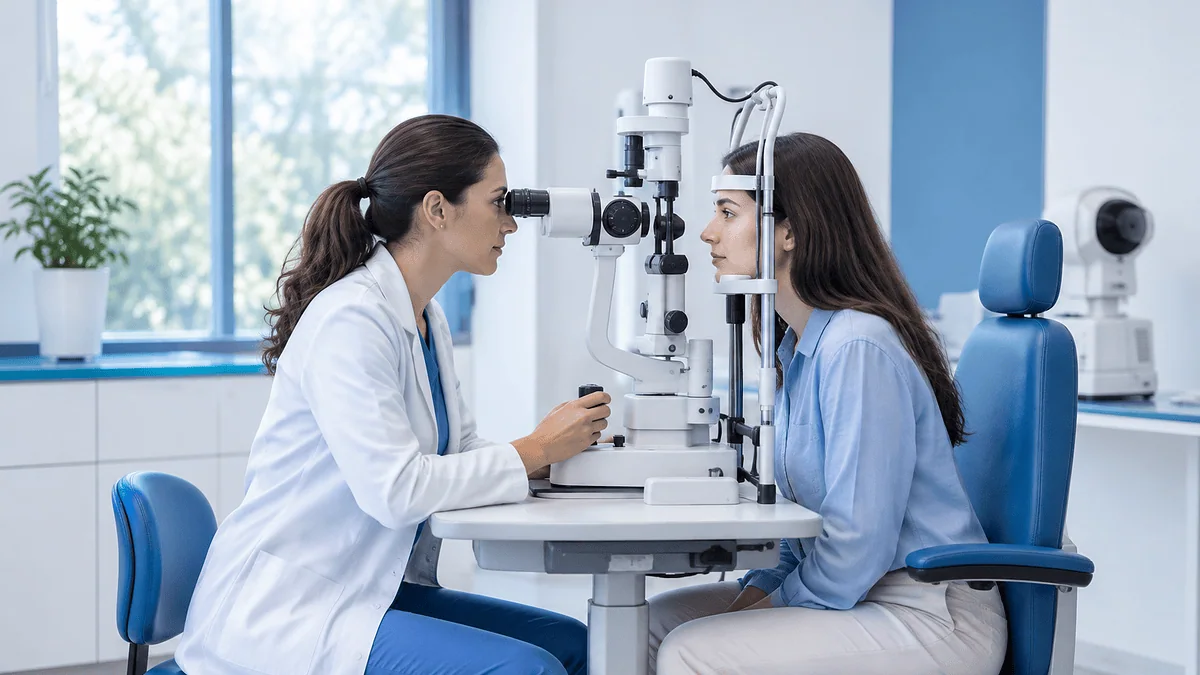
The lids are examined under magnification, often with a slit lamp, the microscope on a chin rest found in most eye rooms. The lower lid may be gently pulled down or turned outward to see its inner surface, where a chalazion often shows as a pale lump. Pressure over the tear sac at the inner corner checks for discharge. Temperature is taken if infection is suspected.
Tests are usually unnecessary. When ordered, they are targeted: a swab of discharge, blood tests for infection markers, and a CT scan of the orbits and sinuses if orbital cellulitis or a fracture is possible. In children with a red, swollen lid, clinicians keep a low threshold for same-day hospital review, because telling the two kinds of cellulitis apart is hard in a child who will not cooperate with an eye movement test.
How long does under eye swelling last?
Timelines depend entirely on the cause, which is the honest reason no single number answers how long under eye swelling lasts.
Swelling from a bite, a contact reaction or a night of side-sleeping typically shrinks over hours to a few days once the trigger is gone. The NHS puts a stye at 1–2 weeks to settle with warm compresses. A chalazion is slower, often weeks and sometimes longer, and a clinician may discuss a minor procedure only if it refuses to shrink. Sinusitis, per NHS guidance, usually clears within 2–3 weeks, with any facial puffiness fading as the congestion does. Cellulitis treated with the right antibiotic is expected to improve quickly, and the prescribing clinician arranges an early review precisely because failure to improve changes the plan.
What lengthens the timeline: squeezing a stye, continuing the cosmetic that caused the reaction, rubbing an itchy lid, wearing contact lenses through an infection, and smoking, which slows healing and worsens sinus disease. What shortens it is mostly leaving things alone and applying the right temperature of compress.
The review thresholds clinicians use are proportionate: within a day or two for anything red, hot and painful; about a week for sinus symptoms that are not easing; two weeks for a lump that is not shrinking; and immediately for the vision and movement signs described above. Swelling that keeps returning in the same spot, even if each episode fades, deserves an eye check in its own right.
What is reasonable to do at home
For the ordinary causes, home care is simple, and the evidence supports keeping it that way.
Temperature is the main lever. A warm compress, a clean cloth soaked in warm (not hot) water and held against the closed lid, encourages a stye or chalazion to drain; the NHS suggests 5–10 minutes a few times a day. A cool compress does the opposite job for itchy allergic swelling or a bite, calming the tissue and easing the urge to rub. Use a fresh cloth each time and keep anything that touches the eye clean.
Remove the suspect. Stop any new eye product, keep hands away from the lid, and leave contact lenses out until the eye is comfortable and any infection has been cleared by a clinician. Sleeping with the head slightly raised reduces overnight pooling. Do not squeeze, pierce or pop any lump; the lid tissue is loose and infection spreads through it easily.
Over-the-counter help has limits. Lubricating eye drops can ease grittiness. Antihistamine tablets or drops reduce histamine-driven itch and swelling, but they will not touch an infection, and a pharmacist can advise whether one suits you, your other medicines and any pregnancy. Antibiotic drops or tablets are prescription decisions made after examination; using leftovers from a previous episode is a common mistake, because the wrong product delays the right diagnosis. For a pregnant reader or a child, the pathway is the same, with a lower bar for a same-day review.
What people often get wrong about swelling under one eye
The first myth is that swelling means allergy. Allergy is common, but it itches and rarely hurts; a lid that is painful and hot is far more likely infected. Taking an antihistamine for a stye or cellulitis loses days.
The second is that one-sided swelling signals a kidney or heart problem. Fluid retention from those organs affects both eyes, often with swollen ankles too. Puffiness under one eye, by itself, does not point there.
Third, that a stye should be popped like a pimple. It should not: the lid’s loose tissue lets bacteria spread, and a stye can turn into cellulitis. Warmth, patience and clean hands are the treatment.
Fourth, that a lump that has stopped hurting has gone. Chalazia stop hurting and stay. More to the point, a painless, slowly growing lid lump that distorts the lashes is exactly what clinicians want to see, because that is how the uncommon lid cancers present; most such lumps turn out benign, but the check is the only way to know.
Fifth, that a child’s swollen eye is just a bite. Often it is. Yet periorbital and orbital cellulitis cluster in childhood, frequently after a cold, and the early stage looks like a bite with redness. A child with a red, swollen lid and a temperature, or who resists looking around, is seen the same day.
Lastly, that a photo sent to a friend who works in healthcare settles it. Swelling is judged by touch, temperature, vision and movement, none of which a photo carries.
When to see a doctor: when to worry about eye swelling
Most swelling under one eye can be watched at home for a few days. Seek care sooner in the situations below.
Call emergency services or go to an emergency department now if there is pain when moving the eye, a bulging eye, double vision or reduced vision, a lid that is red, hot and very painful together with fever or feeling unwell, swelling after a significant blow to the face with numbness or difficulty looking up, or rapid facial swelling with lip, tongue or throat swelling, hoarseness or trouble breathing. In a child, add drowsiness, refusal to drink or a lid swollen shut.
Arrange a same-day appointment with a primary care clinician, urgent care or an eye clinic if the lid is red, warm and tender even without those signs, if there is a painful bump at the inner corner with discharge, if a blistering rash is appearing on one side of the forehead, if you wear contact lenses and the eye is red, or if you are immunosuppressed, have diabetes or are pregnant and the swelling is more than mild.
Book a routine review if a lump is not shrinking after two weeks, sinus symptoms are not improving after about a week or keep returning, swelling recurs in the same place, a lump is slowly growing without pain, or the lid skin is persistently scaly and sore. An eye check in those situations is rarely dramatic. It is mostly a few minutes of looking closely, and it settles the question that brought you here.
Frequently asked questions
How do you treat swelling under one eye?
Treatment follows the cause. A stye or chalazion is managed with warm compresses and no squeezing; an allergic or contact reaction with removal of the trigger and a cool compress; a blocked tear duct with cleaning and, if infected, prescribed antibiotics after examination. Cellulitis needs antibiotics chosen by a clinician, and the orbital form is treated in hospital. Anything red, hot and painful, or affecting vision, should be examined rather than treated at home.
How long can under eye swelling last?
Anywhere from a few hours to several weeks, depending on the cause. Bites, contact reactions and overnight fluid pooling usually fade within days. The NHS gives 1–2 weeks for a stye to settle and 2–3 weeks for sinusitis to clear. A chalazion can persist for weeks or longer. Swelling that is still growing after a day or two, or a lump unchanged after two weeks, is a reason for an eye check.
When should I worry about eye swelling?
Worry, and seek emergency care, when swelling comes with pain on moving the eye, a bulging eye, double or reduced vision, fever or feeling unwell, or with lip, tongue or throat swelling and trouble breathing. Arrange a same-day appointment if the lid is red, hot and tender, if there is a painful bump at the inner corner with discharge, or if a one-sided blistering rash appears on the forehead.
Why is one under eye puffy and the other isn't?
Because the trigger is almost always local to that side. A blocked lid gland, a bite, a cosmetic applied to one eye, a tear duct blockage or a sinus problem on that side swells that eye alone. Whole-body causes such as hay fever, a salty meal or fluid retention tend to affect both. Side-sleeping can also leave the down-side lid fuller in the morning, a harmless puffiness that fades once you are upright.
Can a sinus infection cause swelling under one eye?
Yes, in two ways. Ordinary sinusitis can produce mild, soft puffiness under the eye on the congested side, alongside facial pressure and a blocked nose, and the NHS expects it to clear within 2–3 weeks. Marked swelling with a red, painful lid, or any change in vision or eye movement, suggests the infection has crossed the thin bone into the eye socket, which is orbital cellulitis and needs emergency assessment.
Can a tooth problem cause swelling under one eye?
It can. An abscess around the root of an upper molar or premolar sits close to the floor of the maxillary sinus and the cheek, and infection can track upward to swell the cheek and lower lid on that side. Toothache, a tooth that hurts when tapped, a bad taste or gum swelling point to a dental origin. A dentist or clinician should assess it promptly, because dental infections can spread.
Is it still an allergy if the swelling does not itch?
Probably not. Itch is the hallmark of allergic and contact reactions and of insect bites. Swelling that is painful, hot or red without itch points more toward infection, a stye or a tear sac problem, and a firm painless lump points toward a chalazion. Angioedema is the exception: it is a deep, allergy-type swelling that often does not itch, and it needs emergency care if the tongue, throat or breathing is involved.
What does a swollen lower eyelid with a lump at the inner corner mean?
A tender lump at the inner corner, between the eye and the nose, with watering and sticky discharge, most often means a blocked tear duct whose sac has become infected, called dacryocystitis. Pressing gently on the lump may bring more discharge. It is distinguished from a stye by its position and the watering, and from cellulitis by how localized it is. A same-day assessment is sensible if it is red and painful.
Should I use a warm or cold compress for a swollen eye?
Warm for a stye or chalazion, because heat helps the blocked gland drain; the NHS suggests a clean cloth in warm water for 5–10 minutes a few times a day. Cool for itchy allergic swelling or a bite, because it calms the tissue and the urge to rub. Neither is appropriate as the only treatment for a lid that is red, hot and painful, which needs examination for infection.
My child has a swollen, red eyelid. What should I do?
Arrange a same-day assessment. Periorbital and orbital cellulitis are more common in children, often follow a cold, and begin looking much like a bite. Go straight to an emergency department if your child has a fever, seems drowsy or unwell, will not look around because it hurts, has a bulging eye, or the lid is swollen shut. A clinician will check vision and eye movement and decide whether hospital treatment is needed.
References
- MedlinePlus: Periorbital cellulitis
- MedlinePlus: Orbital cellulitis
- MedlinePlus: Eyelid bump (stye and chalazion)
- NHS: Stye
This article is for general information only and is not a substitute for professional medical advice. Please consult a qualified doctor about your individual situation.
Add us as a Preferred Source to see more of our trusted health content across Google Search, AI Overviews and Discover.

More from the Blog

Toric Lens Implant vs Laser Reshaping for Astigmatism: Two Routes Compared Plainly
Both routes can correct astigmatism, but they work in different parts of the eye. Laser reshaping changes the curve of the cornea and generally…
How Biometry Measurements Decide Your Intraocular Lens Power Before Surgery
Before cataract surgery, the eye is measured with optical or ultrasound biometry to obtain its axial length, the curvature of the cornea and the…

When Is a Vitrectomy Needed? Retinal Detachment, Macular Holes, Bleeding and Scar Tissue
A vitrectomy is needed when the gel inside the eye, the vitreous, must be removed to reach or relieve a problem at the retina.…
Farsightedness (Hyperopia): How It Develops and How Eye Doctors Plan Correction
Farsightedness, also called hyperopia or long-sightedness, is a refractive error in which light focuses behind the retina, usually because the eyeball is slightly short…

LASIK, SMILE or PRK for Myopia: A Neutral Comparison of the Three Laser Routes
LASIK, SMILE and PRK all treat myopia by using a laser to flatten the cornea so light focuses on the retina. LASIK lifts a…
Smart Lens Recovery: Drops, Adaptation Weeks and When Both Eyes Work Together
Smart lens recovery, meaning recovery after a multifocal or trifocal intraocular lens is implanted during cataract or lens-replacement surgery, usually involves a protective shield…