

Testing Positive for COVID-19 While Abroad: Where to Seek Care and When You Can Fly Home

Key Takeaways
- CDC guidance ends isolation when you have been fever-free for 24 hours without fever-reducing medication and symptoms are improving, followed by five more days of masking and distance around others.
- Antiviral medicines for COVID-19 work by blocking viral replication and must be started within roughly the first five to seven days of symptoms, which is why higher-risk travelers should contact a clinician on day one.
- You do not need a negative test to end isolation or to be medically fit to fly; PCR tests can remain positive for weeks after you stop being infectious.
- Aircraft cabins are pressurized to the equivalent of about 6,000 to 8,000 feet, so breathlessness that seems mild at sea level can worsen mid-flight without a clinician on board.
- COVID-19 raises clotting tendency during acute illness, and combined with a long flight this justifies walking the aisle hourly, calf exercises, and hydration.
- The WHO defines post-COVID condition as symptoms present about three months after infection and lasting at least two months, a threshold worth discussing with your usual clinician if recovery stalls.
If you tested positive for COVID-19 abroad, start with your travel insurer's assistance line or your accommodation's medical contact, rest in your room, and seek a clinician promptly if you are over 65, pregnant, immunocompromised, or have chronic illness, since antivirals work best early. Most public health guidance advises not flying until you have been fever-free for 24 hours without medication and symptoms are improving, then masking for several more days.
The pharmacy in a foreign city closes at seven, the test strip on the bathroom counter shows two lines, and your return flight leaves in thirty-six hours. Your throat hurts, your phone is at 12 percent, and the person at the front desk has already said the word “doctor” twice in a language you only half follow. Almost everyone who has tested positive for COVID while traveling remembers this exact moment: not the illness, but the logistics crashing down on top of it.
The good news is that the medical part of the problem is usually the simpler part. COVID-19 in a rested, vaccinated adult tends to follow a predictable arc, and the decisions that matter most in the first few hours are few: whether you need to be seen, how to keep other people safe, and what to tell the airline.
This explainer walks through those decisions in the order you will actually face them, using the same public health guidance that clinicians work from, and leaves every judgment call where it belongs, with the team who can examine you.
Where to seek care first when you've tested positive for COVID while traveling
Your first call is rarely to a hospital. For most travelers the right opening move is the 24-hour assistance number printed on a travel insurance card or credit card benefits sheet. Those lines exist precisely for this situation: they can tell you which local services accept your coverage, arrange a telehealth consultation in your language, and document the episode for any later claim. If you have no insurance, your country’s embassy or consulate can usually provide a list of English-speaking clinicians, though they will not pay for care.
The CDC’s travel health guidance suggests deciding before departure how you would reach medical help abroad, but if that step was skipped, the hotel or rental host is a practical second option. Larger hotels often keep a relationship with a local physician who makes room visits, which also spares you from sitting in a waiting room while infectious.
Where you go depends on how you feel, not on the test result alone. Mild symptoms, a normal appetite, and the ability to walk to the bathroom without breathlessness point toward rest and remote advice. Shortness of breath, chest pressure, or a temperature that keeps climbing despite rest point toward being examined in person, and the CDC lists these among the signs that warrant emergency care rather than a scheduled appointment.
Pharmacies deserve a mention. In many countries pharmacists can assess symptoms, sell rapid tests, and advise which nearby service is open. What they cannot do is decide whether you qualify for prescription antiviral treatment; that judgment sits with a prescribing clinician, and the timing window for those medicines is short, which is why the first day matters.
What actually happens in your body during COVID-19
The virus responsible for COVID-19, SARS-CoV-2, enters through the nose, mouth, or eyes and attaches to receptors on cells lining the airway. Once inside, it hijacks the cell’s machinery to copy itself, which is why early symptoms cluster in the upper airway: sore throat, congestion, cough. The fatigue, aches, and fever that follow are largely the immune system’s doing, a coordinated inflammatory response that raises body temperature and diverts energy toward fighting infection.
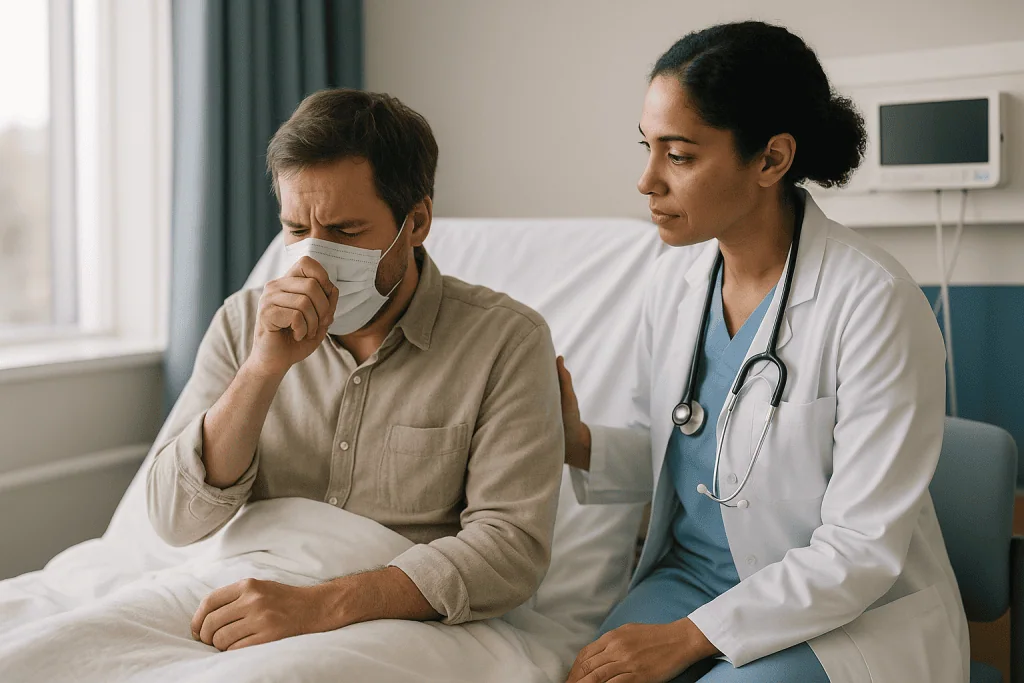
Timing is fairly consistent. The CDC notes that symptoms typically appear 2 to 14 days after exposure, and the WHO describes an average incubation period of 5 to 6 days. That is worth knowing abroad, because it tells you roughly when you were exposed and who else in your travel group may be about to feel unwell.
Most infections stay in the upper airway and resolve as antibodies and T cells clear infected cells. In a minority, the virus reaches deeper lung tissue, where inflammation interferes with oxygen crossing from air sacs into blood. That is the mechanism behind the breathlessness clinicians watch for, and it usually declares itself in the second week rather than the first, according to the WHO’s clinical description.
Two other features shape travel decisions. First, COVID-19 increases the tendency of blood to clot during the acute illness, a point that matters for long flights and is covered later. Second, a positive antigen test reflects viral protein in the nose, not necessarily live, transmissible virus; that is why public health bodies define infectiousness by symptoms and time rather than by the day a test finally turns negative.
Who usually needs a clinician quickly, and who can usually rest and watch
Age and underlying health draw the clearest line. The CDC identifies adults aged 65 and older, people who are pregnant, those with weakened immune systems from disease or medication, and anyone with chronic heart, lung, kidney, or liver disease, diabetes, or obesity as being at higher risk of severe illness. If you fit any of those groups, a same-day conversation with a clinician is reasonable even when symptoms feel trivial, because early treatment options depend on starting within the first several days of illness.
Vaccination changes the picture but does not erase it. A vaccinated older traveler still sits in a higher-risk category than an unvaccinated healthy twenty-five-year-old in terms of hospitalization, so risk assessment adds up the factors rather than choosing one.
Younger, otherwise healthy adults with a sore throat and fatigue are usually asked to wait, meaning rest, fluids, and monitoring rather than an urgent visit. “Wait” is not the same as “ignore”: the NHS advises seeking help if breathlessness develops, if you cannot keep fluids down, or if symptoms worsen rather than plateau after a few days.
A few situations tip even low-risk travelers toward being seen. Anyone alone in a room with no companion to notice deterioration should have a lower threshold for calling. So should people at altitude, where baseline oxygen is already lower, and anyone whose home medicines are running out during an extended stay. The decision about which group you fall into is ultimately clinical; this framework simply helps you describe your situation clearly when you make the call.
Getting a COVID test abroad: antigen, PCR, and what the result actually means
Rapid antigen tests, the strip-in-a-cassette kind sold in pharmacies worldwide, detect viral proteins and give a result in about 15 to 30 minutes. They are most reliable when someone has symptoms and viral load is high. A PCR test, which amplifies viral genetic material in a laboratory, is more sensitive and can stay positive for weeks after recovery, long after a person stops being infectious.

The CDC’s testing guidance explains that a negative antigen test in a symptomatic person does not rule out infection; repeating the test after 48 hours improves accuracy. A positive antigen test, by contrast, is almost always a true positive in a person with symptoms, so there is generally no medical reason to “confirm” it with PCR.
Where PCR does matter abroad is paperwork. Some insurers, employers, or airlines request laboratory documentation before covering a rebooked flight or extended stay. If you anticipate needing that evidence, ask the assistance line early which type of test they accept and whether a telehealth-observed home test counts.
Quality varies. Tests sold in reputable pharmacies in most countries meet national regulatory standards, but a kit that has sat in a hot display window or is past its printed date may perform poorly. Check the expiry, follow the instructions exactly, and read the result within the window the leaflet specifies; a faint line is still a line.
One more point trips people up: you do not need a negative test to end isolation under current CDC guidance. Recovery is judged by fever and symptom trajectory. Testing to “clear yourself” is optional, and a lingering positive antigen result in someone who feels well may simply reflect residual protein rather than a reason to cancel another flight.
Isolation guidelines after a positive COVID test: managing a hotel room or rental
The CDC’s current respiratory virus guidance no longer sets a fixed isolation number. It asks people to stay away from others until two things are true at once: no fever for at least 24 hours without fever-reducing medication, and symptoms improving overall. Once both are met, it recommends five additional days of added precautions, including a well-fitting mask around others, distance, and attention to ventilation, because some people remain contagious in that window.
Translating that into a hotel is mostly about air and surfaces. Open a window if you can. Ask housekeeping to skip your room and leave fresh towels at the door. Request contactless meal delivery, and if you must go to a lobby or corridor, wear a mask that seals against your face; the CDC notes that respirator-style masks offer more protection than loose cloth. Wash hands before touching shared door handles and elevator buttons.
Shared rooms are harder. If a travel companion has not tested positive, ideally one of you moves to a separate room. Where that is impossible, sleeping head-to-toe, maximizing distance, keeping a window cracked, and both wearing masks when awake reduce but do not eliminate risk.
Tell the accommodation. Some travelers hide a positive result fearing eviction, but staff need to protect themselves and other guests, and most properties have handled this many times. Honest disclosure also creates a record that supports insurance claims for extended stays.
Hydration, sleep, and gentle movement around the room round out self-care. The NHS suggests rest, plenty of fluids, and paracetamol or ibuprofen for fever only as directed on the packaging or by a pharmacist; any decision about medicines beyond that belongs with a clinician who knows your history.
COVID-19 treatments abroad: what a clinician may consider and why timing matters
Two broad categories of treatment exist. The first is supportive: fluids, rest, fever control, and, in hospital, supplemental oxygen when blood oxygen falls. The second is antiviral medication, which interferes with the virus’s ability to copy itself and is aimed at people at higher risk of severe disease.
The CDC’s treatment guidance stresses one point above all: antivirals must be started early, within roughly the first five to seven days of symptoms depending on the medicine, because they work by suppressing viral replication and lose value once the immune response, not the virus, is driving illness. This is the practical reason a higher-risk traveler should not wait to see whether things improve on their own.
Oral antivirals are the most likely option in an outpatient setting abroad. One widely used class, protease inhibitors, blocks an enzyme the virus needs to assemble new copies; it can interact with many common prescriptions, including some cholesterol, blood pressure, and heart rhythm medicines, so the prescribing clinician will want a complete list of what you take. Another class, nucleoside analogues, introduces errors into the viral genetic code. Intravenous antivirals are generally reserved for hospital or infusion settings.
Availability differs by country, and a medicine standard at home may be restricted, unavailable, or prescribed under different criteria elsewhere. That is not a reason to travel for treatment; it is a reason to describe your risk factors clearly and let the local clinician decide what is appropriate and obtainable.
Antibiotics do not treat viral infections and are not part of standard COVID-19 care unless a bacterial complication is suspected. Steroids are used in hospitalized patients who need oxygen, not in mild illness, where they can be harmful. Both are decisions for the treating team.
What the next days usually look like: a typical COVID-19 timeline for travelers
Every infection differs, but a recognizable pattern emerges from public health descriptions. The table below summarizes what many people experience and what each stage typically means for travel decisions. Treat it as orientation, not prediction.
| Phase | What many people notice | What it usually means for travel |
|---|---|---|
| Days 1 to 3 | Sore throat, congestion, headache, fatigue, fever peaks | Isolate; contact insurer; higher-risk travelers seek clinician for treatment decision |
| Days 4 to 7 | Cough often worsens, fever usually settles, energy begins returning | Watch breathing closely; flying is generally discouraged until fever-free 24 hours and improving |
| Days 7 to 10 | Most people clearly improving; lingering cough and tiredness common | Many meet criteria to travel with a mask; still avoid crowded, unmasked settings |
| Weeks 2 to 4 | Stamina returns gradually; cough may persist | Normal travel; monitor for symptoms that fail to fade |
| Beyond 12 weeks | Ongoing fatigue, breathlessness, or brain fog in a minority | Discuss possible long COVID with your regular clinician |
The NHS notes that most people feel better within a few days to weeks and recover fully within 12 weeks, while the WHO describes a smaller group whose symptoms continue for three months or longer. The deterioration clinicians watch for tends to appear around days 5 to 10, which is why a traveler who feels “mostly fine” on day four should still reassess breathing daily before rebooking anything.
The five-day precaution period recommended by the CDC begins once fever has been gone 24 hours and symptoms are improving, so for a typical uncomplicated illness the full arc from first symptom to end of added precautions spans roughly 10 days to two weeks.
When can you fly home after you tested positive for COVID while traveling?
No global authority sets a single legal rule. Public health guidance, airline policy, and destination border requirements each contribute, and they do not always agree. Medically, the CDC’s position is clear: do not travel while sick. Its respiratory virus guidance applies the same threshold as for isolation, no fever for 24 hours without medication and improving symptoms, then masking for five additional days, a period that can reasonably include a flight if you feel well enough.
“Well enough” carries real weight at altitude. Aircraft cabins are pressurized to the equivalent of roughly 6,000 to 8,000 feet, where oxygen is thinner. A person whose lungs are inflamed may feel fine at sea level and become breathless mid-flight with no clinician on board. Anyone who was breathless walking a corridor, needed oxygen, or was hospitalized should not board without medical clearance, and airlines often require a fitness-to-fly form in those cases.
Flying earlier than public health advice suggests exposes fellow passengers in an enclosed space for hours. Cabin air is filtered and exchanged frequently, but the person in the adjacent seat is still within the distance at which respiratory droplets travel, and a mask worn correctly for the whole flight is the main protection you can offer them.
Practically, most travelers end up delaying departure by several days. Rebooking on medical grounds is often possible with documentation from a clinician or telehealth service, and insurers typically ask for exactly that. The decision to fly is yours and the airline’s, but it should be informed by a clinician’s assessment of your breathing, not by the cost of another night away.
Can you fly with COVID? Airline rules, border checks, and what to expect at the gate
Airlines vary widely. Some carriers state that passengers with a communicable disease may be denied boarding; others rely on passengers to self-assess. Cabin crew can and do refuse boarding to someone who appears acutely unwell, feverish, or coughing persistently, regardless of what any policy says. Read your carrier’s conditions of carriage, and if you are unsure, call before heading to the airport.
Formal border testing requirements have largely been dropped worldwide, but a small number of countries retain health declarations or the right to screen arriving travelers. Your destination’s official government travel page is the only reliable source; third-party summaries lag behind changes.
Medical clearance forms deserve explanation. Many airlines require a physician-signed document, often called a medical information form, for passengers who have recently been hospitalized, need supplemental oxygen, or have a condition that could worsen in flight. Uncomplicated COVID-19 in someone who has recovered does not usually trigger this, but a hospital stay does. Ask the airline’s special assistance desk what they need and how far in advance.
Masking on board is voluntary in most jurisdictions now, so the responsibility falls on you. A well-fitting respirator worn for the entire flight, removed briefly only to drink, is what the CDC’s guidance for the post-illness precaution window envisions. Choose a window seat if possible, which reduces contact with passengers moving through the aisle, and keep the overhead air vent on.
Honesty with the airline protects you. If you disclose recent illness and are asked to wait a day, you have documentation for insurance. If you conceal it and deteriorate at 35,000 feet, a diversion becomes everyone’s problem, including yours.
Clot prevention and staying comfortable on a long flight after COVID-19
Two clot risks overlap on the flight home. Long periods of immobility slow blood flow in the deep leg veins, which MedlinePlus identifies as a recognized contributor to deep vein thrombosis, a clot in a deep vein usually in the calf or thigh. COVID-19 itself makes blood more prone to clotting during and shortly after the acute illness. Neither risk is large for a healthy adult, but together they justify simple precautions.
Movement is the core measure. Stand and walk the aisle roughly every hour when the seatbelt sign allows. Seated, flex and extend the ankles, press the heels down and lift the toes, and tighten the calf muscles for a few seconds at a time. Avoid crossing the legs for long stretches and do not tuck luggage under the seat where it prevents stretching out.
Hydration helps blood viscosity and also eases the dry cough many people carry out of COVID-19. Drink water regularly and limit alcohol, which dehydrates and encourages sleeping without moving. Graduated compression stockings are used by some travelers on long flights; whether they are appropriate for you, particularly if you have circulation problems or diabetes, is a question for a clinician.
Know the warning signs. Pain or swelling in one calf, especially with warmth or redness, suggests a possible clot. Sudden breathlessness, sharp chest pain worse on breathing in, or coughing up blood can indicate a clot that has traveled to the lung and needs emergency assessment, on landing if in flight. Anyone with a personal or family history of clots, recent surgery, or hormone-based medication should mention the recent infection to their clinician before a long flight so that prevention can be individualized.
Travel insurance, documentation, and getting help from home
Documentation is the unglamorous task that saves the most trouble later. Photograph the positive test with the date visible on your phone screen or a newspaper. Ask any clinician you see, in person or by video, for a written note stating the diagnosis, the date of assessment, and advice regarding travel. Keep receipts for accommodation, meals, and rebooking fees in one folder. Insurers assess claims on paper, and paper gathered in the moment is far more convincing than reconstructions made afterward.
Read the policy wording, not the marketing summary. Cover for illness abroad commonly includes medical treatment and sometimes extended stay and rebooking, but policies vary in whether they require a clinician’s confirmation, whether telehealth counts, and whether a positive self-test is sufficient. The assistance line can tell you what evidence they will want before you incur the cost.
Your embassy or consulate can help in limited but useful ways: providing lists of local clinicians, contacting family if you are hospitalized, and assisting with replacement travel documents if yours expire during an extended stay. They do not provide medical care or pay bills.
Tell someone at home. A daily check-in with a friend or relative provides a safety net if you deteriorate alone; agree a time, and agree what they should do if you miss it. Share your accommodation address and the insurer’s reference number with them.
Employers and schools generally accept a clinician’s note for a delayed return, and many have dealt with exactly this scenario. Communicating early, before your original return date passes, is easier than explaining afterward.
Traveling with a child or an older relative who tests positive
Children most often have milder illness, but they cannot always describe how they feel, and their travel plans depend entirely on the adult with them. The Mayo Clinic notes that fever, cough, and fatigue are the usual pattern in children, with vomiting or diarrhea more common than in adults. Watch for fluid intake and urination, breathing effort, and alertness. A child who is playing between naps is reassuring; a child who is unusually limp, breathing fast, or refusing all fluids needs to be seen.
Comfort measures are the same as at home: fluids offered often, rest, cool rooms, and the fever-control approach your child’s usual clinician has advised. Any question about medicines should go to a pharmacist or clinician, never to a guess based on packaging in a language you cannot read.
Isolation with a child is a matter of degrees. A young child cannot isolate from a caregiver; the realistic goal is protecting others in the accommodation and on the eventual flight, through masking of the adults and, for children old enough to wear one properly, of the child.
An older relative reverses the picture. Their symptoms may be subtle, with confusion, unusual tiredness, or reduced appetite standing in for the classic fever and cough, and their risk of deterioration is higher. The CDC’s higher-risk categories mean a clinician conversation on the first day is reasonable to discuss early treatment. Pay particular attention to existing medicine supplies, since an extended stay can outlast the tablets they packed, and to hydration, which older adults sense less reliably.
The flight home for either group should wait until the same fever-free, improving threshold applies, and for an older relative who was breathless, until a clinician has assessed fitness to fly.
What people often get wrong about testing positive abroad
“I need a negative test before I can fly.” Under current CDC guidance, recovery is judged by fever and symptom improvement, not by a negative result. PCR tests in particular can stay positive for weeks in someone no longer infectious. Some airlines or employers may still ask for one, but that is a policy matter, not a medical one.
“I feel fine, so I’m not contagious.” Infectiousness can persist for several days after symptoms ease, which is exactly why the CDC layers five days of masking and distance on top of the initial recovery threshold.
“Antivirals are for when it gets bad.” The opposite is true. They interfere with viral replication and lose their value once illness is driven by inflammation, which is why the CDC frames the window as the first several days of symptoms. Waiting to see if you worsen can close the door.
“Antibiotics will help me recover faster.” They act on bacteria, not viruses, and add side effects without benefit in uncomplicated COVID-19.
“If I don’t tell the hotel, nothing bad happens.” Staff cleaning your room without warning are placed at risk, and undisclosed illness undermines any later insurance claim for an extended stay.
“The cabin air will infect everyone anyway.” Aircraft filtration is effective; the risk is concentrated in the seats nearest you, which is why a mask worn correctly for the entire flight is a meaningful protection rather than a gesture.
“Once I’m home, it’s over.” A minority of people have symptoms lasting three months or more, the WHO’s threshold for post-COVID condition. Fatigue or breathlessness that fails to fade deserves a conversation with your usual clinician, not stoicism.
Questions to ask your care team while you're still abroad
A short, focused conversation with a clinician, whether by video or in a room, goes further when you arrive with questions rather than hoping the right topics come up. These are the ones travelers most often wish they had asked.
- Given my age and health conditions, do you consider me at higher risk, and does that change what you recommend today?
- Am I within the window where antiviral treatment would be considered, and if so, is it available here and does it interact with anything I take?
- What specific signs should make me seek emergency care rather than call you back?
- How should I monitor my breathing, and is a pulse oximeter useful for me?
- Based on what you have seen, when do you expect I could reasonably fly, and would you provide a written note stating that?
- Do I need a fitness-to-fly form for the airline, and can you complete it?
- If my regular medicines run out during a longer stay, can you help me continue them?
- Are there local rules about isolation or reporting that I need to follow?
- Who should I contact here if I worsen overnight?
- Once home, what should I tell my usual clinician, and is any follow-up needed?
Write the answers down. Illness and unfamiliar surroundings both erode memory, and you may need to relay the clinician’s advice to an airline agent, an insurer, and a relative at home. If language is a barrier, many telehealth services arranged through insurers provide interpreters, and it is reasonable to ask for one rather than nod through instructions you did not fully catch. The clinician’s assessment, not this list, determines the plan; the list simply ensures the plan covers what matters to you.
When to call your doctor
Most COVID-19 infections abroad resolve with rest and patience. A defined set of signs, drawn from CDC guidance, means the situation has changed and needs assessment now, by emergency services if you are alone or the symptoms are severe.
Seek emergency care immediately for any of the following: difficulty breathing or shortness of breath at rest; persistent pain or pressure in the chest; new confusion or difficulty staying awake; pale, gray, or bluish lips, skin, or nail beds; or an inability to keep fluids down for more than a day. In a child, add fast or labored breathing, unusual floppiness or drowsiness, and no urination for many hours.
Call a clinician the same day, without waiting for it to become an emergency, if breathlessness is new even when mild, if fever returns after having settled, if you are in a higher-risk group and have not yet discussed treatment, or if symptoms are worsening rather than steadying after the first few days. The NHS advises the same lower threshold for anyone who feels they cannot cope at home.
After the flight, one calf that is swollen, painful, or warm, or sudden sharp chest pain with breathlessness, needs urgent assessment for a blood clot, as covered earlier.
Once home, book a routine appointment with your usual clinician if a cough, fatigue, or breathlessness persists beyond a few weeks, if you were prescribed treatment abroad and need continuity, or if any medicine was changed. Bring the notes and documents you collected. Every decision about testing, treatment, and follow-up rests with the treating team; this section exists only so that you recognize the moment to call them.
After you get home: follow-up, lingering symptoms, and long COVID
The homecoming flight is not the finish line. The NHS describes a typical recovery in which most people feel better within days to weeks and are fully recovered within 12 weeks, but a lingering cough and reduced stamina in the weeks after infection are common enough to be considered ordinary. Ease back into exercise gradually; a sudden return to hard training while still fatigued tends to prolong recovery rather than shorten it.
Reconnect with your regular clinician if anything was prescribed abroad, if you were hospitalized, or if your routine medicines were interrupted. Records from another country may not reach your home system automatically, so bring the paperwork you gathered, including test results, clinical notes, and any medicine names. That continuity matters particularly for people on anticoagulants, immunosuppressants, or heart medicines, where an antiviral course may have required temporary adjustments that need to be reversed.
The WHO defines post-COVID condition, commonly called long COVID, as symptoms continuing or emerging around three months after infection, lasting at least two months, with no other explanation. Fatigue, breathlessness, and difficulty concentrating are among the most reported. Precise frequency is uncertain and varies by study population, vaccination status, and variant; what the evidence does show is that it affects a meaningful minority and is more likely after severe illness. If you cross that three-month line still unwell, a conversation with your clinician is warranted, and management is usually multidisciplinary rather than a single treatment.
Finally, note what you learned for next time. Travelers who have been through this once tend to pack a few rapid tests, save the insurer’s assistance number in their phone, and check their carrier’s illness policy before departure. None of it prevents infection; all of it shortens the hardest hour when two lines appear on a strip far from home.
Frequently asked questions
Can you fly with COVID if your symptoms are mild?
Public health guidance advises against flying while sick, even with mild symptoms. The CDC threshold is no fever for 24 hours without medication and symptoms clearly improving, after which a mask worn for the whole flight is recommended for five more days. Airlines may also deny boarding to a visibly unwell passenger. Mild symptoms can worsen at cabin altitude, so a clinician’s view on your breathing is worth having before you commit to a seat.
How long should I isolate with COVID in a hotel room?
Current CDC guidance does not use a fixed number of days. You stay away from others until you have had no fever for at least 24 hours without fever-reducing medicine and your symptoms are improving overall, then continue masking, distancing, and ventilating for five additional days. For a typical uncomplicated illness this often means several days in the room followed by cautious movement with a mask, but individual timelines vary.
Where can I get a COVID test abroad if I run out of kits?
Pharmacies in most countries sell rapid antigen tests over the counter, and pharmacists can often advise on nearby clinics. Travel insurer assistance lines and hotel medical contacts can arrange clinician-supervised testing if you need formal documentation. Your embassy or consulate can provide lists of local healthcare providers but does not supply tests. Check expiry dates and follow the leaflet precisely; a faint second line still counts as positive.
Do I need a negative test before flying home?
Medically, no. The CDC judges recovery by fever and symptom improvement, not by a negative result, and PCR tests especially can remain positive for weeks after infectiousness ends. Some airlines, employers, or destination authorities may still request documentation as a matter of policy, so check the specific requirements of your carrier and arrival country before booking. If a test is requested, ask whether antigen or PCR is required.
Should I ask for antiviral treatment while abroad?
It is reasonable to ask, especially if you are over 65, pregnant, immunocompromised, or have chronic conditions, because the CDC identifies these groups as higher risk and treatment must begin within the first several days of symptoms. Availability and prescribing criteria differ by country, and some antivirals interact with common medicines, so bring a full list of what you take. Whether treatment is appropriate is a decision for the prescribing clinician.
What are the isolation guidelines after a positive COVID test if I share a room with someone?
Ideally one person moves to a separate room, which many hotels can arrange. Where that is impossible, maximize distance, sleep head-to-toe, keep a window open for ventilation, and both wear well-fitting masks while awake. The companion should watch for symptoms over the following 2 to 14 days, the CDC’s stated incubation range, and test if they develop. Housekeeping should be paused and meals delivered to the door.
Is it safe to fly after being hospitalized for COVID-19?
Not without medical clearance. Anyone who needed supplemental oxygen or hospital care should be assessed by a clinician for fitness to fly, because cabin pressure at cruising altitude reduces available oxygen. Most airlines require a physician-completed medical form in this situation. Recovery time varies widely, and the treating team, not a general rule, decides when it is appropriate to travel and whether in-flight oxygen is needed.
How do I lower my blood clot risk on the long flight home?
Walk the aisle roughly every hour when permitted, and while seated flex your ankles, lift your heels and toes alternately, and tighten your calves for a few seconds at a time. Drink water regularly and limit alcohol. COVID-19 increases clotting tendency during acute illness, so these habits matter more than usual. If you have a history of clots or take hormone-based medicines, discuss individual prevention with a clinician before flying.
Will my travel insurance cover an extended stay if I test positive?
Many policies include cover for illness abroad, but the details vary on whether a self-test suffices, whether telehealth confirmation counts, and what extended-stay costs are included. Call the assistance line as soon as you test positive to learn what documentation they need, then gather a clinician’s note, dated test evidence, and receipts. Claims are judged on paperwork, so collecting it in real time is the single most useful step.
What if my symptoms have not gone away weeks after I get home?
A lingering cough and reduced stamina are common for a few weeks and usually fade. The NHS notes that most people recover fully within 12 weeks. If fatigue, breathlessness, chest symptoms, or difficulty concentrating persist beyond that, or if new symptoms appear, book an appointment with your regular clinician. The WHO defines post-COVID condition around the three-month mark, and management typically involves your usual care team rather than a single treatment.
References
- CDC – Preventing Spread of Respiratory Viruses When You're Sick
- CDC – Symptoms of COVID-19
- CDC – Treatment and Medication for COVID-19
- WHO – Coronavirus disease (COVID-19) fact sheet
This article is for general information only and is not a substitute for professional medical advice. Please consult a qualified doctor about your individual situation.

More from the Blog

When Does a Common Cold Need a Doctor’s Visit? Ruling Out Flu, COVID-19 and Sinusitis
Most colds improve on their own within 7 to 10 days and do not need a doctor's visit. Call a doctor if symptoms last…

Malaria Prophylaxis: The Options, How They Differ and Why Timing Matters
Malaria prophylaxis means taking a prescription antimalarial before, during and after travel to a malaria-risk area so that parasites delivered by a mosquito bite…

Hand, Foot and Mouth Disease in Adults: Why It Hits Harder and How Long It Lasts
Adults can catch hand, foot and mouth disease, and when they develop symptoms the illness often feels harsher than in children: larger, more painful…

Bug Bite Identification: Mosquito, Tick, Spider or Bed Bug, and the Reactions That Need Care
Bug bite identification works best by pattern, not by a single bump. Mosquito bites raise an itchy welt within minutes on exposed skin. Tick…

Flu vs COVID vs RSV: Telling the Three Apart by Symptoms and Tests
Flu, COVID-19 and RSV share fever, cough and fatigue, so symptoms alone rarely settle which one you have. Flu tends to arrive abruptly with…
Salmonella Infection in Pregnancy, Infants and Older Adults: Why Doctors Monitor More Closely
Salmonella usually causes a self-limited stomach illness, but in pregnancy, infancy and older age the margin for error is thinner. Dehydration develops faster, the…