

The Dental Crown Procedure: Step by Step, From Preparation to Fitting
Key Takeaways
- A traditional crown takes two visits, roughly 60–90 minutes for preparation and 20–45 minutes for fitting, separated by one to three weeks of lab fabrication.
- With local anesthetic, tooth preparation feels comparable to getting a large filling; the numbing injection is typically the most uncomfortable moment of the entire process.
- The dentist removes only about one to two millimeters of tooth structure, roughly the thickness of a nickel, to make room for the crown.
- Same-day CAD/CAM crowns are milled from a ceramic block in the office and completed in about two to four hours, with no temporary and no second appointment.
- The crown itself can’t decay, but the tooth under it can, decay at the gumline margin, not crown wear, is the most common reason crowns eventually fail.
- In the US, $2,000 falls within the normal fee range for a crown; quotes far above or far below the local norm both justify a second opinion.
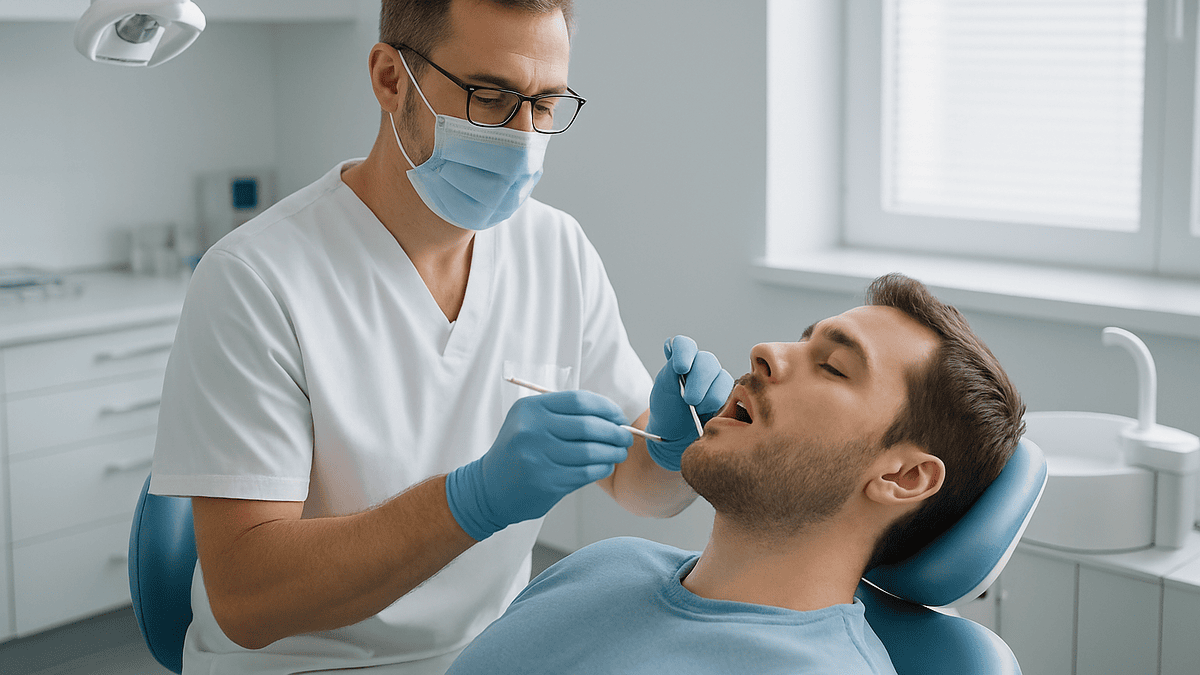
A dental crown procedure usually takes two visits spread over one to three weeks. At the first appointment, the dentist numbs the tooth, reshapes it, takes an impression or digital scan, and places a temporary crown. At the second, the permanent crown is checked for fit and bite, adjusted, and cemented. Some offices mill ceramic crowns on site, finishing everything in a single visit of roughly two to four hours.
It often starts with something small. A popcorn kernel, an olive pit, a bagel that turned out to be a day past its prime, and then that faint, unmistakable click deep in a molar. The tooth doesn’t hurt, exactly. But it doesn’t feel right either, and a week later your dentist is pointing at an X-ray and saying the word crown.
For most people, that word raises three immediate questions: Will it hurt? How long will I be in the chair? And why does this cap for one tooth cost as much as a used laptop?
The honest answers are more reassuring than the internet suggests, and more interesting. A crown is essentially custom engineering at millimeter scale, built to survive a decade or more of chewing forces that can exceed 150 pounds on a back molar. Here is what actually happens, appointment by appointment.
Why do I need a crown instead of a filling?
A filling patches a hole; a crown replaces the tooth’s entire outer shell. Dentists reach for the second option when the first can no longer do its job, and the tipping point is usually structural, not cosmetic.
According to Cleveland Clinic, crowns are typically recommended when a tooth is cracked, badly worn, weakened by a large cavity, or has been treated with a root canal, which leaves the remaining tooth more brittle. There’s a rough rule of thumb many dentists use: once decay or old filling material takes up more than about half the width of the tooth, the remaining walls of enamel are too thin to hold a new filling reliably. Every bite flexes those thin walls, and enamel, hard as it is, doesn’t bend well. It fractures.
A crown works differently. Instead of sitting inside the tooth like a filling, it wraps around it, distributing chewing force down the whole structure the way a bicycle helmet spreads an impact across your skull rather than one spot. That’s why a cracked molar often gets a crown even when a filling would technically fit: the filling would plug the hole but do nothing to stop the crack from spreading toward the root.
Other common reasons include anchoring a dental bridge, covering a dental implant, or restoring a tooth that’s worn flat from years of grinding. In each case the logic is the same: the crown isn’t decoration, it’s a load-bearing structure.
What happens before any drilling starts?
The procedure really begins with detective work. Before committing a tooth to a crown, your dentist needs to confirm two things: that the tooth genuinely needs one, and that the root and surrounding bone are healthy enough to support it.
Expect an X-ray of the tooth and its root. This checks for decay hiding under old fillings, cracks extending below the gumline, and any sign of infection at the root tip. If the nerve inside the tooth is inflamed or infected, a root canal may be needed first: Mayo Clinic notes this is a routine sequence, since crowning over an infected nerve just seals the problem in.
Your dentist will also look at your bite. A tooth that takes heavy grinding forces may steer the material choice toward something tougher, like zirconia, while a front tooth in your smile line may call for layered porcelain that mimics enamel’s translucency.
This is your best window to ask questions, and three are worth asking out loud:
- How much healthy tooth structure is left, and could a smaller restoration (an onlay or large filling) work instead?
- What material do you recommend for this specific tooth, and why?
- What happens if we wait six months?
A good clinician will have concrete answers, often with the X-ray on screen to show you exactly what they’re seeing. If the answer to the last question is “the crack likely spreads and you risk losing the tooth,” that’s useful information. If it’s vague, a second opinion costs far less than an unnecessary crown.
How painful is a dental crown procedure?
Here’s the honest answer: for most people, the procedure itself feels about like getting a large filling. The tooth and surrounding gum are fully numbed with local anesthetic before any drilling starts, and the numbing injection, a few seconds of pinch and pressure, is usually the most uncomfortable moment of the entire two-visit process.
Once the anesthetic takes effect, typically within five to ten minutes, you’ll feel vibration and pressure but not pain. Dentists routinely check before starting; if you feel anything sharp, say so, because more anesthetic can be added. Modern techniques, including topical numbing gel applied before the injection, have made this far gentler than the appointments people remember from decades ago.
What about afterward? Some tenderness is normal for a few days once the numbness wears off: the tooth has just been reshaped, and the gum around it was handled during impressions. Cleveland Clinic describes post-procedure sensitivity to heat, cold, or pressure as common and usually temporary. It tends to peak within the first 48 hours and fade over one to two weeks.
Two situations change the picture. A tooth that was already inflamed before the appointment may ache more afterward and occasionally signals it needs a root canal. And a crown cemented slightly “high”, hitting before your other teeth when you bite, can make the tooth sore until the dentist adjusts it, a five-minute fix.
If dental anxiety itself is the barrier, tell the office when you book. Many practices offer sedation options and will pace the appointment differently for anxious patients. Fear is common, manageable, and nothing to apologize for.
What does “preparing the tooth” actually involve?
Tooth preparation is the heart of the first visit, and it’s more sculpture than demolition. Using a high-speed handpiece, the dentist removes a thin, controlled layer from every surface of the tooth, typically one to two millimeters, about the thickness of a nickel, to create room for the crown to fit over it without making the tooth look bulky or throwing off your bite.
The amount removed depends on the material. All-metal crowns are strong in thin layers, so they need the least reduction. Porcelain and porcelain-fused-to-metal crowns need more space to achieve lifelike color and adequate strength. Your dentist isn’t freelancing here; each material has minimum thickness requirements, and cutting corners produces crowns that crack.
Two other things happen during preparation:
- Decay removal. Any cavity or failing old filling is cleaned out completely. If a lot of tooth is missing afterward, the dentist rebuilds the core with filling material, a “buildup”, so the crown has a solid foundation.
- Margin design. The dentist shapes a precise ledge, called the margin, around the base of the tooth where crown will meet tooth. This junction is the crown’s most vulnerable point for future decay, so its smoothness matters enormously.
The whole shaping process usually takes 20 to 40 minutes, and you’re numb throughout. People are often surprised by how uneventful it feels, mostly water spray, suction, and the sensation of distant vibration. Bring headphones if the sound bothers you; most dentists don’t mind at all.
Impressions or digital scans: how your crown gets its exact shape
A crown has to fit its tooth within a tolerance measured in hundredths of a millimeter, gaps at the margin invite bacteria and decay. Capturing that geometry happens one of two ways.
The traditional method uses impression material: a putty-filled tray pressed over your teeth for two to four minutes while it sets. It’s accurate and time-tested, though people with a strong gag reflex don’t love it. The dentist also takes an impression of the opposing teeth so the lab can build a crown that meets your bite correctly, plus a shade match so the color blends with its neighbors.
The newer method is a digital scan: a wand-shaped intraoral camera glides over the prepared tooth, capturing thousands of images that software stitches into a 3D model in real time. No trays, no putty, no gagging. Both approaches produce clinically excellent crowns; the scan is simply more comfortable and lets the lab start work minutes later instead of days.
One small but important step often happens just before: the dentist tucks a thin retraction cord around the tooth’s base for a few minutes, gently pushing the gum aside so the margin, that critical crown-to-tooth junction, is captured cleanly. It feels like snug pressure, nothing more.
From here, a traditional lab typically needs one to three weeks to fabricate the crown, whether it’s cast in metal, layered in porcelain, or milled from a zirconia block and glazed in a furnace. Your tooth doesn’t wait unprotected in the meantime, which brings us to the temporary.
Living with a temporary crown: the two-week test drive
Before you leave the first appointment, the dentist fits a temporary crown, usually acrylic or composite resin, made chairside in a few minutes, and cements it with a deliberately weak adhesive. That weakness is a feature, not a flaw: the temporary needs to come off easily at the next visit without stressing the tooth underneath.
The temporary has three jobs. It shields the freshly shaped tooth, which would otherwise be painfully sensitive to air and temperature. It holds the neighboring and opposing teeth in position, because teeth drift surprisingly fast, even a week of unopposed space can shift them enough to compromise the final crown’s fit. And it gives you a rough preview of the new tooth’s shape.
Living with it requires modest caution for one to three weeks:
- Chew on the other side when you can, and skip sticky foods, caramel, taffy, and chewing gum are the classic temporary-removers.
- Avoid very hard foods (ice, nuts, crusty bread) on that side; acrylic is far weaker than the final crown.
- Floss carefully, sliding the floss out sideways rather than popping it back up, which can lift the temporary off.
If the temporary comes loose or falls off anyway, don’t panic and don’t wait it out, call the office. An exposed prepared tooth gets sensitive quickly, and drift can begin within days. Reseating a temporary takes minutes. Some people manage a short gap with over-the-counter temporary dental cement from a pharmacy, but that’s a stopgap for a weekend, not a substitute for the visit.
Can I really get a crown in one day?
Yes, if your dentist has the equipment. Same-day crowns use CAD/CAM technology: the dentist scans the prepared tooth digitally, designs the crown on a screen, and sends the file to an in-office milling machine that carves it from a solid block of ceramic in about 15 to 30 minutes. After glazing or polishing, the crown is cemented within the same appointment. Total chair time typically runs two to four hours, and there’s no temporary and no second visit.
Cleveland Clinic notes that same-day crowns are a legitimate option for many teeth, and studies generally show good clinical performance for milled ceramic crowns. But same-day isn’t automatically better, and it isn’t right for every case:
- Material limits. In-office mills work with specific ceramic blocks. Certain cases, very heavy grinders, some complex bites, crowns attached to bridges, may still do better with lab-fabricated options.
- Esthetics on front teeth. A skilled lab technician hand-layering porcelain can achieve subtle color gradients that a monolithic milled block sometimes can’t match. For a front tooth in your smile line, the two-visit lab route may look more natural.
- Availability. The equipment is expensive, so plenty of excellent dentists simply don’t offer it, and that says nothing about their quality.
The practical takeaway: if avoiding a second visit matters to you (travel, schedule, dental anxiety), ask whether same-day is available and appropriate for your specific tooth. If your dentist recommends the lab route for a visible front tooth, that’s often an esthetic judgment call worth trusting.
What happens at the fitting appointment?
The second visit is shorter, usually 20 to 45 minutes, and often doesn’t require numbing at all, though you can ask for it if the tooth is sensitive when the temporary comes off.
The sequence runs like this. The dentist removes the temporary crown and cleans residual cement off the tooth. Then comes the try-in: the permanent crown is seated without cement while the dentist checks three things with real care.
- Marginal fit. Using an explorer (that thin hooked instrument) and sometimes an X-ray, the dentist confirms the crown meets the tooth seamlessly at the gumline, with no ledge or gap where plaque could collect.
- Contacts. Floss should pass between the new crown and its neighbors with a gentle snap, not loose (food traps) and not so tight it can’t pass.
- Bite. You’ll tap and grind on thin colored marking paper. High spots get polished down until the crown meets your other teeth evenly. This step is worth being picky about; even a bite that’s off by the thickness of a sheet of paper can make a tooth ache for weeks.
You’ll also get a mirror check for color and shape, especially on visible teeth. Speak up now, adjustments are easy before cementation and difficult after.
Once everything checks out, the dentist isolates the tooth, applies permanent cement inside the crown, seats it firmly, and removes the excess as it sets. Ten minutes later, you’re done. The cement reaches substantial strength quickly, though many dentists suggest waiting until the numbness fades before eating, purely so you don’t bite your cheek.
How long does it take a dentist to crown a tooth?
Plan for two appointments and a waiting period between them, or one long appointment if your dentist offers same-day milling. Here’s the realistic timeline for the traditional route:
- First visit: 60 to 90 minutes. Numbing, shaping the tooth, impressions or scanning, and making the temporary. A tooth that also needs a core buildup, or decay removal near the nerve, can push this toward two hours.
- Waiting period: one to three weeks. This is lab fabrication time, not the dentist’s schedule padding. Casting, layering porcelain, or milling and sintering zirconia are multi-step processes, and sintering alone involves furnace cycles of several hours.
- Second visit: 20 to 45 minutes. Try-in, adjustments, cementation.
Same-day crowns compress all of that into roughly two to four hours, with a built-in break while the milling machine and glazing furnace work, many offices let you read in the waiting room or step out for coffee.
A few things can lengthen the overall journey. If the tooth needs a root canal first, add one or two appointments before crown work even begins. If the try-in reveals a fit or color problem, the crown may go back to the lab, adding another week, annoying, but far better than cementing a compromised crown. And a tooth broken below the gumline sometimes needs a minor gum procedure and healing time before it can be crowned at all.
The honest average, start to finish: two to four weeks for most people, most of it spent simply waiting comfortably in a temporary.
Which crown material is best? An honest comparison
There is no single best material: there’s a best material for a particular tooth, in a particular mouth, under a particular bite. The main trade-off is almost always strength versus natural appearance, and the table below reflects the way Cleveland Clinic and most mainstream sources frame the options.
| Material | Strength | Appearance | Best suited for | Worth knowing |
|---|---|---|---|---|
| Zirconia | Highest | Good, improving yearly | Molars, heavy grinders | Extremely fracture-resistant; newer translucent versions look better on visible teeth |
| All-porcelain / all-ceramic | Good | Excellent, closest to enamel | Front teeth, visible smile line | Best light-handling and translucency; slightly more brittle under heavy bite force |
| Porcelain-fused-to-metal (PFM) | Very good | Good | Front or back teeth | Decades of track record; a gray line can appear at the gumline as gums recede over time |
| Gold / metal alloys | Very high | Metallic, not tooth-colored | Out-of-sight molars | Requires the least tooth removal; exceptionally gentle on opposing teeth; very long wear record |
| All-resin | Lowest | Fair | Temporary or budget use | Wears down and fractures faster than other options |
A few opinions grounded in evidence: for a second molar nobody will ever see, metal and zirconia remain the workhorses because they tolerate the heaviest chewing loads. For a front tooth, all-ceramic usually wins on looks. And if you grind your teeth at night, mention it: it shifts the material calculus and may earn you a recommendation for a night guard, which protects the crown and every tooth around it.
Is $2,000 a lot for a dental crown?
In the United States, no, $2,000 sits squarely within the normal range. Crown fees commonly run from around $1,000 to $3,500 depending on material, geography, and the complexity of the case, with all-ceramic and zirconia crowns in major metropolitan areas frequently landing between $1,500 and $2,500. Prices vary enough that quoting a single national average would be misleading, but $2,000 should not, on its own, raise eyebrows.
What you’re actually paying for is worth spelling out, because “a cap for one tooth” undersells it:
- Two clinical appointments totaling roughly two hours of dentist and assistant time
- Diagnostic X-rays, anesthetic, impression or scanning materials, and the temporary crown
- Lab fabrication by a trained technician, often $150 to $500 of the fee, or the amortized cost of six-figure milling equipment
- The dentist’s liability for a restoration expected to function for a decade or more
Ways to manage the cost honestly: dental insurance often covers a percentage of crowns deemed medically necessary, typically after a deductible and subject to annual maximums, so ask for a pre-treatment estimate. Dental schools offer crowns at substantially reduced fees, performed by supervised students, appointments run longer, but quality oversight is rigorous. Some employers’ flexible spending or health savings accounts can be used for crowns with pre-tax dollars.
One caution cuts both ways. A quote far above the local range deserves a second opinion, but so does one far below it. Crowns priced dramatically under market sometimes reflect overseas lab work of variable quality or corners cut on materials. The margin fit of a crown is invisible to you and matters for years; it’s a poor place to bargain-hunt blindly.
Why do dentists push for crowns, and how do I know I really need one?
It’s a fair question, and it deserves a non-defensive answer. Crowns are among dentistry’s more profitable procedures, and dentistry, unlike much of medicine, involves clinicians who both diagnose the problem and sell the solution. That structure creates a genuine incentive tension, and pretending otherwise insults your intelligence.
But it’s equally true that crowns are recommended often because the underlying problems are common. Large old fillings fail. Cracked-tooth cases climb with age, decades of chewing is a fatigue test no material passes forever. Root-canal-treated back teeth genuinely do fracture at higher rates without full coverage, which is why crowning them afterward is standard mainstream guidance, not upselling. When a dentist says “this tooth needs a crown,” the odds strongly favor a legitimate recommendation.
How to tell the difference in your own case:
- Ask to see the evidence. A dentist recommending a crown should be able to show you the crack, the failing filling, or the decay on an X-ray or intraoral photo. Most are glad to.
- Ask about alternatives. Onlays, large fillings, or watchful waiting are sometimes reasonable. A trustworthy answer explains the trade-offs rather than dismissing the question.
- Be alert to volume. Needing one or two crowns after years of large fillings is unremarkable. Being told at a first visit that you need six, when your previous dentist saw no problems six months ago, warrants a second opinion.
- Get that second opinion without guilt. Reputable dentists expect it for larger treatment plans. Bring your X-rays; you’re entitled to copies.
Skepticism and trust aren’t opposites here. Verify, then proceed.
What should I do after my crown is cemented?
The first 48 hours are about letting things settle. Mild sensitivity to cold or pressure is common and typically fades within days to two weeks; the tooth has been reshaped, handled, and cemented, and its nerve is entitled to a brief protest. The gum around the crown may be tender too, especially where the retraction cord sat.
Practical guidance for the first days:
- Wait until numbness fully wears off before chewing on that side, not because the crown is fragile, but because numb cheeks and tongues get bitten.
- If your dentist used a cement with a longer setting curve, they may ask you to avoid very sticky or hard foods on that side for 24 hours. Follow their specific instructions over anything you read online, including this.
- Pay attention to your bite. If the crown feels “high”, like that tooth hits first when you close, call the office. This is the single most common post-cementation issue, the adjustment takes minutes, and waiting only prolongs soreness.
Long-term care is unglamorous and effective: brush twice daily, floss once daily with special attention to the crown’s gumline margin, and keep regular checkups. Here’s the fact most people don’t realize: the crown itself can’t decay, but the natural tooth underneath it absolutely can, and the margin where crown meets tooth is the prime target. Cleveland Clinic identifies decay at the margin as a leading reason crowns eventually fail. Floss is cheaper than a replacement crown by roughly three orders of magnitude.
If you grind your teeth at night, ask about a custom night guard. Porcelain is hard but brittle; years of nocturnal grinding is exactly the load pattern that chips it.
How long will my crown last?
The ranges cited by mainstream sources are wide but consistent: Cleveland Clinic puts typical crown lifespan at five to fifteen years, and well-maintained crowns commonly exceed that. Long-term studies of gold crowns in particular have documented survival stretching past twenty years, which is part of why some dentists still favor metal for out-of-sight molars despite its looks.
What actually determines where your crown lands in that range? Mostly things within your influence:
- Hygiene at the margin. New decay creeping under the crown’s edge is the most common failure mode. Daily flossing along the gumline is the single highest-leverage habit.
- Grinding and clenching. Bruxism can chip porcelain and, over years, loosen cement bonds. A night guard is inexpensive insurance.
- Chewing habits. Ice, unpopped popcorn kernels, pens, fingernails, and using teeth as bottle openers or package scissors shorten the life of crowns and natural teeth alike.
- The tooth underneath. A crown on a healthy, well-supported tooth outlasts one placed on a tooth that had little structure remaining. This is partly why dentists prefer to crown teeth before they fracture catastrophically.
Signs a crown is nearing the end of its service: a visible dark line or gap developing at the gumline, food consistently trapping around it, new sensitivity in a tooth that had been quiet for years, or the crown feeling loose or rocking slightly. None of these is an emergency in itself, but each is a make-an-appointment signal. Caught early, some problems can be repaired; caught late, they can cost the tooth.
When to see a dentist, during the process or years later
Most crown journeys are uneventful, but certain symptoms mean you should call rather than wait for your next scheduled visit.
During or shortly after the procedure, contact your dentist if:
- The temporary crown comes off or breaks, reseating it protects the tooth and prevents drift, and it’s a quick visit.
- Pain is severe, throbbing, or waking you at night, or sensitivity is worsening rather than improving after the first week. This can indicate the tooth’s nerve is inflamed and may need a root canal, something Mayo Clinic notes can become necessary even after crown work has begun.
- Your bite feels off, or the crowned tooth hits first when you close. A minor adjustment fixes this; toughing it out doesn’t.
- You notice swelling of the gum or face, a bad taste near the tooth, or a pimple-like bump on the gum. These suggest infection and warrant prompt evaluation.
Months or years later, book a visit if:
- A crown falls out. Keep it, clean, dry, in a small container, because it can often be recemented if the underlying tooth is sound. Don’t glue it back with household adhesive.
- You see a dark line or feel a ledge or gap at the gumline with your tongue or floss.
- A long-quiet crowned tooth becomes sensitive or sore, or the gum around it bleeds persistently despite good brushing.
And one genuine urgency: facial swelling accompanied by fever, or swelling that affects breathing or swallowing, is not a wait-for-Monday situation. Seek same-day care, urgent dental care or an emergency department, because dental infections can occasionally spread quickly. It’s rare. It’s also exactly the scenario where a few hours matter.
Frequently asked questions
How painful is a dental crown procedure?
For most people it feels similar to getting a large filling, pressure and vibration, but not pain, because the tooth is fully numbed with local anesthetic first. The numbing injection itself is usually the most uncomfortable moment. Afterward, mild sensitivity to temperature or pressure is common for a few days to two weeks. Pain that is severe, throbbing, or getting worse rather than better warrants a call to your dentist.
How long does it take a dentist to crown a tooth?
Traditionally, two visits: about 60 to 90 minutes for numbing, shaping, and impressions, then 20 to 45 minutes one to three weeks later to fit and cement the permanent crown. The gap is lab fabrication time. Offices with in-house milling equipment can complete a same-day ceramic crown in a single appointment of roughly two to four hours, with no temporary needed.
Is $2,000 a lot for a dental crown?
No, in the United States, $2,000 sits within the typical range, which commonly runs from about $1,000 to $3,500 depending on material, location, and case complexity. The fee covers two appointments, diagnostics, anesthetic, the temporary crown, and lab fabrication. Insurance often pays a percentage after your deductible, so request a pre-treatment estimate. Dental schools offer crowns at reduced fees with rigorous faculty supervision if cost is a barrier.
Do I need a root canal before getting a crown?
Not usually. Most crowned teeth keep their living nerve, and a root canal is only needed if the nerve is inflamed, infected, or dying, something your dentist assesses with X-rays and testing before starting. The reverse is more common: teeth that have had a root canal often need a crown afterward, because root-canal-treated back teeth are more brittle and fracture at higher rates without full coverage.
Can a crowned tooth still get a cavity?
Yes. The crown material itself cannot decay, but the natural tooth underneath absolutely can, especially at the margin where the crown meets the tooth near the gumline. Decay at this junction is one of the most common reasons crowns eventually fail. Daily flossing along the crown’s gumline, twice-daily brushing, and regular checkups are what protect that vulnerable seam over the years.
What should I do if my temporary crown falls off?
Call your dental office promptly rather than waiting, reseating a temporary takes minutes, and it matters. Without it, the prepared tooth becomes sensitive quickly, and neighboring teeth can drift within days, compromising the fit of your permanent crown. Keep the temporary safe and clean. For a short gap like a weekend, over-the-counter temporary dental cement from a pharmacy can serve as a stopgap, but it is not a substitute for the visit.
Why does my new crown feel high or sensitive when I bite?
A crown that hits before your other teeth when you close, even by the thickness of a sheet of paper, can make the tooth ache and stay sensitive. This is the most common post-cementation issue, and the fix is a quick, painless bite adjustment at the office. Call rather than toughing it out; prolonged excess pressure keeps the tooth’s nerve irritated. General sensitivity without a high bite usually fades within one to two weeks.
Are same-day crowns as good as lab-made crowns?
For many teeth, yes, milled ceramic crowns show good clinical performance in studies, and they eliminate the temporary and the second visit. The trade-offs are material selection, which is limited to specific ceramic blocks, and esthetics on highly visible front teeth, where a lab technician hand-layering porcelain can achieve subtler color gradients. For a back molar, same-day is often an excellent choice; for a front tooth, ask your dentist which route will look more natural.
How long do dental crowns last?
Typically five to fifteen years, according to Cleveland Clinic, and well-maintained crowns commonly last longer, gold crowns in particular have documented survival beyond twenty years. Lifespan depends mostly on habits: flossing at the crown’s gumline margin, avoiding ice-chewing and using teeth as tools, and wearing a night guard if you grind. Watch for warning signs like a dark line at the gumline, new sensitivity, or looseness, and see your dentist early.
Can a dental crown be whitened if my other teeth change color?
No. Porcelain, zirconia, and other crown materials do not respond to whitening products, which only work on natural enamel. This is why dentists match crown shade carefully at placement, and why, if you are considering whitening your natural teeth, it is smart to whiten first and then have the crown made to match the new shade. If an existing crown no longer blends with whitened neighbors, replacement is the only way to change its color.
References
This article is for general information only and is not a substitute for professional medical advice. Please consult a qualified doctor about your individual situation.

More from the Blog

How Long Do Crowns Last? Material by Material, With Care Tips That Matter
Most dental crowns last about 10 to 15 years, and well-made, well-cared-for crowns often serve 20 years or longer. Gold and other metal crowns…

Crown vs Filling: How Dentists Decide When a Tooth Needs More
Dentists generally recommend a filling when a cavity is small and the tooth still has strong walls to support it. A crown becomes the…

Root Canal and Crown Cost: The Combined Bill, Explained Honestly
A root canal and crown done together typically fall within our guide range of EUR 300–850 for international patients treated in Turkey, compared with…
Dental Crown Cost: Zirconia, E-max and Porcelain Prices Compared
A single dental crown costs EUR 200-400 for zirconia and EUR 250-500 for E-max per tooth in our international guide range, compared with roughly…

Types of Dental Crowns: Zirconia, E-max, PFM and Gold: Compared Neutrally
Dentists commonly place four crown types: zirconia (exceptionally strong, increasingly natural-looking), E-max lithium disilicate (the esthetic favorite for front teeth), porcelain-fused-to-metal (a proven middle…

Dental Bridge Cost: Pricing by Type, and When an Implant Beats a Bridge
A three-unit dental bridge costs EUR 650–2,100 in our international guide range (reviewed August 2026), compared with typical prices of GBP 1,500–3,500 in the…