

The Gallbladder: Where It Is, What It Does and How Big It Is
Key Takeaways
- The gallbladder is only three to four inches long and holds about two tablespoons to a quarter cup of bile, but that bile is concentrated several-fold, so a little goes a long way.
- Roughly 10 to 15 percent of U.S. adults have gallstones, and most will never have a single symptom from them.
- A classic gallbladder attack is a steady ache under the right ribs lasting one to five hours, often after a fatty meal and often at night, not cramping, and rarely eased by changing position.
- Fever, yellowing skin or eyes, dark urine, pale stools, or pain that won't ease after several hours are red flags that turn gallbladder pain into a same-day medical problem.
- Losing more than about three pounds a week sharply raises gallstone risk, which makes crash diets one of the most preventable causes of gallbladder trouble.
- After gallbladder removal, bile flows continuously instead of in timed bursts, and most people return to a fully normal diet, pizza included, within weeks to a few months.
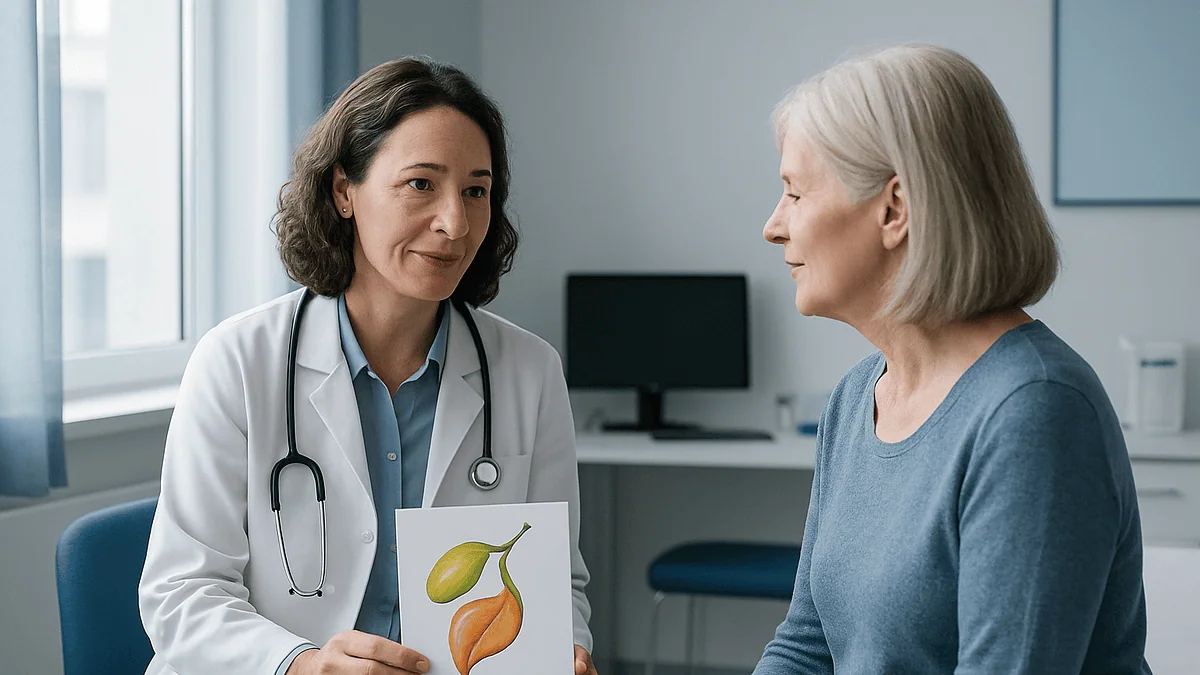
The gallbladder is a small, pear-shaped pouch tucked beneath the liver on the right side of the upper abdomen. Roughly three to four inches long, it stores and concentrates bile made by the liver, then squeezes it into the small intestine to help digest fat. You can live without it, but problems such as gallstones can cause pain that deserves medical attention.
It usually announces itself at night. A rich dinner, maybe fried chicken, maybe a cream sauce, and then, an hour or two later, a steady, boring ache under the right ribs that refuses to shift no matter how you lie. Plenty of people spend that first miserable night blaming the food. The food was only the messenger.
The organ behind the drama is one most of us never think about: a green, thumb-length pouch parked under the liver, quietly doing warehouse work for the digestive system. When it runs smoothly, you never feel it. When a stone jams its exit door, you feel very little else.
Here is the honest tour, where this small organ actually sits, what it contributes to every meal you eat, how big it really is, and what the evidence says about warning signs, trigger foods and life after surgery.
Where is the gallbladder located?
Put your right hand flat against the bottom edge of your right ribcage, fingertips pointing toward the center of your chest. The gallbladder sits just behind that spot, in the upper right quadrant of the abdomen, tucked into a shallow depression on the underside of the liver, which drapes over it like a roof (Cleveland Clinic).
That address explains the classic pain pattern. When the gallbladder becomes inflamed or a stone blocks its outlet, the discomfort typically centers under the right ribs or in the middle of the upper belly, just below the breastbone. Because of shared nerve pathways, the pain often radiates through to the back or up to the tip of the right shoulder blade: a pattern of referred pain that puzzles many people, who assume they’ve pulled a muscle.
The gallbladder isn’t floating alone back there. It connects to a small plumbing network called the biliary tree: the cystic duct drains the gallbladder itself, joining the common bile duct, which carries bile from the liver down to the first stretch of the small intestine, the duodenum. Most gallbladder trouble is, at heart, plumbing trouble, something blocking one of those narrow pipes.
One practical note: pain location is a clue, not a verdict. Upper-abdominal pain has many possible sources, from the stomach to the pancreas to, occasionally, the heart. That’s why imaging, not geography, settles the question.
How big is the gallbladder?
Smaller than most people imagine. A healthy adult gallbladder is roughly three to four inches (7 to 10 centimeters) long and about an inch to an inch and a half wide: the size and shape of a small pear, which is exactly how anatomy textbooks describe it (Cleveland Clinic).
Its capacity is modest too: around 30 to 50 milliliters of bile, which is somewhere between two tablespoons and a quarter cup. That sounds trivial until you remember the gallbladder’s trick: it doesn’t just store bile, it concentrates it, pulling water out through its lining so a small volume packs a much stronger digestive punch than the dilute bile arriving from the liver.
The organ is also a shape-shifter. Before a meal, it swells with stored bile like a small water balloon. After a fatty meal, it contracts, squeezing out much of its contents within an hour or so, and deflates to a fraction of its fasting size. Ultrasound technicians see this daily, which is why they ask you to fast before a gallbladder scan: a full, distended gallbladder is far easier to examine, and stones show up more clearly against the fluid.
Three inches, two tablespoons. For an organ that features in hundreds of thousands of surgeries a year, the gallbladder is remarkably small, and its job, as we’ll see, is more courier than factory.
What does the gallbladder do, exactly?
Think of the liver as a bile factory that never shuts down and the gallbladder as its warehouse and delivery service. The liver produces bile continuously, on the order of 800 to 1,000 milliliters a day, close to a quart (Johns Hopkins Medicine). But your intestine doesn’t need bile continuously. It needs a burst of it when fat arrives.
The gallbladder solves that timing problem in three steps:
- Storage. Between meals, bile flowing from the liver backs up into the gallbladder rather than dribbling uselessly into an empty intestine.
- Concentration. The gallbladder’s lining absorbs water and salts, thickening the bile several-fold. Two tablespoons of this concentrate does the work of a much larger volume of the raw product.
- Timed release. When fat and protein reach the duodenum, intestinal cells release a hormone called cholecystokinin: CCK, aptly translated as “gallbladder mover.” The gallbladder contracts, a small muscular valve at the end of the bile duct relaxes, and concentrated bile squirts onto the arriving meal.
That’s the whole job: store, concentrate, deliver on cue. The gallbladder manufactures nothing. This is why surgeons can remove it without replacing it: the factory upstream keeps running, and bile simply trickles into the intestine steadily instead of arriving in well-timed pulses. Digestion carries on, a little less elegantly.
What is bile, and why does fat need it?
Bile is the body’s dish soap. Fat and water famously refuse to mix, shake oil and vinegar and watch them separate within minutes. Your intestine faces the same chemistry problem: digestive enzymes work in a watery environment, but dietary fat arrives in large, water-repelling globules those enzymes can barely touch.
Bile salts solve this the way detergent lifts grease from a pan. Each molecule has one end that loves water and one end that loves fat, so bile salts surround fat globules and break them into thousands of microscopic droplets: a process called emulsification. That explosion of surface area lets fat-digesting enzymes from the pancreas do their work quickly and completely (Johns Hopkins Medicine).
The stakes go beyond calories. Vitamins A, D, E and K are fat-soluble; they hitch a ride into your bloodstream inside those bile-coated droplets. Without adequate bile flow, absorbing them becomes genuinely difficult, one reason prolonged blockage of the bile ducts is treated as a serious medical problem rather than an inconvenience.
Bile is also a waste chute. It carries bilirubin, the yellow-brown pigment left over when old red blood cells are recycled, out of the body. Bilirubin is what gives stool its normal brown color. When bile can’t flow, because a stone has blocked the duct, for instance, that pigment backs up into the blood instead. The skin and eyes turn yellow, urine darkens, and stools turn pale and clay-colored. Those changes are worth remembering; they reappear later in this article as red flags.
What are the first signs of a bad gallbladder?
The signature complaint is called biliary colic, and the name is misleading. “Colic” suggests cramping that comes and goes; gallbladder pain is usually the opposite: a steady, intense ache or pressure that builds over 15 to 60 minutes and then plateaus, typically under the right ribs or in the center of the upper abdomen. According to the NHS, a typical episode lasts between one and five hours, though it can occasionally pass in minutes (NHS).
Other early clues that people commonly report:
- Pain that radiates to the back, between the shoulder blades, or to the right shoulder
- Nausea, sometimes with vomiting that doesn’t relieve the pain
- Attacks that follow rich or fatty meals, often striking late in the evening or waking you from sleep
- Episodes that recur, days, weeks or months apart, with complete comfort in between
What early gallbladder disease usually does not cause, despite popular belief: everyday bloating, gas or mild indigestion on their own. Those symptoms are common and have many causes; studies of people before and after gallbladder surgery show that vague digestive complaints often persist even after the organ is gone, because the gallbladder was never the culprit.
The pattern that should raise your suspicion is specific: steady upper-right pain, lasting an hour or more, arriving after fatty food, then resolving completely. Once you’ve had one such attack, the odds of another are substantial, which is exactly the conversation to have with a clinician (Mayo Clinic).
What causes gallstones in the first place?
Gallstones form when the chemistry of bile drifts out of balance. Bile keeps cholesterol dissolved the way hot tea keeps sugar dissolved, up to a point. When the liver secretes more cholesterol than the bile salts can hold in solution, crystals form, and crystals grow into stones. Most gallstones in the United States are this cholesterol type; a smaller share are pigment stones, built from bilirubin, which tend to occur with certain blood disorders and liver conditions (NIH/NIDDK).
Sluggish emptying matters too. A gallbladder that contracts weakly, during pregnancy, prolonged fasting or very-low-calorie dieting, lets bile sit and stagnate, giving crystals time to form.
The NIDDK estimates that roughly 10 to 15 percent of U.S. adults have gallstones, and most will never know it: the majority of stones stay silent and never cause symptoms. Risk rises with several factors, some changeable and some not:
- Being female, estrogen increases cholesterol in bile
- Age over 40, and a family history of gallstones
- Pregnancy, and higher body weight
- Rapid weight loss, including after weight-loss surgery
- Certain ancestries, including Native American and Mexican American backgrounds, which carry higher rates
- Diabetes and metabolic syndrome
Notice what’s missing from that list: any single “bad” food. Diet influences risk gradually and indirectly, through weight and bile chemistry. No one gets gallstones from one plate of fries, and, importantly, silent stones discovered by accident usually need no treatment at all, just awareness (NIH/NIDDK).
What foods trigger gallbladder issues?
A distinction worth underlining: food doesn’t create gallbladder disease overnight, but food absolutely triggers attacks in a gallbladder that already contains stones. The mechanism is simple. Fat entering the intestine releases CCK; CCK makes the gallbladder contract hard; if a stone is sitting near the exit, that contraction rams the stone against the outlet. Pain follows within one to a few hours of eating.
The meals patients most often name as triggers are the high-fat ones:
- Fried foods, fried chicken, french fries, doughnuts, anything battered
- Fatty cuts of meat, sausage, bacon and processed meats
- Cream-based sauces, gravies and rich desserts
- Cheese-heavy dishes and full-fat dairy in large amounts
- Very large meals of any kind, which provoke a stronger gallbladder squeeze than the same food spread across the day
If you’re having recurrent attacks and waiting for an evaluation or surgery, a lower-fat eating pattern often reduces the frequency of episodes, not because fat is villainous, but because it lowers the intensity of gallbladder contractions (NHS).
Two counterintuitive points deserve equal billing. First, skipping meals and crash dieting can be as provocative as feasting: long gaps without food let bile stagnate and thicken. Regular, moderate meals keep bile moving. Second, some dietary fat is genuinely useful for gallbladder health over the long run, precisely because it keeps the organ emptying regularly. The goal is rhythm and moderation, not fat phobia.
Is it my gallbladder, heartburn or my heart?
Upper-abdominal pain is a crowded neighborhood, and three residents get confused for one another constantly. The distinctions below are useful patterns, but they are patterns, not guarantees, and heart-related pain in particular can be atypical, especially in women and people with diabetes (Mayo Clinic).
| Feature | Gallbladder attack | Heartburn (reflux) | Heart-related pain |
|---|---|---|---|
| Typical location | Under right ribs or upper mid-abdomen; radiates to back or right shoulder blade | Behind the breastbone, rising toward the throat | Center or left chest; may spread to arm, jaw, neck or back |
| Character | Steady, intense ache or pressure that builds and plateaus | Burning; sour taste; worse lying flat or bending | Pressure, squeezing, tightness; may come with sweating or breathlessness |
| Common trigger | Fatty or large meal, often 1–3 hours earlier; frequently at night | Meals, alcohol, lying down soon after eating | Exertion or stress; sometimes none |
| Typical duration | Steady for 1–5 hours, then resolves | Minutes to hours; eased by antacid-type remedies | Often persistent or recurring in waves |
| Position changes help? | Rarely, people pace, unable to get comfortable | Often, sitting upright helps | No |
The rule that overrides every row of that table: if you have chest pressure with sweating, breathlessness, or pain spreading to the arm or jaw, treat it as a possible heart emergency and call emergency services. Gallbladder pain can wait for morning; a heart attack cannot, and no table should talk anyone out of that call.
When should you see a doctor about gallbladder pain?
Uncomplicated biliary colic is painful but self-limited: it builds, holds for an hour to five, and fades. The dangerous scenarios are the ones where a stone stays stuck, inflaming the gallbladder (cholecystitis), blocking the main bile duct, or triggering pancreatitis. Those need same-day medical care, and the warning signs are recognizable.
Seek urgent or emergency care if abdominal pain comes with any of the following (NHS; Mayo Clinic):
- Pain so severe you cannot sit still or find a comfortable position
- Pain lasting well beyond the typical few hours without easing
- Fever or shaking chills
- Yellowing of the skin or the whites of the eyes
- Dark, tea-colored urine or pale, clay-colored stools
- Persistent vomiting, or inability to keep fluids down
Fever plus right-upper-abdominal pain suggests an inflamed or infected gallbladder. Jaundice and dark urine suggest bile backing up behind a blocked duct: a problem that can escalate quickly and sometimes needs an endoscopic procedure to clear.
And if the attack passes on its own? Still book a routine appointment. One classic episode of biliary colic predicts more; discussing options while you’re well is far better than deciding under pressure in an emergency department. Bring notes: when attacks happen, what you ate, how long they lasted. That timeline is genuinely useful to the clinician who sees you.
How do doctors diagnose gallbladder problems?
Happily, the gallbladder is one of the easier organs to investigate. The workup usually runs in this order:
- Abdominal ultrasound is the first-line test, painless, radiation-free, and excellent at spotting stones, which reflect sound waves and cast telltale shadows. It also shows whether the gallbladder wall is thickened or surrounded by fluid, signs of inflammation. You’ll typically be asked to fast beforehand so the gallbladder is full and easy to see (Mayo Clinic).
- Blood tests check liver enzymes and bilirubin (elevated when bile is backing up), white blood cell count (raised with infection or inflammation), and pancreatic enzymes (to catch stone-related pancreatitis).
- A HIDA scana nuclear medicine study, traces a mildly radioactive marker through the bile system and answers a different question: not “are there stones?” but “is the gallbladder filling and emptying properly?” It’s the go-to test when ultrasound looks normal yet symptoms persist.
- MRCP, a specialized MRI of the bile ducts, maps the plumbing in fine detail when a duct stone is suspected. If one is found, an endoscopic procedure called ERCP can often retrieve it without open surgery.
A caution that saves people grief: finding gallstones is not the same as finding the cause of your symptoms. Because 10 to 15 percent of adults carry silent stones (NIH/NIDDK), a stone on ultrasound plus vague indigestion doesn’t automatically add up to gallbladder disease. Good clinicians match the story to the scan before recommending surgery.
What happens if you have your gallbladder removed?
Removal, cholecystectomy, is among the most commonly performed abdominal operations, and the honest answer about life afterward is reassuringly mundane: for most people, very little changes.
The physiology is straightforward. Your liver keeps making bile at its usual pace; it simply flows steadily down the bile duct into the intestine instead of being stockpiled and released in bursts. You lose the well-timed “squirt” that accompanied fatty meals, but the continuous trickle handles ordinary eating perfectly well. There is no bile shortage, only a scheduling change.
The operation itself is usually laparoscopic: four small incisions, a camera, and typically a same-day discharge. The NHS notes that most people having keyhole surgery go home the same day and return to normal activities in about two weeks; open surgery, needed in a minority of cases, means a longer recovery of roughly six to eight weeks (NHS).
What about side effects? In the early weeks, some people notice looser or more urgent stools, particularly after fatty meals: the steady bile drip can act as a mild laxative. For most, this settles within weeks to a few months as the gut adapts. A small minority have longer-lasting loose stools after fatty food and learn to moderate accordingly; persistent problems are worth discussing with a clinician, since manageable causes exist.
What removal does not do, according to the mainstream evidence: cause weight gain by itself, wreck digestion, or shorten life. The gallbladder is genuinely useful and genuinely optional: a rare combination in human anatomy.
Can I ever eat pizza again after gallbladder removal?
Yes, and for most people, sooner than the internet suggests. This question deserves a direct answer because it’s what patients actually worry about in the pre-op waiting room, usually more than the surgery itself.
Here’s the realistic timeline. In the first days after surgery, most surgical teams suggest gentle, lower-fat eating, not because fat is dangerous, but because your digestive system is adjusting to continuous bile flow and a heavy, greasy meal may send you to the bathroom in a hurry. Over the following weeks, you reintroduce richer foods gradually and pay attention to how you respond (NHS).
By a few months out, the large majority of people eat an essentially normal diet, pizza, birthday cake, holiday dinners included. The gut adapts remarkably well to bile arriving as a steady stream rather than a timed pulse.
A sensible reintroduction strategy:
- Start with one slice, not three, and see how you feel over the next few hours
- Pair rich foods with fiber: a salad alongside the pizza slows fat absorption and softens the bile response
- Spread fat across the day rather than concentrating it in one enormous meal
- Keep brief notes for the first month; personal patterns emerge quickly and vary widely between people
A minority, and it is a minority, find that very greasy meals reliably cause urgency or loose stools long-term. If that’s you, the fix is usually moderation rather than abstinence. Foods are rarely banned after gallbladder surgery; portions are simply negotiated.
Can you prevent gallstones?
Partly. You can’t change your sex, age, genes or ancestry: the heavyweight risk factors. But the modifiable levers are real, and the evidence behind them is consistent (NIH/NIDDK).
Lose weight slowly, if you’re losing it at all. This is the counterintuitive headline. Rapid weight loss, more than about three pounds a week, sharply raises gallstone risk, because the liver dumps extra cholesterol into bile during fast fat breakdown while the under-fed gallbladder empties less often. Crash diets and very-low-calorie plans are classic gallstone setups. Gradual, sustained loss avoids most of that risk and lowers it long-term, since higher body weight itself promotes stones.
Don’t skip meals. Regular eating keeps the gallbladder contracting and bile moving. Long daily fasts let bile sit, concentrate and crystallize. Even a modest breakfast triggers a useful gallbladder squeeze.
Favor fiber and whole foods. Eating patterns rich in vegetables, fruits, whole grains and legumes are associated with lower gallstone rates in large observational studies; patterns heavy in refined carbohydrates and low in fiber track with higher rates. Association isn’t proof, but the direction of the evidence is steady.
Move. Regular physical activity is linked to lower gallstone risk independent of weight, likely through better cholesterol handling and gut motility.
What the evidence does not support: any supplement, tea or “gallbladder-friendly” product marketed for prevention. No pill has been shown to prevent gallstones in healthy people, and claims to the contrary outrun the science.
Do gallbladder cleanses actually work?
No, and the story behind the myth is worth telling, because it’s a beautiful example of how convincing bad evidence can look.
The typical “gallbladder flush” involves drinking large amounts of olive oil and citrus juice, sometimes with herbs, over a day or two. The next morning, believers find soft green pellets in the toilet and conclude the stones have passed. Laboratory analyses tell a different story: those pellets are not gallstones at all. They’re soap, lumps formed when the oil you drank reacts with digestive juices, essentially the same chemistry as making soap in a pot. Real gallstones are hard, often calcified, and don’t dissolve or dislodge on command. The Mayo Clinic’s assessment is blunt: there’s no reliable evidence that gallbladder cleanses prevent or treat gallstones, and the regimens can cause nausea, vomiting, diarrhea and abdominal pain of their own (Mayo Clinic).
There’s a genuine hazard beyond wasted hope. A large oily “flush” provokes a forceful gallbladder contraction, precisely the event that can wedge a real stone into a duct and turn a quiet gallbladder into an emergency.
The appeal of cleanses is understandable: they promise control and a way to avoid surgery. But the evidence-based menu of real options, watchful waiting for silent stones, medication approaches in selected cases, surgery for recurrent attacks, is a conversation for a clinician who knows your scans and your story. Soap pellets, however green and dramatic, are not a treatment.
Frequently asked questions
What happens if you have your gallbladder removed?
For most people, remarkably little changes long-term. The liver keeps making bile; it simply flows steadily into the intestine instead of being stored and released in bursts. Keyhole surgery usually means going home the same day and returning to normal activities in about two weeks. Some people have looser stools after fatty meals early on, which typically settles as the gut adapts. Removal does not cause weight gain by itself or shorten life expectancy.
What are the first signs of a bad gallbladder?
The classic first sign is biliary colic: a steady, intense ache under the right ribs or in the upper mid-abdomen that builds over an hour, lasts one to five hours, and often follows a fatty meal, frequently at night. Pain may radiate to the back or right shoulder blade, often with nausea. Everyday bloating and gas alone are usually not gallbladder signs. If attacks recur, or come with fever or yellowing skin, see a doctor promptly.
Can I ever eat pizza again after gallbladder removal?
Yes. Most people return to a fully normal diet, including pizza, within weeks to a few months of surgery. In the early days, lower-fat eating is gentler while your gut adjusts to continuous bile flow. Reintroduce rich foods gradually, one slice, not three, and pair them with fiber. A minority find very greasy meals cause urgency or loose stools long-term; for them, moderation rather than complete avoidance is usually enough.
What foods trigger gallbladder issues?
High-fat meals are the main trigger for attacks in people who already have gallstones: fried foods, fatty meats, cream sauces, rich desserts and very large meals. Fat prompts a hormone called CCK, which makes the gallbladder contract forcefully, painful if a stone blocks the exit. Skipping meals and crash dieting can also provoke trouble by letting bile stagnate. No single food causes gallstones to form; risk builds gradually through weight and bile chemistry.
Where exactly is gallbladder pain felt?
Most often under the right ribcage or in the middle of the upper abdomen, just below the breastbone. Because of shared nerve pathways, the pain frequently radiates through to the back or up to the tip of the right shoulder blade: a referred-pain pattern many people mistake for a muscle strain. The pain is typically steady rather than cramping, and changing position rarely helps, which distinguishes it from many other abdominal complaints.
Can gallstones go away on their own?
Rarely. Once formed, gallstones generally persist, though most stay silent and never cause symptoms, no treatment is usually needed for stones found by accident. Small stones occasionally pass into the intestine unnoticed, but stones cannot be reliably flushed out, and ‘gallbladder cleanses’ produce soap-like pellets, not real stones. For symptomatic stones, the evidence-based options are surgery or, in selected cases, medication approaches your clinician can explain, decisions best made with imaging in hand.
Do you need your gallbladder to live?
No. The gallbladder stores and concentrates bile but doesn’t make it: the liver does, producing roughly a quart a day. After removal, bile flows continuously into the intestine, and digestion continues normally for the vast majority of people. That said, a healthy gallbladder is genuinely useful, delivering a well-timed pulse of concentrated bile with fatty meals, so removal is reserved for gallbladders causing real problems, not offered as a precaution.
What side of the body is the gallbladder on?
The right side. It sits in the upper right quadrant of the abdomen, tucked beneath the liver, roughly behind the lower edge of the right ribcage. That location explains why gallbladder pain centers under the right ribs and often radiates to the right shoulder blade or the back. Left-sided upper abdominal pain points toward other organs, the stomach, spleen or pancreas, and deserves its own evaluation rather than a gallbladder assumption.
How long does a gallbladder attack last?
A typical episode of biliary colic lasts between one and five hours, according to the NHS, though some pass in minutes. The pain builds steadily, plateaus, and then fades as the stone shifts away from the gallbladder’s outlet. Pain that persists well beyond that window, or comes with fever, chills, yellowing skin, dark urine or persistent vomiting, suggests a stuck stone or inflammation and warrants same-day medical attention rather than waiting it out.
Does gallbladder removal cause weight gain or long-term diarrhea?
The mainstream evidence doesn’t support removal as a direct cause of weight gain; some people gain weight afterward simply because they can eat comfortably again. Loose stools after fatty meals are common in the early weeks, as bile drips continuously into the intestine, and usually settle within weeks to months. A small minority have persistent diarrhea after rich meals; that’s worth raising with a clinician, since manageable causes and practical strategies exist.
References
- Cleveland Clinic: Gallbladder: What It Is, Function, Location & Anatomy
- NIH / NIDDK: Gallstones
- NHS: Gallstones
This article is for general information only and is not a substitute for professional medical advice. Please consult a qualified doctor about your individual situation.

More from the Blog
What a Hernia Feels and Looks Like (and What Gets Mistaken for One)
A hernia usually feels like a dull ache, heaviness, or burning around a soft lump, most often in the groin or near the navel,…
Can Epilepsy Be Cured, Go Away, or Be Grown Out of?
Epilepsy can sometimes go away, but doctors rarely use the word cured. Some childhood epilepsies resolve with age, and specialists consider epilepsy resolved after…
Upper Stomach Pain: Causes and When It Needs a Doctor
To ease upper stomach pain quickly, sit upright, loosen tight clothing, and sip water or a warm non-caffeinated drink; gentle warmth on the abdomen…
Can Stress Cause a Stroke? What the Evidence Says and How to Lower Your Risk
Stress by itself rarely causes a stroke directly, but sustained stress is linked with higher stroke risk. Large international studies show people reporting chronic…
The Four Stages of Cirrhosis, and Whether It Can Be Reversed
Clinicians commonly describe cirrhosis in four stages. Stages 1 and 2 are 'compensated': the scarred liver still performs its jobs, first without and then…
The Early Signs of Parkinson’s, Including Two Newly Recognised Ones
The two newly recognized early signs are hearing loss and epilepsy, identified in a 2022 analysis of UK primary care records as appearing more…