

The Physiological Sigh: The Two-Breath Technique Tested in a Stanford Trial

Key Takeaways
- Healthy people spontaneously produce a double-inhale sigh about every five minutes to reinflate collapsed alveoli; the physiological sigh is that reflex done deliberately.
- In the 2023 Stanford randomized trial, five minutes a day of cyclic sighing for 28 days raised daily positive mood more than mindfulness meditation and lowered resting breathing rate, but did not differ on heart rate variability or sleep.
- The exhale should be longer than both inhales combined, because heart rate naturally slows during exhalation and a long out-breath increases vagus-nerve braking.
- Dizziness or tingling during practice means too much carbon dioxide is being blown off; slower, gentler cycles with normal breaths in between fix it.
- Frequent sighing with air hunger at rest that disappears during sleep or conversation is typical of sighing dyspnea, a benign breathing-pattern disorder that still needs other causes excluded by a clinician.
- Gasping that wakes you from sleep, especially with snoring and daytime sleepiness, points toward obstructive sleep apnea rather than stress and warrants medical evaluation.
The physiological sigh is a two-part breath: a full inhale through the nose, a second short sniff on top to fully inflate the lungs, then one long, slow exhale through the mouth. In a Stanford randomized trial, five minutes a day of this pattern for one month improved mood and lowered resting breathing rate slightly more than meditation. It is a stress-management tool, not a treatment for anxiety disorders.
A colleague of mine does it at red lights. Two quick pulls of air through the nose, the second one almost a sniff, then a long exhale that empties her out like a slow tire leak. She learned it from a 30-second video, which is how most of us met the physiological sigh. As of 2025 the phrase is still climbing in search, carried by short-form clips, podcasts and the unusual fact that, unlike most wellness trends, it has a randomized controlled trial behind it.
That trial, run at Stanford and published in January 2023, pitted three breathing patterns against mindfulness meditation in roughly 110 adults for a month. The double-inhale, long-exhale pattern edged out the rest on daily mood. That is a genuinely interesting result. It is also a modest one, and the gap between what the study showed and what the clips claim is where this article lives.
Here is how the technique works, why the second sip of air matters, what the evidence can and cannot tell you, and the breathing symptoms that deserve a doctor rather than a breathing exercise.
What is the physiological sigh, exactly?
Your body already knows this breath. Watch someone who has just stopped crying, or a dog settling onto a rug, and you will see it: a deep breath, a second little catch of air on top, then a long release. Physiologists have recorded that healthy people produce a spontaneous sigh of this kind roughly every five minutes, about a dozen times an hour, without noticing. The physiological sigh is simply that reflex done on purpose.
The pattern has three parts. First, a full inhale through the nose until the chest feels comfortably full. Second, a brief extra inhale, often described as a sniff, that squeezes in a little more air than the first breath alone. Third, a long, unhurried exhale through the mouth, ideally lasting longer than both inhales combined. One cycle takes about ten seconds. Done once, it is a reset; repeated for five minutes, it becomes what researchers call cyclic sighing.
Two features set it apart from other slow-breathing methods. The double inhale is unusual; most techniques use a single smooth inhale. And the exhale is deliberately the longest phase, which matters because the heart rate naturally slows a little during exhalation and quickens during inhalation. Lengthening the out-breath tilts that rhythm toward slowing.
The technique’s recent fame comes from a Stanford study published in Cell Reports Medicine in 2023, where cyclic sighing was compared head-to-head with box breathing, a fast-paced hyperventilation-and-hold pattern, and mindfulness meditation. We will get to the results. For now the key point is that this is a reflex every mammal performs, repurposed as a tool. That origin is part of its appeal, and part of why claims about it should stay grounded.
How do you do a physiological sigh step by step?
Sit or stand with your shoulders loose; lying down works too, which is one reason people reach for it in bed. Then:
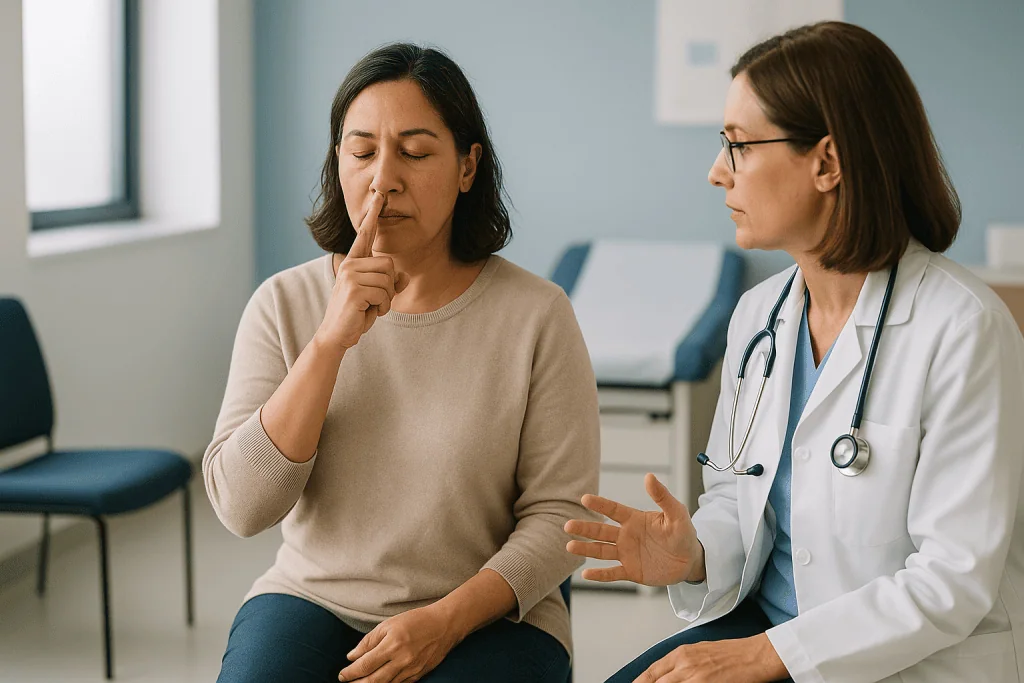
- Inhale through the nose for about two to three seconds, letting the belly and lower ribs expand first rather than hiking the shoulders.
- Take a second, shorter inhale through the nose, almost a sniff, right at the top of the first. You will feel the upper chest fill a little further. It should not be forced.
- Exhale slowly through the mouth, lips slightly pursed as if cooling soup, until the lungs feel comfortably empty. Aim for the exhale to last longer than the two inhales put together, roughly four to eight seconds.
- Breathe normally for a moment, then repeat if you want to.
A few refinements help. If nose breathing is blocked by a cold or allergies, inhaling through the mouth is fine; the mechanics still work. If the second sniff feels awkward, think of it as topping off a glass rather than cramming more in. The exhale is where most people rush; a gentle hum or a whispered count slows it down.
You should feel calmer, not dizzy. Lightheadedness means you are exhaling too hard or repeating too quickly, which blows off carbon dioxide faster than the body likes. Ease off and let breathing settle. The whole point is to signal safety to the nervous system, and straining sends the opposite message.
Many people find one to three sighs enough to take the edge off a tense moment, while the trial protocol used a steady five minutes of repeated cycles. Both are legitimate uses; they simply have different aims, which the next sections unpack.
Why does the double inhale work? The lung mechanics
The second sniff is not a flourish. It solves a small structural problem in the lungs.
Each lung holds hundreds of millions of alveoli, the microscopic air sacs where oxygen passes into the blood and carbon dioxide passes out. Alveoli are coated with surfactant, a soapy fluid that lowers surface tension so the sacs stay open. Even so, during quiet, shallow breathing some alveoli gradually collapse, like a damp paper bag folding in on itself. A normal breath does not reliably reopen them. A sigh does. The first inhale fills the easy spaces; the second pushes air into the stiffer, half-folded ones. This is widely thought to be why the sigh reflex exists at all, and why it fires more often when breathing has been shallow for a while.
Reinflating those sacs does two useful things. It briefly expands the surface available for gas exchange. And the long exhale that follows lets the body offload carbon dioxide efficiently without the overcorrection that comes from fast breathing.
The calming effect runs through a different route. Slow exhalation stimulates the vagus nerve, the long cranial nerve that acts as the main brake of the parasympathetic nervous system, the branch responsible for rest and recovery. During a slow out-breath, vagal signaling to the heart increases and heart rate dips. Repeat that for a few minutes and average heart rate and breathing rate both drift lower, which the brain reads as a signal that the threat has passed.
Much of this mechanism comes from physiology studies and animal research rather than human trials of the technique itself. That is expert-consensus territory: plausible, coherent, and the standard account in respiratory physiology, but not proof that the double inhale specifically outperforms a single slow breath in people. The Stanford trial is the first real attempt at that comparison.
What changed recently: the Stanford trial and the viral surge
Breathing exercises are ancient; randomized trials of specific patterns are not. The event that moved the physiological sigh from podcast curiosity to search trend was a study published on 10 January 2023 in Cell Reports Medicine, indexed on PubMed, from a Stanford team.

The design was straightforward. Adults recruited remotely were randomly assigned to one of four daily five-minute practices for 28 days: cyclic sighing (repeated physiological sighs), box breathing (equal counts of inhale, hold, exhale, hold), cyclic hyperventilation with a breath hold, or mindfulness meditation. About 110 people were analyzed, roughly 25 to 30 per group. Each evening they rated mood and anxiety on standard questionnaires, and a wearable device tracked breathing rate, heart rate variability and sleep.
Three findings drove the headlines. All four groups reported better mood and lower anxiety over the month. The cyclic sighing group showed the largest rise in daily positive mood, and the difference versus meditation was statistically significant. And the sighing group’s resting respiratory rate fell more than the others’, a measurable physiological change rather than a self-report.
Two findings got less airtime. Heart rate variability and sleep measures did not differ meaningfully between groups. And the more days a person actually practiced, the bigger the benefit, which is a reminder that adherence, not technique, may be the biggest lever.
Since then, the trend has been driven by distribution rather than new data: clipped explanations on short-video platforms, the technique appearing in corporate wellness programs, and search interest in "how to do a physiological sigh" outpacing interest in the trial itself. As of 2025 there is no larger replication trial published, so the evidence base is still essentially this one well-designed, small study plus decades of general slow-breathing research.
What the evidence actually says, graded
Evidence comes in tiers, and it helps to be clear which tier each claim sits on.
Randomized trial evidence (strongest tier for a behavioral technique): One trial of about 110 adults over 28 days found that five minutes of cyclic sighing improved self-reported positive mood more than mindfulness meditation and lowered resting breathing rate. The effect on anxiety scores was real but not clearly better than the other practices. Strengths: random assignment, an active comparison group, a physiological outcome. Limits: a small sample, mostly self-reported outcomes, no blinding (you know which breath you are doing), a one-month horizon, and participants who were healthy volunteers rather than people with diagnosed anxiety disorders. It has not yet been replicated at scale.
Broader trial evidence on slow breathing (moderate tier): Dozens of trials over several decades, summarized by Harvard Health, the NHS and Mayo Clinic, show that slow, controlled breathing reduces short-term feelings of stress and lowers heart rate and blood pressure modestly during practice. These trials rarely isolate the double inhale; they support the long exhale and the slow pace.
Physiology and animal research (mechanistic tier): The alveolar-reinflation and vagal-braking explanations are well supported in laboratory science but are explanations of why it might work, not evidence that it does in a given person.
Expert opinion and anecdote (weakest tier): Claims about falling asleep faster, "rewiring" the brain, replacing medication or ending panic attacks live here. No trial supports them.
A fair summary: the physiological sigh is a low-risk, well-tolerated stress tool with one small positive trial and a plausible mechanism. That is better footing than most trending wellness practices stand on. It is not footing for medical claims, and the researchers themselves framed it as a complement to, not a replacement for, established care.
Physiological sigh vs box breathing vs meditation: how they compare
People often ask which technique to pick, so it helps to lay the four practices from the Stanford trial side by side, along with what each is best suited to.
| Practice | Pattern | Trial finding (28 days, 5 min/day) | Best suited to |
|---|---|---|---|
| Cyclic sighing (physiological sigh) | Double nasal inhale, long mouth exhale, repeated | Largest rise in daily positive mood; biggest drop in resting breathing rate | Fast reset in a tense moment; people who find meditation frustrating |
| Box breathing | Inhale, hold, exhale, hold, equal counts (often four seconds each) | Improved mood and anxiety; not significantly different from meditation | Focus before a performance; people who like structure and counting |
| Cyclic hyperventilation with retention | Rapid deep breaths followed by a breath hold | Improved mood; some reported lightheadedness | Not recommended for beginners, anyone with heart or lung disease, pregnancy, or near water |
| Mindfulness meditation | Passive attention to the breath, no control | Improved mood and anxiety; smallest mood gain of the four | Longer-term attention training; strongest independent evidence base overall |
Two caveats keep this honest. The differences between groups were small in absolute terms; everyone improved, and the sighing group improved a little more on one measure. And meditation has a far deeper research literature than any breathing pattern, including trials in people with diagnosed anxiety and depression, so "scored lowest in one small study" does not mean "least useful."
The practical reading is that the physiological sigh wins on speed and simplicity, box breathing on structure, and meditation on long-run evidence. Most people do fine choosing the one they will actually repeat.
How many physiological sighs should you do?
This is the question people type most, and the honest answer has two parts, because there are two different uses.
For an acute moment: one to three sighs. Before a difficult phone call, after a near-miss in traffic, when a child’s tantrum peaks. The reflex version of this breath fires once, and most people feel a noticeable drop in muscle tension and a slower pulse after a single deliberate cycle. There is no trial testing exactly how many are optimal; this is practice-based guidance that lines up with how the body uses sighs naturally.
For a daily practice: the only tested protocol is five minutes of continuous cycles, once a day, which works out to roughly 25 to 30 sighs at a ten-second rhythm. That is what produced the mood and breathing-rate changes over a month. Longer sessions have not been studied for this pattern, and more is not obviously better; the trial’s dose-response finding was about consistency across days, not minutes per session.
A few guardrails apply either way. Stop if you feel dizzy, tingly in the fingers, or faint; those are signs of blowing off too much carbon dioxide, and the fix is slower, gentler cycles with normal breaths in between. Avoid stacking dozens of forceful sighs in a row. And do not practice any breath-control technique while driving, swimming or standing in a hot shower, where a brief lightheaded spell could cause harm.
Think of the single sigh as a brake tap and the five-minute practice as a tune-up. Both are legitimate. Neither needs to be heroic. The Stanford participants who benefited most were simply the ones who showed up most days, which argues for picking a time, perhaps the first minutes after waking or the last before sleep, and keeping it short enough to repeat.
Can anxiety cause shallow breathing?
Yes, and the loop runs in both directions, which is exactly why breathing techniques get a foothold.
When the brain perceives a threat, the sympathetic nervous system, the body’s accelerator, prepares for action. Breathing speeds up and shifts upward into the chest; the diaphragm, the dome-shaped muscle under the lungs that does most of the work of calm breathing, is partly sidelined. This upper-chest pattern is efficient for a sprint and wasteful for a desk. It uses the small neck and shoulder muscles, which tire and ache, and it tends to move air faster than the body needs.
That excess ventilation lowers carbon dioxide in the blood. Carbon dioxide is not just waste; it regulates blood-vessel tone and the release of oxygen from hemoglobin. When it drops, blood vessels in the brain narrow slightly, producing lightheadedness, tingling around the mouth and fingers, a sense of unreality and sometimes chest tightness. Those sensations feel like danger, the brain responds with more alarm, and breathing speeds up further. Cleveland Clinic and the NHS describe this cycle as the engine behind many panic attacks.
Chronic low-grade anxiety produces a quieter version: habitual shallow breathing, frequent throat clearing, a feeling of not getting a satisfying breath, and a strong urge to sigh. People often notice they are holding their breath while reading email.
The physiological sigh interrupts the loop at two points. The deep double inhale recruits the diaphragm and reopens under-used lung tissue, which eases the "can’t get a full breath" feeling. The long exhale slows the rate and lets carbon dioxide recover toward normal. That is a reasonable account of why it feels good quickly.
One distinction matters. Shallow breathing caused by anxiety improves with calming and changes from minute to minute. Shallow breathing caused by asthma, heart failure, anemia or lung disease does not respond to reassurance and often worsens with exertion or lying flat. If you are unsure which you have, that is a question for a clinician, not a breathing exercise.
What causes sudden involuntary gasps or sighs?
Searches for "sudden involuntary gasp" spike alongside interest in the physiological sigh, and most of what people are describing is ordinary.
The spontaneous sigh. As noted earlier, the brainstem triggers a double-inhale sigh roughly every five minutes to reinflate collapsing alveoli. You usually do not notice. Under stress, after a long period of shallow breathing, or when you are bored and still, the drive increases and the sigh becomes conspicuous. It is a maintenance breath, not a warning.
The post-crying shudder. Children, and adults, take stuttering double or triple inhales after sobbing. This is the same reflex working to reset lung volume after irregular breathing.
Hypnic jerks and sleep-onset gasps. As you drift off, the brain’s control of breathing hands over from conscious to automatic systems, and a sudden gasp, twitch or sensation of falling is common and harmless. Fatigue, caffeine and irregular sleep make it more frequent.
Hiccups. A spasm of the diaphragm followed by a snap shut of the vocal cords. Annoying, nearly always benign, and unrelated to sighing.
Air hunger during anxiety. The feeling of needing to gasp or yawn repeatedly, without truly being short of breath, is a classic feature of over-breathing. It usually settles with slower breathing.
The pattern that is not ordinary is gasping that wakes you from sleep, especially with snoring, choking sensations, morning headaches or daytime sleepiness. That cluster is the hallmark of obstructive sleep apnea, where the airway repeatedly narrows during sleep, and MedlinePlus lists it among the breathing symptoms that warrant evaluation. Gasping with chest pain, blue lips, swelling of the legs, or that occurs with exertion also falls outside the reassuring category. Those belong in the final section of this article, and in a doctor’s office.
Is sigh syndrome serious?
"Sigh syndrome," also called sighing dyspnea, is the clinical name for a pattern of frequent, deep, often dramatic sighs accompanied by a sense of not being able to take a satisfying breath, in a person whose lungs and heart check out normal. Dyspnea simply means the sensation of breathlessness.
People with it describe needing to "catch" a breath many times an hour, a tightness across the chest, and relief that lasts only a few breaths. It can be alarming because it mimics heart or lung trouble. The distinguishing features are that it happens at rest rather than with exertion, that it often disappears during conversation or sleep, and that it typically appears during a period of stress, grief or worry. Examinations, oxygen levels and lung function tests are usually normal.
In that sense, sigh syndrome is not dangerous. It does not damage the lungs, and it is not a precursor to asthma or heart disease. It is, however, genuinely uncomfortable and worth taking seriously for two reasons.
First, the diagnosis is one of exclusion. A clinician should rule out asthma, anemia, thyroid overactivity, heart rhythm problems and lung disease before attributing frequent sighing to a breathing-pattern disorder. Those conditions share symptoms and have specific treatments. Nobody should self-assign the label from a search result.
Second, once other causes are excluded, the condition tends to respond well to breathing retraining, which many physiotherapists and respiratory therapists provide, along with attention to the anxiety or stress driving it. The deliberate physiological sigh fits awkwardly here: a well-timed slow sigh can relieve the air-hunger feeling, but someone already sighing compulsively usually needs to learn to breathe less, not more, with an emphasis on gentle nasal diaphragmatic breathing and slow exhales. That is a judgment best made with a clinician who has seen the whole picture.
Who should be cautious with breathing techniques?
The physiological sigh is among the gentlest breathing practices in circulation, and for most healthy adults the risk is essentially a brief dizzy spell from overdoing it. A few groups deserve extra care, mostly because of what happens when a slow technique drifts into a fast one.
People with asthma or chronic obstructive pulmonary disease (COPD). Deep, rapid inhalation through the mouth can irritate sensitive airways and trigger coughing or wheeze in some people. Nasal breathing and an unforced second inhale reduce that risk. Anyone whose symptoms worsen should stop and discuss breathing exercises with the clinician managing their lung condition; pursed-lip and diaphragmatic breathing are often recommended for COPD, but the specifics belong in that conversation.
People with panic disorder. Paradoxically, focusing on the breath can heighten symptoms early on, because attention to breathing is exactly what panic feeds on. The sigh is still usable, and many find it helpful, but it works best as one piece of a treatment plan rather than a stand-alone fix, and a therapist can help time its introduction.
People with heart rhythm disorders, recent cardiac events or very low blood pressure. Slow breathing lowers heart rate and blood pressure slightly. That is usually welcome, but anyone prone to fainting should practice seated.
Pregnancy. Gentle slow breathing, including the physiological sigh, is widely taught in antenatal classes and is considered safe. Breath-holding and hyperventilation patterns are not advised.
Anyone near water, at height or driving. Breath-control exercises of any kind should never be done in a pool, bath or vehicle. Shallow-water blackout from hyperventilation before breath-holding has caused drownings in experienced swimmers.
None of this makes the technique hazardous. It makes it like any tool: safest when used for the job it was designed for, which is easing a stressful moment, and discussed with the treating clinician when a medical condition is in play.
Common myths about the physiological sigh
Short videos compress nuance, and the viral version of this technique has collected some barnacles. Here are the claims worth scraping off.
"It is the fastest way to calm down, proven by Stanford." The trial did not test speed of calming. It measured mood and anxiety at the end of each day over a month. Any feeling of rapid relief is real for many people but rests on experience and physiology, not that study.
"It beat meditation." On one measure, daily positive mood, cyclic sighing scored significantly higher. On anxiety scores, heart rate variability and sleep, the groups were not clearly different. Meditation also has hundreds of trials behind it; this comparison involved about 25 people per arm for 28 days.
"It works by flooding the brain with oxygen." Healthy blood is already nearly saturated with oxygen. The relevant change is in carbon dioxide and in vagal signaling, not in oxygen levels.
"It stimulates the vagus nerve, so it treats inflammation, depression and gut problems." Slow exhalation does increase vagal activity to the heart during practice. The leap from that to treating inflammatory or psychiatric conditions is not supported by trials of this technique, and vagus-nerve claims are among the most over-stretched in wellness media.
"Three sighs will stop a panic attack." They may blunt the physical spiral in some people, and that is worthwhile. Panic disorder is a treatable condition with established therapies, and no breathing exercise replaces them.
"You can replace anxiety medication with breathwork." Nothing in the evidence supports stopping or changing a prescribed medicine on the strength of a breathing practice. That decision belongs with the prescribing clinician, every time.
"More sighs are better." The trial found that more days of practice helped. It did not test longer sessions, and forceful repeated sighing causes dizziness.
Stripped of those claims, what remains is still worth having: a free, portable, well-tolerated technique with a plausible mechanism and one encouraging trial.
Which breathwork benefits are realistic, and which are oversold?
"Breathwork" has become an umbrella for everything from a single calming breath to hour-long, music-driven hyperventilation sessions. The physiological sigh sits at the gentle end, and the benefits worth expecting are correspondingly specific.
Realistic, with reasonable evidence:
- A short-term drop in felt stress and muscle tension within a minute or two of practice, consistent across many slow-breathing trials summarized by Harvard Health and the NHS.
- A modest lowering of heart rate and breathing rate during and shortly after practice.
- Small improvements in daily mood with consistent practice over weeks, shown in the Stanford trial and in broader relaxation-training research.
- An easier transition into sleep for people whose main obstacle is a racing mind at bedtime; this is widely reported and biologically plausible, though not specifically tested for this pattern.
- A sense of agency: having something to do in a stressful moment reduces the helplessness that amplifies stress.
Possible but unproven for this technique: lasting changes in resting blood pressure, improved heart rate variability outside of practice, better focus or athletic recovery. These have some support for slow breathing in general and none specific to the double inhale.
Oversold: treating clinical anxiety or depression on its own, "detoxing," boosting immunity, altering hormones in a meaningful way, or any claim that uses the word "rewire."
A useful comparison: regular physical activity has been studied in tens of thousands of people and reliably improves mood, sleep and cardiovascular markers. The physiological sigh has one trial in about 110. That is not a knock on the sigh. It simply means its best role, on current evidence, is as the thing you do in the thirty seconds before the thing that actually changes your life, which might be a walk, a conversation, or an appointment you have been putting off.
When to see a doctor about breathing or anxiety symptoms
Breathing exercises are for stress. They are not a way to manage symptoms that could signal disease, and the trap with a technique that feels good is that it can delay a conversation that matters. See a clinician promptly if any of these apply.
Seek emergency care (call emergency services) for:
- Sudden shortness of breath with chest pain, pressure or pain spreading to the arm, jaw or back.
- Breathlessness with blue or gray lips or fingertips, confusion, or fainting.
- Severe difficulty breathing after an insect sting, new food or medicine, especially with swelling of the lips or throat.
- Coughing up blood, or breathlessness with a swollen, painful calf.
Book an appointment soon for:
- Shortness of breath that comes on with exertion, worsens when lying flat, or wakes you at night.
- Gasping or choking during sleep, loud snoring, or unrefreshing sleep with daytime drowsiness.
- Frequent sighing, air hunger or chest tightness lasting more than a couple of weeks, even if you suspect stress; the diagnosis of a breathing-pattern disorder requires ruling out other causes first.
- Wheeze, persistent cough, or breathlessness alongside fever or weight loss.
- Anxiety that interferes with work, relationships or sleep, panic attacks, or a sense of dread that does not lift. These are common, treatable conditions, and MedlinePlus, the NHS and Mayo Clinic all list evidence-based options from talking therapies to medication.
- Any thoughts of harming yourself. Contact emergency services or a crisis line immediately; in the US, call or text 988.
If you already take medication for anxiety, depression, asthma, heart disease or blood pressure, keep taking it as prescribed. Adding a breathing practice is reasonable to mention at your next visit. Stopping or reducing a medicine because a breathing technique feels helpful is a decision only the prescribing clinician can safely make with you.
The physiological sigh is a good brake tap. A good doctor is the mechanic. You are allowed to have both.
Frequently asked questions
How many physiological sighs should you do?
One to three sighs for an acute stressful moment, or a continuous five-minute practice once a day if you want the longer-term mood effect studied in the Stanford trial. Five minutes works out to roughly 25 to 30 cycles at a ten-second rhythm. Longer sessions have not been tested for this pattern, and forceful repeated sighing causes dizziness. Consistency across days mattered more than minutes per session in the trial.
Can anxiety cause shallow breathing?
Yes. Anxiety shifts breathing upward into the chest and speeds it up, sidelining the diaphragm and lowering blood carbon dioxide. That produces lightheadedness, tingling and chest tightness, which feel threatening and drive breathing faster still. Anxiety-related shallow breathing changes minute to minute and eases with calming; breathlessness that worsens with exertion or lying flat suggests a lung or heart cause and needs a clinician.
What causes sudden involuntary gasps?
Most often a spontaneous sigh, the brainstem reflex that reinflates lung tissue roughly every five minutes and becomes noticeable under stress. Sleep-onset jerks, post-crying shudders, hiccups and anxiety-related air hunger are other benign causes. Gasping that wakes you from sleep, particularly with snoring, choking sensations or daytime sleepiness, can indicate obstructive sleep apnea and should be evaluated by a doctor.
Is sigh syndrome serious?
Sigh syndrome, or sighing dyspnea, is uncomfortable but not dangerous once other causes are excluded. It involves frequent deep sighs and a feeling of not getting a full breath at rest, with normal lungs and heart on testing, usually during a stressful period. Because asthma, anemia, thyroid and heart conditions can mimic it, the diagnosis should come from a clinician, and breathing retraining then tends to help.
What did the Stanford physiological sigh study actually find?
About 110 adults were randomized to five minutes a day of cyclic sighing, box breathing, cyclic hyperventilation or mindfulness meditation for 28 days. All groups reported better mood and less anxiety. Cyclic sighing produced the largest rise in daily positive mood, significantly more than meditation, and the biggest drop in resting breathing rate. Heart rate variability and sleep did not differ between groups. It was a small, single, unreplicated trial.
Is the physiological sigh better than box breathing?
On one outcome in one small trial, daily positive mood, cyclic sighing scored higher than box breathing and meditation. On anxiety, heart rate variability and sleep, the techniques were not clearly different. Box breathing offers structure that some people prefer, especially before a performance. The better technique is largely the one you will repeat; both are low risk when done slowly and seated.
Can the physiological sigh stop a panic attack?
It can blunt the physical spiral for some people by slowing breathing and letting carbon dioxide recover, which eases dizziness and tingling. No trial shows it stops panic attacks, and panic disorder is a treatable condition with established therapies such as cognitive behavioral therapy. Use the sigh as a tool within a treatment plan, and discuss recurring panic attacks with a clinician rather than relying on breathing alone.
Are the breathwork benefits of the physiological sigh long-lasting?
The only evidence covers 28 days, during which daily mood improved with consistent practice; nobody knows whether benefits persist after stopping. Immediate effects, such as a slower pulse and less muscle tension, last minutes to an hour. Lasting changes in blood pressure, heart rate variability or anxiety levels have some support for slow breathing generally but have not been demonstrated for this specific pattern.
Why does the second inhale matter in a physiological sigh?
The second short inhale pushes air into alveoli, the tiny air sacs, that have partly collapsed during shallow breathing and that a single breath does not reopen. This is believed to be the reason the sigh reflex exists. The mechanism comes from physiology research rather than trials in people, so whether the double inhale outperforms a single slow breath for calming is not yet proven.
Can I use the physiological sigh instead of my anxiety medication?
No. There is no evidence that any breathing technique replaces prescribed treatment for anxiety or depression, and stopping or reducing a medication on your own can cause withdrawal symptoms or relapse. The physiological sigh is a reasonable addition that many clinicians welcome. Any change to a prescription belongs in a conversation with the prescribing doctor, who can weigh your history and options.
References
- NHS: Breathing exercises for stress
- Cleveland Clinic: Diaphragmatic breathing
- MedlinePlus: Breathing difficulty
This article is for general information only and is not a substitute for professional medical advice. Please consult a qualified doctor about your individual situation.

More from the Blog

Do I Have OCD? How OCD Is Diagnosed, Common Signs and Where to Get Help
OCD is more than being tidy or particular. It involves unwanted, intrusive thoughts or urges that cause real distress, plus repetitive behaviors or mental…

The Four Types of OCD: Symptoms of Each and How Treatment Differs
Clinicians commonly group OCD symptoms into four themes: contamination and cleaning, checking and fear of causing harm, symmetry and ordering, and intrusive taboo thoughts…
Stress Headaches: Tension-Type Headache Explained and the Non-Drug Approaches With Evidence
Stress headaches are usually tension-type headaches: a dull, pressing, band-like pain on both sides of the head, mild to moderate, without the nausea or…

Why Do We Dream? The Leading Theories, Explained
Science has not settled on a single reason we dream. The best-supported theories propose that dreams help the brain consolidate memories, process emotional experiences,…

Meditation Benefits: What Randomized Trials Actually Show for Blood Pressure, Pain and Sleep
Randomized trials show meditation produces small to moderate benefits: anxiety, depression and pain scores fall by roughly a third of a standard deviation after…

Dopamine Detox: What the Trend Gets Wrong About Your Brain
A dopamine detox cannot lower or reset dopamine, because the brain never stops producing this essential chemical, which also controls movement and motivation. What…