

TURP Myths Corrected: Incontinence, Intimacy and the Idea That It Treats Prostate Cancer
Key Takeaways
- TURP removes the inner transition zone of the prostate and leaves the outer peripheral zone, which is where most prostate cancers begin, so it neither treats nor prevents cancer.
- Lasting urinary incontinence after TURP is rare because the external sphincter sits below the surgical field; the temporary urgency and leaking of the first weeks come from a bladder recalibrating after years of obstruction.
- Retrograde ejaculation, where semen enters the bladder at orgasm, is the most common permanent change after TURP and is harmless, though it reduces natural fertility.
- PSA usually falls after TURP because less tissue remains to produce it, which resets the screening baseline rather than lowering cancer risk.
- Returning symptoms within the first year or two are more often due to urethral stricture, bladder neck scarring or bladder dysfunction than to prostate regrowth, which is typically slow.
- Most men leave hospital within one to three days with a catheter removed at around 24 to 48 hours, and full recovery is usually three to six weeks, with intermittent pink urine expected during that time.
TURP removes the inner, obstructing part of a benignly enlarged prostate through the urethra to improve urine flow. It is not a prostate cancer treatment, and lasting urinary incontinence after it is uncommon. The most frequent lasting change is retrograde ejaculation, where semen enters the bladder during orgasm. Erections are usually unaffected, and whether TURP suits an individual is decided with the treating urology team.
The waiting-room conversation goes something like this. A man in his late sixties, due to see a urologist about an operation called TURP, leans toward his neighbor and says what he has been told: that it is really for cancer, that he will be in pads for life, and that intimacy is over. His neighbor nods, because he heard the same thing from a brother-in-law who had surgery thirty years ago.
Almost none of it is accurate. TURP myths are stubborn partly because the prostate sits at a crossroads of plumbing, sex and cancer anxiety, and partly because men compare notes across decades of very different surgical techniques. A story from a hospital ward in the 1980s is still shaping decisions today.
This explainer separates what the evidence actually shows from what gets repeated, so the conversation you have with your own care team starts from facts rather than folklore.
What TURP is, and why TURP myths travel so far
Transurethral resection of the prostate, usually shortened to TURP, is an operation that removes the inner portion of an enlarged prostate through the urethra, the tube that carries urine from the bladder out of the body. No skin is cut. The condition it treats is benign prostatic hyperplasia (BPH), a non-cancerous overgrowth of prostate tissue that squeezes the urethra and makes it harder to empty the bladder.
BPH is extraordinarily common. The National Institute of Diabetes and Digestive and Kidney Diseases notes that it affects about half of men between 51 and 60 and up to 90 percent of men over 80. With numbers like that, almost every family has at least one TURP story in circulation, and the stories are rarely checked against evidence.
Three things keep turp myths alive. First, the word prostate triggers cancer worry, so a benign operation gets filed next to cancer surgery in people’s minds, even though the two procedures remove different tissue for different reasons. Second, complication lists are shared without their frequencies: a man hears that incontinence is possible and assumes it is likely. Third, surgical equipment has changed. Modern resectoscopes, saline-based bipolar energy and shorter hospital stays bear little resemblance to the operations many older relatives describe.
None of this means TURP is risk-free. It is a real operation under anesthesia with a recovery period and a well-documented list of possible side effects, which the NHS sets out plainly. The honest position sits between the two extremes: TURP is neither a casual day procedure nor the life-altering ordeal of folklore. The rest of this article walks through each myth in turn and finishes with the questions worth bringing to your own appointment.
How TURP works: what actually happens in the operating room
Picture coring an apple while leaving the skin intact. That is the essential idea. The prostate has an outer capsule and an inner zone that enlarges with BPH; TURP shaves away the inner zone and leaves the capsule in place.
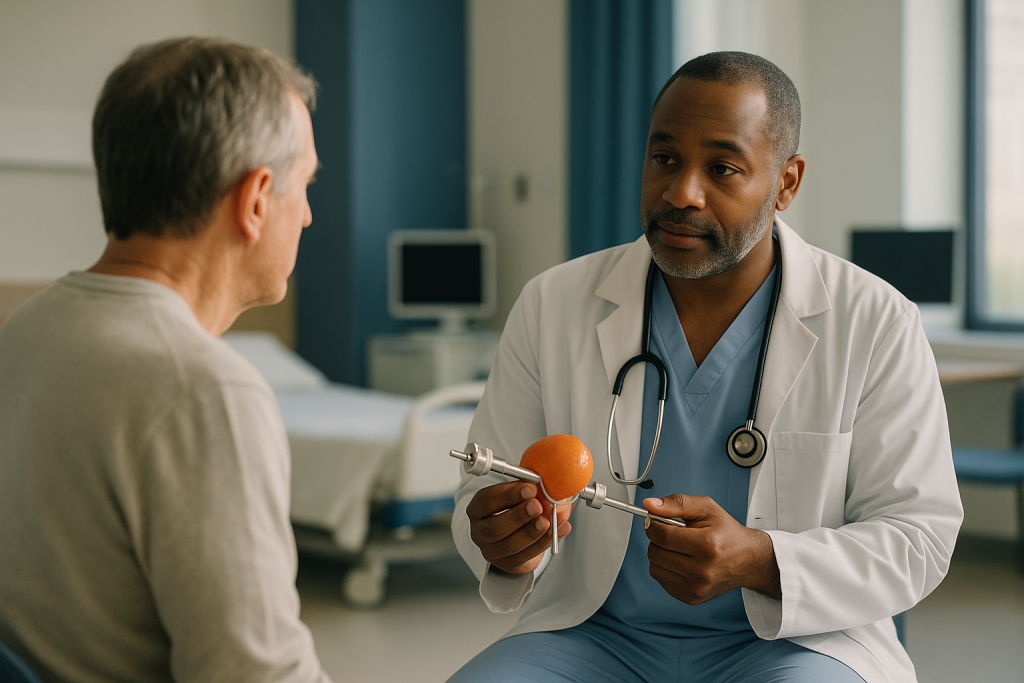
The operation is done under spinal anesthesia (numb from the waist down, often with sedation) or general anesthesia. The surgeon passes a resectoscope, a slim telescope with a camera, a light and a small electrified wire loop, through the opening of the penis and along the urethra to the prostate. Watching on a screen, the surgeon uses the loop to cut tissue away in thin strips, called chips, and to seal blood vessels as they go. Fluid is continuously flushed through the scope so the view stays clear and the chips are washed into the bladder, then rinsed out at the end.
Those chips are not discarded. They go to a pathology laboratory and are examined under a microscope, which is why a small number of men learn after a TURP that cancer cells were present in tissue removed for an unrelated reason.
Mayo Clinic describes the procedure as typically taking about 60 to 90 minutes. Before the patient wakes fully, a catheter, a soft tube, is placed through the urethra into the bladder. It drains urine, allows gentle irrigation to prevent clots, and gives the raw surface a chance to settle.
Two versions exist. Monopolar TURP uses a current that passes through the body and requires a salt-free irrigation fluid. Bipolar TURP, now widely used, keeps the current between two points on the instrument and uses ordinary saline. The practical difference is that saline absorbed into the bloodstream is far less disruptive to body chemistry, which is why bipolar systems reduce the risk of the rare complication known as TUR syndrome, discussed later.
Who TURP is usually for, and who is usually asked to wait
TURP is not offered simply because a prostate is large. It is offered because a large prostate is causing trouble that other approaches have not fixed or cannot fix.
Mayo Clinic lists the typical reasons a urologist moves toward surgery: bothersome urinary symptoms that have not responded well to medicines, repeated inability to pass urine at all (urinary retention), recurrent urinary tract infections, bladder stones, recurrent blood in the urine from the prostate, or signs that back-pressure from the obstruction is affecting the kidneys. The last few are considered firmer indications because they signal harm, not just inconvenience.
Men are usually asked to wait, or steered elsewhere, in several situations:
- Symptoms are mild and manageable with lifestyle changes or medicines that have not yet been tried properly.
- An active urinary infection needs treating first.
- Blood-thinning medicines or a bleeding disorder need a planned approach, decided with the prescribing clinician; nobody should alter these medicines on their own.
- The prostate is very large. Beyond a certain volume, surgeons often prefer laser enucleation or a simple prostatectomy (removal of the inner prostate through an abdominal or robotic approach), because resecting a very big gland loop by loop takes longer and carries more bleeding risk.
- Preserving ejaculation is a priority, in which case alternative procedures with a lower rate of retrograde ejaculation may be discussed.
People often ask about a minimum prostate size for TURP. There isn’t a fixed one. The decision rests on obstruction and symptoms, not volume alone. A man with a relatively small gland but a tight bladder neck may instead be offered a transurethral incision of the prostate (TUIP), where one or two small cuts widen the channel without removing tissue, an option Mayo Clinic describes for smaller prostates.
Measurements such as flow rate, residual urine after voiding and prostate volume on ultrasound inform the choice, but the final recommendation belongs to the treating team.
Is TURP a high-risk surgery? What the evidence actually shows
Risk is the question underneath most of the others, so it deserves a straight answer: TURP is a major operation with a well-characterized safety record, and for most men in reasonable health it is considered a standard, lower-risk procedure rather than a high-risk one. That is different from saying it is trivial.
The NHS groups the possible complications into early and late. Early ones include bleeding (occasionally enough to need a transfusion), urinary infection, temporary difficulty passing urine once the catheter comes out, and TUR syndrome. Late ones include retrograde ejaculation, erectile difficulties in a minority, urethral stricture (scar tissue narrowing the urethra), urinary incontinence, and the chance that symptoms return.
TUR syndrome needs a plain definition because it sounds alarming. During monopolar TURP, the salt-free irrigation fluid can be absorbed through open blood vessels into the bloodstream, diluting the sodium in the blood and causing confusion, nausea and, rarely, more serious problems. The NHS describes it as rare, and the shift to saline-based bipolar equipment has made it rarer still. It is a hospital-phase complication, watched for by the anesthesia and nursing teams, not something that develops at home.
What actually raises an individual’s risk is less the procedure and more the person: age, heart or lung disease, diabetes, kidney function and anticoagulant use. This is why pre-operative assessment exists. A healthy 68-year-old and a frail 84-year-old with heart failure are having very different operations even if the surgical steps are identical.
Most men go home within one to three days, according to the NHS. Deaths directly attributable to TURP are rare in modern series, which is a different statement from saying they never happen. If your care team calls you higher risk, ask why; the answer is usually about your general health, and it may shift the recommendation toward a less invasive option rather than away from treatment altogether.
Myth one: TURP leaves most men incontinent
This is the myth that costs men the most sleep, and it rests on a mix-up.
The muscle that keeps urine in, the external urinary sphincter, sits just below the prostate. During TURP the surgeon works above a visible landmark called the verumontanum, a small ridge inside the prostatic urethra that marks where the sphincter begins. Staying above it is one of the core skills of the operation. The sphincter is not removed and, in the great majority of cases, not damaged.
Why, then, does the myth persist? Partly because of radical prostatectomy, the operation for prostate cancer, which removes the whole gland including tissue right against the sphincter and carries a meaningfully higher rate of leakage. Men hear “prostate surgery” and “incontinence” in the same sentence and do not realize two different operations are being described.
The other reason is that temporary leakage after TURP is genuinely common and genuinely distressing while it lasts. A bladder that has spent years straining against a blockage becomes thick-walled and twitchy. Remove the blockage and it does not instantly relax; urgency, frequency and leaking on the way to the bathroom are typical in the early weeks. Mayo Clinic puts it simply: loss of bladder control may be a temporary problem, and long-term loss of control rarely occurs.
Things that help during that window:
- Pelvic floor exercises, ideally taught by a physiotherapist or continence nurse, which strengthen the muscles that support the sphincter.
- Steady fluid intake rather than restricting drinks, which concentrates urine and irritates the healing surface.
- Limiting caffeine and alcohol while the bladder recalibrates.
If leakage persists beyond the early months, it should be investigated rather than accepted. Causes include an overactive bladder that predated surgery, scarring, or, uncommonly, sphincter injury, and each has its own management pathway. Your urology team will want to know.
Myth two: TURP ends your sex life
Two separate questions hide inside this one: erections and ejaculation. The evidence treats them very differently.
Erections depend on nerves and blood vessels that run along the outside of the prostate capsule. TURP works inside the capsule, so those structures are not in the surgical field. The NHS lists erectile dysfunction as a possible complication affecting a minority of men, and researchers continue to debate how much of that is caused by the operation itself versus the age, diabetes and vascular disease that men having TURP often already have. Some men report erections improve once nighttime trips to the bathroom stop and anxiety eases. The honest summary is that TURP does not reliably cause erectile problems, and anyone who develops them afterward should raise it, because treatments exist and the decision about them sits with the prescribing clinician.
Ejaculation is a different story, and this is where the myth has a real root. Normally, at orgasm, a ring of muscle at the bladder neck closes so semen travels forward. TURP opens up the bladder neck as part of relieving the obstruction. Afterward the path of least resistance often leads backward, and semen enters the bladder instead. This is retrograde ejaculation. The sensation of orgasm is still there, but little or no fluid comes out, and the next urination may look cloudy.
The NHS describes retrograde ejaculation as the most common complication of TURP, affecting the majority of men who have it. It is not harmful and causes no pain. Its two real consequences are reduced natural fertility, which matters for younger men, and the psychological adjustment of a “dry” orgasm, which matters for anyone. Men for whom this is a deal-breaker should say so before surgery, because alternatives exist with lower rates.
Mayo Clinic advises waiting roughly four to six weeks before resuming sexual activity, and your own team may adjust that to your recovery.
Myth three: TURP treats or prevents prostate cancer
It does neither, and understanding why requires one piece of anatomy.
The prostate has zones. BPH arises in the transition zone, the inner tissue wrapped around the urethra. Most prostate cancers arise in the peripheral zone, the outer tissue closest to the rectum. TURP removes the inner zone and deliberately leaves the outer capsule. The tissue where cancer most often begins is exactly the tissue that stays.
So three facts follow. TURP is not a cancer operation; radical prostatectomy, which removes the entire gland, is. TURP does not prevent future cancer, because the at-risk tissue remains. And having BPH does not itself raise cancer risk; Mayo Clinic is explicit that an enlarged prostate is not known to increase the chance of developing prostate cancer, although the two conditions frequently coexist simply because both are common in older men.
Where the myth gets some traction is in two edge cases. First, the chips removed during TURP are examined by a pathologist, and occasionally cancer cells are found by accident in tissue that was removed for flow reasons. That is incidental detection, not treatment, and it leads to a separate conversation about what, if anything, to do next. Second, men who already have advanced prostate cancer and cannot pass urine are sometimes offered a limited “channel” TURP purely to open the passage. The goal there is comfort and drainage, not cancer control.
One practical consequence deserves emphasis. Prostate-specific antigen (PSA) is a protein made by prostate tissue, and a blood test for it is used in cancer screening discussions. Removing a large volume of tissue typically makes PSA fall. A lower number after TURP does not mean cancer risk has dropped; it means the baseline has reset. Future screening decisions should be made against the new baseline, and the decision to screen at all remains a shared one with your clinician.
Prostate regrowth after TURP: how fast can it grow back?
Because the capsule stays, some prostate tissue always remains, and BPH is a continuing biological process rather than a one-time event. Regrowth is therefore real. It is also slow, and it is not the only reason symptoms return.
The NHS notes that the prostate can enlarge again after TURP and that the operation may need to be repeated. Mayo Clinic lists the need for re-treatment among the long-term risks, explaining that some men require follow-up treatment because symptoms do not improve or come back over time, and that sometimes the cause is narrowing of the urethra or bladder neck rather than new tissue. Neither source describes regrowth as rapid; it is usually a matter of many years, not months.
If flow worsens within the first year or two, regrowth is actually a less likely explanation than these:
- Urethral stricture: scar tissue narrowing the urethra where the resectoscope or catheter sat. This can appear months after surgery and often needs a simple stretching or incision procedure.
- Bladder neck contracture: scarring at the opening of the bladder, producing similar symptoms.
- Bladder dysfunction: a bladder weakened by years of obstruction may never regain full squeeze, so emptying stays incomplete despite a clear channel.
- Overactive bladder: urgency and frequency driven by the bladder muscle rather than any blockage.
- Medicines for other conditions that affect bladder function, which should be reviewed only with the prescriber.
Each of these has a different fix, which is why returning symptoms warrant assessment rather than assumption. Flow tests, a bladder scan and sometimes a look inside with a flexible camera sort out which is which.
The factor that most predicts whether tissue is left to regrow is how much was removed in the first place, which depends on gland size and surgical approach. This is one reason very large prostates are often directed toward enucleation techniques that remove the inner gland more completely.
TURP versus the alternatives: a neutral comparison
TURP is often called the reference standard for BPH surgery because newer procedures are measured against it. That does not make it the right choice for everyone. The table below summarizes the main options a urologist might discuss, drawing on the categories described by Mayo Clinic and the NHS. It is a map, not a recommendation; the route is chosen with your team.
| Option | What it involves | Usually considered when | Notable trade-offs |
|---|---|---|---|
| Medicines (alpha-blockers, 5-alpha-reductase inhibitors) | Relax prostate muscle or slowly shrink the gland | Mild to moderate symptoms, first-line | Ongoing use; side effects such as dizziness or sexual changes vary by class |
| Minimally invasive office procedures (prostatic urethral lift, water vapor therapy) | Implants hold tissue apart, or steam shrinks it | Smaller to mid-size glands; priority on preserving ejaculation | Less tissue effect; higher likelihood of later re-treatment |
| TUIP | One or two incisions widen the bladder neck | Small prostate with tight bladder neck | No tissue removed; lower retrograde ejaculation rate |
| TURP | Inner prostate shaved out through the urethra | Moderate to large glands, failed medicines, complications of obstruction | Retrograde ejaculation common; hospital stay; bleeding risk |
| Laser procedures (enucleation or vaporization) | Laser removes or vaporizes inner tissue | Wide size range; enucleation suits very large glands | Often less bleeding; longer irritative symptoms with some techniques |
| Simple prostatectomy (open or robotic) | Inner gland removed through the abdomen | Very large glands or coexisting bladder problems | Larger operation; longer recovery |
Two patterns are worth noticing. The options that preserve ejaculation best tend to remove the least tissue, so they trade sexual side effects for a higher chance of needing something more later. And procedures that remove tissue most completely are the ones most often chosen for the biggest glands. Where you sit on that spectrum depends on your anatomy, your health and what matters most to you.
The first days and weeks after TURP: what recovery usually looks like
The honest shape of recovery is a short hospital phase, a messy first fortnight and a gradual settling over the following month or so.
In hospital, the catheter stays in while the raw surface stops oozing. Mayo Clinic describes it typically remaining for 24 to 48 hours, sometimes longer if bleeding is slower to settle. Nurses may run fluid through it to keep the urine clear of clots. Once it is removed, the first few voids can sting, feel urgent and arrive with little warning. According to the NHS, most men stay in hospital for one to three days.
At home, expect the urine to be pink or occasionally brownish on and off for several weeks; the NHS and Mayo Clinic both describe this as normal as scabs on the healing surface loosen. Small clots can appear, particularly after a bowel movement or a longer walk. Drinking enough fluid, spread through the day, keeps urine dilute and helps flush debris.
Practical advice that most teams give, with the exact version coming from yours:
- Avoid heavy lifting and strenuous exercise; Mayo Clinic suggests roughly four to six weeks.
- Prevent constipation, since straining on the toilet can restart bleeding.
- Walk regularly to reduce clot risk and help the bowel.
- Follow your team’s guidance on driving and on when blood-thinning medicines restart; never adjust these yourself.
Urgency and frequency commonly outlast the bleeding. A bladder that spent years working against resistance needs time to relearn normal signals. Many men notice the biggest improvement in flow within days and the improvement in urgency over weeks.
The NHS puts full recovery at around three to six weeks for most men, with return to desk work often sooner than return to physical jobs. These are typical ranges, not promises; recovery varies with age, gland size and whether anything complicated the operation.
Life after TURP surgery: the long view and the side effects that last
Ask men a year on what changed, and the answers cluster around three themes: the stream, the nights, and sex.
The stream is where TURP does its clearest work. Removing the obstruction physically widens the channel, so the force of urination and the sense of emptying typically improve and stay improved as long as scarring or regrowth do not intervene. This is a mechanical result, not a hope.
Nights are more mixed, and this is where expectations most need adjusting. Getting up to urinate (nocturia) has several causes, and only one of them is prostate obstruction. Older kidneys make more urine at night, sleep becomes lighter with age, heart and leg swelling shift fluid when lying down, and the bladder itself holds less. TURP addresses the obstruction component. Men whose nocturia was mostly about the bladder or about fluid redistribution may find it improves less than their daytime flow. That is not failure of the operation; it is a different problem.
Among long-term TURP side effects, retrograde ejaculation is the one most likely to be permanent, as covered earlier. Urethral stricture can appear months or even a year or more later and presents as a stream that gradually weakens again; it is treatable, and the key is to report it rather than endure it. Erectile function usually remains at its pre-surgery level.
Life after TURP surgery also involves a few administrative realities. PSA has a new baseline. Medicines for prostate symptoms may no longer be needed, but stopping or changing them is a decision for the prescriber, not something to do unilaterally. Follow-up typically includes a flow check and a bladder scan at a few months, and then as symptoms dictate.
Men who learned pelvic floor exercises during recovery often find them worth continuing. The muscles involved support continence into older age regardless of prostate history, and they cost nothing but a few minutes a day.
What people often get wrong about TURP
Some misconceptions are worth correcting in a single breath each, because they come up at nearly every pre-operative appointment.
“It’s really a cancer operation.” No. TURP removes the inner, benign tissue and leaves the outer zone where most cancers start. The cancer operation is radical prostatectomy, a different procedure with a different risk profile.
“Everyone ends up incontinent.” Temporary urgency and leaking are common in the first weeks; lasting loss of bladder control is rare, as Mayo Clinic states. The sphincter is not removed.
“TURP is outdated.” It remains the procedure newer treatments are compared against, and bipolar technology has changed its safety profile. Newer does not automatically mean better for a given gland or a given man.
“It’s a minor procedure.” It is done without an external incision, but it is surgery under anesthesia with a catheter, a hospital stay and weeks of recovery. Treat it with respect.
“Once it’s done, you’re done forever.” Tissue can regrow slowly, and scarring can narrow the channel. Re-treatment is possible years later, and returning symptoms deserve assessment rather than resignation.
“Bigger prostate means TURP is more necessary.” Size alone does not decide anything. Symptoms, obstruction and complications do. Some large glands cause little trouble; some modest ones cause retention.
“Blood in the urine weeks later means something went wrong.” Intermittent pink urine for several weeks is expected as the surface heals. Heavy bleeding, clots that block flow or inability to pass urine are the signals to act on.
“A low PSA after TURP means my cancer risk fell.” It means there is less tissue producing PSA. Screening conversations continue from the new baseline.
“Dry orgasm means orgasm is gone.” Retrograde ejaculation changes where semen goes, not whether orgasm happens. Many men adjust; those who want to avoid it should discuss alternatives before surgery.
Questions to ask your care team before TURP
A good consultation is a two-way exchange, and the most useful questions are the ones specific to you rather than to the operation in general. Consider bringing a written list; it is easy to forget things in a short appointment.
- What size is my prostate, and does that size make TURP the most suitable option for me, or would a laser procedure or a less invasive treatment be considered?
- What exactly is driving the recommendation for surgery now: symptoms, retention, infections, stones, bleeding or kidney effects?
- How much of my nighttime urination do you expect to improve, given my other health conditions?
- Will you be using bipolar or monopolar equipment, and does that change anything for me?
- How should my blood thinners, diabetes medicines or other prescriptions be handled before and after surgery? (Then follow the prescriber’s plan exactly.)
- What is your plan if the pathology report on the removed tissue shows cancer cells?
- How likely is retrograde ejaculation with this approach, and what are my alternatives if preserving ejaculation matters to me?
- What should I expect in the first two weeks, and what signs mean I should call rather than wait?
- Who do I contact out of hours, and how?
- When will my follow-up be, and what will you measure?
- Can I be referred for pelvic floor teaching before surgery so I know the exercises when I need them?
- What is the chance I might need another procedure in the years ahead, and what would that involve?
Two further suggestions. Ask how the team’s advice would differ if you were ten years older or ten years younger; the answer often reveals what is actually weighing in the decision. And if you are unsure, it is reasonable to ask for time to think or for a second opinion. A well-run service will not be offended. The decision is yours to make with them, and it should feel that way.
When to call your doctor after TURP: the red-flag signs
Most recovery wobbles are ordinary and settle with fluids and rest. A short list of symptoms are not ordinary and need same-day contact with your urology team or emergency care. The NHS and Mayo Clinic both highlight the following.
- Inability to pass urine, or a catheter that has stopped draining despite drinking, with a bladder that feels increasingly full and painful. This can mean a clot or debris is blocking the channel and needs prompt relief.
- Heavy bleeding: urine that is dark red rather than pink, or passing large clots repeatedly, especially if accompanied by dizziness or faintness.
- Fever, chills or shaking, which can signal a urinary or bloodstream infection and should not be waited out.
- Severe or worsening pain in the lower abdomen, back or when passing urine, beyond the expected stinging of the first days.
- A swollen, painful calf, sudden breathlessness or chest pain, which can indicate a blood clot in the leg or lung. Call emergency services.
- Confusion, persistent nausea or vomiting in the hours after surgery; in hospital, staff watch for these as possible signs of TUR syndrome, and at home they warrant urgent review.
- Inability to keep fluids down, since dehydration thickens urine and raises the chance of clots blocking flow.
Beyond the immediate recovery period, two slower developments also deserve a call rather than a shrug. A stream that was good for months and then steadily weakens may indicate a stricture, which is easier to treat early. Leakage that persists past the first few months should be assessed rather than managed with pads indefinitely.
When in doubt, call. Urology teams would rather hear about a false alarm than miss a blocked catheter or an infection. The thresholds above are guides; your own discharge instructions take precedence, and every decision about treatment rests with the clinicians who know your case.
Frequently asked questions
Is TURP a high-risk surgery?
For most men in reasonable health, TURP is considered a standard, lower-risk operation rather than a high-risk one, but it is still major surgery under anesthesia. The NHS lists bleeding, infection, temporary retention, retrograde ejaculation, stricture and rare TUR syndrome among the risks. What most raises an individual’s risk is age and existing heart, lung or kidney disease, which is why pre-operative assessment matters and why the team may suggest a less invasive option.
How fast can a prostate grow back after TURP?
Slowly, usually over many years rather than months. Because the capsule is left behind, residual tissue can enlarge again, and both the NHS and Mayo Clinic note that re-treatment is sometimes needed. If symptoms return within the first year or two, scarring in the urethra or bladder neck, or a weakened bladder, are more likely explanations than regrowth, and each has a different treatment, so returning symptoms should be assessed rather than assumed.
What is the minimum prostate size for TURP?
There is no fixed minimum. TURP is chosen on the basis of obstruction, symptoms and complications such as retention or infections, not volume alone. Men with small prostates and a tight bladder neck are often offered a transurethral incision of the prostate (TUIP) instead, which widens the channel without removing tissue. Very large glands are frequently directed toward laser enucleation or simple prostatectomy. The treating team weighs these measurements together.
What is life like after TURP surgery?
Daytime flow and the sense of emptying typically improve and stay improved unless scarring or regrowth intervene. Nighttime urination often improves less because it has causes beyond the prostate. Retrograde ejaculation is usually permanent, while erections generally stay at their pre-surgery level. PSA has a new baseline, prostate medicines may be reviewed by the prescriber, and follow-up usually includes a flow test and bladder scan a few months later.
Does TURP treat prostate cancer?
No. TURP removes the inner tissue that causes benign enlargement and leaves the outer zone where most cancers arise, so it is neither a cancer treatment nor a preventive measure. The removed chips are examined by a pathologist, and occasionally cancer cells are found incidentally, which prompts a separate discussion. Men with advanced cancer who cannot pass urine are sometimes offered a limited channel TURP purely to restore drainage.
Will I be incontinent after TURP?
Lasting incontinence is rare. Mayo Clinic describes loss of bladder control after TURP as usually temporary, with long-term loss occurring rarely, because the sphincter muscle sits below the area being resected. Urgency and leaking in the first weeks are common as the bladder adjusts, and pelvic floor exercises help. Leakage persisting beyond the early months should be investigated, since it may have a treatable cause such as an overactive bladder or scarring.
What are the long-term side effects of TURP?
The main long-term TURP side effects are retrograde ejaculation, which is usually permanent and harmless; urethral stricture or bladder neck scarring, which can appear months later and narrow the stream again; and, in a minority, erectile difficulties, though how much the operation itself causes these is debated. Some men eventually need re-treatment as tissue slowly regrows. Each of these is listed by the NHS and Mayo Clinic and can be assessed if it arises.
What is retrograde ejaculation after TURP?
Retrograde ejaculation means semen travels backward into the bladder at orgasm instead of forward, because TURP opens the bladder neck that normally closes during climax. Orgasm still occurs, little or no fluid emerges, and urine may look cloudy afterward. The NHS describes it as the most common complication of TURP. It is not harmful but reduces natural fertility, so younger men or those who value ejaculation should discuss alternatives beforehand.
How long does the catheter stay in after TURP?
Mayo Clinic describes the catheter typically staying for 24 to 48 hours, sometimes longer if bleeding is slower to settle. While it is in, nurses may run fluid through to keep urine clear of clots. After removal, the first voids can sting and feel urgent. Most men leave hospital within one to three days according to the NHS, and intermittent pink urine for several weeks afterward is expected.
Is TURP outdated compared with laser and newer treatments?
No. TURP remains the reference procedure that newer BPH treatments are compared against, and modern bipolar equipment using saline has reduced the risk of TUR syndrome. Laser procedures, minimally invasive office treatments and simple prostatectomy each suit particular gland sizes and priorities, such as preserving ejaculation or treating very large prostates. Which is best for an individual depends on anatomy, health and preferences, decided with the urology team.
References
- NHS: Transurethral resection of the prostate (TURP)
- NHS: TURP, risks
- MedlinePlus: Transurethral resection of the prostate
This article is for general information only and is not a substitute for professional medical advice. Please consult a qualified doctor about your individual situation.

More from the Blog

What Recovery From Hemolytic Uremic Syndrome Involves: Activity Limits and Follow-Up Tests
HUS recovery after discharge usually means weeks of gradual return to normal energy, a rest-first approach to school and sport, and scheduled blood pressure…

Why Your Urologist Asks for a Bladder Diary: How It Shapes Overactive Bladder Treatment
A bladder diary is a written log, usually kept for about three days, of when you urinate, roughly how much, what you drink, and…

After a Complicated UTI: Repeat Cultures, Follow-Up Imaging and Preventing the Next Episode
After complicated UTI treatment, most people who feel well are not asked to repeat a urine culture; follow-up cultures are usually reserved for pregnancy,…

How Renal Tubular Acidosis Is Treated: Alkali Therapy and Correcting Electrolytes
Renal tubular acidosis is treated by replacing the alkali the kidney tubules fail to keep, usually with sodium bicarbonate or citrate salts, and by…
How Urethritis Is Diagnosed: Urine Tests, Timing the Sample and What Results Change
Urethritis is usually diagnosed from a first-catch urine sample, meaning the first part of the stream, tested with a nucleic acid amplification test for…

Why a Blocked Kidney May Need a Percutaneous Nephrostomy: Hydronephrosis Explained
Hydronephrosis is swelling of a kidney because urine cannot drain past a blockage. A percutaneous nephrostomy is a thin tube placed through the skin…