

TURP Recovery Week by Week: Catheter Days, Bladder Flushing and Getting Back to Normal Routines

Key Takeaways
- Continuous bladder irrigation after a TURP exists to dilute blood and prevent clots from blocking the catheter, and it is usually switched off once drainage turns pale, often within the first night.
- Mayo Clinic gives a typical catheter duration of 24 to 48 hours, while the NHS says most men leave hospital within one to three days.
- The NHS describes on-and-off blood-staining of urine as normal for about two weeks, and a brief return of pink urine around the second or third week is a recognised part of healing as the prostate bed's surface layer separates.
- Walking from day one lowers the risk of leg clots and constipation, whereas heavy lifting, strenuous exercise, driving and sex are usually held for three to four weeks according to NHS guidance.
- The mechanical blockage is relieved on the day the catheter comes out, but Mayo Clinic notes that urgency and frequency can keep improving for weeks to months as the bladder muscle recovers.
- Retrograde ejaculation, where semen flows back into the bladder at orgasm, affects most men after TURP and is permanent but harmless, while erectile nerves lie outside the operative field and most men keep prior function.
After a TURP, most men spend one to three days in hospital with a catheter and bladder flushing, then go home once they can pass urine on their own. Blood-tinged urine, burning and urgency are common for two to three weeks. Gentle walking is encouraged from the first days, while heavy lifting, driving and sex usually wait three to four weeks. Timing varies, so follow your surgical team's instructions.
The night before his operation, a retired schoolteacher I spoke with kept a notebook on the kitchen table. On one page he had written the practical worries: how long the catheter would stay, whether the bladder flushing would hurt, when he could walk the dog again. On the facing page, in smaller handwriting, sat the question he had not asked anyone out loud: what would the weeks afterward really feel like?
That second page is what this article is about. A transurethral resection of the prostate, or TURP, is one of the most established operations for an enlarged prostate, and the surgical part is well described everywhere. The recovery is where the honest detail thins out. Understanding TURP recovery week by week, from the first night of irrigation to the point when a stream feels ordinary again, helps you tell normal healing from a problem that needs a call.
What follows is drawn from mainstream guidance, with the ranges those sources actually give. Your own team’s instructions always take precedence.
What actually happens during a TURP?
A TURP treats benign prostatic hyperplasia, or BPH, the non-cancerous growth of the prostate that squeezes the urethra, the tube carrying urine out of the bladder. The word transurethral simply means the surgeon works through that tube, with no cut on the skin.
Under a general or spinal anaesthetic, the surgeon passes a resectoscope, a slim telescope with a wire loop at its tip, along the penis and into the prostate. The loop carries an electrical current and shaves away the inner core of the gland in small chips, a bit like hollowing out the pulp of an orange while leaving the peel. Fluid runs continuously through the instrument to keep the view clear and carry the chips into the bladder, where they are washed out and sent to the laboratory as a routine check. The NHS describes the operation as taking around an hour.
The prostate tissue left behind is raw and bleeds, which is why a catheter, a soft tube that drains urine from the bladder, is placed at the end of the operation. Over the following weeks that raw surface heals over from the edges inward. Every symptom of recovery, from burning to flecks of blood, traces back to that healing surface and to a bladder that spent years pushing against an obstruction and now has to relearn a quieter rhythm.
Two technical variants matter for recovery. Monopolar TURP uses a salt-free irrigating fluid, which carries a small risk of being absorbed into the bloodstream, a complication called TUR syndrome. Bipolar TURP uses ordinary saline and lowers that particular risk, though both remain standard, guideline-supported techniques. Which one your surgeon uses depends on their training and the equipment available, and it is a fair question to ask.
Who is a TURP usually for, and who is usually asked to wait?
The typical candidate has bothersome symptoms of BPH that have not settled with lifestyle changes or medicines, or has developed a complication that makes waiting risky. Mayo Clinic lists the situations that push a decision toward surgery: repeated urinary retention, where the bladder cannot empty; recurring urinary tract infections; bleeding from the prostate; bladder stones; kidney damage from back pressure; and a very slow stream that lifestyle and medication have not improved.

Medicines come first for most men, and it is worth knowing why. Alpha-blockers relax the muscle in the prostate and bladder neck so urine passes more easily; 5-alpha-reductase inhibitors gradually shrink the gland over months. When those approaches are not enough, or when side effects outweigh benefit, a procedure enters the conversation. Whether and when to move on is a decision for you and your prescribing clinician, never something to change on your own.
Some men are usually asked to wait or offered something different. An active urinary infection is treated first. Blood-thinning medicines need a plan, agreed between the surgeon and whoever prescribes them, because a raw prostate bed bleeds. A very large gland may be better suited to a different operation, since the NHS notes TURP is generally chosen for small to medium-sized prostates. Men with significant heart or lung disease may need an anaesthetic assessment before a date is set, and in some cases a less invasive option or a long-term catheter is safer.
Alternatives now sit alongside TURP in most guidelines: laser procedures that vaporise or enucleate prostate tissue, prostatic urethral lift implants, water vapour therapy and prostate artery embolisation. Each trades speed of recovery against durability and suitability for gland size. Your urologist can explain which are realistic for your anatomy and your other health conditions.
Catheter after TURP surgery: the first 24 hours and bladder flushing explained
You will wake with a catheter already in place, and it is usually a three-way type: one channel drains urine, one holds a small balloon that keeps the tube in the bladder, and one lets sterile fluid flow in. That inflow is the bladder flushing, formally called continuous bladder irrigation. Bags of saline hang above the bed and run into the bladder while the mixture of urine, saline and blood drains out into a large collection bag.
The purpose is straightforward. Fresh blood clots easily, and a clot lodged in a catheter blocks it, distends the bladder and causes pain that patients describe as an urgent, cramping need to pass water that nothing relieves. Keeping fluid moving dilutes the blood and washes small clots out before they can gather. The nursing team adjusts the flow speed to the colour of the drainage: faster while it runs red like cranberry juice, slower as it fades to rosé, then off once it looks like weak tea or clearer. Most men see this change over the first night and morning.
Expect the sensation of the catheter itself to be odd rather than painful: a feeling of fullness, an urge to pass urine even though the bladder is being drained, and occasional spasms as the bladder squeezes against the balloon. Those spasms are common, short and treatable; tell the nurses rather than tolerating them in silence, because medicines exist specifically for bladder spasm and the team can decide what suits you.
Beyond the catheter, the first day is about drinking, eating lightly and getting out of bed with help. The NHS advises that most men stay in hospital for one to three days after a TURP, and the length is largely dictated by how quickly the drainage clears and how the catheter removal goes.
When does the catheter come out, and what if you can't pee afterwards?
Once the irrigation has been off for a while and the drainage stays pale, the balloon is deflated and the catheter slides out. Mayo Clinic gives a typical catheter duration of 24 to 48 hours, though some surgeons prefer to leave it slightly longer if bleeding was heavier or if the bladder was very stretched before surgery. Removal takes seconds and feels like a brief tug and sting.
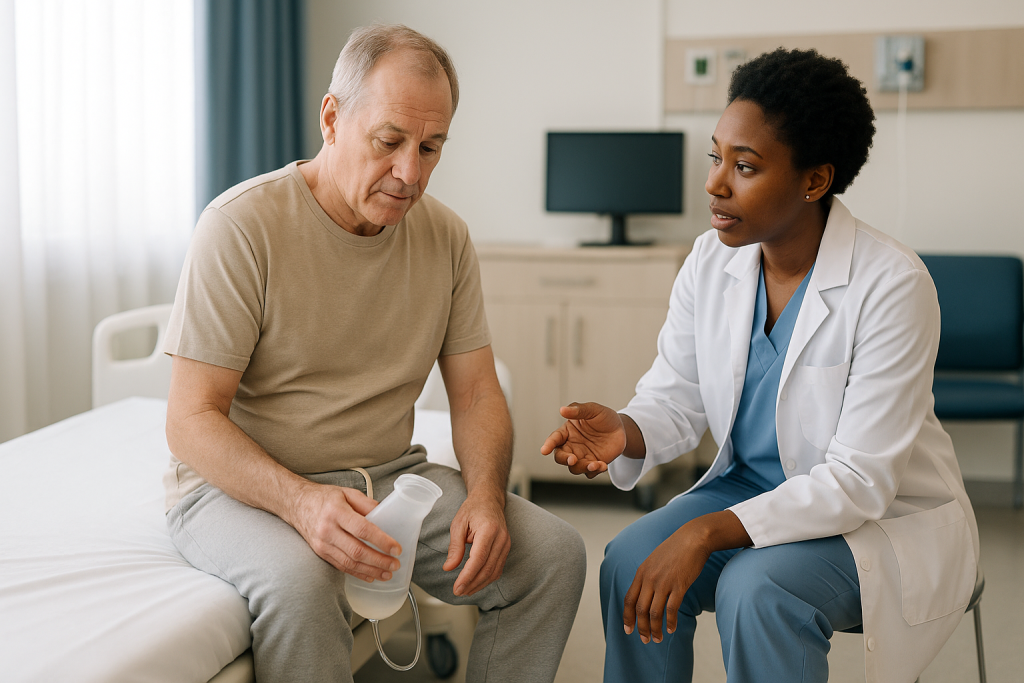
What happens next is called a trial without catheter, and it is the moment many men worry about most. You drink normally, and the team measures how much you pass and, often with a small ultrasound probe on the abdomen, how much stays behind. Passing reasonable volumes and emptying well means you can go home. The first few voids are almost universally uncomfortable: a hot, stinging sensation as urine crosses the raw prostate bed, a sense of urgency that arrives with no warning, and sometimes a stream that stops and starts.
A minority of men cannot pass urine at first. The bladder muscle, weakened by years of straining or simply stunned by the operation and the anaesthetic, does not contract effectively, and swelling in the prostate bed can temporarily narrow the channel. The NHS describes this as a recognised early complication and it is not a sign the operation failed. The usual response is to replace a catheter for a further short period, sometimes with the man going home with it and returning for a second trial about a week later. Bladders that struggled before surgery tend to need the longest to recover their strength.
Going home with a catheter is manageable. A leg bag sits under trousers by day, a larger bag connects at night, and the team will show you how to empty and swap them and how to keep the area clean.
TURP recovery week by week: what days one to seven usually look like
The first week at home has a rhythm of its own, and knowing it in advance removes most of the alarm.
Days one to three, usually the first days home, are dominated by the bladder. You will pass urine often, sometimes every hour, and the urge will feel sharper than it did before surgery. Burning at the start of the stream is expected. Urine will be pink or amber, occasionally with small dark fragments, which are bits of the healing surface coming away. The NHS says it is normal for urine to be blood-stained on and off for the first two weeks. Tiredness surprises people; an operation, an anaesthetic and broken sleep from night-time trips to the bathroom add up.
Days four to seven bring a slow settling. The frequency eases a little, particularly at night, and burning fades to a mild sting. Some men notice leakage when they cough or hurry to the toilet. Urgency incontinence of this kind is common early on and generally improves as inflammation resolves, though it can take weeks. Pads are sensible insurance, not a verdict.
Two priorities matter more than anything else this week, and they are the two men most often neglect. The first is fluid: MedlinePlus advises drinking plenty during the day so the bladder is continuously rinsed and clots have no chance to form, with intake tapering in the evening to protect sleep. The second is avoiding constipation. Straining on the toilet raises pressure in the pelvis and can restart bleeding from the prostate bed. Fibre, fluids and, if your team agrees, a stool softener are far better than force.
Short walks around the house and garden start from day one. Sitting still for hours is the opposite of restful for a healing pelvis.
TURP recovery week by week: weeks two to six and the return to routines
By the second week most men feel noticeably more like themselves, and the practical questions shift from managing symptoms to resuming life. The NHS gives three to four weeks as the typical time before returning to work, driving, strenuous exercise and sex, with lighter desk-based work sometimes possible sooner if your surgeon agrees.
| Milestone | Typical timing | Source |
|---|---|---|
| Catheter removed | 24–48 hours after surgery | Mayo Clinic |
| Discharge from hospital | 1–3 days | NHS |
| Blood-stained urine settles | On and off for about 2 weeks; occasional traces later | NHS |
| Burning and urgency ease | Gradually over several weeks | Mayo Clinic |
| Driving, heavy lifting, strenuous exercise | Usually avoided for 3–4 weeks | NHS |
| Return to work | Around 3–4 weeks, sooner for light duties if advised | NHS |
| Sex resumed | Around 3–4 weeks | NHS |
| Final urinary result judged | Weeks to a few months | Mayo Clinic |
Weeks two and three are the window for a second, smaller bleed, discussed in the next section. Otherwise the pattern is steady: fewer night-time trips, a stream that feels stronger than before the operation, and burning that has become an afterthought.
Weeks four to six are when the bladder’s long-term behaviour reveals itself. Men whose bladders were thickened and irritable from years of obstruction may still feel urgency, and Mayo Clinic notes that the full effect on urinary symptoms can take several weeks to months. Follow-up with the urology team usually falls in this period, and the laboratory report on the removed tissue is discussed then.
How long does it take to pee normally after TURP surgery?
There are two honest answers, because “normal” means two different things.
If normal means a stream that flows freely without straining, many men notice that on the day the catheter comes out. The mechanical obstruction is gone, and the difference in force can be startling after years of dribbling. That is the part of TURP that works quickly.
If normal means passing urine without burning, without a sudden urge, without leaks and without waking at night, the timeline is longer and less predictable. Burning reflects the raw prostate bed and eases as new lining grows over it, typically over two to three weeks. Urgency and frequency come from the bladder muscle itself. A bladder that has pushed against resistance for years becomes thick-walled and twitchy, contracting at low volumes and demanding attention. Removing the blockage does not instantly calm it; the muscle has to unlearn a habit, and Mayo Clinic advises that symptoms can continue to improve over several months.
A few men find that the bladder never fully recovers its capacity, particularly if it was severely overstretched before surgery, and they continue to need medicines for urgency. Others, a small minority, have persistent leakage. The NHS describes long-term incontinence after TURP as uncommon but real, and it is one of the risks that should have been discussed before consent.
What helps in the meantime is unglamorous. Timed voiding, meaning going by the clock rather than waiting for a desperate urge, gives the bladder a predictable schedule. Pelvic floor exercises, the same squeeze-and-release used after prostate cancer surgery, support the sphincter while it is irritated. Limiting caffeine and alcohol in the first weeks reduces irritation. None of these are quick fixes; they are how the bladder is coaxed back to trust.
Bleeding after TURP: what is expected and what is not
Blood in the urine, called hematuria, is the symptom that sends the most men back to the emergency department after a TURP, and most of those visits turn out to be for expected healing. Knowing the pattern makes the difference between a calm glass of water and a frightened midnight drive.
Expected bleeding looks like this. In the first days home, urine is pink to rosé, darker with the first void of the morning because it has sat concentrated overnight, lighter after drinking. Small dark flecks or thin strands are fragments of clot and healing tissue and should pass easily. The colour typically fades over the first week, though the NHS says on-and-off blood-staining for around two weeks is normal.
Then comes a pattern that catches people out. Around the end of the second week, sometimes into the third, the scab-like layer over the prostate bed loosens and separates as new lining forms underneath, much as a scab on a knee lifts before the skin beneath is fully mature. Urine may suddenly turn pink or red again after days of clarity, often after a bout of constipation, a long walk, sex or heavy lifting. Surgeons expect this and it usually settles within a day or two with rest and fluids. It is unsettling precisely because it feels like going backwards.
Bleeding that is not expected is heavier and thicker. Urine the colour of red wine rather than rosé, clots large enough to interrupt the stream, or an inability to pass urine at all because a clot has plugged the outlet, all need urgent assessment. Bleeding from the prostate is treatable, sometimes with a catheter and a washout, occasionally with a return to theatre, but it should never be waited out at home. The red-flag list near the end of this article spells this out.
Is walking OK after TURP? How many days should you rest?
Walking is not just permitted after a TURP; it is one of the most useful things you can do, and the idea of days of strict bed rest is the myth most in need of retiring.
Movement matters for reasons that have little to do with the prostate. Surgery, anaesthesia and lying still thicken the blood and slow its flow through the legs, the conditions in which a deep vein thrombosis, a clot in a leg vein, can form and travel to the lungs. Getting up on the first day, walking the ward corridor and then walking at home a few times daily keeps calf muscles pumping blood back toward the heart. Walking also helps the bowel move, which protects the prostate bed from straining, and it lifts the flat mood that follows any operation.
Rest, properly understood, means avoiding strain rather than avoiding activity. For the first week, gentle walks on level ground, a few minutes at a time, several times a day, are about right. Increase the distance as energy returns. Sitting for long stretches, particularly on hard surfaces, tends to aggravate the pelvic ache more than a stroll does.
The activities to hold back on are those that raise pressure inside the abdomen and pelvis. The NHS advises avoiding heavy lifting, strenuous exercise and driving for around three to four weeks. Cycling deserves special mention: a saddle presses directly on the perineum, the area between the scrotum and anus, right over the healing prostate, and most surgeons ask men to leave the bike alone for the full recovery period. Swimming waits until bleeding has fully stopped and any catheter is out. Golf, gardening that involves digging, and lifting grandchildren sit in the same category as gym work.
If an activity makes your urine turn pink again, that is the pelvis telling you it was too soon. Step back a level for a few days, keep drinking, and try again.
Sex, ejaculation and erections after TURP: what usually changes
This is the section many men read first and few ask about in clinic, so it deserves plain language.
The NHS advises waiting around three to four weeks before resuming sex, mainly because orgasm involves strong pelvic contractions that can disturb the healing prostate bed and restart bleeding. When you do resume, expect the first few occasions to feel different, and possibly to see a little blood in urine afterward.
The most consistent change is retrograde ejaculation. Normally, at climax, a ring of muscle at the bladder neck closes so semen travels forward. A TURP removes tissue at that bladder neck, and afterward semen commonly flows backward into the bladder and is passed later with urine. The sensation of orgasm is usually preserved, but little or no fluid emerges. The NHS states this affects most men who have the operation and is permanent. It is harmless physically, but it matters for men who hope to father children, which is why fertility should be part of the pre-operative conversation.
Erections are a different matter. The nerves responsible for erection run along the outside of the prostate, and a TURP works inside the gland, so most men keep the erectile function they had before. The NHS notes that a small proportion of men do report erectile difficulties afterward, and untangling how much is due to the surgery, to age, to other health conditions or to the anxiety of a difficult recovery is not always possible. If erections change, say so at follow-up; the options for managing erectile dysfunction are the same as for any other cause and are a decision for you and your clinician.
Desire itself is unchanged by the operation, though it may be dampened for a few weeks by fatigue and by feeling unwell. That returns.
How fast does the prostate grow back after TURP, and what about medicines?
A TURP removes the inner part of the prostate, the zone where BPH develops, but it leaves the outer capsule intact. That remaining tissue is still living prostate, still responsive to hormones, and it can slowly enlarge again over the years. The question is not whether regrowth is possible but how often it becomes a problem, and here the evidence is reassuring without being absolute.
Mayo Clinic notes that some men need follow-up treatment because prostate tissue grows back or because scar tissue narrows the urethra. Regrowth is a process measured in years, not months, and for many men the benefit lasts well over a decade. The men most likely to need a second procedure tend to be younger at the first operation, simply because they have more years for tissue to regrow, and those whose original resection removed less tissue.
Scar tissue is the other long-term issue. The urethra or the bladder neck can tighten as it heals, producing a slow stream that returns months after an initially excellent result. A urethral stricture, meaning a scarred narrowing of the tube, is treated with a stretching procedure or a small cut, and it is one reason follow-up appointments matter even when you feel well.
Medicines after TURP are usually fewer, not more. Many men are able to stop the alpha-blocker or 5-alpha-reductase inhibitor they took before surgery, because the obstruction it was managing has been removed. That decision belongs to the prescribing clinician, who will usually wait until the bladder has settled before changing anything. Some men, particularly those with a very irritable bladder, may be offered a medicine for urgency during recovery. None of this should be started, stopped or adjusted without that conversation.
One practical point: a TURP does not remove the risk of prostate cancer, because the outer zone where most cancers arise remains. Whatever screening plan you and your doctor had before continues afterward.
What people often get wrong about TURP recovery
Myths cluster around this operation, partly because so many men have had one and each remembers his own experience as the rule.
“Pink urine means something has gone wrong.” Blood-tinged urine is part of healing for around two weeks, and a brief return of pink around the second or third week is common. Heavy bleeding with clots is the problem, not colour alone.
“I should rest in bed for a week.” Bed rest raises the risk of leg clots and constipation, both of which threaten recovery. Walking from day one is the guideline-level advice; heavy lifting is what waits.
“Drinking less will mean fewer trips to the toilet.” It will also mean concentrated urine that stings more, clots that form more easily and a higher infection risk. Fluids by day, tapering by evening, is the approach MedlinePlus recommends.
“If I still have urgency after a month, the operation failed.” The blockage is fixed on the day; the bladder’s habits take months. Mayo Clinic describes symptom improvement continuing over that longer window.
“TURP causes impotence.” Erectile nerves lie outside the operative field and most men keep their prior function. The consistent change is retrograde ejaculation, which is a different thing entirely.
“Once it’s done, I’m free of prostate problems for life.” Regrowth and scarring can bring symptoms back years later, and the risk of prostate cancer is unchanged.
“Antibiotics after surgery will prevent all burning.” Burning after TURP is mostly from raw tissue, not infection. Antibiotic use is a decision for your team based on your situation, and burning without fever or cloudy, foul-smelling urine is usually healing rather than infection.
The thread running through these is the same: the surgical part of a TURP is fast, and the biological part is slow. Judging the second by the standards of the first is where most disappointment comes from.
Questions to ask your care team before and after a TURP
Consultations are short and memory is unreliable under stress, so take a written list. These are the questions urology nurses say men most often wish they had asked.
Before the operation:
- Will you use a monopolar or bipolar technique, and how large is my prostate on imaging? Size influences whether TURP or another procedure is recommended.
- What is your plan for my blood-thinning or antiplatelet medicines, and who coordinates stopping and restarting them?
- How long do you usually leave the catheter, and what happens if I cannot pass urine when it comes out?
- What are the realistic chances of retrograde ejaculation, erectile change and long-term leakage in your practice?
- Which of my current prostate medicines might change afterward, and when will that be decided?
Before going home:
- How much fluid should I aim for, and by when in the evening should I taper?
- What exactly should I do if I see clots or cannot pass urine at home, and which number do I call at 3 a.m.?
- Is a stool softener appropriate for me, given my other medicines?
- When may I drive, return to my specific job, lift, cycle and have sex?
- When is my follow-up, and will the laboratory result on the removed tissue be discussed then?
At follow-up:
- Has my bladder emptying been measured, and is any residual volume a concern?
- Do my ongoing urgency or leakage warrant treatment, or is more time the right approach?
- What symptoms in the coming years should prompt me to come back?
A good team welcomes these questions. Write the answers down next to them, because the reply you receive at a pre-operative visit is easy to lose in the blur of surgery week.
When to call your doctor after a TURP: red-flag signs
Most recovery days need no medical contact at all. A small number of situations do, and delay makes them harder to treat.
Seek urgent, same-day help, through emergency services if necessary, for any of the following:
- You cannot pass urine for several hours despite drinking, with a growing, painful fullness in the lower abdomen. A clot or swelling may have blocked the outlet, and a distended bladder needs draining promptly.
- Urine that is thick red like wine rather than pink, or clots large enough to interrupt or stop the stream, or bleeding that does not lighten after an hour of drinking and resting.
- Fever with shaking chills, particularly with cloudy or foul-smelling urine or pain in the flank or lower back. Infection after prostate surgery can spread to the bloodstream quickly.
- Sudden chest pain, breathlessness or coughing up blood, which can signal a clot that has travelled to the lungs.
- A swollen, painful or warm calf, the classic sign of a deep vein thrombosis.
- Confusion, severe headache, nausea or vision changes in the first day or two, which can indicate TUR syndrome from fluid absorption.
Contact your urology team or family doctor within a day or two, rather than waiting for the scheduled follow-up, if burning becomes markedly worse instead of better after the first week, if leakage is not improving at all by the third or fourth week, if a catheter you went home with stops draining or leaks around the tube, or if pain in the pelvis or rectum is escalating.
None of these signs means the operation has failed; each means a treatable problem is easier to handle early. The judgement about what is happening, and what to do about it, belongs to the team who know your case. When in doubt, the right choice is the phone call.
Frequently asked questions
How long does it take to pee normally after TURP surgery?
A free-flowing stream usually appears as soon as the catheter is removed, typically one to two days after surgery. Burning and sudden urgency, however, commonly continue for two to three weeks as the raw prostate bed heals, and Mayo Clinic notes that bladder symptoms such as frequency can keep improving for several weeks to months while the muscle recovers from years of pushing against obstruction.
How many days should I rest after TURP surgery?
Rest means avoiding strain, not staying in bed. Gentle walking is encouraged from the first day, and most men are moving around the house comfortably within a week. The NHS advises holding off heavy lifting, strenuous exercise and driving for around three to four weeks, and returning to work in the same window, sooner for light duties if your surgeon agrees.
Is walking OK after TURP?
Yes, and it is actively recommended. Walking keeps blood moving through the leg veins, which lowers the risk of a deep vein thrombosis after surgery, and it helps the bowel work so you avoid straining. Start with short walks on level ground several times a day and extend the distance as energy returns. Cycling is different because the saddle presses on the healing area, and most surgeons ask men to wait.
How fast does the prostate grow back after TURP?
Slowly, over years rather than months. The outer prostate capsule remains and can enlarge again under hormonal influence, and Mayo Clinic notes some men eventually need further treatment because of regrowth or scar tissue. Many men keep their benefit for well over a decade. Younger men at the time of surgery have more years for regrowth and are somewhat more likely to need a repeat procedure.
How long does the catheter stay in after TURP surgery?
Mayo Clinic gives a typical range of 24 to 48 hours. The catheter comes out once bladder flushing has been stopped and the drainage stays pale. If bleeding was heavier or the bladder was very stretched before surgery, some surgeons leave it slightly longer, and a minority of men go home with a catheter for about a week before a second attempt at removal.
What does bladder flushing after TURP actually do?
It rinses the bladder continuously with sterile saline through a three-way catheter so that blood from the prostate bed is diluted and small clots are washed out before they can block the tube. Nurses adjust the flow to the colour of the drainage, running it fast while red and slowing as it fades. It usually stops within the first night or morning once the fluid runs pale.
How long is TURP recovery in total?
The NHS gives three to four weeks as the typical time to return to normal activities, including work, driving and sex. The stream improves immediately, blood-staining settles over about two weeks, and burning fades over two to three weeks. Bladder urgency can take longer, and Mayo Clinic notes that the final urinary result may not be clear for several weeks to months.
Is bleeding after TURP normal two weeks later?
A brief return of pink urine around the second or third week is common and expected. The surface layer over the healing prostate bed separates as new lining forms beneath, much like a scab lifting, and often follows straining, sex or heavier activity. Rest and fluids usually settle it within a day or two. Thick red urine, large clots or an inability to pass urine need urgent assessment.
Will TURP affect my sex life?
The most consistent change is retrograde ejaculation, where semen travels back into the bladder at orgasm and is passed later with urine; the NHS says this affects most men and is permanent but harmless. Erectile nerves lie outside the operative area, so most men keep their previous erectile function, though the NHS notes a small proportion report changes. Sex is usually resumed after three to four weeks.
Can I stop my prostate medicines after TURP?
Possibly, but that decision belongs to your prescribing clinician. Many men no longer need the alpha-blocker or 5-alpha-reductase inhibitor they took before surgery because the obstruction has been removed, yet teams usually wait until the bladder has settled before changing anything. Do not stop, start or adjust any medicine on your own; raise it at your follow-up appointment.
References
- NHS: Transurethral resection of the prostate (TURP)
- NHS: Transurethral resection of the prostate (TURP) – Recovery
- MedlinePlus: Transurethral resection of the prostate
- MedlinePlus: Transurethral resection of the prostate – discharge
This article is for general information only and is not a substitute for professional medical advice. Please consult a qualified doctor about your individual situation.

More from the Blog

After a Renal Angiogram: Puncture Site Rest, Fluids and When Normal Activity Resumes
Recovery after a renal angiogram is usually short. Most people lie flat for several hours so the artery puncture can seal, drink fluids to…

Living With Renal Tubular Acidosis: Bone Health, Kidney Stones and Ongoing Follow-Up
Renal tubular acidosis (RTA) is a kidney tubule disorder that leaves the blood mildly but persistently acidic. Over time that acid load draws calcium…

Ureteroscopy vs Shock Wave Lithotripsy for Ureteral Stones: How the Choice Is Made
Ureteroscopy and shock wave lithotripsy both treat ureteral stones, and neither is better for everyone. Urologists weigh stone size, location, hardness, how far the…

Urinary Infections in Women and Men: Why the Causes Differ and How Care Is Adjusted
Urinary infections differ between women and men mainly because of anatomy. A woman's short urethra opens close to the bowel, so gut bacteria reach…

After Contrast Imaging: The Changes That Mean Your Kidneys Need a Check Sooner
Most people who receive contrast dye for a CT scan or MRI have no lasting effect on their kidneys, but anyone with reduced kidney…

How Renal Osteodystrophy Is Treated: Balancing Calcium, Phosphate and Parathyroid Hormone
Renal osteodystrophy treatment aims to correct the mineral imbalance that damaged kidneys create rather than to treat the bone directly. Care teams limit dietary…