

What a Healed Skin Graft Looks Like: Color, Texture and How the Area Changes Over Years
Key Takeaways
- Skin color and texture belong to the donor site, so a graft keeps the characteristics of where it came from rather than blending into its new location.
- Redness typically peaks around the second or third month and then fades over the first year, with the NHS describing scar maturation continuing for up to two years.
- Split-thickness grafts transfer fewer pigment cells and no sweat or oil glands, which is why they tend to stay paler, smoother, shinier and drier for life.
- Meshed grafts fill their lattice holes with scar tissue, leaving a faint diamond texture that softens but usually remains permanently visible.
- Ultraviolet exposure during the first year is the most preventable cause of a graft turning darker than the surrounding skin, which is why strict sun protection is standard advice.
- A split-thickness donor site usually resurfaces within about one to two weeks but often stays lighter or darker than nearby skin for life.
A healed skin graft usually settles into a patch that stays slightly different from the surrounding skin: often paler or darker, smoother or thinner, with a visible border. Most of the change happens over the first 12 to 24 months as redness fades and the scar matures, but subtle differences in color, texture, hair growth and sweating commonly persist for life. The final look depends on graft type, location and skin tone.
Six weeks after a skin cancer was removed from the side of her nose, a reader wrote to us with a photograph and a single sentence: “Is this what it is going to look like forever?” The patch in the picture was shiny, a shade of pink that did not belong on her face, and edged by a faint ridge she could feel with a fingertip. Nobody had told her that a graft looks its worst well after the stitches come out.
Questions about skin graft appearance long term are among the most common we receive, and they rarely get a straight answer because the honest one is “it depends, and it keeps changing.” A graft is living skin moved to a new address. It brings its old habits with it and takes a long time to settle in.
This explainer walks through what happens in the first weeks, the first year, and the years after that, and separates what the evidence supports from what is simply hoped for.
What a skin graft actually is, and why it never quite matches
A skin graft is a piece of skin lifted completely free from one part of the body (the donor site) and laid onto a wound somewhere else (the recipient site). Unlike a flap, which stays attached to its own blood vessels, a graft arrives with no blood supply at all. It survives only if the wound bed underneath grows new vessels into it. According to MedlinePlus, that process begins within roughly 36 hours of surgery, and surgeons call the moment a graft is securely nourished its “take.”
Two broad types exist. A split-thickness graft contains the epidermis (the outer layer) and only part of the dermis (the deeper, structural layer). A full-thickness graft contains the epidermis and the entire dermis. The distinction matters enormously for the long-term look, because the dermis is where color, thickness, elasticity and most of the skin’s appendages live.
Here is the central mechanism behind every mismatch you will ever notice: skin color and texture are set by where the skin came from, not where it ends up. Pigment cells (melanocytes), blood vessel density, oil glands, hair follicles and dermal thickness are all properties of the donor site. Skin from the thigh placed on the cheek remains, in a real sense, thigh skin. Over the years it adapts to its new environment, but it does not become cheek skin.
Cleveland Clinic lists color difference between the graft and surrounding skin as an expected feature of grafting rather than a complication. That framing is worth holding onto. A visible graft is the normal outcome of a procedure whose first job was to close a wound that could not close on its own, whether after burns, skin cancer removal, trauma or chronic ulcers.
The first weeks: why a new skin graft looks worse before it looks better
Fresh grafts are not pretty, and the early appearance tells you almost nothing about the final result. In the first days the graft often looks pale or mottled because it is living on fluid seeping from the wound bed rather than on blood. Once new vessels connect, it flushes pink, red or even purple. That intense color is a good sign: it means the graft has take.
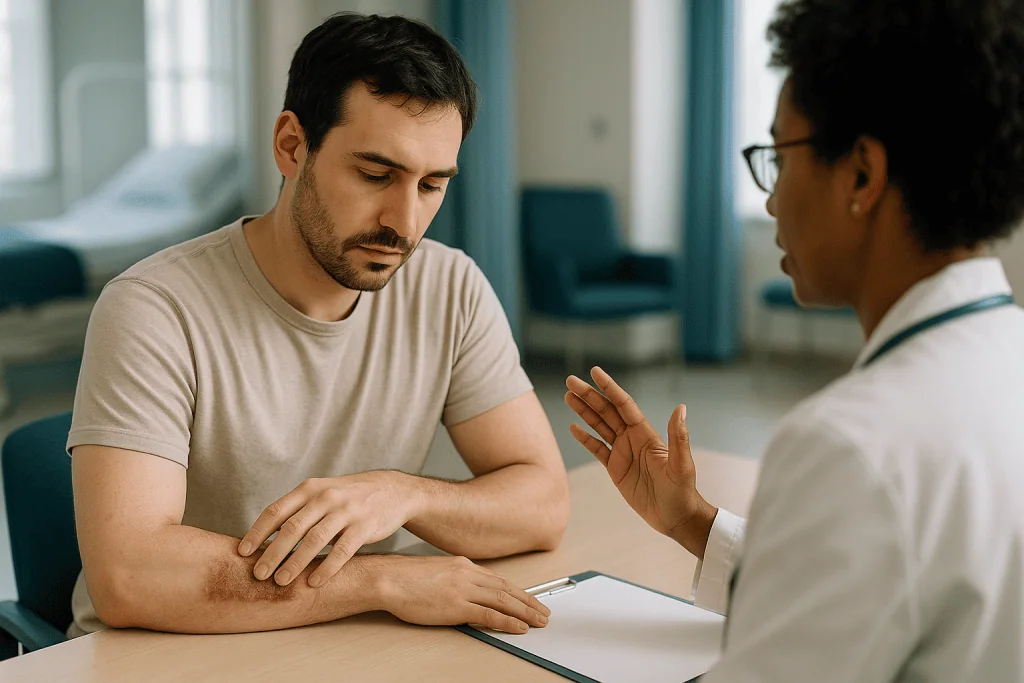
A dressing usually stays in place for the first one to two weeks, and MedlinePlus advises that a graft be protected from trauma and heavy stretching for two to three weeks while those new vessels strengthen. Small blisters, crusts and patches of dark, dry surface are common during this stage. Some of the superficial layer may slough off and regrow underneath; this can look alarming but often does not mean the whole graft has failed. Only the treating team can judge that.
Swelling makes the graft sit proud of the surrounding skin. The edges, where graft meets original skin, form a seam that is typically raised and firm at first. Nerves have been cut, so most grafts feel numb, tingly or oddly hypersensitive in these early weeks.
Meshed grafts, which we will come to shortly, show their diamond or slit pattern most clearly now, with the holes filling in from the edges over one to three weeks. The donor site, meanwhile, goes through its own raw, weeping and crusting phase.
The practical point is that nothing about the graft at week three is stable. Color, height, texture and edge definition will all shift substantially over the coming year. Photographing it at the same angle every month is a far better way to track progress than daily mirror checks, which tend to magnify every change.
Skin graft appearance long term: what the first year usually brings
The first year is when a graft does most of its settling, and the pattern is broadly predictable even though the pace varies widely. The NHS explains that scars in general continue to change for up to two years after injury or surgery, gradually becoming flatter, paler and softer. Grafts follow the same biology, with the added complication that the transplanted skin and the scar at its border mature on slightly different schedules.
Redness tends to peak somewhere around the second or third month. This is the inflammatory phase of healing, when the area is packed with new blood vessels and active repair cells. The graft can look angrier at twelve weeks than it did at four, which catches many people off guard. Itching is common at this stage and reflects regenerating nerve endings and dryness rather than a problem with the graft.
Between roughly three and twelve months, the extra vessels gradually close down. The pink shifts toward the person’s own skin tone, though it rarely arrives exactly. Firmness at the edges softens as the collagen there reorganizes from a chaotic early weave into more orderly bundles. The surface, initially shiny and tight, often develops faint texture and some flexibility.
Thickness changes too. A full-thickness graft that was swollen and puffy generally thins and blends toward the level of adjacent skin. A split-thickness graft may do the opposite and look slightly sunken as swelling leaves and the thin dermis becomes apparent.
By twelve months most grafts have declared their long-term character. What you see at the one-year mark is usually a close preview of the eventual appearance, with further, slower refinement in color and softness still to come over the second year.
Why is my skin graft darker than the skin around it (or much paler)?
Color mismatch is the single most asked-about feature of a healed graft, and it runs in both directions. Understanding why helps set realistic expectations.
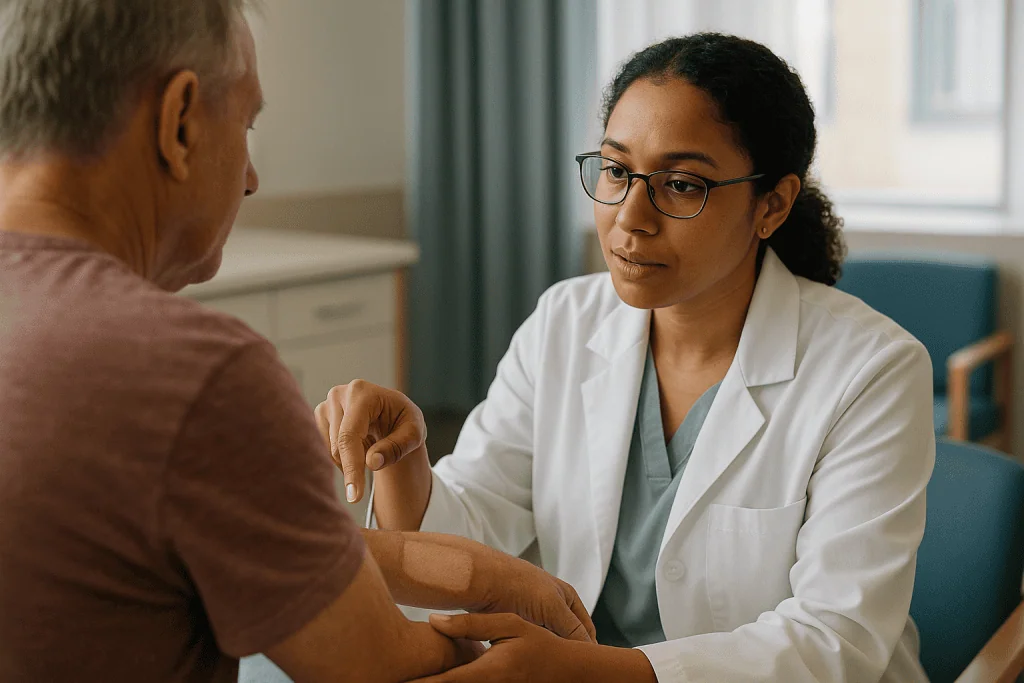
Darkening, called hyperpigmentation, happens when melanocytes in the graft or at its border are over-stimulated. Inflammation during healing is one trigger; ultraviolet light is the other and far more controllable one. A healing graft has a thin, immature outer layer that lets more UV through, and the pigment cells respond by producing extra melanin that then sits in the skin for months or years. The CDC notes that UV exposure drives skin damage year-round, including on cloudy days, which is why clinicians emphasize sun protection on grafts and scars for at least the first year.
Lightening, or hypopigmentation, is more typical of split-thickness grafts. Because they carry only part of the dermis, they transfer fewer melanocytes, and some of those that do travel fail to survive the first days without blood supply. The result is a patch that stays paler than its surroundings and may never regain full color. Thin grafts also lose some of the pink contribution from dermal blood flow.
Skin tone shapes the pattern. Mayo Clinic reports that keloid and pronounced scarring are more common in people with darker skin, and the same melanocyte reactivity that protects against sun damage makes post-inflammatory darkening more likely and more persistent. People with very fair skin more often see a graft that stays pink or appears blotchy.
The donor site is the final variable. Skin from the inner upper arm or groin is paler than skin from the face or forearm that has seen decades of sun. A graft taken from a sun-shielded area will usually look lighter when placed somewhere exposed, regardless of how well it heals.
Skin graft texture change: smooth, tight, bumpy and the mesh pattern
Run a finger across a mature graft and it rarely feels like the skin beside it. The texture story has several threads.
Thin grafts feel smooth and slightly waxy because they lack the oil glands, sweat glands and hair follicles that give normal skin its faint grain. Those structures sit deep in the dermis and are left behind at the donor site when a split-thickness graft is harvested. This is also why such grafts stay dry, do not sweat and, over years, can become flaky without regular moisturizing. Full-thickness grafts carry these structures and usually feel closer to normal skin, sometimes even growing hair if the donor area was hairy.
Tightness comes from contraction. Every healing wound pulls inward as specialized repair cells shorten the new tissue. Thin grafts contract more than thick ones, so a split-thickness graft over a joint or on the face can feel like a band that limits movement. Most contraction happens in the first few months and then stabilizes; it is one reason surgeons favor thicker grafts in mobile or cosmetically sensitive areas.
Bumpiness at the border reflects the scar line where graft meets original skin. This ridge is firm and raised early, then flattens over the maturation period the NHS describes, though a faint step often remains.
Meshing deserves its own explanation. To cover a large wound with a small graft, surgeons may pass a split-thickness graft through a device that cuts a lattice of slits, allowing it to stretch like a net. The holes fill in with new skin from the edges, but that infill is scar rather than graft. The resulting diamond pattern softens and fades with time yet usually remains visible as a faint cobblestone texture for life. Unmeshed sheet grafts avoid this and are typically chosen for the face and hands when enough donor skin is available.
Split-thickness vs full-thickness: how the graft type shapes the long-term look
Because so much of the final appearance is decided by the type of graft chosen, it helps to see the two side by side. Surgeons weigh these trade-offs against wound size, location and available donor skin; the choice is theirs to explain and yours to understand.
| Feature over the years | Split-thickness graft | Full-thickness graft |
|---|---|---|
| Layers transferred | Epidermis plus part of the dermis | Epidermis plus all of the dermis |
| Typical long-term color | Often paler or blotchy; can stay pink or hyperpigment after sun exposure | Closer to donor skin color; better match when donor is chosen near the wound |
| Texture and shine | Smooth, thin, shiny; may look sunken | Nearer to normal skin grain and thickness |
| Sweat, oil and hair | Largely absent; dryness common | Usually preserved; may grow hair |
| Contraction | Greater; tightness possible over joints | Less; favored for face and hands |
| Mesh pattern | Possible if meshed; faint lattice may persist | Not meshed |
| Donor site scar | Flat patch that heals in about 1–2 weeks but may stay discolored | Linear scar where the donor skin was closed with stitches |
| Common uses | Large burns, leg ulcers, broad wounds | Face, eyelids, nose, hands, small defects |
Cleveland Clinic describes the split-thickness donor site healing within about one to two weeks because the remaining dermis regenerates the surface. A full-thickness donor site is closed with sutures and heals like any surgical incision.
Neither type is better in the abstract. A split-thickness graft can cover a wound no full-thickness graft could manage, and sometimes survival of the graft on a poorly vascularized bed matters more than how it will look. The table is a map of tendencies, not a scorecard.
Skin grafts on the face: what changes about the long-term appearance
Facial grafts follow a different playbook, mostly because the stakes for color and contour are higher and because the face has features in which the eye is unforgiving.
Surgeons think of the face in aesthetic units: the nose, each cheek, the forehead, the eyelids, the lips and chin. Light falls on each unit in a characteristic way, and the boundaries between units are natural places to hide a seam. A graft that replaces most of a unit often ends up less noticeable than a small patch sitting in the middle of one, because the edge then runs along a crease the eye expects to see.
Full-thickness grafts are strongly preferred on the face, and the donor skin is usually taken from nearby: behind the ear, the upper eyelid, the side of the neck or just in front of the ear. These areas share the face’s sun history, thickness and pigment, which is why facial grafts frequently achieve a closer long-term color match than grafts elsewhere. Even so, the NHS is clear that scars never disappear entirely, and a graft border on the nose or cheek typically remains visible on close inspection.
Contour is the facial-specific concern. A graft on the nasal tip or ala (the rounded side of the nostril) can heal slightly sunken as the thin dermis settles, or can bulge into a dome, a phenomenon sometimes called pincushioning, as scar tissue under the graft contracts. Both tend to improve over the maturation period but do not always resolve on their own.
Eyelid grafts are thin by design and often blend remarkably well, though their edges can show as fine lines. Grafts near the mouth or eye move constantly, and that movement, along with careful suturing, usually produces a softer scar than static areas like the forehead.
Secondary refinement procedures exist for facial grafts and are discussed later; whether any is appropriate is a conversation for the treating surgeon once the graft has fully matured.
Skin graft after 1 year and beyond: how the area keeps changing over the years
Once the two-year maturation window the NHS describes has passed, the graft is biologically stable, but “stable” does not mean frozen. Several slow processes keep altering how it looks for the rest of a person’s life.
Color drift continues, just at a glacial pace. Pink grafts keep losing their pink. Pale grafts sometimes gain a little pigment over several years as surviving melanocytes multiply and migrate inward from the edges, especially in people with medium or darker skin tones. Grafts that darkened from early sun exposure may fade slowly if protected thereafter. None of this is guaranteed, and the evidence consists mostly of clinical observation rather than controlled studies.
Aging affects grafts and surrounding skin differently. Normal skin loses elasticity, thins and develops fine lines and sun spots over decades. A thin split-thickness graft started out thinner, so it may look more fragile, shinier and more prone to tearing with minor knocks as the years pass. A full-thickness graft from a sun-protected donor site may, paradoxically, age more slowly than the weathered skin around it, so the mismatch can reverse: the graft that once looked too pale can later look smoother and younger than its neighbors.
Body changes matter. Weight gain stretches a graft less readily than normal skin, and weight loss can leave it looking relatively slack. In children, Cleveland Clinic and others note that grafts do not grow in step with the child, so a graft placed in childhood can tighten as the surrounding tissue expands and may need releasing or replacement later. That is a known feature of pediatric grafting, not a failure.
Sun damage accumulates in grafts as it does elsewhere, and a graft placed after skin cancer removal sits in skin that has already proven vulnerable. Lifelong protection and routine skin checks therefore remain relevant long after the graft itself has stopped changing visibly.
The donor site: the scar many people did not expect
Ask someone a year after surgery which mark bothers them more and a surprising number point not to the graft but to the place the skin came from. Donor sites receive little attention in pre-operative conversations, yet they are permanent too.
A split-thickness donor site is a shallow, raw rectangle, often on the thigh, buttock or upper arm. Because the deeper dermis is left intact, it resurfaces itself from the hair follicles and glands that remain, typically within about one to two weeks according to Cleveland Clinic. In the early weeks it is frequently more painful than the grafted area, which has lost its nerve endings while the donor site has exposed its own.
Long term, this patch usually heals flat and smooth. The difficulty is color. Donor sites commonly stay lighter or darker than surrounding skin, sometimes with a slightly shiny or mottled surface, and the rectangular outline can remain faintly visible for life. Hyperpigmentation is more frequent in people with darker skin, consistent with Mayo Clinic’s observation about pigment reactivity and scarring. In some cases a donor site heals with a thickened, raised scar, especially on the chest, shoulders or upper back, where scar tension is high.
A full-thickness donor site is a different animal: an ellipse of skin removed and the edges stitched together. It leaves a linear scar, placed where possible in a crease such as behind the ear or in the groin. It behaves like any incision scar, following the up-to-two-year maturation timeline the NHS describes.
The same care advice applies to both: moisturize once healed, protect from sun for at least the first year, and raise any area that becomes thickened, itchy beyond the ordinary, or slow to resurface with the care team. Donor sites that have not healed within the expected window deserve a look, since delayed healing can signal infection or an underlying circulation or nutrition issue.
Who usually needs a skin graft, and who is usually asked to wait
Grafting is a reconstructive tool rather than an aesthetic choice. MedlinePlus lists the typical reasons: wounds too large to close by stitching, burns, skin loss from infection, surgery to remove skin cancer, venous or diabetic ulcers that will not heal, and contracture release after old scars have tightened. In the facial setting, the most common scenario is a defect left after a skin cancer has been cut out and the surrounding skin cannot be rearranged to cover it.
The decision to graft, rather than to let a wound heal by itself or to use a flap, rests with the surgical team and depends on wound depth, exposed structures, location and how much donor skin is available. Wounds with a healthy, bleeding base of muscle or soft tissue accept grafts well. Wounds over bare bone, tendon or cartilage without a covering layer generally do not, because there is nothing for new vessels to grow from, and those often need a flap instead.
Timing is often the harder question. A graft placed onto an infected wound, a wound with dead tissue, or a cancer site where margins are not yet confirmed clear is likely to fail or to need redoing. Surgeons therefore commonly delay grafting until infection is controlled, the wound bed is clean, and pathology results are back. People who smoke, whose diabetes or blood pressure is poorly controlled, who take medicines that suppress healing or immune function, or whose nutrition is depleted are frequently asked to optimize those factors first, because each reduces the chance of graft take and worsens the eventual scar.
Waiting can feel like a setback. In practice it is usually the difference between a graft that heals once and settles well, and one that fails, scars, and must be repeated on a bed that is now worse than before. Whether and when to proceed is always a conversation with the treating team.
What people often get wrong about how a skin graft heals
Misconceptions about grafts cluster around a few themes, and each one tends to cause unnecessary worry or, occasionally, harm.
The first is the belief that a graft will eventually become invisible. It will not. The NHS states plainly that scars never disappear completely, and a graft is a scar with transplanted skin in the middle of it. A well-matched facial graft can become hard for others to notice, but the person who carries it will usually always be able to find it. Expecting fading rather than vanishing makes the first year far less discouraging.
The second is reading the early color as the final color. The graft at three months, red and raised, is in its most inflamed state. Judging the outcome then is like judging a bruise on day two.
Third, many people assume darkening means the graft is “rejecting.” True rejection in the immune sense does not happen with a person’s own skin. Darkening is pigment, not failure, and is often related to sun exposure that can still be reduced.
Fourth is the idea that a graft that stays numb or does not sweat is unhealthy. Sensation returns slowly and incompletely as nerves regrow over one to two years, and split-thickness grafts never regain sweat glands. Both are expected.
Fifth, a widespread hope is that a cream, oil or supplement will dissolve the scar. Mainstream evidence for topical products on scars is limited; the NHS mentions silicone gels or sheets as options sometimes used for raised scars, and moisturizing helps dryness, but no over-the-counter product has been shown to change the fundamental appearance of a mature graft.
Finally, some people avoid moving a grafted limb or face out of fear of damaging the graft. After the initial protection period MedlinePlus describes, normal movement and any exercises the team prescribes actually help limit contraction. The care team sets those limits; follow theirs rather than general caution.
What you can do to support the long-term look of a graft
Much of a graft’s appearance is set by factors beyond anyone’s control: wound depth, graft type, skin tone, genetics. A few habits do have reasonable evidence behind them, and the care team will tailor them to the individual.
Sun protection comes first because it addresses the most preventable cause of a bad outcome, post-inflammatory darkening. The CDC recommends broad-spectrum sunscreen, shade, hats and protective clothing for everyone, and clinicians typically ask that a healing graft be covered or shaded entirely in the early months, then protected diligently for at least the first year. Facial grafts, which sit in the most sun-exposed skin on the body, benefit most from this discipline.
Moisturizing addresses the dryness of grafts that lack oil glands. A plain, fragrance-free emollient applied once the surface is fully closed keeps the skin supple, reduces itching and lowers the risk of cracking. This is comfort and maintenance rather than scar remodeling.
Gentle massage, once the team confirms the graft is secure, is widely recommended to soften firm edges and may help with tightness. The evidence base is modest and mostly observational, so it is best described as low-risk and possibly helpful.
Silicone gel or sheeting is mentioned by the NHS as an option for raised or hypertrophic scars. Pressure garments are standard after large burn grafts and are prescribed and fitted by the burns team. Neither should be started without guidance, since both have to be used in specific ways to have any effect.
Revision options exist for mature grafts: dermabrasion or laser resurfacing to smooth texture and blend edges, surgical revision of a thickened border, fat grafting beneath a sunken area, or occasionally replacement with a better-matched graft or flap. Surgeons generally wait until maturation is complete, often beyond a year, before considering any of these, and the decision about whether revision is sensible rests with the treating team.
Questions to ask your care team about your graft's appearance
Appointments are short and the questions that matter most often surface afterward. Writing a list before each visit helps. These are the ones that tend to produce the most useful answers about long-term appearance.
- Which type of graft did I have, split-thickness or full-thickness, and where was the donor skin taken from? Knowing this explains much of what you will see later.
- Was the graft meshed? If so, should I expect the pattern to remain visible?
- What color and texture changes do you expect for someone with my skin tone over the next year?
- At what point would you consider the graft mature enough to judge the final result?
- Which signs would make you want to see me sooner, and which are normal parts of healing?
- When can I start moisturizing, massaging and applying sunscreen directly on the graft?
- How long should I keep the graft out of the sun, and what protection do you recommend for this location?
- Are there stretches or movements I should be doing to limit tightness, and any I should avoid for now?
- How will the donor site heal, and what will it look like in a year?
- If I am unhappy with the appearance once it has matured, what revision options might be reasonable, and when would you discuss them?
- Does the original reason for the graft, for example a skin cancer, mean I need ongoing checks of the area?
It is reasonable to ask for your operation note or a summary letter that records the graft type, size and donor site. If you later see a different clinician, that information shapes everything they can tell you about expected appearance and options. Photographs taken at consistent intervals, with the team’s agreement, give both of you an objective record to compare against the gradual changes that are otherwise easy to miss.
When to call your doctor about a healing or healed skin graft
Most changes in a graft’s appearance over months and years are the ordinary business of healing. A smaller set of signs should prompt a prompt call to the surgical team or, when severe, urgent care. The list below is for recognizing warning signs, not for diagnosing yourself; the treating team decides what each one means.
In the first weeks after surgery, contact the team the same day if the graft turns black, gray or deep purple across a wide area, lifts away from the wound bed, or develops thick yellow or green discharge with a foul smell. Spreading redness, warmth or swelling beyond the graft edge, increasing rather than easing pain, fever, or chills can indicate infection, which MedlinePlus lists among the main risks of grafting and which threatens graft survival. Sudden bleeding that soaks a dressing, or a collection of fluid or blood that lifts the graft like a blister, also needs same-day assessment.
Later in the first year, call if the graft or its border thickens into a raised, itchy, tender mass that keeps growing beyond the original wound edges, since this may represent hypertrophic or keloid scarring, which Mayo Clinic notes can appear months after the injury and is easier to manage when caught early. Progressive tightness that limits movement of a joint, an eyelid that no longer closes fully, or a nostril or mouth corner being pulled out of position should likewise be reported rather than waited out.
At any stage, a graft that breaks down and will not re-heal, a new ulcer or crust within or beside a graft placed after skin cancer removal, a changing lump, or a dark spot that enlarges or bleeds warrants review. Grafted skin and the skin around it can develop new cancers, and the area deserves the same vigilance as the rest of the skin.
Severe pain, high fever with a rapidly spreading red area, or signs of a serious allergic or systemic reaction are reasons to seek emergency care immediately rather than waiting for a routine appointment.
Frequently asked questions
Does a skin graft ever look completely normal?
Rarely. A healed graft usually remains at least slightly visible as a patch with a different color, texture or border from the skin around it. Facial full-thickness grafts taken from nearby donor sites can become hard for others to notice, but the NHS is clear that scars do not disappear entirely, and most people can always locate their own graft on close inspection.
What does a skin graft look like after 1 year?
By one year most grafts have lost the bright pink of early healing and show their long-term character: a flatter, softer patch that is somewhat paler or darker than surrounding skin, with a visible but less prominent edge. The NHS notes scars continue maturing for up to two years, so further slow fading in color and softening of the border is still expected after the first anniversary.
Why is my skin graft darker than the skin around it?
Darkening usually reflects extra melanin produced by pigment cells stimulated by inflammation or ultraviolet light during healing, when the graft’s thin outer layer offers little protection. It is more common and more persistent in people with medium and darker skin tones. It does not mean the graft is failing. Continued sun protection may allow some fading over time, though this is gradual and not guaranteed.
Why is my skin graft lighter than my normal skin?
Paleness is most typical of split-thickness grafts, which carry only part of the dermis and therefore fewer pigment cells, some of which do not survive the first days without blood supply. A donor site that was sun-shielded, such as the inner arm or thigh, also contributes lighter skin. Some color may return over several years as pigment cells migrate inward, but many thin grafts stay lighter permanently.
Will the mesh pattern on my skin graft go away?
The pattern fades but usually does not vanish. Meshing cuts a lattice of slits so a small graft can stretch over a large wound; the holes heal with scar tissue rather than graft skin. As the area matures over one to two years, the contrast between graft and scar softens, leaving a faint cobblestone or diamond texture that typically remains visible for life, especially in certain lighting.
How does skin graft texture change over time?
Early grafts are swollen, shiny and tight. Over the first year swelling settles, edges flatten and the surface gains some flexibility. Split-thickness grafts stay smooth and relatively dry because they lack oil and sweat glands, while full-thickness grafts develop texture closer to normal skin and may grow hair. Tightness from contraction mostly stabilizes within the first several months.
Will a skin graft on my face match my skin color?
Facial grafts often match better than grafts elsewhere because surgeons usually use full-thickness skin from nearby donor sites such as behind the ear or the neck, which share the face’s pigment, thickness and sun history. Even so, a visible border and small differences in tone or contour commonly remain. The match keeps improving slowly through the two-year maturation period the NHS describes.
Will my skin graft sweat, grow hair or regain feeling?
It depends on graft type. Split-thickness grafts do not regain sweat glands, oil glands or hair because those structures were left in the donor site; full-thickness grafts usually keep them and may grow hair if the donor area was hairy. Sensation returns gradually and incompletely in both types as nerves regrow over roughly one to two years, and some permanent numbness or altered feeling is common.
Can anything make a healed skin graft look better years later?
Options exist, but none erase a graft. Dermabrasion or laser resurfacing can soften texture and blend edges, surgical revision can flatten a thickened border, and fat grafting can lift a sunken area. The NHS mentions silicone products for raised scars. Surgeons usually wait until the graft is fully mature before considering any of these, and whether revision is appropriate is a decision for the treating team.
Does a skin graft need sun protection forever?
Protection is most critical in the first year, when the immature surface lets through more ultraviolet light and pigment cells are easily over-stimulated. After that, the CDC’s general advice on broad-spectrum sunscreen, shade and protective clothing applies to grafted skin as it does to all skin. Grafts placed after skin cancer removal sit in vulnerable areas and benefit from lifelong protection and routine skin checks.
References
This article is for general information only and is not a substitute for professional medical advice. Please consult a qualified doctor about your individual situation.

More from the Blog

What to Avoid Before Dermal Fillers: Alcohol, Blood Thinners and Supplements That Bruise
Before dermal fillers, most injectors ask you to avoid alcohol for about a day, to swap aspirin or ibuprofen taken for minor aches for…
Tissue Expansion Timeline: Weekly Fills, the Stretching Phase and Second-Stage Reconstruction
A tissue expander timeline usually runs in three phases. The expander is placed in a first operation; once the incision has healed over the…
How Long Do Mesotherapy Results Last and Why Sessions Are Spaced Weeks Apart
Mesotherapy results are temporary. Small studies and practice protocols generally describe visible skin changes lasting a few weeks to a few months after a…
What Buccal Fat Removal Is: The Procedure, Who It Suits and What to Expect
Buccal fat removal is a cosmetic surgery that takes out part of the buccal fat pad, a pocket of deep fat in the lower…
Before Mole Removal: Why Bleeding History and Past Scars Matter to Your Dermatologist
Before mole removal, tell your doctor about any bleeding tendency, past heavy bleeding after cuts or dental work, every blood thinner, antiplatelet medicine or…

Cryoablation Recovery: Monitoring on Day One, Light Activity and When Exercise Resumes
Cryoablation recovery time is usually short compared with open surgery. Most people go home the same day or after one night of monitoring, feel…