

What a Pulmonary Rehabilitation Session Involves: Exercise, Breathing Training and Education

Key Takeaways
- Pulmonary rehabilitation combines supervised exercise training, breathing techniques and education, and the exercise component is what produces most of the gains in walking distance seen in trials.
- A typical program runs two or more group sessions a week for at least six weeks according to the NHS, with many US programs lasting around eight to twelve weeks.
- Lung function measured by spirometry usually does not change after a program; what improves is muscle efficiency, breathing pattern, confidence and daily function.
- Pursed-lip breathing works by creating gentle back-pressure that helps floppy airways stay open on exhalation so trapped air can leave before the next breath.
- A current flare-up, unassessed chest pain or an unstable heart rhythm are the usual reasons a program asks someone to wait, while needing oxygen or a walker is not.
- Gains fade within months if activity stops, which is why every program ends with a maintenance plan and why repeating a course after a decline is a recognized option.
Pulmonary rehabilitation is a supervised program for people with chronic lung disease that combines exercise training, breathing techniques and education. A typical session includes a warm-up, monitored aerobic and strength work, practice with breathing control, and a short class on topics such as inhaler technique, pacing and recognizing flare-ups. Programs usually run two or more group sessions a week for at least six weeks, with a plan for continuing at home.
The referral slip says pulmonary rehab, and the first reaction is often a quiet, stubborn no. You cannot walk from the car to the mailbox without stopping, so a gym class with a treadmill sounds like a cruel joke. Someone in the waiting room probably said the same thing out loud.
Yet the people who run these programs hear that objection every week, and they have built the whole thing around it. Pulmonary rehabilitation was never designed for people who can exercise comfortably. It was designed for people who cannot, and who have slowly shrunk their lives to fit the breathlessness.
So what does pulmonary rehabilitation involve, hour by hour, once you walk through the door? This explainer follows a session from check-in to cool-down, then looks honestly at who benefits, how long it lasts, what the evidence does and does not show, and when a symptom during the program means stopping and calling your doctor.
What does pulmonary rehabilitation involve, in plain terms?
Strip away the clinical name and pulmonary rehabilitation is three things braided together: supervised exercise, training in how to breathe more efficiently, and education about living with a long-term lung condition. The National Heart, Lung, and Blood Institute, part of the NIH, describes it as a supervised program that may include exercise training, nutrition counseling, education about your condition, and techniques to save energy and manage breathlessness.
The word rehabilitation can mislead. In a knee program the goal is to restore the joint. In lung disease the damaged tissue usually does not regrow, so the target shifts. The program works on everything around the lungs: the leg and arm muscles that have weakened from inactivity, the heart that has not been pushed in years, the breathing pattern that tightens with panic, and the habits that decide whether a flare-up ends in a clinic visit or a hospital bed.
Dyspnea, the medical word for breathlessness, drives this. Breathless people move less. Moving less weakens muscles, so the same task now demands more oxygen, which produces more breathlessness. The program is a deliberate interruption of that spiral, run by a team that typically includes respiratory therapists, physiotherapists or exercise physiologists, nurses and sometimes a dietitian, with a physician overseeing the plan.
Most programs are group-based, which matters more than it sounds. Sitting on a stationary bike beside someone who also stops to catch their breath removes a layer of embarrassment that keeps many people housebound. The NHS notes that programs are usually run as group sessions, and participants often describe that company as the part they did not expect to value.
What actually happens in a typical session, start to finish
Picture a room with a handful of treadmills, stationary bikes, a rack of light hand weights, chairs set in a loose circle and a whiteboard. Sessions commonly last about an hour and a half to two hours, though the exact structure varies by program.
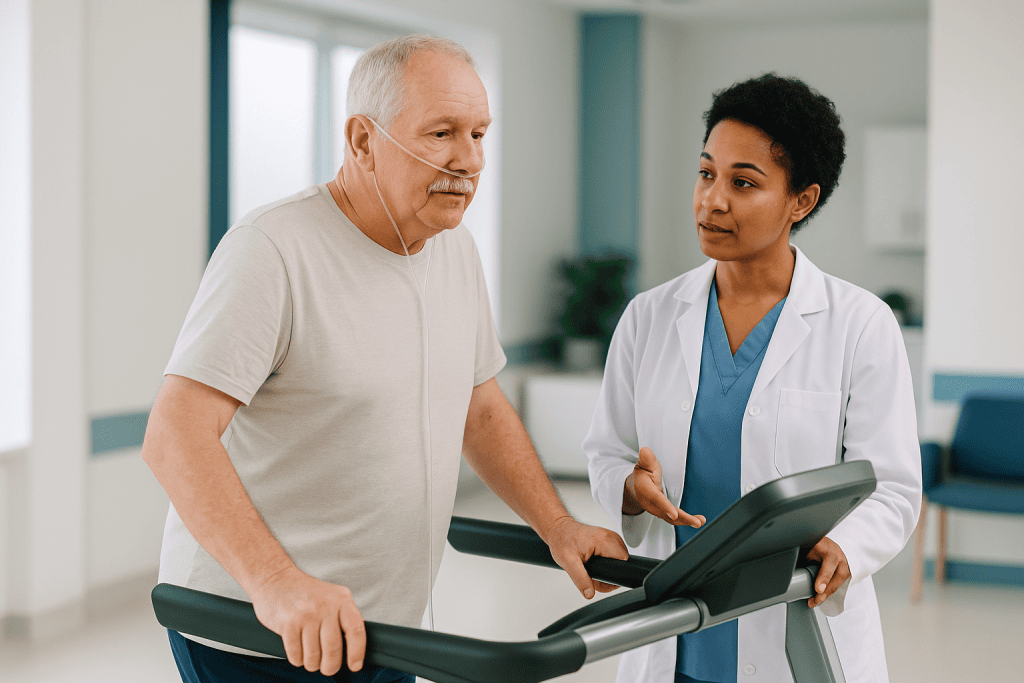
You start at a desk, not a machine. Someone checks your blood pressure, heart rate and oxygen saturation. Pulse oximetry, a clip on the fingertip that estimates how much oxygen your blood is carrying, is used throughout the session. Staff ask how you have felt since the last visit, whether your cough or sputum has changed, and whether you have used your prescribed reliever medicine more than usual. If you use supplemental oxygen, you wear it as prescribed.
The warm-up follows, often five to ten minutes of easy marching, arm circles and gentle stretches done seated or standing. Then the exercise block: aerobic work on a bike, treadmill or walking track, usually in intervals so you can rest, followed by strength exercises for legs, arms and trunk. A therapist watches your oximeter, asks you to rate your breathlessness on a simple 0-to-10 scale, and adjusts pace or resistance in real time.
After a cool-down, the group moves to the chairs. This is the education and breathing-training segment: a short talk on a set topic, a chance to practice pursed-lip breathing or a position that eases breathlessness, and time for questions. A final set of vital signs closes the session.
Nothing about this is a fitness test. Stopping to rest is expected and planned for, and the staff would rather you speak up at a six on the breathlessness scale than push silently to a nine.
The exercise component: why your legs matter as much as your lungs
People arrive expecting lung exercises and find themselves pedaling. The reason is physiological. In chronic lung disease the limit to walking is often not the lungs alone but deconditioned leg muscles that demand more oxygen for less work. Train those muscles and the same stroll uses less oxygen, so the lungs are asked for less.
Aerobic training forms the backbone. Walking and cycling are the usual choices because they load the big muscle groups and are easy to measure. Your starting point often comes from a 6-minute walk test, a standardized measure of how far you can walk on a flat course in six minutes, done at the assessment visit. From that, the team sets a target pace. Interval training, alternating a few minutes of effort with rest, lets people who cannot sustain continuous exercise still accumulate a meaningful dose.
Strength training is the second pillar. Light dumbbells, resistance bands and body-weight moves such as sit-to-stand target the thighs, hips, shoulders and upper back. Upper-body strength gets particular attention because tasks like washing hair or lifting a grocery bag involve arm muscles that also help with breathing, which is why they can feel so disproportionately exhausting.
Some programs add inspiratory muscle training, breathing in against a small resistance device to strengthen the diaphragm, though guidance treats this as an optional add-on rather than a core element.
Progression is gradual and individual. Expect the resistance or walking speed to creep up over the weeks as your scores improve. Expect, too, that on a bad-air day or after a poor night the team will scale back without comment. The MedlinePlus pulmonary rehabilitation overview stresses that the plan is tailored to you, not pulled from a chart.
Breathing training: the techniques you practice and why they help
Breathing training does not make lungs bigger. It changes how you use the capacity you have, and it gives you something to do in the moment when breathlessness spikes into fear.
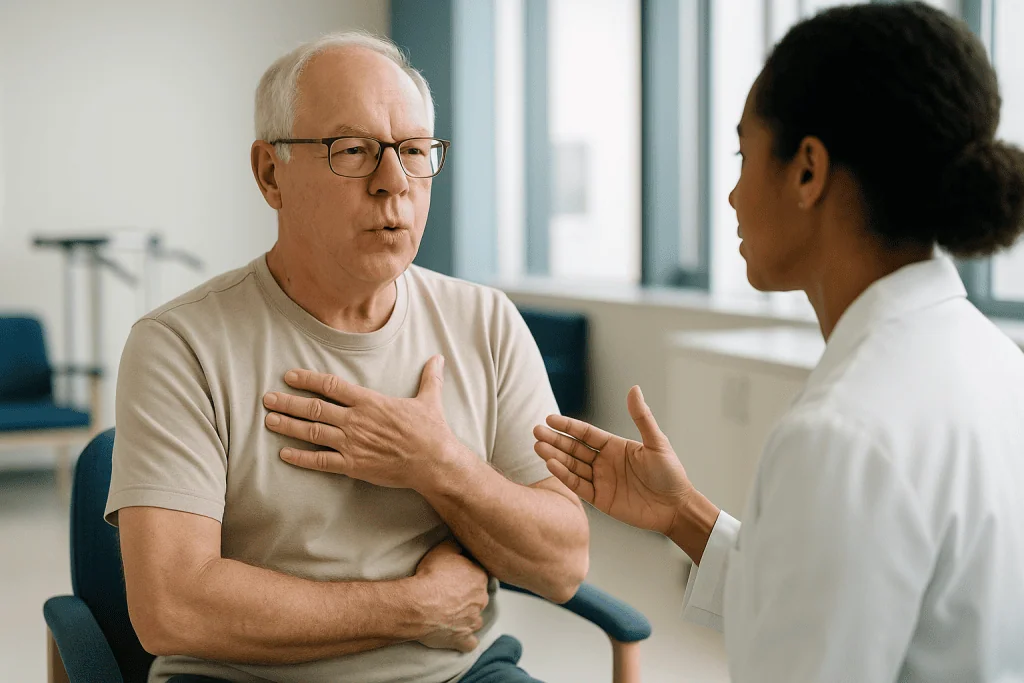
Pursed-lip breathing is the technique most people learn first. You breathe in through the nose for a count, then out slowly through lips held as if cooling soup, taking roughly twice as long to exhale as to inhale. In conditions where the airways tend to collapse on exhalation, such as COPD (chronic obstructive pulmonary disease, a group of conditions including emphysema and chronic bronchitis that narrow the airways), the gentle back-pressure helps keep them open longer so trapped air can leave. Less trapped air means the next breath has room.
Diaphragmatic breathing, sometimes called belly breathing, trains you to let the abdomen rise on the in-breath rather than hitching the shoulders. Many breathless people develop a fast, shallow upper-chest pattern that recruits neck muscles and tires quickly.
Positions of ease are practical, not mystical: leaning forward with forearms on a table or knees, or standing with hands braced on a counter. These fix the shoulder girdle so accessory muscles can help the diaphragm. Paced breathing coordinates breath with movement, exhaling as you climb a step or lift an arm so effort and out-breath land together.
Airway clearance techniques appear when a condition produces a lot of mucus; a therapist may teach a controlled cough or a huff that moves secretions without exhausting you.
The point of practicing these while sitting calmly in a group is that they are then available, almost automatic, on the stairs at home. The NHS lists breathing techniques alongside exercise and education as the standard components of a program.
Education: what the classes actually cover
The teaching segment is where the program stops being about today’s workout and starts being about the next five years. Topics rotate across the weeks, and most programs cover a similar core.
Understanding your condition comes first: what happens in the airways or lung tissue, what a spirometry report means (spirometry is the breathing test that measures how much air you can blow out and how fast), and why symptoms fluctuate. Inhaler technique usually gets its own session, because a surprising share of people use their devices in a way that lands little medicine where it is needed. Staff watch you use your own prescribed inhaler and correct the mechanics; they do not change what is prescribed, and any question about the medicine itself goes back to your prescriber.
Recognizing a flare-up, called an exacerbation, is another staple. The class covers early warning signs, the written action plan your doctor may have given you, and when to call for help rather than wait. Energy conservation and pacing teach you to break tasks into chunks, sit for jobs you used to stand for, and plan the day around your best hours.
Further topics commonly include nutrition for people who are losing weight without trying or carrying extra weight that loads the chest, the role of supplemental oxygen when prescribed, sleep, vaccinations as advised by your care team, managing anxiety and low mood, and, where relevant, stopping smoking. Johns Hopkins describes education, nutritional counseling and psychosocial support as standard parts of the program alongside exercise.
The sessions are conversational. The best ones are the ones where a participant interrupts with a story about the time they ran out of breath in a supermarket and the whole room nods.
Who is pulmonary rehabilitation usually for, and who is asked to wait?
COPD is the condition most often linked to pulmonary rehabilitation, and the strongest evidence is there. Guidance from the NHS describes it as suitable for people whose breathlessness limits daily activities despite treatment, and recommends it after a hospital admission for a flare-up. Mayo Clinic lists it among the standard treatments for COPD, with the aim of helping people stay active and take part in everyday activities.
The door is wider than COPD, though. Programs commonly take people with interstitial lung disease (a group of conditions that scar the lung tissue, including pulmonary fibrosis), bronchiectasis (permanently widened airways that collect mucus), severe or difficult asthma, pulmonary hypertension (high blood pressure in the lung arteries), and people preparing for or recovering from lung surgery or transplant. Some programs enroll people with lasting breathlessness after a severe respiratory infection.
The common thread is symptoms that limit life, not a particular test number. Someone with moderate disease on paper who has stopped leaving the house may gain more than someone with worse numbers who still gardens daily.
Who is asked to wait? A current flare-up is the usual reason; the team generally wants you stable first. Unstable heart disease, an uncontrolled heart rhythm, or recent chest pain that has not been assessed are reasons to delay until a cardiologist or your physician clears exercise. Conditions that make safe exercise impossible, such as severe joint problems or significant cognitive impairment that prevents following instructions, may rule out a standard program, though adapted options sometimes exist.
Smoking does not exclude you, and neither does needing oxygen or a walking aid. The decision about timing and suitability rests with the referring doctor and the program team after an assessment, never with a leaflet.
How long does pulmonary rehab last?
The honest answer has two parts: the program and the practice that follows it.
The program itself is time-limited. The NHS describes a typical course as two or more group sessions a week for at least six weeks. Many programs in the United States run longer, often around eight to twelve weeks, and the NHLBI notes that programs may last several weeks to months. Each session, as described earlier, commonly fills about an hour and a half to two hours including the education segment.
The front end adds a little. Before the first class you attend an assessment: a medical review, measurement of your walking capacity, questionnaires about breathlessness and daily life, and a safety screen. The same measures are repeated at the end so you and the team can see what changed.
Why not shorter? Muscle adapts slowly, especially in people who have been inactive for years. Two weeks of exercise improves confidence; six to twelve weeks starts to shift physiology. Why not longer under supervision? Because the aim is to hand the habit back to you. A course that never ends teaches dependence on the room.
Which brings in the second part. The gains made in a program fade if activity stops, usually within months, so the final weeks focus on a maintenance plan: a home routine, a community exercise group, a walking schedule, or a maintenance class if one exists. Some people are re-referred years later after a decline or hospital stay, and repeating a program is a recognized option rather than a failure.
Insurance and public programs frequently set limits on the number of covered sessions and have eligibility rules that change over time; the program coordinator checks this before you start, and it is worth asking directly.
Center-based or pulmonary rehab at home: how the formats compare
Most of the evidence comes from supervised programs in hospitals or outpatient centers, but home-based and remotely supervised versions have grown, partly because travel is a genuine barrier when breathing is hard. Each format trades something.
| Feature | Center-based group program | Home-based program | Remote or tele-rehab |
|---|---|---|---|
| Supervision | Staff present; vitals and oxygen monitored in real time | Periodic visits or phone calls; self-monitoring between | Live video sessions; self-monitoring with reported readings |
| Equipment | Treadmills, bikes, weights provided | Walking outdoors or indoors, bands, household items | Similar to home; some programs loan devices |
| Peer contact | High; group education and shared experience | Low unless combined with group calls | Moderate; group video possible |
| Travel burden | Highest | None | None, but needs a device and connection |
| Evidence base | Largest and longest established | Growing; appears comparable for many people in studies | Smaller; promising, still developing |
The center-based format remains the reference standard because it is what most trials studied and because moment-to-moment monitoring matters for people whose oxygen levels drop on exertion. Home-based programs suit people who are stable, confident with self-monitoring and live far from a center. Tele-rehab sits in between and depends heavily on how comfortable you are with a screen.
No format is right for everyone. The team’s assessment, including how your oxygen behaves when you walk, usually guides the choice, and hybrid arrangements that begin in a center and finish at home are increasingly common.
What the first weeks usually feel like
The first session is mostly conversation and measurement. Expect to walk a corridor for six minutes while someone follows with a clipboard and an oximeter, to answer questions about how far you can go before stopping and how your mood has been, and to leave without having done anything that resembles a workout.
Week one and two are about finding the floor. Exercise is deliberately light, and many people feel slightly cheated. This is intentional: staff want to see how you respond, where your oxygen settles, and how long you need to recover between intervals before they load you up. Some muscle soreness in the thighs a day or two after a session is ordinary; sharp joint pain or chest pain is not and should be reported.
By weeks three and four, resistance and pace creep upward. The breathing techniques start to feel less awkward, and people often report a small, specific win: carrying laundry upstairs without stopping, or finishing a phone call while walking. Breathlessness during exercise does not vanish. What changes is that it stops being frightening, because you have felt it in a safe room and watched it pass.
The middle weeks can sag. Novelty fades, travel wears thin, and a cold or a bad-air week can knock you back. Programs expect this, and the team will usually say that showing up tired and doing less is still worth the trip.
The final sessions repeat the initial measurements and build the maintenance plan. Johns Hopkins and the NHLBI both emphasize that benefits depend on continuing the exercise and techniques after the formal program ends; think of the course as learning to swim, not as the swim itself.
Can your lungs get better after pulmonary rehab?
This is the question beneath all the others, and it deserves a straight answer. In most chronic lung diseases, pulmonary rehabilitation does not reverse the damage to lung tissue, and spirometry numbers typically do not change much. Anyone who tells you otherwise is overselling.
What the evidence does show, consistently across decades of trials in COPD, is that people who complete a program can walk farther, feel less breathless during daily activities, report better quality of life, and feel less anxious and low. The NHLBI summarizes the aims as improving your ability to breathe, to exercise and to function in daily life, and NHS guidance recommends the program specifically because of these improvements in symptoms and activity, not because of any change in lung function.
How can you walk farther with the same lungs? Three mechanisms do the work. Stronger leg muscles extract oxygen more efficiently, so the lungs are asked to deliver less for the same task. A slower, deeper breathing pattern reduces the air trapping that makes each breath feel like inhaling on top of a full tank. And desensitization, the simple experience of being breathless under supervision and recovering, lowers the fear response that makes dyspnea feel like suffocation.
There is also evidence that completing a program after a hospital admission for a COPD flare-up is associated with fewer readmissions, which is why guidelines push for referral soon after discharge. Those findings come from reviews of trial data, and like all such data they describe groups, not individuals.
So: your lungs may not get better in the way a scan would show. Your life, measured in stairs climbed and outings kept, often does. That distinction is worth holding onto when you compare notes with a neighbor whose numbers improved for a different reason.
What are the disadvantages of pulmonary rehabilitation?
Serious harm from a supervised program is uncommon, which is one reason guidelines recommend it so broadly. But disadvantages exist, and a fair explainer names them.
Time and travel are the biggest. Two or three trips a week for two months or more is a real demand on someone who tires easily, depends on a driver, or lives an hour from the center. Dropout rates in studies are meaningful for exactly this reason, and the people who drop out are often those with the most to gain.
Physical discomfort is expected but not trivial. Muscle soreness, fatigue for the rest of the day, and transient breathlessness during exercise are normal responses, and some people find the early weeks discouraging before any benefit shows. Falls can occur in any exercise setting, and programs screen for balance problems and use supports for that reason.
Medical risks are low under supervision but not zero. Exertion can lower oxygen saturation in some people, which is why oximetry is continuous and oxygen is used when prescribed. Exercise can also unmask heart rhythm problems or angina, one reason the pre-program assessment exists and why unstable heart disease is a cause for delay.
Benefits fade without maintenance. If the program ends and activity stops, the gains usually erode over months, which can feel like having been given something and then losing it.
Access is uneven. Programs are not available everywhere, waiting lists exist, and coverage rules can limit sessions. People with the most severe disease, or who need the most help getting there, are sometimes the least able to attend.
None of this argues against referral. It argues for an honest conversation with the team about logistics, and for choosing a format you can actually finish.
What people often get wrong about what pulmonary rehabilitation involves
Myths cluster around this program, and several of them stop people at the referral stage.
The first is that you must be fit enough to exercise before you can join. The opposite is closer to true: the program exists for people who cannot walk to the mailbox, and the first weeks are built around that starting point. Needing oxygen or a walker is a reason for the team to adapt the plan, not a reason to say no.
The second is that it is only for COPD. COPD has the deepest evidence, but programs routinely enroll people with pulmonary fibrosis, bronchiectasis, pulmonary hypertension and other conditions, and people recovering from lung surgery.
The third is that it is a cure or will restore lung function. It is a management tool. It changes muscles, breathing patterns, confidence and knowledge, and those changes are large enough to matter in daily life, but lung tissue is not rebuilt.
The fourth is that being breathless during exercise is dangerous and a sign to stop entirely. Controlled breathlessness, monitored and recovered from, is part of the training. Staff distinguish that from the red flags described later in this article.
The fifth is that one course lasts forever. The benefit is like fitness in anyone: it persists only while the activity continues. Programs end with a maintenance plan for that reason, and re-referral later is a legitimate option.
The sixth is that breathing exercises alone would do the same job. They help, especially in the moment, but the gains in walking distance and daily function in trials come from the exercise training component, with breathing and education supporting it.
And a quiet seventh: many people assume it will be humiliating. The group is made of people stopping to catch their breath. Nobody is watching the clock on your treadmill but you.
Questions to ask your care team
A referral conversation goes better with specific questions in hand. These are the ones that tend to change decisions.
- Why are you recommending pulmonary rehabilitation for me now, and what do you hope changes?
- Is there anything about my heart, joints or oxygen levels that needs checking before I start?
- Which formats are available to me: center-based, home-based, remote or a mix?
- How many sessions a week, for how many weeks, and how long is each session?
- Is there a waiting list, and what should I do to stay active while I wait?
- Should I use my prescribed reliever inhaler before sessions, and will the program staff check my technique?
- If I use oxygen, how will it be managed during exercise?
- What symptoms during a session should make me stop and tell someone?
- How will progress be measured, and will I see my before-and-after results?
- What is the maintenance plan after the program ends, and is there a maintenance class?
- How many sessions does my coverage allow, and what are the eligibility conditions?
- If I have a flare-up partway through, do I pause, restart or rejoin a later group?
Bring a list of your medicines and any recent breathing or heart tests to the assessment, and bring the person who usually drives you if transport will be shared. The answers to these questions are individual; the same program can look quite different for two people with the same diagnosis, and the decision about what is right for you belongs with your treating team.
When to call your doctor
Supervised sessions have staff trained to spot trouble, but much of a program happens at home, and the program itself can reveal problems that were hidden by inactivity. Knowing the difference between expected effort and a warning sign is part of what you are there to learn.
Call emergency services, or ask staff to, for chest pain or pressure that does not ease with rest, severe breathlessness that does not settle with rest and your usual prescribed reliever, blue or gray lips or fingertips, fainting or near-fainting, sudden confusion or difficulty staying awake, or coughing up more than a streak of blood.
Contact your doctor or the program the same day if you notice a flare-up pattern: breathlessness clearly worse than your baseline for more than a day, a change in the color, thickness or amount of sputum, fever or chills, new swelling in both ankles, or needing your reliever far more often than usual. Follow the written action plan if you have one, and let the team know before the next session.
Seek urgent assessment for a new, one-sided painful or swollen calf, or sudden sharp chest pain with breathlessness, since these can indicate a blood clot, a risk that rises with reduced mobility.
Tell the program staff about new dizziness, palpitations, joint pain that lasts, or any fall, even one without injury. These are reasons to adjust the plan, not to quit.
Finally, the general rule from MedlinePlus applies: if a symptom frightens you or feels different from your usual breathlessness, it is a reason to call, not to wait and see. The program is a safe place to be breathless; it is also where you learn which breathlessness is not safe to ignore.
Frequently asked questions
How long does pulmonary rehab last, and how long is each session?
A typical program runs two or more group sessions a week for at least six weeks, according to NHS guidance, and many programs in the United States continue for around eight to twelve weeks. Each session commonly fills about an hour and a half to two hours, including the warm-up, exercise block, cool-down and education segment. An assessment visit comes before the first class, and the same measurements are repeated at the end.
What are the disadvantages of pulmonary rehabilitation?
The main disadvantages are practical: frequent travel, time commitment, fatigue and muscle soreness in the early weeks, and gains that fade if exercise stops afterward. Medical risks under supervision are low but include drops in oxygen on exertion and unmasking of heart problems, which is why the pre-program assessment and continuous monitoring exist. Access is uneven, waiting lists are common and coverage may limit the number of sessions.
Can your lungs get better after pulmonary rehab?
Lung tissue itself usually does not repair, and spirometry numbers typically change little. What improves, consistently in trials, is how far people can walk, how breathless they feel during daily tasks, mood and quality of life. The mechanism is stronger leg muscles that need less oxygen for the same work, a slower breathing pattern that reduces air trapping, and reduced fear of breathlessness after experiencing it safely.
How long will Medicare pay for pulmonary rehab?
Public and private coverage programs usually cap the number of covered sessions and set eligibility conditions based on diagnosis and severity, and those rules are updated over time, so quoting a fixed figure here would risk being out of date. The program coordinator verifies coverage before you begin and can tell you the current session limit, whether additional sessions can be requested, and what documentation your doctor needs to supply.
What pulmonary rehab exercises can I expect to do?
Expect aerobic work such as walking on a treadmill or track and pedaling a stationary bike, often in intervals with rests, plus strength exercises using light dumbbells, resistance bands and body-weight moves like sit-to-stand. Upper-body work gets particular attention because arm muscles also assist breathing. Some programs add inspiratory muscle training against a small resistance device. Intensity starts low and rises gradually based on your monitored response.
Is pulmonary rehab at home as good as going to a center?
Studies of structured home-based programs suggest results comparable to center-based programs for many stable people, though the evidence base is smaller and newer. Center-based programs remain the reference standard because of real-time monitoring of oxygen and heart rhythm and because of peer support. Home or remote formats suit people who are stable, confident self-monitoring and far from a center. The team’s assessment, especially how your oxygen behaves when walking, usually guides the choice.
Do I have to be able to exercise already to join?
No. The program is designed for people whose breathlessness has made exercise feel impossible, and the first weeks are set at a deliberately light level while staff learn how you respond. Needing supplemental oxygen, a walking aid or frequent rests does not exclude you; the plan is adapted. The usual reasons to delay are a current flare-up or unassessed heart symptoms, which the pre-program assessment screens for.
Is pulmonary rehabilitation only for people with COPD?
COPD has the strongest evidence and the most referrals, but programs commonly enroll people with interstitial lung disease including pulmonary fibrosis, bronchiectasis, severe asthma, pulmonary hypertension and those preparing for or recovering from lung surgery or transplant. Some also take people with lasting breathlessness after a severe respiratory infection. The shared feature is breathlessness that limits daily life despite other treatment, rather than one specific diagnosis.
Should I feel breathless during pulmonary rehab sessions?
Yes, controlled breathlessness is part of the training. Staff ask you to rate it on a simple scale and aim for a moderate level you can recover from within a few minutes, while watching your oxygen reading. Experiencing breathlessness in a safe setting and recovering is one way the program reduces fear. Chest pain, dizziness, blue lips or breathlessness that does not settle with rest are different and should be reported immediately.
What happens after pulmonary rehabilitation ends?
The final sessions repeat the initial walking test and questionnaires so you can see what changed, then focus on a maintenance plan: a home routine, a walking schedule, a community class or a maintenance group where available. Benefits erode over months if activity stops, so continuing is the point of the course. People who decline later or are admitted for a flare-up can be re-referred and repeat a program.
References
- MedlinePlus: Pulmonary Rehabilitation
- NIH National Heart, Lung, and Blood Institute: Pulmonary Rehabilitation
- NHS: Chronic obstructive pulmonary disease (COPD), Treatment
This article is for general information only and is not a substitute for professional medical advice. Please consult a qualified doctor about your individual situation.

More from the Blog
Daily Life After Vision Rehabilitation: Practicing Contrast Strategies and Orientation Skills
Living with low vision after rehabilitation works best when contrast and orientation skills become daily habits: use dark-on-light or light-on-dark pairings for food, stairs,…
Shockwave Therapy for Plantar Fasciitis: What the Trials Show
Shockwave therapy shows moderate evidence of benefit for chronic plantar fasciitis. Randomized trials and meta-analyses find it relieves heel pain better than sham treatment…
Inside a Bobath Treatment Session: Guided Handling, Positioning and Task Practice
A Bobath therapy session is a hands-on neurological rehabilitation appointment, usually with a physiotherapist or occupational therapist, in which the therapist guides your movement,…

Who Is Vision Rehabilitation For? Making the Most of Remaining Sight After Vision Loss
Vision rehabilitation is for anyone whose sight loss cannot be fixed with glasses, contact lenses, medicine or surgery, and who finds reading, moving around,…
Physical Therapy Myths: No Pain No Gain, Machines Do the Work and Other Misconceptions
Physical therapy myths often come from a kernel of truth stretched too far. Some effort and mild, short-lived soreness can be part of rehabilitation,…

Magnifiers, Lighting and Electronic Aids: How Vision Rehabilitation Training Works
Low vision aids training is a rehabilitation program that teaches people with permanent, uncorrectable vision loss to use magnifiers, task lighting, contrast changes and…