

What All On 6 Results Look and Feel Like: Fixed Teeth on Six Implants Over the Years
Key Takeaways
- The teeth fitted on surgery day are almost always a provisional acrylic bridge; the definitive bridge is made only after bone has healed around the implants over several months.
- Implants lack the nerve-rich ligament of natural teeth, so bite force is harder to judge and a fixed bridge feels solid but subtly different, a sensation most people adapt to within weeks.
- Six implants provide load spread and redundancy, so losing one post is less likely to force a bridge remake than with four, but they also need adequate bone at six sites.
- Peri-implantitis, bone loss driven by plaque bacteria around an implant, is the main long-term threat and is more likely in smokers and people with a history of gum disease.
- The implants and the bridge age on different clocks: integrated implants can last for decades, while the bridge is a wearing component that typically needs servicing and eventual refurbishment.
- Daily cleaning under the bridge with an irrigator or threaded floss, plus scheduled professional reviews and a night guard for grinders, is what separates stable ten-year results from early problems.
All-on-6 results are a full arch of fixed teeth supported by six dental implants anchored in the jawbone. In the first weeks most people wear a lighter provisional bridge while bone heals around the implants over several months; the final bridge then allows ordinary chewing and speech. Long-term appearance and function depend on bone healing, daily cleaning, professional maintenance and habits such as smoking or grinding.
She kept a hand in front of her mouth when she laughed. It had become so automatic that her daughter noticed before she did, scrolling past photos from a family wedding and pointing out that every single one showed the same half-hidden smile. Years of failing teeth, two partial dentures that clicked at the wrong moments, and a quiet retreat from restaurant menus had led her to a consultation about full-arch implants.
What she wanted to know was not the procedure itself. She wanted to know what all on 6 results would actually look and feel like at breakfast the next morning, at her nephew’s graduation six months later, and ten years down the line when the novelty had long worn off.
That is the honest question this article tries to answer: not the glossy transformation photo, but the texture of living with a fixed set of teeth held in place by six titanium posts, from the swollen first week to the slow, ordinary years that follow.
What all on 6 results actually mean, beyond the photo
A full-arch implant restoration replaces every tooth in the upper or lower jaw with a single connected bridge screwed onto implants. “All-on-6” simply describes that bridge resting on six implants, usually spread from the front of the jaw toward the back. A dental implant is a small post, most often titanium, placed into the jawbone to act as an artificial tooth root. Over several months, living bone grows tightly against its surface, a process called osseointegration, which is what lets a bridge take the force of chewing without moving.
So when people search for all on 6 results, they are really asking three separate questions. First, what does the mouth look like: the shape of the teeth, the color, the way the lips sit, whether the gumline shows pink acrylic or ceramic. Second, what does it feel like: biting into an apple, speaking on the phone, waking up without taking anything out of a glass. Third, how do those two things change over time as bone remodels and materials age.
Mayo Clinic describes dental implant surgery as a staged process that can take many months from start to finish, most of that time spent waiting for bone to heal rather than in the chair. That timeline shapes everything about the results you can expect, because the teeth you leave with on surgery day are rarely the teeth you keep.
It helps to think of the outcome less as a single reveal and more as a sequence: a provisional bridge, a healing period, a final bridge, and then decades of maintenance. Each stage looks and feels different, and the honest answer to “what are the results like” depends on which stage you are asking about.
How All-on-6 works: what actually happens on the day
The surgical appointment is usually one long session rather than several short ones. Under local anesthesia, often with sedation arranged by the treating team, any remaining teeth in the arch are removed. The surgeon then shapes the bone ridge to create a level platform and places six implants into predetermined positions, guided by three-dimensional scans taken beforehand. The posterior implants are sometimes angled to use the denser bone that sits in front of the sinus cavities in the upper jaw or the main nerve canal in the lower jaw.
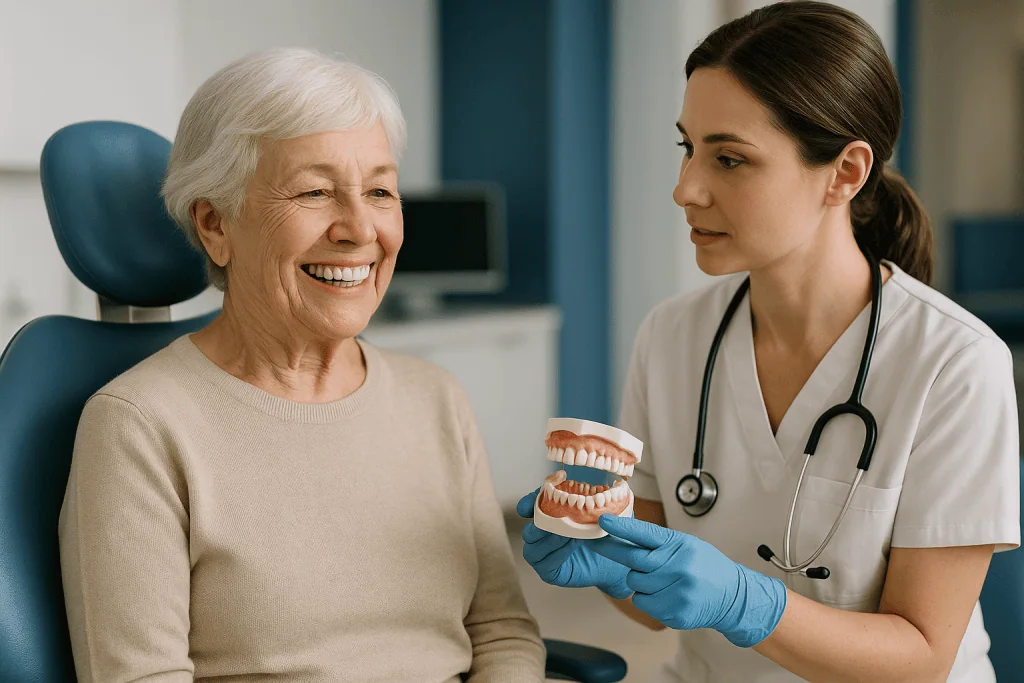
Small connector pieces called abutments are attached to the implants. An abutment is the metal link that sits above the gum and lets a bridge be screwed onto the implant below. If the implants are judged stable enough at placement, a provisional bridge, typically made of reinforced acrylic, is fitted the same day or within a day or two. Cleveland Clinic notes that same-day loading is possible in selected cases, but that the decision rests on how firmly each implant sits in bone at the time of surgery.
If the bone is softer or grafting was needed, the team may instead leave the implants covered under the gum and provide a removable denture while healing happens. Neither path is better in the abstract; they are different routes to the same destination chosen on the day based on what the surgeon finds.
From the patient’s chair, the experience is mostly pressure, vibration and time. The parts people remember afterward are the numb lower lip for a few hours, the taste of saline rinse, and the odd sensation of running a tongue over smooth new teeth where there were gaps or sore roots that morning.
Who All-on-6 is usually for, and who is usually asked to wait
Full-arch implant bridges are generally considered when most or all of the teeth in one jaw are missing, failing, or cannot reasonably be saved. Typical reasons include advanced gum disease, extensive decay, teeth worn down by grinding, or years of struggling with a loose complete denture. Mayo Clinic lists adequate bone, healthy oral tissues and the ability to commit to several months of healing among the general requirements for implant surgery.
Six implants, rather than four, is often chosen when the arch is longer, when bite forces are expected to be high, or when the surgeon wants extra support so that the loss of any single implant does not compromise the whole bridge. The choice is made from the scan and the clinical examination, not from a menu.
Some people are routinely asked to wait or to prepare first:
- Active, untreated gum disease: NHS guidance describes periodontitis as an infection that destroys the bone supporting teeth, and placing implants into an infected environment raises the risk of the same process around the posts.
- Poorly controlled diabetes or other conditions that slow wound healing, which the medical team will want stabilized.
- Heavy smoking, which Mayo Clinic flags as a factor that contributes to implant failure; many surgeons ask for a period of cessation before and after surgery.
- Certain medicines that affect bone turnover or immune function, where the prescribing clinician should be consulted before any plan is finalized.
- Jaws that have not finished growing, which is why full-arch implants are not offered to adolescents.
Being asked to wait is not a refusal. It usually means the team believes the long-term result will be better if the ground is prepared first, and that judgment belongs to the surgeon and physician working together.
All on 6 before and after: what changes and what the pictures leave out
Before-and-after galleries dominate search results for a reason. The visual difference between a mouth of broken, discolored teeth and a clean new arch is dramatic, and it is genuinely what many people experience. Lips that had folded inward over collapsed ridges regain support. The lower face can look slightly longer because the bite height is restored. Speech sounds that depended on teeth, particularly “s” and “f” sounds, often become crisper once the tongue adjusts.
What the photographs do not show is as important as what they do. They are almost always taken of the final bridge, not the provisional one worn for the first several months. They rarely show the pink acrylic or ceramic “gum” portion that sits above the teeth to replace lost bone and tissue, which is visible in many people when they smile broadly. They do not show the small gap sometimes left between the bridge and the natural gum to allow cleaning, which can feel strange to the tongue and occasionally traps food.
Photos also cannot convey proprioception. Natural teeth have ligaments packed with nerve endings that tell the brain how hard they are biting; implants sit directly in bone and lack that feedback. People describe the sensation as teeth that feel “solid but a little numb,” and most adapt within weeks, but it is a real and permanent difference.
Finally, a before-and-after photo is a single moment. It says nothing about the bridge at year eight, when acrylic teeth may have worn or stained, or about the maintenance appointments in between. A fair expectation of all on 6 before and after results includes the whole arc, not the best frame.
The first days and weeks: what early results feel like
The first week is about swelling, soft food and sleep. Mayo Clinic lists swelling of the gums and face, bruising, pain at the implant sites and minor bleeding as expected after implant surgery, usually easing over several days. With a full arch, that is multiplied across the whole jaw, so most people look visibly puffy for several days and feel stiff when opening wide.
The treating team typically advises a soft or liquid diet during this early period, both to protect the healing sites and because the provisional bridge is not designed for hard food. Cleveland Clinic describes a soft-food period that commonly lasts several weeks while the bone begins to heal. Scrambled eggs, yogurt, soups and well-cooked pasta become the menu; crusty bread and steak wait.
Speech can be surprisingly affected. The provisional bridge is bulkier than the final one, and the tongue has to relearn where teeth now sit. A lisp for a week or two is common and almost always fades with reading aloud and ordinary conversation.
Pain is usually managed with medicines chosen by the surgical team; the mechanism and duration of anything prescribed should be discussed with them rather than adjusted independently. Many people report that discomfort peaks around day two or three and then drops steadily.
By the end of week two, most people are back at desk work and daily errands. The mouth still feels new, but the dominant emotion many describe is relief: no more loose denture, no more infected teeth, and a face that looks like theirs again, even if it is a provisional version.
Months two to six: provisional teeth, healing bone and the final bridge
This is the stage the galleries skip. The provisional bridge does its job but it is a working prototype. The teeth are acrylic, the color may be slightly off from what was planned, and the shape is often a little bulkier than the final design. Its purpose is to let the implants heal under controlled load while the patient eats and speaks.
Underneath, osseointegration is happening. Mayo Clinic notes that this bone growth can take several months and that nothing can rush it; the timeline is set by biology rather than by appointment availability. During this period the team typically checks the implants, adjusts the bite on the provisional, and watches the gums settle as swelling resolves and the ridge remodels.
Once the implants are confirmed stable, impressions or digital scans are taken for the definitive bridge. This is where aesthetic decisions are finalized: tooth shade, length, how much pink is shown, whether the material is acrylic on a metal frame or a monolithic ceramic such as zirconia. Zirconia is a hard, tooth-colored ceramic used for strength and stain resistance; acrylic is lighter and easier to repair. Each has trade-offs the team will explain.
Fitting the final bridge changes the feel noticeably. People often describe it as slimmer, cooler against the tongue and more natural in the way the lips rest. Chewing confidence rises because the material is designed for full function. Many say this, not surgery day, is the moment the result truly “arrives.”
Expect small adjustments afterward. A bite that was set in the lab may need fine tuning once the jaw muscles find their new resting pattern over the following weeks.
What all on 6 results feel like when eating, speaking and sleeping
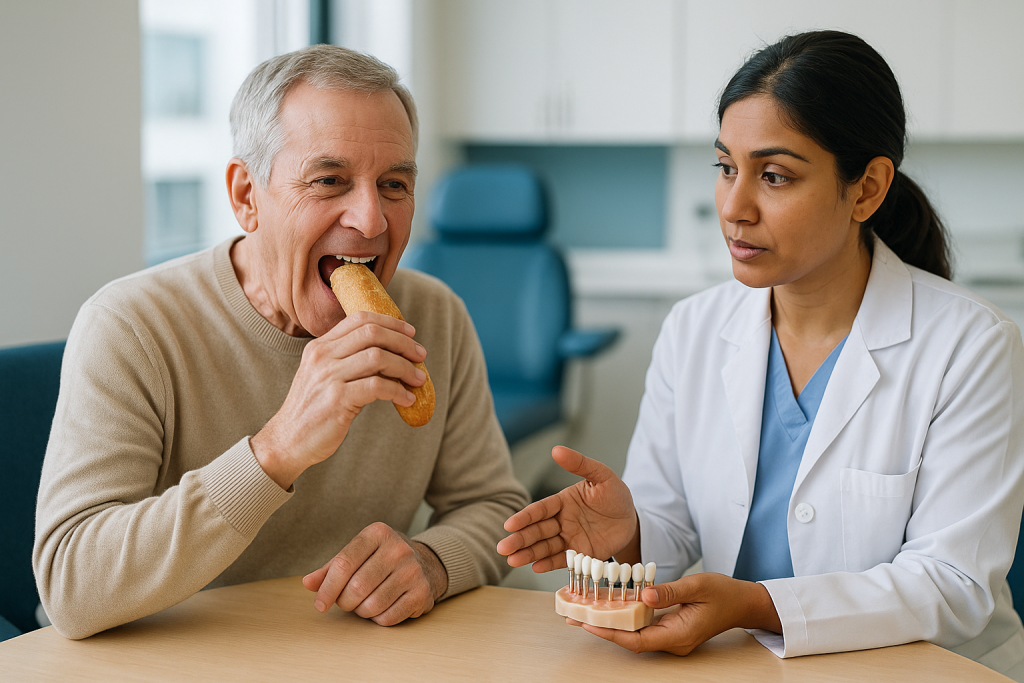
Ask people with a fixed full-arch bridge what changed most and the answers cluster around three ordinary moments. The first is biting. With a complete denture, chewing force is limited by the gum ridge underneath and by the fear of the plate shifting. A bridge anchored to six implants transfers force into bone, so apples, corn on the cob and crusty bread become possible again. Most people still avoid cracking nuts or ice, which is the same advice given for natural teeth.
The second is speech. Because the bridge does not move and the palate is left uncovered, taste and temperature perception are typically better than with an upper denture that covers the roof of the mouth. Words no longer need to be formed around a plate. Some people notice a faint whistle through the hygiene gap under the bridge for a while; it usually fades as speech patterns adapt.
The third is the morning. There is nothing to remove at night and nothing to soak. For people who spent years sleeping without teeth, waking with a full smile is described as one of the most emotionally significant parts of the result.
There are honest downsides in daily feel. The lack of ligament feedback means a grain of sand in a salad can go unnoticed until it crunches. Food can collect under the bridge and must be flushed out. The bridge can feel slightly larger than natural teeth in the first months. People who clench or grind, a condition Mayo Clinic describes as bruxism, may be advised to wear a night guard to protect both the bridge and the implants from excess force.
All on 6 vs all on 4 and conventional dentures: a side-by-side view
People weighing full-arch options usually compare three paths: a fixed bridge on six implants, the same type of bridge on four, and a conventional removable denture. The table below summarizes typical differences in neutral terms. It is a planning aid, not a verdict; the right choice depends on bone volume, bite forces, general health and personal priorities, which the treating team will assess.
| Feature | Fixed bridge on six implants | Fixed bridge on four implants | Conventional complete denture |
|---|---|---|---|
| How it stays in place | Screwed onto six implants in bone | Screwed onto four implants, rear ones often angled | Suction, gum support, adhesive |
| Removal | Only by the dental team | Only by the dental team | Daily by the wearer |
| Surgery required | Yes, one arch-wide procedure | Yes, one arch-wide procedure | No, unless extractions needed |
| Bone requirement | Needs adequate bone at six sites; grafting sometimes used | Designed to use available front bone | None, but ridge continues to shrink over time |
| Load distribution | Spread across six posts | Spread across four posts | Onto gum and bone ridge |
| Effect if one support fails | Bridge often remains usable while repair is planned | Loss of one post more likely to require bridge remake | Not applicable |
| Palate coverage (upper jaw) | Uncovered | Uncovered | Usually covered |
| Daily cleaning | Brushing plus flushing under bridge | Brushing plus flushing under bridge | Removal and soaking |
| Healing time before final teeth | Several months, per Mayo Clinic | Several months, per Mayo Clinic | Weeks for gum settling after extractions |
Two points deserve emphasis. Six implants are not automatically “better” than four; they provide redundancy and spread load, which matters more in some jaws than others. And a well-made denture remains a legitimate option for people who cannot or prefer not to have surgery. MedlinePlus lists implants alongside bridges and dentures as standard tooth-replacement choices, each with its own place.
All on 6 dental implants lifespan: what the evidence actually shows
The single most common question about full-arch implants is how long they last, and the honest answer has two parts, because the implants and the bridge age differently.
The implants themselves, once integrated into bone, are designed to remain for the long term. Cleveland Clinic describes implants as a durable option that, with good care, can last for decades. That phrasing is deliberately broad. Long-term outcomes depend heavily on the health of the bone and gum around each post, and the main threat is peri-implantitis, an inflammatory condition in which bacteria cause bone loss around an implant in much the same way periodontitis damages the bone around natural teeth.
The bridge is a different story. It is a manufactured object subjected to thousands of chewing cycles a day. Acrylic teeth wear, chip and stain; ceramic bridges resist staining but can fracture under heavy force; screws can loosen; the pink material can discolor. Most dental teams treat the bridge as a component that will need servicing and, eventually, replacement or refurbishment during the life of the implants. Asking about the expected service life of the specific bridge material being proposed is a reasonable question for the consultation.
Population-level figures for full-arch survival vary widely between studies depending on follow-up length, definitions of failure and patient selection, so no single percentage can be quoted responsibly here. What is consistent across mainstream guidance is the list of factors that shorten lifespan: smoking, untreated gum inflammation, uncontrolled diabetes, heavy grinding without a guard, and skipping maintenance visits. Mayo Clinic names smoking and poor oral hygiene specifically as contributors to implant failure.
Put plainly, the lifespan of all on 6 dental implants is less a fixed number than a reflection of how the mouth around them is looked after.
All on 6 disadvantages people wish they had known
Search engines fill with “are they worth it” questions because the downsides tend to surface after the decision rather than before. A fair explainer puts them in plain view.
- It is major surgery. Removing a full arch of teeth and placing six implants in one session is a significant procedure with the general risks Mayo Clinic lists for implant surgery: infection, injury to nearby teeth or blood vessels, nerve damage causing numbness or tingling, and sinus problems with upper implants.
- Healthy teeth may be removed. When most of an arch is failing, the plan often includes extracting the few sound teeth left so the bridge can be made as a single unit. Some people later wish they had asked more about saving them.
- The bridge covers lost gum and bone. The pink section is functional and necessary, but it is visible in some smiles, and the transition line can feel unnatural to the tongue.
- Cleaning is more work than natural teeth. Food packs under the bridge; daily flushing with a water irrigator or threading floss is non-negotiable to prevent inflammation.
- Sensation is different. The missing ligament feedback means bite force is harder to judge, and some people report a persistent sense of “wearing” their teeth.
- Components fail. Screws loosen, teeth chip, and the bridge may need removal for repair. Each visit requires a clinician who can service that system.
- Bone loss can continue. Peri-implantitis is a real risk, particularly in smokers and people with a history of gum disease, and it can lead to implant loss years after an apparently perfect result.
- The result is permanent. There is no simple route back to natural teeth, and switching to a removable option later means living with a surgically altered ridge.
None of these makes the treatment wrong for the right person. They are the realistic trade-offs that belong in an informed decision.
Keeping all on 6 results looking good: daily care and maintenance visits
The people who report the most stable results years later tend to share a routine rather than a secret. It has three parts.
Daily cleaning comes first. The bridge is brushed like natural teeth, with attention to the junction where it meets the gum. Underneath, where a toothbrush cannot reach, the space is cleaned with a water irrigator, interdental brushes sized by the hygienist, or floss threaded beneath the bridge. Cleveland Clinic advises treating implant restorations with the same discipline as natural teeth: brushing twice a day, cleaning between and under, and avoiding tobacco. NHS guidance on gum disease makes the mechanism clear: plaque left on surfaces at the gumline triggers inflammation, and inflammation around an implant is the first step toward bone loss.
Professional maintenance comes second. Full-arch bridges are typically reviewed on a schedule set by the treating team, often more frequently than ordinary dental check-ups in the first years. At these visits the clinician examines the gum around each implant, checks for bleeding or pocketing, verifies that screws are tight and may periodically remove the bridge entirely for deep cleaning and inspection. X-rays taken at intervals track bone levels; a slow change on film is the earliest warning of trouble, long before anything feels wrong.
Habit management comes third. Night guards are commonly recommended for people who clench or grind, since Mayo Clinic notes that bruxism can damage dental restorations. Smoking cessation protects both the gum seal around implants and general healing. Blood sugar control matters for the same reason.
One practical note: people who move house or change dentists should carry a record of their implant system and bridge design. Different manufacturers use different screws and tools, and a new clinician needs that information to service the work safely.
What people often get wrong about full-arch implant results
Several beliefs circulate widely enough to deserve direct correction.
“You walk out with your permanent teeth.” In most cases, no. Same-day teeth are provisional. The final bridge is made after bone has healed over several months, and the look and feel of the two differ meaningfully.
“Implants cannot get gum disease.” They can get the implant equivalent. Peri-implantitis causes bone loss around posts and is driven by the same plaque bacteria that cause periodontitis. Implants do not decay, but the tissue around them is fully vulnerable.
“Six implants are always better than four.” More implants add redundancy but also require more bone and more surgical sites. The appropriate number depends on the individual jaw and bite, and the surgeon’s judgment matters more than the figure in the name.
“The result is maintenance-free.” Bridges need servicing, screws need checking, and gums need professional cleaning. Skipping visits is one of the most reliable ways to shorten the life of the work.
“It will feel exactly like natural teeth.” It will feel solid and function well, but the absence of ligament sensation and the presence of the pink flange mean it feels like very good prosthetic teeth, not like the teeth you were born with.
“Before-and-after photos show the typical outcome.” They show selected outcomes at their best moment. Realistic expectations include provisional stages, adjustments and the inevitable wear of materials.
“Age rules it out.” Mayo Clinic frames candidacy around bone, health and healing capacity rather than age itself. Older adults with healthy tissues are often suitable; younger adults with uncontrolled gum disease may not be. The assessment is individual.
Questions to ask your care team before committing
A good consultation leaves room for questions that go beyond the brochure. These are the ones that most directly affect what the results will look and feel like.
- Which of my remaining teeth could be saved, and what would change if we kept them rather than removing the whole arch?
- From my scan, why six implants rather than four or eight for my jaw specifically?
- Will I receive a provisional bridge on the day of surgery, or will I wear a removable denture during healing, and what decides that?
- How long do you expect my healing period to be before the final bridge, and what would extend it?
- What material do you propose for the final bridge, and what are its known wear and repair characteristics?
- How much pink material will be visible when I smile, and can I see a mock-up or digital preview first?
- What does the maintenance schedule look like in year one and in later years, and what does a typical maintenance visit involve?
- How will I clean under the bridge, and who will teach me?
- If one implant fails, what happens to the bridge?
- Do I grind my teeth, and will I need a night guard?
- How do my medicines and medical conditions affect healing, and should my physician be involved in planning?
- Who do I contact after hours if something goes wrong in the first week?
Writing the answers down matters. The consultation often covers a lot of ground quickly, and people frequently discover months later that a point they half-heard, such as the hygiene gap or the acrylic provisional, was the thing that would have most shaped their expectations. The team should welcome these questions; a plan that survives them is a plan worth having.
When to call your doctor: red-flag signs after All-on-6 surgery
Some discomfort, swelling and spotting of blood are expected in the first days, and the surgical team will give specific instructions. Certain signs, however, fall outside the ordinary and should prompt a same-day call to the treating team, or emergency care if severe.
- Bleeding that does not slow with firm pressure on gauze after a sustained period, or that restarts heavily after it had stopped.
- Swelling that keeps increasing after the third day, spreads toward the eye or down the neck, or makes it hard to swallow or breathe. Difficulty breathing is an emergency.
- Fever, chills, or a foul taste and discharge from the surgical sites, which can indicate infection.
- Pain that worsens after initially improving, or pain not controlled by what the team prescribed.
- Numbness or tingling of the lip, chin or tongue that persists beyond the expected wearing-off of local anesthesia, which can signal nerve involvement and should be assessed early.
- A sudden feeling that the bridge is loose, rocking or clicking, or a screw-access hole that has opened.
- Nasal congestion, nosebleeds or air escaping into the mouth when blowing the nose after upper-jaw implants, which can point to sinus involvement.
- Any allergic-type reaction such as rash, facial swelling or wheeze after a new medicine; call for urgent advice.
In the longer term, bleeding or pus at the gumline around the bridge, a bad smell that cleaning does not clear, gum recession exposing metal, or new mobility of the bridge all warrant an appointment rather than waiting for the next scheduled review. Mayo Clinic notes that early recognition of infection or implant problems gives the team the best chance to intervene before bone is lost. When in doubt, the right move is to call; the people who placed the implants would rather hear from you a day early than a month late.
Frequently asked questions
Are all-on-6 dental implants worth it?
Whether a full-arch bridge on six implants is worth it depends on how much a fixed, non-removable set of teeth would change daily life for you, weighed against major surgery, months of healing, lifelong maintenance and real risks such as peri-implantitis. People who struggled with loose dentures or chronic dental infection often value the stability highly; those with several savable teeth may be better served by other options. The treating team can lay out your specific trade-offs.
What do all on 6 results look like right after surgery?
Immediately after surgery most people have visible facial swelling, some bruising and a provisional acrylic bridge that is bulkier and slightly less refined than the final one. The smile is complete, which many find emotionally significant, but the gums are still settling and the bite may need adjustment. Over the following weeks swelling resolves, speech normalizes and the mouth begins to feel like the person’s own again.
What is the average lifespan of All-on-6 dental implants?
No single average can be quoted responsibly, because published figures vary with follow-up length and patient selection. Cleveland Clinic describes well-maintained implants as lasting for decades, while the bridge on top is a wearing component that typically needs servicing or replacement during that time. Smoking, gum inflammation, uncontrolled diabetes, grinding without a guard and missed maintenance visits are the factors most consistently linked to shorter lifespan.
What are the disadvantages of all-on-6 dental implants?
The main disadvantages are the scale of the surgery and its risks, the removal of any remaining natural teeth, a visible pink gum section in some smiles, more demanding daily cleaning under the bridge, altered bite sensation, the chance of chipped teeth or loose screws, the possibility of peri-implantitis and bone loss, and the fact that the change is permanent. These are realistic trade-offs rather than reasons to avoid treatment for a suitable candidate.
What do all on 6 before and after photos not show?
They rarely show the provisional bridge worn for several months, the pink prosthetic gum visible in broad smiles, the hygiene gap under the bridge, or how acrylic teeth look after years of wear and staining. They also cannot show the altered sensation of chewing on implants or the maintenance visits in between. A photograph captures one chosen moment; the result is a long timeline.
How is all on 6 vs all on 4 different in feel and risk?
Day to day, both deliver a fixed bridge that feels similar when chewing and speaking. The practical difference is engineering: six implants spread chewing load across more posts and provide redundancy, so the bridge may remain usable if one implant fails, whereas four-implant designs are more dependent on each post. Six implants require adequate bone at more sites and more surgical work. The surgeon chooses based on the scan and bite.
What I wish I knew before dental implants, according to patients?
Common reflections include not realizing the first teeth were temporary, underestimating the soft-food period, being surprised by the pink flange and the gap beneath the bridge, discovering how much cleaning is needed underneath, and not asking whether some natural teeth could have been saved. Many also wish they had understood that maintenance visits and possible repairs are part of the long-term picture rather than an exception.
Can you eat normally with All-on-6 implants?
Once the final bridge is fitted and the implants have integrated, most people eat a normal varied diet, including firmer foods that were difficult with a denture. During the healing months the team usually advises soft foods to protect the provisional bridge and the implants. Long term, very hard items such as ice or nut shells are generally avoided, which is the same advice given for natural teeth.
Does smoking affect all on 6 results?
Yes. Mayo Clinic lists smoking among the factors that contribute to dental implant failure, because it impairs blood flow and healing in the gum and bone around the posts and increases susceptibility to infection. Many surgical teams ask people to stop before surgery and throughout healing, and continued smoking is associated with a higher risk of peri-implantitis in later years. Any cessation plan should be discussed with your clinician.
How often do All-on-6 bridges need to be checked?
The schedule is set by the treating team and often involves more frequent reviews in the first year, then regular visits thereafter. At these appointments the clinician checks the gum around each implant, confirms screws are tight, cleans surfaces that home care cannot reach, periodically takes X-rays to track bone levels and may remove the bridge entirely for inspection. Missing these visits is a common route to late problems.
References
This article is for general information only and is not a substitute for professional medical advice. Please consult a qualified doctor about your individual situation.

More from the Blog
The Dental Implant Process: Every Stage From First Scan to Final Crown
The dental implant process typically unfolds over three to nine months. It begins with a 3D scan and treatment planning, followed by any needed…
Why an ENT Check May Come Before a Sinus Lift When You Have Chronic Sinusitis or Allergies
An ENT (ear, nose and throat) check often comes before a sinus lift because the graft is placed directly beneath the maxillary sinus lining,…

Sinus Lift Healing Timeline: From Graft Placement to the Day Your Implants Can Be Planned
A sinus lift usually needs several months to heal before implants can be planned. Cleveland Clinic and Mayo Clinic describe bone graft maturation as…
Who Needs Full Mouth Reconstruction? Worn, Eroded and Missing Teeth That Add Up to a Rebuild
Full mouth reconstruction is usually considered when several problems overlap in one mouth: teeth worn flat by grinding, enamel dissolved by acid, multiple missing…

Full Mouth Reconstruction Stages: Bite Stabilization, Tooth Rebuilding and the Final Fit
Full mouth reconstruction usually moves through three stages. First, the bite is stabilized and gum disease, decay, grinding and jaw-joint problems are treated. Second,…

How to Clean Around Zygomatic Implants and a Fixed Bridge: Water Flossers and Recall Visits
Cleaning zygomatic implants and the fixed bridge they support means brushing twice daily with a soft brush, cleaning under the bridge with interdental brushes,…