

What Causes a Gummy Smile? Gum Overgrowth, Short Teeth, Jaw Position and Lip Movement

Key Takeaways
- Excessive gingival display has four main mechanisms, gum overgrowth, short or partly covered teeth, a vertically long upper jaw, and a short or high-lifting lip, and they frequently overlap in one person.
- Only gum overgrowth signals a health concern; the other three causes involve completely healthy tissue and are matters of appearance and preference.
- Altered passive eruption means full-size teeth are hiding under gum that never finished retreating after adolescence, which is why probing for the enamel border is a key part of assessment.
- Some calcium channel blockers, anticonvulsants and immunosuppressants can enlarge gum tissue as a side effect, and any change should be discussed with the prescriber rather than acted on alone.
- Botulinum toxin reduces lip lift by temporarily blocking nerve signals to muscle, and Mayo Clinic notes the effect generally lasts about three to four months, making it maintenance rather than a permanent change.
- Lip-driven gummy smiles often soften with age as the upper lip lengthens and drops, while jaw-driven ones do not change and medicine-related overgrowth can persist while the prescription continues.
A gummy smile, which dentists call excessive gingival display, usually comes from one of four sources or a mix of them: gum tissue that has thickened or never receded fully from the teeth, teeth that are short or partly buried, an upper jaw that has grown longer vertically than average, or an upper lip that is short or lifts unusually high when you smile. The cause guides any treatment.
There is a particular tilt of the head that some people learn early. Chin down, lips closed around the teeth, a smile that stops just short of the eyes. In group photos they are the one who looks pleased rather than delighted, because delighted means the lip goes up and a pink band of gum appears above the teeth. Many of them have never asked a dentist about it. Quite a few assume it is simply how their face is.
That assumption is half right. Gummy smile causes are almost always structural rather than a sign of poor care, but “structural” covers four very different things, and telling them apart changes everything about what, if anything, could be done. A person whose gums have thickened from inflammation is in a different situation from a person whose upper jaw grew a few millimeters longer than average.
This article walks through each of those causes, how a dental team sorts one from another, what the evidence honestly says about age and sex, and what treatment paths exist for each. Decisions belong with your own clinicians. The aim here is to make that conversation shorter and better informed.
What is a gummy smile, and how much gum is too much?
Dentists use the phrase excessive gingival display, which simply means more gum tissue is visible above the upper front teeth during a full smile than the person or clinician would like. There is no diagnosis attached to it in the way there is for gum disease. It is a description of appearance, measured in millimeters of pink tissue between the bottom edge of the upper lip and the necks of the teeth.
Where the line sits is partly a matter of taste. Many clinical texts describe a smile that shows the full crowns of the upper teeth plus a thin strip of gum as within the typical range, and a smile showing several millimeters of gum as “gummy.” Those thresholds come from surveys of what dentists and laypeople rate as attractive, not from any health outcome. A smile that reveals more gum is not weaker, more prone to decay, or more likely to develop periodontitis by virtue of showing more tissue.
Why, then, does it matter clinically at all? Two reasons. First, one of the gummy smile causes, swollen or overgrown gum tissue, can be a marker of inflammation, certain medicines, or an inherited condition, and those deserve a proper look. Second, when someone is bothered enough by their smile to change their behavior, hiding it in photos or covering their mouth while laughing, that distress is real, and a well-matched treatment is only possible once the mechanism is known.
Think of the smile as a picture frame. The lip is the top edge of the frame, the gum line is the mat, and the teeth are the artwork. A gummy appearance can come from a frame that sits too high, a mat that is too wide, artwork that is too small, or a whole canvas that has been hung too low on the wall. Each of the four main causes maps onto one of those, and the next section lays them side by side.
Gummy smile causes at a glance: the four main mechanisms
Most explanations for excessive gingival display fall into four groups, and many people have more than one at once. Sorting them early is useful because they are handled by different specialists, and because two of them can look identical in a mirror while requiring opposite approaches.

| Cause | What is going on | Common clues | Who usually assesses it |
|---|---|---|---|
| Gum overgrowth | Gum tissue is thicker or more swollen than normal, covering part of the tooth | Puffy, sometimes red or bleeding gums; onset after starting a medicine; family history | General dentist, periodontist |
| Short or partly covered teeth | Teeth are naturally small, worn down, or never fully emerged from the gum (altered passive eruption) | Square, stubby-looking front teeth; healthy pink gums; often present since teens | General dentist, periodontist |
| Jaw position | The upper jaw has grown longer vertically than average (vertical maxillary excess) | Gum shows even at rest with lips apart; longer lower face; lips may not meet easily | Orthodontist, oral and maxillofacial surgeon |
| Lip movement | The upper lip is short, or the muscles lift it unusually high when smiling (hyperactive upper lip) | Normal tooth length and gums; lip rises a long way between rest and full smile | General dentist, oral surgeon, or clinician experienced in facial muscle treatment |
The table hides one complication: the causes stack. A person can have a slightly long upper jaw plus a lip that lifts high, and either one alone might not have produced a noticeable result. This is why a single treatment aimed at only one factor sometimes produces a smaller change than expected. A careful examination, described later, is designed to estimate how much each layer contributes before anyone proposes a plan.
The following four sections take each row in turn.
Gum overgrowth: when the tissue itself is the problem
Healthy gum tissue hugs the neck of each tooth in a thin, firm collar. When that collar thickens, the visible tooth shortens and the pink area grows, even though nothing about the teeth or jaw has changed. Dentists call this gingival hyperplasia or gingival enlargement, meaning the gum has increased in bulk.
The most common driver is inflammation. Plaque, the sticky film of bacteria that forms on teeth, irritates the gum margin and causes it to swell. Mayo Clinic describes gingivitis as gum irritation, redness and swelling that is common and usually reversible with good home care and professional cleaning. Swollen gums from gingivitis can be a temporary contributor to a gummy appearance, and they often settle once the inflammation is addressed, which is one reason a dental hygiene assessment usually comes before any discussion of cosmetic change.
Some medicines can cause gum tissue to enlarge as a side effect. Drug classes most often linked to this include certain calcium channel blockers used for blood pressure, some anticonvulsants used for seizures, and some immunosuppressants used after transplant. The mechanism is thought to involve altered turnover of the connective tissue in the gum, and it is worse when plaque is also present. If gum growth appeared after a prescription started, that is worth mentioning to both the dentist and the prescriber. Nobody should stop or alter a medicine because of a gum change; the prescribing clinician weighs the options.
Hormonal shifts during puberty and pregnancy can also make gums more reactive to plaque, producing temporary swelling. A rarer cause is hereditary gingival fibromatosis, an inherited condition in which gum tissue grows excessively and may need to be surgically reduced more than once over a lifetime.
The clue that overgrowth, rather than tooth size or jaw shape, is at work is usually texture and color: gums that look puffy, glossy, or bleed on brushing, and teeth whose true size is revealed when a probe finds them hiding under the tissue.
Short teeth and altered passive eruption
Some people’s upper front teeth look short and square, more like small tiles than the longer ovals seen in most adult mouths. Two different things can produce that look, and only one of them involves the tooth actually being small.
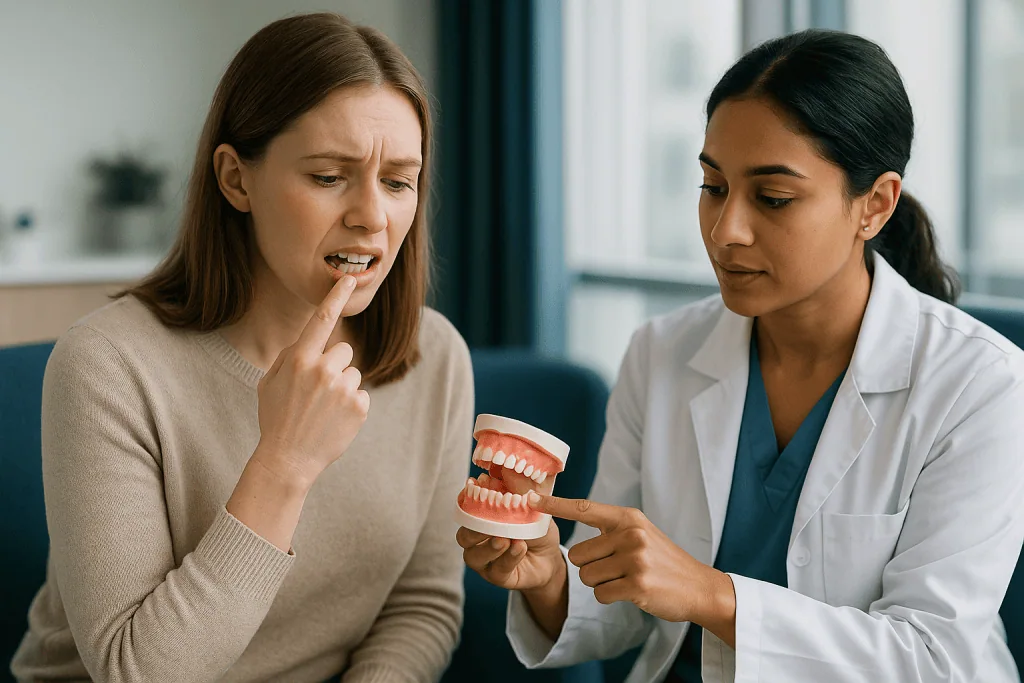
The first is genuine size. Tooth dimensions are inherited, and some people simply have shorter crowns, the part of the tooth above the gum. Wear also shortens teeth over years, especially in people who grind or clench, and shorter teeth mean the gum occupies a larger share of the smile even though it has not moved at all.
The second, and probably the more frequent explanation among healthy young adults, is altered passive eruption. In plain terms, the gum never finished retreating from the tooth after it came in. During the teenage years, after the adult teeth emerge, the gum margin normally drifts slowly toward the root until it settles just above the enamel border. When that process stalls, several millimeters of perfectly good enamel stay tucked beneath the gum, and the visible portion looks stubby. The teeth are full size; they are wearing a collar that is too high.
Distinguishing these matters because the treatments differ. A tooth that is truly short may be a candidate for restorative work to lengthen it, while a tooth hidden by gum can be uncovered by reshaping the tissue and, sometimes, the underlying bone. A dentist works this out by gently probing to find where the enamel ends, and often by taking an X-ray to see how far the bone sits from that border. The relationship between bone crest, enamel edge and gum margin dictates whether a soft-tissue-only procedure would be stable or whether bone also needs to be recontoured.
The reassuring part for people in this group is that their gums are typically healthy. The appearance is a developmental quirk, not a sign of disease or neglect, and it does not by itself put the teeth at risk.
Jaw position: vertical maxillary excess explained
The maxilla is the upper jaw, the bone that holds the upper teeth and forms part of the floor of the nose. In some people it grows a little longer from top to bottom than average. Clinicians call this vertical maxillary excess, and it is the one gummy smile cause rooted in the skeleton rather than in soft tissue or the teeth.
Because the whole tooth-bearing segment sits lower relative to the lip, both the teeth and the gum above them are displayed more than usual. A useful clue is what happens at rest. Most people show little or no tooth when their lips are relaxed and slightly parted. Someone with a vertically long maxilla may show a good deal of tooth, and sometimes gum, without smiling at all. The lower third of the face may look long, the lips may feel as though they need effort to close, and the chin can appear to sit back.
This pattern is developmental, present from adolescence once facial growth completes, and it is often mirrored elsewhere in the family. It does not arise from habits, though prolonged mouth breathing in childhood has been discussed as a possible contributor to vertical facial growth; the evidence there is observational and the direction of cause and effect is not settled.
Vertical maxillary excess is important to identify because treatments aimed at gum or lip alone will not shift the position of the bone. Orthodontists sometimes manage milder cases by moving the upper teeth upward within the bone using braces or aligners with anchorage devices. More pronounced cases are the territory of orthognathic surgery, corrective jaw surgery in which the maxilla is repositioned, planned jointly by an orthodontist and an oral and maxillofacial surgeon. That is a significant operation with its own recovery and risks, and it is generally reserved for people whose jaw relationship also affects bite, breathing or facial balance rather than smile appearance alone.
Lip movement: the hyperactive upper lip and the short lip
Watch a face go from neutral to a wide grin and the upper lip travels upward, pulled by a group of small muscles around the nose and cheeks. In most adults that lift is modest. In some it is dramatic, and the lip rises well past the gum line even though the teeth are normal length and the jaw sits where it should. That pattern is described as a hyperactive upper lip.
The muscles responsible, chiefly the ones that elevate the lip and flare the nostrils, are not diseased. They simply pull harder or attach in a way that produces more excursion. Clinicians estimate this by measuring how far the lip moves between rest and full smile; a large distance points toward the muscle as the main factor.
A short upper lip is a related but separate issue. Here the lip does not necessarily move more, it just starts closer to the teeth, so even an ordinary lift exposes gum. Lip length is measured from the base of the nose to the lip edge and, like tooth size, is largely inherited.
Both lip-related causes are recognizable because everything else checks out: the gums are healthy and firm, probing shows the enamel border where expected, the X-ray shows normal bone levels, and the teeth do not show excessively at rest. The gumminess appears only in motion.
Treatments in this group act on the lip rather than the teeth. One approach uses injections of botulinum toxin, a medicine that temporarily blocks the nerve signal telling a muscle to contract, to reduce how far the lip lifts. Mayo Clinic notes that the effect of botulinum toxin injections generally lasts about three to four months, after which treatment would be repeated if wanted. A surgical alternative, lip repositioning, shortens the inner lining of the lip so it cannot rise as high. Neither is appropriate if the real driver is jaw length or gum overgrowth, which is why the examination comes first.
How does a dentist work out which cause you have?
The assessment is unhurried and mostly hands-on. Expect a dentist or periodontist to spend as much time watching you talk and smile as looking inside your mouth.
The visit usually begins with history. When did you first notice the appearance? Did it change after a new prescription, a pregnancy, or a period of poor gum health? Does anyone in the family share the look? Have you ever had orthodontic treatment? Those answers narrow the field before any instrument is picked up.
Then come measurements. Tooth length is recorded, often on the two upper front teeth and the canines, and compared with typical adult proportions. A periodontal probe, a thin blunt instrument with millimeter markings, is slid gently along the gum edge to find where the enamel ends. If enamel continues well below the gum margin, altered passive eruption is likely. Probing also reveals pocket depth and bleeding, the standard signs of inflammation described by the NHS and Mayo Clinic.
Your clinician will ask you to relax the lips, then to smile fully, and will measure how much tooth shows in each position and how far the lip travels between them. A large travel distance with normal teeth points to the lip. Tooth showing at rest points toward the jaw. Photographs from the front and side are common, as is a look at overall facial proportions.
X-rays complete the picture. A small film of the front teeth shows where the bone crest sits relative to the enamel border, which decides whether reshaping gum alone would hold or whether bone must be adjusted too. For suspected jaw-length issues, a side-view skull X-ray called a cephalogram measures vertical facial dimensions.
Only after all of this does a conversation about options make sense. If you are offered a treatment before anyone has probed your gums or measured your lip movement, it is fair to ask what the diagnosis is and how it was reached.
Is a gummy smile a health problem or a cosmetic one?
For most people it is cosmetic. Showing gum does not weaken teeth, invite decay, or cause pain. Three of the four main causes, short teeth, jaw length and lip movement, involve tissue that is entirely healthy. If nothing about the appearance troubles you, there is no medical reason to treat it, and a clinician who suggests otherwise should be asked for the evidence.
The exception is gum overgrowth, and it is a meaningful one. Swollen gums are usually inflamed gums, and inflammation is the first stage of gum disease. MedlinePlus and the NHS both describe the progression: plaque irritates the gum (gingivitis), and if it is not controlled the inflammation can spread to the bone and ligament that anchor teeth (periodontitis), which is a leading cause of tooth loss in adults. Enlarged gum tissue also traps plaque more easily, creating a loop in which swelling feeds further irritation.
Medicine-related enlargement carries a similar caution. The tissue itself is not dangerous, but it can make brushing and flossing awkward, and the combination of bulky gum and retained plaque increases the risk of periodontal breakdown over time. It is a reason to keep up with professional cleanings, not a reason to change the medicine on your own.
There is one more health angle worth stating plainly, because it is often skipped. Feeling unable to smile freely has consequences. People who cover their mouths, avoid photographs, or rehearse a closed-lip expression are carrying a low-level social burden every day. That is not vanity; it is a quality-of-life issue, and it is legitimate to raise with a dentist even when the tissue is perfectly healthy. The response should be an honest explanation of what the cause is and what could realistically change, not a hard sell and not a dismissal.
How rare is a gummy smile, and why do some girls and women seem to have one more often?
Neither question has a crisp answer, and it is better to say so than to quote a number that sounds precise.
There is no large population survey, of the kind run for gum disease or tooth decay, that counts how many adults show more than a few millimeters of gum when they smile. The figures that circulate online come from small studies of dental students, orthodontic patients, or volunteers photographed in a single clinic, and they vary widely depending on where the researchers drew the line. What can be said with confidence is that excessive gingival display is common enough that every general dentist sees it regularly, and rare enough that it stands out in a group photograph. Calling it “rare” overstates it; calling it “normal variation” is closer to the truth.
On sex differences, several small studies have reported that women, on average, show slightly more gum when smiling than men, and that the difference is most visible in young adulthood. Two mechanisms are usually proposed. Women tend to have shorter upper lips on average, and lip length is one of the four causes discussed here. Women may also, on average, smile more broadly in social settings, which lifts the lip further. Neither explanation has been tested rigorously in a large mixed population, so this remains a reasonable hypothesis rather than an established fact.
It is worth being careful with the framing. Noticing that a trait appears more often in one group is not the same as saying it needs correcting in that group. Much of the online discussion of gummy smiles in women reflects beauty standards rather than dental science, and the standards shift. The clinical questions are the same for everyone: are the gums healthy, which mechanism is at work, and does the person themselves want anything to change?
Does a gummy smile go away with age?
Often it lessens, and sometimes it disappears, but the reason depends on the cause, and for one group it can go the other way.
The upper lip changes across adulthood. Its supporting tissue thins and the lip itself tends to lengthen and drop, so the same smile shows less tooth and less gum at fifty than it did at twenty. This is why many older adults show mostly lower teeth when they smile, the reverse of the youthful pattern. For someone whose gummy smile comes from a short or highly mobile lip, the passing decades often bring a natural reduction without any treatment. Dentists sometimes mention this to younger people weighing an irreversible procedure, not to dissuade them, but so the decision includes the fact that the appearance may soften on its own.
Altered passive eruption behaves differently. Because the gum never completed its retreat, it usually does not do so later either. The look tends to be stable rather than improving, although the general lengthening of the lip may still make it less noticeable in middle age.
Jaw length is fixed once growth is complete, typically in the late teens. It does not shorten with age. The soft tissue around it changes, which can make the display less obvious, but the skeletal relationship is what it is.
Gum overgrowth is the wild card. If it stems from a long-term medicine, it can persist or slowly increase for as long as the prescription continues, and it worsens when plaque control slips. Inflammatory swelling from gingivitis waxes and wanes with gum health. So for this group, age alone is not a reliable ally; oral hygiene and regular professional care are what shift the picture.
The honest summary: waiting is a genuine option for lip-driven cases, a neutral one for tooth-driven cases, and not a strategy at all for overgrowth.
How do I get rid of my gummy smile? Gummy smile treatment options matched to cause
There is no single procedure for a gummy smile, because there is no single cause. Each option below acts on one mechanism, which is why the diagnostic visit described earlier carries so much weight. The choice, and whether to treat at all, rests with you and the treating team.
For inflammatory gum overgrowth, the first step is almost always non-surgical: professional cleaning to remove plaque and hardened deposits, followed by a period of improved home care to let the swelling subside. Mayo Clinic describes this as the standard approach to gingivitis, and the gum often shrinks back toward its normal contour once irritation is removed. Overgrowth that persists after inflammation is controlled, including medicine-related or hereditary enlargement, may be trimmed surgically in a gingivectomy, the removal of excess gum tissue.
For teeth hidden by gum, crown lengthening is the usual procedure. A periodontist reshapes the gum and, when the bone crest sits too close to the enamel border, recontours a small amount of bone so the new gum position will be stable. The teeth themselves are not altered. Where teeth are genuinely short or worn, restorative dentistry such as bonding or veneers may be discussed to add length, sometimes combined with gum reshaping.
For a lip that lifts too far, botulinum toxin injections temporarily weaken the elevator muscles so the lip rises less; the effect wears off over roughly three to four months according to Mayo Clinic, so it is a maintenance approach rather than a one-time fix. Lip repositioning surgery offers a longer-lasting alternative by limiting how far the lip can travel.
For a vertically long upper jaw, orthodontic movement of the teeth upward can help in milder cases. Larger discrepancies are addressed with orthognathic surgery, which repositions the maxilla itself. This is major surgery, planned over many months with braces before and after, and is typically considered only when function is also affected.
Combining approaches is common when more than one cause is present.
Who is usually offered treatment, and who is usually asked to wait
Suitability is less about age or how much gum shows and more about three questions: is the mouth healthy, has growth finished, and is the person’s goal something the identified mechanism can actually deliver?
Adults with stable gum health and a clear single cause are the most straightforward candidates. Someone with altered passive eruption and firm, pink gums is the classic person offered crown lengthening. Someone with a hyperactive lip, normal teeth and no jaw discrepancy is the classic candidate for lip-directed options.
Several groups are commonly asked to wait or to address something else first.
- People with active gingivitis or periodontitis. Cosmetic reshaping of inflamed tissue is unpredictable, and the NHS and Mayo Clinic both emphasize controlling gum disease as the priority in its own right. Treatment for appearance is revisited once the gums are stable.
- Teenagers whose facial growth is not complete. Gum position, lip length and jaw dimensions all shift during adolescence. Orthodontists usually prefer to see growth finish before irreversible steps, because a problem visible at fourteen may look different at nineteen.
- People taking a medicine linked to gum enlargement. Surgical trimming can be done, but the tissue may regrow while the medicine continues, so the dental team and prescriber often talk first about whether the treatment plan should account for that.
- Smokers and people with poorly controlled diabetes. Both slow gum healing and raise the risk of complications after periodontal surgery, and clinicians may ask for changes before proceeding.
- Anyone whose expectation does not match the mechanism. A person hoping a gum procedure will change a long lower face has a jaw-position issue, and honest counseling comes before any consent form.
Being asked to wait is not a refusal. It usually means the team wants a result that lasts, and that the safest sequence starts somewhere other than the cosmetic step.
What the following days and weeks usually look like
Recovery depends entirely on which path was taken, so the honest answer is a set of sketches rather than a single timeline. Your own team will give you ranges specific to your procedure; the notes below describe what people commonly report.
After a professional cleaning for inflamed gums, the tissue is often tender for a day or two and may bleed slightly when brushed. Swelling begins to reduce as plaque is kept away, and the gum contour continues to change over subsequent weeks as inflammation settles. This is the gentlest path and the one with the least disruption.
After a gingivectomy or crown lengthening, expect soreness, some swelling and minor oozing in the first days. Dentists typically advise soft foods, careful cleaning around the surgical site, and avoiding vigorous rinsing early on. The gum margin looks raw at first and gradually takes on its final shape as it heals; periodontists often ask patients to wait several weeks before judging the result, and longer before any planned restorative work on the same teeth, because the tissue keeps maturing. Sensitivity to cold on newly exposed tooth surfaces is common and usually eases.
After botulinum toxin injections, most people return to normal activities the same day. The muscle effect comes on gradually rather than immediately, and Mayo Clinic notes that results are temporary, typically lasting about three to four months before the muscle regains its full pull. Temporary asymmetry of the smile, drooping of the lip, or difficulty with certain lip movements are recognized possibilities that fade as the medicine wears off.
After lip repositioning surgery, swelling and tightness of the upper lip are expected for a week or more, with dissolving stitches inside the lip and a period of restricted wide smiling while the tissue knits.
Orthognathic surgery is in a different category, involving hospital stay, a soft or liquid diet for weeks, facial swelling that resolves over months, and ongoing orthodontics. The surgical team walks through this in detail during planning.
What people often get wrong about gummy smile causes
Because the topic sits at the crossroads of dentistry and beauty, it collects myths. A few deserve a direct correction.
“It means I don’t brush well enough.” Only one of the four causes involves gum health, and even then the overgrowth may stem from a medicine or an inherited condition rather than hygiene. Short teeth, jaw length and lip movement are developmental. Many people with gummy smiles have immaculate gums.
“One treatment fixes any gummy smile.” Websites often present a single procedure as “the” answer. A lip-directed treatment will not uncover teeth buried under gum, and reshaping gum will not change a long upper jaw. Matching the option to the mechanism is the entire skill.
“Injections are a permanent solution.” Botulinum toxin temporarily blocks the nerve signal to muscle. Mayo Clinic states the effect generally lasts around three to four months. It can be repeated, but it is maintenance, not a one-time change.
“Gum reshaping makes the gums grow back thicker.” Healthy gum trimmed to a stable position, with bone recontoured where needed, generally stays where it is placed. Regrowth is mainly a concern when the original cause, such as a medicine or inflammation, is still active.
“Braces cause a gummy smile.” Orthodontic treatment can, in some cases, extrude front teeth and bring gum down with them, but it is also a tool for correcting excessive display by moving teeth upward. The effect depends on the plan, not on braces as such.
“Children with gummy smiles will grow out of it.” Sometimes. Lip length increases and the gum margin usually retreats during adolescence, so a gummy smile at eight often looks different at eighteen. It is not guaranteed, which is why orthodontists watch rather than treat early in most cases.
“Showing gum is a flaw.” It is variation. Plenty of widely admired faces show gum when they smile. Treatment is for people who want it, not people who are told they need it.
Questions to ask your care team
A good consultation leaves you able to explain your own diagnosis in one sentence. If you cannot, the conversation is not finished. These prompts help.
- Which of the four mechanisms, gum tissue, tooth length, jaw position or lip movement, is driving my smile, and how did you determine that?
- Did you probe to find the enamel border, and where does my bone crest sit relative to it?
- How much do my teeth show at rest, and how far does my upper lip travel when I smile?
- Are my gums currently healthy? If not, what needs to happen before any cosmetic step?
- Could any of my medicines be contributing to gum enlargement, and should my prescriber be part of this conversation?
- If I did nothing, how would you expect this to change over the next ten or twenty years?
- What is the least invasive option for my mechanism, and what does it not address?
- Is this procedure reversible? If not, what happens if I am unhappy with the result?
- What are the recognized complications, how often do they occur in the published literature, and how would they be managed?
- How many weeks or months before the final appearance can be judged?
- Will I need further treatment later, such as repeat injections or restorative work on the same teeth?
- Who else should be involved: a periodontist, orthodontist, or oral and maxillofacial surgeon?
Notice that none of these ask the clinician to promise a result. Photographs of previous patients can be informative, but they show other people’s mouths. The measurements from your own examination are what predict what can change for you, and a team that can walk you through those numbers is one that understands the problem.
When to call your doctor or dentist
A gummy smile on its own is not urgent. Certain changes around it are, because they point to inflammation, infection or a systemic cause rather than facial structure.
Arrange a routine appointment if your gums have become noticeably larger over weeks or months, especially after starting a new medicine, if they bleed regularly when you brush or floss, or if they look red, shiny or puffy rather than pale pink and firm. The NHS and MedlinePlus list bleeding, swelling and redness as the early signs of gum disease, and early assessment is when it is most manageable. Do not change or stop any prescription on your own; raise it with the prescriber.
Contact your dentist promptly, within a day or so, for:
- a lump or swelling on the gum that is growing quickly, painful, or discharging pus;
- gum tissue that bleeds heavily or spontaneously without brushing;
- teeth that feel loose or have shifted position;
- persistent bad taste or odor along with swollen gums;
- after any gum, lip or jaw procedure: bleeding that does not stop with gentle pressure, swelling that keeps increasing after the first few days, fever, or pain that worsens rather than eases.
Seek urgent or emergency care if facial swelling spreads toward the eye or neck, if you have difficulty swallowing or breathing, or if you develop a high fever with a swollen face. These can indicate a spreading infection that needs treatment the same day.
Following botulinum toxin injections, Mayo Clinic advises contacting your provider if you notice muscle weakness, vision changes, trouble speaking or swallowing, or breathing difficulty, even though these are uncommon.
Every judgment about whether a gummy smile warrants treatment, and which treatment, belongs with you and the clinicians who have examined your mouth.
Frequently asked questions
How do I get rid of my gummy smile?
The route depends on the cause, so an examination comes first. Inflamed, swollen gums usually respond to professional cleaning and better home care. Teeth hidden under excess gum can be uncovered with crown lengthening. A lip that lifts too far can be treated with muscle-relaxing injections or lip repositioning surgery. A vertically long upper jaw is addressed orthodontically or, in larger cases, with jaw surgery. Your dental team matches the option to the mechanism.
Does a gummy smile go away with age?
It often becomes less noticeable, mainly because the upper lip lengthens and drops across adulthood, so less tooth and gum show during a smile. That helps most when the cause is a short or highly mobile lip. Gum that never fully retreated from the teeth tends to stay put, jaw length does not change after growth ends, and medicine-related gum enlargement can persist while the medicine continues.
Why do some girls and women have gummy smiles more often?
Small studies have reported that women on average show slightly more gum when smiling than men, most visibly in young adulthood. The usual explanations are a shorter average upper lip and a tendency to smile more broadly. These findings come from limited samples rather than large population studies, so the difference is plausible but not firmly established, and it does not mean the trait needs correcting.
How rare is a gummy smile?
No large population survey has counted it, so any precise percentage should be treated cautiously. Estimates online come from small groups such as dental students or orthodontic patients and vary depending on how many millimeters of gum the researchers counted as excessive. It is common enough that general dentists see it regularly and is best described as a normal variation in facial proportions rather than a rare condition.
What is excessive gingival display in plain terms?
It is the clinical name for a gummy smile: more gum tissue visible above the upper teeth during a full smile than is typical. It is a description of appearance rather than a disease. Dentists measure it in millimeters between the edge of the upper lip and the necks of the teeth, and then look for which of four mechanisms is responsible before discussing whether anything should be done.
Can medicines cause my gums to grow over my teeth?
Yes. Certain calcium channel blockers used for blood pressure, some anticonvulsants, and some immunosuppressants are known to cause gingival enlargement in some people, particularly when plaque is also present. The gum becomes bulkier and covers more of the tooth. If you notice this after starting a prescription, tell both your dentist and the prescribing clinician. Never stop or adjust a medicine on your own because of a gum change.
What is a hyperactive upper lip and how is it diagnosed?
A hyperactive upper lip is one that rises unusually far when you smile because the small elevator muscles around the nose and cheeks pull it higher than average. Dentists diagnose it by measuring how far the lip travels between a relaxed position and a full smile, and by confirming that tooth length, gum health and jaw position are all within normal limits. The gumminess appears only in motion.
Is crown lengthening the same as gum contouring?
They overlap. Gum contouring or gingivectomy reshapes soft tissue only. Crown lengthening may include the same soft-tissue reshaping but also recontours a small amount of underlying bone when the bone crest sits too close to the enamel border, so the new gum position stays stable. An X-ray and probing tell the periodontist which is appropriate. The teeth themselves are not cut or altered in either procedure.
Will my gummy smile treatment options change if my gums are inflamed?
Usually the order changes. Most clinicians treat active gingivitis or periodontitis before any cosmetic procedure, because inflamed tissue heals unpredictably and swelling can itself be part of the gummy appearance. Once gums are stable, the remaining display is measured again; sometimes it is smaller than expected and the plan is adjusted. Controlling gum disease is also worthwhile for tooth health regardless of appearance.
Can children or teenagers be treated for a gummy smile?
Most dental teams prefer to watch and wait. Lip length, gum position and jaw dimensions all change through adolescence, and a gummy smile in childhood often looks different once growth finishes in the late teens. Orthodontists may plan tooth movement during these years if the bite also needs correction, but irreversible gum or lip procedures are generally deferred until growth is complete and the picture is stable.
References
- NHS: Gum disease
- MedlinePlus: Gum Disease
- NIH National Institute of Dental and Craniofacial Research: Periodontal (Gum) Disease
This article is for general information only and is not a substitute for professional medical advice. Please consult a qualified doctor about your individual situation.

More from the Blog
Dental Fillings During Pregnancy: Timing, X-Ray Shielding and Anesthesia Considerations
Dental fillings during pregnancy are generally considered safe and are often recommended rather than delayed, because untreated decay can progress to pain or infection.…

Can You Drink Coffee With Clear Aligners In? Eating, Drinking and the Water-Only Rule
Most orthodontic teams advise drinking only plain water while clear aligners are in. Coffee, tea and other drinks can stain the plastic, hot liquids…

Composite Bonding Aftercare: Coffee, Tea and Habits That Keep the Resin Looking Even
Composite bonding aftercare centers on protecting a resin surface that is softer and more porous than natural enamel. Most dentists advise avoiding coffee, tea,…

How Sore Are Metal Braces in the First Days, and How Is Discomfort Eased?
Metal braces soreness is usually a dull ache and tenderness when biting, beginning a few hours after fitting, peaking around days two and three,…
What Laser Assisted Dental Procedures Can and Cannot Do: Realistic Results by Treatment Type
Laser dental treatment results depend on the procedure. For soft-tissue work such as gum reshaping, tongue-tie release and small biopsies, lasers cut precisely with…

Gum Graft vs Bonding for Gum Recession: Covering the Root or Protecting It
A gum graft and dental bonding address gum recession differently. A graft moves or places soft tissue to cover the exposed root and rebuild…