

What Do Continuous Glucose Monitors and Insulin Pumps Change in Type 1 Diabetes Care?

Key Takeaways
- A CGM measures glucose in the fluid under the skin, not in blood, so readings can trail a fingerstick by several minutes when glucose is changing fast.
- An insulin pump uses only rapid-acting insulin, which is why a blocked infusion set can lead toward ketoacidosis within hours rather than days.
- International consensus targets for most adults with type 1 diabetes are more than 70 percent of CGM readings in range and less than 4 percent below range.
- Trials consistently show that linking a CGM and pump into an automated system produces its largest and most reliable gains overnight.
- A CGM paired with injections is a complete and widely used treatment pathway; a pump is not required to benefit from continuous monitoring.
- Lying on a sensor during sleep can produce a falsely low reading, known as a compression low, that resolves once pressure is removed.
Continuous glucose monitors and insulin pumps change type 1 diabetes care mainly by replacing guesswork with trend data and replacing manual injections with programmable, often automated, insulin delivery. A CGM shows glucose every few minutes; a pump delivers rapid-acting insulin continuously. Linked as an automated insulin delivery system, they can adjust insulin between meals and overnight. They do not remove the need for carbohydrate counting, device care or clinical supervision.
Somewhere tonight a parent is standing in a child’s doorway holding a glucose meter and a lancet, weighing whether to wake her. Across town, an adult with type 1 diabetes is doing quiet arithmetic over a restaurant menu while the conversation moves on without him. The question of a CGM and insulin pump in type 1 diabetes care rarely begins in a clinic. It begins in moments like these, when the mental load of a disease that never clocks off becomes the thing people most want to change.
The technology has moved quickly, and so has the noise around it. Device adverts promise freedom; online forums trade horror stories about alarms at 3 a.m. and adhesive rashes. Both are partly true, which is exactly why a calm look at the evidence matters.
This explainer sets out what each device actually does, what changes when they are linked, who is usually offered them, and what the first weeks tend to feel like. It stays honest about the trade-offs, because a device you resent wearing is a device that stops helping.
How does a continuous glucose monitor actually work?
A continuous glucose monitor, or CGM, is a small sensor worn on the skin, usually the upper arm or abdomen, with a fine flexible filament sitting just beneath the surface. It does not measure blood. It measures glucose in interstitial fluid, the thin layer of fluid that bathes the cells under the skin. A transmitter sends that reading to a phone or a dedicated receiver every few minutes, so instead of a handful of isolated fingerstick numbers a person sees a continuous line, with arrows showing whether glucose is rising, falling or steady.
That difference in what is measured explains the most common confusion. Glucose moves from the bloodstream into interstitial fluid with a short delay, so a CGM reading can trail a fingerstick by several minutes, most noticeably when glucose is changing fast after food or exercise. The NIH’s National Institute of Diabetes and Digestive and Kidney Diseases notes that this lag is expected and that a fingerstick check is still advised when symptoms do not match the number or before treating a suspected low.
Sensors are worn for a fixed period, typically in the range of one to two weeks depending on the device, then replaced. Most systems can sound an alert when glucose crosses a threshold set with the care team, and some can warn that a low is predicted before it arrives. The NHS distinguishes real-time CGM, which streams readings automatically, from flash monitoring, where the user scans the sensor to see the data; the clinical idea is the same, the behaviour it asks of the wearer is slightly different.
The reports matter as much as the live number. Data collected over days and weeks builds a pattern a clinician can read: the dawn rise, the post-lunch spike, the overnight drift. Those patterns, not any single reading, are what drive changes to treatment.
How does an insulin pump work, and what is it doing under the skin?
An insulin pump is a pocket-sized device that holds a reservoir of rapid-acting insulin and pushes tiny amounts of it through a cannula, a short soft tube placed under the skin, around the clock. Some pumps connect to the cannula through thin tubing; patch pumps sit directly on the skin with no tubing at all. The cannula and its adhesive, together called the infusion set, are changed every few days, with placement sites rotated to protect the skin.
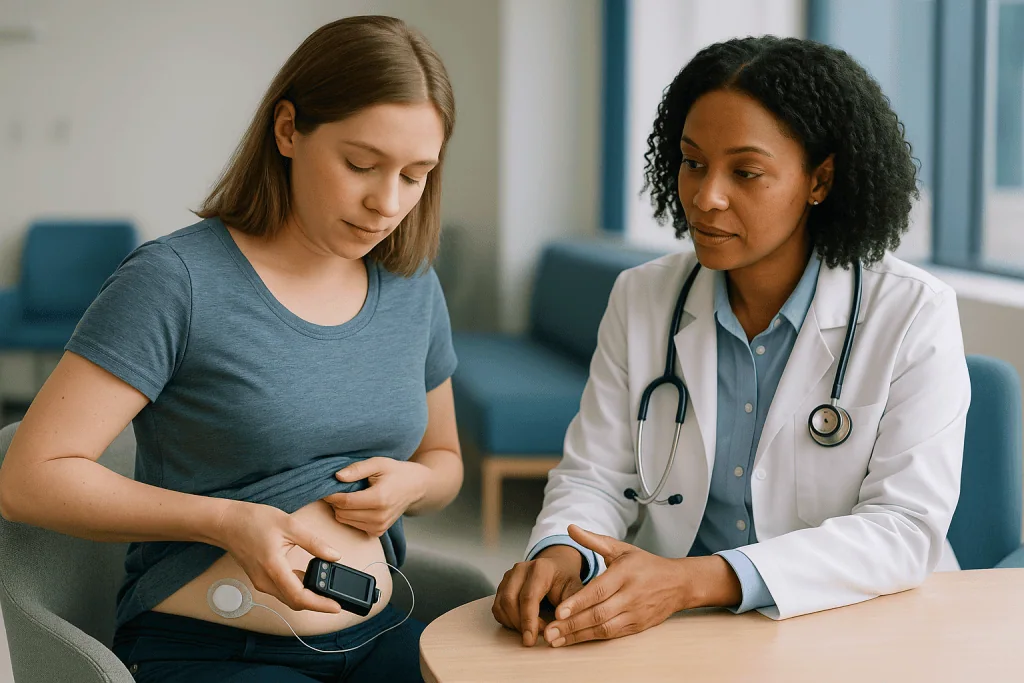
The pump replaces two kinds of insulin dosing that people on injections manage separately. The first is basal insulin, the steady background supply that keeps glucose stable between meals and overnight; on injections this comes from a long-acting insulin, while a pump delivers it as a continuous trickle of rapid-acting insulin that can be programmed to vary hour by hour. The second is bolus insulin, the larger amount taken for food or to correct a high, which the user requests through the pump’s buttons or app, usually after entering carbohydrates and letting the device calculate using settings the care team has programmed.
This design has one consequence worth stating plainly. Because there is no long-acting insulin in the body, any interruption to delivery, from a kinked cannula to a leaking reservoir, can lead to rising glucose and ketones within hours rather than days. Pump users are taught to treat an unexplained high as a possible set failure first. The CDC describes diabetic ketoacidosis, a dangerous build-up of acids in the blood when the body runs short of insulin, as a medical emergency.
Everything the pump does, it does according to settings decided by the prescribing clinician: basal patterns, carbohydrate ratios, correction factors and how long insulin is assumed to stay active. The pump makes delivery more precise and more flexible. It does not make those decisions by itself.
What do a CGM and insulin pump change in type 1 diabetes when they work together?
On their own, each device solves half a problem. The CGM shows what glucose is doing; the pump changes what insulin is doing. Connect them with software and you get automated insulin delivery, often called a hybrid closed loop: the CGM feeds a reading to an algorithm every few minutes, and the algorithm adjusts the pump’s background insulin up or down, pauses it when a low is predicted, and in many systems adds small automatic corrections when glucose runs high.
The word hybrid is doing real work. Current systems still need the wearer to announce meals and, in most cases, to enter carbohydrates, because food raises glucose faster than any algorithm can safely chase it. Exercise, illness and stress also need human input. What the automation does well is the unglamorous background task: the quiet overnight hours and the long stretches between meals where small, frequent adjustments add up.
That is where the evidence is strongest. Randomized trials indexed in the NIH’s PubMed library consistently show that automated systems increase the proportion of the day spent in the target glucose range compared with the same devices used without a connecting algorithm, with the largest and most reliable gains overnight and with fewer low-glucose episodes. The Mayo Clinic describes these systems as a standard option in type 1 care rather than an experimental one.
What changes for the person wearing it is less about any single number and more about texture. Fewer middle-of-the-night alarms. Waking closer to range. Less time spent correcting yesterday’s miscalculation. Clinicians sometimes describe it as removing the night shift from a 24-hour job.
The limits are equally real. Sensors can fail or read inaccurately, infusion sets can block, and a well-designed algorithm working from a bad reading will make a confidently wrong decision. Automation reduces the burden; it does not remove responsibility.
What is time in range, and why has it joined HbA1c as a measure of control?
For decades, type 1 diabetes care was judged almost entirely by HbA1c, a blood test that reflects average glucose over the previous two to three months. It remains the measure most strongly linked to long-term complications, and it is not going anywhere. The trouble is that an average hides the extremes. Two people can share an identical HbA1c while one spends the day in a gentle band and the other swings between severe lows and steep highs.
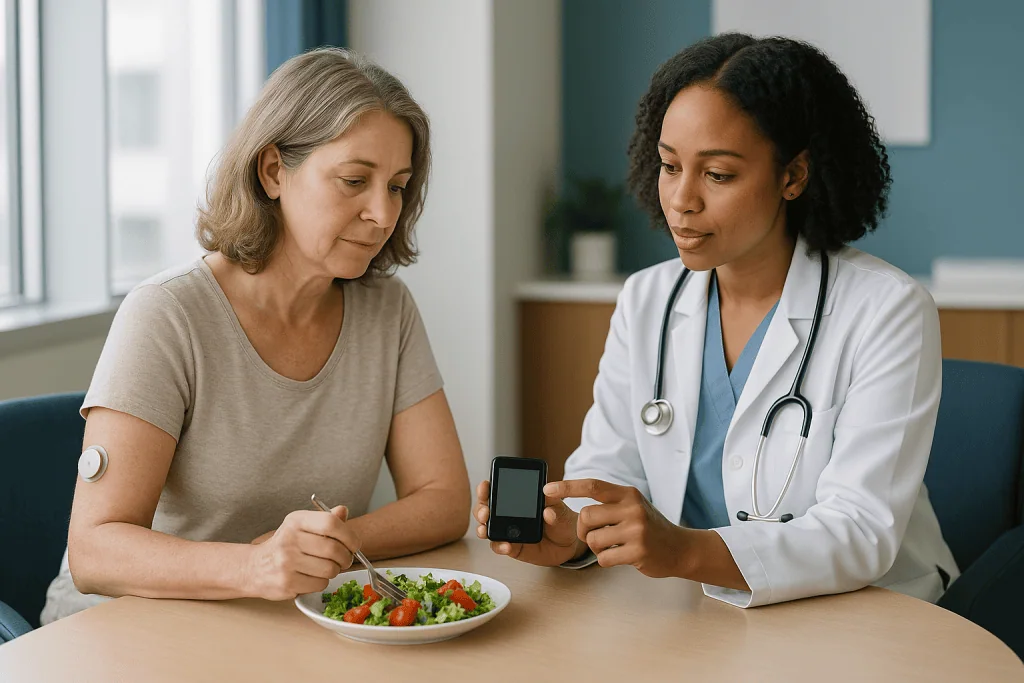
CGM data made a second measure possible: time in range, the percentage of readings that fall within the target glucose band agreed with the care team. An international consensus published in the journal Diabetes Care, and indexed on PubMed, set goals for most adults with type 1 diabetes of more than 70 percent of readings in range, less than 4 percent below range, less than 1 percent very low, less than 25 percent above range and less than 5 percent very high. The same group recommended looser targets for older or frailer adults and tighter ones in pregnancy.
These numbers reframe the goal. Instead of asking only whether the average is acceptable, the clinician can ask where the problems are. A high time below range overnight points to background insulin that is too strong; a cluster of highs after breakfast points elsewhere. The standard CGM report, called an ambulatory glucose profile, lays this out as a single page, with a shaded band showing a typical day.
The consensus also stressed that targets are individual. For a child who fears lows, a person with hypoglycemia unawareness, or someone living alone, accepting slightly more time above range in exchange for fewer lows can be the safer plan. The right target is the one the treating team sets with the person in front of them.
Insulin pump vs injections for type 1: what does the evidence actually show?
People often expect a pump alone to transform their numbers. The evidence is more nuanced. Multiple daily injections, or MDI, means a long-acting insulin once or twice a day plus rapid-acting insulin at meals. Compared head to head with a pump, and with both groups using the same glucose monitoring, trials have generally shown only modest differences in HbA1c, with the pump’s clearest advantages being flexibility of background insulin and fewer severe lows in some groups.
The gap widens when monitoring is added. A CGM on its own, paired with injections, improves time in range for most people who wear it consistently, which is why national guidance in several countries now treats real-time or flash monitoring as a baseline offer for everyone with type 1 diabetes, independent of whether they use a pump. Add a pump and link the two with an algorithm, and the improvement becomes larger again, especially overnight.
So the honest ranking is not pump versus injections. It is: injections with fingersticks, then injections with CGM, then pump with CGM, then automated insulin delivery, with each step typically adding benefit and each step adding something to wear, charge, replace and troubleshoot.
The Mayo Clinic frames the choice as individual rather than hierarchical. Some people on injections with a CGM achieve excellent, stable control and prefer the simplicity of having nothing attached between meals. Others find the hour-by-hour adjustability of a pump essential for shift work, intense sport or unpredictable days. Children and their caregivers often value automation most for the overnight hours.
A reasonable summary of the research: monitoring drives the largest single gain, automation drives the next, and the pump on its own is a tool whose value depends almost entirely on how it is used and who supports it.
Who is a CGM and insulin pump for type 1 usually offered to, and who is asked to wait?
Guidance has shifted toward offering continuous monitoring to essentially everyone with type 1 diabetes, from toddlers to older adults, because the burden of fingersticks and the risk of unrecognized lows apply at every age. The NHS lists CGM or flash monitoring as something people with type 1 should be able to access as part of routine care. Pumps and automated systems are usually considered next, with particular attention to certain situations.
Teams tend to prioritize automation for people with recurrent severe hypoglycemia or impaired awareness of lows; those whose HbA1c stays above target despite real effort on injections; children, where overnight control is hard to manage by hand; people planning or in pregnancy, when targets tighten sharply; and anyone whose life makes a fixed injection schedule impractical.
Who is asked to wait, or to think carefully first? Usually not people with the so-called wrong kind of diabetes, since pumps are not reserved for difficult cases. More often it is a question of readiness. Devices demand daily attention: changing sets on schedule, responding to alarms, keeping backup supplies and knowing what to do when the technology fails. Someone in the middle of a crisis, newly diagnosed and still learning the basics of carbohydrate counting, or unwilling to wear a sensor consistently may be advised to build those foundations first. Severe skin conditions at the usual wear sites, or a history of adhesive allergy, can also shape the choice of device.
None of this is a judgement about character. It is an attempt to match a tool to a life. Teams typically offer structured education before a start, sometimes including a trial period, and the decision to proceed, to pause or to choose a different route always sits with the treating clinicians and the person they are treating.
Fingersticks, CGM, pump or automated system: a side-by-side comparison
The table below sets out the four common ways people with type 1 diabetes monitor glucose and deliver insulin, and what each leaves on the wearer’s shoulders.
| Approach | How glucose is known | How insulin is delivered | What you still do yourself | Main trade-off |
|---|---|---|---|---|
| Fingersticks plus injections | Several blood checks a day | Long-acting plus mealtime injections | Everything: timing, counting, correcting, overnight checks | No devices to wear; no warning between checks |
| CGM plus injections | Reading every few minutes with alerts | Long-acting plus mealtime injections | All dosing decisions, now with trend data | Big gain in information, same dosing effort |
| Pump without CGM | Fingersticks | Continuous rapid-acting insulin, user-requested boluses | Checks, carb entry, set changes, troubleshooting | Flexible delivery, limited visibility |
| Automated insulin delivery | CGM feeding an algorithm | Pump adjusts background insulin automatically | Meal announcements, set and sensor changes, failure plans | Most automation, most equipment |
Read across the rows and a pattern emerges: each step down the table hands a task to a machine while adding a device to maintain. The person whose biggest problem is not knowing what glucose is doing between checks gets the most from a CGM. The person who knows exactly what is happening but cannot keep up with hour-by-hour adjustments gets the most from automation.
It is also worth noticing what does not change in any row. Carbohydrates still need estimating. Sick days still need a plan. Insulin still needs to be in date and stored correctly. The equipment reshapes the work; it does not abolish it, and a care team’s job is to help someone choose the row that fits the work they can realistically sustain.
What do the first days and weeks on a CGM or pump usually look like?
Starting a CGM is usually the gentler transition. The first sensor goes on in clinic or at home with guidance, alerts are set deliberately wide to avoid a barrage of alarms, and the early task is simply to watch. Many people are startled by what they see: the breakfast spike they never caught with a fingerstick, the overnight dip they slept through. Clinicians often warn against reacting to every arrow in week one, because chasing the line tends to produce the swings people are trying to avoid.
A pump start is more structured. Education typically covers how to fill a reservoir, insert and rotate infusion sets, enter food, and, crucially, what to do when the pump cannot deliver. Some teams run a short period on saline before switching to insulin so the mechanics become routine without clinical risk. The initial settings are a clinician’s best estimate from the previous injection doses, and the Mayo Clinic notes they are refined over the following visits as real-world data arrives. Expect several conversations about adjustments in the early weeks rather than a single set-and-forget appointment.
With automated systems there is often a learning phase for the algorithm itself, during which it gathers data before taking fuller control. Users commonly describe a period of trusting the device less than they should, then more than they should, before settling somewhere sensible.
Skin is the unglamorous story of month one. Finding adhesives that hold through a shower yet come off without a rash, learning which sites give reliable readings, and rotating placements to protect tissue all take trial and error.
Through all of it, one habit matters most: keeping fingerstick supplies, ketone strips and a backup injection plan to hand, and knowing exactly who to call. The device is new; the disease is not.
Sleeping with an insulin pump, showering, swimming and exercise: how daily life changes
Yes, you sleep with an insulin pump on. Background insulin is needed through the night, so the pump stays attached, clipped to a waistband, tucked into a pocket sewn into sleepwear, or simply lying on the mattress on its tubing. Patch pumps have nothing to clip. Most people report that the tubing fear fades within a few nights; rolling onto a device is uncomfortable rather than dangerous, and sets are designed to withstand ordinary movement.
Sleep does produce one CGM quirk worth knowing. Lying directly on a sensor can squeeze the interstitial fluid around it and produce a falsely low reading, sometimes called a compression low. The number recovers once the pressure is off. If a nighttime alarm shows a sudden sharp drop with no obvious cause and symptoms do not fit, a fingerstick check before treating is the sensible move, which is exactly what NIH guidance on CGM recommends whenever symptoms and readings disagree.
Water is a design question, not a medical one. Sensors are generally built to be worn in the shower; pumps vary, with some water resistant and others meant to be disconnected briefly. Because the body has no long-acting insulin on board, disconnections are kept short and the care team will advise how long is reasonable for that individual.
Exercise is where the CGM earns its place. Trend arrows show a drop coming before it arrives, and automated systems can be told in advance that activity is planned so they ease off background insulin. Specific adjustments for sport are individual and are set with the clinician rather than copied from another person’s routine.
Travel needs a little planning: carrying double supplies, keeping insulin out of extreme heat, and following the device maker’s guidance on airport scanners. None of it is complicated. All of it is easier when thought about in advance.
Can you use a CGM without an insulin pump, or a pump without a CGM?
Both are possible, and both are common. A CGM pairs with injections perfectly well. The sensor streams data to a phone, the person dosing by pen uses the trends to time meals and corrections, and the reports give the clinic the same ambulatory glucose profile a pump user would have. For a large share of people with type 1 diabetes this is the arrangement that fits their life, and the NHS treats monitoring as a standalone offer rather than something tied to pump use. Connected insulin pens, which record the time and amount of each injection and display it alongside CGM data, have narrowed the information gap further.
A pump without a CGM also works, as it did for years before sensors became widespread. The user checks with fingersticks and enters the result for the pump’s bolus calculation. What is not possible is automation: the predictive low suspend and automatic adjustments that define an automated insulin delivery system depend on a sensor feeding the algorithm every few minutes. Switch the sensor off and the pump reverts to following its programmed settings exactly, with no response to the glucose it cannot see.
The practical answer to which combination suits whom depends on where the difficulty lies. Someone whose nights are stable but whose days are chaotic may gain most from a CGM alone. Someone with frequent overnight lows is the textbook candidate for linking the two. Someone with sensitive skin may find one device tolerable and two too many, at least to begin with.
Teams increasingly introduce the devices in stages, monitoring first, pump second, automation third, so that each new habit has time to settle before the next arrives. The pacing, like the choice, belongs to the person and their clinicians together.
What are the honest downsides: skin, alarms, ketones and device failure
Any explainer that lists only benefits is doing the reader a disservice, so here is the other column of the ledger.
Skin takes the first hit. Adhesive irritation, itching and occasional allergic reactions are among the most common reasons people stop wearing sensors or pumps. Repeated infusion set placement in the same area can cause lipohypertrophy, a rubbery thickening of fat under the skin that absorbs insulin unpredictably. Site rotation and barrier products help, but some skin simply does not cooperate.
Alarms are the second. A sensor that warns about every wobble becomes background noise, and alarm fatigue, the tendency to silence or ignore alerts, is a recognized problem. Some people also find that seeing a number every five minutes feeds anxiety rather than easing it. Thresholds and alert settings are adjustable and are worth discussing openly rather than enduring.
Ketones are the risk that matters most. Because a pump delivers only rapid-acting insulin, a blocked or dislodged set can tip the body toward diabetic ketoacidosis within hours. The CDC lists nausea, vomiting, abdominal pain, fruity-smelling breath, rapid breathing and confusion as warning signs that need urgent care. Every pump user needs ketone testing supplies and a written plan for switching to injections, agreed with the team before it is ever needed.
Then there is simple failure. Batteries die, transmitters drop signal, sensors occasionally read badly on day one or day fourteen, software updates arrive at inconvenient moments. The system is only as reliable as its weakest component and the person’s backup plan.
Finally, there is visibility and logistics: a device on the arm invites questions; supplies must be reordered on time; coverage and eligibility conversations can be tiring. None of these is a reason to avoid technology. All of them are reasons to go in clear-eyed.
What people often get wrong about a CGM and insulin pump
Myth: the pump is an artificial pancreas that handles everything. Even the most advanced hybrid closed loop still needs meals announced, sets changed, sensors replaced and sick days managed. The automation is powerful and partial.
Myth: a CGM means never pricking a finger again. Fingerstick checks remain advisable when symptoms do not match the reading, when a sensor is newly placed or near the end of its life, and before treating a suspected low that seems out of character. The frequency falls dramatically; it does not fall to zero.
Myth: a pump means eating whatever you like. A pump makes it easier to match insulin to food, including meals that digest slowly, but the carbohydrates still have to be estimated and the insulin still has to be requested.
Myth: pumps are for people whose diabetes is out of control. Guidance increasingly treats pumps and automation as mainstream options, not as a last resort or a mark of failure.
Myth: the CGM is wrong if it does not match the meter. The two measure different fluids with a built-in delay. Small differences, larger when glucose is changing quickly, are expected and do not mean the sensor is faulty.
Myth: there is one best insulin pump. Devices differ in tubing, size, waterproofing, algorithm behaviour and sensor compatibility. The best one is the one a particular person will wear consistently and whose features match their life, which is a conversation for the care team, not a ranking.
Myth: automation eliminates lows. It reduces them, especially overnight, and the consensus targets still allow a small percentage of time below range because zero is not realistic.
Myth: once settings are right, they stay right. Insulin needs shift with growth, weight, activity, illness and age. Reviewing data with the team is ongoing, not a one-time setup.
Questions to ask your care team before starting
Walking into a device appointment with questions written down tends to produce a better plan than hoping the right topics come up. These are the ones clinicians say they wish more people asked.
- Given my patterns, where is my glucose causing the most trouble: nights, mornings, after meals or around exercise? Which device addresses that first?
- Would you suggest starting with monitoring alone, or monitoring and a pump together? Why that order for me?
- What time in range target are we aiming for, and how will we review the reports and how often?
- Which sensor and pump combinations are compatible with each other, and does my choice of one restrict the other later?
- How will the initial pump settings be chosen from my current injection regimen, and how quickly will they be adjusted?
- What is my written plan if the pump fails, the set blocks or I run out of supplies? Which injectable insulin do I keep at home and when do I switch to it?
- When should I test for ketones, and at what ketone result do I call you or go to an emergency department?
- What alert thresholds should I start with, and what should I do if the alarms become overwhelming?
- How do I manage the devices during illness, intense exercise, swimming and travel?
- What should I do about skin irritation, and which sites are safest for me to rotate between?
- Who do I contact out of hours, and what counts as urgent?
- If I am planning pregnancy, how would targets and device settings change?
- What training is included, and is there a trial period before I commit?
Answers will be individual. The point of asking is not to second-guess the team but to leave the room understanding the plan well enough to follow it at 3 a.m. without anyone to consult.
When to call your doctor
Technology changes how quickly problems are noticed; it does not change which problems are dangerous. Keep this list where you can find it.
Seek emergency care immediately for signs of diabetic ketoacidosis: persistent vomiting, abdominal pain, deep or rapid breathing, fruity-smelling breath, severe drowsiness or confusion, especially alongside high glucose readings or moderate to high ketones on testing. The CDC classifies DKA as a medical emergency. Pump users should treat an unexplained high that does not fall after a correction as a possible infusion set failure and follow their written backup plan while seeking advice.
Also seek urgent help for a severe low that needed another person’s assistance, caused loss of consciousness or a seizure; for repeated lows that do not respond to the usual treatment; or for any episode of confusion or unusual behaviour that a companion notices.
Call your care team the same day if an infusion or sensor site becomes red, hot, swollen or painful, or is leaking pus, which can indicate infection; if glucose is running persistently out of range for more than a day or two with no obvious cause; if you have a vomiting illness and cannot keep fluids down; if a device has failed and you are unsure how to bridge with injections; or if sensor readings and fingersticks disagree repeatedly and widely.
Raise at the next appointment patterns of overnight lows, recurrent early-morning highs, growing anxiety about the data, alarm fatigue, skin reactions that keep returning, or any sense that the equipment is adding to the burden rather than lifting it. These are not failures; they are exactly the information a team needs to adjust the plan.
Whatever the devices show, judgement about treatment changes rests with the prescribing clinician. When in doubt, a phone call costs nothing and often prevents a hospital visit.
Frequently asked questions
How much does an automated insulin pump system cost per month?
This article does not give prices, because costs and coverage vary so widely by country, insurer and individual circumstances that any figure would mislead. The useful step is to ask the diabetes care team which devices they can prescribe and support, then ask the insurer or health service directly what is covered, what documentation is needed and how ongoing supplies such as sensors and infusion sets are provided.
Do you sleep with an insulin pump on?
Yes. Background insulin is needed overnight, so the pump stays attached while you sleep, clipped to clothing, in a pocket or resting on the bed on its tubing; patch pumps simply stay on the skin. Most people stop noticing it within a few nights. Automated systems do much of their best work overnight, adjusting background insulin while the wearer sleeps and pausing delivery when a low is predicted.
What is the best insulin pump for a type 1 diabetic?
There is no single best insulin pump. Devices differ in tubing versus patch design, size, water resistance, how their algorithms behave, which sensors they pair with and how much user input they require. The right choice depends on the wearer’s glucose patterns, skin, lifestyle and comfort with technology, and on what the care team can support and the health system provides. That decision is made together with the treating clinicians.
Can I use my insulin pump without a CGM?
Yes. A pump can be used with fingerstick checks, with the user entering each result for bolus calculations, as was standard before sensors became common. What is lost without a CGM is automation: predictive low suspend and automatic background adjustments only work when a sensor feeds glucose readings to the algorithm every few minutes. Without the sensor, the pump follows its programmed settings exactly.
What is the difference between real-time CGM and flash glucose monitoring?
Both use a sensor under the skin to measure glucose in interstitial fluid. Real-time CGM streams readings automatically to a phone or receiver and can sound alarms without any action from the wearer. Flash monitoring requires the user to scan the sensor to see the current reading and recent trend, though newer flash systems also offer alerts. The NHS describes both as options for people with type 1 diabetes.
Why does my CGM reading not match my fingerstick meter?
Because they measure glucose in different places. A fingerstick measures blood; a CGM measures interstitial fluid under the skin, which lags behind blood by several minutes. Differences are largest when glucose is rising or falling quickly, after meals or exercise. A small gap is expected. If the two disagree widely and repeatedly, or if symptoms do not fit the sensor reading, check with a fingerstick and tell the care team.
What is a compression low on a CGM?
A compression low is a falsely low reading that happens when pressure, most often from lying on the sensor during sleep, squeezes the interstitial fluid around the filament. The number drops sharply and then recovers once the pressure is relieved. If a nighttime alarm shows a sudden fall with no obvious reason and you feel well, confirm with a fingerstick before treating, as NIH guidance on CGM advises.
How does an insulin pump handle type 1 diabetes during illness?
Illness usually raises insulin needs, and a pump allows background delivery to be adjusted according to the sick-day plan agreed with the care team. The critical safety step is ketone testing, because vomiting and high glucose with ketones can signal diabetic ketoacidosis, which the CDC describes as an emergency. Pump users should also suspect a failed infusion set if glucose stays high, and follow their written backup plan while seeking advice.
Are CGMs and insulin pumps used in children with type 1 diabetes?
Yes, and increasingly from a young age. Continuous monitoring reduces fingersticks and lets caregivers see overnight glucose remotely, while automated insulin delivery is valued for managing the night hours that are hardest to control by hand. Pediatric teams tailor targets, alert settings and training to the child and family, and the choice of device and timing always rests with the treating clinicians.
Can you go through airport security with an insulin pump and CGM?
People travel with these devices every day. Manufacturers publish specific guidance on which scanners their sensors and pumps can pass through and when to request a hand check instead, and following that guidance is the safest course. Carrying a clinician’s letter, keeping insulin and supplies in hand luggage with protection from heat, and packing roughly double what the trip requires are the standard precautions.
References
- Continuous Glucose Monitoring, National Institute of Diabetes and Digestive and Kidney Diseases (NIH)
- Insulin, Medicines, and Other Diabetes Treatments, National Institute of Diabetes and Digestive and Kidney Diseases (NIH)
- Diabetic Ketoacidosis, Centers for Disease Control and Prevention
This article is for general information only and is not a substitute for professional medical advice. Please consult a qualified doctor about your individual situation.

More from the Blog
Why Does Your Endocrinologist Want to Know Early About Pregnancy Plans With Hashimoto?
Your endocrinologist asks about pregnancy plans early because a developing baby depends entirely on the mother's thyroid hormone until roughly week 12, and the…

When Does Medication Come Before or After Acromegaly Surgery? How the Sequence Is Decided
In acromegaly, surgery to remove the pituitary tumor is usually the first treatment, and medication typically follows only if growth hormone remains high afterward.…
Reading Your Thyroid Treatment Plan: Questions to Ask Before Choosing Medication or Surgery
Before choosing thyroid medication or surgery, ask your doctor what your exact diagnosis is, what each option does to the gland, how long results…

How Type 1 Diabetes Care Is Planned From Diagnosis: Monitoring, Education and Follow-Up
A type 1 diabetes care plan is a written, individualized agreement between the person and their diabetes team covering four pillars: insulin replacement, glucose…

Watchful Waiting, Medication or Surgery for a Pituitary Tumor: How Do Specialists Decide?
Specialists choose between watchful waiting, medication and surgery for a pituitary tumor by weighing three things: whether the tumor secretes excess hormone, how large…

Transsphenoidal Surgery for Acromegaly: How the Adenoma Is Removed Through the Nose
Acromegaly is usually treated first by removing the growth hormone-producing pituitary adenoma through the nose, a procedure called transsphenoidal surgery. Working through a nostril…