

Transsphenoidal Surgery for Acromegaly: How the Adenoma Is Removed Through the Nose

Key Takeaways
- Transsphenoidal surgery reaches the pituitary through a nostril and the sphenoid sinus, so no brain tissue is crossed and no external incision is made.
- The Endocrine Society guideline names surgery as the usual first-line treatment for acromegaly caused by a removable pituitary adenoma.
- Tumors under 10 mm (microadenomas) are cleared more often than larger or cavernous-sinus-invading macroadenomas, which is why size and MRI extension drive expectations.
- IGF-1 falls slowly, so the definitive hormone check is set at around 12 weeks after surgery rather than in the first month.
- The most important early warning sign at home is clear, watery drainage from the nose on leaning forward, which can indicate a spinal fluid leak.
- Bony changes of long-standing acromegaly do not reverse after surgery, but soft tissue swelling, sweating and sleep apnea frequently improve as growth hormone falls.
Acromegaly is usually treated first by removing the growth hormone-producing pituitary adenoma through the nose, a procedure called transsphenoidal surgery. Working through a nostril with a thin endoscope, the surgeon opens the sphenoid sinus, reaches the pituitary gland just behind it and removes the tumor without cutting the skull open. Whether hormone levels normalize depends mainly on tumor size and spread, and the treating team confirms the result with blood tests over the following months.
The ring that used to spin loosely now will not come off. Shoes have crept up a size, and an old photograph shows a jawline that looks like it belongs to someone else. By the time a person hears the word acromegaly, the changes have often been unfolding for years, so slowly that nobody noticed. Then a scan shows a small growth on the pituitary gland, and the next sentence from the endocrinologist can sound almost unbelievable: the recommended treatment is acromegaly surgery through the nose.
People understandably picture the worst. Brain surgery. A shaved head. A long scar. The reality is quieter and, in most respects, more reassuring. The pituitary sits in a bony pocket at the base of the skull, and the air-filled sinus behind the nose happens to open almost directly onto it. Surgeons have used that shortcut for more than a century, and today they do it with a camera the width of a pencil.
This article walks through what the operation actually involves, who it suits, what recovery tends to look like week by week and where the honest uncertainties lie.
Why the nose? The pituitary gland sits closer to it than you would think
The pituitary is a pea-sized gland that hangs from the underside of the brain and directs most of the body’s hormone traffic, including growth hormone. It rests in a shallow bony cup called the sella turcica, which is the saddle-shaped hollow at the base of the skull. Directly beneath and in front of that cup lies the sphenoid sinus, an air pocket deep behind the nose. Between the two is a wall of bone thinner than an eggshell.
That geography is the whole story. Reaching the gland from above would mean lifting part of the brain aside; reaching it from the front means passing through a nostril, across the sphenoid sinus and through that thin partition. No brain tissue is crossed. No visible incision is made. The word transsphenoidal simply means “through the sphenoid.”
In acromegaly, the problem is an adenoma, a benign (noncancerous) tumor of the pituitary cells that make growth hormone, or GH. Too much GH prompts the liver to release excess insulin-like growth factor 1, or IGF-1, the messenger that actually drives tissue overgrowth. According to the National Institute of Diabetes and Digestive and Kidney Diseases, acromegaly is rare, diagnosed in roughly 3 to 4 people per million each year, and a pituitary adenoma is the cause in the great majority of cases (NIH NIDDK).
Because these tumors are benign, the aim of the operation is not to eliminate a cancer but to shut off a hormone factory. Every fragment of adenoma that can be removed safely brings GH and IGF-1 closer to normal, which is what protects the heart, joints, blood sugar and sleep in the years afterward. The Endocrine Society’s clinical practice guideline names surgery as the usual first-line treatment for most people whose tumor appears removable (Endocrine Society guideline, PubMed).
How acromegaly surgery through the nose actually works, step by step
The operation is done under general anesthesia, so the patient is asleep throughout. What follows is the typical endoscopic sequence, though every surgical team adapts it.
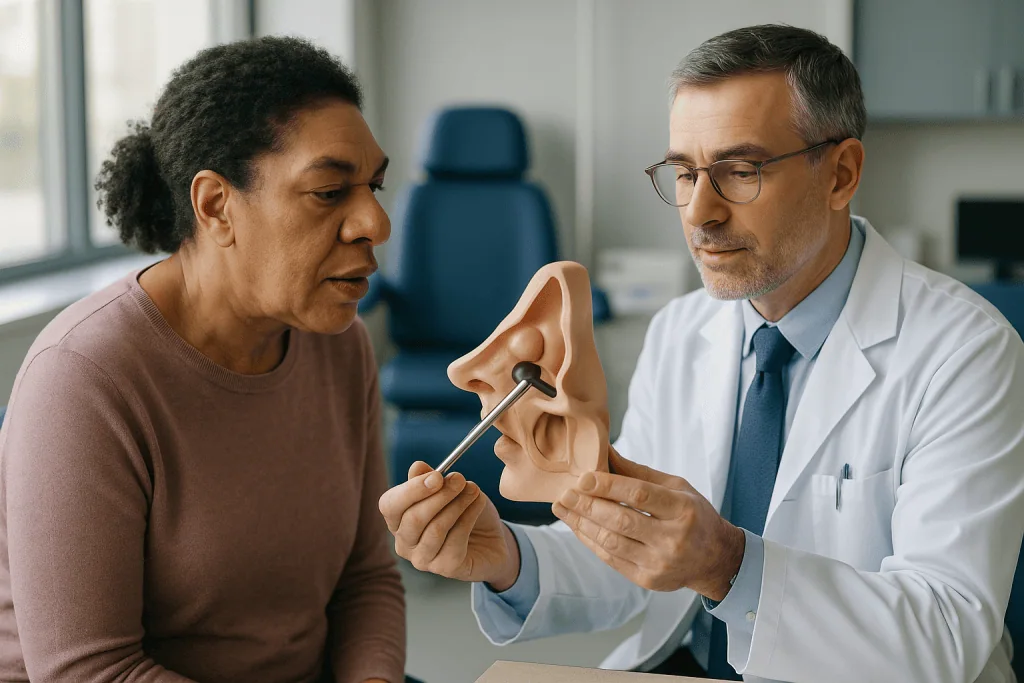
First, the surgeon passes an endoscope, a rigid tube with a lens and light source at the tip, into one nostril. The image appears on a screen at magnification, giving a wide, bright view that a naked eye could never achieve inside such a narrow corridor. A second instrument is usually introduced through the same or the other nostril. Nothing is done to the outside of the nose.
Second, the team creates a working path. The back wall of the nasal cavity opens into the sphenoid sinus through a natural opening, which is widened. Once inside the sinus, the surgeon can see the bulge of the sella floor, sometimes with the adenoma already thinning the bone from behind.
Third, a small window is made in that bony floor, and the tough membrane beneath it, the dura, is opened. The adenoma is now in view. Pituitary adenomas are typically softer than the normal gland, and GH-secreting ones often have a distinct color and texture, which helps the surgeon tell tumor from healthy tissue. The tumor is removed piece by piece with fine suction and ring-shaped curettes, working outward until only normal gland or bone remains.
Fourth, the surgeon inspects the cavity, often angling the endoscope to look around corners, then closes. If the fluid layer around the brain has been breached, a patch of the patient’s own tissue or a synthetic sealant is placed over the opening. Nasal packing may or may not be used; practice varies.
MedlinePlus describes the procedure as taking a few hours in total, though complex tumors can take longer (MedlinePlus, pituitary tumor removal). The patient wakes up with a sore, blocked nose and, in most cases, no external sign that anything happened.
Can a pituitary tumor really be removed through the nose? Endoscope versus microscope
Yes, and it has been done for well over a hundred years. The early versions used an incision under the upper lip and a surgical microscope looking straight down a metal speculum. That microscopic approach still exists and remains a sound technique in experienced hands. What changed over the past two decades is the widespread shift to a fully endoscopic route through the nostril itself, with no lip incision.
The practical differences matter to patients, so here they are in plain terms. A microscope looks along a straight line; whatever lies to the side of that line is invisible. An endoscope can be advanced right up to the sella and angled, so the surgeon can look laterally toward the cavernous sinuses, the blood-filled channels on either side of the gland through which the carotid arteries and eye-movement nerves run. That wider view is one reason surgeons often prefer the endoscope for tumors that spread sideways or upward.
The tradeoff is depth perception. A standard endoscope gives a two-dimensional image, so the surgeon relies on movement cues and experience, and increasingly on navigation systems that track instruments on a preoperative scan. Three-dimensional endoscopes exist but are not universal.
Comparative studies, summarized in the Endocrine Society guideline, have not shown a decisive hormonal advantage for one technique over the other in acromegaly; outcomes track more closely with the surgeon’s experience and the tumor’s size and invasion than with the instrument (Endocrine Society guideline, PubMed). Mayo Clinic notes that the endoscopic route is now the most common way pituitary tumors are removed and that the nasal approach avoids the visible scarring and brain retraction of an open operation (Mayo Clinic).
The honest answer to the question, then, is that the route through the nose is standard, not experimental, and the choice between endoscope and microscope is a matter of team expertise rather than one being right and the other wrong.
Who is acromegaly surgery through the nose usually for, and who is usually asked to wait
The Endocrine Society guideline recommends transsphenoidal surgery as first-line treatment for most people with acromegaly caused by a pituitary adenoma, and it is the only treatment that can remove the source of excess growth hormone in a single step (Endocrine Society guideline, PubMed). The strongest candidates share a few features.

Tumors confined to the sella, or extending upward toward the optic nerves without wrapping around the carotid arteries, are the ones most likely to be removed completely. A tumor pressing on the optic chiasm, the crossing point of the nerves from both eyes, adds urgency, because vision can be protected by relieving the pressure promptly. People whose general health allows a general anesthetic of a few hours are also typical candidates.
Surgery is still often offered even when complete removal is unlikely. Reducing the bulk of a large, invasive tumor lowers GH output and can make later medicines or radiation work better; the guideline describes this debulking role explicitly.
Some people are asked to wait or to consider a different first step. Severe, untreated heart failure or sleep apnea related to acromegaly may need stabilizing before anesthesia is safe, and a period of medical therapy is sometimes used to lower GH and shrink soft tissue in the airway beforehand. A tumor buried entirely inside the cavernous sinus, where the carotid artery runs, cannot be removed safely, so those patients may be steered toward medication or radiation from the outset. Rarely, acromegaly arises from a GH-releasing tumor elsewhere in the body, and in that case pituitary surgery is not the answer at all (NIH NIDDK).
None of these are rigid rules. They are the factors a multidisciplinary team, usually an endocrinologist, a pituitary surgeon and often an ear, nose and throat specialist, weighs together before recommending a plan.
Is pituitary surgery major surgery? An honest answer
It is both, depending on which way you look at it. Measured by what the body experiences, transsphenoidal surgery is far gentler than most operations near the brain. There is no scalp incision, no opening of the skull and no handling of brain tissue. Blood loss is usually small. People are commonly walking the next day, and MedlinePlus lists hospital stays measured in days rather than weeks for uncomplicated cases (MedlinePlus, pituitary tumor removal).
Measured by what is at stake anatomically, it is unquestionably major. Within a few millimeters of the working area lie the carotid arteries, the optic nerves, the nerves that move the eyes and the fluid space surrounding the brain. Hormone balance for the rest of a person’s life depends on how the remaining gland is treated. That is why these operations are concentrated in centers where the team performs them regularly, and why the Endocrine Society guideline emphasizes surgeon experience as a determinant of outcome (Endocrine Society guideline, PubMed).
A useful way to think about it: the recovery is like a substantial sinus operation, while the planning and monitoring are like brain surgery. Patients meet an anesthesiologist beforehand, have baseline hormone and vision testing, and are watched closely afterward for changes in fluid balance and sodium. The NHS describes the procedure as generally safe but notes the need for follow-up because hormone levels can shift in either direction afterward (NHS).
So when a friend says “it is just through the nose, it is nothing,” they are half right. And when another says “it is brain surgery, be terrified,” they are half right too. The truth is a serious operation with a comparatively kind recovery, which is a combination worth understanding rather than fearing.
What happens before the operation: tests, scans and the anesthesia conversation
The weeks before surgery are busy with measurement. An MRI of the pituitary, usually with contrast, maps the adenoma’s exact size and its relationship to the optic chiasm and cavernous sinuses; this scan is what the surgeon studies while planning the route and what navigation systems use during the operation. A CT scan of the sinuses is often added to show the bony anatomy of the sphenoid, which varies considerably between people.
Blood tests establish a baseline for every pituitary hormone, not only GH and IGF-1. Cortisol, thyroid hormone, prolactin and sex hormones are checked because a large adenoma can already be squeezing normal gland tissue, and because any deficiency needs to be known before anesthesia. Low cortisol in particular must be corrected first, since the stress of surgery demands it (Mayo Clinic).
A formal visual field test is standard if the tumor comes near the optic nerves; it gives a before-and-after comparison that cannot be reconstructed later. Many teams also arrange a sleep study or cardiac assessment, because acromegaly commonly enlarges the tongue and soft tissues of the throat and thickens heart muscle, both of which the anesthesiologist needs to plan around (MedlinePlus, acromegaly).
The anesthesia visit deserves attention. Enlarged facial bones and airway tissue can make placing a breathing tube harder than usual, so the anesthesiologist may use specialized equipment or techniques. This is routine for teams that treat acromegaly and is a good reason to ask how often they do.
Practical preparation usually includes stopping blood-thinning medicines on the surgeon’s instructions, avoiding nose-blowing practice habits, and arranging help at home for the first week. Patients who smoke are generally advised that stopping improves sinus healing. Decisions about any regular medication belong with the prescribing clinician; nothing should be changed on a general article’s say-so.
Microadenoma or macroadenoma: how tumor size changes the operation and the outlook
Pituitary adenomas are divided by a single measurement. A microadenoma is under 10 millimeters across; a macroadenoma is 10 millimeters or larger (Mayo Clinic). Most GH-secreting tumors are macroadenomas by the time acromegaly is recognized, because the disease develops so slowly.
Size changes almost everything about the surgery and the expectations attached to it. The Endocrine Society guideline states plainly that the chance of achieving normal hormone levels with surgery is higher for microadenomas and for macroadenomas that have not invaded the cavernous sinus, and lower for large or invasive tumors (Endocrine Society guideline, PubMed). The table below summarizes what tends to differ.
| Feature | Microadenoma (under 10 mm) | Macroadenoma (10 mm or more) |
|---|---|---|
| Typical relationship to normal gland | Sits within gland; normal tissue usually preserved | May compress or thin the gland; higher chance of hormone deficiency before and after surgery |
| Extension beyond the sella | Uncommon | Frequent, upward toward optic chiasm or sideways into cavernous sinus |
| Likelihood of complete removal | Higher, per Endocrine Society guideline | Depends on invasion; lower when cavernous sinus is involved |
| Risk of spinal fluid leak | Lower | Somewhat higher, especially with upward extension |
| Need for additional treatment | Less common | More common; medicines or radiation may follow |
| Hospital stay and early recovery | Usually shorter | Similar for most, longer if complications arise |
Two caveats keep this table honest. First, size is a proxy; a small tumor tucked against the carotid artery can be harder to clear than a larger one sitting neatly in the sella. Second, a macroadenoma that cannot be fully removed is still often worth operating on, because reducing tumor volume lowers GH and can improve the response to later medical therapy. The surgeon’s preoperative MRI review is what turns these generalities into a specific expectation for one person.
What can go wrong: the risks of transsphenoidal surgery explained without drama
Every operation carries risk, and this one is no exception. The most useful thing a patient can do is understand which problems are common and temporary, which are uncommon and manageable, and which are rare but serious.
Common and usually temporary: nasal congestion, crusting, reduced smell and a dull headache. These are the expected aftermath of working through the sinuses and generally settle over weeks. A short-lived disturbance of water balance is also frequent. The back of the pituitary releases the hormone that tells the kidneys to hold onto water; if it is bruised, the body can produce large volumes of dilute urine, a condition called diabetes insipidus (unrelated to blood sugar). It is usually transient and monitored with fluid charts and sodium tests in hospital (MedlinePlus, pituitary tumor removal).
Less common but well recognized: a leak of cerebrospinal fluid, the clear liquid that cushions the brain, through the surgical opening. Surgeons watch for it during the operation and repair it on the spot; when it appears later, it shows as clear, watery drainage from the nose, especially on leaning forward, and it may need a second procedure to seal. Because the sinus connects to the brain lining once opened, an unrepaired leak raises the risk of meningitis, which is why the drainage sign is treated seriously.
Hormone deficiency is another important category. Removing tumor can disturb normal gland tissue, leaving low cortisol, thyroid hormone or sex hormones, sometimes permanently. This is more likely with large tumors and is managed with replacement therapy prescribed by the endocrinologist (NHS).
Rare but serious: injury to the carotid artery, damage to vision, stroke or severe bleeding. These are the risks that justify specialist teams and careful imaging. Mayo Clinic and MedlinePlus both list them as uncommon, and the Endocrine Society guideline notes complication rates are lower in experienced hands (Mayo Clinic; Endocrine Society guideline, PubMed). None of this should be read as a checklist for fear, only as the reason consent conversations take time.
The first days after surgery: what the hospital stay is really like
Waking from transsphenoidal surgery is, for most people, an odd mix of relief and stuffiness. The nose feels blocked and sore, and breathing happens through the mouth, which leaves the throat dry. Headache is usual, controlled with medicines the team selects. There is often surprisingly little pain elsewhere, because no muscle or bone of the face has been cut from outside.
The nursing routine over the following days is built around three things. Fluid balance comes first: how much a person drinks and how much urine they pass is measured, and blood sodium is checked regularly, because the water-balance disturbance described earlier can appear in the first day or two and, less predictably, again around a week later. Vision is assessed at intervals, particularly if the tumor was near the optic nerves. And the nose is inspected for any watery, clear drainage that could signal a spinal fluid leak.
Patients are encouraged to sit up and walk within a day. Sitting upright also eases pressure at the surgical site. The rules people find hardest are the nasal ones: no nose-blowing, sneezing with the mouth open, no straining, no bending with the head low and no drinking through straws, all to avoid pushing air or pressure back toward the repaired sella. These restrictions typically continue for several weeks.
Growth hormone begins falling within hours if the tumor has been removed, and many teams measure it in the first day or two as an early indicator, while recognizing that the definitive answer comes later (Endocrine Society guideline, PubMed). Some patients notice softer hands or less sweating within days, a striking early sign of hormone dropping, though this is anecdotal and not a measure of success.
MedlinePlus describes discharge within a few days for uncomplicated cases (MedlinePlus, pituitary tumor removal). Going home comes with written instructions on nasal care, a list of warning signs, and dates for hormone testing and clinic review.
Endoscopic transsphenoidal surgery recovery: what the following weeks usually look like
Recovery from surgery through the nose is a story told in two timelines that run at different speeds. The sinuses heal over weeks; the hormonal picture settles over months.
In the first week at home, the nose is the main event. Congestion, crusting and a blocked feeling are normal, and saline rinses or sprays are often advised by the team once they judge the repair secure. Smell and taste are frequently dulled. Fatigue is common and is partly the anesthetic, partly the sudden hormonal shift that follows removing a GH-secreting tumor. Short walks help; lifting, bending and anything that raises pressure in the head remain off limits.
By weeks two to four, most people feel steadily better. Many return to desk work in this window, while more physical jobs usually wait longer; MedlinePlus frames the return to normal activity in terms of a few weeks rather than days (MedlinePlus, pituitary tumor removal). An ear, nose and throat review during this period is common, to clear crusts and check that the sinus is healing. Some crusting can persist for two to three months, and a small subset of people notice worse nasal symptoms for a spell before improvement, which is expected as the lining regenerates.
Through weeks four to twelve, restrictions ease on the surgeon’s advice. Flying is usually cleared once any risk of a spinal fluid leak has passed; the specific timing is a team decision. Sleep often improves as soft tissue in the airway shrinks, and joint aches may lessen, though bony changes of long-standing acromegaly do not reverse.
Recovery from macroadenoma surgery follows the same pattern for most people, with two qualifications. Hormone replacement may be part of the picture if normal gland was compressed, and the chance of needing further treatment is higher, so the follow-up plan is more elaborate. The rhythm of daily life, though, tends to return on a similar schedule.
How do you know the surgery worked? IGF-1, GH testing and the 12-week check
Feeling better is welcome but is not the yardstick. Acromegaly is judged controlled or not by blood tests, and the timing of those tests is set by how the hormones behave.
Growth hormone itself is released in pulses and clears from the blood quickly, so a level drawn the morning after surgery gives an early clue. IGF-1 moves more slowly; it reflects average GH exposure over weeks, so it takes time to reach its new baseline. For that reason, the Endocrine Society guideline advises measuring IGF-1 and GH at around 12 weeks after surgery, not sooner, to decide whether the operation achieved biochemical control (Endocrine Society guideline, PubMed). Testing earlier risks a misleadingly high IGF-1 that has simply not finished falling.
Control is defined in the guideline as an IGF-1 within the normal range for age, together with a GH level that suppresses appropriately, often assessed after a sugary drink in an oral glucose tolerance test, because glucose normally switches GH off. Neither number is a target for patients to chase; they are markers the endocrinologist interprets alongside symptoms and imaging.
An MRI is also usually repeated at roughly the same 12-week point, once postoperative swelling and packing material have settled, to show whether any tumor remains and where. That scan becomes the new baseline for years of surveillance.
What if the numbers are normal? Follow-up continues, typically with annual IGF-1 measurement, because adenomas can regrow. What if they are not? That is not a failure of the patient or a verdict on the surgeon; it is common with large or invasive tumors and leads directly into the next conversation about medicines, repeat surgery or radiation.
Remaining pituitary function is checked too. Cortisol reserve, thyroid hormone and sex hormones are reassessed in the early weeks, since deficiencies can emerge or, occasionally, recover after surgery (NHS).
When some tumor stays behind: medicines, repeat surgery and radiation as next steps
A meaningful share of people, particularly those with macroadenomas that reached the cavernous sinus, will have persistent excess GH after their first operation. The Endocrine Society guideline lays out a sequence of options, and the choice among them is individual (Endocrine Society guideline, PubMed).
Medical therapy is the usual next step. Three classes are described in mainstream guidance. Somatostatin analogs mimic the body’s own brake on growth hormone, binding receptors on the tumor and reducing GH release; they can also shrink some tumors over months. Dopamine agonists, more familiar from other pituitary conditions, act on a different receptor and are generally considered for milder hormone elevation. A GH receptor antagonist works downstream, blocking growth hormone at its target tissues so that IGF-1 falls even when the tumor keeps producing GH. Each has a distinct side-effect profile, each is judged by IGF-1 response over roughly three-month intervals, and every decision about starting, combining or adjusting them belongs to the prescribing endocrinologist (Mayo Clinic; NIH NIDDK).
Repeat transsphenoidal surgery is sometimes offered when the remaining tumor is accessible on MRI, for instance a piece left behind in the sella rather than inside the cavernous sinus. Second operations are technically more demanding because of scar tissue, which is one reason teams look carefully at the scan before recommending one.
Radiation therapy is typically reserved for tumor that cannot be removed and is not controlled by medicine. Focused techniques deliver a precise dose to the residual adenoma over one or a few sessions. Its main limitation is time: hormone levels fall gradually over years rather than months, so medicines usually bridge the gap, and it carries a long-term risk of reducing normal pituitary function (NHS).
None of these paths is a consolation prize. Many people reach controlled IGF-1 through a combination, and the goal throughout is the same as it was on the day of surgery: protecting the heart, metabolism and joints for the decades ahead.
What people often get wrong about pituitary surgery through the nose
Misunderstandings about this operation are remarkably consistent, and correcting them changes how people feel walking into the consultation.
“They go through the brain.” They do not. The route passes through the nasal cavity and sphenoid sinus to the front of the pituitary, which sits outside the brain proper, beneath it. No brain tissue is cut or moved.
“There will be a scar or a broken nose.” The endoscopic technique uses the nostril as it is. There is no external incision, and the nasal bones are not broken. Some older or specific approaches involve a small cut inside the upper lip or nasal septum, but these are internal and heal without visible marks.
“Once the tumor is out, the acromegaly is gone.” Removing the adenoma stops excess hormone production, but the long-term effects already established, thickened bone, an enlarged jaw, arthritic joints, do not reverse. Soft tissue swelling, sweating, sleep apnea and blood sugar often improve, sometimes markedly, which is real benefit. The disease is managed and monitored, not erased.
“It is a small procedure, so nothing can go wrong.” The recovery is gentle, but the neighborhood is not. The carotid arteries, optic nerves and hormonal control center are all within millimeters, which is precisely why the procedure is done by specialist teams.
“My IGF-1 is still high a month after surgery, so it failed.” IGF-1 falls slowly. The Endocrine Society guideline deliberately sets the definitive test at about 12 weeks, because earlier readings can overstate residual disease (Endocrine Society guideline, PubMed).
“Medicine could have avoided surgery entirely.” For most people with a removable adenoma, guidelines still place surgery first, because it is the only option that can remove the hormone source in one step and it improves the odds that any later medicine works. Medical therapy as the first choice is reserved for specific situations, decided case by case (Mayo Clinic).
Questions to ask your care team before agreeing to acromegaly surgery
A good consultation is a two-way exchange, and specific questions tend to draw specific answers. These are the ones patients and families often find most useful, grouped by theme.
On the tumor and the plan:
- On my MRI, does the adenoma extend into the cavernous sinus or toward the optic nerves, and how does that shape what you expect to remove?
- Is the goal complete removal or reducing the tumor’s size to help later treatment?
- Will you use an endoscopic or microscopic approach, and why for my anatomy?
On the team and the setting:
- How many transsphenoidal operations for acromegaly does this team perform in a typical year?
- Will an ear, nose and throat surgeon be part of the operation and the follow-up?
- Who monitors my hormones afterward, and how do I reach them?
On risks specific to me:
- Given my tumor’s size, what is my risk of new hormone deficiencies, and would they likely be temporary or permanent?
- Does my airway or heart require any special preparation for anesthesia?
- What are the signs of a spinal fluid leak or low sodium, and exactly whom do I call?
On what comes after:
- When will IGF-1 and GH be measured, and what results would lead you to recommend further treatment?
- How long should I expect nasal restrictions, time off work and the wait before flying?
- If some tumor remains, which options would you consider first for me, and what are their tradeoffs?
Writing the answers down, or bringing someone who will, matters more than it sounds. Consultations for a rare condition contain a great deal of new vocabulary, and the decision belongs to a person who understands what has been said, in partnership with the team that will carry it out.
When to call your doctor after surgery: red-flag signs that should not wait
Most of the recovery from pituitary surgery through the nose is uneventful, and the discomforts of a healing sinus are expected. A short list of signs, however, warrants a prompt call to the surgical or endocrine team, or emergency care if they are severe or arrive out of hours.
Clear, watery fluid dripping from the nose, especially when leaning forward, or a persistent salty or metallic taste at the back of the throat, can indicate a cerebrospinal fluid leak and needs same-day assessment (MedlinePlus, pituitary tumor removal).
A high fever, a stiff neck, severe headache with sensitivity to light, or new confusion may signal meningitis, which is a medical emergency.
Passing very large volumes of pale urine with intense thirst, or the opposite pattern of nausea, headache, unusual drowsiness and feeling generally unwell about a week after surgery, can both reflect disturbed sodium balance and should be reported the same day; the team may ask for an urgent blood test.
Profound weakness, dizziness on standing, vomiting or feeling faint may point to low cortisol, particularly in anyone told their cortisol reserve was uncertain. This can become dangerous quickly and should never be waited out.
Any new change in vision, such as blurring, double vision, a drooping eyelid or loss of part of the visual field, needs urgent review.
Heavy nosebleeds that do not stop with gentle pressure, or repeated bleeding, should be seen promptly, as should calf pain or swelling, chest pain or sudden breathlessness, which can indicate a blood clot after any operation.
The general principle is simple: nasal stuffiness, mild headache and tiredness are expected; anything involving clear fluid, fever, confusion, vision, urine volume or feeling faint is not, and the team would much rather hear about it early. The NHS and Mayo Clinic both emphasize that hormone shifts after pituitary surgery can appear days to weeks later, which is why the warning list stays relevant beyond the first few days at home (NHS; Mayo Clinic).
Frequently asked questions
Is it possible to remove a pituitary tumor through the nose?
Yes, and it is the standard way pituitary adenomas are removed. The sphenoid sinus behind the nose sits directly against the bony pocket holding the pituitary, separated by a thin wall. A surgeon passes an endoscope through the nostril, opens that wall and removes the tumor without touching brain tissue or making an external cut. The technique has been refined for more than a century.
How long does it take to recover from brain surgery through the nose?
Most people are up and walking within a day and home within a few days, according to MedlinePlus. Nasal congestion and fatigue dominate the first two weeks, and many return to desk work within a few weeks, while heavier activity and flying wait for the surgeon’s clearance. Hormone levels take about 12 weeks to settle enough for the definitive blood test.
How long does it take to recover from macroadenoma surgery?
The day-to-day recovery for a macroadenoma is similar to that for a smaller tumor: a few days in hospital, several weeks of nasal healing and gradual return to activity. The differences lie in follow-up. Large tumors carry a higher chance of hormone deficiency needing replacement and of residual tissue needing medicines or radiation, so monitoring is more extensive over the first year.
Is pituitary surgery major surgery?
It is a major operation with a comparatively gentle recovery. There is no skull opening or brain retraction, and pain is usually modest. Yet the carotid arteries, optic nerves and the body’s hormonal control center lie within millimeters of the working area, which is why specialist teams perform it and why fluid balance, sodium and vision are watched closely afterward.
Does acromegaly go away after the tumor is removed through the nose?
Removing the adenoma stops excess growth hormone production in many people, and soft tissue swelling, sweating, sleep apnea and blood sugar often improve. Bone changes such as an enlarged jaw and thickened fingers do not reverse. The condition is considered controlled when IGF-1 and GH normalize on testing around 12 weeks later, and lifelong monitoring continues because tumors can regrow.
What does endoscopic transsphenoidal surgery recovery feel like in the first week?
Expect a blocked, sore nose, mouth breathing, dulled smell, headache and noticeable tiredness. Nose-blowing, straining, bending low and drinking through straws are avoided to protect the surgical repair. Short walks are encouraged. Many people are surprised by how little facial pain there is, because nothing has been cut from outside; the sinuses simply need time to heal.
Will there be a scar after having a pituitary tumor removed through the nose?
With the endoscopic technique there is no external scar, because the instruments pass through the nostril as it is and the nasal bones are not broken. Some approaches use a small internal incision inside the upper lip or the nasal septum, which heals without a visible mark. Bruising of the face is unusual.
How soon after acromegaly surgery will I know if it worked?
A growth hormone level in the first day or two gives an early hint, but the decisive test is IGF-1 and GH measured about 12 weeks after surgery, as the Endocrine Society guideline advises. IGF-1 reflects hormone exposure over weeks and falls gradually, so an earlier reading can look falsely high. An MRI at the same point shows whether any tumor remains.
What happens if the surgeon cannot remove all of the tumor?
This is common with large tumors that reach the cavernous sinus, and it does not mean the operation was pointless, since reducing tumor volume lowers hormone output. The next steps, decided with an endocrinologist, may include medicines that suppress GH or block its action, a second operation if remaining tissue is accessible, or focused radiation whose effect builds over years.
Can acromegaly surgery through the nose affect my other hormones?
It can. Removing tumor may disturb normal gland tissue, leading to low cortisol, thyroid hormone or sex hormones, sometimes temporarily and sometimes permanently, more often after macroadenoma surgery. A short-lived disturbance of water balance is also frequent. All of these are checked with blood tests in hospital and in the early weeks, and any deficiency is managed with replacement prescribed by the endocrinologist.
References
This article is for general information only and is not a substitute for professional medical advice. Please consult a qualified doctor about your individual situation.

More from the Blog
How to Read a Longevity Report: Cardiovascular, Metabolic and Cancer Risk Markers Explained
A longevity report explained simply is a bundle of standard laboratory tests, blood pressure readings and sometimes imaging, grouped into cardiovascular, metabolic and cancer…

Graves Disease Work-Up: Thyroid Hormone Tests, Antibodies, Ultrasound and Scintigraphy
Graves disease is usually diagnosed with blood tests first: a low or undetectable TSH with raised free T4 or T3 confirms an overactive thyroid,…

Why Is Thyroid Disease Monitored More Closely in Pregnancy, and How Is Care Coordinated?
Thyroid disease in pregnancy is monitored more closely because pregnancy changes how the thyroid works and because the baby depends on the mother's thyroid…

Questions to Ask Your Endocrine Surgeon Before a Parathyroidectomy
Before a parathyroidectomy, ask your endocrine surgeon which gland or glands are thought to be overactive, whether a focused or four-gland operation is planned,…
Endoscopic Pituitary Tumor Surgery Explained: The Transsphenoidal Route and What It Avoids
Transsphenoidal surgery is an operation that reaches the pituitary gland through the nose and the sphenoid sinus, an air pocket behind the nasal cavity…

Surgery, Medication or Radiotherapy for Acromegaly: How Do Specialists Combine the Three?
Specialists usually start with transsphenoidal surgery to remove the pituitary tumor when it can be reached safely, then add medicines such as somatostatin analogs,…