

What Does Video EEG Monitoring Show That a Routine EEG Cannot in Epilepsy Care?
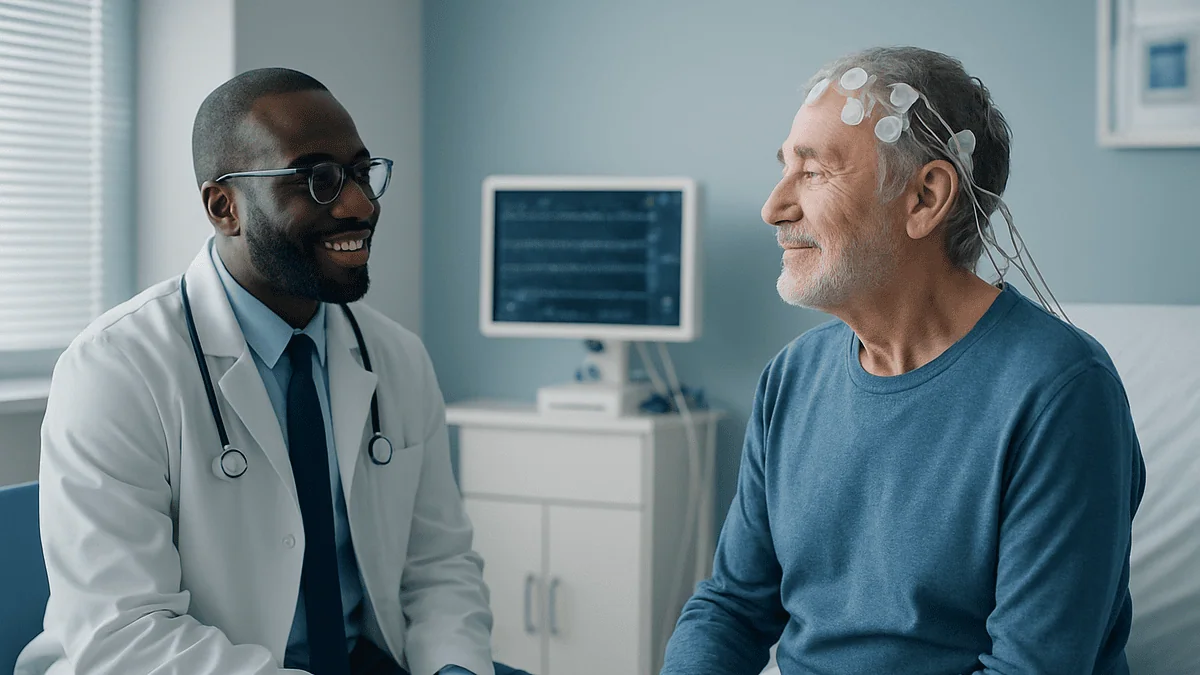
Key Takeaways
- A routine EEG records about 20 to 40 minutes of brain activity, usually between seizures, while video EEG monitoring can continue for several days with a synchronized camera.
- The NHS states an EEG alone cannot confirm or rule out epilepsy, which is why a normal routine result often leads to longer monitoring rather than reassurance.
- Pairing video with the tracing lets reviewers separate true epileptic seizures from dissociative (non-epileptic) events, fainting, and movement artifacts that can mimic spikes on paper.
- Where the rhythm begins on the electrodes, matched to the first movement on camera, helps classify a seizure as focal or generalized, a distinction that shapes treatment choices.
- Electrodes only record; the realistic risks of video EEG are scalp irritation from adhesive, seizures provoked during activation under supervision, and the fatigue of a multi-day stay.
- Any change to seizure medicines during monitoring is planned by the neurology team, carried out under continuous observation, and never something to attempt on your own before or after the stay.
Video EEG monitoring records brain-wave activity and a synchronized video of the person for many hours or several days, so clinicians can see what the body is doing at the exact moment the brain tracing changes. A routine EEG samples only about 20 to 40 minutes, usually between events, so it often cannot capture a seizure, show where it begins, or distinguish epileptic from non-epileptic episodes.
The second time it happened, her husband filmed it on his phone. Forty seconds of shaking, a vacant stare, then confusion. At the clinic a week later, the routine EEG came back normal. The neurologist read the report, watched the phone clip twice, and said something that felt almost contradictory: the normal test did not mean nothing was wrong, and the phone video, helpful as it was, could not tell them what the brain was doing during those forty seconds.
That gap is exactly what video EEG monitoring for epilepsy is designed to close. Instead of a brief snapshot taken on a quiet afternoon, it keeps recording while the person eats, sleeps, talks, and, ideally, has one of the episodes in question, with a camera fixed on them the whole time.
Here is what that longer, paired recording reveals, why it is sometimes the only way to settle a diagnosis, and what the days in a monitoring unit are actually like.
What a routine EEG actually measures, and why 20 minutes is a small window
An electroencephalogram, or EEG, is a recording of the tiny electrical signals produced by brain cells as they communicate. Small metal discs called electrodes are attached to the scalp with paste; MedlinePlus describes between 16 and 25 of them in a standard setup. Wires carry the signal to a machine that draws it as wavy lines, one line per pair of electrodes.
The routine version is short. Mayo Clinic puts the recording itself at roughly 20 to 40 minutes, during which the technologist may ask you to breathe fast, look at a flashing light, or close your eyes and relax. Those maneuvers are meant to coax out abnormal patterns that hide when the brain is calm.
What the tracing shows in an epilepsy work-up falls into two broad categories. The first is an actual seizure, called an ictal event, unfolding on the page. The second, far more common in a short test, is interictal activity: brief spikes or sharp waves that appear between seizures and suggest a brain prone to them. Both are useful. Neither is guaranteed to show up on the day.
That is the fundamental limitation. Seizures are unpredictable, and a 30-minute recording is a thin slice of a person’s week. The NHS is direct about this: an EEG cannot by itself confirm or rule out epilepsy, because some people with epilepsy have normal routine recordings and some people without epilepsy show minor irregularities. A normal result narrows the picture without closing it.
Think of it as listening to a house for half an hour to decide whether the plumbing knocks. If the pipes stay quiet, you have learned something, but not that they never knock.
What happens during video EEG monitoring for epilepsy, hour by hour
Video EEG monitoring keeps the same electrodes in place for far longer and adds a camera. In most settings this happens in a dedicated hospital area, often called an epilepsy monitoring unit, a ward where staff are trained to watch the recordings and respond to seizures around the clock.
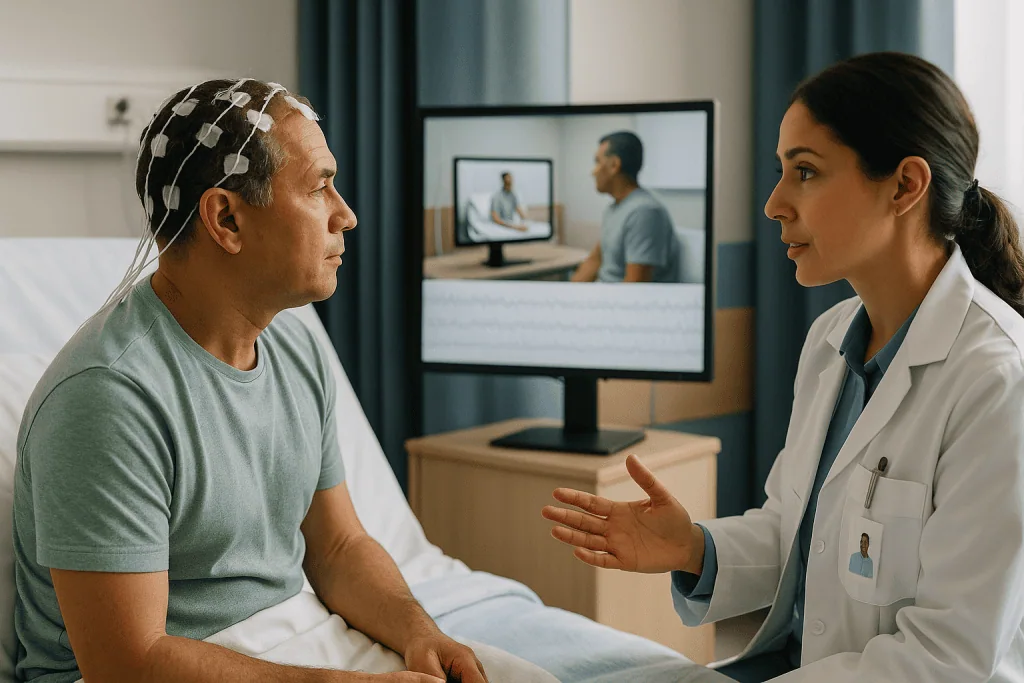
The first hours are practical. A technologist measures your head, marks electrode positions, cleans each spot, and glues the discs down with a paste or adhesive designed to hold for days rather than minutes. The wires are gathered into a bundle and often wrapped in gauze so you can move your head freely. A ceiling-mounted camera and microphone record the room; the brain-wave trace and the video are time-stamped together so a reviewer can scrub to any second and see both at once.
Then, mostly, you live. You eat, read, sleep, and talk with visitors within the camera’s view. Mayo Clinic notes this kind of monitoring may continue for several days. You may be asked to press a button or tell a nurse when you feel a warning sensation, so the team can mark the moment and examine you during the event: asking you to name an object, follow a command, or remember a word.
Some units use the same activation methods as a routine test, including a period of shortened sleep, because tiredness lowers the seizure threshold in many people. Whether any of that is used, and whether medicine schedules are adjusted, is decided by the treating neurologist and explained to you before it happens.
When the team has recorded enough, or when the planned stay ends, the electrodes come off with a solvent, the hair gets a thorough wash, and the analysis begins.
Video EEG vs routine EEG: the differences at a glance
People often ask what the difference is between an EEG and a video EEG test, expecting a different machine. The electrodes and the amplifier are essentially the same. What changes is time, setting, and the second stream of information.
| Feature | Routine EEG | Video EEG monitoring |
|---|---|---|
| Recording length | About 20 to 40 minutes (Mayo Clinic) | Hours to several days (Mayo Clinic) |
| Setting | Outpatient room, awake or briefly dozing | Hospital monitoring unit, or at home for ambulatory versions |
| Video | Usually none | Continuous, synchronized with the tracing |
| Main goal | Look for between-seizure abnormalities | Capture the actual events and correlate behavior with brain activity |
| Sleep recorded | Sometimes a nap | Full nights, including deep sleep |
| Staff response during a seizure | Technologist present | Nurses and technologists trained to examine and protect during events |
| Medicine adjustments | Not typical | Sometimes planned by the team to increase the chance of recording an event |
There is a middle option worth knowing about. Ambulatory EEG sends you home wearing a portable recorder for a day or more. It buys time but usually sacrifices the camera and the trained observer at the bedside, so it answers some questions and not others. Cleveland Clinic and Johns Hopkins both describe these three formats as tools a neurologist chooses among based on the question being asked, not as a ladder everyone climbs.
The honest summary: a routine EEG asks whether the brain looks seizure-prone at rest. Video EEG asks what actually happens during the episodes you came in about.
Why the video matters as much as the brain-wave tracing
Brain waves alone can mislead. Chewing, blinking, sweating, and shifting in bed all create electrical noise that can mimic abnormal activity on paper. Without seeing the person, a reviewer may have to guess whether a sharp deflection was a spike from the temporal lobe or a jaw clench. With the camera, the guess disappears.
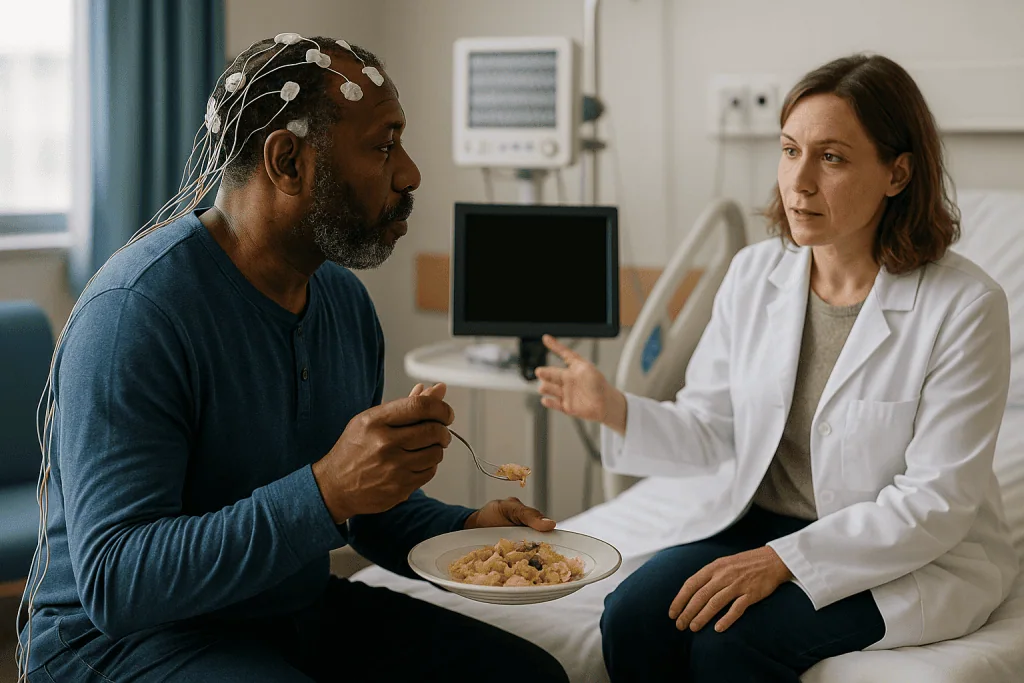
The reverse problem is just as important. Some episodes look dramatic on video, with shaking, unresponsiveness, and eyes closed, while the EEG stays completely normal throughout. That combination points toward events that are not epileptic seizures. The NHS calls these dissociative seizures, sometimes labeled functional or non-epileptic attacks; they are real, involuntary, and distressing, but they arise from a different mechanism and are managed differently. Video EEG is the recognized way to tell them apart from epilepsy, because a phone clip cannot show what the brain was doing, and a routine EEG almost never catches one.
The pairing also sharpens the description of epileptic seizures themselves. Where the eyes turn, which hand moves first, whether speech is preserved, how long confusion lasts afterward: each of these is a clue to which part of the brain is involved. Read alongside the tracing, the video lets the team say not just “this was a seizure” but “this was a focal seizure beginning in the left temporal region,” a distinction that shapes every downstream decision.
Finally, the camera catches what nobody notices. Brief nighttime seizures, subtle arm posturing, a two-second lapse in awareness during a conversation with a visitor. Families frequently discover the episodes are more frequent, or different, than anyone realized. Cleveland Clinic describes this correlation of behavior with electrical activity as the core purpose of the test.
Who is usually referred for video EEG monitoring for epilepsy, and who is asked to wait
Not everyone with a seizure needs days in a monitoring unit. Mayo Clinic and the NHS describe a stepwise work-up: a detailed history, a routine EEG, and usually brain imaging come first, and for many people that is enough to start a conversation about treatment. Video EEG is reached for when those steps leave a specific question open.
The common reasons a neurologist recommends it include:
- The episodes continue despite a diagnosis and medicine, and the team wants to confirm the events being treated are actually epileptic seizures.
- The description of the events is unclear or inconsistent, and epilepsy needs to be distinguished from fainting, sleep disorders, or dissociative seizures.
- The seizure type is uncertain, which matters because focal seizures (starting in one region) and generalized seizures (involving both sides from the start) are approached differently.
- Surgery or a device is being considered, and the team needs to locate where seizures begin as precisely as scalp recording allows.
- Seizures are suspected but have never been witnessed by a clinician, for example during sleep.
People are often asked to wait, or offered a shorter test first, when the situation is more straightforward. A single well-described seizure with a clear provoking factor, a routine EEG that already shows a characteristic pattern, or events so infrequent that a several-day stay is unlikely to catch one may all lead a neurologist to choose a different path, at least initially. Someone who is medically unstable for other reasons may also be scheduled once they are well.
None of this is a ranking of how serious a person’s problem is. The referral reflects whether the test is likely to answer the question in front of the team, and that judgment sits with the treating neurologist.
How long does a video EEG take?
The honest answer is: as long as it takes to record what the team needs, within a stay that is planned in advance and can be shortened or occasionally extended. Mayo Clinic describes video EEG monitoring as lasting several days in many cases, and Cleveland Clinic frames inpatient monitoring as anywhere from a day to multiple days depending on how often events occur. Some questions are answered in a single night; others need most of a week.
Three things drive the length. The first is frequency. Someone having several episodes a day may provide enough recordings quickly. Someone whose events come twice a month will need either a longer window or planned steps to increase the odds, which the team will discuss beforehand. The second is the goal. Confirming whether events are epileptic may take fewer recordings than mapping the precise onset region before a surgical discussion. The third is what the first recorded event shows; a clear, typical seizure can settle the matter sooner than an ambiguous one.
Setup itself, from measuring the scalp to the final electrode check, commonly takes an hour or more, and removal plus hair washing adds time at the end. Expect the first day to feel slow and the last to feel rushed.
Ambulatory EEG, the take-home version, typically runs for one or more full days, according to Johns Hopkins, but it usually lacks the video and the bedside examination.
A practical note: because the stay is open-ended within a range, pack for the longer end. Loose, front-opening tops that do not need to pass over the head, books, chargers, and familiar pillows make a difference when the days stretch out.
What should you not do before an EEG test?
Preparation for video EEG mirrors preparation for a routine test, with a few additions for the longer stay. The instructions from your unit override anything general, but the common guidance from MedlinePlus, Mayo Clinic, and Cleveland Clinic runs like this.
Do not arrive with product in your hair. Wash it the night before or that morning and skip conditioner, gel, mousse, spray, oils, and leave-in treatments. Electrodes need clean, dry scalp to make good contact, and residue is the most common reason for a poor-quality recording. Braids, extensions, and weaves usually need to be taken out; ask the unit in advance if that is a concern, because some can work around certain styles.
Do not load up on caffeine. MedlinePlus advises avoiding it on the day of the test, since it can change the background rhythm of the recording. Regular meals are fine and usually encouraged; low blood sugar can itself alter brain waves.
Do not stop or change your prescribed medicines on your own. If the team plans any adjustment to increase the chance of recording an event, they will tell you exactly what to do and when, and it will happen under observation. Bring a current list of everything you take, including supplements.
Do not assume sleep is optional. Some units request a shortened night before admission because sleep deprivation is a recognized activation method; others want you rested. Ask which applies to you.
Bring the people who have seen your episodes, or at least their written descriptions and any phone videos. A family member who can say “yes, that was one of them” while watching the monitor is worth a great deal to the interpreting team.
What are the risks of a video EEG?
The recording itself is passive. Electrodes only listen; nothing is delivered into the brain, and MedlinePlus describes the EEG as a safe test. The realistic risks come from three other sources: the skin, the seizures the test is trying to provoke, and the disruption of a hospital stay.
Skin comes first because it is nearly universal. Days of adhesive and paste can leave scalp irritation, tenderness, or small red marks where the electrodes sat. These typically settle within days. Rarely, a person reacts to the glue or the solvent used at removal; tell the team about any known adhesive allergies.
Seizures are the point, and that is the paradox. If the team uses activation methods such as flashing lights, rapid breathing, reduced sleep, or planned medicine adjustment, the aim is to record an event, and events carry their own risks: falls, injury, a bitten tongue, or a seizure that lasts longer than usual. A monitoring unit is built around this. Beds have padding and rails, staff watch the video feed continuously, and protocols exist for treating a prolonged seizure immediately. Mayo Clinic notes that seizures triggered during the test are managed by the medical team on the spot. The risk is real; the environment is designed to make it the safest place for it to happen.
The third category is quieter. Several days indoors with a wired head, limited mobility, and interrupted sleep can leave people tired, low, and irritable. A small number of people find they have no events at all during the stay, which is frustrating but is itself information the team uses.
Alternatives, when video EEG is not suitable, include repeated routine EEGs, sleep-deprived EEG, or ambulatory recording. Each trades away something the monitoring unit provides.
What the team is looking for: onset, spread, and events that are not epilepsy
When the neurologist and technologists review the recording, they are working through a short list of questions, each of which a routine EEG struggles to answer.
Are the recorded events epileptic? A seizure on EEG has a characteristic evolution: a rhythm that starts, builds, changes frequency, and spreads, then gives way to slowing afterward. Events with no such change, however dramatic on camera, are unlikely to be epileptic. This single distinction reshapes care for a meaningful number of people, because dissociative seizures, fainting spells, and certain sleep behaviors each have their own management path, as the NHS outlines.
Where does it start? Focal seizures begin in one region and may or may not spread. The first electrodes to show the rhythmic change, matched against the first movement on video, point toward the onset zone. Generalized seizures light up both hemispheres from the first second. This is the difference between two categories of epilepsy that respond to different approaches, which is why the classification matters so much to the prescriber.
What happens in between? Nights of recording capture sleep stages that a daytime test never sees. Some epileptiform discharges, the spikes and sharp waves that mark a seizure-prone brain, appear almost exclusively in deeper sleep. Their location and frequency add to the map.
Are there events nobody counted? Reviewers routinely find brief seizures the person and family did not recognize, particularly subtle focal seizures with only a pause in awareness. The count of events per day can turn out to be very different from the count in the diary.
The report that emerges is not a verdict handed down by a machine. It is a synthesis, and the treating neurologist walks through what it does and does not settle.
What happens with seizure medicines during an epilepsy monitoring unit stay
This is the part of monitoring people most often worry about, so it deserves plain language. Anti-seizure medicines work by making brain cells less likely to fire in the runaway, synchronized way that produces a seizure. Different classes do this through different mechanisms, some by calming the channels that let electrical charge into cells, others by strengthening the brain’s own inhibitory signaling. When they are working, seizures become rarer, which is excellent for daily life and inconvenient for a test whose purpose is to record one.
For that reason, some monitoring teams plan a temporary, supervised change to a person’s usual schedule during the stay. It is never something the person does themselves, never decided at the bedside on a whim, and never applied to everyone. Whether it happens depends on the question being asked, how frequent the events are, the type of medicine, and the person’s history, including whether they have ever had a prolonged seizure. Some people go through the entire stay on their normal routine.
If an adjustment is planned, the team explains the timeline, watches the monitors continuously, keeps rescue treatments ready, and restores the usual schedule as recording goals are met or the stay ends. Mayo Clinic describes this careful, observed approach as part of how monitoring units operate.
Two things follow for you. First, ask directly whether any change is planned, and what the plan is if a seizure runs long. Second, do not adjust anything before admission or after discharge unless the prescribing clinician has told you to, in writing if possible. The point of the exercise is to gather information safely; the decisions about treatment that flow from it belong to the conversation afterward.
What the days and weeks after monitoring usually look like
Leaving the unit tends to feel abrupt. The electrodes come off, the hair gets its first real wash in days, and you walk out into daylight with a scalp that feels tender and slightly waxy. Most of the physical aftermath is minor and short-lived: red marks fading over a few days, some residual glue that comes out with another wash or two, and a stretch of catching up on sleep if the stay involved shortened nights.
If your usual medicine schedule was changed during monitoring, the team will have restored it, or given you specific written instructions about how it resumes. The days right after discharge are a period to be cautious anyway, because seizure risk can be a little higher after any disruption to routine and sleep. Standard advice from the NHS applies: avoid driving until cleared, be careful around water and heights, and let people around you know what to do if an event happens.
The analysis takes time. Reviewing several days of continuous recording second by second is laborious, and the report usually arrives at a follow-up appointment rather than at the bedside. Ask before you leave when that appointment is and how you will be contacted if something needs attention sooner.
The follow-up itself is where the test becomes useful. Depending on what was recorded, the conversation might confirm a diagnosis and a current plan, redirect toward a different explanation for the events, refine the seizure type in a way that changes which medicine class makes sense, or open a discussion about further evaluation, including whether surgical options are worth exploring. Occasionally the conclusion is that no events were captured and another approach is needed. Each of these outcomes is a step, and the next one is chosen together with the treating team.
What people often get wrong about video EEG
A few misunderstandings come up so reliably that clearing them saves real anxiety.
“A normal EEG means I don’t have epilepsy.” The NHS is explicit that an EEG cannot rule epilepsy out. A short recording between seizures can look entirely normal in someone who has them regularly. The diagnosis rests on the history, the description of events, imaging, and EEG together; video monitoring exists precisely because the routine test misses things.
“The electrodes send electricity into my head.” They do not. Electrodes only record. There is no current, no radiation, and no sensation beyond the cool paste and the pull of the adhesive. MedlinePlus describes the test as safe for this reason.
“Video EEG is the same as a brain scan.” An MRI or CT shows structure: the shape of the brain, a scar, a malformation. EEG shows function: what the cells are doing right now. The two answer different questions, and in epilepsy care they are usually read side by side.
“They’ll make me have a seizure.” Some units use activation methods, and some plan supervised medicine adjustment, but these are discussed and consented to in advance, applied selectively, and carried out under continuous observation. Many people go through monitoring with no provoked event at all.
“If the events aren’t epileptic, they’re not real.” Dissociative seizures are involuntary and can be as disabling as epileptic ones. Identifying them is not a dismissal; it is the first step toward the right kind of help, which is why the distinction is worth several days in a hospital bed.
“A home phone video is just as good.” A phone clip is enormously helpful and worth bringing, but it shows only the body. Video EEG shows the body and the brain in the same second, which is the whole point.
Questions to ask your care team
Monitoring goes better when you walk in knowing what the team hopes to learn and what will be asked of you. These questions are a reasonable starting point; write the answers down, because the first day is busy.
- What specific question is this test meant to answer for me, and what will happen if no events are recorded?
- How long is the planned stay, and what would make it shorter or longer?
- Will any of my medicines be adjusted during the stay? If so, what is the plan, who decides, and what is done if a seizure lasts longer than usual?
- Will you use activation methods such as reduced sleep, flashing lights, or rapid breathing?
- Should I shorten my sleep before admission, or arrive rested?
- How should I prepare my hair, and can you accommodate my hairstyle or head covering?
- Can a family member who has witnessed my episodes stay with me, and should they bring their phone videos?
- What should I do when I feel a warning sign: press a button, call out, or both?
- Can I shower, walk in the corridor, or use my laptop while connected?
- When and how will I get the results, and who will explain them?
- What precautions should I take in the days after discharge, particularly around driving and sleep?
- If the events turn out not to be epileptic, what does the next step look like?
None of these are challenges to the team. Monitoring units generally welcome them, because a person who understands the plan presses the button at the right moment, describes their warning sensations clearly, and copes better with the slow hours. The answers you receive should be specific to you; where they differ from anything written here, the team’s guidance is the one to follow.
When to call your doctor
Video EEG is a diagnostic stay, not a treatment, but the period around it carries a few moments where prompt contact matters. Between referral and admission, and again after discharge, treat the following as reasons to call the clinic the same day or seek urgent care, in line with guidance from the NHS and CDC:
- A seizure lasting longer than five minutes, or repeated seizures without recovery in between. This is an emergency; call emergency services immediately.
- A first-ever seizure, or a seizure that is clearly different from your usual pattern.
- Injury during a seizure, including a head strike, a suspected fracture, or a bitten tongue that keeps bleeding.
- Difficulty breathing, blue-tinged lips, or failure to regain awareness after the event.
- A seizure in water, or during pregnancy, or with a fever and stiff neck.
- After discharge: spreading redness, swelling, warmth, or discharge from an electrode site, or a rash that extends beyond the scalp.
- New or worsening low mood, or thoughts of self-harm, which can accompany the disruption of a hospital stay and any change to routine.
- Confusion about what medicine schedule you should be following after monitoring. Do not guess; call and ask.
For everything less urgent, your neurology team remains the right first contact: questions about results, a change in how often events occur, side effects from medicines, or uncertainty about when it is safe to drive or return to work. The report from monitoring is a set of findings, and every decision about what those findings mean for your treatment, including whether anything changes at all, rests with the clinicians who know your history and can examine you. Write down what you notice, bring it to the follow-up, and let the team put the pieces together.
Frequently asked questions
How long does a video EEG take?
Typically from one night to several days, according to Mayo Clinic and Cleveland Clinic, with the exact length set by how often your events occur and what question the team needs answered. Setup takes an hour or more, and the stay may be shortened once enough events are recorded or extended if none appear. Pack for the longer end of the range your unit gives you.
What is the difference between an EEG and a video EEG test?
The electrodes and equipment are essentially the same; the difference is time and a camera. A routine EEG lasts roughly 20 to 40 minutes and mostly looks for abnormalities between seizures. Video EEG records continuously for hours or days with synchronized video, so clinicians can see exactly what the body does when the brain tracing changes and capture the actual episodes.
What are the risks of a video EEG?
The recording itself is safe because electrodes only listen. Risks come from scalp irritation caused by days of adhesive, from seizures deliberately provoked through activation methods or supervised medicine adjustment, and from the tiredness of a hospital stay. Monitoring units use padded beds, continuous observation, and rescue protocols so that any seizure happens in a controlled setting.
What should you not do before an EEG test?
Do not use hair products such as conditioner, gel, spray, or oil, because residue prevents good electrode contact. MedlinePlus also advises avoiding caffeine on the test day. Do not stop or change prescribed medicines unless your team has told you to, do not skip meals, and check whether your unit wants you sleep-deprived or rested before admission.
Is video EEG vs routine EEG a choice patients make, or is it up to the doctor?
The treating neurologist recommends the format based on the question left unanswered by your history, imaging, and any earlier EEG. Routine EEG is usually first; video EEG is chosen when events need to be captured, classified, or distinguished from non-epileptic episodes. You can ask what each option would tell them and why one is preferred.
What is an epilepsy monitoring unit stay actually like day to day?
Mostly quiet. You stay in view of a ceiling camera, wires bundled behind your head, eating, reading, and sleeping as normally as possible. Nurses and technologists watch the feed around the clock and may examine you during an event. You can usually have visitors, and a family member who has seen your episodes can help confirm which recorded events are typical.
Can video EEG monitoring show where in the brain seizures start?
Often it can narrow the region. The first electrodes to show a rhythmic change, matched against the first movement on video, point toward the onset zone and help classify the seizure as focal or generalized. Scalp electrodes have limits, and for surgical planning some people need further evaluation, which the treating team would explain if relevant.
What happens if I do not have a seizure during video EEG monitoring?
It happens, and it is still information. The team may extend the stay within safe limits, use activation methods, or conclude that another approach, such as repeat ambulatory recording, is more likely to capture your events. Nights of recording also reveal between-seizure abnormalities in sleep that a daytime test misses, so the stay is rarely wasted.
Will my seizure medicine be stopped during video EEG monitoring?
Not necessarily, and never by you. Some teams plan a temporary, supervised adjustment to increase the chance of recording an event, decided in advance and carried out under continuous observation with rescue treatment available. Many people stay on their usual schedule throughout. Ask your team directly whether any change is planned and how your routine resumes afterward.
Can video EEG tell the difference between epileptic and non-epileptic seizures?
This is one of its main strengths. An epileptic seizure shows a characteristic evolving rhythm on the tracing at the moment the video shows the event. Dissociative or functional seizures, which the NHS describes as real and involuntary, show no such change. Because a routine EEG almost never catches an episode, video monitoring is the standard way to make this distinction.
References
- MedlinePlus: EEG (Electroencephalogram)
- NHS: Epilepsy – Diagnosis
- Cleveland Clinic: Electroencephalogram (EEG)
- CDC: About Epilepsy
This article is for general information only and is not a substitute for professional medical advice. Please consult a qualified doctor about your individual situation.

More from the Blog
Preparing for a Craniotomy: Blood Thinners, Fasting, Smoking and the Anesthesia Review
Preparing for a craniotomy usually means a pre-operative assessment several weeks ahead, a carefully timed plan for any blood-thinning medicine set by the prescribing…

Can Diet Texture Changes Make Eating Safer With Dysphagia? What a Swallowing Plan Covers
Yes, changing food and drink textures can make eating safer for many people with dysphagia, but only when the textures match a swallowing assessment.…

After Stroke Medicine: How Family Can Support Swallowing Checks and Daily Medicines
Family members support a stroke patient after discharge by following the swallowing plan set by the speech and language team, using only the food…

What to Ask Before Starting a Disease-Modifying Therapy for Multiple Sclerosis
Before starting a disease-modifying therapy for multiple sclerosis, ask your neurologist how active your MS appears on MRI and clinically, why this class of…

Is FND Treatable? What the Decision Path Looks Like After Other Conditions Are Excluded
Yes, FND is treatable. Functional neurological disorder is diagnosed by positive clinical signs, not only by ruling other conditions out, and treatment is tailored…
How Do EMG, Nerve Studies and Genetic Tests Pin Down a Neuromuscular Disease Diagnosis?
EMG and genetic testing pin down a neuromuscular disease diagnosis by working from different directions. Nerve conduction studies and EMG measure how nerves carry…