

What Happens After ICSI Egg Retrieval? Cramping, Bloating and Embryos Watched Before Transfer

Key Takeaways
- ICSI is performed within hours of retrieval, the same day, and the fertilization result is usually known the next morning, long before your body has finished recovering.
- Cramping typically peaks on the day of retrieval and the day after, while bloating often lasts about a week because punctured follicles become hormone-producing corpora lutea and slow the bowel.
- Roughly 50 to 80 percent of injected eggs fertilize with ICSI, so a drop from eggs collected to embryos is expected biology, not a laboratory failure.
- Mild OHSS affects up to about one in three stimulated cycles and severe OHSS around one in a hundred; a fresh-transfer pregnancy can worsen it, which is why freeze-all is often advised.
- Egg retrieval collects only the follicles already recruited that month, so it does not reduce the future egg reserve or make later conception harder.
- Electrolyte drinks help hold fluid in the circulation when vessels are leaky, but the real OHSS prevention lies in the stimulation plan, trigger choice and transfer decision made by the team.
After ICSI egg retrieval, most people spend a day or two with period-like cramping, bloating and spotting while the ovaries settle. In the laboratory, sperm is injected into each mature egg within hours, fertilization is checked the next morning and embryos are watched for 2 to 5 days before a fresh transfer or freezing. Worsening pain, rapid swelling, vomiting or breathlessness need same-day medical advice.
The recovery bay is quiet except for the beep of a blood pressure cuff. Someone hands you a cracker and a cup of water, your partner is scrolling without reading, and a nurse says the words you have waited two weeks to hear: “We got eleven.” Then the odd part begins. Your job is to go home and rest. The eggs, meanwhile, are starting the busiest 120 hours of the whole cycle in a room you will never see.
That split is what makes icsi recovery after egg retrieval so strange to live through. Your body is sore, puffy and a little hormonal; the laboratory is calm, methodical and silent. People search for day-by-day timelines because nobody tells them what normal cramping feels like, how much bloating is too much, or why the phone call about fertilization comes before they have finished the first box of tissues.
This explainer follows both tracks at once: what your abdomen is doing, what the embryologists are doing, and where the two meet at transfer.
What actually happens during ICSI egg retrieval and in the hours after
Egg retrieval, also called egg collection, is a short procedure in which a fertility doctor passes a fine needle through the vaginal wall, guided by ultrasound, and draws fluid from each follicle on the ovaries. A follicle is the small fluid-filled sac that holds one egg. The NHS describes the procedure as taking around 15 to 20 minutes under sedation or anesthesia, with the eggs timed to be collected about 34 to 38 hours after the final “trigger” injection that finishes their maturation.
Each tube of follicular fluid goes straight to an embryologist, who finds the egg under a microscope and places it in a culture dish inside an incubator set to body temperature. From that moment the eggs live on a separate clock from you.
ICSI stands for intracytoplasmic sperm injection: one sperm is picked up in a glass needle thinner than a hair and injected directly into the center of one egg, instead of leaving thousands of sperm to find their own way. The Cleveland Clinic notes that it was developed for male-factor infertility, such as very low sperm counts or sperm that move poorly, and that it is also used when eggs have been frozen or when a previous conventional IVF cycle produced no fertilization.
Meanwhile you wake slowly, usually within 30 to 60 minutes. Sedation leaves most people drowsy for the rest of the day, which is why every unit insists someone else drives you home. Expect a mild ache low in the pelvis, some light spotting from the needle track, and an urge to urinate because fluid was given through a drip. None of those are warning signs. They are simply what a dozen punctures through a vaginal wall and two swollen ovaries feel like once the sedation wears off.
How long after egg retrieval is ICSI done?
Sooner than most people imagine. In almost all programs the injection happens the same day, within a few hours of collection. The Cleveland Clinic explains that eggs are first stripped of the cloud of surrounding cells so the embryologist can judge their maturity, then only mature eggs, those that have completed their final division, are injected.
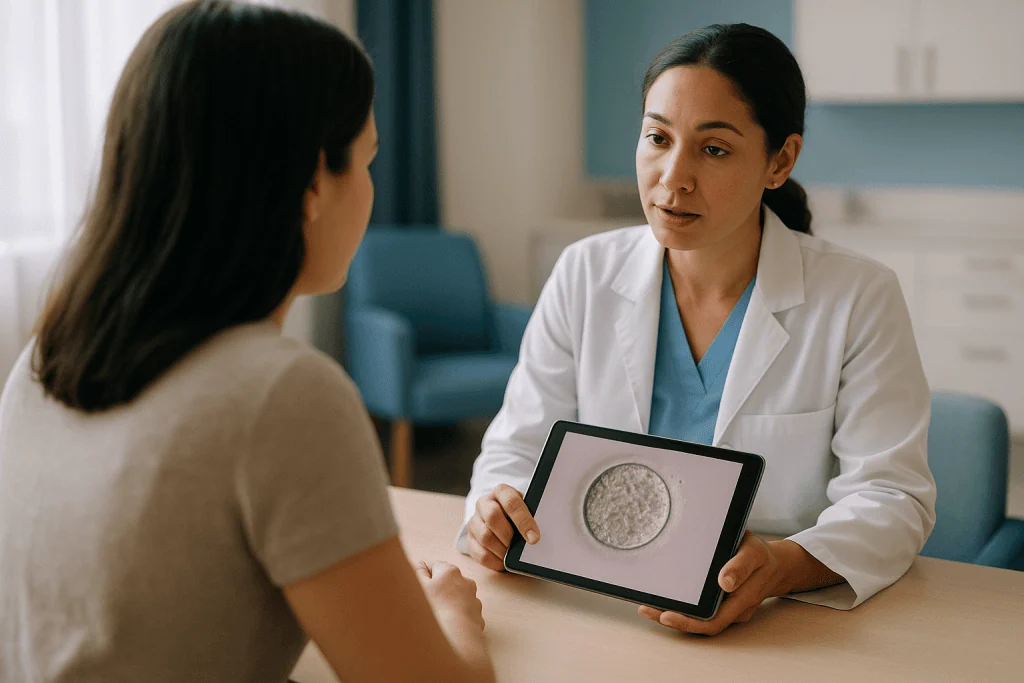
Why the wait of a few hours rather than injecting immediately? An egg finishes maturing in the follicle after the trigger injection, and some are collected a little before they are fully ready. A short rest in culture lets stragglers catch up. Inject too early and the egg’s internal machinery is not primed; wait too long and the egg begins to age in the dish. Laboratory protocols land on a window measured in hours, not days, and the exact timing is a judgment call made by the embryologist, not something you need to influence.
Sperm is usually produced on the morning of retrieval, or thawed from a frozen sample if that was the plan. It is washed and concentrated, and the embryologist selects individual sperm with normal shape and movement under high magnification. For men with no sperm in the ejaculate, sperm may have been retrieved surgically from the testicle beforehand; those samples are often frozen and thawed for the ICSI day.
So while you are at home deciding between the sofa and the bed, the injection is already finished. The eggs then go back into the incubator overnight. The first real piece of news, how many fertilized normally, is typically available the next morning, roughly 16 to 18 hours after the injection, when embryologists look for the two small structures (pronuclei) that show an egg has accepted the sperm’s genetic material.
Cramping after egg retrieval: why it happens and what is typical
Picture the ovaries at the end of stimulation. In a natural month a single follicle grows to about two centimeters. After stimulation medicines, each ovary may hold ten or more follicles of that size, so an organ normally the size of an almond is temporarily closer to a lemon or small orange. Those enlarged ovaries press on the bladder, bowel and pelvic ligaments, and that pressure registers as a dull, dragging ache.
Layer onto that the needle. Every follicle punctured leaves a tiny bleeding point on the ovarian surface, and a small amount of blood and follicular fluid often pools in the pelvis. Blood is irritating to the lining of the abdomen, which is why some people feel a sharper twinge when standing up or when the bladder fills.
The pattern most people describe is menstrual-type cramping that peaks on the day of retrieval and the day after, then eases steadily. The Mayo Clinic lists cramping, a feeling of fullness and pressure, and light vaginal bleeding among the common after-effects, and notes that most people return to normal activities within a day. Some soreness while walking or bending can linger for most of a week while the follicles collapse and shrink.
What helps is unglamorous: warmth across the lower abdomen, lying on whichever side eases the pressure, gentle short walks to keep the bowel moving, and over-the-counter pain relief only if your clinic has said which kind is compatible with the rest of your plan. Avoid anything you have not cleared with the team; some common analgesics are discouraged in the days around transfer and the team will have a specific view.
Cramping that steadily worsens instead of fading, or pain that becomes one-sided and sharp, is a different story, and it belongs in the “When to call your doctor” section below.
Bloating after egg retrieval: ovaries, fluid and the hormone picture
Bloating after egg retrieval has three sources, and separating them explains why it can get briefly worse before it gets better.
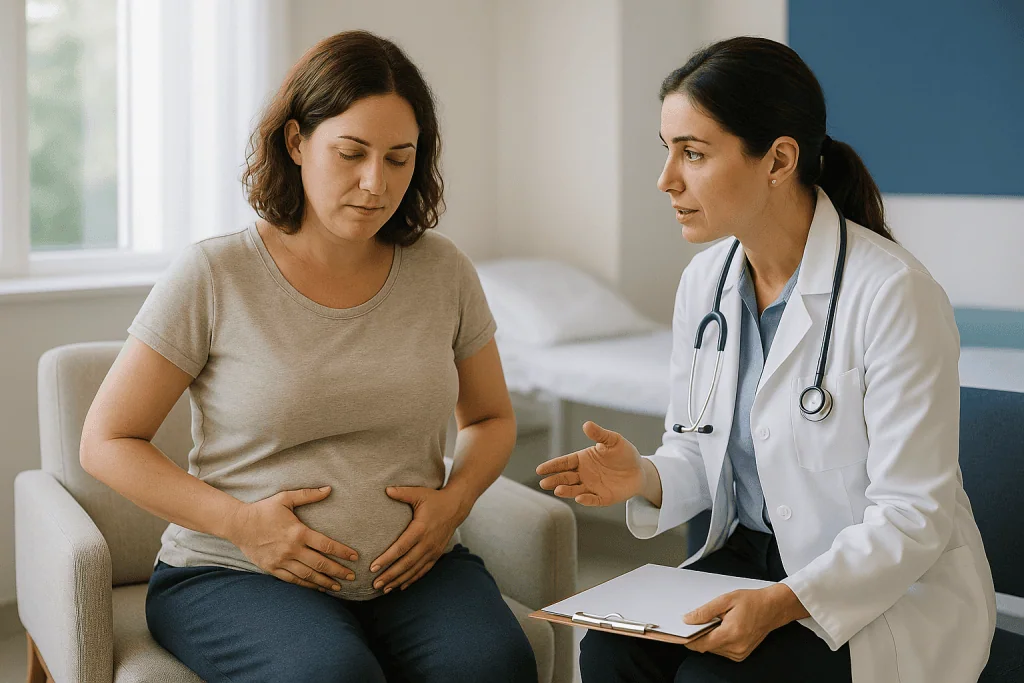
The first is the ovaries themselves. Retrieval removes the eggs but not the follicles; each punctured follicle fills with blood and becomes a corpus luteum, the small hormone-producing gland that would normally form after ovulation. With many follicles, the ovaries stay enlarged for a week or more.
The second is hormonal. Those corpora lutea produce large amounts of estrogen and progesterone, and the trigger injection adds hCG, the pregnancy hormone, to the mix. Together they relax smooth muscle in the bowel, which slows digestion and traps gas. Constipation after retrieval is almost universal for this reason, and it contributes as much to the tight-waistband feeling as the ovaries do.
The third source is fluid. High hormone levels make tiny blood vessels leakier, so a little fluid shifts out of the bloodstream into the abdomen. In most people this is modest and disappears within days. In a minority it becomes ovarian hyperstimulation syndrome (OHSS), which has its own section below.
Typical bloating feels like the day before a heavy period, is worst in the evening, and improves gradually over about a week. Loose clothing, small frequent meals, fiber and fluids, and gentle movement all help the bowel do its job. Weighing yourself each morning sounds excessive but gives you an objective marker, because fluid gain shows on the scale before it shows in a photograph.
Bloating that progresses day on day, a waistline you can measure growing, or feeling full after a few mouthfuls are signals to call rather than wait. The team may bring you in for an ultrasound and blood tests to check fluid and kidney function.
ICSI recovery after egg retrieval: what each day usually looks like
Timelines vary with how many eggs were collected, how high the hormone levels ran, and whether a fresh transfer is planned. The table shows the typical pattern described by the NHS and Mayo Clinic for an uncomplicated cycle; your own clinic’s instructions override it.
| Day | Your body | In the laboratory |
|---|---|---|
| Day 0 (retrieval) | Drowsy from sedation, period-type cramps, light spotting, urge to urinate | Eggs assessed for maturity; ICSI performed within hours |
| Day 1 | Cramping often peaks; bloating and constipation begin; most people walk and eat normally | Fertilization check: eggs with two pronuclei counted and reported |
| Day 2 | Soreness eases; luteal medicines underway if a fresh transfer is planned | Embryos at 2 to 4 cells; early cleavage noted |
| Day 3 | Bloating may be the main complaint; energy returning | Embryos at 6 to 8 cells; some programs transfer today |
| Day 5 | Most cramping gone; ovaries still enlarged on scan | Blastocyst stage; transfer, freezing or extended culture to day 6 |
| Days 7–14 | Waist returns toward normal; a period arrives if no transfer or if the cycle is unsuccessful | Frozen embryos stored; pregnancy test after transfer |
Two features of this timeline surprise people. First, the laboratory moves faster than the body; the fertilization call arrives while you are still too sore to sit comfortably. Second, if a freeze-all approach is chosen, recovery actually gets simpler, because without luteal support medicines the hormone levels fall and a period arrives roughly 10 to 14 days after retrieval, taking the bloating with it.
What the embryology team is watching while you recover
The incubator is not a waiting room. Embryologists are looking for specific milestones, and knowing them turns the daily phone calls from cryptic numbers into a story.
Fertilization is the first checkpoint. Not every mature egg accepts the sperm, even with ICSI placing it directly inside. The Cleveland Clinic reports that ICSI fertilizes roughly 50 to 80 percent of injected eggs. A result of seven fertilized from ten mature eggs is therefore within the expected range, not a disappointment, although it is natural to feel the drop from “eleven collected” to a smaller number.
Cleavage comes next. A fertilized egg should divide into two cells by day 2, four cells later that day, and roughly eight cells by day 3. Embryologists note the number of cells, how even they are, and how much cellular debris (fragmentation) is present. Uneven or heavily fragmented embryos can still produce pregnancies, but they are statistically less likely to.
Between day 3 and day 5 the embryo compacts into a tight ball and then forms a blastocyst: a fluid-filled sphere with an inner group of cells that becomes the fetus and an outer layer that becomes the placenta. Reaching this stage is a meaningful filter; a proportion of embryos that look fine on day 3 stop developing before day 5. This is why some people see their numbers fall again mid-week, and why many laboratories prefer to transfer or freeze at the blastocyst stage when enough embryos are available.
Grading systems differ between laboratories, so a “4AB” in one program is not directly comparable to a grade in another. Ask your embryologist to translate rather than comparing notes online. The grades describe appearance under a microscope; they do not see chromosomes, and an attractive embryo can still carry a chromosomal problem.
Who usually goes to a fresh transfer, and who is asked to wait
The fork in the road comes around day 3 to 5. A fresh transfer places an embryo into the uterus in the same cycle; a freeze-all cycle vitrifies (flash-freezes) every suitable embryo for transfer in a later, unstimulated month. The decision is clinical and belongs to your team, but the reasoning is predictable.
A fresh transfer is usually considered when hormone levels were moderate, the ovaries are not grossly enlarged, the uterine lining looks receptive on ultrasound, and there is no medical reason to delay. Many people in this group move straight on.
Waiting is more often advised in several situations:
- Risk of OHSS. The NHS and Mayo Clinic both note that pregnancy, through its own hCG, can turn mild OHSS into severe OHSS. Freezing embryos and letting the ovaries settle removes that risk for the current month.
- Very high progesterone before retrieval, which can make the lining out of step with the embryo.
- Genetic testing of embryos (PGT), because biopsy results take days to weeks.
- Fluid in the uterine cavity, a thin lining, bleeding, or an unexpected finding such as a polyp.
- Personal circumstances: illness, travel that cannot be moved, or simply needing a pause.
Being asked to wait can feel like a setback. The evidence suggests otherwise for many people: frozen transfers into a calmer uterus perform at least as well as fresh ones in most groups, and in those at high risk of OHSS they are the safer choice. The emotional cost is real; the biological cost, for a vitrified blastocyst, is small. Ask the team which factor drove the recommendation in your case, so the delay has a reason attached to it rather than feeling arbitrary.
Why electrolyte drinks, salt and protein keep coming up after egg retrieval
Scroll any fertility forum and you will see the advice to drink sports drinks and eat salty, protein-rich food in the days after retrieval. The reasoning is borrowed from the management of OHSS, and it is worth understanding what it can and cannot do.
The leaky-vessel problem described above means fluid drifts out of the bloodstream into the abdominal cavity. Plain water follows the same path, so drinking large volumes of water alone can leave the blood relatively concentrated while the belly swells. Drinks containing sodium and other electrolytes hold fluid in the circulation more effectively, and protein in the diet supports the blood proteins that keep fluid where it belongs. The Mayo Clinic lists increased fluid intake, including electrolyte-containing drinks, and avoiding strenuous activity among the usual comfort measures for mild OHSS, under a clinician’s guidance.
Three honest caveats. First, this is supportive care for the minority who develop fluid shifts; for someone with mild bloating and no OHSS it is harmless but not transformative. Second, no particular branded product has been shown to improve outcomes, and oral rehydration solutions, broth, or any drink with a reasonable sodium content do the same job. Third, if you have high blood pressure, kidney disease or diabetes, the salt and sugar in these drinks matter, and your team should set the plan.
Monitoring your own urine output is more useful than any specific drink. Passing less urine than usual despite drinking, or urine that is consistently dark, suggests the body is holding fluid in the wrong place and is one of the signals clinicians ask about when assessing OHSS. Treat the beverage advice as one small tool, not a shield.
Progesterone and the luteal phase: what the medicines are doing
If a fresh transfer is planned, you will usually start luteal support shortly after retrieval. The luteal phase is the second half of a cycle, when the lining of the uterus is prepared for an embryo. Understanding why the medicine is there makes the daily routine less of a chore.
In a natural cycle the single corpus luteum produces progesterone until a placenta can take over. In a stimulated cycle the ovaries hold many corpora lutea, which sounds like it would mean more than enough progesterone. The problem lies elsewhere: the medicines used to stop premature ovulation during stimulation also suppress the brain signal (luteinizing hormone) that keeps the corpora lutea working. Without that signal they fade early, progesterone falls, and the lining can shed before an embryo has a chance to implant. Supplementing progesterone bridges the gap.
The hormone is usually given vaginally, by injection, or occasionally by mouth, and continues through the pregnancy test and, if positive, for several more weeks until the placenta is established. The form, timing and duration are decisions for the prescribing clinician and differ between programs for sound reasons; this article deliberately describes none of them.
Progesterone has side effects that overlap confusingly with early pregnancy and with retrieval recovery: breast tenderness, tiredness, mild nausea, constipation, and more bloating. Vaginal preparations can cause discharge and irritation. This overlap is why the two-week wait is so difficult to read, and why most clinics ask people not to interpret symptoms, in either direction, before the blood test.
In a freeze-all cycle luteal support is usually not given, hormone levels fall naturally and a period follows. Nothing has been withheld; the medicine simply has no job to do that month.
Signs of OHSS after egg retrieval and how it is graded
Ovarian hyperstimulation syndrome is the complication every fertility nurse is quietly screening for during the week after retrieval. It happens when the stimulated ovaries release substances that make blood vessels leaky, shifting fluid out of the circulation into the abdomen and, in severe cases, around the lungs.
The NHS reports that mild OHSS is common, affecting up to about a third of people undergoing IVF-type treatment, while severe OHSS is rare, in the region of 1 in 100 cycles. Risk is higher with a large number of follicles, polycystic ovaries, high estrogen levels, younger age, low body weight, a previous episode, and especially if pregnancy follows a fresh transfer, because the embryo’s hCG restarts the process.
Mild OHSS feels like an exaggerated version of normal recovery: abdominal bloating and discomfort, mild nausea, enlarged ovaries on ultrasound. It usually settles within a week to ten days with rest, fluids and monitoring.
Moderate OHSS adds measurable fluid in the abdomen on ultrasound, more marked swelling, and often vomiting. Severe OHSS involves large fluid collections, rapid weight gain, very little urine, concentrated blood, breathlessness from fluid around the lungs, and a raised risk of blood clots because the blood is thickened and movement is reduced. Severe cases are admitted to hospital for intravenous fluids, blood-thinning injections, and sometimes drainage of abdominal fluid.
Timing matters for interpretation. Early OHSS appears within about a week of the trigger injection and is driven by the trigger itself. Late OHSS appears around ten or more days after retrieval and almost always means a pregnancy has begun; it tends to be more prolonged. Either way, the trend is the key observation. Symptoms that plateau and then recede are reassuring; symptoms that climb each day are the ones your team wants to hear about the same day.
Is it harder to get pregnant after egg retrieval?
This question hides two worries, and each deserves a straight answer.
The first is about the current cycle: does the procedure itself bruise the uterus or ovaries in a way that lowers the chance of implantation? The needle passes through the vaginal wall into the ovaries; it does not enter the uterus or touch the lining where an embryo would implant. The lining is affected by hormone levels, not by the retrieval. This is precisely why clinics freeze embryos when hormone levels are extreme, and why a frozen transfer a month or two later gives the uterus a quiet, well-prepared environment.
The second worry is long-term: does removing a dozen eggs deplete the supply and make future conception, natural or assisted, harder? The eggs collected in a stimulated cycle are the cohort that was already recruited for that month. Without stimulation, one would have ovulated and the rest would have been lost through the normal process of follicle death (atresia). Stimulation rescues the group rather than drawing extra eggs from the future reserve. Medical reference sources, including MedlinePlus, do not list reduced future fertility as a consequence of egg collection.
There are genuine but uncommon exceptions. Infection after retrieval, or a significant bleed into the ovary, can leave scarring, and the NHS lists pelvic infection and bleeding among the rare procedural risks. These are reasons to take fever and worsening pain seriously, not reasons to fear a routine, uncomplicated collection.
Natural conception after a treatment cycle, including in the month or two following an unsuccessful transfer, is well documented and is one of the quietly cheering facts in fertility medicine. The retrieval has not closed any doors.
What people often get wrong about ICSI recovery
Some myths cause needless worry; a few cause real harm by delaying a phone call. These are the ones worth retiring.
“Bed rest improves the result.” It does not, and it raises the risk of blood clots at a time when hormone levels already thicken the blood. Gentle walking from the first day is what guidance supports. Rest when tired, move when you can.
“More eggs always means a better cycle.” A high count raises the chance of having a blastocyst to transfer, but it also raises OHSS risk and often leads to a freeze-all decision. A modest number of mature eggs can produce an excellent outcome. Quality and maturity, not the headline number, drive the result.
“ICSI guarantees fertilization.” As the Cleveland Clinic notes, around 50 to 80 percent of injected eggs fertilize. Total fertilization failure is rare with ICSI but not impossible; it usually points to an egg or sperm factor rather than a laboratory error.
“Bloating means it worked.” Bloating in the first week comes from the ovaries and from luteal medicines, and it occurs whether or not an embryo implants. Likewise, cramping during the two-week wait has no reliable meaning.
“Painkillers are banned.” Most clinics approve a specific over-the-counter option and discourage others; the rule is to ask, not to suffer, and not to improvise.
“Sports drinks prevent OHSS.” They are a supportive measure for fluid balance, not a preventive. Prevention lies in the stimulation plan, the choice of trigger and the freeze-all decision, all of which sit with the team.
“Grades online are comparable to mine.” Grading systems vary between laboratories, and appearance does not reveal chromosomes. Comparing a stranger’s embryo photo with yours is the fastest route to unnecessary distress.
What the numbers actually show about first-time ICSI
People search for the success rate of a first ICSI cycle expecting a single figure. There is no honest single number, because the chance of a live birth depends far more on the age of the person whose eggs are used, the number of good-quality embryos, and the underlying diagnosis than on the ICSI step itself.
Two evidence-based points frame expectations. First, ICSI exists to solve a fertilization problem, mainly male-factor infertility. When sperm parameters are normal, large studies and guideline bodies have not found that adding ICSI improves the live-birth rate over conventional IVF; it simply adds a laboratory step. If your clinic recommends ICSI, ask what problem it is solving in your case.
Second, age governs the odds. The NHS publishes national IVF live-birth rates per embryo transferred that fall steadily with the age of the egg provider: around a third of cycles for those under 35, declining through the late thirties, and well under one in ten after 42. These are population averages drawn from all cycles, not a prediction for any individual, and they describe outcomes per transfer rather than per retrieval.
A first cycle also carries information value. The team learns how your ovaries respond to a given stimulation plan, how your eggs fertilize and how embryos develop, and that knowledge shapes any second attempt. A first cycle that ends without a pregnancy but with frozen embryos stored is, in practical terms, a partial success that most people do not count.
Beware any source, including a clinic website, that quotes a single success percentage without stating age band, denominator (per retrieval, per transfer or per embryo) and whether the figure is a clinical pregnancy or a live birth. The denominators matter more than the headline.
Getting back to normal: work, exercise, sex and travel during ICSI recovery after egg retrieval
The practical questions arrive on the second day, once the cramping fades enough to think about the diary.
Work. Most people take the retrieval day and often the following day off, then return to desk-based work. Physically demanding jobs may need a few more days while the ovaries remain enlarged and tender. Sedation is the hard limit: no driving, operating machinery or signing important documents for 24 hours.
Exercise. Walking is encouraged from the first day. High-impact exercise, heavy lifting, twisting sports and anything that jolts the pelvis are usually paused for one to two weeks, until the ovaries have shrunk back. The specific concern is ovarian torsion, in which an enlarged, heavy ovary twists on its own blood supply, causing sudden severe one-sided pain that needs urgent surgical assessment. It is uncommon, but enlarged ovaries are the main risk factor, which is why the restriction exists.
Sex. Many clinics advise avoiding penetrative sex for a week or so after retrieval, because of the puncture sites, the enlarged ovaries and, in a fresh-transfer cycle, the small chance that unretrieved follicles release eggs. Ask your team for their guidance rather than assuming.
Travel. Short journeys are fine once the sedation has worn off. Longer trips, especially flights, are better delayed until any OHSS risk has passed, typically a week to ten days, and until you are within reach of your clinic for the fertilization news and any transfer. Hormone levels raise clot risk, so on any long journey walk the aisle hourly, keep fluids up, and discuss compression stockings with the team.
Alcohol and smoking. Both are discouraged throughout treatment, and alcohol interacts with sedation for the first day.
Mood. Hormone swings, fatigue and waiting make tearfulness and irritability common in this week. It is physiology as much as circumstance, and it passes.
Questions to ask your care team after egg retrieval
The days after retrieval are full of phone calls that last ninety seconds. Having questions ready turns them into useful conversations. These are the ones that tend to matter most.
- How many eggs were mature, and how many fertilized normally? Ask for both numbers, because the gap between them tells you more than either alone.
- What day will you make the fresh-versus-freeze decision, and which factors will drive it in my case?
- What is my personal OHSS risk based on my follicle count and hormone levels, and what specific symptoms should prompt a call?
- Which over-the-counter pain relief is compatible with my plan, and which should I avoid?
- When will I hear about embryo development, and on which days should I expect no call at all?
- If embryos are frozen, how many are at the blastocyst stage, and how does your laboratory grade them?
- Was ICSI used for all eggs or a proportion, and what was the reason in my cycle?
- If a transfer goes ahead, when is the pregnancy test, and what happens to the medicines if it is positive or negative?
- How long should I pause exercise, sex and travel, and is there anything specific to my job I should know?
- Who do I contact out of hours, and what counts as an emergency rather than a routine query?
- If this cycle does not produce a pregnancy, what will you have learned from it, and what would change next time?
Write the answers down or ask for them in the patient portal. Sedation blunts memory on day 0, and the emotional weight of the week blurs the rest. A written record also makes any later cycle easier to plan, because the response to stimulation and the fertilization pattern are the two most useful facts a first cycle produces.
When to call your doctor
Most recovery after ICSI egg retrieval is uncomfortable but uneventful, and the pattern is the reassuring part: symptoms peak within a day or two and then recede. The signals below break that pattern and need same-day advice from your fertility unit or, out of hours, emergency care.
- Abdominal pain that worsens rather than eases after the first 24 to 48 hours, or that is not controlled by the pain relief your team approved.
- Sudden severe one-sided pelvic pain, especially with nausea or vomiting, which can indicate ovarian torsion and needs urgent assessment.
- Rapidly increasing bloating, a measurable increase in waist size, or weight gain of more than about a kilogram (two pounds) from one day to the next, a pattern the Mayo Clinic flags as a sign of worsening OHSS.
- Passing much less urine than usual despite drinking, or dark concentrated urine.
- Persistent vomiting or being unable to keep fluids down.
- Shortness of breath, chest pain, or a cough that is new, which can indicate fluid around the lungs or, rarely, a blood clot in the lung.
- Pain, swelling, warmth or redness in a calf, which can indicate a clot in the leg.
- Heavy vaginal bleeding, soaking a pad an hour, or bleeding that does not settle.
- Fever, chills, or foul-smelling discharge, which can indicate pelvic infection.
- Fainting, dizziness on standing, or a racing heartbeat.
Call sooner rather than later. Fertility units expect these calls in the week after retrieval and would far rather assess a person who turns out to have ordinary bloating than miss early severe OHSS or a clot. If you cannot reach the unit and any of the breathing, chest, calf, fainting or severe pain symptoms are present, treat it as an emergency.
Every decision about what happens next, from a hospital review to the timing of a transfer, sits with your treating team, who know your hormone levels, your scan findings and your history. This article explains the territory; they hold the map.
Frequently asked questions
How long after egg retrieval is ICSI done?
ICSI is almost always performed on the same day as egg retrieval, within a few hours of collection. Eggs are first checked for maturity, because only mature eggs can be injected, and a short rest in culture allows late-maturing eggs to catch up. The injected eggs then return to the incubator overnight, and fertilization is assessed the following morning, roughly 16 to 18 hours later.
What is the typical egg retrieval recovery time before I feel normal?
Most people are back to light daily activity within a day or two and feel largely themselves within about a week. Cramping fades fastest; bloating and constipation linger longer because the ovaries stay enlarged and hormone levels remain high. Higher egg numbers and fresh-transfer medicines tend to extend the bloated phase, while a freeze-all cycle usually resolves once a period arrives around 10 to 14 days later.
What is the success rate for first-time ICSI?
There is no single figure, because live-birth chances depend mainly on the age of the egg provider, embryo quality and the underlying diagnosis rather than on the ICSI step. National NHS data for IVF-type cycles show rates per transfer falling from around a third under age 35 to well under one in ten after 42. ICSI does not raise these rates when sperm is normal; it exists to overcome fertilization problems.
Is it harder to get pregnant after egg retrieval?
No. The retrieval needle enters the ovaries through the vaginal wall and never touches the uterine lining, and the eggs collected are those already recruited for that month, which would otherwise have been lost. Future egg reserve is not reduced. Rare complications such as infection or significant bleeding can cause scarring, which is why fever or worsening pain should be reported promptly, but routine collection does not lower future fertility.
Why do people drink electrolyte or sports drinks after egg retrieval?
After stimulation, hormone changes make small blood vessels leaky, so fluid can shift from the bloodstream into the abdomen. Drinks containing sodium and electrolytes help keep fluid in the circulation better than plain water, which is why they are suggested as supportive care for mild ovarian hyperstimulation. Any electrolyte drink, broth or oral rehydration solution does the same job; no branded product improves outcomes, and your team should set the plan.
How much bloating after egg retrieval is normal?
Bloating that feels like the day before a heavy period, is worse in the evening and slowly improves over about a week is typical. It comes from enlarged ovaries, slowed digestion and mild fluid shifts. Bloating that increases day after day, a measurable growth in waist size, rapid weight gain, feeling full after a few mouthfuls or passing little urine are signs of worsening ovarian hyperstimulation and need a same-day call.
What are the early signs of OHSS after egg retrieval?
Early OHSS appears within about a week of the trigger injection with progressive abdominal swelling, nausea, discomfort and sometimes vomiting. Mild cases affect up to about a third of stimulated cycles and settle with rest, fluids and monitoring. Rapid weight gain, very little urine, breathlessness or severe pain indicate a more serious form that needs urgent assessment. Late OHSS, starting ten or more days after retrieval, usually signals an early pregnancy.
Why did my embryo numbers fall between the fertilization call and day 5?
Attrition at each stage is normal biology. Only mature eggs can be injected, 50 to 80 percent of those typically fertilize, and a proportion of fertilized embryos stop developing before reaching the blastocyst stage on day 5 or 6. Reaching blastocyst is a meaningful filter that tends to select embryos with better developmental potential, which is why many laboratories prefer to transfer or freeze at that stage.
Why was I told to freeze all my embryos instead of having a fresh transfer?
The most common reasons are a risk of ovarian hyperstimulation, since pregnancy hormones can worsen it, very high hormone levels that may put the uterine lining out of step with the embryo, planned genetic testing of embryos, or an unexpected finding such as fluid in the uterus. Frozen transfers into a calm, unstimulated uterus perform at least as well as fresh ones for most people, so the delay is a safety measure rather than a setback.
When can I exercise, have sex and travel after ICSI egg retrieval?
Gentle walking is encouraged from day one. High-impact exercise, heavy lifting and twisting sports are usually paused for one to two weeks to avoid torsion of the enlarged ovaries. Many clinics advise no penetrative sex for about a week. Longer travel and flights are best delayed until any OHSS risk has passed, typically a week to ten days, with hourly walking and good hydration on any long journey to reduce clot risk.
References
This article is for general information only and is not a substitute for professional medical advice. Please consult a qualified doctor about your individual situation.

More from the Blog
After Male Reproduction Testing: How Results Point to Lifestyle Steps, Procedures or IVF
After male fertility testing, results usually steer care in one of four directions. Borderline semen findings often lead to lifestyle changes and a repeat…

Who Is a Candidate for IUI Insemination? Tube Health, Sperm Findings and Age Considerations
A good candidate for IUI usually has at least one open fallopian tube, ovulates or can be helped to ovulate with medicine, and has…
Is It Time for a Second Opinion on Infertility Treatment? When a Fresh Review Makes Sense
An infertility second opinion is a fresh, independent review of your test results, diagnosis and treatment plan by a different fertility specialist. It commonly…

Egg Quality: Can Supplements Improve It? What CoQ10 and Others Show
CoQ10 cannot reverse age-related decline in egg quality, but small randomized trials suggest that taking it for a few months before IVF may modestly…
PCOS Hair Loss and Acne: The Androgen Link and the Treatments That Address It
PCOS hair loss and acne are both driven mainly by excess androgens, the hormones that shrink scalp follicles and overstimulate oil glands, often amplified…

The Endometriosis Diet: What Anti-Inflammatory Eating Can and Cannot Do
An endometriosis diet rich in vegetables, fruit, whole grains, legumes, fish and olive oil, with fewer trans fats, processed meats and alcohol, may ease…