

What Makes a UTI Complicated? Obstruction, Catheters, Pregnancy and Kidney Involvement

Key Takeaways
- A UTI is classed as complicated because of the person and setting, not the intensity of symptoms: being male, pregnant, catheterized, diabetic, immunosuppressed or having a blocked or abnormal urinary tract all qualify.
- An infected kidney behind a blockage is a medical emergency in which antibiotics alone rarely work until the obstruction is drained with a stent or nephrostomy tube.
- The CDC attributes the large majority of hospital-acquired UTIs to urinary catheters, with infection risk rising every day the device remains in place.
- Pregnancy is always treated as complicated because hormonal and mechanical changes make it easier for bacteria to climb to the kidneys, which is why even symptom-free bacteria in urine are treated.
- Persistent fever or worsening pain after 48 to 72 hours of appropriate treatment is the standard trigger for imaging and reassessment, according to the StatPearls review.
- Bacteria in the urine of an older adult or a person with a long-term catheter who has no symptoms is usually colonization, and treating it offers no benefit while fueling resistance.
A UTI is called complicated when something about the person or their urinary tract raises the risk that standard treatment will fail or the infection will spread. Common reasons include blocked urine flow from stones or an enlarged prostate, a urinary catheter, pregnancy, infection reaching the kidneys, diabetes, a weakened immune system, being male, or abnormal urinary anatomy. The label guides testing, antibiotic choice and follow-up rather than describing how painful it feels.
The burning had started on a Tuesday, and by Thursday she was 31 weeks pregnant, sitting on the edge of an exam table, and hearing a word she did not expect: complicated. Her symptoms were no worse than the bladder infection she had shrugged off in college. Nothing about it felt dramatic. Yet the midwife wanted a urine culture sent, a follow-up scheduled, and a call if she ran a fever.
Across the hall, a man in his seventies with a catheter was hearing the same word for a different reason. So was a woman whose scan had shown a kidney stone sitting where urine should have been flowing freely.
Understanding what makes a UTI complicated clears up that confusion. The term is not a verdict on severity or on how you feel. It is a clinical shorthand for the circumstances that change how doctors think, test and treat, and knowing which circumstances count helps you ask better questions.
What makes a UTI complicated? The definition doctors actually use
Ask three patients what a complicated urinary tract infection is and most will describe a bad one: high fever, days off work, a hospital bed. Clinicians mean something narrower and more useful. A urinary tract infection, or UTI, is an infection anywhere along the path urine takes, from the kidneys down through the ureters, bladder and urethra. It becomes complicated when a structural, functional or host-related factor increases the likelihood that the infection will resist standard treatment, recur, or spread beyond the bladder.
The StatPearls reference published through the NIH frames it this way: an uncomplicated UTI is a bladder infection in a healthy, non-pregnant woman with a normal urinary tract. Everything outside that box tends to be treated as complicated. That includes infections in men, in pregnancy, in people with diabetes or suppressed immunity, in anyone with a catheter or a blockage, and any infection that has reached the kidneys.
Why draw the line there? Because the healthy female bladder is unusually forgiving. Its lining sheds infected cells, frequent urination flushes bacteria out, and a short course of antibiotics usually finishes the job. Remove one of those advantages and the arithmetic changes. Urine that pools behind a stone cannot flush anything. A catheter gives bacteria a permanent surface to cling to. A weakened immune system cannot mount the usual counterattack.
The label therefore triggers a different workflow. Doctors are more likely to send a urine culture before starting treatment, choose a broader antibiotic while waiting for results, consider imaging, plan a longer course, and arrange follow-up rather than assuming the story ends when symptoms fade. None of that means panic. It means the infection is being taken seriously in proportion to the conditions around it.
Complicated vs uncomplicated UTI: what is actually happening inside the urinary tract
Picture the urinary tract as a plumbing system that stays clean mostly by flow. Urine is produced continuously in the kidneys, travels down two narrow tubes called ureters, collects in the bladder and leaves through the urethra. Bacteria, most often Escherichia coli from the bowel, reach the urethral opening constantly. What prevents infection is not sterility but movement: each void carries stragglers out before they establish a foothold.
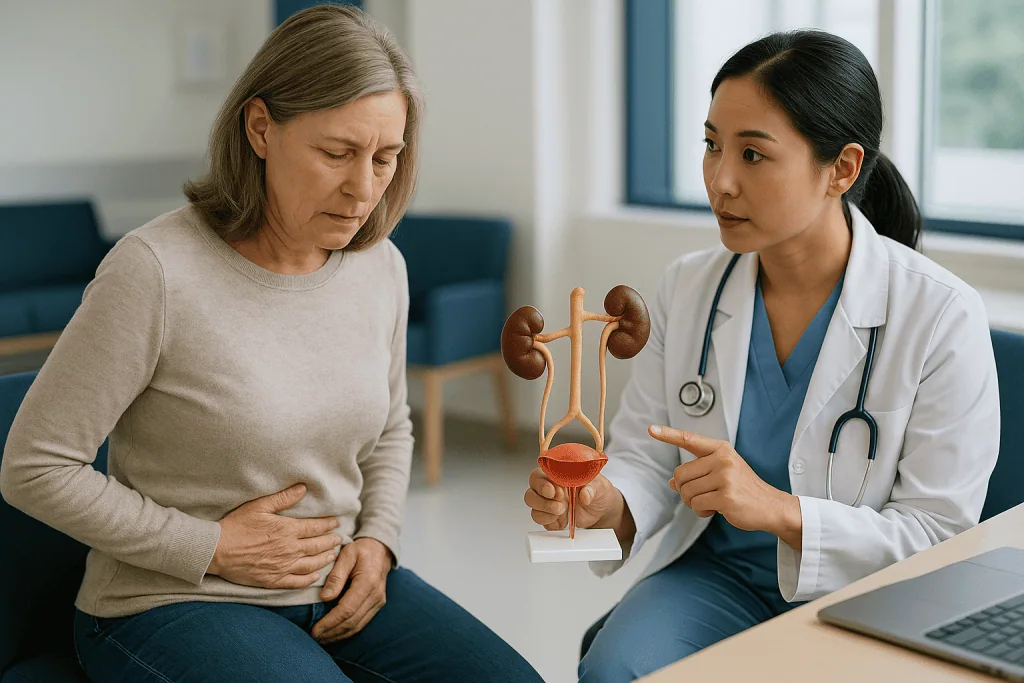
Infection begins when bacteria adhere to the bladder wall using hair-like projections called fimbriae, multiply faster than they are flushed, and provoke inflammation. The result is the familiar burning, urgency and frequency of cystitis, the medical term for bladder infection. According to the Mayo Clinic, E. coli is responsible for the majority of these infections, precisely because it is so well equipped to cling on.
In an uncomplicated case, the story usually ends there. The bladder lining releases immune signals, white cells arrive, antibiotics tip the balance and symptoms settle within days.
A complicated infection is one in which the defenses have a gap. If urine cannot drain fully, bacteria sit in a warm, nutrient-rich reservoir with time to multiply. If a foreign object such as a catheter is present, bacteria form a protective slime layer called biofilm that shields them from both immune cells and antibiotics. If the valves where the ureters enter the bladder leak backward, infected urine can climb toward the kidneys. Once bacteria reach kidney tissue, which is rich in blood vessels, they have a route into the bloodstream. That progression, from bladder to kidney to blood, is what the complicated label is designed to anticipate and interrupt.
Obstruction: why blocked urine flow changes everything
Of all the factors that make a UTI complicated, obstruction is the one clinicians worry about most urgently. Anything that narrows or blocks the passage of urine turns the system from a river into a pond. Kidney stones are the classic example. An enlarged prostate in men, scar tissue narrowing the urethra, a tumor pressing on a ureter, or a bladder that no longer empties properly because of nerve damage all do the same thing.
The consequences build in layers. Stagnant urine allows bacteria to multiply unchecked. Pressure backs up toward the kidney, causing swelling called hydronephrosis, which means urine is stretching the kidney’s collecting system because it cannot escape. Antibiotics carried in the blood reach obstructed, infected tissue poorly. And the pressure itself damages kidney cells over time.
The StatPearls review describes an infected, obstructed kidney as a genuine emergency, because the combination can progress to sepsis quickly. The treatment logic follows from the mechanism: antibiotics alone are rarely enough when urine is trapped. The blockage has to be relieved, either by placing a thin tube called a ureteral stent past the stone, or by inserting a drainage tube through the back directly into the kidney, known as a nephrostomy. Only once urine is flowing again can medication do its work.
Some bacteria exploit obstruction further. Proteus species produce an enzyme that makes urine alkaline, encouraging a type of stone that grows around the bacteria themselves. The stone then shelters the infection, and the infection feeds the stone. Breaking that loop requires removing the stone entirely, which is why a urologist, a surgeon specializing in the urinary tract, is often part of the team when obstruction and infection coincide.
Catheter-associated UTI: how a tube turns infection into a different problem
A urinary catheter is a flexible tube placed through the urethra, or sometimes through the abdominal wall, to drain the bladder when a person cannot empty it themselves. It saves lives in intensive care, after surgery and in long-term neurological conditions. It also gives bacteria something they rarely get in a healthy bladder: a permanent surface.

Within hours of insertion, microbes begin coating the catheter with biofilm, a structured community of bacteria embedded in a slime they produce themselves. Biofilm behaves less like a colony and more like a fortress. Immune cells struggle to penetrate it, and antibiotic concentrations that would clear free-floating bacteria barely dent the organisms inside. The catheter also holds the urethral opening ajar and provides a track along which bacteria can travel from the skin into the bladder.
The CDC reports that catheter-associated urinary tract infections are among the most common healthcare-associated infections, with the large majority of hospital-acquired UTIs linked to a catheter, and that the risk of infection rises with every day the device stays in place. That single fact drives much of modern hospital practice: catheters are inserted only when there is a clear reason and removed as soon as that reason ends.
Catheters create one further wrinkle. Nearly everyone with a long-term catheter has bacteria in their urine. That is colonization, not infection, and the CDC and StatPearls both caution against treating it in the absence of symptoms such as fever, new pain, or a change in mental state. Treating colonized urine breeds resistance without helping the patient. When true infection is diagnosed, part of the treatment is usually replacing the catheter itself, because leaving the biofilm-coated tube in place invites the infection straight back.
UTI in pregnancy: why every infection gets the complicated label
Pregnancy reshapes the urinary tract in ways that favor bacteria, which is why a bladder infection that would be routine at any other time is treated as complicated the moment a pregnancy test is positive.
The hormone progesterone relaxes smooth muscle throughout the body, including the muscle in the ureters. Those tubes widen and move urine more sluggishly. As the uterus grows, it presses on the ureters, particularly the right one, causing a mild, physiological version of hydronephrosis in many pregnancies. Blood flow to the kidneys increases, producing more urine, and the bladder holds it under more pressure with less complete emptying. Each change alone is minor. Together they make it easier for bacteria to climb from bladder to kidney.
The NHS notes that pregnant women are more prone to UTIs and to kidney infections specifically. That matters for two people. A kidney infection in pregnancy can trigger high fever, dehydration and, in serious cases, sepsis in the mother. Research summarized by the NIH also links untreated urinary infection in pregnancy with preterm labor and low birth weight, which is why obstetric care includes routine urine testing even when there are no symptoms.
That screening addresses a condition called asymptomatic bacteriuria: significant bacteria in the urine without any complaint. Outside pregnancy it is generally left alone. During pregnancy it is treated, because a meaningful share of these silent infections would otherwise progress to the kidneys.
Antibiotic choice is more constrained in pregnancy, since some classes are avoided at certain stages for the baby’s safety. The obstetric team weighs infection risk against medication risk case by case, and a repeat urine test after treatment is common to confirm the bacteria are gone rather than merely quieter.
Kidney involvement: when a bladder infection becomes pyelonephritis
Pyelonephritis is the medical name for a kidney infection: bacteria have traveled up the ureter and are now inflaming the kidney tissue itself. It sits on the far side of the line that separates uncomplicated from complicated, and it feels different. Where cystitis is local and irritating, pyelonephritis is systemic. The Mayo Clinic describes fever, chills, pain in the back or side just below the ribs, nausea and vomiting, often on top of the bladder symptoms that preceded it.
The kidneys are dense with blood vessels, filtering the entire blood volume many times a day. That makes them a poor place to have an infection, because bacteria can slip from kidney tissue into the circulation. When they do, the result is bacteremia, meaning bacteria in the blood, and potentially urosepsis, the body’s dangerous, whole-system response to a urinary infection. Sepsis is what turns a UTI from an uncomfortable week into a medical emergency.
Repeated or severe kidney infections can also leave scars. Scarred kidney tissue no longer filters, and in children with underlying reflux, or adults with recurrent obstruction, cumulative scarring can impair kidney function over years. A collection of pus inside or around the kidney, called an abscess, is a rarer complication that may need drainage as well as antibiotics.
Doctors usually manage milder kidney infections at home with oral antibiotics and close follow-up. Hospital admission for intravenous treatment is more likely with high fever, vomiting that prevents keeping medication down, pregnancy, significant underlying illness, or suspected obstruction. The StatPearls review advises imaging, typically an ultrasound or CT scan, when a patient is not clearly improving within about 48 to 72 hours of starting appropriate treatment, since persistent fever suggests a stone, abscess or blockage that antibiotics alone cannot resolve.
Who is usually told their UTI is complicated, and who is usually asked to wait
Beyond the four headline factors, several other circumstances routinely move an infection into the complicated category. Men are included almost by default: their longer urethra makes infection less common, but when it occurs it frequently involves the prostate, which is difficult for antibiotics to penetrate and slow to clear. People with diabetes face higher glucose in their urine, which feeds bacteria, along with nerve changes that can impair bladder emptying and immune responses that are slightly blunted. Anyone taking medication that suppresses the immune system, including transplant recipients and people undergoing chemotherapy, has less capacity to contain infection. Children with structural abnormalities, adults with spinal cord injuries, people who have recently had a urinary procedure, and those whose infection began in a hospital or nursing home all fall into the same broad group. So does anyone whose infection keeps returning or has not responded to first-line treatment.
The flip side is equally important. Not every positive urine test needs antibiotics, and doctors are increasingly asked to hold back in specific situations. Bacteria in the urine of an older adult who feels well is usually colonization. The same is true for someone with a long-term catheter and no fever or new symptoms. The NHS and the CDC both discourage treating these findings, because the antibiotics deliver no benefit and drive resistance.
A healthy, non-pregnant woman with mild bladder symptoms may also be offered a short delay: fluids, pain relief and a prescription to fill only if things have not improved within a couple of days. The NHS notes that mild UTIs sometimes settle without antibiotics. Watchful waiting is never the plan for someone with a complicating factor, which is exactly why the label exists.
Complicated vs uncomplicated UTI at a glance
The distinction becomes clearer when the two categories are set side by side. The table below summarizes how clinicians typically approach each, drawing on the StatPearls review and NHS guidance. Individual care varies, and the treating team decides which path applies.
| Feature | Uncomplicated UTI | Complicated UTI |
|---|---|---|
| Typical patient | Healthy, non-pregnant woman with normal urinary tract | Men, pregnant women, people with catheters, obstruction, diabetes, immune suppression or abnormal anatomy |
| Location | Bladder only | Bladder, or extended to kidneys or bloodstream |
| Urine culture before treatment | Often not needed | Usually sent, to identify the organism and its sensitivities |
| Imaging | Rarely | Considered when obstruction, stones or poor response suspected |
| Antibiotic approach | Short course of a first-line agent | Broader initial choice, adjusted to culture results; longer course |
| Other interventions | Fluids, pain relief | Relief of obstruction, catheter change, sometimes hospital admission |
| Follow-up | Return only if symptoms persist | Planned review; repeat testing in pregnancy and some other groups |
Two points deserve emphasis. First, the complicated column is not a description of how ill a person looks on day one. A pregnant woman with mild burning and a man with a catheter and a low-grade fever are both in it. Second, the extra steps are not defensive medicine. Each responds to a specific mechanism described earlier: the culture because resistant organisms are more common in this group, the imaging because trapped urine defeats antibiotics, the longer course because bacteria in prostate tissue or biofilm take longer to clear.
How do I know if my UTI is complicated? Signs of a complicated UTI your doctor looks for
You cannot reliably classify your own infection, and this is not a checklist for doing so. What you can do is understand the questions your clinician is silently asking, so the conversation goes faster and nothing relevant gets left out.
The first question is about you rather than your symptoms. Are you male? Pregnant, or possibly pregnant? Do you have diabetes, kidney disease, a transplant, or take medication that suppresses immunity? Have you had kidney stones, prostate problems, urinary surgery, or a catheter, even briefly? Did the infection start in a hospital or care facility? A yes to any of these places the infection in the complicated category before a single test result returns, which is why offering that history unprompted is genuinely helpful.
The second question is whether the infection has moved beyond the bladder. Bladder symptoms are local: burning, urgency, frequency, cloudy or bloody urine, pressure low in the pelvis. The Cleveland Clinic and the NHS describe the features that suggest the kidneys are involved as fever, shaking chills, pain in the flank or back below the ribs, nausea, vomiting and a general sense of being unwell. Any of these shifts the assessment.
The third question is whether the body is showing signs of a systemic response, which is what people usually mean when they ask what qualifies as a severe UTI. Confusion, rapid breathing, a racing heart, low blood pressure, very little urine output or skin that is cold and mottled point toward sepsis and need emergency evaluation, whatever the underlying category.
The final question is history. Has this happened before, and did the last treatment work? An infection that returns within weeks, or never fully cleared, is treated as complicated because something, whether a resistant organism or a hidden structural problem, is keeping it alive.
What is the hardest UTI bacteria to get rid of?
There is no single champion, but a few organisms consistently make complicated infections harder to treat, and understanding why helps explain the emphasis on urine cultures.
E. coli remains the most common cause even in complicated infections, according to StatPearls, but the strains found in hospitals and in people with repeated antibiotic exposure are increasingly likely to carry resistance genes. The most discussed are those producing extended-spectrum beta-lactamases, or ESBLs: enzymes that destroy several of the most widely used antibiotic classes. An ESBL-producing E. coli can look identical on a routine test to a susceptible one; only the culture and sensitivity report reveals the difference. That gap between starting treatment and knowing what will work is the central challenge of complicated UTI.
Klebsiella species behave similarly and frequently carry the same resistance mechanisms. Pseudomonas aeruginosa is notorious in catheter-associated infections because it builds biofilm efficiently and has a naturally thick outer membrane that keeps many drugs out. Enterococcus, another gut organism, is intrinsically resistant to several antibiotic classes, and some strains have acquired resistance to vancomycin, one of the drugs reserved for difficult infections. Proteus, as described earlier, creates its own shelter by promoting stone formation.
What makes these organisms hard is rarely the bacterium alone. It is the combination of resistance with a physical hiding place: biofilm on a catheter, a stone, the prostate gland, or an abscess. Antibiotics are chosen partly on the culture and partly on where the bacteria are sitting, and clearing the hiding place is often the decisive step. The WHO has identified antibiotic resistance in these very organisms as a global health priority, which is why the practice of culturing first and treating colonization never has moved from good manners to necessity.
Complicated UTI treatment: what the plan typically involves
People searching for how to get rid of a complicated UTI often expect a single answer. The honest answer is that treatment is a sequence, and each step depends on the one before.
It usually begins with a urine sample sent for culture before any antibiotic is taken, so the laboratory can identify the organism and test which drugs it responds to. Results take a day or two. Because waiting untreated is not safe in complicated infection, the clinician starts an empiric antibiotic in the meantime, one chosen to cover the organisms most likely in that setting and based on local resistance patterns. When the culture returns, the treatment is narrowed or switched. This two-stage approach is standard across guidance from the CDC and the StatPearls review.
Route matters. Someone who is vomiting, septic or pregnant with a kidney infection is often admitted for intravenous antibiotics, then switched to oral tablets once fever settles and the culture confirms an option that works by mouth. Milder complicated infections are frequently managed entirely at home.
Duration is longer than for a simple bladder infection. StatPearls describes typical courses for complicated UTI in the range of roughly one to two weeks, with the exact length set by the prescriber according to the organism, the site and the response. Stopping early because symptoms have gone is one of the most common reasons these infections come back.
Finally, and most importantly, treatment addresses the complicating factor itself. That may mean relieving an obstruction, changing or removing a catheter, draining an abscess, adjusting diabetes management or reviewing immunosuppressive medication with the specialist who prescribes it. Antibiotics quiet the infection; fixing the underlying problem keeps it quiet. Every one of those decisions rests with the treating team, who can see the culture results and the imaging that the rest of us cannot.
What the following days and weeks usually look like
Recovery from a complicated UTI is measured in days for symptoms and weeks for full confidence, and knowing the typical rhythm helps you recognize when something is off course.
Within the first two to three days of appropriate treatment, most people notice the sharpest symptoms easing. The NHS states that kidney infection symptoms generally begin to improve within a few days of starting antibiotics, though tiredness can linger. Fever usually breaks first, then flank pain, then the bladder irritation. The StatPearls review uses that same 48-to-72-hour window as a checkpoint: if fever persists or pain worsens past it, the plan is reassessed, usually with imaging and a review of the culture result, because the likeliest explanations are an organism the empiric antibiotic does not cover or a blockage that needs draining.
Through the rest of the course, the job is to finish it. Feeling well at day five is expected, not a sign that the remaining tablets are unnecessary. Drinking enough fluid to keep urine pale supports the natural flushing that antibiotics rely on, without any need to force excessive volumes.
In the weeks after, follow-up depends on the complicating factor. Pregnant women commonly have a repeat urine test to confirm clearance, and the NHS notes that some are monitored throughout the rest of the pregnancy. People whose infection revealed a stone or prostate enlargement will typically be referred to a urologist to deal with the underlying cause. Someone with a catheter may have a review of whether the catheter is still needed at all.
Fatigue after a kidney infection can outlast every other symptom, and that is normal. What is not normal is a return of fever, new pain or symptoms creeping back after finishing treatment, each of which warrants a prompt call rather than watchful patience.
What people often get wrong about complicated UTIs
Much of the confusion around this topic comes from a handful of persistent beliefs, some harmless, some genuinely risky.
Complicated means severe. It means the setting is riskier, not that you currently feel terrible. A pregnant woman with mild burning has a complicated UTI. A healthy young woman in agony from cystitis may not.
Men do not get UTIs. They get them less often, but when they do, the infection is treated as complicated because the prostate is frequently involved and slow to clear. Men with bladder symptoms should not wait it out.
Cranberry products treat infection. The NIH Office of Dietary Supplements notes that evidence for cranberry in preventing recurrent UTIs is mixed and that there is no good evidence it treats an established infection. In a complicated UTI, relying on cranberry instead of assessment risks a kidney infection.
Drinking lots of water will flush it out. Hydration supports treatment but cannot overcome an obstruction, a catheter biofilm or a resistant organism. When urine cannot drain, more of it simply raises the pressure.
Any bacteria in the urine must be treated. In older adults and people with long-term catheters, bacteria without symptoms are usually colonization. Treating them offers no benefit and fuels resistance, a point the CDC makes explicitly.
Leftover antibiotics from last time will do. The organism may differ, the previous course may have been the wrong class for this infection, and a partial course is the ideal way to select for resistance. It also delays the culture that would have guided proper treatment.
Once symptoms go, the infection is gone. In complicated infection, symptom relief comes well before bacterial clearance, particularly in prostate tissue or around a stone. Finishing the course and attending follow-up is what separates a resolved infection from a paused one.
Questions to ask your care team
A complicated UTI diagnosis is a moment when a few well-aimed questions change how well you understand your own care. You do not need medical vocabulary; you need to know what your team is watching and what they expect you to watch.
Start with the classification itself. What specifically makes my infection complicated? Is it my anatomy, a catheter, pregnancy, another health condition, or signs that the kidneys are involved? Knowing the answer tells you which parts of the plan are addressing the infection and which are addressing the cause.
Then move to the plan. Useful questions include:
- Has a urine culture been sent, and when will the result change my treatment if it needs to?
- Do I need imaging to look for a stone or a blockage, and if not now, what would prompt it?
- How long is my antibiotic course, and what should I do if I miss a dose or cannot keep it down?
- By what day should I expect to feel noticeably better, and what should I do if I do not?
- If I have a catheter, does it need to be changed as part of treatment, and is it still necessary?
- If I am pregnant, will my urine be rechecked after treatment and how often through the pregnancy?
- Which of my other medicines, including any that suppress immunity or affect blood sugar, matter here?
- Do I need a referral to a urologist or another specialist once this infection has settled?
- What are the specific warning signs that should send me to emergency care rather than waiting for a call back?
Write the answers down, or ask for them in a printed summary. A complicated infection often involves more than one clinician, and the notes you carry between them are frequently the thread that holds the plan together.
When to call your doctor
Most complicated UTIs are treated successfully at home or after a short hospital stay, but the path to a good outcome runs through early recognition of the moments when the plan needs to change. Contact your care team the same day if you are pregnant, male, living with a catheter, diabetes or a suppressed immune system, or have a history of stones or urinary surgery and develop any urinary symptoms at all, since watchful waiting is not appropriate in these situations. Call promptly if bladder symptoms have not eased after two to three days of treatment, if symptoms return after finishing a course, or if you develop new back or flank pain, fever, chills, nausea or vomiting, which the Mayo Clinic and NHS identify as signs that infection may have reached the kidneys.
Seek emergency care immediately, without waiting for an appointment, for any of the following: a high fever with shaking chills; confusion, unusual drowsiness or difficulty staying awake; rapid breathing or a racing heartbeat; skin that looks pale, blotchy or bluish, or feels cold and clammy; passing very little or no urine for several hours; severe pain in the side or back, particularly with vomiting; inability to keep fluids or medication down; or, in pregnancy, contractions, bleeding, reduced fetal movement or fluid leaking. These features can indicate sepsis or an obstructed, infected kidney, both of which are time-critical.
None of this guidance replaces the judgment of the clinicians who can examine you, review your culture and see your imaging. Their assessment determines whether your infection is complicated, what that means for you, and how it should be managed. The purpose of understanding the term is not to make those decisions yourself but to arrive at them informed, ask the right questions, and recognize quickly when the situation calls for another conversation.
Frequently asked questions
How do I know if my UTI is complicated?
You generally cannot classify it yourself; a clinician decides based on your circumstances and examination. Infections in men, in pregnancy, in people with catheters, diabetes, suppressed immunity, kidney stones, prostate enlargement or abnormal urinary anatomy are treated as complicated, as is any infection with fever, flank pain or vomiting that suggests kidney involvement. Telling your doctor about these factors upfront helps them choose the right tests and treatment quickly.
What qualifies as a severe UTI?
Severity usually refers to infection that has spread beyond the bladder or is affecting the whole body. Kidney infection with high fever, chills, back pain and vomiting is one level; sepsis, marked by confusion, rapid breathing, racing heart, low blood pressure or very little urine, is the most serious. These signs need urgent medical evaluation regardless of whether the infection was originally labeled complicated or uncomplicated.
What is the hardest UTI bacteria to get rid of?
Resistant strains of E. coli and Klebsiella that produce ESBL enzymes, Pseudomonas in catheter biofilms, Enterococcus with intrinsic or acquired resistance, and stone-forming Proteus are consistently the most difficult, according to the StatPearls review. Difficulty comes from the combination of antibiotic resistance and a physical hiding place such as a catheter, stone or the prostate, which is why removing that hiding place is often as important as the drug chosen.
How to get rid of a complicated UTI?
Treatment is a sequence rather than a single step: a urine culture is sent, an initial antibiotic is started while results are awaited, the choice is adjusted once the organism and its sensitivities are known, and the complicating factor itself is addressed, such as draining a blockage or changing a catheter. Courses are longer than for simple cystitis and must be completed. Your prescribing clinician sets every detail of the plan.
What is the difference between a complicated vs uncomplicated UTI?
An uncomplicated UTI is a bladder infection in a healthy, non-pregnant woman with a normal urinary tract, usually treated with a short antibiotic course and no further tests. A complicated UTI is any infection with a factor raising the risk of treatment failure or spread, such as male sex, pregnancy, catheters, obstruction, diabetes or kidney involvement, and typically involves a culture, a broader and longer antibiotic plan, possible imaging and planned follow-up.
What are the signs of a complicated UTI reaching the kidneys?
The Mayo Clinic and NHS describe fever, shaking chills, pain in the back or side below the ribs, nausea, vomiting and feeling generally unwell as features suggesting kidney infection, often alongside earlier bladder symptoms like burning and urgency. These signs mean the infection has moved beyond the bladder and need same-day medical assessment. Confusion, rapid breathing or very low urine output suggest sepsis and require emergency care.
Why is a catheter-associated UTI treated differently?
Bacteria on a catheter form biofilm, a protective slime layer that shields them from immune cells and antibiotics, so medication alone often fails unless the catheter is changed or removed. Almost everyone with a long-term catheter has bacteria in their urine without infection, and the CDC advises against treating that colonization when there are no symptoms. True infection is diagnosed by symptoms such as fever or new pain, not by a positive culture alone.
Why is a UTI in pregnancy always considered complicated?
Progesterone relaxes the ureters, the growing uterus compresses them, and the bladder empties less completely, so bacteria travel to the kidneys more easily. The NHS notes pregnant women are more prone to kidney infections, and NIH-summarized research links untreated infection with preterm birth and low birth weight. That is why routine urine screening happens in pregnancy and even symptom-free bacteria are treated, with the obstetric team choosing antibiotics considered safe at that stage.
How long does a complicated UTI take to get better?
Most people notice fever and pain easing within two to three days of appropriate antibiotics, according to NHS guidance on kidney infection, though tiredness can last longer. The StatPearls review uses 48 to 72 hours as the checkpoint for reassessment if symptoms persist. Full courses for complicated infection typically run around one to two weeks as set by the prescriber, and follow-up testing is common in pregnancy and some other groups.
Can a complicated UTI go away on its own?
It is not safe to assume so. Mild bladder infections in healthy, non-pregnant women sometimes settle without antibiotics, but the factors that define a complicated UTI, such as obstruction, catheters, pregnancy or kidney involvement, are precisely the ones that allow infection to persist and spread toward the kidneys and bloodstream. Anyone with these factors and urinary symptoms should be assessed promptly rather than waiting to see what happens.
References
- Complicated Urinary Tract Infections – StatPearls (NIH National Library of Medicine)
- Kidney infection – NHS
- Urinary tract infections (UTIs) – NHS
- Clinical Overview of Urinary Tract Infections – CDC
This article is for general information only and is not a substitute for professional medical advice. Please consult a qualified doctor about your individual situation.

More from the Blog

Passing Stone Fragments After ESWL: What the First Days Feel Like and How Fluids Help
After ESWL, the crushed stone leaves the body as sand-like grit and small fragments in the urine, usually over the following days to weeks.…

How Hemolytic Uremic Syndrome Is Treated in Hospital: Fluids, Transfusion and Dialysis Support
Hemolytic uremic syndrome is treated in hospital with supportive care rather than a single drug: carefully balanced intravenous fluids, close monitoring of kidney function…

What Do Tests for Urethra Diseases Involve? Cystoscopy, Uroflowmetry and Ultrasound Explained
Tests for urethra diseases usually combine a urine sample, uroflowmetry (urinating into a machine that measures flow rate), an ultrasound of the bladder and…

Which Scans Show a Ureter Problem? Ultrasound, CT and Kidney Function Tests Explained
A non-contrast CT scan is the most accurate way to find a stone or blockage in a ureter, while ultrasound is often the first…

Renal Replacement Therapy Options: Hemodialysis, Peritoneal Dialysis and Transplant Compared
Hemodialysis filters blood through a machine, usually three times a week; peritoneal dialysis uses the lining of the abdomen as a filter at home,…
How Do Urinary Biomarkers Fit Into Bladder Cancer Surveillance Between Cystoscopy Visits?
Urinary biomarkers are laboratory tests on a urine sample that look for cancer-related cells, proteins or DNA changes. In bladder cancer surveillance they are…