

What Pulmonary Rehabilitation Offers People With Bronchiectasis: Realistic Expectations

Key Takeaways
- Pulmonary rehabilitation improves walking distance, breathlessness during activity, and quality of life in bronchiectasis in the short term, but does not change lung function tests or the appearance of the airways on a CT scan.
- Breathlessness in bronchiectasis is driven partly by deconditioned leg muscles that demand more oxygen for the same task, which is why whole-body exercise rather than breathing exercises alone produces the stamina gains seen in trials.
- Bronchiectasis programs should include coaching in airway clearance techniques such as the active cycle of breathing, which general COPD-style rehabilitation may not emphasize.
- A Cochrane review found that gains in exercise capacity and quality of life decline over the months after supervised sessions end unless exercise continues, so the maintenance plan matters as much as the program.
- Evidence that rehabilitation reduces flare-ups comes mainly from a single year-long trial and is graded as low certainty, so it should be seen as a possible benefit rather than an established one.
- Increased sputum in the first weeks of training often means mucus is mobilizing, whereas a color change, fever, or feeling unwell signals a possible infection that needs clinical assessment.
Pulmonary rehabilitation for bronchiectasis is a supervised program of exercise training, airway clearance coaching, and education that usually runs for several weeks. Evidence from systematic reviews shows it can improve walking distance, reduce breathlessness during activity, and lift day-to-day quality of life while the program lasts. It does not repair widened airways, and gains tend to fade unless exercise continues, so your care team decides whether and when it fits your treatment plan.
Her bus stop is two blocks away. For years it was nothing; lately it means pausing at the corner, hand on a lamppost, coughing until the mucus shifts. The letter in her bag says a chest specialist thinks pulmonary rehabilitation for bronchiectasis would help. She wants to know one thing before she signs up: help how much, and for how long?
That is a fair question, and the honest answer sits somewhere between the brochure optimism people fear and the quiet resignation many patients have already settled into. Bronchiectasis is a condition in which parts of the airways have become permanently widened and scarred, so mucus pools and infections return. No class or treadmill changes that anatomy.
What a well-run program can change is how the rest of the body copes with it: the leg muscles, the breathing pattern, the confidence to walk the two blocks without planning an escape route. This article sets out what the evidence supports, what it does not, and how to talk about it with the team looking after you.
What pulmonary rehabilitation for bronchiectasis actually involves
Pulmonary rehabilitation is a structured program, usually led by respiratory physiotherapists, nurses, and exercise specialists, that combines supervised exercise with education about living with a chronic lung condition. The word “rehabilitation” can mislead; nobody is recovering from an injury. The aim is to retrain a body that has gradually learned to avoid effort.
A typical session has three parts. The first is aerobic exercise: walking on a track or treadmill, pedaling a stationary bike, sometimes stepping or arm cycling. Intensity is set from a baseline assessment, often a six-minute walk test, which simply measures how far you can walk on a flat course in six minutes while a clinician watches your oxygen saturation (the percentage of red blood cells carrying oxygen) and your heart rate. The second part is strength work for legs, arms, and trunk, because weak thigh muscles demand more oxygen for the same task and drive breathlessness as surely as the lungs do. The third part is education, delivered in small groups: how the condition behaves, how to recognize a flare-up early, how to pace activity, how inhaled medicines are meant to be used, and how to manage anxiety when the chest feels tight.
For bronchiectasis specifically, programs usually add a fourth strand that general lung rehab for emphysema might not emphasize: airway clearance. Participants are coached in techniques that move mucus from small airways to larger ones where a cough can clear it, and in how to time those techniques around exercise.
Programs run in hospital outpatient departments, community centers, and increasingly at home with remote supervision. According to the National Heart, Lung, and Blood Institute, most programs involve sessions several times a week over a period of weeks to months, with a personalized plan built from the initial assessment. Nothing about it is passive; the people who gain most are the ones who treat it as training rather than treatment.
Why exercise matters when the airways are permanently widened
It seems counterintuitive. If the problem is scarred, mucus-filled airways, why would pedaling a bike help? The explanation lies in what breathlessness actually is: a mismatch between the demand the body makes for oxygen and what the lungs can comfortably deliver. Damaged lungs raise the ceiling of effort. Deconditioned muscles raise the demand. Rehabilitation works on the second half of that equation.
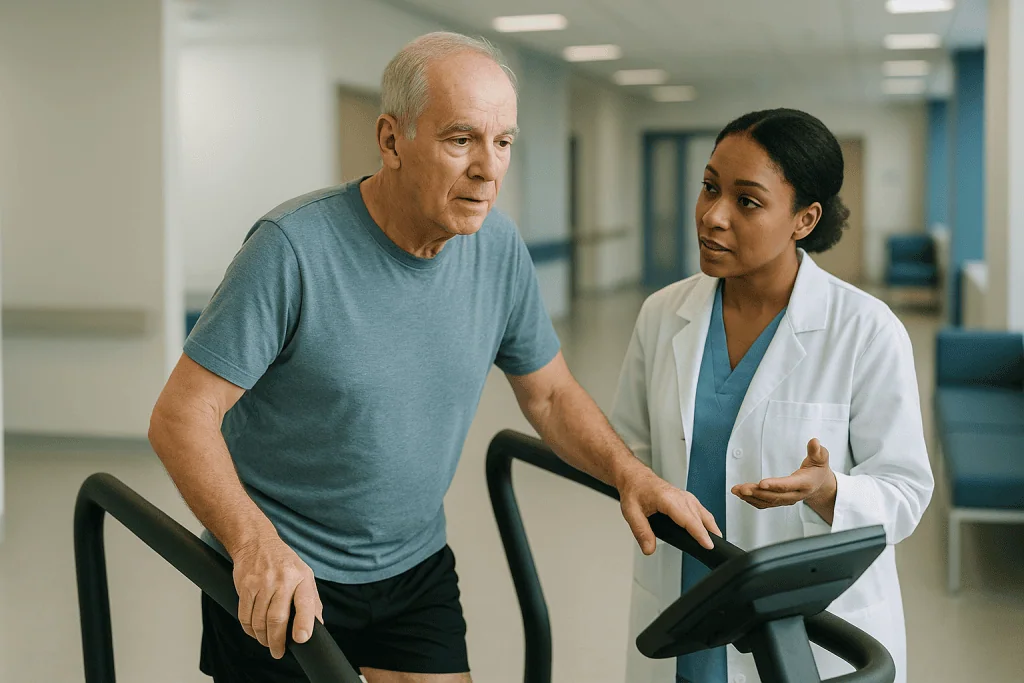
When someone with bronchiectasis starts avoiding stairs, the thigh and calf muscles lose capillaries and mitochondria, the tiny structures that use oxygen to make energy. Within weeks they become less efficient, needing more oxygen and producing more lactate for the same work. Breathing rate climbs earlier, the sensation of air hunger arrives sooner, and the person avoids more. Physiotherapists call this the dyspnea spiral, dyspnea being the clinical term for the feeling of not getting enough air.
Training reverses the muscular half of the spiral. Aerobic work rebuilds the oxygen-using machinery inside muscle; resistance work adds the force needed to climb a step without recruiting every fiber at once. The lungs do not change on a scan, yet the same walk feels easier because the body is asking less of them.
Exercise also acts directly on mucus. Deeper, faster breathing during exertion increases airflow through the airways and jostles secretions loose. Several bronchiectasis programs deliberately schedule airway clearance after a bout of exercise for that reason, and some patients report that a brisk walk clears their chest better than a seated breathing routine alone.
There is a third, less measurable effect. People who have been frightened of breathlessness learn, under supervision and with a pulse oximeter on their finger, that feeling out of breath is uncomfortable but not dangerous at controlled levels. That recalibration often outlasts the physical gains.
How airway clearance techniques for bronchiectasis fit into pulmonary rehab
Airway clearance is the daily routine of moving mucus up and out, and in bronchiectasis it is as central as any medicine. The NHS describes it as a cornerstone of treatment because retained mucus feeds the bacteria that cause repeated infections, and repeated infections cause further airway damage. Breaking that loop is the whole point.
Most programs teach the active cycle of breathing techniques. It has three phases that repeat: relaxed breathing to settle the chest; several deep breaths with a brief pause at the top, which gets air behind trapped mucus; and a “huff,” a forced exhalation with the mouth open, like fogging a mirror, which carries the loosened secretions upward without the airway collapse that a hard cough can trigger. A clinician watches your technique, because small errors, such as huffing from the top of the breath when mucus is deep in the chest, make the routine far less effective.
Other approaches include postural drainage, where gravity assists by positioning the affected lobe uppermost, and handheld devices that oscillate the airflow or hold a gentle back-pressure in the airways during exhalation. Which combination suits you depends on where your bronchiectasis is on the CT scan, how much sputum you produce, and what you will realistically do every day. A perfect routine that is abandoned after a fortnight loses to an adequate one that becomes a habit.
Within a rehabilitation program, the sequence is usually the same: inhaled medicines first if prescribed, then exercise, then airway clearance while the mucus is already mobile. Participants learn to notice the signals of a chest that needs clearing and to adjust frequency during a flare-up. The payoff is not just a clearer chest; it is lower infection pressure on lungs that cannot afford more scarring.
Who pulmonary rehabilitation is usually for, and who is asked to wait
The usual candidate is someone whose bronchiectasis limits what they can do. Breathless on a slope, slower than friends on a walk, tired by the afternoon, or quietly cutting activities out of life: these are the referral triggers that matter more than any number on a breathing test. People who have had two or more flare-ups in a year are often prioritized, because education about early recognition and better airway clearance may change how the next one unfolds.
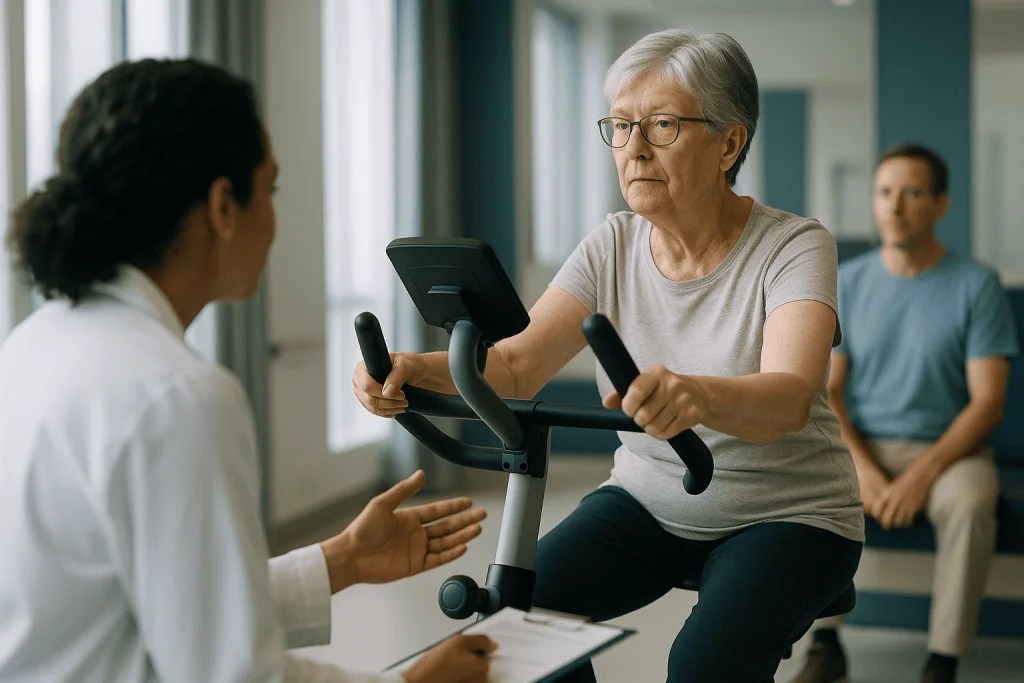
Severity on a scan is not a barrier. Someone with extensive disease who is still mobile can gain as much, sometimes more, than someone with milder changes. Age is not a barrier either; programs routinely include people in their eighties, with exercise scaled to what they can safely do. Supplemental oxygen users can take part with oxygen worn during sessions.
Some people are asked to wait, usually for a defined reason rather than a permanent one:
- During an active flare-up requiring antibiotics, because exercising while infected is uncomfortable and the baseline assessment would be misleading. Most programs reassess once treatment is complete.
- With unstable heart disease, uncontrolled blood pressure, or a recent cardiac event, until a cardiologist has given a clear plan.
- With a joint or spine problem that prevents safe walking or cycling, until a seated alternative can be arranged.
- With a very recent episode of coughing up significant blood, until the cause has been assessed.
Thinking or memory problems that make it hard to follow instructions are a relative barrier, often managed with a companion attending. Smoking is not an exclusion, though programs will offer support to stop. The decision belongs with the referring specialist and the rehabilitation team, who will run a pre-program medical screen. If you are told to wait, ask what needs to change and when the question will be revisited.
What a bronchiectasis exercise program looks like week by week
Programs vary in length and format, so the timeline below describes a common structure rather than a fixed schedule. The NHS notes that pulmonary rehabilitation courses typically run for about six to eight weeks with two sessions a week, and the National Heart, Lung, and Blood Institute describes programs lasting weeks to months. Yours may be shorter, longer, or home-based.
| Phase | What usually happens | What you might notice |
|---|---|---|
| Assessment visit | Medical screen, walking test, strength and breathlessness scores, airway clearance review, goal setting | Relief that someone has measured the problem; sometimes surprise at how far you did walk |
| Weeks 1–2 | Low-to-moderate exercise to learn equipment and pacing; first education sessions; technique coaching for clearance | Muscle soreness, tiredness after sessions, possibly more sputum as it mobilizes |
| Weeks 3–5 | Progressive increases in duration and resistance; more independent exercise; flare-up action planning | Stairs feeling less daunting; recovery after effort getting quicker |
| Weeks 6–8 | Peak training load; home program design; repeat walking test and questionnaires | Measurable change in distance or breathlessness score; mixed feelings about finishing |
| Afterward | Maintenance plan, community exercise referral, follow-up with the chest team | Gains hold if activity continues; drift if it stops |
Two patterns are worth anticipating. In the first fortnight, many people feel worse before they feel better: muscles ache, and a chest that has been quietly holding mucus may produce more of it as exercise shakes it loose. That is usually a sign the routine is working, not failing, though the team will want to know about any fever or color change in sputum. By the midpoint, the subjective shift tends to arrive before the measured one; the same corridor simply feels shorter. Final assessments then put a number on it.
What the evidence shows: realistic expectations for breathlessness and stamina
The research base for pulmonary rehabilitation in bronchiectasis is smaller than for COPD, where tens of thousands of participants have been studied. Bronchiectasis trials number in the hundreds of participants in total, so conclusions carry wider uncertainty, and this is the first thing an honest explainer should say.
With that caveat, the picture from systematic reviews, including a Cochrane review of exercise training for bronchiectasis, is consistent on the short-term outcomes that patients care about. Immediately after a program, participants on average walk further in standardized tests, report less breathlessness during activity, and score better on quality-of-life questionnaires designed for chronic cough and sputum. The size of the walking improvement is typically in the range that researchers consider meaningful, meaning a difference a person would notice in daily life, rather than a statistical curiosity.
Three things the evidence does not support deserve equal billing. Measured lung function, the volumes and flows recorded by spirometry (breathing into a machine that measures how much and how fast you exhale), does not change in a clinically important way; the lungs are not being repaired. Improvements in walking distance and quality of life tend to decline in the months after supervised sessions end unless exercise continues, a finding the Cochrane review highlights. And there is no reliable evidence that rehabilitation alters long-term survival in bronchiectasis; the studies are too small and too short to say either way.
Put plainly: expect to climb stairs more easily, cough with more control, and feel less afraid of exertion. Do not expect a different CT scan. The program is a tool for living better with a fixed structural problem, and judged on that standard the evidence, while modest in size, points reliably in one direction.
Does pulmonary rehabilitation reduce bronchiectasis flare-ups?
A flare-up, or exacerbation, is the medical term for a period when symptoms worsen beyond the usual day-to-day variation: more sputum, a change in its color or thickness, more breathlessness, fatigue, sometimes fever. Exacerbations drive hospital admissions and accelerate airway damage, so whether rehabilitation reduces them is the question with the highest stakes.
The evidence here is suggestive rather than settled. At least one randomized trial included in the Cochrane review followed participants for a year and found fewer exacerbations in the group that had completed exercise training, along with a longer time before the first flare-up. That is encouraging, but a single trial with a modest sample is not a basis for promises, and the review authors graded the certainty of this finding as low. Larger studies are needed before anyone can say with confidence that rehabilitation prevents infections.
There are plausible mechanisms. Better airway clearance technique, reinforced over weeks of coaching, should reduce the volume of stagnant mucus available to bacteria. Education on recognizing a flare-up early may lead to prompter treatment, which can shorten episodes. Regular exercise appears to have modest effects on immune function and on systemic inflammation. Each of these is reasonable; none has been proven in bronchiectasis specifically to the standard a guideline would require.
What this means in practice is that a program may be part of the strategy for reducing flare-ups, alongside whatever maintenance treatments your specialist prescribes, but it is not a substitute for them. If you complete rehabilitation and still have frequent exacerbations, that is a signal for your chest team to look again at the underlying causes, at the microbiology of your sputum, and at other treatment options, not a sign that you did the program wrong.
What pulmonary rehabilitation cannot do for bronchiectasis
Any treatment explainer that only lists benefits is advertising. Here is the other column.
It cannot reverse structural damage. The widened, thick-walled airways seen on a CT scan will look the same afterward. Rehabilitation changes the body around the lungs, not the lungs themselves, and anyone suggesting otherwise is selling something.
It cannot replace the search for a cause. Bronchiectasis has many drivers: a severe childhood infection, immune deficiency, inflammatory bowel disease, rheumatoid arthritis, allergic reactions to a common mold, inherited conditions affecting mucus or airway cilia, and others. The NHS and the National Heart, Lung, and Blood Institute both stress that identifying a treatable cause can change the course of the disease. A program will not do that investigation; your specialist will.
It cannot treat an infection. If sputum has turned green, volume has doubled, and you feel unwell, you need a clinical assessment and probably antibiotics, not an extra session on the bike. Programs routinely pause participants during exacerbations for exactly this reason.
It cannot guarantee that gains last. Across chronic lung conditions, the consistent finding is that benefits decay over months once supervision ends unless exercise becomes routine. The program hands you tools; it does not fit them permanently.
It cannot fix everything that causes breathlessness. Anemia, heart failure, obesity, anxiety, deconditioning from other illnesses, and side effects of medicines all contribute in some people. A good program will flag suspicions to your doctor, but managing them is a separate task.
Finally, it cannot work without attendance. Dropout rates in pulmonary rehabilitation are substantial in many studies, often for practical reasons such as transport or fatigue. If barriers exist, raising them before you start, rather than drifting away halfway through, gives the team a chance to adapt the format.
How rehabilitation sits alongside medicines and other bronchiectasis treatments
Think of bronchiectasis care as several strands running in parallel. Rehabilitation is one; the others are decided and adjusted by your prescribing clinician, and nothing in a rehab program should prompt you to change them on your own.
Airway clearance, already discussed, is the daily foundation. Some people are prescribed inhaled saline or other mucus-thinning treatments to use before clearance sessions; the mechanism is to draw water into secretions and lower their stickiness so they move more easily. Whether these help varies between individuals and is a specialist decision.
Antibiotics are used in two ways. Short courses treat flare-ups, and the NHS notes these are often longer than the courses used for a simple chest infection in healthy lungs because the mucus-filled airways are harder to clear of bacteria. Long-term, low-frequency antibiotics, sometimes from the macrolide class, are considered for people with frequent exacerbations; part of their effect is thought to be anti-inflammatory rather than purely antibacterial. These carry risks, including effects on hearing and heart rhythm and the development of resistant bacteria, which is why they are reserved for specific situations and monitored.
Inhaled bronchodilators, medicines that relax airway muscle, may be prescribed if there is coexisting asthma or COPD, or if testing shows a response. Programs often teach inhaler technique, which is frequently poor even in long-term users, but they do not alter what is prescribed.
Vaccination against influenza and pneumococcal infection is recommended for people with chronic lung disease, and keeping up with these is usually part of program education. Surgery to remove a damaged lobe is uncommon and reserved for localized disease with uncontrolled symptoms.
Rehabilitation strengthens the body that all these treatments act upon. It is complementary to each and a replacement for none. If a conflict seems to arise, for instance a medicine causing muscle cramps during training, the right move is to tell both the rehab team and the prescriber, not to stop anything.
Keeping the gains after pulmonary rehab for bronchiectasis ends
The last supervised session is the most dangerous moment in the whole process. For weeks there has been a timetable, a team, and a group of people who understand what a bad chest day feels like. Then the structure disappears and ordinary life, with its weather and fatigue and competing demands, resumes. The research is blunt about what follows: without continued exercise, walking distance and quality-of-life scores drift back toward baseline over the following six to twelve months.
The protective factor is not willpower; it is design. Programs that end well spend their final sessions building a maintenance plan with the participant rather than for them. Useful elements include:
- A written home exercise prescription with specific activities, durations, and a method for judging intensity, often a simple breathlessness scale.
- Referral to a community exercise class or walking group that accepts people with lung conditions, so that supervision tapers rather than vanishes.
- A clear statement of which exercises to continue, modify, or stop during a flare-up, and how to restart afterward without losing heart.
- Airway clearance written into a daily routine, tied to an existing habit such as brushing teeth, so it survives busy weeks.
- A follow-up appointment with the chest team at which maintenance is on the agenda.
Some services offer repeat programs after a year or after a hospital admission, and asking whether that is possible is reasonable. Others provide maintenance sessions at lower frequency.
Realistic goal-setting matters more than ambition. A twenty-minute walk most days that actually happens outperforms a gym membership that lapses in February. People who keep their gains tend to describe exercise not as treatment but as something they would miss, and that shift usually happens when the activity is chosen to be enjoyable rather than merely effective.
Home-based and remotely supervised programs: do they work as well?
Not everyone can travel to a hospital twice a week for two months. Transport, work, caring responsibilities, and sheer exhaustion keep many eligible people away from center-based rehabilitation, which is one reason uptake in chronic lung disease has historically been poor. Home-based and remotely supervised programs were developed to close that gap, and they expanded rapidly when in-person services were disrupted.
The model varies. Some services provide an initial face-to-face assessment and then supervise exercise by video call, with the participant walking indoors or using a step and resistance bands. Others issue a written program with weekly phone coaching. Some use apps that log activity and symptoms for a clinician to review. Education sessions move online or onto printed material.
Evidence in COPD, where most of the comparative studies have been done, suggests home-based programs can deliver gains in walking capacity and quality of life broadly similar to center-based ones when they include real supervision and progression, rather than a leaflet alone. Bronchiectasis-specific comparisons are sparse, so this is an extrapolation and should be described as one.
The trade-offs are practical. At home there is no treadmill to set a precise pace, no clinician watching oxygen saturation in real time, and no group of peers. Airway clearance coaching is harder over a screen because technique errors are subtle. For people with low oxygen levels, significant heart disease, or severe disease, center-based supervision is usually preferred for safety.
On the other side of the ledger, home programs teach exercise in the environment where it must eventually continue, which may help with the maintenance problem. If distance or energy is the barrier to attending, asking your team whether a home or hybrid option exists is sensible. The choice of format is theirs to recommend based on your clinical picture; the choice to show up remains yours.
What people often get wrong about pulmonary rehabilitation and bronchiectasis
Misconceptions keep eligible people away or set them up for disappointment. These are the ones clinicians hear most.
“My lungs are too damaged for exercise to help.” The opposite is closer to the truth. The more limited the lungs, the more it matters that the rest of the body uses oxygen efficiently. Programs scale exercise to ability, and people on oxygen or with extensive disease are routinely included.
“Getting breathless during exercise is harmful.” Controlled breathlessness under supervision is the mechanism of training, not a side effect. Oxygen levels are monitored, and the team will set limits. What is harmful is the long-term avoidance of effort that breathlessness provokes.
“If I am coughing more after sessions, something is wrong.” Increased sputum in the first weeks often means mucus is mobilizing. Color change, fever, or feeling unwell are different and should be reported.
“Rehabilitation will improve my lung function tests.” It generally will not, and that is not its purpose. Judge it by what you can do, not by spirometry.
“Once I finish, I am fixed.” The gains are conditional on continuing. The program is the beginning of a habit, not the end of a treatment course.
“It is the same as the COPD program.” There is overlap, but bronchiectasis programs should include airway clearance coaching and education about infection recognition that a generic program may not emphasize. Asking whether the program is tailored is reasonable.
“Breathing exercises alone are enough.” Breathing techniques help with clearance and control, but the evidence for improved stamina comes from whole-body exercise training. A seated routine is a complement, not a substitute.
“It is only for older people.” Bronchiectasis occurs at all ages, including in young adults with inherited causes, and so does deconditioning.
Questions to ask your care team before starting
A referral is the start of a conversation, not the end of one. These questions help you understand what you are agreeing to and how it fits the rest of your care.
- Is this program designed or adapted for bronchiectasis, and will it include supervised airway clearance coaching rather than exercise alone?
- How long does the program run, how many sessions a week, and what happens if I miss some because of a flare-up?
- What will be measured at the start and end, and how will you decide whether it has worked for me?
- Should I use my inhaled medicines or do airway clearance before each session, and in what order?
- Will my oxygen levels be monitored during exercise, and what level would prompt you to stop or adjust?
- Is there a home-based or hybrid option if travel becomes difficult, and how does supervision work in that format?
- What should I do if I develop signs of a chest infection partway through: pause, continue at lower intensity, or contact the program first?
- Who do I report new symptoms to during the program, the rehab team or my usual chest clinic?
- What is the plan for after the program ends, and is a community class or maintenance session available?
- Has the cause of my bronchiectasis been investigated, and are there other treatments being considered alongside rehabilitation?
- Are there any exercises I should avoid because of my heart, joints, or other conditions?
- Could I speak with someone who has completed the program?
Write the answers down. Several of them, particularly the order of inhalers, clearance, and exercise, and the plan for infections, are easy to muddle once sessions begin. If an answer is “it depends,” ask what it depends on. Teams generally welcome these questions; they signal a participant who intends to finish.
When to call your doctor
Rehabilitation is safe for most people when properly screened and supervised, but bronchiectasis itself can change quickly, and exercise can occasionally unmask other problems. Knowing which symptoms need prompt attention lets you train with confidence rather than anxiety.
Contact your chest team or usual doctor promptly if, during or between sessions, you notice a sustained increase in sputum volume, a change in its color to darker yellow, green, or brown, or a thicker consistency lasting more than a day or two; new or worsening breathlessness at rest or at your usual level of activity; fever, chills, or a general sense of being unwell; chest pain that is new or different from your usual chest discomfort; or unusual fatigue that does not settle with rest. These are typical signs of a flare-up, and the NHS advises that earlier treatment of exacerbations is generally better.
Seek urgent care, calling emergency services if necessary, for coughing up more than a small streak of blood, especially if it is fresh and continues; severe breathlessness that does not ease with rest or your usual inhaled medicine; blue or gray lips or fingertips; chest pain spreading to the arm, jaw, or back, or accompanied by sweating or nausea; sudden dizziness, fainting, or confusion; or a rapid, irregular heartbeat that does not settle within a few minutes of stopping activity.
Tell the rehabilitation team about anything that happened at home, even if it resolved. They may adjust your program, ask you to pause, or contact your specialist. Never increase, decrease, or stop a prescribed medicine on your own in response to a symptom; the prescribing clinician makes those decisions, and the program staff will help you reach them. Every treatment choice in bronchiectasis, including whether to continue or pause rehabilitation, belongs with the team who know your scan, your sputum results, and your history.
Frequently asked questions
What is pulmonary rehab for bronchiectasis, in simple terms?
It is a supervised program of exercise training, airway clearance coaching, and education, usually running over several weeks, designed to help people with permanently widened airways do more with less breathlessness. It does not repair the airways. Instead it strengthens the muscles that demand oxygen, teaches techniques to clear mucus, and builds confidence in managing symptoms, with your chest team deciding whether it fits your plan.
How long does a bronchiectasis exercise program usually last?
The NHS describes typical pulmonary rehabilitation courses as running about six to eight weeks with roughly two sessions a week, and the National Heart, Lung, and Blood Institute describes programs lasting weeks to months. Local formats vary, and home-based versions may be structured differently. Your team will tell you the schedule for the program you are referred to and how missed sessions during a flare-up are handled.
Will pulmonary rehabilitation improve my lung function?
Usually not in a measurable way. Spirometry, the breathing test that measures how much air you move and how fast, generally does not change meaningfully after rehabilitation in bronchiectasis. The benefits show up in walking distance, breathlessness during activity, and quality of life rather than in lung volumes. Judging the program by what you can do, not by test numbers, gives a truer picture.
Can exercise make bronchiectasis worse?
Properly supervised exercise is not known to worsen bronchiectasis, and avoiding activity tends to make breathlessness worse over time through muscle deconditioning. Programs screen for heart and other conditions first, monitor oxygen levels during sessions, and pause participants during infections. Report any fever, change in sputum color, chest pain, or coughing up blood promptly rather than pushing through.
Which airway clearance techniques for bronchiectasis are taught in rehab?
Most programs teach the active cycle of breathing techniques: relaxed breathing, deep breaths with a brief hold, and huffing to move loosened mucus upward. Some add postural drainage using gravity, or handheld devices that oscillate airflow or provide gentle back-pressure. The combination depends on where your disease sits on the scan and how much sputum you produce, and a physiotherapist checks your technique.
Are bronchiectasis breathing exercises enough on their own?
They are valuable for clearing mucus and controlling breathlessness, but the evidence for improved stamina and walking capacity comes from whole-body exercise training, not breathing routines alone. A seated breathing program is a complement to aerobic and strength work, not a replacement. If mobility problems prevent walking or cycling, ask whether seated exercise alternatives can be arranged.
Does pulmonary rehabilitation reduce bronchiectasis flare-ups?
Possibly, but the evidence is limited. One year-long trial in a Cochrane review found fewer exacerbations and a longer time to the first flare-up after exercise training, graded as low-certainty evidence. Plausible mechanisms include better airway clearance and earlier recognition of infections. It should be seen as one part of a flare-up strategy decided by your specialist, not a stand-alone preventive.
What happens if I get a chest infection during the program?
Most programs pause you during an exacerbation that needs antibiotic treatment, because exercising while infected is uncomfortable and progress measurements would be misleading. You rejoin once the infection has settled, often with a brief reassessment. Ask at the start who to contact if symptoms change, so you know whether to call the rehab team or your usual chest clinic first.
How do I keep the benefits after the program finishes?
Continue exercising regularly, ideally through a community class, walking group, or written home program designed with your team before you finish. Gains in walking distance and quality of life tend to fade over six to twelve months when activity stops. Building airway clearance and exercise into existing daily routines, and keeping a follow-up appointment, improves the odds that habits survive.
Can I do pulmonary rehabilitation at home instead of at a hospital?
Many services now offer home-based or hybrid programs with video or phone supervision, and evidence from COPD suggests these can deliver similar gains when real supervision and progression are included. Bronchiectasis-specific comparisons are limited. Center-based programs are usually preferred for people with low oxygen levels or significant heart disease. Your team will recommend the format that suits your clinical picture.
References
- National Heart, Lung, and Blood Institute: Pulmonary Rehabilitation
- National Heart, Lung, and Blood Institute: Bronchiectasis
- NHS: Bronchiectasis, Treatment
- MedlinePlus: Pulmonary Rehabilitation
This article is for general information only and is not a substitute for professional medical advice. Please consult a qualified doctor about your individual situation.

More from the Blog

Daily Life With Pulmonary Disease: Air Quality, Vaccinations and Staying Active Under Treatment
Daily life with chronic lung disease goes more smoothly when three habits become routine: checking local air quality and adjusting outdoor plans on poor…

Inside the Operating Room During Robotic Thoracic Surgery: Ports, Docking and the Chest Tube
Robotic thoracic surgery procedure steps follow a set sequence: general anesthesia with one-lung ventilation, positioning on the side, three to five small incisions (ports)…

Pneumothorax in Young, Tall Adults and Athletes: Why It Happens and How Care Differs
Spontaneous pneumothorax, a collapsed lung with no obvious injury, occurs most often in tall, slim people in their late teens to thirties, usually because…

Preparing for a Pulmonology Consultation: Scans, Breathing Tests and Records to Bring
To prepare for a pulmonology appointment, gather your actual chest X-ray and CT images (not only the written reports), any previous spirometry or lung…

What Does Daily Cystic Fibrosis Treatment Involve? Airway Clearance, Inhalers and Nutrition
Daily cystic fibrosis treatment usually combines airway clearance to loosen and cough out thick mucus, inhaled medicines that open the airways, thin secretions or…

Is It Bacterial or Viral Pneumonia? How the Cause Changes Your Treatment Plan
Bacterial and viral pneumonia are treated differently because the cause decides which medicines can help. Bacterial pneumonia is usually treated with antibiotics chosen by…